Teaching and Learning in Second Life as Part of a Blended Approach: Reflections and Lessons learnedSheila Yoshikawa Sheila Webber, Se (Рresentation : Teaching and Learning in Second Life as Part of a Blended Approach: Reflections and Lessons learned ...
Paul Costantino brings the world of medical microbiology to the big screens. Through the use high definition video technologies students are visually immersed into a world where bacteria the size of a pin head becomes the size of basket ball. Such visual technology captured characteristics beyond that of static images, provided classroom equity and discussion around student’s culture plates.
"A number of initiatives and startups are hoping to offers ways to give people some sort of formal(ized) recognition for their informal learning – or at least for the skills they possess for which they don’t have official diplomas or degrees. Among them: Mozilla’s Open Badges project, the social endorsement site Skills.to, the soon-to-launch Degreed, and the open-to-the-public-just-today LearningJar."
KF: There is certainly a growing interest in examining the possibilities of these new forms of recognising learning. Whether they will need to address assurance of learning concerns remains to be seen. Outside of academia and some of the accredited professions formal qualifications may not be as important as some higher education proponents may suggest.
"The issue of how we use social media for our own development as teachers and as digitally skilled individuals, is one that I believe is of vital importance though, not just because it can enable us to keep developing as teachers through the content, ideas, resources and above all people it gives us access to, but also because the way use digital media for our own development should guide and influence the way we use it with our students and build their digital literacies and communication skills."
KF: Nic Peachey is emerging as one of the leading curators on technology and learning. In this post Nic outlines how he works with social media to find, capture, process and redistribute information.
Online education is the next hot bet in venture capital.
...using a proprietary technology platform developed by a New York-based company called 2-Tor, the Kenan-Flagler program creates a virtual classroom that is more intimate than 90% of the seminars I’ve taught in or taken. That’s because a quarter of every student’s computer screen is a grid of the dozen other students in the class – in close-up!
Robin Good: The New Hive is a new, free web service which allows you to create custom web pages on an ad-free empty canvas, while making it very easy to add text, images, video and audio clips and to size, style it and position it anywhere on the page.
Newly create web pages can be set to private or public access, and their content can be easily shared to all major social media networks.
"The New Hive is your radically simple, drag + drop, blank canvas + self publishing tool."
Schoox is an Academy for Self-Learners where members can teach, learn and certify their knowledge online. Users can create private or public online courses by using files or web resources incredibly easy and in seconds.
KF: This approach blends together curation, OER and independent learning. In conjunction with a good badge system there is making of an informal alternative to any educational sector.
Online education is a hot topic if you are an academic institution or a corporation looking to train your employees with a learning management system (LMS)...
The 33 Digital Skills Every 21st Century Teacher should Have
Every single teacher is concerned about his/ her teaching practices and the skills involved in this process. How many times have you wondered about a better way to teach the same lesson you have delivered to an eariler class? How often have you used technology to engage your students and improve their learning ?
(2012). Ten suggestions for improving academic research in education and technology. Learning, Media and Technology.
KF: An engaging editorial about approaches to the scholarship of teaching and learning with a strong elearning imperative. Thought provoking and somewhat challenging if one is just beginning to move in this direction; contains some useful insights that often stall effective engagement.
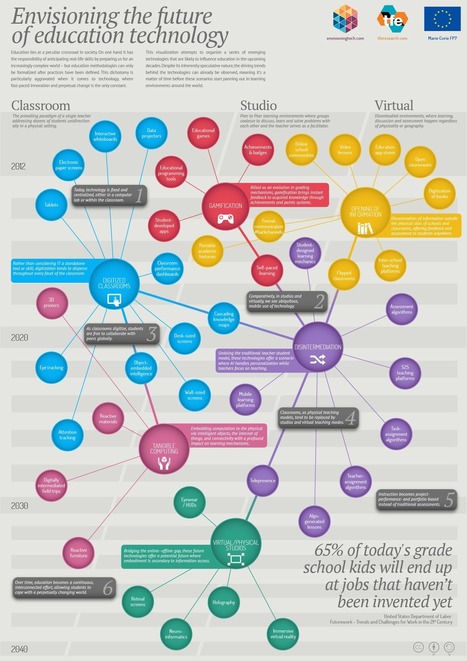
"Education lies at a peculiar crossroad in society. On one hand it has the responsibility of anticipating real-life skills by preparing us for an increasingly complex world – but education methodologies can only be formalized after practices have been defined. This dichotomy is particularly aggravated when it comes to technology, where fast-paced innovation and perpetual change is the only constant.
This visualization attempts to organize a series of emerging technologies that are likely to influence education in the upcoming decades. Despite its inherently speculative nature, the driving trends behind the technologies can already be observed, meaning it's a matter of time before these scenarios start panning out in learning environments around the world."
eMeet.me is a free, web based, online meeting service thats so easy and fun, that even grandma could use it.
You can video conference, screen share, and chat. People can dial in by phone, or use their computer camera and microphone. We even record your meetings for later playback!
KF: A terrific alternative supporting online meetings. The application allows video, voice and screensharing. Has a free entry level servcie and potential as a way of supporttng online learning communities.
An upbeat and hopeful video about what the future of education could look like, posted by the New Brunswick Department of Education, provides an insightful peek into the future of education and extrapolates some exciting …...
Universal Design for Learning (UDL) is a framework that addresses the primary barrier to fostering expert learners within instructional environments: inflexible, “one-size-fits-all” curricula. It is inflexible curricula that raise unintentional barriers to learning. Learners who are “in the margins”, such as learners who are gifted and talented or have disabilities, are particularly vulnerable. However, even learners who are identified as “average” may not have their learning needs met due to poor curricular design.
The traditional lecture model is the standard learning method in most American classrooms, but there is growing interest in new learning models that are encouraging students and teachers to "learn now, lecture later."
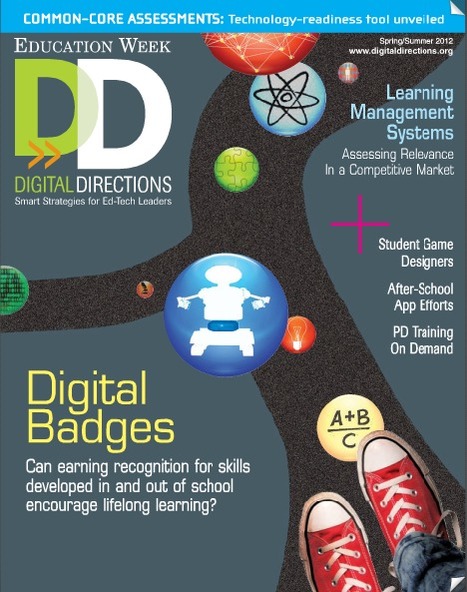
KF: An online magazine for EdTech Leaders. While the magazine focusses mainly on K-12 contexts there is plenty of general content that can be applied in higher education. This issue features an article about Digital Badges.
In my several years of teaching online I have developed a variety of time-management tools that have helped me to stay on top of my classes while making my efforts smoother and easier; hundreds of colleagues I’ve discussed this with over the years also have their favorite ways of managing time. As you can imagine, this collective wisdom includes a multitude of approaches (in fact, nearly 300 so far!), but what I present to you here is what I think are the best of the best. Use one, some, or all of these, and I assure you that you’ll have a much better time teaching online!
Online learning is no longer foreign to traditional universities, where courses formerly held in large lecture halls are migrating to the Web. But at residential liberal arts colleges, whose appeal often lies in the promise of small classes and regular face time with professors, online education has had a harder time gaining a foothold.
Personal Learning Networks, or PLNs, have been around for a long time. Originally they were your family, relatives and friends, or probably other educators and fellow teachers you work with in the same institution, but now and thanks to the development of web technologies and wireless connections, the concept of PLNs has been expanded to engulf people you have never met before in real world. Much of the learning nowadays takes place online and via a network of interconnected relations.
Lexim is a learning management system that is available to all teachers, regardless of which system their institution has adopted.
"Lexim is proud to announce the immediate availability of their learning management system, a software as a service (SaaS) product being made available to all teachers for free. Lexim allows teachers from any institution to deliver their teaching materials online, engage and work with students, assess work and report on student progress. The cloud-based service gives customers access to an enterprise ready learning management system, built for the modern classroom."
KF: Alternatives are often useful. This is free system that allows teachers to create learning spaces regardless of whether or not their institution provides a standrad LMS.
Take a picture with our app, and it's online in seconds
Three Ring is a website that allows you to securely upload photos of student work. With Three Ring, you can sort by class, student, or custom tag to easily find the artifact you're looking for.
You can pull up a student's work for parent-teacher conferences, administrative meetings, formative assessment, or use as exemplars."
To get content containing either thought or leadership enter:
To get content containing both thought and leadership enter:
To get content containing the expression thought leadership enter:
You can enter several keywords and you can refine them whenever you want. Our suggestion engine uses more signals but entering a few keywords here will rapidly give you great content to curate.


 Your new post is loading...