


What is your personal digital learning environment and how do you use it?
Main obstacles for building and maintaining a PLE?
Change in use of technologies in the last 5 years?
What are your views on the PLE vs VLE debate?
Is the VLE really dead?

 Your new post is loading...
 Scoop.it! What is your personal digital learning environment and how do you use it? Main obstacles for building and maintaining a PLE? Change in use of technologies in the last 5 years? What are your views on the PLE vs VLE debate? Is the VLE really dead? 
No comment yet.
Sign up to comment
Scoop.it!

Technology should be integrated into education as enabling tools where we ask "Which technology will address my teaching need?" rather than reverse engineering our approach of trying to find a need for the technology. Technology has opened up the opportunities to provide personalised, flexible and inclusive educational programs that breakdown boundaries and provide for authentic learning experiences (Laurillard, 2008).
The following educational alignment of technologies has been designed to better inform you of the educational affordances of each technology. Technologies are aligned to four learning principles - reflection, collaboration, authentic tasks and creation.
Scoop.it!

Digital devices that can be used to assist blended learning...
iPads and other tablet devices have dominated technology news in recent years. This is mainly due to the unprecedented uptake of these technologies; records are still being broken. The devices have inevitably found their way into educational settings as educators globally seek ways to leverage the interest in new technology towards improved pedagogy. These devices are capable of supplementing, and often replacing, traditional desktop and laptop computers. They have the added dimension of being enabled with locative, motion, audio-visual and spatial capabilities, along with mobile multimedia capture and creation features. Multi-touch and gestural forms of input are also possible. This combination of interest and capability is driving a huge shift towards mobile learning.
Scoop.it!

As long as I'm in a Scoop.it mood today, might as well include Russell Stannard's "Free online tutorials for teachers and students. These are step by step camtasia screencasts that take you through a whole range of ict and web2.0 tools." If you can't find it here, THEN search YouTube. Via Vance Stevens, Lee Webster
Scoop.it!
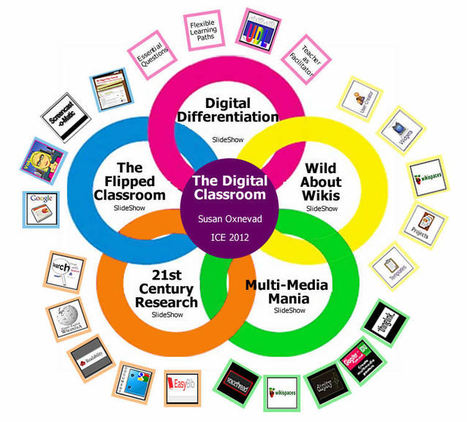
"I have just returned from the Illinois Computing Educators Conference where I had the opportunity to facilitate a full day session titled Design Your Digital Classroom. This session wasn't about the ratio of students to machines, nor was it a prescription for using one type of technology. The focus was on how to use technology as a tool for learning to support all learners in the 24/7 classroom. The participants were dedicated, innovative educators from across the state of Illinois, each bringing their own expertise and needs to the group. Each leaving excited about something that worked for them. Differentiated instruction and flexible learning paths work for everyone!"
Scoop.it!

The times they are a changin’, and in this essay, I’d like to suggest they are changing in a way that has massive implications for education: sources of credibility—once the domain of expensive degrees–are becoming democratized, decentralized, and diversified.
Scoop.it!

If you are looking for even more visual data in your streams and if you are looking for more connections on Pinterest, here are 15 more boards to consider.
Scoop.it!

Does your university really need a staff newsletter or a Facebook page? Tracy Playle explains why social media strategies need a clear objective to drive their purpose
Scoop.it!

"Although the Open Educational Resources (OERs) movement has been developed almost a decade ago, Australian higher education sector seems to be still resisting this movement. This project intends to develop a “Feasibility Protocol” to enable and facilitate the adoption, use and management of OERs for learning and teaching within higher education (HE) institutions in Australia. This project will also explore how OERs will enhance teaching and learning, enable and widen participation for key social inclusion targets in higher education, promote lifelong learning and bridge the gap between non-formal, informal and formal learning in Australia. This is very important for the development of Australia education national and internationally because it will support educational institutions that are currently limited by the lack of guidance regarding OERs, speed up the process of appropriate adoption of OERs, and provide additional venues for universities to pursue innovative strategies to better support current students, attract new ones and be internationally recognised and competitive."
Scoop.it!

Imagine sitting in a crowd of 1000 or so students in a university lecture hall and not understanding something. Do you ask a question or do you just zone out and log onto Facebook instead?
Outside our university lecture halls, the rest of the world is in the grips of a digital communications revolution offering an ever increasing number of options for truly engaging, personalised learning.
Scoop.it!

"Subtext makes it easy to interact with your students in the pages of digital books. You can post and answer questions, link to relevant Web content and create assignments and quizzes—all right in the text. Better yet, your students can share ideas and work together to make connections as they read. Think of it as anywhere, anytime classroom reading guided by you."
Scoop.it!

In higher education, we’ve been talking about “e-learning” for years.
"The future of today’s universities probably lies between the “massification” of online education – in which thousands or millions more students can learn the basic and common courses on an online adaptive system – and small tutorial sessions, utilising the benefits of face to face teaching.
From such “disruption” the best education will emerge if we manage to marry the interactive, intelligent and immersive possibilities of virtual worlds and instant digital communications tools with the talents and passion of great teachers."
KF: There are special implications for a range of disciplines - health sciences, performing arts, spatial sciences, etc where the experience of different physical realities has to play an important role in learning. The use of MUVEs, augmented reality and virtual reality is yet to be realised broadly in many of these areas. There will be a necessary development of thinking around how to utilise these technologies.
Scoop.it!

Tom Vander Ark is an education advocate, advisor, and author of Getting Smart: How Personal Digital Learning is Changing the World. Tom is Founder and Executive Editor of Getting Smart and a partner in Learn Capital.
"The education sector is in the early stages of transitioning from learning management systems (LMS) to learning platform ecosystems. In fact, a lot of U.S. schools will skip the LMS phase and go straight from print to platform."
KF: The influence of social media, open access learning and new learner expectations is bringing about a shift in the way technology is deployed in formal learnign contexts. For many higher education teachers the LMS is still at the core of blended and online learning; however the role of that core is changing as more and more external resources and media are integrated into the process.

Alberto Rivera's curator insight,
June 11, 2022 1:30 PM
Where are the next GEN Learning Platforms? This article has the 19 post-pandemic ideals that would make for a better learning platform. The pandemic has changed the ideals of online learning, so because of the pandemic, they have jump-started what LMS have in their aseinal.
|
Scoop.it!

This education article shares simple strategies to integrate 21st century skills into everyday instruction, starting with the science classroom.
Read more: http://www.teachhub.com/teaching-21st-century-skills
Via Gust MEES
Scoop.it!

Learning in Networks of Knowledge is a new paradigm for higher education, based on the changing nature and form of knowledge work in contemporary digital networked conditions. The LINK site explores and supports this knowledge – network – learning approach. LINK contains dozens of ideas about teaching and learning via the Internet, as well as tools (freely available web-based applications) that you can use.
Scoop.it!

Hotseat is, at its simplest, a microblogging system allowing lecturers to post questions and discussion points during a lecture. The system can be used to assess the level of interest in particular posts, and to poll the group on key understandings, and identify points for further discussion.
Students are given an active voice and invited to contribute to the lecture by posting questions, comments and insights. The system can be used to assess the level of interest in particular posts, and to poll the group on key understandings, and identify points for further discussion.
Scoop.it!
Students in the Environmental and Spatial Technology (EAST) program, at Horace Mann Magnet Middle School, in Little Rock, Arkansas, connect with nature through projects that serve their community.
KF: Although this project is drawn from the K-12 sector it highlights some of the key shifts that future cohorts of undergraduates will have experienced. The models represneted can be leveraged and modofed to make them more relevant to Higher Education where much greater levels that current engagement are called for. Review this video knowing that your approaches to Teaching and Learning will necessarily have to shift.
Scoop.it!

.The Future of Educational Technology and Education 3.0... Thinking of what education might look like in the next decade, one quickly realizes that the trends in technology are leaving a large number of our students behind.
"The thought on your mind at this point is most likely wondering what machine I keep referring to. The machine in question is the one we have been so busy teaching and training since roughly 1969. You’ve probably guessed it by now that I am referring to the internet. The great cloud of knowledge that we call the internet is precisely the mechanism that we will use to build the platform of Education 3.0. When the platform is finally in place, the decade to follow will see the greatest amount of wealth, discoveries and use of human potential that we have witnessed during our time on this earth. The only question that remains to be answered is the point at which I will leave this article. When will we allow the user to use the machine to its potential?"
Scoop.it!

Online learning saves time for students. Students in online courses have 24/7 access to their course materials, other students, and their instructor. For working students, this is an incredible benefit. But we often hear that online learning takes a lot of an instructor’s time.
Scoop.it!

A British Library report into research behaviour and information seeking habits finds that along with access to online resources, training in how to make best use of those resources, is lacking.
Scoop.it!

From
c3

ICVL Project intends to explore and propose innovations in education in the perspective of the Knowledge Society. The International Conference on Virtual Learning has the following objectives: creating a framework for a large scale introduction of the eLearning approaches in teaching and training activities; assisting the teachers, professors and trainers in the use of innovative teaching technologies both in formal education and life-long learning; stimulating the development of eLearning projects and software for education process and systems; promoting and developing scientific research for eLearning, educational software and virtual reality.
Scoop.it!

Katie Ash and Ian Quillen are staff writers for Education Week Digital Directions.
"By now, you've probably heard of Sal Khan, the educator who began by creating videos to explain math to his cousins, which has grown into a library of over 3,000 assorted educational clips with more than 150 million views on YouTube. The resulting Khan Academy, a nonprofit organization that aims to provide students with free access to all those resources, has received grant funding from educational philanthropy giants like the Bill & Melinda Gates Foundation."
KF: I think its important to read this with an awareness of how and why its occurred and against the backdrop of all the Khan Academy popularity. There’s a real risk that the very substantial baby will be thrown out with the relatively shallow bathwater. Many other factors come into play around the affective and conative dimensions of learning. The critique is largely on the basis of teaching - learning is domain of the learner. In a collection of resources like Sal Khan's there are bound to be the odd error - non-example is a key part of concept attainment. Videos can easily be re-recorded to remedy faults, but there is a growing body of evidence that resources like Khan Academy have had significant impact on improving student engagement. Learning isn't about "getting it right" - that's the role of assessment.
Scoop.it!

More than 1,000 years of formal university learning and teaching does not change quickly, or without a struggle.
Scoop.it!

insights & innovations at the intersections from Scott Moore...
I am designing a class that I am going to teach next year. It is going to have elements of being flipped or simply blended. In any case, I am looking into different ways in which I can assess student learning that goes on during semester, whether in the classroom or out.
Several tools are available that provide assessment for different types of situations...
Scoop.it!

There’s no other Industry in the world that was more affected by Apple refusing to embrace Adobe Flash in their iOS devices like the eLearning Industry. I don’t have the ...
"We need to get out of our comfort zone and explore mobile applications and learn about what these apps do well and apply these principles to our mLearning design."
|






