Hybrid Pedagogy is an academic and networked journal of teaching and technology that combines the strands of critical and digital pedagogy to arrive at the best social and civil uses of technology and digital media in education.
Despite ongoing debate about the effects of online learning, a report from the Pew Internet and American Life Project and Elon University shows that a majority of technology stakeholders expect it to transform higher education by 2020.
In a report released today, Pew and Elon University said that 60 percent of internet experts, researchers, observers and users polled said they agreed that by 2020, “there will be mass adoption of teleconferencing and distance learning to leverage expert resources … a transition to ‘hybrid’ classes that combine online learning components with less-frequent on-campus, in-person class meetings.” By comparison, 39 percent endorsed the contrary position that “in 2020 higher education will not be much different from the way it is today.”
Did you know that in 2011, Google Apps released 100+ new updates? With so many new updates how to keep does one keep up with all the new releases and updates? Try Ask Google Guru where you can find Google Apps Training Videos by topic, by level (beginner, intermediate, Gooru), and Migration Guides.
‘Punk degenerated from being a force for change, to becoming just another element in the grand media circus. Sold out, sanitised and strangled, punk had become just another social commodity, a burnt-out memory of how it might have been.’ Penny Rimbaud of Crass
I argue that e-learning has experienced these three things over its recent lifespan. There is a claim made a number of intellectual theorists and futurists in higher education who argue that, at this time and at this juncture, technology will be the greatest instrument of change for higher education and that universities are facing the most significant challenges in their history as a result of the impact of technology on their learners and their way of learning...
Global MOOCs, Enhanced Media and The Media Psychology Effect...
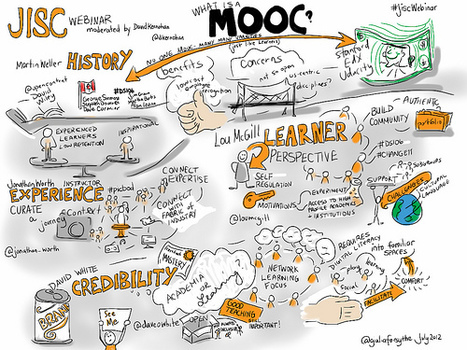
"MOOCs, Massive Open Online Courses, have recently become a widely publicized, actively discussed, topic of interest in higher education. The term MOOC is a “neologism,” i.e., a new word or new use of an old word. While MOOC is actually still quite a general and diverse pedagogical format used to organize learning, teaching or training experiences in a collaborative way, the word MOOC is now regularly used in the media as a metaphor for a number of large scale approaches. The word MOOC seems to have passed into the language as a neologism."
KF: the article considers structural and business dimensions of MOOC, their role in Higher Ed and what the future might hold. Based on a larger work, a book sharing the same title.
Long and short: the variety of technologies that allow people to be on line–text, audio, video, virtual–create opportunities for education that simply cannot be replicated in quality, affordability, or availability by traditional means. It is not in-person or on-line, as if there is a choice. It is on-line and in-person for the fortunate, or it is on-line or nothing for those with less opportunity.
Faculty and staff from the University of Minnesota accomplished what some might consider a near-miracle of publishing: they turned blank pages into a 317-page book in 10 weeks.
"An astute [and amusing] observation by Professor Thelin in his essay Professors and Online Learning featured recently in Inside Higher Ed; more for his choice of the word ‘sinister’ in his description of online learning, which is how numerous faculty view online learning in higher education – bad, threatening, dark, even frightening."
"The winds of technological change are likely to blow apart educational institutes — and journalism training — and by 2020 universities will likely be quite different than they are today, according to a survey of Internet and education experts released today by the Pew Internet & American Life Project and Elon University... This means journalism education will face challenges very similar to the ones faced by the media industry 15 years ago — a disruption in the economic model for schools and a disruption in the content and teaching methods for education."
The Higher Education Quality Council of Ontario (HEQCO) has launched a Request for Proposals (RFP) for an extensive literature review and environmental scan of online learning related to the productivity of postsecondary education institutions. By drawing from international comparisons and community/institution best-practice, the idea is to better understand the cost and quality implications of online learning and how the productivity of postsecondary education systems and institutions might be enhanced.
"We find that learning outcomes are essentially the same—that students in the hybrid format "pay no price” for this mode of instruction in terms of pass rates, final exam scores, and performance on a standardized assessment of statistical literacy. These zero-difference coefficients are precisely estimated. We also conduct speculative cost simulations and find that adopting hybrid models of instruction in large introductory courses have the potential to significantly reduce instructor compensation costs in the long run."
KF: There is a growing body of such reports suggesting that concerns about academic achievement in online and blended contexts seem to be unfounded.
THERE are several problems with the growing chorus championing online education (The Australian, June 6). The argument is that since recent information and communication technologies are clearly disruptive technologies, higher education is failing by not (yet) adopting them.
Proselytisers assert that universities are shortchanging their students and underserving society, and that most current institutions risk being superseded by new institutions or processes that will make them anachronistic if not redundant.
The more apocalyptic claims are that universities will soon be as obsolete as newspapers are becoming.
Many of the online evangelists are politicians, technophiles or businesspeople. Few are educationalists or people with much experience of distance education. Of course, the critics claim that current institutions and their staff are trapped in their traditional ways and either cannot see or resist the imperative to change.
The Connected Educators Book Club is an opportunity to read books about or related to online communities, then discuss them with your peers and the author, through asynchronous dialog (in a book club circle on Google+) and weekly real-time multimedia discussions (on Blackboard Collaborate). You’ll also receive weekly emails from the club highlighting the latest book-related discussions and events.
"The theory behind the visitation program is to foster a positive relationship between the faculty and the institution; therefore, enhancing faculty-student engagement and interaction." ... "The ability to network fosters a sense of community that allows individuals to benchmark their performance against fellow instructors, increasing teaching effectiveness, student learning, and alignment with the university’s goals. Based on survey results, faculty indicated they enjoyed meeting fellow instructors that teach within their college and might even teach the same course in a different section."
As a life-long learner, I have appreciated engaging and interacting with a wide variety of educators in a few Massively Open Online Courses (MOOCs). The concept of a MOOC is has been around for a while. In previous blog posts, I have shared the definition of a MOOC and my participation and experience. I have appreciated learning from the #eci831 and #CCK09 MOOC facilitators, such as Alec Couros, George Siemens & Stephen Downes.
Traditional American universities are suddenly running scared of YouTube, Xconomy reports, along with Vimeo, 5min, iTunes U, TED and the Internet Archive.
Without YouTube, Sal Khan and Khan Academy could never have reached his 4 million unique viewers a month with their 3,200 videos, viewed 170 million times.
We can say six million students are now taking at least one online course, but do we know what those students look like? According to a new survey, the average student is a white, 33-year-old female with a full-time job that pays around $65,000 per year. She’s likely studying business — the most popular field of study — in hopes of advancing in her current career.
KF: Reasonably small sample, but the report rings true. The artcle seems to hold some interest for marketing and corporate comms types who may see the issues raised as reflective of their efforts.
A couple of pieces in the New York Times and Washington Post have attracted some attention over the past couple of weeks for their descriptions of online and blended-learning environments–and both have made the mistake of assuming that just because one experience is a certain way, that all experiences in these environments are that way. As I have said countless times, just because an experience is online or blended, does not make it necessarily good or bad, just as just because an experience is in a “traditional” face-to-face environment does not make it good or bad.
I wrote letters to the editors about both. Given that the editors chose not to publish them, I have chosen to publish them below.
"The college experience of 2020 will further shift from in-person lectures on brick-and-mortar campuses in favor of Web-based learning, according to a majority of technology experts, education administrators, and Internet users who responded to a survey conducted by the Pew Research Center and Elon University. Sixty percent of the 1,021 respondents agreed with a statement predicting that technology will have a powerful influence on education in the coming decade, foreseeing "mass adoption" of online classes, and graduation requirements customized to individual learning. Thirty-nine percent sided with a contrasting prediction that institutions will incorporate new technology without changing educational paradigms."
"'Who will lead the way for innovation in education?' This is one of the big questions concerning higher education as the 21st century moves into its second decade. In a general sense, it would seem that brick-and-mortar institutions would be at the forefront of such innovation given their resources, easy face-to-face collaboration and infrastructure. The question remains though, are such institutional structures really supportive of innovation or is there a better alternative?"
"Gone is the time when PowerPoint was the most impressive communication technology in the lecture hall. These days, students and professors enjoy the power of Twitter, a tool that allows for digital discussions to supplement and even guide lecture sessions. So how exactly is Twitter changing the college lecture as we know it? Read on to find out about 10 different ways."
KF: The backchannel has become a popular feature of academic conferences over recent years. The basic structure of the backchannel is a behind the scenes discussion of the presentation by attendees and remote participants who are interested in a topic or speaker. The backchannel has a well-documented decade-long history and has become a core component of many conferences. The invention of the #hashtag (a form of metadata on live social media) means that conference participants can post and follow discussion points using social media like Twitter. Similarly, these tools can be utilised to provide a platform for learners in the traditional "delivery" context of lectures and large classes.
To get content containing either thought or leadership enter:
To get content containing both thought and leadership enter:
To get content containing the expression thought leadership enter:
You can enter several keywords and you can refine them whenever you want. Our suggestion engine uses more signals but entering a few keywords here will rapidly give you great content to curate.


 Your new post is loading...