Your new post is loading...
Moving a course from brick-and-mortar to online requires rethinking how you deliver content, replicate in-class interactions and pinpoint areas for improvement.

|
Scooped by
Kim Flintoff
July 30, 2019 10:48 PM
|
Right now, all sorts of technology, including educational software, is “adaptive.” That means it’s pre-programmed to take certain steps, based on what a user—say, a student—does. In simple terms, if a kid taking an adaptive test gets an answer right, the system knows to give that kid a tougher question next. (Think of this as a much more sophisticated, computerized version of those choose-your-own adventure books you might have read as kid.)
Plenty of experts would call those systems “AI” and plenty of vendors market their educational software that way. But these so-called “rule-based” systems aren’t the “fancy, sexy AI” that’s grabbing headlines, said Robert Murphy, a senior policy researcher for the RAND Corporation. That’s because all the information is already pre-programmed. The machine can’t get any better at a particular task.

|
Scooped by
Peter Mellow
July 30, 2019 9:26 PM
|
Learn how to effectively present your product designs to non-designers, clients, or other stakeholders on your team. Gain insight on how to successfully communicate your UI/UX designs so you walk away with useful, actionable feedback. Shot by [Abul Bashar Muhammad Salahuddin](https://dribbble.com/shots/3837903-presentation).
|
|
Scooped by
Peter Mellow
July 4, 2019 9:18 PM
|
The printed book just won’t die. But another print-based technology—the copy machine—is disappearing from many academic libraries, as librarians swa
|
|
Scooped by
Peter Mellow
July 2, 2019 10:00 PM
|
Providing lecture capture materials as supplements to a large auditorium classroom experience resulted in a surprising transformation of the student-t
|
|
Scooped by
Peter Mellow
July 1, 2019 6:40 PM
|
Explore the emerging, exciting field of Digital Learning and find out how to transform your professional practice with this online course from Deakin Uni.
|
|
Scooped by
Peter Mellow
June 29, 2019 10:14 PM
|
About two or three times a month I get requests to meet or talk on the phone to someone who is looking for a career in online learning, educational technology or instructional design. I am always happy to give half an hour of my time to help as best as I can. We need good quality people in this field.
|
|
Scooped by
Peter Mellow
June 29, 2019 5:45 AM
|
Author of new book explains how she has adapted James Lang's principles for the virtual classroom, to help online instructors produce better learning.
|
|
Scooped by
Peter Mellow
June 27, 2019 9:23 PM
|
My professional and personal blog, which includes my experiences of learning technology and eLearning practices, ideas and challenges with learning.
|
|
Scooped by
Peter Mellow
June 20, 2019 8:42 PM
|
Michelle Janning explains what she (and her students) learned when she brought guest lecturers into her course via video.
|
|
Scooped by
Peter Mellow
June 13, 2019 6:01 PM
|
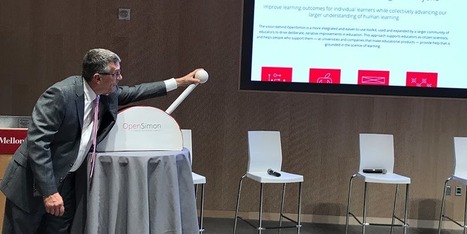
For a moment this week, the provost of Carnegie Mellon University looked a bit like a game show host as he grabbed the lever of an oversized switch and called on an audience to join him in a countdown—“5, 4, 3, 2, 1.” Then, he toggled the cardboard lever and declared open a new website, one that gave away software that took more than $100 million in grant funding to develop.
It was an unusually theatrical moment for a gathering to announce the release of software tools to help professors improve their teaching. But the organizers were playfully acknowledging the size of their project’s ambition—which they hope will spark a more data-driven and experimental approach to teaching at colleges around the country. And the flair was fitting, since success will end up being based not so much on how well the software works, but on how well its creators can attract momentum to their cause—and change the culture of the academic profession to make teaching an area professors are excited to make discoveries around.
The software tools released at the event are called the OpenSimon Toolkit, and they can help colleges create digital courseware and measure how well their course materials work. The various pieces can work together or stand alone, depending on what colleges need, and the source code will be made open so that colleges can customize the tools to fit their own needs.
|
|
Scooped by
Peter Mellow
June 8, 2019 10:15 PM
|
New ventures hope to fill a need as the number of African high school graduates grows, along with demand for a more highly skilled work force.
|
|
Scooped by
Peter Mellow
June 5, 2019 12:31 AM
|
Managing digital transcripts is the top use case for blockchain in the higher education space, but more colleges and universities are starting to explore the technology's potential in new ways.
|
|
|
Scooped by
Peter Mellow
July 31, 2019 6:21 PM
|
Following on from What’s in a Name Part 1: Learning Designers This blog post is structured as Frequently Asked Questions and Responses, from the author’s perspective. Thes…
|
|
Scooped by
Kim Flintoff
July 30, 2019 10:47 PM
|
What Is Digital Transformation?
Digital transformation (Dx) is a series of deep and coordinated culture, workforce, and technology shifts that enable new educational and operating models and transform an institution’s operations, strategic directions, and value proposition.
Dx is being driven by technology trends and changes that are enabling a new approach to everything from how digital architectures are being incorporated to how campus leaders interact with the IT organization, all targeting improved student outcomes, more effective teaching and learning methods, new research capabilities, and an evolution in business models. Dx requires agile and flexible leaders at all levels who can enable the college or university to rapidly and efficiently achieve its strategic aims.
|
|
Scooped by
Peter Mellow
July 5, 2019 1:04 AM
|
|
|
Scooped by
Peter Mellow
July 4, 2019 1:17 AM
|
Four-and-a-half years after Amazon first released Alexa, its voice-activated virtual assistant, the technology is finding its footing in education
|
|
Scooped by
Peter Mellow
July 2, 2019 7:08 PM
|
Building community in online classrooms is a difficult task. Here are five tips to help you get started.
|
|
Scooped by
Peter Mellow
July 1, 2019 5:58 PM
|
By implementing UDL, higher education IT leaders can have a profound, quiet, positive (dare we say, sneaky?) impact on learner persistence, retention,
|
|
Scooped by
Kim Flintoff
June 29, 2019 9:56 PM
|
Prodding kids to become agile digital-media autodidacts is one way Digital Harbor fulfills its mission of preparing youth for a future that will have jobs and careers that don’t yet exist. Another way is through its student-staffed 3D print shop, where more advanced kids learn digital design and fabrication skills as well as workplace protocol all while making products—ranging from braille rings to wheelchair joysticks—for paying clients. The students handle everything—invoicing, project management, quality control, shipping, communication with customers—and learn the importance of things like showing up on time. They even find new clients by attending fairs and setting up and maintaining a website that advertises their services. “We’re really trying to make the students leaders,” says Grimes, “to make them feel like they have experiences that they can legitimately list on a résumé before they even graduate high school.”
|
|
Scooped by
Peter Mellow
June 28, 2019 1:44 AM
|
Spread the love, Neuroscience is changing the pedagogy of education, and it’s about time. Schools have long been ready to embrace scientific theory and research. Everything educators incorporate in their instruction today must first consider whether it aligns with the neuroscience of learning. What we bring into the classroom must be research-based, relevant and ready to support teachers. Without a foundation of research, edtech is only an amusement What we know about the brain and how it learns affects how we design and deliver instruction. It’s critical that edtech companies pay attention to the latest research and apply it in their …
|
|
Scooped by
Peter Mellow
June 24, 2019 6:32 PM
|
Learning engineering has the potential to create new opportunities for learning and technology stakeholders that drive greater value and results, ulti
|
|
Rescooped by
Peter Mellow
from STE(A)M
June 18, 2019 12:01 AM
|
"The newest librarian at the University of Oklahoma is a robot. It’s a chatbot, which library officials plan to add to the library’s website this summer to answer some of the most common questions students come in with, as well as to help them get started with their research. The system can tackle things like “where can I print?” or “what databases do you have about biology?” Anything it can’t answer gets sent to a human librarian."
Via EDTECH@UTRGV, NextLearning
|
|
Scooped by
Peter Mellow
June 12, 2019 12:43 AM
|
Thanks to an initiative to bring adaptive active blended learning to classrooms, ASU is meeting students where they are and making class time full of more high-value engagement.
|
|
Scooped by
Peter Mellow
June 5, 2019 6:11 PM
|
In a survey of 1,500 online students, most considered the value of their degree equal to or greater than the cost they paid to take it. Among those who have attended face-to-face and online courses, the majority said that online learning is as good as or better than attending courses on campus. The survey was conducted by Learning House and Aslanian Market Research.
|


 Scoop.it!