Edumorfosis.it
443.4K views | +3 today
Follow
Edumorfosis.it
New Learning Ecologies, Instructional Design, EdTech, eLearning, mLearning & more...
Curated by Edumorfosis
Your new post is loading...
Scoop.it!

John Moravec: "No esperen el permiso de nadie para empezar a cambiar la educación"

John Moravec: "No esperen el permiso de nadie para empezar a cambiar la educación" | Edumorfosis.it | Scoop.it

Su concepto del «knowmad» —el trabajador nómada del conocimiento, creativo, colaborativo y capaz de aprender en cualquier contexto— no es una simple etiqueta, sino el perfil del ciudadano que ya habita este presente líquido. Su propuesta de «leapfrogging» no es una invitación a la reforma, sino un llamado a dar un salto cuántico, a dejar de poner parches en un sistema que necesita ser reimaginado desde sus cimientos.

En un 2025 donde la inteligencia artificial generativa redefine a diario las fronteras del saber y la incertidumbre es la única constante, dialogar con John Moravec no es un ejercicio académico, es una necesidad estratégica. Es conversar con quien lleva más de una década advirtiéndonos sobre la tormenta que ya llegó y, más importante aún, enseñándonos a construir mejores barcos.

Edumorfosis's insight:

Es una lástima que los EduKnowmads tengamos que implantar nuestros proyectos educativos fuera del sistema universitario. Mi experiencia de no pedirle permiso a mis superiores para transformar la educación no le agradaba a algunos dirigentes que terminaban obstaculizando procesos y desautorizando las iniciativas tecno-educativa. Otros se aprovechaban del impacto educativo generado para justificar los jugosos salarios de sus puestos administrativos. Mientras ellos ascendían, yo permanecía en el mismo lugar, viendo como los demás recibían compensaciones y ascensos de rango. Yo no pedí permiso para seguir aprendiendo a transformar la educación, pero terminé saliéndome del sistema por el mal trato institucional e injusticias cometidas en los 20 años que laboré para la Universidad... 

No comment yet.
Scoop.it!

GPT-Building, Agentic Workflow Design & Intelligent Content Curation

GPT-Building, Agentic Workflow Design & Intelligent Content Curation | Edumorfosis.it | Scoop.it

As my work with Synthesia showed, a whopping 84% of instructional designers report using Generative AI tools on a weekly basis at the end of last year. Despite this, my own research suggest that only ~2% of current job ads explicitly mention AI competencies as a requirement for the Instructional Design role.

But in this paradox paradox sits some exciting promise. Why? Because established usage & adoption patterns - like those among PC users in the 1970s and 80s - show us that a disconnect between individual behaviours and market requirements is often a precursor to widespread and systematic change.

No comment yet.
Scoop.it!

¿Más profesores por alumno es sinónimo de mejor aprendizaje? El papel de la ratio en educación

¿Más profesores por alumno es sinónimo de mejor aprendizaje? El papel de la ratio en educación | Edumorfosis.it | Scoop.it

La lógica indica que un maestro o una maestra trabajarán mejor, podrán atender de forma más personalizada y dedicar más tiempo a sus alumnos si tienen 15 en clase que si tienen 25. Pero más allá de la lógica, ¿qué dice la evidencia empírica sobre el papel de la ratio en las diferentes etapas educativas?

La proporción entre estudiantes y docentes incide en la calidad del aprendizaje de manera diferente según la etapa educativa, las particularidades propias de la institución y las características del profesorado.

No comment yet.
Scoop.it!

Universidades alérgicas a la IA

Universidades alérgicas a la IA | Edumorfosis.it | Scoop.it

La mayoría de las universidades occidentales quedan malparadas. Mientras Beijing entrena a sus estudiantes en prompts y verificación, Oxford, Harvard o buena parte de la Russell Group siguen midiéndose la pureza textual con el absurdo y desfasado Turnitin, y amenazando con suspensos ejemplares. El negocio de la «detección de IA», nacido para combatir un supuesto tsunami de plagio, ya despierta recelos: el despliegue de Turnitin Originality ha generado críticas por su opacidad metodológica y su altísimo índice de falsos positivos. 

No es un problema meramente técnico: es convertir la clase en un juego del gato y el ratón que estropea la confianza y desperdicia horas que podrían dedicarse a enseñar, a contrastar y a pensar. El resultado es un clima en el que estudiantes inocentes ven su expediente manchado por «frases sospechosas» y profesores cansados de perseguir fantasmas absurdos y de cumplir reglas mal diseñadas recurren a un software que promete certezas imposibles.

No comment yet.
Scoop.it!

Delegar la metodología de una investigación a la IA: ¿Viable o no?

Delegar la metodología de una investigación a la IA: ¿Viable o no? | Edumorfosis.it | Scoop.it

El empleo de la IA en todas las actividades de investigación es una realidad que no se puede ocultar. Tan real como los problemas que se advierten en las tesis de los estudiantes universitarios. Los estudiantes suelen enfrentarse a deficiencias en el conocimiento del tema a investigar, la formación en investigación y las habilidades esenciales de redacción y ortografía (Rodríguez et al., 2023) Otros problemas comunes se relacionan con la gestión del tiempo, dificultades en la selección de temas y comentarios inconsistentes de los asesores (Sharma, 2024). 

Es común encontrarnos errores en la determinación de las categorías centrales como el problema, el objetivo, las variables, entre otras. Por lo general debemos revisar una y varias veces la relación entre problema y objetivo. Incluso días antes de las defensas se vuelven a realizar ajustes a estas categorías. Entonces cómo es posible que el resto del trabajo se evalúe correctamente, mientras que se siguen modificando las categorías antes mencionadas.

No comment yet.
Scoop.it!

[PDF] AI in Education 2025

[PDF] AI in Education 2025 | Edumorfosis.it | Scoop.it

AI is transforming nearly every aspect of our society, from how work gets done to how companies operate. It’s changing how we talk with our doctors, our employees, and our customers, bridging language gaps and helping us communicate more clearly and effectively. And it’s transforming education too.

Across the globe, educators are using AI to increase student agency, giving them a greater sense of ownership over how they learn. Education leaders and institutions are leveraging AI to enhance operational and administrative processes and are tapping into real-time data to improve student success. And an exciting shift is starting when it comes to the benefits of using AI—no longer just a timesaver, it can empower everyone to reimagine opportunities for the future of education together.

To better understand the state of AI in education, Microsoft Education has conducted numerous studies and surveys and collaborated with academic institutions and organizations. We’ve also surveyed academic and IT leaders, educators, and students from around the world; explore the extended survey data for more insights.

A follow-up to our AI in Education Report in 2024, this year’s edition reveals much about the ongoing evolution of AI in education, from how audiences feel about it to how it’s being used in education today—and how it might be used in the future.

Mª de Lourdes Ferrando Rodríguez's curator insight, July 25, 12:49 PM
Informe sobre IA en la educación

Scoop.it!

[PDF] Bullshit Universities: The future of Automated Education

[PDF] Bullshit Universities: The future of Automated Education | Edumorfosis.it | Scoop.it

The advent of ChatGPT, and the subsequent rapid improvement in the performance of what has become known as Generative AI, has led to many pundits declaring that AI will revolutionize education, as well as work, in the future. In this paper, we argue that enthusiasm for the use of AI in tertiary education is misplaced. A proper understanding of the nature of the outputs of AI suggests that it would be profoundly misguided to replace human teachers with AI, while the history of automation in other settings suggests that it is naïve to think that AI can be developed to assist human teachers without replacing them. The dream that AI could teach students effectively neglects the importance of ‘learning how’ in order to ‘learn that’, that teachers are also role models, and the social nature of education. To the extent that students need to learn how to use AI, they should do so in specialized study skills units. Rather than creating a market for dodgy educational AI by lowering their ambitions about what they can offer, universities should invest in smaller class sizes and teachers who are passionate about their disciplines. To flourish in the future, just as much as they do today, societies will need people who have learned to think and not—or not just—intelligent machines.

No comment yet.
Scoop.it!

Lack of Engagement? That’s not education’s only problem!

Lack of Engagement? That’s not education’s only problem! | Edumorfosis.it | Scoop.it

The three essential dimensions of education systems and curricula in terms of how students interact with that curriculum:


  1. Engagement: Students might engage because they recognize the value of what they’re learning, even if they don’t particularly enjoy it. Multiple factors drive this engagement—teaching styles, content relevance, cultural factors—all contributing to whether students see value in what they’re learning.
  2. Commitment: This describes how willing students are to invest effort and persist with the learning process, whether through following established structures or driving their own learning forward.
  3. Agency: This means having the ability to make decisions appropriately at their age level, having choices that genuinely impact outcomes, and opportunities to make good choices. 
No comment yet.
Scoop.it!

AI model selection for Instructional Design

AI model selection for Instructional Design | Edumorfosis.it | Scoop.it

From some initial research conducted over the last month, I’ve found that the vast majority of Instructional Designers choose their AI tools based on UX preference and cost.

Meanwhile, in the workplace, most L&D teams are allocated AI tools based on the existing tech stack rather than tool performance. TLDR: If your org already uses Microsoft Office Suite and Teams, you will more than likely be allocated MS Copilot as your AI sidekick for the L&D workflow.

No comment yet.
Scoop.it!

AI in Education — The next 10 years (2025–2035) 

AI in Education — The next 10 years (2025–2035)  | Edumorfosis.it | Scoop.it

Artificial Intelligence promises to transform education by tailoring instruction, automating routine tasks, and reshaping teachers’ roles. UNESCO stresses that AI “has the potential to address some of the biggest challenges in education today, innovate teaching and learning practices, and accelerate progress towards [Education 2030]”. Governments and experts foresee AI becoming pervasive in classrooms, but emphasize a human-centric approach. For example, UNESCO and OECD frameworks urge that AI should “support teachers in their educational and pedagogical responsibilities,” with human interaction remaining at the core of education. In practice, schools will use AI tools for everything from designing lessons to grading assignments, while policymakers plan to steer AI adoption carefully to ensure inclusion and equity.

No comment yet.
Scoop.it!

Your synthetic educator looks perfect, but can it actually teach?

Your synthetic educator looks perfect, but can it actually teach? | Edumorfosis.it | Scoop.it

In the last 2-3 years, AI avatars have evolved from futuristic novelty to an increasingly mainstream feature of corporate training. With platforms like Synthesia making avatar-based video creation accessible to every L&D team, we're already seeing a dramatic shift in how organisations deliver training at scale with AI avatars (literally) front and centre. This shift represents more than just a technological upgrade—it's fundamentally changing how we think about the relationship between instructor and learner.

The business case is compelling: avatar-based training can save hours of production time and millions of dollars each year by eliminating the need for human presenters, reducing reshoot costs, and enabling rapid content updates. Organisations can create consistent training experiences across global teams, overcome scheduling constraints with subject matter experts, and scale personalised instruction in ways that were previously impossible.

No comment yet.
Scoop.it!

Canadian universities grapple with evaluating students amid AI cheating fears 

Canadian universities grapple with evaluating students amid AI cheating fears  | Edumorfosis.it | Scoop.it

In Canada, some professors are making a similar move amid widespread reports of AI cheating, while others are testing out oral exams or finding ways to incorporate AI. Six in 10 Canadian students said they use generative AI for their schoolwork, according to an October 2024 study from KPMG in Canada.

"We are definitely in a moment of transition with a lot of our assessments," said Karsten Mundel, co-chair of the University of Alberta's AI steering committee.

No comment yet.
Scoop.it!

Powering Up: Essential skills for success in the Age of AI

Powering Up: Essential skills for success in the Age of AI | Edumorfosis.it | Scoop.it

The enthusiastic response highlights a growing recognition across industries: In an era of rapid technological change and artificial intelligence (AI) development, uniquely human abilities are more crucial than ever for workplace success. According to a recent Deloitte Insights report, 92% of companies now say that human capabilities and soft skills matter more than hard skills.

Clark uses a different term for these talents – power skills – to emphasize their critical importance. He and Sandra Sjoberg, associate dean and director of marketing and innovation programs at WGU School of Business, have become strong advocates for their central role in higher education today.

No comment yet.
Scoop.it!

[PDF] The challenges of AI in Higher Education and Institutional Responses: Is there room for competency frameworks? 

[PDF] The challenges of AI in Higher Education and Institutional Responses: Is there room for competency frameworks?  | Edumorfosis.it | Scoop.it

El documento de trabajo "Los retos de la IA en la educación superior y las respuestas institucionales: ¿Hay lugar para marcos de competencias?", publicado por UNESCO IESALC, ofrece una revisión sistemática del estado actual de la integración de la inteligencia artificial (IA) en la educación superior. Aunque la IA presenta oportunidades significativas para la transformación pedagógica y administrativa, las instituciones de educación superior (IES) tienen lagunas críticas para prepararse y responder eficazmente a esta realidad. Las autoras, Arianna Valentini y Alep Blancas, defienden la necesidad urgente de desarrollar un marco integral de competencias de IA adaptado específicamente al contexto de la enseñanza superior.


La metodología del informe incluyó una revisión bibliográfica de enero de 2021 a agosto de 2024, complementada con un ejercicio de evaluación de las iniciativas relacionadas con la IA en 16 instituciones de educación superior en cinco regiones de la UNESCO. Este doble enfoque permitió a las investigadoras identificar una brecha crítica entre el rápido ritmo de adopción de la IA y la falta de respuestas institucionales estructuradas.

No comment yet.
Scoop.it!

A new paper just found something horrifying about kids who get phones early in life

A new paper just found something horrifying about kids who get phones early in life | Edumorfosis.it | Scoop.it

Children who are provided with access to smartphones before the age of 13 are, per a jarring new study, far more likely to suffer severe mental health problems down the line.

No comment yet.
Scoop.it!

Introducing the SME interview bot

Introducing the SME interview bot | Edumorfosis.it | Scoop.it

Having run thousands of interviews with Instruction Designers over the years, one thing is very clear: one of the key challenges we face in optimizing both the speed and quality of our work is wrangling the right information from Subject Matter Experts (SMEs).

If you’ve ever spent hours chasing the right person, only to receive half-remembered insights and a tone of impenetrable acronyms, you’re not alone. As one L&D colleague at a big corporate said to me just this week:

Access to SMEs, and the ability to consistently get the right information from them is the single biggest challenge in our projects. We spend more far more time chasing clarity than actually building training.

No comment yet.
Scoop.it!

The academics taking on ‘cheating’ students using AI to write their essays

Undergraduate dependence on AI is endemic. Almost all students – 92% – are using it in some capacity, up from 66% in 2024, a survey of more than 10,000 students conducted earlier this year by the Higher Education Policy Institute (HEPI), a leading think tank focused on higher education policy, found.

While fewer students admit to using AI for direct help with their assessments, evidence of cheating is growing – even as it becomes harder to detect. Nearly 7,000 confirmed cases of students passing off AI-Generated work as their own were recorded across universities in 2023–24. Experts warn these numbers represent only the tip of the iceberg.

No comment yet.
Scoop.it!

Blood in the Instructional Design machine?

Blood in the Instructional Design machine? | Edumorfosis.it | Scoop.it

The more sophisticated and arguably more urgent questions we must now ask are: "How will AI change my job?”. What we’re really asking here is, will AI degrade our skills? Will it automate the creative, satisfying parts of our work and - contrary to the promise of AI - leave us with the administrative drudgery?

This is the new reality check for the Instructional Design profession and education professionals more broadly. The greatest risk to our roles may not be a future of unemployment, but a future of profound professional dissatisfaction.

The data and testimonials emerging from across the knowledge economy suggest we are at a pivotal crossroads, facing two divergent paths for human-AI collaboration. One path sees AI as a tireless assistant, a tool that handles the toil and frees us to focus on the strategic and creative work we love. The other, more insidious path, sees the machine doing the "fun stuff" while the human is left with the functional drudgery of feeding it source files and managing its output.

This is the "inverted centaur" model—where the human becomes the machine's hands, not the other way around. This is not a distant fear; it is a choice being made right now in the design of our tools and the structure of our teams. It is the central fight for the soul of our work.

No comment yet.
Scoop.it!

Beyond the hype: What 18 recent research papers say about how to use AI in Instructional Design

Beyond the hype: What 18 recent research papers say about how to use AI in Instructional Design | Edumorfosis.it | Scoop.it

In the last 18 months amidst all of the hype we have seen a growing body of peer-reviewed research on AI & Instructional Design, providing us with systematic, robust and reliable data on how AI is being used in Instructional Design and how it’s impacting (for better or worse) the speed and quality of our work.

Perhaps unsurprisingly, the results are far more nuanced than either the AI evangelists or the skeptics would have you believe. Some findings might surprise you — others will validate concerns you've probably been too polite to voice in all those AI webinars you've attended recently.

No comment yet.
Scoop.it!

[PDF] Empowering Learners for the Age of AI

[PDF] Empowering Learners for the Age of AI | Edumorfosis.it | Scoop.it

As Artificial Intelligence (AI) increasingly influences how we access information, communicate, and make decisions, AI literacy becomes essential for navigating daily life, creating with purpose, and preparing for the future of learning and work. AI literacy equips learners and educators to understand both the risks and opportunities that AI presents, and to make meaningful and ethical decisions about its use.


It helps learners critically evaluate AI’s impact on their lives, education, and communities while preparing them to shape the future. However, to fully realize the potential of AI literacy to shape learning, key barriers to implementation must be addressed, including:

  • A lack of a shared understanding of what AI literacy is and how to teach it.
  • Uncertainty about how AI fits into various subject areas.


This publication serves as a starting point for teachers, education leaders, education policymakers, and learning designers to understand AI literacy and decide how it fits their needs. Establishing a common language about AI literacy is instrumental for consistency across diverse educational settings.

Edumorfosis's insight:

Artificial Intelligence (AI) has become a widely used tool in our everyday life, including for learning, personalized assistance, and entertainment. Therefore, young people must be able to understand how AI works, its societal impact, and how to use it ethically in order to be prepared for a society and economy in the age of AI

Integrating AI literacy into education is essential to equip students with the critical thinking skills necessary to understand, interact with, and innovate using digital technologies, preparing them to contribute meaningfully to society” (Lidija Kralj) 


Richard Platt's curator insight, July 19, 3:17 AM

As Artificial Intelligence (AI) increasingly influences how we access information, communicate, and make decisions, AI literacy becomes essential for navigating daily life, creating with purpose, and preparing for the future of learning and work. AI literacy equips learners and educators to understand both the risks and opportunities that AI presents, and to make meaningful and ethical decisions about its use

Scoop.it!

Graduados, inteligencia artificial y un mercado laboral en transición

Graduados, inteligencia artificial y un mercado laboral en transición | Edumorfosis.it | Scoop.it

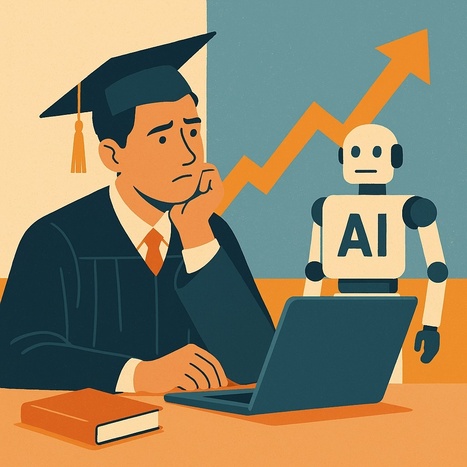
Parece evidente que estamos ante una tormenta perfecta: economía, inteligencia artificial y exceso de formación. La subida del desempleo juvenil (5.8 % en los Estados Unidos) y el aumento del subempleo (más del 40 %), apuntan a que no hablamos tan solo de un problema tecnológico: la economía está ralentizada, las empresas recortan puestos y hay una sobreproducción de graduados. En algunas compañías se están dedicando a pedir a los responsables de equipo que demuestren que la contratación que pretenden conseguir va a desempeñar funciones que una inteligencia artificial no podría llevar a cabo. Esta llamada «elite overproduction» o inflación de credenciales, está amenazando con devaluar los títulos universitarios.

Edumorfosis's insight:

Enrique Dans recomienda a los jóvenes ingresar al mercado laboral con un título universitario, certificaciones y experiencia práctica con herramientas de IA. Que puedan impulzar más sus habilidades de comunicación, ética, liderazgo, actitud resiliente y estratégica frente a la incertidumbre. Que sigan aprendiendo al establecer alianzas con empresas para lanzar bootcamps y micro‑credenciales. Que se orienten a nuevos nichos de posibilidades y no solo a las grandes corporaciones. 

No comment yet.
Scoop.it!

AFT to launch National Academy for AI Instruction with Microsoft, OpenAI, Anthropic and United Federation of Teachers

AFT to launch National Academy for AI Instruction with Microsoft, OpenAI, Anthropic and United Federation of Teachers | Edumorfosis.it | Scoop.it

The AFT, alongside the United Federation of Teachers and lead partner Microsoft Corp., founding partner OpenAI, and Anthropic, announced the launch of the National Academy for AI Instruction today. The groundbreaking $23 million education initiative will provide access to free AI training and curriculum for all 1.8 million members of the AFT, starting with K-12 educators. It will be based at a state-of-the-art bricks-and-mortar Manhattan facility designed to transform how artificial intelligence is taught and integrated into classrooms across the United States. 

The academy will help address the gap in structured, accessible AI training and provide a national model for AI-integrated curriculum and teaching that puts educators in the driver’s seat.

Edumorfosis's insight:

La AFT, junto con la Federación Unida de Maestros y su socio principal, Microsoft Corp., el socio fundador, OpenAI, y Anthropic, anunció hoy el lanzamiento de la Academia Nacional para la Instrucción en IA. Esta innovadora iniciativa educativa, con un presupuesto de 23 millones de dólares, brindará acceso a capacitación y currículo gratuitos en IA a los 1,8 millones de miembros de la AFT, comenzando por los educadores de primaria y secundaria. Tendrá su sede en unas instalaciones físicas de vanguardia en Manhattan, diseñadas para transformar la enseñanza y la integración de la inteligencia artificial en las aulas de todo Estados Unidos.

La academia ayudará a abordar la brecha en la capacitación estructurada y accesible en IA y proporcionará un modelo nacional para el currículo y la enseñanza integrados con IA que pone a los educadores al mando.

No comment yet.
Scoop.it!

Personal Growth over Productivity: AI makes current Education Obsolete

Personal Growth over Productivity: AI makes current Education Obsolete | Edumorfosis.it | Scoop.it

Younger generations must be raised to develop their own motivations and goals to prevent their physical and mental atrophy. It is urgent to replace the current productivity-driven education systems with an alternate model that fosters personal growth. This model will preserve children’s innate authenticity and alertness. Providing them with an environment that motivates them to reach their full potential will ensure that children will enjoy a life-long journey of personal growth in a society where AI replaces the need for survival-driven productivity.

No comment yet.
Scoop.it!

[Infographic] How people are using GenAl

[Infographic] How people are using GenAl | Edumorfosis.it | Scoop.it

Teams today aren’t just asked to execute tasks: They’re called upon to solve problems. You’d think that many brains working together would mean better solutions, but the reality is that too often problem-solving teams fall victim to inefficiency, conflict, and cautious conclusions. The two charts below will help your team think about how to collaborate better and come up with the best solutions for the thorniest challenges.

According to Harvard Business Review the use of GPT is becoming more intimate:


  • A significant shift from traditional technical applications to more deeply personal and emotional uses of Generative AI, with custom GPTs enabling tailored solutions in therapy, personal organization, and self-improvement.
  • Underscoring the transformative impact of GenAI on daily life and professional environments, demonstrating how effective, user-driven applications are accelerating behavioral change and redefining productivity and support in both personal and business contexts.


No comment yet.
Scoop.it!

Manuel Hidalgo: "Acaba el curso y las sensaciones son muy malas, en muy poco tiempo hemos visto una caída en picado de la actitud del alumno medio"

Manuel Hidalgo: "Acaba el curso y las sensaciones son muy malas, en muy poco tiempo hemos visto una caída en picado de la actitud del alumno medio" | Edumorfosis.it | Scoop.it

¿Ha empeorado la calidad del alumnado en las universidades españolas? Manuel Hidalgo asegura que sí. El profesor universitario ha compartido su hipótesis en su cuenta de X (antes Twitter), donde ha publicado un hilo que trata esta problemática actual.

Edumorfosis's insight:

Son tantos los factores que provocan el desinterés de los estudiantes para aprender en los cursos universitarios. Lo cierto es que no deberíamos percibir el aprendizaje como un evento pre-programado condicionado a la enseña en la exclusividad del aula encapsulada. Aprender es más un deseo personal de superar las propias limitaciones. Y eso conlleva disciplina, compromiso, persistencia, resiliencia, madurez, temple, rigor y motivación intrínseca. Tenemos que ponernos en la posición del estudiante para entender lo que ellos piensan respecto a su proceso de aprendizaje. Desde nuestro lado como profesores, solo podemos decir que la calidad de los estudiantes ha ido decayendo con el pasar de los años. Sin embargo, nos hemos detenido a pensar si nuestra calidad educativa ha mejorado en algo en estos años. 

No comment yet.