 Your new post is loading...
Looking for a Textbook on Generative AI in Education?
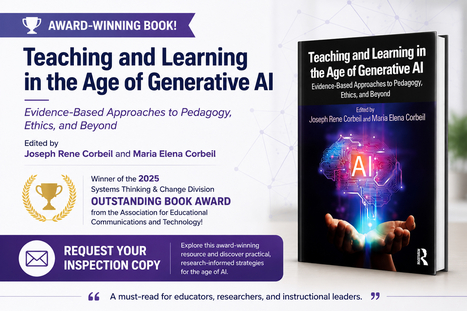
Teaching and Learning in the Age of Generative AI: Evidence-Based Approaches to Pedagogy, Ethics, and Beyond Edited by Joseph Rene Corbeil & Maria Elena Corbeil (2025) 🏆 Winner of the 2025 Systems Thinking & Change Division Outstanding Book Award from the Association for Educational Communications and Technology! If you are designing a course that addresses generative AI in education, this award-winning volume provides a research-driven, classroom-ready foundation. Rather than offering hype or fear, this book helps educators:
- Ground AI integration in learning theory and research
- Address academic integrity with thoughtful, practical strategies
- Redesign assessment for an AI-enabled world
- Explore ethics, bias, privacy, and institutional responsibility
- Leverage AI to enhance critical thinking and digital literacy
Bookended by historical and forward-looking analyses of AI in education, the chapters move beyond surface-level discussions to provide evidence-based approaches for real classrooms—K–12, higher education, and professional learning environments.
This text is ideal for:
- Undergraduate and graduate teacher education programs
- Curriculum & Instruction courses
- Educational Technology programs
- Higher education faculty development
- School technology coordinators and talent development professionals
Adopting a GenAI textbook for an upcoming semester? We invite you to request an inspection copy and explore how this resource can support your students in navigating AI with skill, ethics, and informed judgment.
Request your inspection copy today.

|
Scooped by
EDTECH@UTRGV
Today, 10:02 AM
|
"AI is not making us less intelligent. It is reducing the amount of intelligence we practise. The real problem is that we can slowly forget how to do things we no longer have to do. AI skill atrophy and cognitive offloading go hand in hand, and in this article we look at what happens when we outsource the thinking, judgement, and struggle that made those skills ours in the first place."
|
|
Scooped by
EDTECH@UTRGV
Today, 9:59 AM
|
"Underneath the numbers, the nature of work is changing yet again, and this time it’s turning everyone into a manager instead of a maker of widgets. That makes this a story about human in the loop and who keeps the agency. A person who can’t read what an agent did is still in the loop on paper, while the agent makes the calls."
|
|
Scooped by
EDTECH@UTRGV
October 19, 11:12 AM
|
A new European Union ruling is forcing giant AI companies to start using AI watermarks. This could have positive implications for AI detection efforts by teachers.
|
|
Scooped by
EDTECH@UTRGV
October 19, 11:09 AM
|
"As the world increasingly recognizes the need for safer and more secure AI, U.S. colleges and universities are trying to meet a growing demand for AI security education that prepares future workers to safeguard businesses’ and governments’ powerful AI systems.
AI cybersecurity education programs, from undergraduate and graduate classes to professional certificates, are sprouting up all over the country, as experts warn that young people need to understand how to manage AI risks as they enter a workforce teeming with algorithms, models and agents. The recent autonomous-hacking incidents involving frontier AI models have further underscored the need for cybersecurity education."
|
|
Scooped by
EDTECH@UTRGV
October 19, 11:06 AM
|
"As you start the school year, have you thought about what is missing, or more precisely, who might be missing? Are you aware that technologies, even so-called advanced ones, especially instructional materials provided through web-based applications and programs, do not always meet standards and guidelines for accessibility for all students? By accessibility, we mean that students should be able to access, use, and learn with those web-based programs and applications with relatively the same ease as their peers."
|
|
Scooped by
EDTECH@UTRGV
October 16, 10:34 AM
|
"Students were mostly supportive of the policy, saying that banning electronic devices from the classroom improved their learning."
|
|
Scooped by
EDTECH@UTRGV
October 16, 10:28 AM
|
"Remember when the initial wave of generative AI tools hit our screens, and the immediate reaction across higher education was a collective gasp, followed by a scramble for detection software? It felt like the academic world was bracing for an apocalypse of plagiarism, ready to unleash digital bloodhounds on any suspicious-looking essay. The promise of these AI detection tools was clear: they would be the ultimate arbiters of academic integrity, swiftly identifying any text not born of a human mind. But as is often the case with rapidly evolving technology, the reality has proven far more nuanced, and frankly, a good deal more complicated."
|
|
Scooped by
EDTECH@UTRGV
October 15, 10:01 AM
|
By understanding the historic rhythm of technology panics, education leaders can more effectively guide their institutions as AI continues to evolve
|
|
Scooped by
EDTECH@UTRGV
October 15, 9:57 AM
|
In a recent Gallup Inc poll, 79 percent of Americans believe that artificial intelligence will reduce the number of jobs over the next 10 years.
|
|
Scooped by
EDTECH@UTRGV
October 15, 9:52 AM
|
"No one is going to save your career from AI. That’s the most useful thing anyone can tell you about your job, and the sooner you believe it, the sooner you start building a version of yourself the next economy will actually need."
|
|
Scooped by
EDTECH@UTRGV
October 12, 3:12 PM
|
"Where to start is its own question. The honest answer is where the value concentrates, not where the automation is easiest."
|
|
Scooped by
EDTECH@UTRGV
October 12, 3:08 PM
|
The most useful question is: What is the customer trying to accomplish in the limited time and attention they are willing to give us?
|
|
|
Scooped by
EDTECH@UTRGV
Today, 10:06 AM
|
"The evolution of digital accessibility has given us principles, standards, and tools to identify and remove barriers embedded within digital experiences. But as technology moves towards increasingly dynamic, personalized, and intelligent experiences, can the inclusion of accessibility remain static as it always were till recent? — or more than ever today, do we need to rethink how the term accessibility adapts alongside the people and contexts it is designed for?”
|
|
Scooped by
EDTECH@UTRGV
Today, 10:01 AM
|
"Agents used to wait for a prompt because everyone thought that AI was only chat. Now they triage inboxes, update records, and send messages while we’re in another meeting. That’s the whole point of them, and it’s also where the trouble starts."
|
|
Scooped by
EDTECH@UTRGV
Today, 9:56 AM
|
"uturism was an early 20th-century avant-garde artistic and social movement that originated in Italy, celebrating the speed, machinery, technology, and dynamic energy of modern life while violently rejecting traditional art and history. It launched on February 20, 1909, when Italian poet Filippo Tommaso Marinetti published the Manifesto of Futurism on the front page of the Paris newspaper Le Figaro. The core goal was to liberate Italy from the heavy weight of its classical past, glorifying industrial cities, automobiles, and airplanes over museums and libraries. The movement’s alignment with Italian Fascism led to its decline."
|
|
Scooped by
EDTECH@UTRGV
October 19, 11:10 AM
|
Geoffrey Hinton, known as the “Godfather of AI” due to his pioneering work in the field, has a new, bold idea to regulate AI systems.
|
|
Scooped by
EDTECH@UTRGV
October 19, 11:08 AM
|
According to the McKinsey Global Institute, the importance of people skills will likely be emphasized by generative AI.
|
|
Scooped by
EDTECH@UTRGV
October 16, 10:36 AM
|
"OpenAI recently brought ChatGPT for Teachers to 55 more school systems, giving over 100,000 educators access. Leah Belsky, OpenAI’s vice president of education, warns that AI risks enfeebling the next generation without proper implementation. Data shows that students with stronger prior knowledge and curiosity benefit the most from AI tools. To combat this stratification, educators must cultivate student purpose and shift away from simply grading finished products. Instead, schools are exploring live demonstrations and AI-driven analysis of student interactions to evaluate the learning process. Ultimately, technology cannot replace human motivation, leaving teachers responsible for inspiring curiosity."
|
|
Scooped by
EDTECH@UTRGV
October 16, 10:30 AM
|
Curriculum must evolve beyond AI tools and teach learner agency, judgment, verification, and critical thinking for true digital literacy.
|
|
Scooped by
EDTECH@UTRGV
October 16, 10:24 AM
|
A three-year longitudinal study of Nigerian computer science students found that AI ethics awareness, reflection, and perceived responsible use all grew substantially but developed independently rather than as a coordinated progression from knowledge to action.
|
|
Scooped by
EDTECH@UTRGV
October 15, 9:59 AM
|
Learn how teacher preparation programs can teach responsible AI use while protecting student privacy, confidentiality, dignity, and trust in K-12 education.
|
|
Scooped by
EDTECH@UTRGV
October 15, 9:55 AM
|
Read this report for timely statistics about U.S.-based online higher education, student outcomes, ROI, and more.
|
|
Scooped by
EDTECH@UTRGV
October 15, 9:48 AM
|
The moving AI frontier in instructional design, and what it means for our roles & jobs
|
|
Scooped by
EDTECH@UTRGV
October 12, 3:11 PM
|
The goal isn't to keep AI out but to control how it gets in and what rules it must follow.
|
|
Scooped by
EDTECH@UTRGV
October 12, 3:04 PM
|
To move beyond discrete tactical gains, organizations must integrate AI with robust systems of record, clean data and flexible software partnerships.
|

























"Platforms like NotebookLM are useful for lowering access friction and making dense, imposing texts approachable for a broader student demographic. But if we simply host AI-generated audio files on our LMS instances and expect learning to occur on its own, the data suggest we will be disappointed."