

The goal isn't to keep AI out but to control how it gets in and what rules it must follow.


|
Scooped by
EDTECH@UTRGV
onto Educational Technology News October 12, 3:11 PM
|
 Scoop.it!
The goal isn't to keep AI out but to control how it gets in and what rules it must follow.

 Your new post is loading...
Scoop.it!
|
|
|
Scooped by
EDTECH@UTRGV
November 2, 7:35 AM
|
Scoop.it!
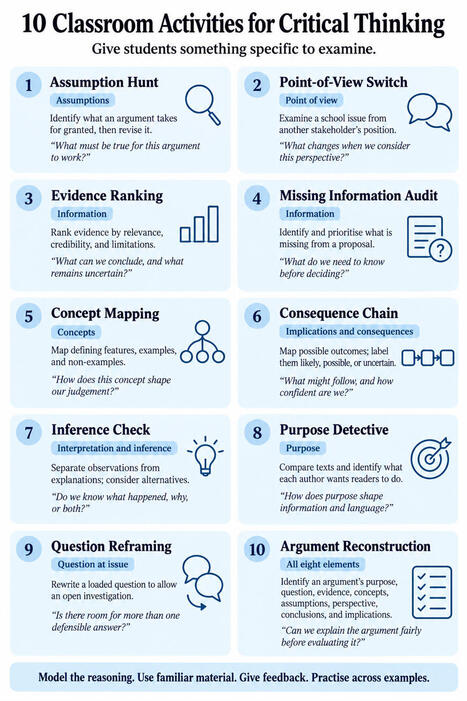
"Critical thinking becomes easier to teach when students have something specific to examine. Instead of asking them simply to “think critically,” we can ask them to identify a purpose, question an assumption, evaluate information, or explain how they reached a conclusion."
"The eight elements provide a structure for this work: purpose, question at issue, information, interpretation and inference, concepts, assumptions, implications and consequences, and point of view."
|
|
Scooped by
EDTECH@UTRGV
November 2, 7:31 AM
|
Scoop.it!
A majority of employers remain confident in higher ed, with just less than half saying college degrees will become more important as AI advances.
"80% of employers said they prefer job candidates with a bachelor's or associate degree—even when the position does not require one."
|
|
Scooped by
EDTECH@UTRGV
November 2, 7:26 AM
|
Scoop.it!

A new report from the Center for Digital Thriving at Harvard University found AI suspicion is fueling a lack of trust between teachers and educators. A report author shares three strategies for overcoming that.
"Teachers are worried about students using AI to cheat, while students are worried about being accused of cheating and that their teachers are using AI in ways they shouldn’t"
|
|
Scooped by
EDTECH@UTRGV
October 30, 1:05 PM
|
Scoop.it!

Nearly four-in-ten U.S. adults are in an online community. These virtual third spaces can take many forms, like Facebook groups, online video games or fandom forums on Reddit.
|
|
Scooped by
EDTECH@UTRGV
October 30, 1:02 PM
|
Scoop.it!

As institutions work to set technology priorities and budgets for the year ahead, now is the time to determine what to add, what to consolidate, and where to get more from existing investments.
"Technology value depends on more than acquisition and implementation: Higher ed institutions need to consider how tools fit within the broader ecosystem, whether people will use them, what complexity they add or remove, and what it takes to sustain them over time."

|
|
Scooped by
EDTECH@UTRGV
October 30, 12:57 PM
|
Scoop.it!

"Practitioners know what good output looks like and should own the final call, with operations handling the plumbing."
"Generative tools produce something plausible every time, and the errors hide in details only a practitioner checks."
|
|
Scooped by
EDTECH@UTRGV
October 29, 3:10 PM
|
Scoop.it!

Deciding whether students should use AI requires balancing safety with the developmental need to learn about managing risk.
"Children, it turns out, may actually benefit from play experiences involving height, speed, uncertainty and even a little fear. A hazard is something kids can’t reasonably be expected to recognize or know how to handle. Managing risk asks them to learn by making a judgment call."
|
|
Scooped by
EDTECH@UTRGV
October 29, 3:04 PM
|
Scoop.it!

And most employers prefer to hire workers with a college degree, even if the job doesn’t require one. Despite fears that AI will replace many entry-level white collar jobs, new data shows that many employers still want workers with a college degree.
"Despite fears that AI will replace many entry-level white collar jobs, new data shows that many employers still want workers with a college degree."
|
|
Scooped by
EDTECH@UTRGV
October 29, 3:01 PM
|
Scoop.it!
"We see AI interfaces every day, and many of them already follow the basic best practices of designing for AI. But what happens when the task is more complex: when generating an answer takes minutes rather than seconds, and the subject of research has many sides to it?"
"When an answer takes seconds, a misunderstood prompt costs very little. The user rephrases and tries again. When an answer takes minutes, a wrong start is expensive: the user waits, reads a long report, realises it answers a different question, and has to start over."
|
|
Scooped by
EDTECH@UTRGV
October 28, 10:52 AM
|
Scoop.it!

"Generative AI has made eLearning faster and cheaper to produce, but it can also make it easier to optimize for completion rates while neglecting capability. Organizations should judge AI-assisted training by what employees can actually do afterwards."
"AI has made eLearning cheaper to produce, but it also makes it easy to ignore what matters."
|
|
Scooped by
EDTECH@UTRGV
October 28, 10:49 AM
|
Scoop.it!

Discover how ChatGPT-powered job interview practice helps students build language skills, strengthen professional communication, and gain confidence through scaffolded learning.
"When classroom tasks reflect familiar situations—such as interacting in professional environments, navigating institutions, participating in multilingual communities, and communicating in person or through digital platforms—students engage more fully and demonstrate greater retention"
|
|
Scooped by
EDTECH@UTRGV
October 28, 10:44 AM
|
Scoop.it!

Clearly, many aspects of everyday living have begun to change in the emerging, evolving age of AI. Higher education must acknowledge and adapt to those changes and anticipate the ones yet to come. Some faculty members fail to recognize that the world has changed and we must respond to those changes in how and what we do to prepare learners for their careers and personal aspirations. It is frustrating for many to be required to redesign their teaching content and methods in response to the larger worldwide technological changes. Yet, here we are—the world in fact has changed.
"[F]aculty need to change from conveyors of information and knowledge to cultivators of higher-order critical and creative thinking as well as associated skills of analysis, synthesis, prediction, projection, interpolation and extrapolation."
|
|
Scooped by
EDTECH@UTRGV
November 2, 7:39 AM
|
Scoop.it!

AI tutors won’t teach students to think until the conversation itself becomes the assessment.
"[W]hen the assessment is a live, adaptive conversation judged on how the student reasons, there is much less to outsource, and the transcript makes it easier to tell whose thinking it was."
|
|
Scooped by
EDTECH@UTRGV
November 2, 7:33 AM
|
Scoop.it!

Universities are embedding technical competencies and ethics into learning outcomes, faculty development and degree requirements.
Universities "are taking varied approaches to ensure every graduate can understand, evaluate and apply AI in their field. Business schools are leading the push, with the expectation that AI proficiency will become a baseline workplace skill."
|
|
Scooped by
EDTECH@UTRGV
November 2, 7:29 AM
|
Scoop.it!

Understand the importance of completion rates and how they connect learning data to people and performance effectively.
"Completion rates and satisfaction scores can tell you whether people participated. However, they rarely explain whether the learning made a meaningful difference once employees returned to work."
|
|
Scooped by
EDTECH@UTRGV
November 2, 7:24 AM
|
Scoop.it!

Small AI helps young people build the skills and confidence to move from the classroom into meaningful jobs. The World Bank Group is working with countries to pilot small AI tools that support teachers, personalize learning, and support students.
"Using inputs such as classroom observations, teacher reflections, and teaching evaluations, [small AI] delivers coaching through a simple app on phones teachers already have and can accommodate intermittent internet connectivity."
|
|
Scooped by
EDTECH@UTRGV
October 30, 1:03 PM
|
Scoop.it!

As generative AI has become embedded in the tools students use to search, write, create, translate, organize, and receive feedback, the boundary between "using AI" and "not using AI" has become increasingly difficult to define. More importantly, treating AI use as a binary choice does little to help students understand the different roles AI can appropriately play in learning.
"AI use needs more nuance than "allowed" or "prohibited": Because AI is increasingly embedded in everyday tools, students need clear guidance on how much AI involvement is appropriate for a given learning task."
|
|
Scooped by
EDTECH@UTRGV
October 30, 1:00 PM
|
Scoop.it!
"“Presence is a sense of being in a place and belonging to a group” [1]. This article is a comparative review examining the effects of social presence, as well as the importance of instructional immediacy, on student instructional success, and the necessity of considering learner gratification within traditional educational settings and emergency remote teaching (ERT) in higher education settings. Considerable research on the significance of social presence in the online learning community has been conducted, yet there is still much to learn."
"While there is a definite correlation in CMC between the development and sustenance of social presence along with instructional immediacy in online learning situations, ERT environments ultimately involve an additional element of importance: emotional well-being"
|
|
Scooped by
EDTECH@UTRGV
October 30, 12:54 PM
|
Scoop.it!

Why higher education needs trust, critical thinking, and authentic assessment, not surveillance alone.
"If students believe their instructor is primarily trying to catch them, they may become more focused on avoiding detection than on developing intellectual independence. The question becomes not 'What did I learn?' but 'Will this look suspicious?'”
|
|
Scooped by
EDTECH@UTRGV
October 29, 3:08 PM
|
Scoop.it!

Explore the podcast vs. blog discussion to determine which format best meets your learning needs and preferences.
"In the debate podcast vs. blog, start by thinking about what your learners need to learn, not just which format you prefer...the best approach is not to pick one format over another, but to make sure employees get the support they need when they need it."
|
|
Scooped by
EDTECH@UTRGV
October 29, 3:03 PM
|
Scoop.it!
"Exposure to artificial intelligence runs through the tasks you do each week, not the role on your badge. Here’s how to measure yours and lower the risk."
"Artificial intelligence doesn’t care about your job title or mine. It’s probabilistically predicting an outcome without looking at your LinkedIn."
|
|
Scooped by
EDTECH@UTRGV
October 29, 2:58 PM
|
Scoop.it!

Aka, how to innovate the learning experience & improve outcomes with game design
"Game designers have long seen games as, essentially, learning experiences...By analysing the mechanisms of game design we can start to understand what sorts of design approaches make people stay with a challenge long enough to try a strategy, see what happens, use the feedback and try again."
|
|
Scooped by
EDTECH@UTRGV
October 28, 10:50 AM
|
Scoop.it!

Artificial intelligence is rapidly changing career paths so it's up to us to prepare students with skills that empower them across all fields and jobs
"For many professions, AI will start by changing individual responsibilities long before it completely eliminates an entire occupation."
|
|
Scooped by
EDTECH@UTRGV
October 28, 10:46 AM
|
Scoop.it!

VR, AR and AI can expand training opportunities, but physical practice remains essential when workers must handle equipment, coordinate with teams and perform correctly in high-risk situations.
"When applied with care and rigor, these technologies [VR, AR, and AI], these technologies can helpfully supplement learning can helpfully supplement learning."
|
|
Scooped by
EDTECH@UTRGV
October 27, 9:25 AM
|
Scoop.it!

"New AI-powered summaries help teachers identify common questions, learning strengths and areas needing support, while Google also introduces direct publishing of Gemini-built apps to Google Sites"
"Teachers can now view an overall summary of student engagement, along with common themes from student interactions such as recurring questions, areas of strength and suggested areas for support. They can also review individual student chat transcripts for added context and to check the accuracy of the AI-generated insights."









"AI has developed something of a Dr. Jekyll and Mr. Hyde problem. The same technology that is delivering extraordinary productivity is raising very real questions about access, control and unintended actions."