 Your new post is loading...

|
Scooped by
EDTECH@UTRGV
February 11, 5:29 PM
|
Looking for a Textbook on Generative AI in Education?
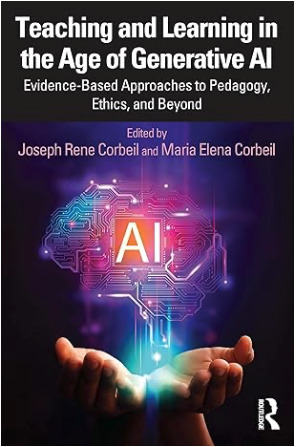
Teaching and Learning in the Age of Generative AI: Evidence-Based Approaches to Pedagogy, Ethics, and Beyond Edited by Joseph Rene Corbeil & Maria Elena Corbeil (2025) 🏆 Winner of the 2025 Systems Thinking & Change Division Outstanding Book Award from the Association for Educational Communications and Technology! If you are designing a course that addresses generative AI in education, this award-winning volume provides a research-driven, classroom-ready foundation. Rather than offering hype or fear, this book helps educators:
- Ground AI integration in learning theory and research
- Address academic integrity with thoughtful, practical strategies
- Redesign assessment for an AI-enabled world
- Explore ethics, bias, privacy, and institutional responsibility
- Leverage AI to enhance critical thinking and digital literacy
Bookended by historical and forward-looking analyses of AI in education, the chapters move beyond surface-level discussions to provide evidence-based approaches for real classrooms—K–12, higher education, and professional learning environments.
This text is ideal for:
- Undergraduate and graduate teacher education programs
- Curriculum & Instruction courses
- Educational Technology programs
- Higher education faculty development
- School technology coordinators and talent development professionals
Adopting a GenAI textbook for an upcoming semester? We invite you to request an inspection copy and explore how this resource can support your students in navigating AI with skill, ethics, and informed judgment.
Request your inspection copy today.
|
|
Scooped by
EDTECH@UTRGV
Today, 12:13 PM
|
"As higher ed institutions pay tech companies millions to provide students and faculty access to custom AI-powered tools, some faculty in Colorado and California are pushing back."
|
|
Scooped by
EDTECH@UTRGV
Today, 12:08 PM
|
Researchers make progress with an older ed tech idea: personalized practice.
|
|
Scooped by
EDTECH@UTRGV
Today, 12:06 PM
|
"There are a growing number of companies offering social chatbots that can act like friends, enemies, lovers, adventurous companions, or the manifestation of a fictional or real person you’ve always wanted to meet. You can pick A.I. Elon Musk’s brain or spar with A.I. Draco Malfoy. The myriad characters, often created by fellow users, offer drama, romance, therapy and LOLs."
|
|
Scooped by
EDTECH@UTRGV
Today, 11:53 AM
|
6 ways school leaders should adjust how AI is used so as to avoid teacher overload and potential burnout
|
|
Scooped by
EDTECH@UTRGV
April 3, 11:57 AM
|
"With the rapid advancement of generative artificial intelligence (GenAI) technology, the potential educational applications of Chat generative pre-trained transformers (ChatGPT) have attracted significant attention. However, the research on the specific effects of ChatGPT on student learning outcomes and its moderating factors remains insufficient. This study aimed to quantify the effects of ChatGPT on student learning outcomes and explore relevant moderating variables using a meta-analysis approach."
|
|
Scooped by
EDTECH@UTRGV
April 3, 11:52 AM
|
Educators are no longer naively wondering if students will use generative AI to do their homework for them. A big question now is how to determine what students are actually learning.
|
|
Scooped by
EDTECH@UTRGV
April 3, 11:45 AM
|
"Language has always evolved. But this time, it’s being rewired faster than most of us can keep up with, and our sentences are caught in the middle."
|
|
Scooped by
EDTECH@UTRGV
April 3, 11:38 AM
|
"Building intuitive AI products requires designing for context management"
|
|
Scooped by
EDTECH@UTRGV
April 1, 1:59 PM
|
"AI agents are starting to look less like chatbots and more like services. They can coordinate tasks, call tools and make changes in production systems without a human reviewing every step. For large enterprises, that autonomy is both an opportunity and a risk. The question is no longer whether an AI system can generate a good answer. It is whether you can govern what the system does."
|
|
Scooped by
EDTECH@UTRGV
April 1, 1:55 PM
|
In a new series, we will test the limits of the latest AI technology by pitting it against human experts.
|
|
Scooped by
EDTECH@UTRGV
April 1, 1:46 PM
|
In his book and Senate testimony, a neuroscientist offers a three-pronged case against screens and edtech in schools.
|
|
Scooped by
EDTECH@UTRGV
April 1, 1:40 PM
|
What are you doing to ensure that the degree and certificate candidates at your institution are prepared to thrive in the new environment that is emerging in this year and next? Technologists, economists and visionaries are warning us that in the next three to 18 months, we are going to experience rapid and pervasive disruption of our professional lives, workplace models and distribution of income. Professional positions requiring college degrees will be lost, remade into highly productive, cost-efficient, hybrid human-AI models where human contributions and compensation will collectively shrink and evaporate.
|
|
|
Scooped by
EDTECH@UTRGV
Today, 12:15 PM
|
QUALITY OVER QUANTITY: A re-examination of digital tools was already underway in districts, as part of curriculum reviews and budget trimming afte
|
|
Scooped by
EDTECH@UTRGV
Today, 12:10 PM
|
AI is transforming higher education with personalized learning, hybrid models, and smarter systems—while redefining quality, access, and future-ready skills.
|
|
Scooped by
EDTECH@UTRGV
Today, 12:07 PM
|
The technology is always on call and is quite competent. But it lacks the contemplation and attention to detail that yield great works of art.
|
|
Scooped by
EDTECH@UTRGV
Today, 11:55 AM
|
AI is already in young children's lives. Sweta Shah explains the current landscape of AI-enabled products affecting young children.
|
|
Scooped by
EDTECH@UTRGV
April 3, 11:59 AM
|
Discover how using AI to teach critical thinking in higher education turns AI errors into powerful classroom strategies that build information literacy and academic judgment.
|
|
Scooped by
EDTECH@UTRGV
April 3, 11:54 AM
|
A pilot study analyzing college students’ writing with AI shows an interactive process, from brainstorming to editing the output produced by chatbots.
|
|
Scooped by
EDTECH@UTRGV
April 3, 11:50 AM
|
"Many organizations are struggling to scale gen AI and agentic AI. But adoption challenges are not technical—they are experiential. Here’s how to design AI tools that people will embrace."
|
|
Scooped by
EDTECH@UTRGV
April 3, 11:40 AM
|
"An article published in 2025 proposed a newly observed disorder called Generative AI Addiction Syndrome (GAID), describing how some users feel anxious when cut off from AI, lose sleep over it, or withdraw from social contact. Is AI really addictive, or is it the way it’s designed that hooks us? As AI becomes more common, these are questions worth asking."
|
|
Scooped by
EDTECH@UTRGV
April 1, 2:03 PM
|
"The rise of generative AI in higher education is reshaping how feedback is delivered, but meaningful learning could be undermined if its use is not carefully guided by principles of care, trust and connection, according to new research led by the University of Surrey. Published in Assessment & Evaluation in Higher Education, the paper explores how generative AI technologies, including chatbots such as ChatGPT, are transforming feedback for students—highlighting both the opportunities and risks of AI in education."
|
|
Scooped by
EDTECH@UTRGV
April 1, 1:58 PM
|
"Artificial intelligence (AI) is quickly moving beyond chatbots and copilots. A new generation of AI agents is beginning to perform real actions. These agents can access APIs, move money, retrieve data, write code, interact with customers and even coordinate other agents. That shift raises a simple but critical question: Who is watching what the agent actually does?"
|
|
Scooped by
EDTECH@UTRGV
April 1, 1:54 PM
|
Explore the concept of a learning mindset and its importance for organizations in today's fast-paced, AI-driven world.
|
|
Scooped by
EDTECH@UTRGV
April 1, 1:43 PM
|
Conversations with Kevin Hogan—Pineville ISD technology coordinator Kenzo Vanhaesebroeck explains why vague-on-purpose policy, a grading scale for AI use, and teacher-to-teacher modeling are the best defenses a small district has against an overnight technological revolution
|
|
Scooped by
EDTECH@UTRGV
April 1, 1:37 PM
|
"AI didn’t teach designers to code. It gave them back the decisions that were always theirs."
|



























I sure wish these tools were available back in the early 1980s when I was taking Chemistry. I may have enjoyed (and understood) it more.