"Defensive architecture is revealing on a number of levels, because it is not the product of accident or thoughtlessness, but a thought process. It is a sort of unkindness that is considered, designed, approved, funded and made real with the explicit motive to exclude and harass. It reveals how corporate hygiene has overridden human considerations…"
The government should try to develop better methods to keep homeless out of the street. Planning and designating a place to the homeless group by offering better conditions, will change the problem. As the architects have new ideas to resolve a problem with the homeless, they should also be formulating ideas to prevent homelessness such as providing feasible shelter on the street. Part of the problem is that shelters should be marketed in the communities. Local businesses, policies and general communities could be more active in helping these minority groups to get aid and better their life. Cities should provide more programs and aid for the homeless group.
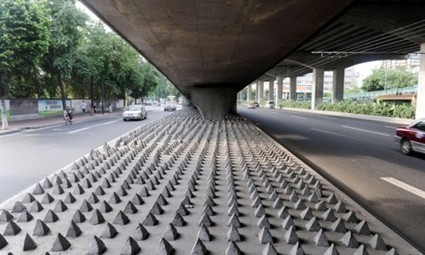
These structures such as benches with dividers that make it impossible to lie down, spikes and protrusions on window ledges and in front of store windows, forests of pointed cement structures under bridges and freeways, emissions of high pitched sounds, and sprinklers that intermittently go off on sidewalks to prevent camping overnight are very rude and without a shadow of a doubt send a message to the homeless that they aren't welcomed, and we will do whatever it takes to make sure they cannot be comfortable; even something as simple as sitting on a windowsill.
This article deals with unit 7 because it discusses architecture and new things in cities. In some cities they have defensive architecture to make it harder for homeless people to live. For example benches with dividers, and pointed cement structures under bridges. This tells the homeless they are unwanted and that others don't care about them.Some corporations have turned to aggressive ways to keep out homeless and the article says the government is denying it. In addition there are few resources to help the homeless and what they do have is insufficient. It also notes that free shelters are very rare. The author says that we should worry a little more about the homeless because "given just the right turn of events, it could happen to us."
One in five undergraduate students nationwide is parenting while attending college. These student parents face unique challenges, with financial strain being one of the most significant factors. The rising costs of college tuition, child care, and housing compound their difficulties, often leaving them vulnerable to housing insecurity. An estimated 3 in 5 students nationwide experience some form of housing insecurity during their educational journeys (Sainthilaire,2019). This issue disproportionately affects students of color, with Black and Hispanic households more likely to be cost-burdened.
Dive into the future of customer engagement and witness firsthand how AI Chat Agent can transform your lead generation and customer interaction. This demo showcases the incredible benefits and efficiency of our human-like AI agents, demonstrating how they can seamlessly enhance your business operations.
What's the Trend? Everything old is new again. At least in China, where the popularity of shopping for pre-owned products online is on the rise. The trend
"Generative AI tools such as ChatGPT are already impacting the job market. A new study shows a 21% reduction in demand for freelance jobs that are automation-prone and don’t require consistent human attention."
Many people are hoping for wind and solar PV to transform grid electricity in a favorable way. Is this really possible? Is it really feasible for intermittent renewables to generate a large share of grid electricity? The answer increasingly looks as if it is, "No, the costs are too great, and the return on investment…
This paper proposes a dynamic cascade model to investigate the systemic risk posed by sector-level industries within the U.S. inter-industry network. We then use this model to study the effect of the disruptions presented by Covid-19 on the U.S. economy. We construct a weighted digraph G = (V,E,W) using the industry-by-industry total requirements table for 2018, provided by the Bureau of Economic Analysis (BEA). We impose an initial shock that disrupts the production capacity of one or more industries, and we calculate the propagation of production shortages with a modified Cobb–Douglas production function. For the Covid-19 case, we model the initial shock based on the loss of labor between March and April 2020 as reported by the Bureau of Labor Statistics (BLS). The industries within the network are assigned a resilience that determines the ability of an industry to absorb input losses, such that if the rate of input loss exceeds the resilience, the industry fails, and its outputs go to zero. We observed a critical resilience, such that, below this critical value, the network experienced a catastrophic cascade resulting in total network collapse. Lastly, we model the economic recovery from June 2020 through March 2021 using BLS data.
- Our bills/notes bypass everything, counterfeit pens and machines. - Can be used in banks but can be used else where same like normal money - We have the best HOLOGRAMS AND DUPLICATING MACHINES - UV: YES. https://www.gobalcurrencyint.net
EUR - Euro USD - US Dollar DNR - DINAR GBP - British Pound INR - Indian Rupee AUD - Australian Dollar CAD - Canadian Dollar AED - Emirati Dirham ZAR - Rand CHF - Swiss Franc CNY - Chinese Yuan Renminbi MYR - Malaysian Ringgit THB - Thai Baht NZD - New Zealand Dollar SAR - Saudi Arabian Riyal QAR - Qatari Riyal
X5 Retail Group, Russia’s largest food retailer, has partnered with Sber and Visa to launch what it describes as ‘pay with a glance’ biometrics at self-service checkout terminals in Perekrestok supermarkets and Pyaterochka convenience stores.
"Mall owners and retailers are trying to capitalize as teens and twenty-somethings show about as much interest in shopping in person as baby boomers do ..."
As Beijing braces for a new showdown over trade, Xi Jinping is sticking with economic policies aimed at making China the world’s most powerful country.
Thomas Sowell discusses economic inequality, racial inequality, and the myths that have continued to falsely describe the system of poverty among different racial and economic classes. He explains the economic theories behind these pervasive myths and proposes fact-based solutions for seemingly intractable situations.
Sowell discusses his early life as a high school dropout and his first full-time job as a Western Union messenger delivering telegrams. He admits to flirting with Marxism in his early twenties as he first tried to grapple with the housing inequality he saw across the neighborhoods of New York City. Marxism, he says, was the only explanation he could find at the time. He went on to serve in the Marine Corps before continuing his education in economics at Harvard and earning a master’s at Columbia and a PhD at the University of Chicago.
Sowell’s first job after his receiving his PhD in economics was working for the Department of Labor, and he says it was there that he realized Marxism was not the answer. He argues that the government has its own institutional interests in inequality that cannot be explained through Marxism. He began to be discouraged by Marxism and the government in general and began searching for better economic ideas and solutions (the free market).
Robinson and Sowell discuss Sowell’s written works, his ideas of racial and economic inequality, the state of the United States today, and much more.
Interested in exclusive Uncommon Knowledge content? Check out Uncommon Knowledge on social media!
An electric car has been tested that managed a huge 1,100 mile range on a single charge. A massive jump from current electric cars like the Tesla Model
The way restaurants serve their guests has changed dramatically in the wake of COVID-19. Digital displays offer the opportunity to make those changes more beneficial to the bottom line.
To get content containing either thought or leadership enter:
To get content containing both thought and leadership enter:
To get content containing the expression thought leadership enter:
You can enter several keywords and you can refine them whenever you want. Our suggestion engine uses more signals but entering a few keywords here will rapidly give you great content to curate.




 Your new post is loading...




















The government should try to develop better methods to keep homeless out of the street. Planning and designating a place to the homeless group by offering better conditions, will change the problem. As the architects have new ideas to resolve a problem with the homeless, they should also be formulating ideas to prevent homelessness such as providing feasible shelter on the street. Part of the problem is that shelters should be marketed in the communities. Local businesses, policies and general communities could be more active in helping these minority groups to get aid and better their life. Cities should provide more programs and aid for the homeless group.
These structures such as benches with dividers that make it impossible to lie down, spikes and protrusions on window ledges and in front of store windows, forests of pointed cement structures under bridges and freeways, emissions of high pitched sounds, and sprinklers that intermittently go off on sidewalks to prevent camping overnight are very rude and without a shadow of a doubt send a message to the homeless that they aren't welcomed, and we will do whatever it takes to make sure they cannot be comfortable; even something as simple as sitting on a windowsill.
This article deals with unit 7 because it discusses architecture and new things in cities. In some cities they have defensive architecture to make it harder for homeless people to live. For example benches with dividers, and pointed cement structures under bridges. This tells the homeless they are unwanted and that others don't care about them.Some corporations have turned to aggressive ways to keep out homeless and the article says the government is denying it. In addition there are few resources to help the homeless and what they do have is insufficient. It also notes that free shelters are very rare. The author says that we should worry a little more about the homeless because "given just the right turn of events, it could happen to us."