 Your new post is loading...

|
Scooped by
Dennis Swender
March 15, 2015 2:29 PM
|
A promo piece (2:26) for my ISTE11 Presentation "A Picture is Worth 1000 Words: Infographics as a Creative Assessment". Royalty free music from Soundzabound.com…
|
|
Scooped by
Dennis Swender
March 15, 2015 2:26 PM
|
Harold Jarche "Platform capitalism is beginning to define the economy for the second Gilded Age we seem to be entering. It requires 4 contributing factors, which when combined, create a perfect opportunity for the “uberization” of almost any industry...
...Any work that can be billed by the hour is probably a commodity. Any work that can be standardized is a commodity in the eyes of platform capitalists. Any work that can be represented as a flowchart, and eventually put into a software program, is a commodity.
What’s left is work that is creative. Solving complex or wicked problems is another area for human work. Dealing with people as individuals, requires human compassion and empathy." (emphasis mine - doconnor)
|
|
Scooped by
Dennis Swender
March 15, 2015 2:24 PM
|
When people think about creating a great website they often envision a stylish and professional layout, a striking design and images that look like they were just taken out of a magazine. But while looks are definitely important for a website, it’s crucial not to neglect another significant criteria – the site’s usability.
|
|
Scooped by
Dennis Swender
March 15, 2015 2:23 PM
|
Effective web design must begin with a clear goal or purpose for the website. When visitors enter a website they normally start scanning from the top left. …
|
|
Scooped by
Dennis Swender
March 15, 2015 2:22 PM
|
Tony Karrer: As always I do this by looking through eLearning Learning and related sites like Communities and Networks Connection. I looked at Virtual Classroom, Distance Learning, ILT, Teaching Distance Learning. I also did some quick searches for various kinds of things and added them into eLearning Learning (via delicious). So together, I’ve collected a bunch of resources pretty quickly. That said, there’s so much already out there on this – I’m at this point not quite sure what the real question was/is. Certainly a lot of this is already findable. I hope this is useful. But I think the problem at this point might be something else. Still here are 60 great resources.
|
|
Scooped by
Dennis Swender
March 15, 2015 2:19 PM
|
Most amazing of all, Google made this tool available for free. This despite an educational -- and, let's be honest, entertainment -- value that's virtually impossible to measure.
What you maybe didn't know is that Google has long offered a Pro version of Earth as well, one that cost a hefty $399 per year. Now, however, you can get Google Earth Pro absolutely free.
First things first: The words "free trial" still appear in that URL, but as you'll see when you click through to the sign-up page, "Sign up is no longer required for Google Earth Pro." All you have to do is download the installer, run it, then sign in using your e-mail address (as your username) and license code GEPFREE.
|
|
Scooped by
Dennis Swender
March 15, 2015 4:58 AM
|
By Mark Boulton: “Whitespace,” or “negative space” is the space between elements in a composition. More specifically, the space between major elements in a composition is “macro whitespace.” Micro whitespace, is—yes, you’ve guessed it—the space between smaller elements: between list items, between a caption and an image, or between words and letters. The itty-bitty stuff.
So what does whitespace do?
|
|
Scooped by
Dennis Swender
March 15, 2015 4:56 AM
|
So what’s a teacher to do? If you plan lessons that involve students using online programs and apps, you’re likely to hit the campus firewall or possibly even risk compromising your students’ privacy. Yet, if you keep your lessons offline, you know you’re missing a huge opportunity to engage students by using technology in meaningful, real-world ways. Well, never fear, because we’ve got all of the answers you seek. Follow these steps to get your class online and using popular apps, without worrying about keeping student data private.
|
|
Scooped by
Dennis Swender
March 15, 2015 4:20 AM
|
|
|
Rescooped by
Dennis Swender
from Educational Technology News
March 12, 2015 1:08 PM
|
"Recently, the online education firm Coursera announced a new arrangement with Google, Instagram and other tech firms to launch what some are calling “microdegrees” – a set of online courses plus a hands-on capstone project designed in conjunction with top universities and leading high-tech firms. Coursera is one of America’s leading MOOC developers (Massive Open Online Courses)."
Via EDTECH@UTRGV
|
|
Rescooped by
Dennis Swender
from Educational Technology News
March 12, 2015 1:05 PM
|
"Zhaozeng Yin, an assistant professor of computer science at the Missouri University of Science and Technology, has developed a smartphone app that uses facial recognition techniques to take classroom attendance. Yin, who says that roll-calling is “tedious” and takes up “maybe 10% of total [class] time,” used pattern recognition, his specialty, to develop the app. Most facial recognition systems have to identify individuals out of the entire world’s population, but Yin’s app just has to check off the same forty faces."
Via EDTECH@UTRGV
|
|
Rescooped by
Dennis Swender
from Educational Technology News
March 12, 2015 1:03 PM
|
"From gamification to crowdsourcing, improve learning with these interactive elements
Today’s students are a uniquely interactive group. Most of the 80 million Americans who are part of the millennial generation—a group that comprises the lion’s share of today’s student population—can’t remember a time when they didn’t have instant access to the internet. Most of them grew up playing video games, and ever since they can remember, they’ve been in constant contact with friends via social media platforms and text messages. A growing number of today’s instructors also fall into this group."
Via EDTECH@UTRGV
|
|
Rescooped by
Dennis Swender
from Educational Technology News
March 12, 2015 1:03 PM
|
"Online discussions are the lifeblood of an online class. Without rich, ongoing discussions, learning is minimized. However, many online courses don’t help online learners understand how to post a new idea or response; the types of communications or posts that contribute to learning or share examples of good posts. As a result, online learners are often left to their own devices with many online discussions stalling or sinking to a level of mediocrity."
Via EDTECH@UTRGV
|
|
|
Scooped by
Dennis Swender
March 15, 2015 2:27 PM
|
Aurasma can encourage learners to go beyond the classroom to connect and enhance what they learn by pulling resources from the physical and the digital and then sharing those augmented reality scenes with others. Learning Objectives: Write a multi-part fictional narrative that logically ties in with actual locations on the school campus.Create an engaging narrative experience for the reader through expressive and provocative narration, animation, and/or images.Evaluate and deconstruct the narratives of others through class-wide discussion and reflection of own narrative.
|
|
Scooped by
Dennis Swender
March 15, 2015 2:26 PM
|
In any given classroom, there are invariably learners who simply don’t connect with what’s being taught. Lectures can be easy to tune out. A textbook can feel dense and boring to finish. Even a video can pose limitations for learners with sight or hearing difficulties. When these are the only options available, some learners are bound to fall behind without requesting special support, while others will surge ahead. Differentiation is one way to bridge this gap, and another is adapting the curriculum to suit all learners, instead of adjusting it to support the needs of each one.
That latter approach, called Universal Design for Learning (UDL), operates under a handful of broad principles that mainly concern themselves with the what, how and why of learning.
|
|
Scooped by
Dennis Swender
March 15, 2015 2:23 PM
|
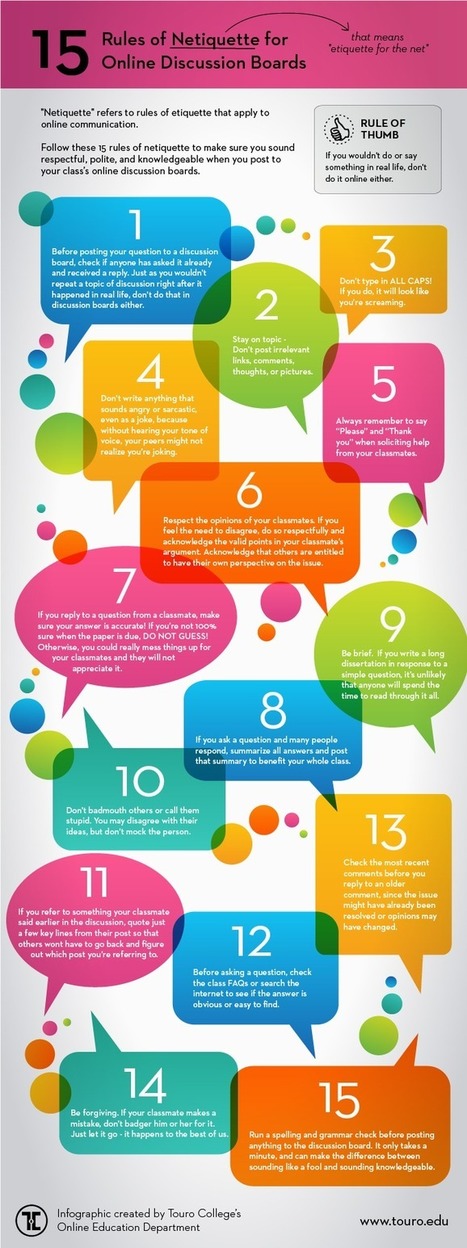
“Netiquette” refers to rules of etiquette that apply to online communication.
Follow these 15 rules of netiquette to make sure you sound respectful, polite, and knowledgeable when you post to your class’s online discussion boards.
|
|
Scooped by
Dennis Swender
March 15, 2015 2:22 PM
|
Most of us turn to the internet when we are looking for resources to use for a presentation, report or article. The internet holds the key to so many robust resources.
Yet how many of these resources can you legally use for free? How many of them can you adapt?
That’s where Open Educational Resources (OER) can help. Here’s an infographic from the Center for Open Educational Resources and Language Learning (at the University of Texas at Austin) that can help.
|
|
Rescooped by
Dennis Swender
from Into the Driver's Seat
March 15, 2015 2:20 PM
|
|
|
Scooped by
Dennis Swender
March 15, 2015 2:18 PM
|
By Clark Quinn: "My colleague Charles Jennings recently posted on the value of autonomous learning (worth reading!), sparked by a diagram provided by another ITA colleague, Jane Hart (that I also thought was insightful). In Charles’ post he also included an IBM diagram that triggered some associations."
|
|
Scooped by
Dennis Swender
March 15, 2015 4:58 AM
|
The Educational Assessment Landscape Infographic gives a clear picture of how educational assessment works and how it supports today's students.
|
|
Scooped by
Dennis Swender
March 15, 2015 4:22 AM
|
If you're designing an eLearning course, you need to keep the entire process as organized as possible. Stay focused with these 10 eLearning resources.
|
|
Rescooped by
Dennis Swender
from Educational Technology News
March 12, 2015 1:08 PM
|
"Taking classes global is one of my favorite ways that technology redefines what education can do. It boggles the mind to think that a classroom, individual or place can be thousands of miles away but close enough virtually to engage in face-to-face conversation. With communication tools like Google Hangouts, Skype and FaceTime, virtually anyone with an Internet connection can be reached from a classroom."
Via EDTECH@UTRGV
|
|
Rescooped by
Dennis Swender
from Educational Technology News
March 12, 2015 1:06 PM
|
"You might have learned or seen many techniques to create an effective eLearning. But after all these learnings have you ever realized that to gain and retain the attention of a Learner is the most challenging aspect of an eLearning course design. In this article, I will take you through an effective 5 step design model to gain the attention of a Learner."
Via EDTECH@UTRGV
|
|
Rescooped by
Dennis Swender
from Educational Technology News
March 12, 2015 1:04 PM
|
"Forget about the PISA results that show how poorly American 15-year-olds do against students in other countries when solving real-world problems in math, reading and science. What about the Millennials? According to new analysis by testing company ETS, this generation of adults born after 1980 demonstrate "weak skills" in literacy, numeracy and technology problem solving — in spite of having more years of schooling than all other previous generations."
Via EDTECH@UTRGV
|
|
Rescooped by
Dennis Swender
from Educational Technology News
March 12, 2015 1:03 PM
|
" Tech is shifting faster than teacher training can keep up. The solution is to keep it simple
I recently had the pleasure of spending a few hours in a friend’s classroom where I introduced her students to technology applications that would engage them in “showing what they know” at different points in their learning. Having worked with this teacher for many years, I had always considered her a technology pioneer."
Via EDTECH@UTRGV
|


 Scoop.it!




















I love the idea of students creating infographics for presenting work and this short video illustrates the many contexts where this method could be really effective.
Vídeo-resumen de la ponencia de Kathy Schorck "A Picture is Worth 1000 Words: Infographics as a Creative Assessment" (Una imagen vale más que 1000 palabras: Infografía como una evaluación creativa).