The Micro environment, that's our business and everyone that is directly involved and/or has a stake in the business:
entrepreneurs, personnel, investors and their families; customers, partners, suppliers, distributors and financiers; tax office, chamber of commerce, trade or industry association; i.e. people that you do business with on a regular basis and that have a direct interest in the success of your business.
The Meso environment, that's your direct business environment:
potential customers, partners and investors; potential suppliers, distributors and financiers; local society and environment; competitors, local rules and other stakeholders.
The Macro environment, everybody and everything else that might have an influence on your business:
(technological and demographic) trends infrastructure, politics and legislation crime and war the economy, society and the environment
The way that the FAANG companies use metrics to build products is vital to their success. They invest an army of people and homegrown tools to pull it off. My last article, Balancing short-term and…
Voici les 10 Solutions concrètes pour gérer les dépendances : 1- Board de dépendances programmées 2- Bloqueurs visualisés 3- Surveiller les temps systémiques d'attente 4- Simulez vos interfaces 5- Supprimer les dépendances environnementales 6- Ne gérez pas vos dépendances, cassez les ! 7- Utiliser des politiques explicites pour accélérer 8- Intégrez vos dépendances dans votre backlog 9- Gérer les deux extrémités de la dépendance 10- Utiliser une Dependency Map
1.1 Les quatre étapes de formation des équipes 1.2 Les rôles d'équipe : principes 1.3 Les neuf rôles d'équipe 1.3.1 Le coordinateur 1.3.2 Le shaper 1.3.3 L'implementer 1.3.4 Le completer finisher 1.3.5 Le plant 1.3.6 Le monitor evaluator 1.3.7 Le resource investigator 1.3.8 Le team worker 1.3.9 Le specialist 1.4 Combinaison de rôles d'équipe
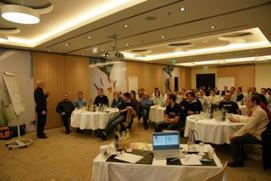
Boris had invited to an event that gave all participants of this event the chance to talk to Jeff Sutherland directly.The meeting was run like a speed dating event. Every 20 minutes the people on one table needed to change to another table.This format created a very good atmosphere and a very high communication saturation. Jeff Sutherland introduced this word because he works with James Coplien and he is an specialist for mapping communication saturation of teams. The theory behind this says that a team is most productive, when everybody in the team knows everything. (See Copliens article Patterns on Productive Organizations).
Jeff Sutherland - Scrum Brunch - Vienna
The other new idea of Jeff was to show the audience the way to leave the Fix Price / Fix Date trap, by follow the Money for Nothing, Change for Free escape. It is a very intuitive way of convincing customers, especially people who are in charge of budget to use an agile development approach. You can see this approach in any training that is given by Jeff or myself.
Le Product Owner ou le Business Analyst : présente les User Stories, la valeur derrière leurs réalisation, l’utilisateur final qui va en bénéficier, leurs paramètres et contraintes. Il s’assure que ces 2 amigos (Le développeur et le testeur) les comprend. Développeur : indique les configurations et/ou les développements techniques à réaliser pour implémenter chaque user story et construire ainsi l’incrément du produit. Il analyse les impacts sur l’ensemble technique suite à chaque nouveau développement pour aider également à la définition des cas de test. Le testeur : Assure la qualité des tests à réaliser en l’occurrence la qualité du produit. Il peut préparer les ensembles de données pour les cas de test, il est aidé par les autres membres de l’équipe pour trouver les exceptions et les cas manquants. Il doit s’occuper en premier lieu des critères d’acceptation à co-definir avec le PO et le développeur.
Ces trois amigos partagent des points de vue et des perspectives différents, ce qui peut causer des problèmes ou par contre conduire tout le monde à une discussion pertinente et à des conclusions pointues. Bénéfices des 3 amigos
Avec les bons 3 Amigos, la qualité ne sera pas un problème, ni la définition du « Done ». Cette pratique permet de:
Assurer une bonne analyse et compréhension de l’équipe agile des besoins et de la valeur à livrer. Fournir des tests de grande qualité qui assure la qualité de notre produit livré. Challenger parfois le besoin, l’affiner et améliorer la valeur à livrer. Met au claire les critères d’acceptation et le cas de test à réaliser ou à automatiser. Etc.
Quand le produit est lancé en commercialisation, Anaïs en voit déjà les limites et commence à penser à une V2 et une ouverture de capital. Elle prend quelques contacts dans les fonds d’investissement mais n’arrive pas à trouver leur adhésion : à cette époque les données du marché sont plutôt pessimistes malgré son début de traction (une vingtaine de clients dans le 1er mois).
Elle écume toutes les aides possibles pour le projet, puis sur les conseils du Réseau entreprendre et d’Atlanpole décide finalement, mais un peu à contrecœur, la transformation de BeApp en agence.
I have worked on many new products in my career as a product manager. Every time I start with a new product, I get sweaty palms and an adrenalin rush. Sweaty palms because of the ambiguity of the…
NOWSHAK : Rencontres Inspirantes avec Rémi Camus partie 2
Découvrir les secrets de la motivation d'un homme au parcours singulier et exceptionnel , c'est ce que je vous propose lors de cette rencontre inspirante avec Rémi CAMUS, explorateur professionnel : traverser l'Australie en courant, descendre le Mekong en Hydrospeed et effectuer le Tour de France à la Nage.
Dans cet épisode nous partons à la découverte des motivations intrinseques de l'aventurier. Quels sont ses secrets pour continuer à avancer en dépit des situations difficiles ? Eléments de réponse dans cette vidéo !
crédits photos et videos : Valentin Lam (@lamspics)
Creating impact is similar to creating customer value. The same general rules apply. But where customer value aims at the customer on an individual level, impact aims at a community or society in general. When we measure impact, we take into consideration all costs, not just the business costs, but also social, environmental and economic costs.
Our brain sees cause-effect relationships where there are none and does not notice problems where there are some. We try to explain the inexplicable, are interested in details and hierarchies. Therefore, when “everything is difficult,” you must look for flexible approaches - and here Agile comes to the rescue.
Sprint Backlog Commitment is the final act of this Ubermeeting. In the first few Sprints, I literally read aloud what "Commit" does and does not mean so that there is no doubt in anyone's mind. Once the team commits to the work, the meeting adjourns.
During the Sprint, Multi-Tasking is Forbidden. Work must be in addressed and completed in Priority Order.
Some Engineers understand this right away. Others feel most productive or fulfilled when they have multiple projects in progress. They don't appreciate my pointing out that there is no value in incomplete work – but point it out, I do. Often.
I insist and enforce that they work on cards without multi-tasking and in priority order. Sometimes this leads to petulant protests with people sitting idle but they’re doing less damage in that mode than with their hands in nine projects, none of which will be done.
Three key reasons that I believe I am successful with this approach are:
I find the biggest, nastiest problem that the team has and solve in within a day or two of the first Planning meeting if at all possible. Some teams quickly volunteer this problem to me in their first Retrospective while others require observation, careful listening and behind-the-scenes reconnaissance to tease it out. Especially for those teams who haven't worked directly with me yet, having that very large problem go away underscores that they are important to me, that I take them seriously and that I am working hard to make their world a better place.
Since I am the head of Agile Practice for the entire company, I am never a new Team’s permanent Scrum Master. This gives me the freedom to create a bit (but only a very small amount) of "Us vs. Him" atmosphere at first. It causes the team to bond in what is often an entirely new way than they have before, and also sets up their permanent Scrum Master to be the "good cop" down the road. It allows me to be more firm about standing during Stand-Up, keeping your estimates private until the vote is called during estimation, etc. Keeping in mind that I generally have to bow out and move on to another team after just a few weeks, by which point they are functioning very well and are (on average) around the 500% mark, most teams tolerate this very well and learn good habits more quickly – even if it does leave me feeling a bit a schoolmarm.
I think Socrates was on to something. When I see something going wrong – say, someone sitting during the Daily Stand-Up – I don't always address the transgressor directly. Instead, sometimes I stop the meeting and ask the team, "Team, do any of you see something going wrong with our meeting right now?" Ironically, it is almost always the most skeptical or resistant person who is the first to correct the insolently perched teammate. Soon, they start calling one another on leaning or sitting long before I stop the meeting and ask what's going wrong. It helps them begin to police themselves so that I don't always have to be around to elicit good behavior.
This is roughly how I have driven teams into hyper-productivity in as few as four weeks, and why one of my co-workers calls me "The Scrum Whisperer." I have one team that has achieved 1,650% higher targeted value contribution per week after just four months (16 Sprints) together. We are pretty proud of those numbers.
One of the trickiest concepts to grasp in product development is that of a product vision. I have written about the topic before. My conclusions in that article was that a product vision should…
For effective, modern, cloud-connected software systems we need to organize our teams in certain ways. Taking account of Conway’s Law, we look to match the team structures to the required software architecture, enabling or restricting communication and collaboration for the best outcomes.
This talk will cover the basics of organization design using Team Topologies, exploring a selection of key team types, and how and when to use them in order to make the development and operation of your software systems as effective as possible. The talk is based on the forthcoming 2019 book Team Topologies and first-hand experience helping companies around the world with the design of their technology teams.
Key takeaways:
1. Why using the “Spotify Model” of team design is not enough
2. The four fundamental team topologies needed for modern software delivery
3. The three team interaction modes that enable fast flow and rapid learning
4. How to address Conway’s Law, cognitive load, and team evolution with Team Topologies
Dans de nombreuses organisations d’aujourd’hui, le coaching est considéré comme une compétence essentielle pour les leaders, les gestionnaires, les Scrum Masters et les consultants qui soutiennent les équipes qui cherchent à développer les compétences et les pratiques de l’auto-organisation.
Durant notre cours Coaching pour leaders, nous expliquons la distinction entre quatre postures différentes que les gens peuvent adopter pour aider les autres :
Le docteur L’expert La paire de bras Le coach
Toutes ces postures peuvent être utiles dans le cadre de certaines situations et relations, mais souvent c’est la posture de coach qui exige des gens le plus grand effort. Le présent billet décrit chacune de ces quatre postures du point de vue de l’aidant. Ces distinctions sont inspirées par le travail d’Edgar Schein, Peter Block et Co-Active Coaching.
rôles au travail : la richesse d'une équipe vient de sa diversité Meredith Belbin et les rôles au travail par Emmanuel Kerdraon1 juillet 2019Temps de lecture : 4 minutes
Raymond Meredith BELBIN (1926 – ) est un psychosociologue anglais qui s’est spécialisé dans l’étude du management d’équipe. Il est connu pour avoir mis en évidence les différents rôles permettant d’optimiser la performance d’une équipe projet (« Belbin Team Roles »). A partir de questions-clés (Qu’est-ce qu’une équipe performante ? Pourquoi certaines équipes réussissent mieux que d’autres ? Quelles sont les compétences nécessaires pour atteindre la performance maximale ?), il a observé et modélisé ce qui constitue une équipe-projet fonctionnelle et productive. Les rôles au travail : « Nul n’est parfait, mais une équipe peut l’être »
Son credo est que des individus « imparfaits » peuvent constituer des équipes « parfaites », dans la mesure où les qualités et défauts respectifs sont pris en compte et équilibrés au moment de la constitution de l’équipe.
Dès lors, il s’agit d’utiliser au mieux la diversité au sein des groupes, de s’appuyer sur les différentes « forces » et d’intégrer les « faiblesses supportables » de chacun, car elles peuvent être compensées par les autres membres de l’équipe et donc ne pas être un frein à l’efficacité collective. portrait de Meredith Belbin, psycho-sociologue britannique
La force collective d’une équipe résulte donc dans la complémentarité et l’équilibre des compétences et attitudes manifestées par les membres de cette équipe.
Do you want a collection of brilliant minds or a brilliant collection of minds ? Meredith Belbin
Les 9 rôles au travail classifiés par Meredith Belbin
A partir d’outils de diagnostic individuels et collectifs, la méthode BELBIN permet d’évaluer la répartition des différentes forces au sein d’une équipe de travail.
Plus de 20 ans d’études ont mis en exergue 9 grands rôles ou profils au travail :
Concepteur (imaginatif, créatif, nouvelles idées, originalité, intuition…). Promoteur (ouvert, dynamique, entreprenant, communicant…). Organisateur (dévoué, organisé, sens pratique, efficacité, pragmatique…). Propulseur (défis, proactif, énergique, fonceur, rôle moteur…) Soutien (sociable, empathique, esprit d’équipe, entraide…). Spécialiste (expert dans son domaine, capacité à résoudre des problèmes pointus…). Finisseur (appliqué, consciencieux, perfectionniste, concret…). Contrôleur (froid, prudent, réaliste, sens du détail, évaluateur…). Coordinateur (confiance en soi, stratège, centré sur l’objectif, manager…).
Ces rôles se regroupent entre eux suivant leur orientation principale :
Learn what it takes to build a successful startup using the Customer Development process, where entrepreneurs "get out of the building" to gather and iterate on feedback.
This study investigates how the circular economy and business models are related in the current business and management literature. Based on bibliometric analytical procedures, 253 articles were retrieved from the Scopus, Web of Science, and ScienceDirect scientific databases. The articles were analyzed according to network analysis principles, and key terms were mapped into a network. We used VOSviewer to build the network, explore the most-researched terms and their relationships, and identify less-explored terms and research gaps. We furthermore conducted a qualitative review of selected publications to provide an illustration of quantitative results and delve deeper into the research topics. The main findings revealed the networks of current topics as they appear in the publications such as business models, the circular economy, circular business models, value, supply chain, transition, resource, waste, and reuse, and their most prevalent relationships. The results also highlighted several emerging topics such as those connected with managerial, supply-side, demand-side, networking, performance, and contextual considerations of circular business models.
Je vais vous raconter ici le point de vue d’un mentor de Startup Weekend, après en avoir fait deux (Nantes puis Sophia Antipolis).La particularité des startups weekends est qu’ils font éclor
To get content containing either thought or leadership enter:
To get content containing both thought and leadership enter:
To get content containing the expression thought leadership enter:
You can enter several keywords and you can refine them whenever you want. Our suggestion engine uses more signals but entering a few keywords here will rapidly give you great content to curate.


 Your new post is loading...