Your new post is loading...
 Your new post is loading...
|
Scooped by
Mickael Ruau
February 17, 2022 1:12 AM
|
Too often, agile remains confined to software development. But companies that successfully implement agile across their entire enterprise can create an exceptional customer experience and gain an edge over the competition.
|
Scooped by
Mickael Ruau
February 16, 2022 1:53 AM
|
In Pitch and Sales we introduce the AIDA sales cycle, which starts which getting attention and creating interest. The customer journey start in a similar way.
|
Scooped by
Mickael Ruau
February 16, 2022 1:15 AM
|
Product leaders often talk about product vision, product strategy, and product roadmap. However, how do you define these terms?
|
Scooped by
Mickael Ruau
February 15, 2022 12:58 AM
|
Nous allons parler de la différence (ou pas) entre Scrum Master et coach agile et voir comment vous pouvez améliorer votre posture de coach.
|
Scooped by
Mickael Ruau
February 14, 2022 6:44 AM
|
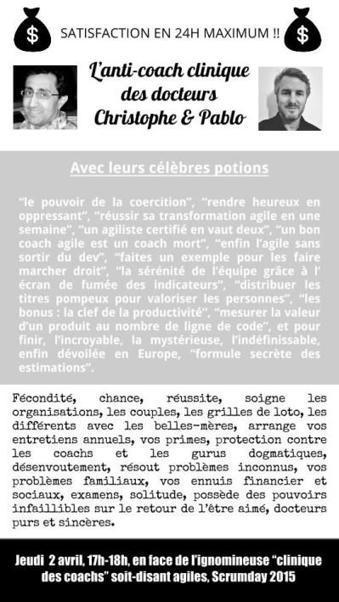
En plus des ateliers et présentations du ScrumDay 2015 des 2 et 3 avril derniers, se tenait une Coach Clinic. Entretien privilégié avec les Coachs ayant participé au bon déroulement de l'atelier, au calme le 5 avril, et complété par l'équipe sur le blog d'Ayeba.
|
Scooped by
Mickael Ruau
February 14, 2022 6:14 AM
|
1. ENGAGEMENT DE RÉSULTAT Engagement côté Fournisseur : Les engagements du fournisseur portent sur la réalisation d’un scope à chaque itération du projet. ce scope est défini par : -
L’utilisation de 95% de la capacité de production de l’équipe, 5% étant provisionné pour gérer des aléas; -
Une répartition de 3 types d’activités sur 100% des charges disponibles : -
Un nombre de points Fibonacci (vélocité) à réaliser en fonction d’une productivité de référence; -
Un nombre d’anomalies connues à corriger en surveillant le non dépassement d’un seuil d’anomalie de référence; -
Un nombre de tâches associées ni aux corrections, ni aux fonctionnalités pondérées, à réaliser durant l’itération (gestion de projet, mise en place d’outil…). -
Une prédictibilité de référence représentant le % minimum des objectifs d’itération à atteindre en fin d’itération (85% en général) réalisation des 3 types d’activités. Le rendement de la machine à réaliser des produits logiciels en quelque sorte. En fin d’itération, la prédictibilité réelle est mesurée et comparée à la prédictibilité de référence. Des bonus ou des malus pour le Fournisseur en sont déduits (>85% => Bonus, <85% => Malus). Son calcul repose sur la formule : % de vélocité + % de tâches prévues réalisées + % de corrections réalisées Engagement côté Client : Le Client a obligation de collaborer durant toute la durée du projet sur : -
Les différents ateliers d’IHM, fonctionnels, techniques …; -
Les cérémonies agiles (planification et bilan d’itération, Sanity check, Rétrospectives …; -
Les recettes intermédiaires et la recette définitive; -
Les comités de pilotage; -
Les vérifications documentaires; -
Le suivi de projet.
|
Scooped by
Mickael Ruau
February 14, 2022 6:06 AM
|
La manière de contractualiser des développements Agile est un choix crucial qui peut avoir de lourdes conséquences sur la réussite d'un produit. Cette conférence parcourra les bénéfices et inconvénients de chaque contrat en les illustrant à l'aide de cas réels.
|
Scooped by
Mickael Ruau
February 14, 2022 1:25 AM
|
I sometimes get asked about product/feature prioritization frameworks. In particular, which one(s) do I suggest people use. Before getting into the answer to that question, let’s define what we mean…
|
Scooped by
Mickael Ruau
February 12, 2022 4:46 AM
|
The Pocket Guide of Essential YC Advice
• Launch now • Build something people want • Do things that don’t scale • Find the 90 / 10 solution • Find 10-100 customers who love your product • All startups are badly broken at some point • Write code – talk to users • “It’s not your money” • Growth is the result of a great product not the precursor • Don’t scale your team/product until you have built something people want • Valuation is not equal to success or even probability of success • Avoid long negotiated deals with big customers if you can • Avoid big company corporate development queries – they will only waste time • Avoid conferences unless they are the best way to get customers • Pre-product market fit – do things that don’t scale: remain small/nimble • Startups can only solve one problem well at any given time • Founder relationships matter more than you think • Sometimes you need to fire your customers (they might be killing you) • Ignore your competitors, you will more likely die of suicide than murder • Most companies don’t die because they run out of money • Be nice! Or at least don’t be a jerk • Get sleep and exercise – take care of yourself
|
Scooped by
Mickael Ruau
February 12, 2022 3:36 AM
|
La traction, comme très souvent dans les startups, n’échappe pas au principe du « fais-en beaucoup pour essayer de récolter un peu ». Je m’explique. Vous ne pouvez faire une landing page et attendre. De même, vous ne pouvez pas vous inscrire à un concours et attendre ou encore envoyer des communiqués de presse et attendre. L’ennemi de la traction c’est l’inaction.
Il n’y a pas pire qu’une startup inactive. Vous voulez de la traction ? Il va falloir envoyer du contenu, donner de l’info, créer de l’activité et y consacrer beaucoup de temps. Voilà comment essayer (je dis essayer car rien n’est sûr en matière de traction) de créer de la traction en 8 étapes
|
Scooped by
Mickael Ruau
February 12, 2022 2:51 AM
|
Abstract Effectuation, as an emerging theoretical approach in entrepreneurship, is receiving increasing attention in research and practice. Still, the integration of effectuation in sustainable entrepreneurship literature is sparse, and its influence on the sustainability orientation of ventures has so far not been examined in the academic literature. This article, therefore, investigates the influence that causal and effectual behaviors have on the sustainability orientation of established entrepreneurial ventures. This is important to consider, especially if entrepreneurial behaviors were to influence sustainability orientation negatively, this could potentially thwart the venture's ability to create lasting sustainability value. Based on a quantitative survey among 140 sustainable ventures, we find support for the hypothesis that causal behaviors reinforce sustainability orientation. We demonstrate that effectual behaviors exert a positive influence on sustainability orientation as well. Thus, the experimentation and flexibility of goals that ventures possess reflect that effectual behaviors are not at the expense of sustainability orientation. These results can inform sustainable entrepreneurs and educators to use both behaviors purposefully and highlight causal and effectual behaviors are equally important elements for sustainable entrepreneurship education.
|
Scooped by
Mickael Ruau
February 12, 2022 2:27 AM
|
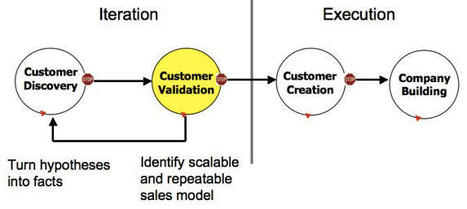
If you confuse Lean with Cheap when you do find a repeatable and scalable sales model, you will starve your company for resources needed to scale. Customer Development (and Lean) is about continuous customer contact/iteration to find the right time for execution.
The Customer Development Venture Pitch At this point I often hear entrepreneurs say, “We don’t have the money to scale. We’ve been running on small investments from friends and family or angels. How do we raise the big bucks?”
How to raise real money with a Customer Development presentation in the next post.
|
Scooped by
Mickael Ruau
February 11, 2022 5:58 AM
|
Content of this MOOC Module:
Value Web 1: (script) Clip 1: Model of a simple supply chain for the cotton industry in Mozambique Clip 2: How a supply chain can turn onto a value web Clip 3: How to do a gap analysis on your value web Clip 4: How to improve the performance of your value web Value Web 2: (under construction) Model of a simple overseas trade supply chain How to position yourself in the supply chain How to choose partners and distributors
|
|
Scooped by
Mickael Ruau
February 17, 2022 1:11 AM
|
Cette présentation aborde les Cette présentation aborde les apports de la contractualisation agile face aux modèles contractuels en place dans les entreprises …
|
Scooped by
Mickael Ruau
February 16, 2022 1:29 AM
|
En 20 ans, l’agilité est passée du statut de fantasme altermondialiste à celui de méthode […]
|
Scooped by
Mickael Ruau
February 15, 2022 1:04 AM
|
Last year I saw the term ‘Kanban roadmap’ emerge subtly in some product circles. At first I thought it was a bit of a faux pas, perhaps something that would die off naturally as some things do.
|
Scooped by
Mickael Ruau
February 15, 2022 12:51 AM
|
The creators of blue ocean use value innovation to make competition irrelevant by creating a leap in value for buyers and their company which opens up new and uncontested market space. - Value without innovation – focuses on value creation on incremental scale. Improves value but insufficient to stand out in market place.
- Innovation without value – technology driven , market pioneering or futuristic which are sometimes beyond what buyers are ready to accept and pay for.
- Value innovation – requires companies to orient the whole system toward achieving leap in value for both buyers and themselves where innovation is aligned with utility, price and cost positions.
|
Scooped by
Mickael Ruau
February 14, 2022 6:41 AM
|
Le Coach Clinic est un workshop d’une heure que nous proposons à certaines communautés basées sur la participation volontaire ; on impose jamais à qui que ce soit d’être présent. Nous pouvons proposer cet exercice à une communauté agile, une communauté de développeurs, une communauté marketing…
L’entraide est une action réalisable dans l’ensemble de l’entreprise et pas seulement au niveau des communautés agiles.
Un facilitateur va proposer aux membres de la communauté agile de se réunir à une heure précise toutes les semaines (c’est un exemple) ; si l’agilité n’est pas encore bien en place voire bien acceptée, il est possible de proposer l’atelier le midi en invitant les participants à déjeuner pendant le déroulé de l’atelier.
|
Scooped by
Mickael Ruau
February 14, 2022 6:09 AM
|
J’ai pu voir des contrats s’inspirant de cette méthode prévoir par exemple en guise d’objet une description de ladite méthode. Or l’objet du contrat est tout simplement fondamental en droit et le confondre avec une « méthode » de collaboration est juridiquement mortifère.
|
Scooped by
Mickael Ruau
February 14, 2022 1:33 AM
|
This post describes a way of tracking growth experiments using Google Sheets.
You can find all of the templates in this Google Folder. The growth experiments belong to a method that is strongly based on Brian Balfour’s “How to build a Growth Machine” article. The original on www.coelevate.com no longer exists but this one KissMetrics article seems to contain most of the important points. In my opinion, Balfour’s writing and thinking is some of the smartest in the business.
|
Scooped by
Mickael Ruau
February 14, 2022 1:00 AM
|
Sarasvathy concluded that master entrepreneurs rely on what she calls effectual reasoning. Brilliant improvisers, the entrepreneurs don't start out with concrete goals. Instead, they constantly assess how to use their personal strengths and whatever resources they have at hand to develop goals on the fly, while creatively reacting to contingencies. By contrast, corporate executives—those in the study group were also enormously successful in their chosen field—use causal reasoning. They set a goal and diligently seek the best ways to achieve it. Early indications suggest the rookie company founders are spread all across the effectual-to-causal scale. But those who grew up around family businesses will more likely swing effectual, while those with M.B.A.'s display a causal bent. Not surprisingly, angels and seasoned VCs think much more like expert entrepreneurs than do novice investors. She used her research to develop her theory of the five principals of highly successful entrepreneurs. (source: Inc.com)
|
Scooped by
Mickael Ruau
February 12, 2022 3:57 AM
|
I recently shared all our secret strategies that helped us to grow to $10M in Annual Recurring Revenue in just 3.5 years, being fully bootstrapped. Something I didn't mention is that our company is now valued at $150M. But mentioning this valuation means that a deal happened... If you've
|
Scooped by
Mickael Ruau
February 12, 2022 3:35 AM
|
There’s one important thing we have to get out of the way:
Growth has nothing to do with tactics; it has everything to do with process.
So says Brian Balfour, former VP of Growth at Hubspot.
You hear all the time about X company tripled their growth by doing X hack. The fact is that it worked for them, and it’s unlikely to work for you.
Balfour spoke at 500 Distro, where he outlined the process he uses for growing companies. Below are the notes from that talk.
|
Scooped by
Mickael Ruau
February 12, 2022 2:29 AM
|
The Business Model Canvas is brilliant. It has been used for several years now and it's benefits are evident. Meanwhile some of it's drawbacks are evident as well. In my opinion the major drawbacks lie in the field of customer value and market, competition and alternatives. In this module, we will focus on the relation between value proposition and customer segments in the Business Model Canvas. I have based this module on the work of: Alexander Osterwalder and the team of Business Model Generation, Derek Abell end Peter J. Thomson (credit to them!)
|
Scooped by
Mickael Ruau
February 12, 2022 1:38 AM
|
The truth is that many startups make the same mistake of thinking if something doesn’t work, it must be everything, or they just guess the wrong reason why their business is not working. The truth is, any part of a customer’s experience can influence them. Here are some other metrics to consider, my own 5C Scorecard:
Customer Numbers A simple, binary index, set and measured for each period, provides visibility, clarity and simplicity of your North Star.
Conversion Rate to be a very telling KPI in that it reveals a combination of the company’s ability to sell its products to its customers and the customers’ desire for the product. It is particularly instructive to track and review Conversion Rate over time and regularly run experiments to improve.
Customer Acquisition Cost (‘CAC’) CAC is the unit cost of spend on sales and marketing, on average, to acquire a new customer. This tells us about the efficiency and effectiveness of our marketing efforts, although it’s more meaningful when combined with other metrics detailed below, and when measured over time.
Customer Retention Rate indicates the percentage of paying customers who remain paying customers during a given time period. The converse to retention rate is Churn (or Attrition), the percentage of customers you lose in a given period. When you see high retention rates over an indicative time period, you know you have a sticky product that is keeping customers happy. This is also an indicator of capital efficiency.
Customer Lifetime Value (‘CLTV’) is the measurement of the net value of an average customer over the estimated life of the relationship. Improving the ratio of CLTV/CAC is critical to building a sustainable company.
There is also one financial metric you need to keep a track on at this stage:
Cash Burn This is simply the net cashflow per month and is critical to the survival of any startup. Runway is the measure of the amount of time until have in terms of cash, expressed in terms of months.
Short Runways cause entrepreneurs to be myopic and removes the liberty to tweak and iterate when necessary. It also forces them to focus on the next fundraising round instead of on growing the business. It’s a separate discussion from this blog, but fund raising should be focused on milestones, not the runway.
|
Companies that rely on overly specialized roles create meaningful inefficiencies that can damage the customer experience. (See Exhibit 1.) Customers forced to endure delays owing to multiple handoffs or rework will soon take their business elsewhere. Yet many large companies find restructuring difficult because their organizations are bogged down by a large and highly customized product catalog, disparate IT systems, or poorly integrated M&A activity—all of which bolster the need for specialized resources. While displacing deeply entrenched processes and practices can be difficult, companies that successfully incorporate agile beyond software see transformative results.