|
|
Scooped by
Decision Intelligence
onto Decision Intelligence News July 14, 3:08 PM
|
|
|
Scooped by
Decision Intelligence
onto Decision Intelligence News July 14, 3:08 PM
|
|
|
Decision Intelligence News
Decision Intelligence (DI) is the discipline concerned with how organizations and individuals design, support, and improve decision making at scale. It connects actions to outcomes in context by integrating human judgment, data, models, text, and AI into coherent decision systems. Decision Intelligence News curates developments across DI and related fields, including AI, machine learning, governance, enterprise architecture, orchestration, measurement, and decision modeling. Learn more at www.opendi.org and www.learn-di.com. Curated by Decision Intelligence |
Your new post is loading...
|
|
Scooped by
Decision Intelligence
April 1, 2022 6:29 PM
|
Although #decisionintelligence was identified by the Gartner Group and several others as a top technology for 2022, I've found that there aren't many practical, step-by-step introductions to how to get started with it out there. Here's one.
|
|
Scooped by
Decision Intelligence
September 2, 6:47 PM
|
"Today's biggest challenges - from climate change to business strategy - require connecting insights across domains. But we're stuck in silos
...
Imagine a world where
- A climate model from Team A feeds into an economic simulator from Team B
- Your startup's decision tool integrates seamlessly with enterprise platforms
- Researches and practitioners share a common framework
- The best ideas win because interoperability removes barriers
That's what standardization enables."
|
|
Scooped by
Decision Intelligence
August 31, 7:05 PM
|
"As organizations gain more intelligence from AI, leaders risk losing the judgment needed to challenge, contextualize, and ultimately improve decisions."
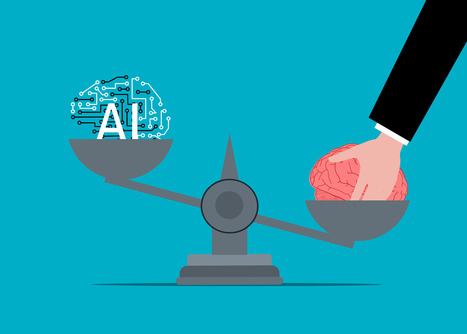
This article highlights the risk that sophisticated decision-support systems are training leaders to defer to systems rather than exercising their own judgment. As organizations embed AI into more decision-making processes, there is a growing risk that human judgment becomes passive, with leaders accepting persuasive-sounding recommendations without sufficient challenge or contextual reasoning due to cognitive offloading and automation bias. This reinforces the importance of designing decision systems that preserve human judgement, make reasoning transparent, and ensure AI augments, rather than replaces, sound judgment. Contributor: Michael Redford.
|
|
Scooped by
Decision Intelligence
August 29, 8:39 PM
|
The team wanted to build an AI agent. The idea had momentum. The engineers were capable. The technical path looked plausible. In many organizations, that would have been enough: a new tool, a motivated team, a fast-moving mandate, and a prototype waiting to happen.
In the AI era, technical capabilities are advancing faster than organizations’ ability to absorb them. Using SAP’s Institute for Product and Engineering as a central case, Decision Intelligence pioneer Lorien Pratt explores why technically successful innovations so often fail to change real-world practice. The article shows how psychological safety, judgment under uncertainty, productive disagreement, and disciplined conversations help people challenge weak assumptions and carry new practices into complex enterprises. For Decision Intelligence practitioners, the lesson is fundamental: tools, models, and AI create lasting value only when organizations develop the human capacity to adopt and sustain better ways of deciding.
|
|
Scooped by
Decision Intelligence
August 21, 5:14 PM
|
"... in an economy that can generate answers at extraordinary speed, knowing which answer to act on may become more valuable than knowing how to generate one."
The democratization of AI-generated analysis is not a new idea. Nor is the argument that the talent race will be won by those with the best understanding of outcomes, and how they relate to actions, rather than those possessing the widest AI toolbox. What stands out about this article is DI's expanding reach, both globally, through its publication in India, and its appearance in a more mainstream news outlet. The shift in audience is as notable as the shift in geography, highlighting DI's growing relevance across the broader business landscape. Contributor: Michael Redford.
|
|
Scooped by
Decision Intelligence
August 10, 5:22 PM
|
"One of DI's most important contributions is that it insists that good decisions rest on causal understanding, not just statistical association. I assert that this insistence is what makes a decision-making process ethical
...
But why is causal inference crucial to ethical decision-making? The ecological fallacy points to this answer. The ecological fallacy is the mistaken assumption that an effect measured on average across a group applies equally to every member of that group (or, conversely, that an effect observed in a few individuals will scale up to the whole population). Picture a pond full of frogs..."
Lagally puts the interdisciplinary value of Decision Intelligence into practice by considering one of its fundamental tools, the causal decision model, within the broader context of decision ethics, grounded in realistic examples of ecological policy and intervention. What are the ethical implications of statistical estimation vs. causal inference? What makes a decision ethical in the first place? Lagally navigates these questions and presents a concise argument with an eye for concrete outcomes, relevant examples, and realistic limitations. Contributor: Isaac Kellogg.
|
|
Scooped by
Decision Intelligence
July 27, 12:02 PM
|
"What's really interesting about this moment in the evolution of technology, especially AI, is we're not really focused on outcomes. ... We focus on the tech, the tech, the tech. But pick up your favorite AI article and check to see whether it ever talks about the outcomes that AI is meant to achieve as opposed to all the things that might try to convince you to 'token max'.
Years from now we'll realize ... what we really care about is achieving business outcomes, whether they are profit margins for a commercial company, the health of constituents if we're in public health, the happiness of the people in our country if we're in government, or any other kind of measurable outcome that you care about."
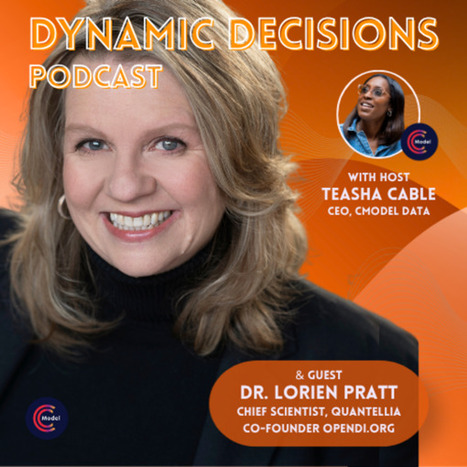
Two of the co-founders of the Open Decision Intelligence (OpenDI) initiative sit down to discuss tech's last mile problem, P-decisions vs C-decisions, decision rights and the gap between authority and responsibility, the importance of open interoperability standards, and more. The two cover many crucial topics that are increasingly relevant for both the Decision Intelligence industry and the broader AI-focused tech industry as a whole. Cable's insightful questions and Dr. Pratt's expert answers motivate DI at a high level for leadership and organizations in a way that they can back up with their experience and understanding of the lower-level mechanics that make those organizations tick. Contributor: Isaac Kellogg.
|
|
Scooped by
Decision Intelligence
July 14, 3:08 PM
|
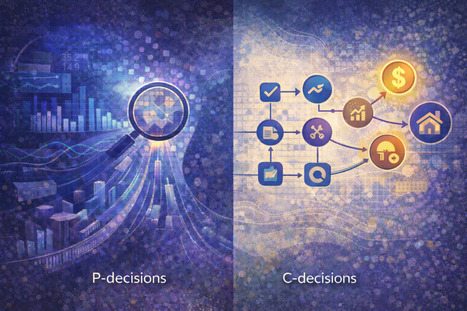
Causal inference shares significant common motivations, ideas, and tools with Decision Intelligence. Through realistic examples, this article discusses what DI readers will recognize as the classic P- vs. C-decision dilemma: the shortcomings of predictive Machine Learning models.
DI's decision models center humans, capturing and aligning their expertise around a multi-link causal structure with a wide variety of applications from interactive simulation to statistical optimization. This article's causal inference approach leads toward a few specialized programming tools somewhat more narrow in scope, aimed at statistical analysis or derivation of particular causal relationships. Look for strong overlapping insights that stem from those shared motivations and familiar ideas: correlations are not levers; predictions do not always map cleanly to outcomes or actions; in a complex and confusing decision-making scenario, modeling the causal structure (even with a simple drawing) is often invaluable. Contributor: Isaac Kellogg.
|
|
Scooped by
Decision Intelligence
June 18, 5:22 PM
|
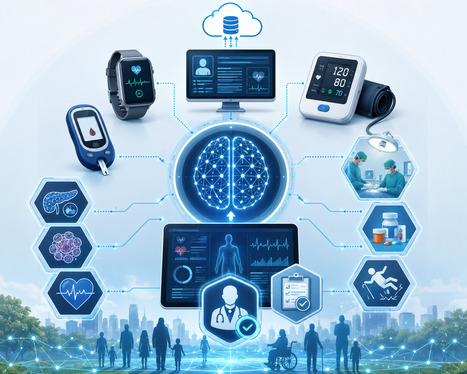
"This critical review of Internet of Medical Things (IoMT) devices provides a broad range of health-related applications of AI and their use in healthcare decision making. The authors explained that AI is “being used for decision-making and predicting the expected effects of diseases and consequences in the longer term." They noted that AI can be used to improve decision-making ability and evaluation of associated risk assessment of IoMT devices. In one example data from electronic medical records, blood-pressure monitors, and glucometers are fed into a decision-support system in which "the ML algorithm is programmed to suggest a diet plan for the patient and indicates to the patient whether a doctor visit is needed." The authors found in summary, “AI-based outcomes support earlier prediction and determine the level of risk while diagnosing disease."
The article reviews AI- and IoMT-enabled applications across an array of clinical domains, including diabetes management (including gestational diabetes), cancer diagnosis, cardiac monitoring, surgical care, medication administration, and fall prevention in older adults, emphasizing the application of predictive analytics to improve diagnostics and other healthcare decision making. These examples demonstrate how healthcare is evolving from retrospective monitoring toward predictive and prescriptive decision support. By reducing the time between signal detection, risk identification, and intervention, AI-enabled decision systems have the potential to improve outcomes, reduce costs, and prevent harm at both the individual and population levels. Contributor: Bernadette Howlett.
|
|
Scooped by
Decision Intelligence
June 9, 6:49 PM
|
Organizations now have more data, analytics, and AI than ever before. But are they really making better decisions, leading to better outcomes?
Many still struggle with the same core problem: how to connect actions to outcomes in complex situations, with or without technology.
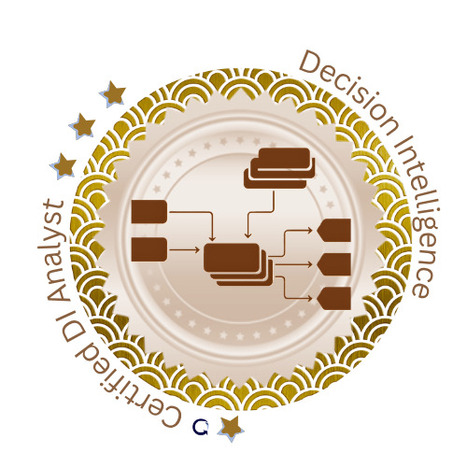
The Certified DI Analyst Program teaches you how. It is a structured step-by-step certification program where you can earn a digitally verifiable credential through expert-graded homework and capstone work, including oral presentation and feedback.
You’ll learn how technology teams can communicate better with the business, map important decisions, understand consequences, think more strategically, align stakeholders, and see where data, AI, evidence, and human judgment can improve outcomes.
The grading in this course is exemplary - detailed feedback on all your work. And at the end a valuable certification that separates you from the pack, whether you're a technologist, consultant, or leader.
|
|
Scooped by
Decision Intelligence
June 8, 5:19 PM
|
“The widespread organizational adoption of business intelligence and analytics systems has not resolved a persistent structural problem: the gap between the availability of analytical information and its effective use in decision-making.” Drawing on evidence that includes public health dashboard failures during the COVID-19 pandemic, the author argues that information overload, insufficient narrative context, and poor communication design can prevent decision-makers from translating data into effective action."
Many public health (and other types) of organizations have invested heavily in dashboards and analytics, yet decision-makers often feel overwhelmed by volumes of visuals and struggle to convert information into action. This article argues that effective decision support requires more than visualization; it needs timely, data-informed guidance on actions to take. Clear action guidance requires information resources that reduce cognitive overload and provide relevant context. This has direct implications for public health leaders who need systems that help practitioners move from data awareness to timely, evidence-informed decisions. The article points to public health dashboard failures during the COVID-19 pandemic as a reminder that when critical information lacks sufficient context and narrative guidance, organizations struggle to translate available data into effective action. Rather than relying on dashboards that require users to sift through metrics, interpret patterns, and determine next steps, decision-oriented systems can reduce cognitive burden, and time, by delivering actionable recommendations and continuously refining those recommendations as outcomes and new data become available. The time-to-action advantage of decision intelligence is a critical public health capability, where days and even hours can mean the difference between containing a problem and responding after preventable harm has occurred. Contributor: Bernadette Howlett.
|
|
Scooped by
Decision Intelligence
June 5, 2:15 PM
|
“Despite advances in clinical care, technology, and health system infrastructure, maternal deaths [in the United States] remain higher than in most other high-income nations… Black women, in particular, continue to experience maternal mortality rates that far exceed those of their White counterparts, even after adjusting for socioeconomic status and education.” The authors further explained, “While advances in machine learning have improved the prediction of obstetric complications, these models rarely translate into actionable operational decisions.” As such, “Gradient boosting models were used to predict postpartum hemorrhage risk and short-term resource demand. These predictions were then incorporated into a reinforcement learning–based optimization system to guide dynamic resource allocation.” And the results indicated important positive outcomes: “Causal analysis indicated that adequate resource availability was associated with a 21% reduction in severe maternal morbidity (ARR = 0.79; 95% CI: 0.72–0.87), with stronger effects in structurally vulnerable populations.”
Decision intelligence can be used to improve operational readiness in hospitals (and perhaps other settings), which is often overlooked as an intervention. Important positive impacts can be achieved on serious health problems, including maternal morbidity and mortality. As the authors stated, hospitals “do not act on probabilities alone. They act on resources – what is available, what is not, and what can be mobilized in time. A model that predicts hemorrhage risk without informing resource allocation risks becoming, in a sense, informationally rich but operationally incomplete.” This study demonstrated the wisdom of using decision intelligence to translate data and technology to the operational reality of a hospital, and the harm prevention that can be achieved by doing so. Contributor: Bernadette Howlett.
|
|
Scooped by
Decision Intelligence
June 2, 4:54 PM
|
"One of the most persistent sources of confusion we see in organizations that want to improve decision making using AI and/or data science is a quiet category error: treating all decisions as if they were the same kind of problem. They aren’t.
...
This distinction isn’t academic. It shapes what methods work, what risks we take, and whether AI actually improves decision quality."
What is a pattern-based decision? What is a causal decision? What's the difference? Why should you care? This article clearly and concisely answers each of these questions. As more and more organizations explore the role of AI in their decision-making processes, those that take the time to understand this distinction will gain a powerful intuition for guiding that exploration. The concepts explained here sit at the center of DI's ability to reveal where and how various forms of AI fit into decision making, where they do not, and when they don't, what works better instead. Contributor: Isaac Kellogg.
|
|
Scooped by
Decision Intelligence
June 1, 2:39 PM
|
“The integration of artificial intelligence (AI) in healthcare is rapidly progressing from diagnostic support to predictive analytics. However, most existing clinical AI systems remain limited to generating predictions without translating them into individualized, actionable decisions for patients.” This article suggests the need to move from predictive models to ‘patient-centric decision intelligence,’ which contextualizes complex patient data in support of personalized clinical decision-making."
Decision Intelligence has the potential to improve patient care quality by integrating clinical data, patient preferences, social determinants of health, and real-time feedback to support more personalized and timely treatment decisions. DI systems might reduce diagnostic delays, medical errors, and unnecessary variation in care by helping clinicians identify the most effective interventions and adapt care as patient conditions change. At the same time, DI may help lower healthcare costs by improving resource allocation, reducing avoidable hospitalizations and procedures, and supporting more efficient use of limited clinical capacity. Contributor: Bernadette Howlett.
|
|
Scooped by
Decision Intelligence
May 18, 3:12 PM
|
"Three consecutive drought years have tested every assumption built into the [Yakima River Basin's] governance framework. A fourth drought year in 2026 has just been declared.
Against this backdrop, decision intelligence (DI) has a specific and urgent role to play.
...
We will build a DI design through the construction of a causal decision diagram (CDD), which shows factors that cause different outcomes, variables that can be controlled, and where models or data feed into the decision process."
This applies DI to a real-world decision with complex ecological and humanitarian ramifications by walking through the process of building a CDD for the decision. It's especially useful as an example that carefully considers and clearly communicates areas where existing models, datasets, constraints, and metrics naturally fit into the decision model being built. DI is powerful as a connective tissue between people, data, actions, and outcomes, backed by solid engineering at every step, and Lagally demonstrates that here. Contributor: Isaac Kellogg.
|
|
Scooped by
Decision Intelligence
May 15, 1:50 PM
|
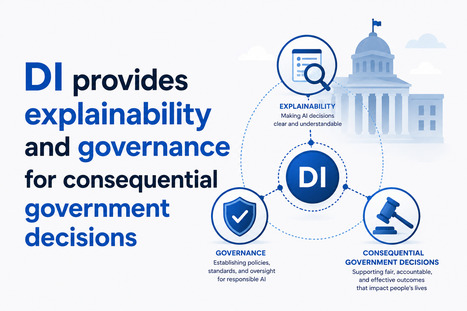
“Regulated industries and governments cannot rely on opaque 'black box' systems for consequential decisions. DI elevates explainability from a technical requirement to a governance imperative.”
There is a growing pressure for greater transparency in automated decision-making, particularly as government agencies expand the use of AI in citizen services. These pressures are driving a shift in governance models towards explainable AI and retaining human-in-the-loop mechanisms to promote transparency and fairness in decisions that directly impact the public. DI provides a practical framework for building trust by ensuring decision flows remain visible and auditable. Contributor: Michael Redford.
|
|
Scooped by
Decision Intelligence
May 11, 11:31 AM
|
"We are not lacking data, tools or talent. What we lack is a system and a mindset that turns intelligence into action. And that gap is exactly where decision intelligence begins.
...
This is a big shift from how most of us have traditionally thought about data and analytics. And honestly, this framework makes you look under the hood of how decisions really get made in your organization. That’s not always comfortable. ... But that's where the value is."
Wadodkar gives high level insight into the mindset shift facing data and analytics professionals as organizations turn to Decision Intelligence to help close the gap between data and outcomes. Her tips for CDAOs center decisions instead of data, with a focus on actions and measurable outcomes. She writes for executives and c-suite data analytics professionals, so her advice is rooted in the more familiar territory of Business Intelligence, KPIs, and high-level org strategy. There isn't airspace given toward representing decisions causally, or even just visualizing them, but the high-level mindset shift away from data-first and toward decisions-first is crucial, and Wadodkar speaks to that well. Contributor: Isaac Kellogg.
|
|
Scooped by
Decision Intelligence
May 8, 2:14 PM
|
“... there are thousands of decisions that happen every day across complex supply chains, and we see decision intelligence as an opportunity to increase productivity"
This is an example of how more decision-centric operating models are delivering value at enterprise scale. While forecasting and planning functions have long existed within supply chain management, Hershey's transformation comes from improving how these activities are connected to operational decision-making across the supply chain. Rather than focusing primarily on technology tooling, the story highlights how better decision orchestration and tighter alignment between planning and execution can materially improve business outcomes. Contributor: Michael Redford.
|
|
Scooped by
Decision Intelligence
May 4, 1:19 PM
|
"The business world is on the cusp of a profound shift, moving away from the 'data-driven' mantra to one that is 'decision-centric,' powered by Decision Intelligence Platforms.
...
Decision-making augmentation involves platforms ensuring a human has processed, integrated, and contextualized information, while also managing the approval workflow (like coordinating sign-offs)."
Gartner's first Decision Intelligence Platforms Magic Quadrant highlights DI as a significant force addressing meaningful gaps in the business world's approach to both decision-making and AI (and the combination of the two). This article provides a high-level peek into Gartner's analysis, with interview quotes that surface some of the crucial discussions motivating DI, like the value of human expertise, the push and pull of transparency and accountability, and DI's market relationship to the big players in AI. Contributor: Isaac Kellogg
|
|
Scooped by
Decision Intelligence
April 30, 8:20 PM
|
“Just 5% of integrated AI pilots are extracting millions in value, while the vast majority remain stuck with no measurable P&L impact. This divide does not seem to be driven by model quality or regulation, but seems to be determined by approach.”
The report underscores the need to shift from focusing on tools to decisions. GenAI delivers value when it enhances how organizations make and execute decisions, not just how they automate tasks or deploy general purpose tools. Teams following a traditional SaaS rollout are missing this. In contrast, the successful builders focus on domain fluency and tightly align AI with specific, high-impact business decisions that address real pain points. Contributor: Michael Redford.
|
|
Scooped by
Decision Intelligence
April 24, 3:39 PM
|
"A dashboard is not decision intelligence. Visibility is not decision intelligence. Workflow automation is not decision intelligence unless it improves the quality, speed, and coordination of operational decisions. ... Supply chain technology is moving toward a layer that can sit above fragmented systems, interpret context, connect signals, support tradeoff decisions, and help coordinate action under changing conditions."
How can Decision Intelligence deliver value as an emerging category in supply chain technology solutions? This post aims to define DI in the context of supply chain strategy, with enough precision to capture what differentiates it from other existing solution categories, in order to spotlight why that difference is valuable and why DI is becoming more relevant to supply chains now. Contributor: Isaac Kellogg.
|
|
Scooped by
Decision Intelligence
April 23, 5:49 PM
|
“The central thesis of this study is that value manifests only when AI evolves into true Decision Intelligence embedded within the institution's core processes.”
A good, practical case study from Bank of America showing how Decision Intelligence has been adopted at the enterprise level to tackle a growing AI-driven management challenge: as investment and use cases expand, AI often struggles to deliver stable, scalable decision-making. Contributor: Michael Redford
|
|
Scooped by
Decision Intelligence
April 21, 11:13 AM
|
Human-AI delegation is driving reorganization as AI budgets triple and human expertise is displaced. Chief information officers (CIOs) and data and analytics (D&A) leaders responsible for organizing decision intelligence (DI) talent must adopt decision user-networked intelligence teams (UNITs) to be
Organizations tend to over-index on technology when deploying decision intelligence. In this article Gartner DI lead David Pidsley counters with the fact that combined teams of AI and humans produce the best results. Contributor: Lorien Pratt
|
|
Scooped by
Decision Intelligence
April 20, 1:50 PM
|
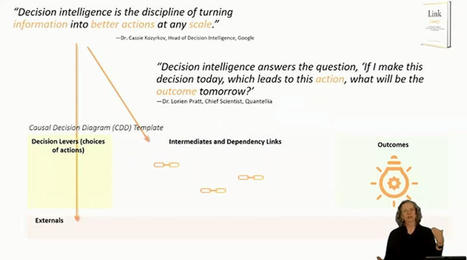
Causal Decision Diagrams help decision-makers visually capture the causal relationships between desired goals, the different choices of levers to pull, and any intermediate results that connect them.
A good introduction to causal decision diagrams, which serve to align people with each other and with technology. These are core to "C decisions" - or causal decisions - which capture the "why" of choices of actions within a context. Contributor: Lorien Pratt.
|
|
Scooped by
Decision Intelligence
April 12, 2:27 PM
|
Hosted by Teasha Cable, the Dynamic Decisions Podcast explores how leaders and organizations make better decisions in complex environments. Topics include AI, judgment, digital transformation, and the connection between choices and outcomes.
Teasha Cable is one of the pioneers helping bring more explicit, practical thinking about decision making into business leadership. As CEO and co-founder of CModel, and a co-founder of OpenDI, she has been helping build not just a company, but a broader field infrastructure around better decisions, clearer models, and stronger connections between actions and outcomes. The Dynamic Decisions Podcast reflects that same commitment: thoughtful, practical conversations about how leaders make consequential decisions under real-world conditions of uncertainty, complexity, and competing priorities.
|
|
Scooped by
Decision Intelligence
March 31, 2023 7:21 PM
|
"The Getting Started with Decision Intelligence course gives you a “DI practice in a box”. A step-by-step, hands-on method that has been proven in hundreds of organizations worldwide.
*We’ll be using ChatGPT / generative AI in live course sessions to supercharge DI"
Former students of this course are starting new companies based on DI, using what they learned for competitive advantage offering more than just BI, AI, and analytics.

Causal inference shares significant common motivations, ideas, and tools with Decision Intelligence. Through realistic examples, this article discusses what DI readers will recognize as the classic P- vs. C-decision dilemma: the shortcomings of predictive Machine Learning models.
DI's decision models center humans, capturing and aligning their expertise around a multi-link causal structure with a wide variety of applications from interactive simulation to statistical optimization. This article's causal inference approach leads toward a few specialized programming tools somewhat more narrow in scope, aimed at statistical analysis or derivation of particular causal relationships. Look for strong overlapping insights that stem from those shared motivations and familiar ideas: correlations are not levers; predictions do not always map cleanly to outcomes or actions; in a complex and confusing decision-making scenario, modeling the causal structure (even with a simple drawing) is often invaluable. Contributor: Isaac Kellogg.