


This from the late Russell Means (15 March 2011): "When we lose our language, we lose our culture."


 Your new post is loading...
 Scoop.it! This from the late Russell Means (15 March 2011): "When we lose our language, we lose our culture."
Dennis Swender's insight:
Share your insight

No comment yet.
Sign up to comment
Scoop.it!
"STEVENSVILLE — There’s a new game in town for World Language programs in Queen Anne’s County. It’s called the Seal of Biliteracy. It was first introduced in Maryland with the graduating class of 2017. The award acknowledges high school seniors who have attained high levels of proficiency in listening, speaking, reading, and writing in one or more languages in addition to English. Students earning the Seal of Biliteracy receive a medal, special recognition at senior awards ceremonies, and the Seal is affixed on the graduating seniors’ diploma or transcript so that every college or future employer knows the student has attained the status of being 'biliterate.'
Scoop.it!

Are you interested in starting your own language learning website? Find out 7 tips that will help you build a successful online language learning platform.
Scoop.it!

Tips on grammar, speaking, writing, vocabulary, quotes, informal language usage, academic language

Juan Camilo G Montoya's curator insight,
February 17, 2020 3:08 PM
Having an extended repertoire is essential for us as English teachers considering the fact that if we can explain meanings to students using synonyms or another tool in the same language, we can enrich and accelerate their language learning processes.
Scoop.it!

An integrated skills lesson for adult esl students and general English language learners about how to be on time, and manage your time more effectively. Includes a video listening comprehension test and discussion activities. Via Sue Lyon-Jones
Scoop.it!
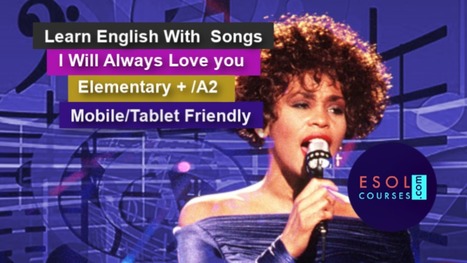
English Listening Comprehension exercise on the popular song I Will Always Love You, by Whitney Houston, to practise English listening skills and using high frequency English verbs. Watch the video, and then complete a gap fill exercise. Part of a free series of online listening activities designed to help you learn English through listening to popular songs. Browse our site for hundreds of free English language lessons, games, and teaching materials for ELT and literacy teachers. Via Sue Lyon-Jones

Katherine Giraldo's curator insight,
February 19, 2020 10:00 AM
Lerning English with a song can be very useful and easy since you can practice your listening, speaking and pronunciation at the same time also you can choose songs that like you to make the experience more funnny. When you learn a new language, there are lots of unusual sounds that your mouth is not used to making. Singing helps our mouths to form the right shapes and make these sounds loudly and clearly. Singing also helps us learn how stronger and weaker sounds are pronounced differently in English.

Luisa Fernanda Tapasco's curator insight,
March 17, 2020 5:02 PM
In the search for different strategies for improving English skills, and in this case listening, it has been found that listening to songs can be of great benefit in expanding vocabulary, and that in a certain way it is an exposure to the language for develop understanding of those who speak it. In the development of autonomy, each apprentice must be aware of the best strategy for each one.
Scoop.it!

A simple picture vocabulary and grammar lesson to learn English words for high frequency action verbs and how to use them in a sentence. Suitable for use with adult esl beginners, elementary English learners and kids. Part of a free series of easy online grammar and vocabulary lessons, with examples and interactive quizzes. Via Sue Lyon-Jones
Scoop.it!

A free esl crossword puzzle for English students of all ages. All the words in the crossword puzzle are compound nouns for food and drink. Suitable for use in class or self-study between lessons. Via Sue Lyon-Jones
Scoop.it!

An easy online English crossword for adult esl beginners. Learn and practise some simple words we use in daily life that start with the letter S. Via Sue Lyon-Jones
Scoop.it!

"Pixton Comic Maker is one of our favourite tools for creating educational comics. We have already featured it in previous posts here in EdTech and mLearning. However, today we want to draw your attention to this handy feature that was released a few months ago ..." Via Leona Ungerer

Leona Ungerer's curator insight,
February 4, 2020 4:25 AM
New feature: "Paxton Comics add-in is an extension you can easily install on your PowerPoint and enables you to easily insert comic characters into your slides".
Scoop.it!

When children start school in an industrialized country, their native language is for the most part the one used by the teachers. Conversely, in many Via Charles Tiayon

Charles Tiayon's curator insight,
February 6, 2020 3:13 AM
BY LOTFI SAYAHI FEBRUARY 5TH 2020 When children start school in an industrialized country, their native language is for the most part the one used by the teachers. Conversely, in many developing countries, the former colonial languages have been proclaimed languages of instruction within the classroom at the expense of native indigenous languages. A third scenario is something in-between: The language used at school is related to the home language but is a significantly different variety. This is the case in the Arabic-speaking world where the native dialects are used at home and on the street while Modern Standard Arabic is used in education and in other formal domains. In the latter two cases, the stakes are higher for the students from the very onset of their learning journey: They must acquire a second linguistic system and develop literacy skills, both at the same time. In North Africa, students acquire their native Arabic dialects at home before starting school. Some students also acquire Berber in the areas where it’s still transmitted naturally. Since the Arabic vernaculars aren’t standardized or officially recognized by the state, they’re not taught at schools and there aren’t any textbooks or dictionaries aimed at native speakers. As a result, students must develop literacy in Modern Standard Arabic, a language that diverges to a significant extent from the native vernaculars. There are different words that refer to the same things and even aspects of the grammar are different. For example, while Tunisian Arabic has seven subject pronouns (eight in some varieties), Modern Standard Arabic has twelve, including the dual pronouns that don’t exist in vernacular Arabic. As a result, Tunisian students have to make a conscious effort not only to develop literacy in the standard variety of Arabic, but also to learn how to speak it extemporaneously in order to communicate successfully in the classroom. In addition to Modern Standard Arabic, schools in Tunisia, Algeria and Morocco introduce French as a second language, usually in elementary school. In Tunisia, the instruction of French starts around the age of eight, before French becomes a language of instruction for many subjects starting in middle school. Both in the educational system and on the local job market, a divide exists between students who pursue their studies primarily in Modern Standard Arabic and those who do so in French. STEM education (science, technology, engineering, and mathematics), including computer science, is delivered in French in Tunisian high schools. Students who choose tracks that focus more on these subjects will develop higher levels of proficiency in French than students who choose the humanities stream, which has more hours of instruction in Modern Standard Arabic. The result of this added exposure to either language creates a gap in levels of proficiency that stratifies the Tunisian population according to their comfort using Modern Standard Arabic and/ or French. This has implications for social mobility, as both languages have different and competing symbolic, cultural, and material capitals in the Tunisian linguistic market. Proficiency in French is often used as a proxy metric for educational attainment, professional competence, and overall higher socioeconomic status. Modern Standard Arabic on the other hand is closely associated with the national religious and cultural heritage and pan-Arab ideologies. With this rivalry between Modern Standard Arabic and French in the background, the local Arabic vernacular, Tunisian Arabic, is gradually acquiring more capital and starting to be used by private citizens and public authorities alike on multiplatform media. This is more so since the 2011 Revolution. Additionally, the turn of the century has brought with it an increased presence of English as a global language. Thanks to the vast amounts of materials available for the acquisition of English, increasing numbers of Tunisians are developing higher levels of proficiency in this language and employing it in daily conversation and on social media. While there are public discussions about which languages to use at school, conflicting ideologies make it hard for real change to happen. For the time being, it appears that North African students will continue to develop initial literacy in Modern Standard Arabic and use French in many STEM subjects throughout their educational trajectory. This affects school attainment for many school children who may fall behind, not necessarily because the subject matter is challenging, just because they don’t understand the language of instruction. Featured Image Credit: Lindstedt via Unsplash Lotfi Sayahi is professor and former chair in the department of languages, literatures and cultures at the State University of New York at Albany. He is the author of Diglossia and Language Contact: Language Variation and Change in North Africa (2014, CUP), Diglossia in North Africa, (2017, ORE Linguistics), and Diglossia (2019, OBO Linguistics).
Scoop.it!

Vocab Victor can improve your students' vocabulary and help them build a network of native-like word associations. Via Dr. Tom D'Amico (@TDOttawa)
Scoop.it!

MemoStack is an online tool to help you make your own Via Ana Cristina Pratas
Dennis Swender's insight:
Share your insight
|
Scoop.it!

It’s also an LMS that enables you to create and track the use of learning materials across your classes, and a teacher development tool that enables you to train teachers in aspects of materials development and instructional design. Via Nik Peachey
Scoop.it!

The beauty of academic education is that the majority of it comes from books that can be more easily produced in areas with greater resources.
Scoop.it!

In an effort to keep the Internet alive and interesting for a billion Indians, search giant Google has announced the launch of multiple Indian languages support across its products. Via Charles Tiayon
Scoop.it!

An online English grammar lesson about personal pronouns. Learn how to use the subject pronouns I, We, You, He, She, They, and It correctly to refer to people and things in a sentence. Part of a free online grammar course for teaching and learning English. Suitable for self-study or use in the classroom. Via Sue Lyon-Jones
Scoop.it!
Practise your English listening skills and learn about world history, current events and different cultures at the same time with our free online lessons. Browse hundreds of free teaching resources and self-study lessons for practising English listening skills. Via Sue Lyon-Jones
Scoop.it!

An online English lesson about the relative pronouns who and that, with examples of how to use them correctly to give information and ask questions about people and things. Part of a series of online vocabulary and grammar lessons for adult English students and young learners. Via Sue Lyon-Jones
Scoop.it!

Free online crossword games for adult students and kids. Play to review and practise spelling English words, or just for fun! Free to play and suitable for use in class or at home. Via Sue Lyon-Jones
Scoop.it!

An easy online crossword game for Elementary students, featuring simple English words that start with the letter R. Via Sue Lyon-Jones
Scoop.it!

An easy online English crossword for adult esl beginners and kids. Learn and practise some high frequency words beginning with the letter T. Via Sue Lyon-Jones
Scoop.it!

Two “passports” expanded my horizons, transformed my life and opened up the world: the game of tennis and languages. To learn a different language is to encounter a different logic, a different cadence, a different sequence of words. It prepares you to think differently and to adapt, and tennis is all about adapting, every point, every shot. Via Charles Tiayon
Charles Tiayon's curator insight,
February 2, 2020 10:22 PM
Frustrated in her desire to learn the piano and unable to find anyone in her small Czech village to teach her English, Martina Navratilova sought out French and German lessons instead. Here, in an extract from a new book, the tennis superstar says the sport that made her name is a language too. Navratilova: nine-times Wimbledon champion ( Rex ) Two “passports” expanded my horizons, transformed my life and opened up the world: the game of tennis and languages. To learn a different language is to encounter a different logic, a different cadence, a different sequence of words. It prepares you to think differently and to adapt, and tennis is all about adapting, every point, every shot. You have to figure things out fast and react to instantly changing circumstances. And strangely enough, I believe being left-handed, the odd one, has helped me with language and tennis. We lefties are more versatile. We have to flip...
Scoop.it!

"See how to adapt popular apps to get students speaking, listening, reading, and writing in the target language ..." Move beyond vocabulary with Quizlet Incorporate listening and drawing activities with Pear Deck Create a digital pen pal program via videos with Flipgrid Bring music and song competitions to your class with Lyrics Training Host an online discussion via Padlet Lead a virtual field trip with Google Tour CreatorVia Leona Ungerer
Scoop.it!
Charles Tiayon's curator insight,
January 27, 2020 3:22 AM
It isn’t often that five year olds get to step into the role of educator, but that’s exactly what happens when five-year-old Orley heads home after kindergarten. “Do mom and dad speak French?” the little boy is asked. A smile extends across his face as he replies. “I’m teaching them.” He goes on to count to 20 in French and sing the entirety of Bonjour Mes Amis. His French immersion teacher Jenny Wondga says this kind of pride is just one of the many benefits of learning a second language.
“They can say things in different ways. It makes them open to different cultures and different backgrounds.” Wondga taught 18 French immersion kindergartners at Edmonton’s Oliver School last year. This year, 24 are enrolled and interest continues to climb. “Parents want their children to learn languages. They want them to have what they didn’t have and they want them to experience new things at school. It’s a sentiment echoed across Canada. Statistics Canada tracked the rate of English-French bilingualism in a cohort of children, aged five to 17 years old. In the 10 years between 2006 and 2016, the rate of bilingualism increased from 17 per cent to 27 per cent. That is no surprise to Pierre-Yves Mocquais, the dean of the University of Alberta’s Campus Saint-Jean. It’s a premier training centre for French teachers in Canada.
“A lot of parents, who themselves have gone through French immersion during the first generation, now want their kids to do the same,” Mocquais explained. “The increase is therefore exponential.” Mocquais says demand is so high that in spite of doubling the number of French education graduates over the last four years, there still aren’t enough educators to teach French. He believes the issue represents a shift in Canadian culture. “The generation of the 30-somethings right now are sensitive to that.
For Wondga, learning French as a child opened education and career opportunities, including a Quebec exchange program in high school and a practicum in France. It also awakened her passion for languages: she is now fluent in five. “Learning as many languages is beneficial to anybody. It’s a great tool to have.” 
Jhon Campaz's curator insight,
March 4, 2020 2:50 PM
Justifying bilingualism is not always easy, parents of bilingual children may not see the benefits and the career opportunities speaking a second language can bring to our, one of them as this article explains is: “It opens children's minds. It makes them great communicators, It makes them open to different cultures and different backgrounds.”. Understanding that bilingualism brings cognitive and also social advantages over children grow and academic success should be enough motivation for teachers to seek for the best bilingual education for children. 
Julián Pulido's curator insight,
March 17, 2020 1:25 PM
Bilingualism, what should be a real context in every single person of the world, not only with English but also with ithers languages, is now just a dream for most of the people even in countries of europe. Nowadays, a lot of latino people wonder how are they going to leave to countries as U.S or Canada. It is quite dissapointing the fact that even there in these ''dreamed'' countries, the bilingualism context is something that is still in progress.
As this article says, learning another language has a lot of benefits such as making you more capable to communicate with others, makes your mind more open than the monolingual people. etc. |






