Your new post is loading...

|
Rescooped by
Gilbert C FAURE
from Immunology and Biotherapies
January 30, 2020 1:15 PM
|
Point of view of an Immunologist/curator in 2020 Après Bobcatsss 2020, ECIL 2021, ICDF 2022, HESIVAXs with the motto UTA "Understand to Act" Notre proposition « Désinformation Vaccinale: Curation, Observatoire, Littératies » a été retenue pour le séminaire annuel de l’Académie des Controverses et de la Communication Sensible, intitulé « La désinformation : nouvelles formes, nouveaux défis », qui s'est tenu à Paris le mardi 26 novembre 2024. Voir ci-après posts du 27 novembre, avec lien vers la présentation sur Slideshare. Présentation le 20 mars 2025 à InfoxsurSeine deux jours pour décrypter la désinformation et échanger autour des solutions.
Quels outils concrets face aux manipulations de l’information et à l’essor de l’IA générative ? Avez vous acheté le numéro Juillet/septembre 2025 de la RECHERCHE sur LE FAUX? des sujets à approfondir - Vaccins et argent Making money with vaccines, against vaccines le sujet le plus chaud, de 3,36 euros par mois à 300 millions de dollars? - Publications vraies et fausses particulièrement difficile - Obligations, exemptions, incitations, peut-être plus simple?
|
|
Scooped by
Gilbert C FAURE
January 13, 8:01 AM
|
[Conférence] « Penser les transitions informationnelles dans le domaine de la santé : mutations et enjeux pour la société » par Karen Nuvoli Type de manifestation Conférence(s) Date (smart) 15 janvier 2026, 16:00 - 17:30 Lieu En ligne et à Mulhouse Organisateur(s) Karen Nuvoli Le Centre de...
|
|
Scooped by
Gilbert C FAURE
January 13, 7:47 AM
|
La trêve des confiseurs n'aura pas duré bien longtemps dans le secteur de la santé. Effectivement, l'ANSM a rallumé une vieille guerre qui ne risque pas de cesser puisque les preuves scientifiques ne seront jamais réunies pour départager les belligérants. Transis du vaccin antigrippal contre partisans de l'homéopathie de bon…
|
|
Scooped by
Gilbert C FAURE
January 13, 7:15 AM
|
|
|
Scooped by
Gilbert C FAURE
January 13, 7:14 AM
|
A political movement rather than a scientifically based one. And now trickling down from federal to states… And of such nothing good in the ropes…
From Oprah to Bill Maher, famous folks have made dumb or reckless comments about vaccines and gave Jenny McCarthy a soapbox.
Via VERONICA LESTER
Social media—the use of platforms like Facebook, Twitter, and Instagram to communicate and share content—has made our world feel smaller and more connected. However, these technologies also have made it easier create, consume, and share unverified, anecdotal information posing as facts. The anti-vaccine movement has proliferated over recent years, in part because of its most vocal proponents using social media to churn out often misleading information. The Rise of the Anti-Vax Movement Perhaps one of the most successful public health interventions in history, the advent of vaccines has led to the global eradication of smallpox, the nearly global eradication of polio, and a drastic decrease in the morbidity and mortality associated with other infectious diseases.1 As a result, many parents are unaware of the threats that these infectious diseases posed for previous generations, and as such, may believe that vaccinations are no longer necessary for their children. Vaccination refusal has increased in the United States in the last decade, and many other countries have also recorded substantial proportions of parents expressing concerns about the safety of vaccines.2 While health officials maintain that routine childhood vaccines are safe and effective, many parents in developed countries still hesitate to have them administered to their children. Worldwide, 13% of parents decide to forgo vaccinating their children, including 17% of parents in the World Health Organization's European region.3 Although access to health care is an important factor influencing vaccine coverage rates, vaccination refusal also directly affects these rates and is a significant contributor to outbreaks of some infectious diseases—particularly in regions where vaccination refusal is geographically clustered and population immunity is compromised.2 This is exemplified in that outbreaks of pertussis and measles are known to spread through populations where rates of vaccination refusal are high.2 Vaccine hesitancy is a decision-making process that is dependent on trust in healthcare providers and mainstream medicine, among other variables. However, through the combination of homophily—a theory that asserts individuals tend to form connections with others who are similar to them in characteristics such as socioeconomic status, values, beliefs, or attitudes—and the convenience of social media, individuals who have anti-vaccine beliefs can consume information that adheres to their system of beliefs and ignore dissenting information.4 Many members of the medical and scientific communities believe that vaccine hesitancy is a major threat to global health, and since 2013, the World Economic Forum has listed digital misinformation among the main threats to our society.4 Social media platforms have created a direct path for users to produce and consume content, reshaping the way people receive information. Anti-vaccination rhetoric has become part of the mainstream dialogue regarding childhood vaccination, and social media is often employed to foster online spaces that strengthen and popularize anti-vaccination theories. Despite having been disproved multiple times, perhaps the most popular anti-vaccine theory is that the mumps-measles-rubella (MMR) vaccine causes autism. Mandatory vaccination policies only seem to fuel the controversy. A 2014 study5 sought to test the effectiveness of messages designed to reduce vaccine misperceptions and increase MMR vaccination rates. During the study, 1759 parents in the United States age >18 years with children age <17 and younger were surveyed. Participants were randomly assigned to a control group or received 1 of 4 interventions: - Information from the Centers for Disease Control and Prevention explaining the lack of evidence that MMR causes autism,
- Textual information from the Vaccine Information Statement about the dangers of the diseases prevented by MMR,
- Images of children who have diseases prevented by the MMR vaccine, or
- A dramatic narrative from the CDC about an infant who almost died from measles
None of the interventions increased a parent's desire to vaccinate a child. While disproving claims of an MMR-autism link reduced misconceptions that vaccines cause autism, intent to vaccinate their children was decreased in parents who had the least positive attitudes toward vaccination. In addition, images of sick children increased belief in a vaccine-autism link, while the measles narrative increased beliefs in vaccine side effects. Conspiracy theories have become endemic among anti-vaccination groups. These sentiments have been compounded in recent years by decreased trust in the institutions that manufacture or distribute vaccines.1 The effect of vaccination refusal on public health is particularly challenging when misinformation is disseminated through social media. Thought influencers in the anti-vaccine movement include doctors, celebrities, community organizers, and “mommy bloggers” who collectively speak to an audience of about 7 million Facebook followers.1 The potential for disseminating harmful health-related information through social media seems to be at an all-time high. Echo Chambers, Structural Oppression, and Conspiracy Theories Social media echo chambers—where users only hear and see information that echoes their own beliefs—further energize the anti-vaccine movement. Clusters of users with opposing views rarely interact with one another, leaving little room for constructive debate. A 2017 study4 analyzed the interaction of 2.6 million Facebook users over 7 years and 5 months. This study's authors found that the consumption of content about vaccines is dominated by the echo chamber effect, and polarization increased over the years. Online users selected information adhering to their belief systems, tended to ignore dissenting information, and joined polarized groups that reinforced that shared narrative, according to the study. These segregated communities emerged directly from users' consumption habits, which may explain why social media campaigns that provide accurate information have limited reach. Vaccine refusal has also been promoted on Twitter. A study2 found that Twitter users who were more often exposed to negative opinions about the safety and value of human papillomavirus(HPV) vaccines were more likely to tweet negative opinions than users who were more often exposed to neutral or positive information. These tweets, which included misinformation, anecdotes, and opinions that may result in vaccine hesitancy or refusal, made up the majority of HPV vaccine-related information exposures for nearly 30% of users that tweeted about HPV vaccines during the study period. In addition, users expressing negative opinions about HPV vaccines were more closely connected to other users expressing the same opinions. Further, anti-vaccine conversations often center around moral outrage and structural oppression by institutional government and the media, suggesting a strong logic of “conspiracy-style” beliefs and thinking.6 Although anti-vaccination networks on Facebook are global in scope, sub-network activity appears to be “small world”.6 This polarization isn't just limited to conspiracy theories, but all issues perceived as critical by users, including geopolitics and health.4 Overcoming the Anti-Vax Digital Divide For the pro-vaccine movement, strategies still exist for sharing information effectively. Vaccine hesitancy and refusal are complex social issues that require interventions at the individual, provider, healthcare system, and national levels. There are ways to leverage social media to reinforce positive sentiments about the value of vaccination: - Ongoing surveillance of opinions about vaccination on social media can complement surveys and other monitoring methods to improve the reach of and response to public health communication strategies.2
- To research ways to counter anti-vaccination thinking, public health professionals should understand the content of anti-vaccination echo chambers through passive involvement in those groups.4
- Delayed vaccination can signal a need for more information, presenting an opportunity to increase education for this group.1
Social media, while fertile ground for activity for anti-vaccine activists, also can provide a platform for understanding the motivations behind vaccine hesitancy and refusal. The casual nature of social media has altered the doctor-patient interaction—and profoundly changed the way information is disseminated. Empowering experts and health officials to participate in discussions on social media about vaccination is critical to bridging the vaccination information gap. The public's reliance on social media for vital information has and will continue to increase, and its influence on personal decision-making regarding health. The immediacy and informal nature of social media gives thought leaders a marked advantage in communicating with and influencing the public. In an era when more than 2.3 billion people in 232 countries are active on social media,7 the public health community can correct misinformation by establishing its own social media communities and leveraging established channels to provide facts about the safety and value of vaccines. References - Stein RA. The golden age of anti-vaccine conspiracies [published online December 5, 2017]. Germs. doi: 10.18683/germs.2017.1122
- Dunn AG, Leask J, Zhou X, Mandl KD, Coiera E. Associations Between Exposure to and Expression of Negative Opinions About Human Papillomavirus Vaccines on Social Media: An Observational Study [published online June 10, 2015]. J Med Internet Res. doi: 10.2196/jmir.4343
- Orr D, Baram-Tsabari A. Science and Politics in the Polio Vaccination Debate on Facebook: A Mixed-Methods Approach to Public Engagement in a Science-Based Dialogue [published online March 30, 2018] J Microbiol Biol Educ. doi: 10.1128/jmbe.v19i1.1500
- Schmidt AL, Zollo F, Scala A, Betsch C, Quattrociocchi W. Polarization of the vaccination debate on Facebook [published online June 14, 2018]. Vaccine. doi: 10.1016/j.vaccine.2018.05.040
- Nyhan B, Reifler J, Richey S, Freed GL. Effective Messages in Vaccine Promotion: A Randomized Trial Pediatrics. 2014;133(4).
- Smith N, Graham T. Mapping the anti-vaccination movement on Facebook [published online December 27, 2017]. Information, Communication & Society. doi: 10.1080/1369118X.2017.1418406
- Gu Z, Badger P, Su J, Zhang E, Li X, Zhang L. A vaccine crisis in the era of social media[published online August 11, 2017]. Natl Sci Rev. 2017;5(1):8-10 doi: 10.1093/nsr/nwx098
Via Plus91, Lionel Reichardt / le Pharmageek
The World Health Organization recently declared that "vaccine hesitancy" was one of the top 10 threats to global health. This is just the latest harmful consequence of the anti-vax movement.
Via Lionel Reichardt / le Pharmageek
In the hallway the other day a colleague stopped me and said, “Hey, do you want to see something funny?” “Sure,” I said, and he showed me the YouTube video called “How Anti-Vaxxers Sound to Normal People.” The video highlighted that those who choose not to vaccinate themselves or their children do so for reasons that do not make sense, and frankly seem somewhat absurd. It is a very funny video, and I felt common ground with all aspects of it. We laughed, and then I went back to my daily work of seeing patients. I thought about the video repeatedly over the following days, and it reminded me of a similarly powerful video I had seen recently as well, “Penn and Teller on Vaccinations.” This video portrays two individuals rolling balls through plastic figurines that represented people. The balls, as infectious agents, knock down (kill) the plastic figurines that represented people. Half of the “population” is protected by a plexiglass board (vaccines), and the other half not.
Via Giuseppe Fattori
|
|
Rescooped by
Gilbert C FAURE
from Dyslexia DiaBlogue®
January 13, 6:56 AM
|
Paul Offit likes to tell a story about how his wife, pediatrician Bonnie Offit, was about to give a child a vaccination when the kid was struck by a seizure. Had she given the injection a minute sooner, Paul Offit says, it would surely have appeared as though the vaccine had caused the seizure and probably no study in the world would have convinced the parent otherwise. (The Offits have such studies at the ready — Paul is the director of the Vaccine Education Center at the Children’s Hospital of Philadelphia and author of “Deadly Choices: How the Anti-Vaccine Movement Threatens Us All.”) Indeed, famous anti-vaxxer Jenny McCarthy has said her son’s autism and seizures are linked to “so many shots” because vaccinations preceded his symptoms.
But, as Offit’s story suggests, the fact that a child became sick after a vaccine is not strong evidence that the immunization was to blame. Psychologists have a name for the cognitive bias that makes us prone to assigning a causal relationship to two events simply because they happened one after the other: the “illusion of causality.” A study recently published in the British Journal of Psychology investigates how this illusion influences the way we process new information. Its finding: Causal illusions don’t just cement erroneous ideas in the mind; they can also prevent new information from correcting them.
Via Lou Salza, Carolyn D Cowen
|
|
Rescooped by
Gilbert C FAURE
from Daily Magazine
January 13, 6:54 AM
|
Vaccines save lives -- this is a matter of scientific consensus. They?re incredibly safe, they don't cause autism, and they prevent diseases.
Via THE OFFICIAL ANDREASCY
|
|
Scooped by
Gilbert C FAURE
January 13, 4:13 AM
|
Face à la désinformation, l’inaction n’est pas une option Nous avons remis à Mme Stéphanie Rist, ministre de la santé, un rapport sur la désinformation en santé. Voir la couverture ci-contre. Vous pouvez télécharger la version française du rapport. Un accueil bienvenu de la plupart des professionnels Nous avons fait…
|
|
Scooped by
Gilbert C FAURE
January 13, 3:59 AM
|
Articles scientifiques plus de 200 articles sur le sujet des Fake News et de la vaccination dans ce topic En fait les publications n'ont vraiment démarré qu'en 2020 dans le contexte du Covid. Beaucoup avec les délais de recherche et publication semblent un peu décalées par rapport à l'évolution rapide du sujet. Une impression, il y a plus de papiers focalisés sur les pays en développement que sur l'Europe et les USA? Attention, il y a des revues/éditeurs prédatrices et/ou franchement anti-vaccination Attention Des images d'articles pseudo-scientifiques sont utilisés pour faire passer des messages Des articles médicaux et biologiques/immunologiques sont aussi présents. Néanmoins la plupart des articles méthodologiques sélectionnés sont affichés dans les topics Immunologie et Biothérapies et Mucosal Immunity Réseaux Sociaux couverts maintenant Substack Twitter/X Youtube Linkedin
|
|
|
Scooped by
Gilbert C FAURE
January 13, 9:37 AM
|
|
|
Scooped by
Gilbert C FAURE
January 13, 7:50 AM
|
Vaccine hesitancy can be understood and overcome
|
|
Scooped by
Gilbert C FAURE
January 13, 7:34 AM
|
From a top cause of cancer death to a disease on the path to elimination, the story of cervical cancer prevention is a masterclass in long-game public health. This new History of Vaccines blog post walks through the arc: Papanicolaou’s persistence in developing the Pap test, Henrietta Lacks and the use of HeLa cells in vaccine research, and Harald zur Hausen’s work showing that high-risk HPV types like 16 and 18 are the necessary cause of most cervical cancers.
Today, HPV vaccines can prevent the majority of HPV-attributable cancers, and updated guidelines now include options like self-collected HPV testing—especially important for people who face barriers to pelvic exams. Yet the article underscores that progress has not been shared equally: cervical cancer death rates remain about 65% higher for Black and Native American women compared with White women in the U.S., and nearly 94% of cervical cancer deaths worldwide occur in low- and middle-income countries.
The blog post also reminds readers that vaccination does not replace screening; the strongest protection comes from combining HPV vaccination (for all genders) with guideline-based cervical cancer screening and timely follow-up. WHO’s 90–70–90 targets offer a realistic blueprint for elimination, but success will depend on policy decisions—such as school-entry HPV vaccine requirements—and on investing in the everyday infrastructure of prevention: school nurses, clinic staff, lab professionals, and community outreach.
Read more on the History of Vaccines blog:
https://buff.ly/BLAx1MY
#PublicHealth #CervicalCancer #HPV #VaccinesWork #HealthEquity
|
|
Scooped by
Gilbert C FAURE
January 13, 7:15 AM
|
With the rise of misinformation and disinformation in health and science, I’ve been thinking a lot about how harmful actors and industries are increasingly well positioned to shape public narratives and push their agendas.
This year, in my role as medical editor at Guardian Australia, I’m keen to take a closer look at the commercial determinants of health, and particularly how harmful industries influence policy, research, media and everyday health decisions.
Much of this influence is becoming harder to trace, more sophisticated, and more underground. Industries such as tobacco are becoming more clever at how they fund individuals and hiding this funding through front-groups.
If you work in health, medicine, public health or research and:
-Are seeing the impacts of misinformation or industry influence in your work
- Have noticed emerging tactics or patterns worth scrutiny
- Have a story, concern or idea you think deserves journalistic attention (even outside of this area of misinformation and commercial determinants)
- Or simply have an idea you think I should look into
I’d love to hear from you.
Please get in touch via DM or email (rather than public comments): melissa.davey@theguardian.com . Confidentiality will always be respected.
|
|
Rescooped by
Gilbert C FAURE
from veille vaccination
January 13, 7:02 AM
|
"Anti-vax" has become a popular stance. How do clinicians react when patients or their families refuse recommended vaccinations? What are the consequences of vaccination refusal on unvaccinated and vaccinated populations? How can pediatricians and other clinicians manage patients who are in the anti-vax camp?
Via HAS-veille
Robert F. Kennedy Jr.: Anti-Vaxxer
The Slatest
Generation Rescue has a well-known advocacy for anti-science, commonly misinterprets real science, and has a history of nasty attacks on those who point out their logical fallacies.
Via VERONICA LESTER
If an unvaccinated child passes a disease onto a baby who’s too young to be vaccinated, should its parents be able to sue the infected child’s parents for negligence?
Via Sepp Hasslberger, shelbylaneMD
After advertisers complained about programmatic ad placements on anti-vax videos, YouTube removed ads on videos that advocate against vaccination.
Via Lionel Reichardt / le Pharmageek
For years, we have been talking about the power and potential of social media and how family physicians can use it to disseminate important health information to the public, correct misinformation in the media, raise the profile of family medicine, and advocate for our patients and practices. Along the way, many of you have joined us in the Twitterverse, but there is so much more to be done. Although some still debate whether physicians should even be using social media, we would posit that it is an obligation. Physicians know the science of medicine and the facts about our health care system. When we are not present in social media, other voices -- all too often uninformed voices -- can dominate important conversations. Here's one example. In an attempt to manipulate and build public opinion against the use of vaccinations, from mid-August to Dec. 1, 2014, roughly250,000 tweets(www.wired.com) were sent using a popular anti-vaccine hashtag. One-fourth of those tweets originated from just 10 prominent anti-vax Twitter accounts, but to the casual observer, it looked as if the anti-vaccine movement was growing.
Via Giuseppe Fattori
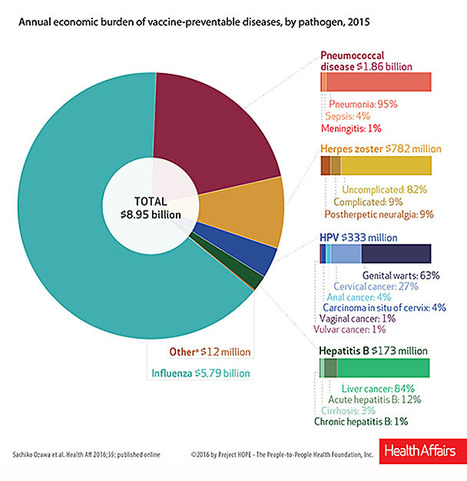
Vaccines save thousands of lives in the United States every year, but many adults remain unvaccinated. Low rates of vaccine uptake lead to costs to individuals and society in terms of deaths and disabilities, which are avoidable, and they create economic losses from doctor visits, hospitalizations, and lost income. To identify the magnitude of this problem, we calculated the current economic burden that is attributable to vaccine-preventable diseases among US adults. We estimated the total remaining economic burden at approximately $9 billion (plausibility range: $4.7–$15.2 billion) in a single year, 2015, from vaccine-preventable diseases related to ten vaccines recommended for adults ages nineteen and older. Unvaccinated individuals are responsible for almost 80 percent, or $7.1 billion, of the financial burden. Sixty-five percent of the estimated annual economic burden, equivalent to $5.8 billion (plausibility range: $2.0–$11.6 billion), resulted from influenza alone—a vaccine-preventable disease that causes substantial numbers of hospitalizations and morbidity each year. It should be noted that this study examined a static annual estimate of the unvaccinated cohort, and therefore not all cases in this group are necessarily preventable by increased vaccination because of less than 100 percent vaccine efficacy.
Via Pharma Guy, Giuseppe Fattori, Lionel Reichardt / le Pharmageek
Search for “vaccines.” At least within our filter bubble, the top item in Google’s “In the news” section earlier this week was an anti-vax column about the “feds’ plan to force vaccines on adults.” The first of the regular search results was the...
Via Charles Tiayon, Susan Myburgh
|
|
Scooped by
Gilbert C FAURE
January 13, 4:06 AM
|
Face à la circulation massive de fausses informations en santé, Stéphanie Rist, ministre de la Santé et de la Famille, de l'Autonomie et des Personnes handicapées, annonce le lancement de la…
|
|
Scooped by
Gilbert C FAURE
January 13, 3:50 AM
|
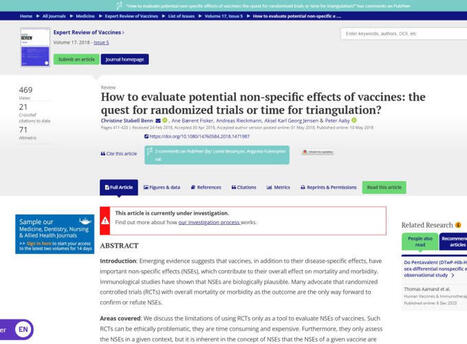
🔎 📰 THIS IS AN EPIC QUOTE to illustrate NSE believers' double standards - from Expert Review of Vaccines, 17:5, 411-420,
DOI: 10.1080/14760584.2018.1471987
Make note of the year this socalled "expert" review was published - 2018;
bolded parts by me.
"𝐒𝐜𝐢𝐞𝐧𝐜𝐞 𝐢𝐬 𝐚𝐥𝐬𝐨 𝐚𝐛𝐨𝐮𝐭 𝐚𝐜𝐜𝐨𝐮𝐧𝐭𝐢𝐧𝐠 𝐟𝐨𝐫 𝐚𝐥𝐥 𝐝𝐚𝐭𝐚. Unfortunately,
in the current ‘medical science’ culture, 𝐭𝐡𝐞𝐫𝐞 𝐢𝐬 𝐚 𝐭𝐞𝐧𝐝𝐞𝐧𝐜𝐲 𝐭𝐨 𝐟𝐨𝐜𝐮𝐬 𝐨𝐧 𝐑𝐂𝐓𝐬 𝐚𝐬 𝐚 𝐦𝐞𝐭𝐡𝐨𝐝 𝐭𝐨 𝐜𝐨𝐧𝐭𝐫𝐨𝐥 𝐩𝐨𝐭𝐞𝐧𝐭𝐢𝐚𝐥 𝐛𝐢𝐚𝐬𝐞𝐬. 𝐓𝐡𝐢𝐬 𝐠𝐨𝐞𝐬 𝐡𝐚𝐧𝐝 𝐢𝐧 𝐡𝐚𝐧𝐝 𝐰𝐢𝐭𝐡 𝐚 𝐭𝐞𝐧𝐝𝐞𝐧𝐜𝐲 𝐭𝐨 𝐝𝐢𝐬𝐦𝐢𝐬𝐬 𝐨𝐛𝐬𝐞𝐫𝐯𝐚𝐭𝐢𝐨𝐧𝐚𝐥 𝐬𝐭𝐮𝐝𝐢𝐞𝐬, 𝐛𝐞𝐜𝐚𝐮𝐬𝐞 𝐭𝐡𝐞𝐲 𝐦𝐢𝐠𝐡𝐭 𝐡𝐚𝐯𝐞 𝐫𝐢𝐬𝐤 𝐨𝐟 𝐛𝐢𝐚𝐬, 𝐞𝐯𝐞𝐧 𝐰𝐡𝐞𝐧 𝐢𝐭 𝐰𝐨𝐮𝐥𝐝 𝐧𝐨𝐭 𝐛𝐞 𝐞𝐭𝐡𝐢𝐜𝐚𝐥𝐥𝐲 𝐚𝐜𝐜𝐞𝐩𝐭𝐚𝐛𝐥𝐞 𝐭𝐨 𝐜𝐨𝐧𝐝𝐮𝐜𝐭 𝐚𝐧 𝐑𝐂𝐓. Studies are dismissed even though the potential bias has not been shown to have an effect or the bias is in the opposite direction. In this way we throw away information, which may be important in a triangulation analysis. 𝐅𝐨𝐫 𝐞𝐱𝐚𝐦𝐩𝐥𝐞, 𝐢𝐭 𝐡𝐚𝐬 𝐧𝐨𝐭 𝐛𝐞𝐞𝐧 𝐩𝐨𝐬𝐬𝐢𝐛𝐥𝐞 𝐭𝐨 𝐜𝐨𝐧𝐝𝐮𝐜𝐭 𝐑𝐂𝐓𝐬 𝐨𝐟 𝐃𝐓𝐏 𝐢𝐧 𝐡𝐢𝐠𝐡-𝐦𝐨𝐫𝐭𝐚𝐥𝐢𝐭𝐲 𝐚𝐫𝐞𝐚𝐬, but all natural experiments and observational studies suggest that DTP is associated with increased female mortality [34]."
🤔
Hey - how about "accounting for all the data" by accounting for NCT00244673? - A DTP trial on 6.534 children in Guinea-Bissau. The trial was completed in 2011 and since then the mortality data were just forgotten - misplaced ... put aside or-what-ever excuse the investigators came up with (who by the way overlap the authors of this "expert" review.)
14 years "delay" in publishing mortality results.
Today let's celebrate that Taylor & Francis Research Insights is finally taking some kind of action by investigating this publication ❗ Oddly enough the evidence has been sitting with the publisher for 8 months ⏳at least. And frankly I'm not sure what it is that needs investigation. 🤷🏼♀️ The evidence is right there in front of them. 🙈 🙉 🙊
📢 ... Pssst service information to tax payers in the US - in case you did not know... these are the same researchers who recieved an unsolicited grant of $ 1.6 mio. US 💰 from the CDC to run a trial on the hepatitis B vaccine in Guinea-Bissau.
... and btw the hepatitis B vaccine 💉 is known to be safe and effective against a very serious lifelong infection.
#NSEvaccNeverReplicated #ScienceIntegrity
|


![[Conférence] « Penser les transitions informationnelles dans le domaine de la santé : mutations et enjeux pour la société » par Karen Nuvoli | Crem | Hésitations Vaccinales: Observatoire HESIVAXs | Scoop.it](https://img.scoop.it/sirk2gerhXbr8LWgobY25Dl72eJkfbmt4t8yenImKBVvK0kTmF0xjctABnaLJIm9)