Colaborando para una mejor educación en línea para adelantar la evolución de la enseñanza y aprendizaje usando la tecnología y pedagogía como estrategias.
Have you ever found yourself browsing the internet for hours, looking for GOOD Excel datasets to download and use? Maybe you just want some data to practice your Excel skills?
Even if you do find a dataset on a random site, there are usually restrictions on how you can use the data. The datasets also tend to he quite limited in information and hard to decipher.
Instead, we can harness the power of AI and use Chat GPT to generate small or large, relevant datasets for us. We can specify exactly what columns we need and then let ChatGPT work it's magic!
Chapters 00:00 Introduction 01:32 Open Chat GPT and explore the interface 02:40 Providing context when working with Chat GPT 03:15 Type the prompt to generate an employee dataset with custom columns 04:25 Analyze the results 04:45 Modify the prompt 06:38 Download the dataset as a .csv file 07:37 Use Chat GPT to generate a dataset that can be used in a Pivot Table 09:54 Modify the prompt to replace column data 10:30 Download the dataset 10:45 Create a Pivot Table 11:53 Close
Informing product leads and their teams of innovators, designers, and developers as they work toward safety, security, and trust while creating AI products and services for use in education.
In this short [What is a Data Scientist?] video 🎥, we will explore the fascinating world of data science and answer the question, "What is a data scientist?" We will dive into the skills, tools, and industries that this profession encompasses. From programming to communication, data scientists play a crucial role in making sense of large amounts of data and driving informed decisions. Whether you're considering a career in this field or simply curious about it, this short [What is a Data Scientist?] video 🎥 will provide you with a comprehensive understanding of what it means to be a data scientist. Don't forget to like, share, and subscribe for more content on the latest tech trends and data science insights. Thank you for watching!
🔴 Please also Join us in the Virtual Consulting Community by Subscribing to the Virtual Consulting YouTube Channel at 👉 https://www.youtube.com/c/VirtualConsulting101?sub_confirmation=1 and Please Click the Bell 🔔 Icon so that You are Notified and Never Miss an Episode, All for FREE.
🔴 Please Find additional Resources 🧰 on Virtual Consulting Firm's Home Page 👉 http://www.TheVCF.com
🎮 New Virtual Consulting Discord Server 🎮 🔴 Please also Join Us in the New Virtual Consulting Community 🎮 Discord Server, for FREE, at 👉 https://discord.gg/MbhfxUsFRT
🙏 New Virtual Consulting Patreon 🙏 🙏 Please Help us be able to continue to produce frequent quality content to Help You Learn How To Get Started and Succeed in Virtual Consulting as a Virtual Consultant! by Supporting Virtual Consulting via Patreon at 👉 https://www.patreon.com/VirtualConsulting
In this article, we look at a range of awesome AI apps that offer some amazing features.Artificial Intelligence (AI) has transformed the way we interact...
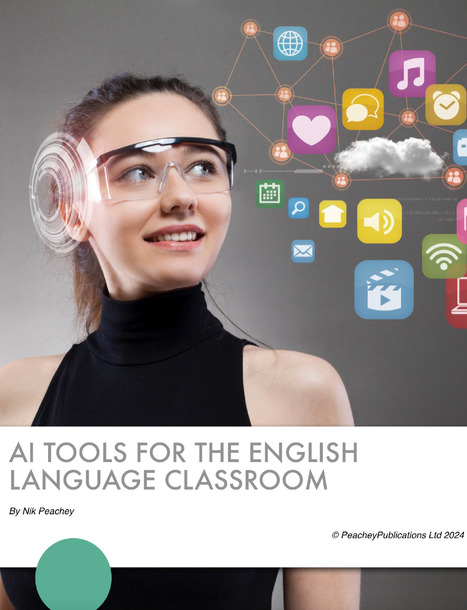
This book has been designed to act as a practical resource that should help you to get a better understanding of the kinds of AI tools that are available and how to use them in the English language classroom.
Today, November 30, 2023, mark’s the first anniversary of OpenAI’s ChatGPT. In the last year, the AI chatbot has secured support from major Silicon Valley companies and seen integration across various fields including academia, the arts, marketing, medicine, gaming, and government.
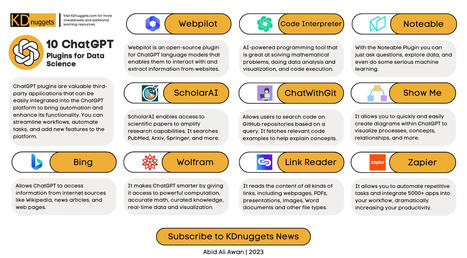
10 ChatGPT Plugins for Data Science Cheat Sheet • Noteable Plugin: The ChatGPT Plugin That Automates Data Analysis • 3 Ways to Access Claude AI for Free • What are Vector Databases and Why Are They Important for LLMs?
For the past few months, it feels like everybody has been going AI crazy. Futurists like myself have long been predicting that it will revolutionise our lives and, if you look closely, it’s plain to see it already is. Mostly, though, this has been happening ‘under the hood’ – quietly powering tools we use every day such as Google, Netflix and Uber in a way that is (by design) invisible to the end user.
ChatGPT and related tools and applications such as Bing and the soon-to-be-released Bard, on the other hand, are ‘in-your-face’ AI. Millions of us, who have now had the chance to see them in action, have been left in no doubt that this is something truly new, genuinely revolutionary and a little (perhaps a lot) scary.
"Key Takeaways: Online education is rapidly evolving with new technologies and methodologies. Flexible learning models and improved accessibility are significant benefits of online education. University partnerships with companies and technological advancements are shaping the future of online learning. Focus on data and research to back up the transformative power of online education."
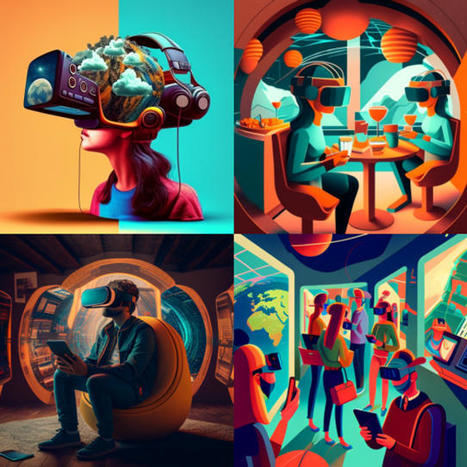
"One of the biggest drivers of change in online education is technology. Innovations like Artificial Intelligence (AI) and Virtual Reality (VR) are revolutionizing how content is delivered and consumed."
La Inteligencia Artificial tiene la capacidad de transformar y optimizar múltiples aspectos de la gestión del talento. Gracias al análisis de grandes volúmenes de datos de manera rápida y precisa, permite a los profesionales de RRHH tomar decisiones estratégicas y con datos consolidados. Además, si la sabemos aplicar correctamente, ahorraremos tiempo y reduciremos cualquier tipo de sesgo humano.
In this video, we'll show you how to potentially earn money by creating children's YouTube learning videos with the help of some AI tools. We'll show you how to create simple 2D AI animations that people are posting on YouTube Channels every day and it's much easier than you think!
RECOMMENDED VIDEOS: ● • Make $500/Day Creating Faceless Kids ... ● • Make $500/Week by creating a Monetiza... ● • Make $1,499 Weekly by Creating Educat... ● • Make $23,000 Monthly (Passive Income)... ● • Create A Faceless Gadgets Review Chan...
IGNORE THESE: #youtubeautomation #aitools #facelessyoutubechannel __________________________________ Disclaimer: Please be advised that I am not a financial advisor or a career advisor. All the information shared on the channel is for entertainment only. My results are from hard work and dedication and may not equal the same results you receive. These results are not typical. Your results can be more or less. Some links in my description are affiliate links, so if you click through and make a purchase, I may receive a small commission and this comes directly from the company and does not affect you in anyway. These affiliate links allow me to continue to post free content on YouTube. The content shared in my videos is accurate and reflects my knowledge as of the recording date. However, I cannot assure its accuracy at a later time.
Make Money Online 2024, Make money, Passive income, 2024, viral, How to make money online, Faceless YouTube Channel, Free AI Tools, Views, AI-generated Content, YouTube Tutorial, Monetization Strategies, Faceless Content Creation, Maximizing Views, Effective YouTube Channel Creation, youtube automation,faceless youtube channel,how to make a faceless youtube channel with ai,create faceless animation videos,create animation videos,how to make kids cartoon videos,how to make animated cartoon video,how to make cartoon using canva,how to make animation using canva,faceless youtube channel ideas,kids animation channel,make kids animation canva,faceless ai youtube channel,make money online,howto,makemoney,ai,chatgpt,free,trending,viral 2024, YouTube, children, learning, animation, AI tools, income, monetization, educational content, kid-friendly, video creation, passive income, tutorial, free resources, lucrative, creative process, engaging content
Arizona State University researchers will continue to make strides in the use of AI in real-world situations thanks in part to a $2.8 million grant and collaboration with the National Science Foundation (NSF).
Our understanding of how the brain and AI work has advanced considerably. The best model of the human brain we have today dates from the 1970s and is based on neural networks. For each characteristic, a knowledge or emotion is associated. We reconstruct concepts whenever we need them. Our memories are linked to each other by common characteristics. The brain reuses features. It does not re-record common elements. What we remember is a reconstruction. Eventually, the brain eliminates concepts that are not often called upon. This happens at night, during REM (rapid eye movement), when the eyes make rapid movements. For example, if you’ve been bitten by a dog, you’ll forget less and associate more dangerous characteristics with the dog. To see in front of us, the back of the eye is black. We have a black disc caused by the optic nerve at the back of each eye. We can’t see what’s in front of us without the brain, which reconstructs the visual environment from the periphery. We can deceive the eye with optical illusions. This new understanding makes it possible to treat post-traumatic disorders with EMDR(Eye Movement Desensitization and Reprocessing). It reuses this phase of sleep to rebalance the neural network. For example, war veterans are taught that a loud noise is not necessarily associated with an explosive. In the early 2010s, scientists set out to model how the brain works. The Human Brain Project set out to create a program that would reproduce brain function on a computer. At first, this model couldn’t do much. Fei-fei Li, from Stanford University, observed that a baby doesn’t know much, but only learns after exposure to its environment. The researchers then exposed the program to videos, images, sounds and text. How we teach computers to understand pictures 2015 – Fei Fei Li – Ted: https://youtu.be/40riCqvRoMs?si=FLj3q0q4yjGhMrDG Each piece of content is associated with an emotion and a degree of strength to mimic a child’s learning. e.g.: funny, very funny. The Human Brain Project learned as well as a human child. For example, it recognizes a cat. Facebook, around 2015-2016, created two neural networks. Facebook had access to a lot of content for training. They made the two networks communicate. These networks talked to each other. Facebook stopped the experiment because the two networks had created a new language that humans didn’t understand. Sam Altman has shown that these networks have a real talent for languages, and has developed his own text-only Neural Network: Chat GPT. It’s called LLM (large language model). At the same time, Sam Altma’s company, Open AI, developed another neural network trained solely with images associated with text: DALL-E. It’s called Clip (contrastive language-image pretraining). DALL-E uses Chap GPT to give context to images. In 2022, Chap GPT finished training DALL-E and Chap GPT and made them available to the public. These AIs are generative artificial intelligences: they are capable of understanding an image or text and expressing themselves on demand. For example, they can write a 5-line poem about spring, or draw a daisy like Van Gogh. For this purpose, DALL-E and Chap GPT are extremely powerful and have met with enormous success. Researchers have developed applications for these AIs: recognizing a weed in a field and pulling it out mechanically, recognizing a cancerous tumor on a lung X-ray, being able to generate descriptions for the visually impaired, and so on. LLMs (large language models) are capable of improving a text. But because AI speaks so well, humans have the impression that it knows. Some use it as a personal assistant or as an oracle. But these artificial intelligences work on form, not content. They don’t reason, they don’t tell the truth. Big companies like Microsoft or Google, who make Chat GPT or one of its clones available, wanted to capitalize on people’s expectations. They’ve disguised the LLM so that their expression looks like reasoning. For example, showing the 5 best restaurants in town or giving advice for relationships. The operation of neural networks, generative AI, is extremely energy-intensive. The processors that run neural networks aren’t built for it. These processors test all eventualities until they find the right one. In the pilot phase of Google’s AI with a limited number of users, Google’s power consumption increased by 48%. Generating an image with DALL-E consumes as much electricity as it takes to charge a smartphone. Generating a page of text with Chat GPT emits as much CO2 as 6 km by car. In December 2023, there were 10 million daily users of Chat GPT. For every twenty texts requested from Chat GPT, half a liter of clean water is consumed to cool the data centers. Générer une image consomme autant d’énergie que pour charger un smartphone (et autres chiffres affolants sur les IA) – Usbek & Rica: https://usbeketrica.com/fr/article/generer-une-image-consomme-autant-d-energie-que-pour-charger-un-smartphone-et-autres-chiffres-affolants-sur-les-ia To train its neural networks, chat GPT made extensive use of employees in Kenya who were underpaid ($2 a day), mistreated and had no social security. Many of these employees are traumatized by some shocking images. ‘It’s destroyed me completely’: Kenyan moderators decry toll of training of AI models – The Guardian: https://www.theguardian.com/technology/2023/aug/02/ai-chatbot-training-human-toll-content-moderator-meta-openai Manufacturers are running massive communication campaigns to show that AI can improve health, agriculture, climate change and construction. For example, Google’s Alphafold has made it possible to understand millions of proteins, whereas the entire scientific community used to be able to understand a maximum of two per year. This is being used to create medicines or understand how pollutants affect the human body. Another example: robots that water or apply pesticides only where necessary. In these cases, AI will benefit humanity. Google DeepMind’s Latest AI Model Is Poised to Revolutionize Drug Discovery – Time: https://time.com/6975934/google-deepmind-alphafold-3-ai/ On the other hand, if we use it for entertainment, to make people laugh or to replace office work, we’re going to make the climate crisis worse, as it would generate tons of extra CO2. Using artificial intelligence to listen an entire conversation in a videoconference and summarize the discussions has a major impact on the environment. There is a human cost and an environmental cost. On the Unsustainability of ChatGPT: Impact of Large Language Models on the Sustainable Development Goals – UNU Macau: https://unu.edu/macau/blog-post/unsustainability-chatgpt-impact-large-language-models-sustainable-development-goals We need to evolve our use of AI with public research into microprocessors so that they consume less power. Only one company in Taiwan, TSMC, produces microprocessors that meet the demands of Open AI, and they are not efficient enough. Legislation needs to evolve to prevent these artificial intelligences from being trained by quasi-slaves, and to avoid our personal data ending up in the content generated by these AIs. Replacing a human with an AI just creates more CO2. Humans will continue to exist, but without work. Let’s use Artificial Intelligence, but with relevance. Strategies for mitigating the global energy and carbon impact of artificial intelligence – SDG: https://sdgs.un.org/sites/default/files/2023-05/B29%20-%20Xue%20-%20Strategies%20for%20mitigating%20the%20global%20energy%20and%20carbon%20impact%20of%20AI.pdf Translated with DeepL.com (free version) Related Posts
Imagine having your own team of AI experts in diverse fields available 24/7, ready to help with any task, decision, or question you might have. Get the job done, learn new skills or just have fun - for free.
Mejora tus habilidades para escribir ensayos con Chat GPT.
La humanidad no se queda quieta. Cada día, realizamos más y más descubrimientos e inventamos nuevas tecnologías que mejoran nuestras vidas. ChatGPT de OpenAI no es una excepción a esto. Esta increíble innovación ya ha conmovido a todos en el mundo, incluyendo a aquellos que trabajan en el sector educativo. Algunos de ellos están preocupados de que la invención de ChatGPT afectará negativamente el proceso de aprendizaje, asegurando que los estudiantes dejarán de esforzarse en sus estudios. Sin embargo, nuestros expertos están seguros de que este modelo de lenguaje de IA solo les beneficiará.
Thirty-eight percent of educators expect to adopt AI tools in the coming year, and 57% said they believe such tools should be used, according to a new report.
Between 2019 and 2023, 17% more teachers used digital platforms to increase student participation, and 17% also paid more attention to students' social and emotional needs, the report found.
The gig economy has become a prominent and rapidly growing segment of the modern workforce, with millions of people around the world now relying on gig work as their primary source of income. From ride-hailing drivers to freelance writers, gig work offers flexibility and autonomy, allowing individuals to choose when and how they work. However, the emergence of the metaverse - a virtual world where users can interact with each other and digital objects in a shared space - is poised to disrupt the gig economy in profound ways, both positive and negative.
To get content containing either thought or leadership enter:
To get content containing both thought and leadership enter:
To get content containing the expression thought leadership enter:
You can enter several keywords and you can refine them whenever you want. Our suggestion engine uses more signals but entering a few keywords here will rapidly give you great content to curate.


 Your new post is loading...


 Scoop.it!