A team of researchers led by the Department of Energy’s Lawrence Berkeley National Laboratory (Berkeley Lab) has developed a simple method that could turn ordinary semiconducting materials into quantum machines – superthin devices marked by extraordinary electronic behavior. Such an advancement could help to revolutionize a number of industries aiming for energy-efficient electronic systems – and provide a platform for exotic new physics.
The study describing the method, which stacks together 2D layers of tungsten disulfide and tungsten diselenide to create an intricately patterned material, or superlattice, was published online recently in the journal Nature.
“This is an amazing discovery because we didn’t think of these semiconducting materials as strongly interacting,” said Feng Wang, a condensed matter physicist with Berkeley Lab’s Materials Sciences Division and professor of physics at UC Berkeley. “Now this work has brought these seemingly ordinary semiconductors into the quantum materials space.”
Two-dimensional (2D) materials, which are just one atom thick, are like nanosized building blocks that can be stacked arbitrarily to form tiny devices. When the lattices of two 2D materials are similar and well-aligned, a repeating pattern called a moiré superlattice can form.
For the past decade, researchers have been studying ways to combine different 2D materials, often starting with graphene – a material known for its ability to efficiently conduct heat and electricity. Out of this body of work, other researchers had discovered that moiré superlattices formed with graphene exhibit exotic physics such as superconductivity when the layers are aligned at just the right angle.
The new study, led by Wang, used 2D samples of semiconducting materials – tungsten disulfide and tungsten diselenide – to show that the twist angle between layers provides a “tuning knob” to turn a 2D semiconducting system into an exotic quantum material with highly interacting electrons.
Blue-blooded and armored with 10 spindly legs, horseshoe crabs have perhaps always seemed a bit out of place.
First thought to be closely related to crabs, lobsters and other crustaceans, in 1881 evolutionary biologist E. Ray Lankester placed them solidly in a group more similar to spiders and scorpions. Horseshoe crabs have since been thought to be ancestors of the arachnids, but molecular sequence data have always been sparse enough to cast doubt.
University of Wisconsin-Madison evolutionary biologists Jesús Ballesteros and Prashant Sharma hope, then, that their recent study published in the journal Systematic Biology helps firmly plant ancient horseshoe crabs within the arachnid family tree.
By analyzing troves of genetic data and considering a vast number of possible ways to examine it, the scientists now have a high degree of confidence that horseshoe crabs do indeed belong within the arachnids.
"By showing that horseshoe crabs are part of the arachnid radiation, instead of a lineage closely related to but independent of arachnids, all previous hypotheses on the evolution of arachnids need to be revised," says Ballesteros, a postdoctoral researcher in Sharma's lab. "It's a major shift in our understanding of arthropod evolution."
Arthropods are often considered the most successful animals on the planet since they occupy land, water and sky and include more than a million species. This grouping includes insects, crustaceans and arachnids. Horseshoe crabs have been challenging to classify within the arthropods because analysis of the animals' genome has repeatedly shown them to be related to arachnids like spiders, scorpions, mites, ticks and lesser-known creatures such as vinegaroons. Yet, "scientists assumed it was an error, that there was a problem with the data," says Ballesteros.
NASA has captured unprecedented photos of the interaction of shockwaves from two supersonic aircraft, part of its research into developing planes that can fly faster than sound without thunderous "sonic booms".
When an aircraft crosses that threshold—around 1,225 kilometers (760 miles) per hour at sea level—it produces waves from the pressure it puts on the air around it, which merge to cause the ear-splitting sound.
In an intricate maneuver by "rock star" pilots at NASA's Armstrong Flight Research Center in California, two supersonic T-38 jets flew just 30 feet (nine meters) apart below another plane waiting to photograph them with an advanced, high-speed camera, the agency said. The rendezvous—at an altitude of around 30,000 feet—yielded mesmerizing images of the shockwaves emanating from both planes.
With one jet flying just behind the other, "the shocks are going to be shaped differently", said Neal Smith of AerospaceComputing Inc, an engineering firm that works with NASA, in a post on the agency's website. "This data is really going to help us advance our understanding of how these shocks interact."
Sonic booms can be a major nuisance, capable of not just startling people on the ground but also causing damage—like shattered windows—and this has led to strong restrictions on supersonic flight over land in jurisdictions like the United States.
Sonic booms have long been an issue for military and commercial air travel and have limited the speeds at which air travel can occur. Learning more about this topic in such detail and scale is extremely impressive and will go a long way to determining the future of air travel on earth.
The theoretical chemist Salvatore Torquato met with the number theorist Matthew de Courcy-Ireland to explain that he had done something highly unorthodox with prime numbers, those positive integers that are divisible only by 1 and themselves.
A professor of chemistry at Princeton University, Torquato normally studies patterns in the structure of physical systems, such as the arrangement of particles in crystals, colloids and even, in one of his better-known results, a pack of M&Ms. In his field, a standard way to deduce structure is to diffract X-rays off things.
When hit with X-rays, disorderly molecules in liquids or glass scatter them every which way, creating no discernible pattern. But the symmetrically arranged atoms in a crystal reflect light waves in sync, producing periodic bright spots where reflected waves constructively interfere. The spacing of these bright spots, known as “Bragg peaks” after the father-and-son crystallographers who pioneered diffraction in the 1910s, reveals the organization of the scattering objects.
Sex determination in birds is a little different than in mammals. In mammals, males have one copy of each sex chromosome (X and Y) while females have two copies of the X chromosome. In birds, it’s the opposite. Their sex chromosomes are called Z and W, and it’s the females that have a single copy of each (ZW), whereas the males have two of the same (ZZ). Sex cells’ nuclei, including sperm and eggs, usually have only one copy of either chromosome—males produce only Z-carrying sperm, and females produce either Z- or W-carrying eggs.
This gynandromorphic cardinal has been seen eating in the backyard of bird-lovers Shirley and Jeffrey Caldwell. Shirley snapped a photo of the rare bird through her kitchen window as it perched on a tree at the end of her yard. Gynandromorphy like that in this cardinal occurs when a female egg cell develops with two nuclei—one with a Z and one with a W—and it’s “double fertilized” by two Z-carrying sperm.
The chimeric individual then develops with half of its body as a male ZZ and the other half as a female ZW. If you were to examine a cell from the bright red male side, it would have cells with ZZ chromosomes. If you looked at a cell from the left, it would have cells with ZW chromosomes. This phenomenon happens in birds, many insects, and crustaceans. Part of what makes this particular cardinal so exciting to Hooper is that it may be able to reproduce. “Most gynandromorph individuals are infertile, but this one may actually be fertile as the left side is female, and only the left ovary in birds in functional.”
Single cells had many of the genes and functions needed for complex life to evolve. Billions of years ago, life crossed a threshold. Single cells started to band together, and a world of formless, unicellular life was on course to evolve into the riot of shapes and functions of multicellular life today, from ants to pear trees to people. It's a transition as momentous as any in the history of life, and until recently we had no idea how it happened.
The valley between unicellular and multicellular life seems almost unbridgeable. A single cell's existence is simple and limited. Like hermits, microbes need only be concerned with feeding themselves; neither coordination nor cooperation with others is necessary, though some microbes occasionally join forces. In contrast, cells in a multicellular organism, from the four cells in some algae to the 37 trillion in a human, give up their independence to stick together tenaciously; they take on specialized functions, and they curtail their own reproduction for the greater good, growing only as much as they need to fulfill their functions. When they rebel, cancer can break out.
Multicellularity brings new capabilities. Animals, for example, gain mobility for seeking better habitat, eluding predators, and chasing down prey. Plants can probe deep into the soil for water and nutrients; they can also grow toward sunny spots to maximize photosynthesis. Fungi build massive reproductive structures to spread their spores. But for all of multicellularity's benefits, says László Nagy, an evolutionary biologist at the Biological Research Centre of the Hungarian Academy of Sciences in Szeged, it has traditionally "been viewed as a major transition with large genetic hurdles to it."
Now, Nagy and other researchers are learning it may not have been so difficult after all. The evidence comes from multiple directions. The evolutionary histories of some groups of organisms record repeated transitions from single-celled to multicellular forms, suggesting the hurdles could not have been so high. Genetic comparisons between simple multicellular organisms and their single-celled relatives have revealed that much of the molecular equipment needed for cells to band together and coordinate their activities may have been in place well before multicellularity evolved. And clever experiments have shown that in the test tube, single-celled life can evolve the beginnings of multicellularity in just a few hundred generations—an evolutionary instant.
Evolutionary biologists still debate what drove simple aggregates of cells to become more and more complex, leading to the wondrous diversity of life today. But embarking on that road no longer seems so daunting. "We are beginning to get a sense of how it might have occurred," says Ben Kerr, an evolutionary biologist at the University of Washington in Seattle. "You take what seems to be a major step in evolution and make it a series of minor steps."
The rapid acceleration of a cheetah chasing down its prey is slow motion compared with the pee flying out of the rear end of a glassy sharpshooter. A new study has found this centimeter-long, plant-sucking insect has specialized structures to accelerate the removal of waste at 200 meters per second squared, an order of magnitude faster than a cheetah can get up to speed. More than just an excretory curiosity, the sharpshooter’s behavior could one day help engineers design new kinds of printers and other devices that move tiny amounts of fluids around.
The sharpshooter has an unquenchable thirst. It taps into the water-conducting tissue of a variety of plants, from which it needs to suck up as much as 300 times its weight in liquid a day to get enough nutrients to survive. All that liquid has to go somewhere, and the droplets flung from these insects’ rear ends rain down from infested trees.
Splattered one day by leafhopper showers, one biophysicist decided to take a close look at the sharpshooter’s rainmaking machinery. High-speed videos revealed each droplet accumulates on a pointy tip at the far end of the sharpshooter’s anus, which has a joint that catapults the water away, he and colleagues report here today at the annual meeting of the Society for Integrative and Comparative Biology.
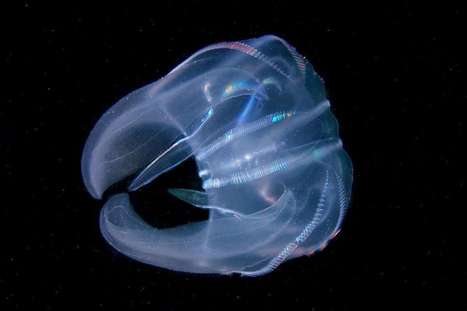
A jellyfish-like creature has a neat trick that makes it unique among animals: its anus forms only when it needs to defecate, then disappears without a trace. “That is the really spectacular finding here,” says Sidney Tamm of the Marine Biological Laboratory in Woods Hole, Massachusetts, who made the discovery. “There is no documentation of a transient anus in any other animals that I know of.” Tamm thinks the discovery might represent an intermediate stage in evolution.
But when Tamm studied the warty comb jelly (Mnemiopsis leidyi), he could not find its anus. Only when the animals are actually defecating does a tiny opening appear – and it disappears again straight afterwards. “It is not visible when the animal is not pooping,” says Tamm. “There’s no trace under the microscope. It’s invisible to me.”
His observations show there is no permanent connection between the gut and the rear of the body. Instead, as waste accumulates, part of the gut starts to balloon out until it touches the outer layer, or epidermis. The gut then fuses with the epidermis, forming an anal opening. Once excretion is complete, the process is reversed and the anus vanishes.
Colon cancer is exacerbated by a common oral bacterium that works in concert with oncogenic mutations to amplify cancer signaling.
An oral bacterium, Fusobacterium nucleatum, was recognized years ago as a promoter of colon cancer. But exactly how F. nucleatum worsened colon cancer remained unknown. Now, thanks to research carried out at Columbia University, the bacterium’s cancer-exacerbating ways are better understood. Basically, the bacterium provides the second hit in a two-hit mechanism, completing a feedback loop that amplifies cancer signaling.
The Columbia scientists, led by Yiping W. Han, PhD, professor of microbial sciences, followed up on a finding that they had uncovered earlier. They had discovered that the bacterium makes a molecule called FadA adhesin, triggering a signaling pathway in colon cells that has been implicated in several cancers. They also found that FadA adhesin stimulates the growth of cancerous cells, not that of healthy cells.
“We needed to find out why F. nucleatum seems to interact only with cancerous cells,” Han pointed out. Working with cell cultures, the researchers found that noncancerous colon cells lack Annexin A1, a protein that stimulates cancer growth. The researchers then confirmed both in vitro and later in mice that disabling Annexin A1 prevented F. nucleatum from binding to the cancer cells, slowing their growth. The researchers also discovered that F. nucleatum increases production of Annexin A1, attracting more of the bacteria.
Filmmaker Jan van IJken's Becoming reveals the fascinating genesis of animal life. A single cell is transformed into a complete, complex living organism with a beating heart and running bloodstream. Observe the stages of development that occur within an Alpine newt embryo (Ichthyosaura alpestris) in this fascinating six minute time-lapse captured over a three week period.
Few tech companies have crashed and burned in recent years like Theranos, a blood-testing startup that claimed it would revolutionize healthcare by doing away with “big bad needles.” Investors put hundreds of millions in Theranos despite its lack of published science. But money moves fast in Silicon Valley, where the company began – and sometimes it moves too quickly for the ideas behind it to keep pace.
A new study suggests that many of the highest-valued healthcare startups – from buzzy health insurance companies like Oscar to biotechs with record-breaking IPOs like Moderna – are failing to publish quality scientific research.
That could put us on the brink of the next Theranos, say the authors of the study, who hail from Stanford and New York University.
While it isn’t perfect, peer-reviewed research is a critical source of vetting for any startup whose product could put people’s lives at risk.
In the case of Theranos, launched over a decade ago by Stanford drop-out Elizabeth Holmes, investors put hundreds of millions in a concept with little-to-no published science to support it. When it was gradually revealed that the advanced technology required for such an idea did not yet exist, the company – and Holmes, who’d amassed a net worth of $4.5 billion after the company was valued at $9 billion – toppled.
Yet we may be on the cusp of seeing the next Theranos, according to a team of Stanford and New York University researchers that includes John P.A. Ioannidis, an early Theranos whistle-blower and a researcher with a reputation for well-regarded critiques. In a new study published Monday in the European Journal of Clinical Investigation, Ioannidis and his coauthors reveal that dozens of other healthcare startups valued at more than $1 billion (also known as unicorns) have published little or no research in peer-reviewed literature.
Peer review involves subjecting your work to outside experts in the same field. Whether it’s a health startup claiming its platform will save patients money or a biotech company claiming its new therapy can cure cancer or Alzheimer’s, those assertions can and should be measured and quantified. That’s especially true when a startup’s technology puts people’s lives at risk, as is often the case in healthcare.
“To the extent that health care startups are responsible for pushing the frontiers of medicine, patients’ lives hang in the balance,” Ioannidis and coauthors wrote in a Stat opinion piece published the day after their study came out.
A thunderous crackle ripped through the Amazon rain forest Wednesday evening, carrying with it the notion that the world is entering a new, even more connected age.
Founded in 2012, OneWeb is the brainchild of Wyler, an idealistic, relentless and oft controversial technology executive who has made it his mission in life to spread the internet to all corners of the globe. The company has raised more than $2 billion from Richard Branson’s Virgin Group, SoftBank Group Corp., Qualcomm Inc., Airbus SE and others to build an initial fleet of 650 satellites and eventually as many as 1,980. The satellites will be tasked with beaming internet service down to cheap antennas placed on things like hospitals, schools and homes that cannot be reached by fiber optic cables.
OneWeb is about a year behind schedule and watched as Elon Musk’s SpaceX launched a pair of test satellites for a rival space internet service last year. The startup was also under pressure to have a successful launch before the end of November, when its right to valuable spectrum would have expired. Both OneWeb and Space Exploration Technologies Corp. plan to launch fleets of satellites this year to build out their services and cover more of the globe.
These first six OneWeb satellites are test units, and the company will put them through their paces over the next six months to make sure they operate as expected. “If we get six out of six working, that will be amazing,” Wyler said. They were launched by Arianespace, the European aerospace company that uses a large site in French Guiana as its rocket hub. Arianespace can take up to 36 of the 330-pound satellites to orbit per flight and is contracted for 20 more OneWeb launches in coming years.
The new satellites are smaller, cheaper and faster at delivering data than older satellite internet models from operators such as ViaSat Inc. and Inmarsat Plc. OneWeb says it can build the units at a rate of two a day for less than a 10th of the cost of a traditional system. The older satellites also orbit at about 18,500 miles versus about 750 miles for OneWeb’s machines, which should help OneWeb deliver data more quickly.
OneWeb and SpaceX plan to offer services to people in remote and poorer areas, giving them the same access to the internet that the rest of the world enjoys. They also want to sell more lucrative services for connecting things like planes, cars and ships.
A volunteer working with the NASA-led Backyard Worlds: Planet 9 project has found the oldest and coldest known white dwarf — an old Earth-sized remnant of a sun-like star that has died — ringed by dust and debris. Astronomers suspect this could be the first known white dwarf with multiple dust rings. Adam Schneider, a research scientist at the School of Earth and Space Exploration, was part of the team that unwrapped the discovery data to draw a picture of the white dwarf's surprising details.
The star, LSPM J0207+3331 or J0207 for short, is forcing researchers to reconsider models of planetary systems and could help us learn about the distant future of our solar system. Adam Schneider, a research scientist at Arizona State University's School of Earth and Space Exploration, was part of the team that unwrapped the discovery data to draw a picture of the white dwarf's surprising details.
Backyard Worlds: Planet 9 is a project led by Marc Kuchner, an astrophysicist at NASA’s Goddard Space Flight Center. Launched two years ago, it enlists volunteers to sort through infrared data for new discoveries using an online interface and search engine.
"This white dwarf is so old that whatever process is feeding material into its rings must operate on billion-year timescales," Debes said. "Most of the models scientists have created to explain rings around white dwarfs only work well up to around 100 million years, so this star is really challenging our assumptions of how planetary systems evolve."
Adding to the puzzle, the J0207 disk may be composed of more than one distinct ring-like component, an arrangement never before seen in circumstellar material surrounding a white dwarf. To study the rings and their structure, Debes and Kuchner contacted collaborator Adam Burgasser at the University of California, San Diego to obtain follow-up observations with the Keck II telescope at the W. M. Keck Observatory in Hawaii. The Keck observations helped confirm J0207’s record-setting properties. Now scientists are left to puzzle how it fits into their models.
Debes compared the population of asteroid belt analogs in white dwarf systems to the grains of sand in an hourglass. Initially, there’s a steady stream of material. The planets fling asteroids inward towards the white dwarf to be torn apart, maintaining a dusty disk. But over time, the asteroid belts become depleted, just like grains of sand in the hourglass. Eventually, all the material in the disk falls down onto the surface of the white dwarf, so older white dwarfs like J0207 should be less likely to have disks or rings.
Follow-up with future missions like NASA's James Webb Space Telescope may help astronomers tease apart the ring’s constituent parts.
Astronomers have detected a stealthy black hole from its effects on an interstellar gas cloud. This intermediate mass black hole is one of over 100 million quiet black holes expected to be lurking in our Galaxy. These results provide a new method to search for other hidden black holes and help us understand the growth and evolution of black holes.
Black holes are objects with such strong gravity that everything, including light, is sucked in and cannot escape. Because black holes do not emit light, astronomers must infer their existence from the effects their gravity produces in other objects. Black holes range in mass from about 5 times the mass of the Sun to supermassive black holes millions of times the mass of the Sun. Astronomers think that small black holes merge and gradually grow into large ones, but no one had ever found an intermediate mass black hole, hundreds or thousands of times the mass of the Sun.
A research team led by Shunya Takekawa at the National Astronomical Observatory of Japan noticed HCN-0.009-0.044, a gas cloud moving strangely near the center of the Galaxy 25,000 light-years away from Earth in the constellation Sagittarius. They used ALMA (Atacama Large Millimeter/submillimeter Array) to perform high resolution observations of the cloud and found that it is swirling around an invisible massive object.
Takekawa explains, "Detailed kinematic analyses revealed that an enormous mass, 30,000 times that of the Sun, was concentrated in a region much smaller than our Solar System. This and the lack of any observed object at that location strongly suggests an intermediate-mass black hole. By analyzing other anomalous clouds, we hope to expose other quiet black holes."
Scientists in the Emergent Photonics Lab (EPic Lab) at the University of Sussex have made a breakthrough to a crucial element of an atomic clock—devices which could reduce our reliance on satellite mapping in the future—using cutting-edge laser beam technology. Their development greatly improves the efficiency of the lancet (which in a traditional clock is responsible for counting), by 80% - something which scientists around the world have been racing to achieve.
Currently, the UK is reliant on the US and the EU for the satellite mapping that many of us have on our phones and in our cars. That makes us vulnerable not only to the whims of international politics, but also to the availability of satellite signal.
Dr. Alessia Pasquazi from the EPic Lab in the School of Mathematical and Physical Sciences at the University of Sussex explains the breakthrough: "With a portable atomic clock, an ambulance, for example, will be able to still access their mapping whilst in a tunnel, and a commuter will be able to plan their route whilst on the underground or without mobile phone signal in the countryside. Portable atomic clocks would work on an extremely accurate form of geo-mapping, enabling access to your location and planned route without the need for satellite signal.
"Our breakthrough improves the efficiency of the part of the clock responsible for counting by 80%. This takes us one step closer to seeing portable atomic clocks replacing satellite mapping, like GPS, which could happen within 20 years. This technology will changes people's everyday lives as well as potentially being applicable in driverless cars, drones and the aerospace industry. It's exciting that this development has happened here at Sussex."
In the waters of a Japanese hot spring, scientists have discovered a new family of giant virus that sounds like the stuff of Greek myths: The Medusavirus.
Like the mythical monster Medusa, a newfound giant virus turns its host to "stone." But, luckily for us, its hosts are amoebas. Now called Medusavirus for its seemingly mythical powers, the strange virus was pulled from the muddy waters of a hot spring in Japan, according to a new study, published Feb. 6 in the Journal of Virology. Medusavirus belongs to a group known as "giant viruses," which have exceptionally large genomes compared with most other viruses.
The virus infects single-celled organisms known as Acanthamoeba castellanii,a type of amoeba. When the researchers infected these amoebas in lab dishes, they found that the virus prompted the amoebas to develop a thick outer "shell" and enter a dormant state known as encystment. (The amoeba can naturally enter this state in response to stress in its environment.) That behavior reminded the researchers of the mythological monster Medusa, who, according to Greek mythology, could turn onlookers to stone with her gaze. [Going Viral: 6 New Findings About Viruses]
While the virus doesn't sport a head full of writhing snakes, researchers found a just-as-amazing, unique feature on Medusavirus' outer surface: more than 2,600 spherical-headed spikes, according to the study, led by researchers at Kyoto University and Tokyo University of Science in Japan. The virus is different enough from other giant viruses that the researchers proposed that it should be classified in a new family: Medusaviridae.
Interestingly, a number of genes in Medusavirus were also found in its amoeba hosts. This suggest that Medusavirus has infected these amoebas since "ancient times" and that the two microorganisms have exchanged genes over the course of evolution, the researchers said.
"Medusavirus is a unique giant virus that still preserves the ancient footprints of the virus-host evolutionary interactions," the researchers said in a statement. The scientists plan to continue to study Medusavirus with the hope of further unraveling the evolutionary history of viruses and cells.
Long-acting medicines have proved as effective as daily pills in preventing HIV from replicating, according to results from twin trials that enrolled more than 1,000 people in 16 countries.
The drugs tested, cabotegravir and rilpivirine, are given once a month as an injection. They are the first of several long-acting antiretroviral HIV medicines in development, which researchers hope will tackle one of the toughest challenges in the fight against HIV: how to ensure that people consistently take the drugs that can prevent the virus from replicating in their cells. Skipped doses put people with HIV, and their sexual partners, at risk.
Researchers say long-acting medicines could ensure that the vast majority of people who are prescribed antiretroviral drugs — the standard treatment for HIV — successfully suppress the virus, in line with goals set by the United Nations. And it could help the US government to meet its aim of reducing HIV transmission in the country by 90% in the next decade. Researchers hope that long-acting drugs might prevent HIV, too.
“The combination is paradigm shifting,” says Chloe Orkin, an HIV researcher at Queen Mary University of London, who reported the trial findings on 7 March at the Conference on Retroviruses and Opportunistic Infections in Seattle, Washington. “Instead of being reminded that you have HIV 365 days a year, it’s reduced to just 12,” she says. “That gives people a kind of freedom.”
Research shows how the Antarctic blackfin icefish differs from its close relatives on the genetic level.
Becoming the modern icefish required millions of years of natural gene hacking. Parts of their genomes that, in adults, were dedicated to making antifreeze for blood were greatly expanded. More genome space became dedicated to making ice-preventing proteins in the shell-like casings that surround icefish embryos.
Frigid water holds more gasses, including oxygen, than warmer water does. But in water so cold, red blood becomes gunky, hard to pump and more likely to freeze. So the fish basically “evolved a therapy for anemia,” said John Postlethwait, a developmental biologist at the University of Oregon who also worked on the paper.
It developed supersize gills and lost its scales, which enabled it to absorb the water’s plentiful oxygen through its skin. It also expanded its circulatory system with extra vasculature and a heart four times the size of closely related, red-blooded species.
Over evolutionary time, the icefish accumulated lipids, or fats, which, like oil, float in water. It also developed floppy bones that were less mineralized than those of their ancestors. This allowed the icefish to rise in the water column, like spaghetti in boiling water, and eat krill and other creatures that couldn’t be found near the sea floor.
The research team is still working to understand how these adaptations in bone density are reflected in the icefish genome. That may lead to insights into how humans lose bone density and develop osteoporosis with age, the researchers said.
Similarly, by looking at how the icefish gets by with severe anemia, scientists may learn something about why humans don’t.
Creatures such as the icefish are what Charles Darwin called “wrecks of ancient life,” because they lost important traits of their ancestors, like red blood cells and dense bones. Dr. Postlethwait calls them “evolutionary mutant models,” because their genomes could help explain why some physiological traits can be adaptive for one animal but disease states in another. The icefish may be a wreck of ancient life, but it’s a wonderful wreck.
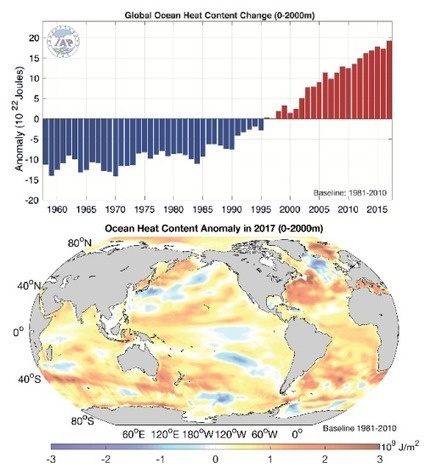
2017 was the warmest year on record for the global ocean according to an updated ocean analysis from Institute of Atmospheric Physics/Chinese Academy of Science (IAP/CAS). The oceans in the upper 2000 m were 1.51 × 10^22 J warmer than the second warmest year of 2015 and 19.19 × 10^22 J above the 1981–2010 climatological reference period. Owing to its large heat capacity, the ocean accumulates the warming derived from human activities; indeed, more than 90% of Earth’s residual heat related to global warming is absorbed by the ocean. As such, the global ocean heat content record robustly represents the signature of global warming and is impacted less by weather-related noise and climate variability such as El Niño and La Niña events. According to the IAP ocean analysis, the last five years have been the five warmest years in the ocean. Therefore, the long-term warming trend driven by human activities continued unabated.
The increase in ocean heat content for 2017 occurred in most regions of the world (Figure). The human greenhouse gas footprint continues to impact the Earth system. Increases in ocean temperature cause ocean volume expansion, which contributes to the global mean sea level rise. The increase in ocean heat of 1.51 × 10^22 J in 2017 resulted in a 1.7 mm sea global level rise. Other consequences include declining ocean oxygen, bleaching of coral reefs, and melting sea ice and ice shelves.
Mice with vision enhanced by nanotechnology were able to see infrared light as well as visible light, reports a study published February 28 in the journal Cell. A single injection of nanoparticles in the mice's eyes bestowed infrared vision for up to 10 weeks with minimal side effects, allowing them to see infrared light even during the day and with enough specificity to distinguish between different shapes. These findings could lead to advancements in human infrared vision technologies, including potential applications in civilian encryption, security, and military operations.
Humans and other mammals are limited to seeing a range of wavelengths of light called visible light, which includes the wavelengths of the rainbow. But infrared radiation, which has a longer wavelength, is all around us. People, animals and objects emit infrared light as they give off heat, and objects can also reflect infrared light.
"The visible light that can be perceived by human's natural vision occupies just a very small fraction of the electromagnetic spectrum," says senior author Tian Xue of the University of Science and Technology of China. "Electromagnetic waves longer or shorter than visible light carry lots of information."
A multidisciplinary group of scientists led by Xue and Jin Bao at the University of Science and Technology of China as well as Gang Han at the University of Massachusetts Medical School, developed the nanotechnology to work with the eye's existing structures. When light enters the eye and hits the retina, the rods and cones -- or photoreceptor cells -- absorb the photons with visible light wavelengths and send corresponding electric signals to the brain," says Han. "Because infrared wavelengths are too long to be absorbed by photoreceptors, we are not able to perceive them."
In this study, the scientists made nanoparticles that can anchor tightly to photoreceptor cells and act as tiny infrared light transducers. When infrared light hits the retina, the nanoparticles capture the longer infrared wavelengths and emit shorter wavelengths within the visible light range. The nearby rod or cone then absorbs the shorter wavelength and sends a normal signal to the brain, as if visible light had hit the retina. "In our experiment, nanoparticles absorbed infrared light around 980 nm in wavelength and converted it into light peaked at 535 nm, which made the infrared light appear as the color green," says Bao.
The researchers tested the nanoparticles in mice, which, like humans, cannot see infrared naturally. Mice that received the injections showed unconscious physical signs that they were detecting infrared light, such as their pupils constricting, while mice injected with only the buffer solution didn't respond to infrared light.
To test whether the mice could make sense of the infrared light, the researchers set up a series of maze tasks to show the mice could see infrared in daylight conditions, simultaneously with visible light. In rare cases, side effects from the injections such as cloudy corneas occurred but disappeared within less than a week. This may have been caused by the injection process alone because mice that only received injections of the buffer solution had a similar rate of these side effects. Other tests found no damage to the retina's structure following the sub-retinal injections.
"In our study, we have shown that both rods and cones bind these nanoparticles and were activated by the near infrared light," says Xue. "So we believe this technology will also work in human eyes, not only for generating super vision but also for therapeutic solutions in human red color vision deficits."
This pi day, we can write down more digits of the famous irrational number than ever before. An extra 9 trillion digits after the decimal point have been discovered, smashing the previous world record set back in 2013.
In November, after 105 days of round the clock computation, pi enthusiast Peter Trueb’s computer finally calculated 22,459,157,718,361 fully verified digits of pi. “I was really surprised that it worked so smoothly, I was so happy,” says Trueb, who is an R&D scientist by day.
Trueb realized that breaking the pi world record required two things: fast computation and fast storage. Luckily, the company that he works for, Dectris, has experience with both, and was willing to sponsor the project. He built a computer with 24 hard drives, each containing 6 terabytes of memory, to store the huge quantity of data produced with each step of the process. To run the calculations, he used a computer program called γ-cruncher developed by Alexander Yee that is available for free online.
Yee developed γ-cruncher as a hobby when he was in high school, and now works for a hedge fund in Chicago. The software uses the Chudnovsky algorithm for calculating pi. It’s quite a complicated mathematical formula, but what really makes γ-cruncher useful is its ability to perform calculations with trillions of digits. “Imagine trying to multiply two numbers that are a trillion digits long on a blackboard. It just wouldn’t work,” Yee says. “Instead, we need lots of fancy algorithms to streamline the calculations.”
This is not the first time γ-cruncher has broken pi world records, but previously Yee has played a role. “It was a complete surprise. Normally people run their setup past me first to check if things will run smoothly,” he says. “Peter just sent me an email one day saying that he had broken the world record.” The final file containing the 22 trillion digits of pi is nearly 9 terabytes in size. If printed out, it would fill a library of several million books containing a thousand pages each.
If you measure the polarization of a photon, you instantly change it. Utility companies could use this fact to detect snoops trying to invade the system.
Cybersecurity experts have sounded the alarm for years: Hackers are ogling the U.S. power grid. The threat isn’t merely hypothetical—a group affiliated with the Russian government gained remote access to energy companies’ computers, the Department of Homeland Security published last March. In some cases, the hackers could even directly send commands to mess with hardware, which meant they could have cut off the power entirely to customers’ homes.
To shut these hackers out, utility companies need better security. One group of physicists think they have a patch: quantum-encrypted power stations. They tested the idea this February, hauling several SUVs’ worth of lasers, electronics, and extremely sensitive detectors from Oak Ridge National Laboratory, Tennessee, down to Chattanooga. After a hundred-mile drive, they pulled the vehicles up to EPB, the local utility company, and hooked up their machines to some of EPB’s unused optical fiber. Over the period of a week, they repeatedly directed infrared light down the fiber in a 25-mile loop and monitored the properties of the light as it went out and back, out and back. And during that demo, they showed how two different quantum encryption systems could be integrated into existing grid infrastructure. “We’re hoping to show that the concept can be deployed today,” says physicist Nick Peters of Oak Ridge.
Using this equipment, they successfully sent and received a series of numbers known as a key using a protocol known as quantum key distribution, or QKD, which guarantees that nobody has tampered with the numbers. QKD secures data by exploiting the strange rules of quantum mechanics.
Roughly, here’s how it works: The sender beams single infrared photons oriented in different directions—polarizations—that correspond to 1’s and 0’s. A receiver measures those orientations. Then, the sender and receiver compare some of their numbers. In quantum mechanics, if you measure a photon’s polarization, you instantly alter it from one state to another. If a hacker had tried to intercept the photons, they would have introduced a telltale statistical error in the numbers, and you would know that the connection was not secure. “QKD gives you the confidence that the key has not changed from when it was sent,” says Donna Dodson, a cybersecurity expert at the National Institute of Standards and Technology.
If the stats look good, the sender and receiver can then go ahead and use that key to scramble a message. “It’s based on your trust of physics,” says Peters. This is in contrast with conventional encryption methods, which guarantee security by assuming computers aren’t fast enough to decipher their algorithms in a reasonable amount of time. Peters’s group thinks that a utility company could use quantum-encrypted data to communicate with their hardware. For someone to intercept or change a quantum-encrypted data stream, they’d have to defy quantum mechanics.
The approach comes with technical challenges, of course. One challenge is simply the reality of working on the grid itself. It’s a mishmash of transformers, switches, and sundry parts installed over various years, and grafting on any new technology is difficult. “You can’t just shut the power off,” says physicist Tom Venhaus of Los Alamos National Laboratory, who collaborated on the project. “It’s like working on a car with its engine running.”
Recent developments in artificial intelligence (AI) point to an age where forgery of documents, pictures, audio recordings, videos, and online identities will occur with unprecedented ease. AI is poised to make high-fidelity forgery inexpensive and automated, leading to potentially disastrous consequences for democracy, security, and society. As an AI researcher, I’m here to sound the alarm, and to suggest a partial solution.
In February 2019, AI-based forgery reached a watershed moment–the OpenAI research company announced GPT-2, an AI generator of text so seemingly authentic that they deemed it too dangerous to release publicly for fears of misuse. Sample paragraphs generated by GPT-2 are a chilling facsimile of human- authored text. Unfortunately, even more powerful tools are sure to follow and be deployed by rogue actors.
Automated forgery is already prevalent on social media, as we witnessed during the 2016 U.S. elections. Twitter has uncovered tens of thousands of automated accounts linked to Russia in the months preceding the 2016 election, according to The Washington Post. Facebook estimated that fake news spread by Russian-backed bots from January 2015 to August 2017 reached potentially half of the 250 million Americans who are eligible to vote.
The problem extends far beyond bots. Doctored images are commonplace, and recent advances in image processing have enabled the creation of realistic fake video. Researchers demonstrated this new capability with AI-generated video of former President Barack Obama speaking phrases that were previously only audio clips.
Then came “deepfakes,” AI-generated videos of entirely new facial expressions of a target person created by stitching together two faces in an eerily convincing way. This face-swapping technology is sufficiently available that it has started appearing in pornography, with several high-profile celebrities‘ faces added to pornographic videos. A viral video of Obama issuing a warning about deepfakes was, itself, a fake.
His estimated age means he was born way back in the 1500s!
Can there really be a living higher animal that’s over five centuries old? It may seem impossible, but scientists have discovered one such beast living in the Northern Atlantic Ocean: a Greenland Shark. It’s long been known that this particular shark is older than most, but scientists had no idea just how old he was until recently. Now that they’ve pinpointed his age to be 512 years old, he’s claimed the title of world’s oldest living vertebrate.
Greenland sharks are one of the slowest growing species in the world, and don’t actually reach full maturity until they’re over 150 years old. Because of this, they typically live for crazy long amounts of time. In fact, previous reports have posited that Greenland sharks can easily live past the age of 400 years.
This 512-year-old shark definitely takes the cake, though. His estimated age means he was born way back in the 1500s! But how do scientists know how old he is? Especially since he’s still alive.
It’s actually fairly simple. Marine biologists measured the amounts of radiocarbon in the eye lenses of the Greenland shark to find his age. They didn’t just measure his, though. They studied a huge swath of Greenland sharks for their research. And because of their hard work, the field is getting much more accurate information, which it has lacked in the past.
Measuring any animal’s age used to take more guesswork than science, but times are changing. While the animals’ size used to be a determining factor for age, it’s been shown to be a poor gauge.
In addition, the Greenland shark doesn’t stay in the same area for its whole life. It’s in their nature to roam around, and so they’re not restricted to just the North Atlantic.
We should not be creating conscious, humanoid agents but an entirely new sort of entity, rather like oracles, with no conscience, no fear of death, no distracting loves and hates.
AI in its current manifestations is parasitic on human intelligence. It quite indiscriminately gorges on whatever has been produced by human creators and extracts the patterns to be found there—including some of our most pernicious habits. These machines do not (yet) have the goals or strategies or capacities for self-criticism and innovation to permit them to transcend their databases by reflectively thinking about their own thinking and their own goals.
They are helpless, not in the sense of being shackled agents or disabled agents but in the sense of not being agents at all—not having the capacity to be “moved by reasons” (as Kant put it) presented to them. It is important that we keep it that way, which will take some doing.
In the long term, “strong AI,” or general artificial intelligence, is possible in principle but not desirable (more on this later). The far more constrained AI that’s practically possible today is not necessarily evil. But it poses its own set of dangers—chiefly that it might be mistaken for strong AI!
To get content containing either thought or leadership enter:
To get content containing both thought and leadership enter:
To get content containing the expression thought leadership enter:
You can enter several keywords and you can refine them whenever you want. Our suggestion engine uses more signals but entering a few keywords here will rapidly give you great content to curate.


 Your new post is loading...