Your new post is loading...

|
Scooped by
Dr. Stefan Gruenwald
May 28, 2019 1:00 PM
|
Astronomers are up in arms about the impact SpaceX's Starlink constellation could have, and fear our views of the night sky could be ruined forever. On Thursday, May 23, 2019, Elon Musk’s SpaceX successfully launched its first 60 Starlink satellites, a planned mega constellation of satellites designed to beam internet from space to the world. But since footage emerged of the train of satellites in the night sky, astronomers have been up in arms at the impact Starlink could have on our views of the cosmos. Starlink is designed to eventually consist of 12,000 satellites, orbiting at altitudes of about 550 kilometers and 1,200 kilometers. SpaceX is one of nine companies known to be working on global space internet, and already concerns have been raised about space junk. Now astronomers too are worried about what the future may hold. “The potential tragedy of a mega-constellation like Starlink is that for the rest of humanity it changes how the night sky looks,” says Ronald Drimmel from the Turin Astrophysical Observatory in Italy. “Starlink, and other mega constellations, would ruin the sky for everyone on the planet.” Following the Starlink launch, several observers – including amateur astronomer Marco Langbroek – captured footage of the satellites in orbit. All 60 were deployed in a train, one behind the other, but astronomers were surprised that the satellites shone brighter than many had expected them to. “What I had not anticipated was how bright the objects were and how spectacular a view it would be,” says Langbroek. “It really was an incredible and bizarre view to see that whole train of objects in a line moving across the sky.”
|
|
Scooped by
Dr. Stefan Gruenwald
May 27, 2019 12:02 PM
|
In the May 2019 edition of the Physics World Stories podcast, Andrew Glester reflects on the biggest astronomy story of the year – the first ever image of a black hole and its “shadow”. Unless you’ve been living in a black hole yourself, you will have seen the glowing donut/eye of Sauron/smiley face, which is actually the supermassive black hole at the centre of the M87 elliptical galaxy, some 55 million light-years from Earth. The image represents an incredible feat of science and engineering, produced from petabytes of data captured by the Event Horizon Telescope (EHT), a network of individual radio telescopes and telescopic arrays scattered across the globe. The EHT team reported the results in six papers in a special issue of Astrophysical Journal Letters, which is published by the Institute of Physics on behalf of the American Astronomical Society. To find out more about the story behind the discovery, Glester catches up with three scientists from the EHT team who also hold positions at Radboud University in the Netherlands. First up is Monika Mościbrodzka, a member of EHT’s data analysis team who speaks about the significance of the discovery and the future prospects for the project. “Black holes are no longer just a theory. It’s now reality”, she says. Meanwhile, Freek Roelof explains how the group generated the image from all the raw radio wave data. He worked on data collection at the Submillimeter Telescope (SMT) on Mount Graham, Arizona. When not doing cutting edge science Roelof plays the guitar and you can hear some of his black-hole-inspired songs in the podcast. Since the publication of the image, many people have asked the question: “Why did these astronomers look all the way to the M87 galaxy, when we have a black hole – Sagittarius A* – at the centre of our own galaxy?” The reason comes down to scale. Despite being a thousand times further away, the black hole at the centre of M87 is a whopping 0.7 billion solar masses, a thousand times more massive than Sagittarius A*. But now that the EHT has proved its capability, you wouldn’t bet against the collaboration capturing an image our Sagittarius A* at some point. In the meantime, you can take a look at this virtual reality simulation based on best-fit models of observations of Sagittarius A*. Its creator, Jordy Davelaar, joins the podcast to explain how and why he created it.
|
|
Scooped by
Dr. Stefan Gruenwald
May 27, 2019 11:56 AM
|
It’s difficult to fathom the immensity of a supermassive black hole, a special kind of object that sits in the center of large galaxies and can grow to billions of times the mass of the Sun. But what’s even more mind-boggling is imagining the cosmic fireworks when these giants crash into each other and unite as one. “When these objects merge, there is more energy produced than the rest of the universe put together,” Paul McNamara, a scientist at the European Space Agency (ESA), told Motherboard over the phone. Scientists have never directly witnessed supermassive black hole mergers, but McNamara and his colleagues plan to change that in the coming decades with two next-generation space observatories, according to an ESA release published on Thursday. The missions—the Advanced Telescope for High-ENergy Astrophysics (Athena) and the Laser Interferometer Space Antenna (LISA)— are both unprecedented. Overview of the Athena and LISA missions. Image: ESA/S. Poletti Athena, currently on track for a 2031 launch, will be the largest X-ray observatory ever built, capable of spotting high-energy sources with up to 100 times the precision of past missions. LISA, slated for liftoff in 2034, is a constellation of three satellites that will fly 1.5 million miles apart in an orbit that trails Earth’s path around the Sun. It will be the first gravitational wave detector in space, attuned to hear ripples in the fabric of spacetime produced by disruptive cosmic events such as supermassive black hole collisions. Though it will take more than a decade to develop the advanced missions, it will be worth the wait if they are able to give humanity its first glimpse of these colossal mergers. “If any of these objects ever merge in the universe, LISA will detect them,” said McNamara, who is on the LISA team at ESA. “It’s quite a phenomenal statement to say, but we can measure these objects out beyond what we call cosmic dawn, before the first stars in the universe.”
|
|
Scooped by
Dr. Stefan Gruenwald
May 27, 2019 11:51 AM
|
Imagine how different our understanding of the Universe would be if we saw nothing beyond the Milky Way. It looks like it's surrounded by other galaxies, and perhaps it is from a certain perspective. But if we were to take that "flight through the Universe" video around MCG+01-02-015's neighborhood, the number of galaxies we'd encounter along that flight would be zero. To the best of our knowledge -- using Hubble Deep Field-quality observations -- this galaxy is all by its lonesome for some hundred million light years in all directions. This ultra distant galaxy is larger and brighter than our own Milky Way, and contains over a trillion stars, perhaps some 5-to-10 times as many as our own galaxy. And well past it, just as in many locations in the Universe, you can see the great cosmic backdrop of galaxies that appear in every broad direction and location we've ever looked. There are other galaxies as well in the general field, but these are either much closer to us (and hence, very far from the main galaxy) than our perspective-free image would indicate, like the spiral below, Many of these void galaxies, located far, far away from any others, are made up of gas that is largely untouched -- other than what formed all on its own -- by any other clumps of matter that came about since the Big Bang. So, we would have come up empty handed if we were looking for the expanding Universe if we were this galaxy instead of being inside our own Milky Way. The telescope that Hubble used to make his Universe-changing discovery was commissioned in 1917, yet we would have found absolutely no other galaxies at all from MCG+01-02-015's perspective throughout all of the 1920s, 30s, 40s and 50s. Would we have stopped looking? Would we have concluded that we were the only galaxy in the Universe, and never have discovered things like the expanding Universe, the Big Bang, and dark matter, which all require other galaxies to reveal themselves to us? How fortunate we are, around the darkest time of the year, that the entire Universe made it easy for us to discover it. How unfortunate must an inhabitant of this distant, lonely galaxy be, that the Universe itself seems to be conspiring to hide itself. And it makes you wonder, just a little bit, in what ways is our galaxy and our position in the Universe unusual, and what incorrect assumptions are we making because we only have one point-of-view to call our own?
|
|
Scooped by
Dr. Stefan Gruenwald
May 25, 2019 1:57 AM
|
The International Thermonuclear Experimental Reactor (ITER) nuclear fusion program reached an important milestone this month. Earlier this month, the director-general of the International Thermonuclear Experimental Reactor (ITER) announced that construction of the project had reached the halfway point. It’s an important milestone for the multi-billion-dollar facility being constructed in southern France. The goal is to begin generating plasma, an essential component of nuclear fusion reactors, by 2025. ITER (Latin for “Way”) is a partnership of 35 countries, all hoping to share in the scientific rewards. “This gives us confidence as we face the remaining 50 percent,” Dr. Bernard Bigot of ITER told the journal Live Science. When completed, the plasma circulating in the core of the reactor will be 270 million degrees Fahrenheit, or about ten times hotter than the sun. The massive superconducting magnets surrounding the core will be cooled to minus 452 degrees, as cold as the depths of space. “So many of the technologies involved are really at the cutting edge,” Bigot said. Unlike traditional nuclear reactors, which generate power by splitting larger atoms into smaller ones, the ITER fusion reactor will combine hydrogen isotopes (deuterium and tritium). At extremely high temperatures, hydrogen gas can become plasma — sometimes called the fourth state of matter — where the electrons are separated from their nuclei. Most experimental fusion reactors use a tokamak, which is a superheated donut-shaped device surrounded by superconducting magnets that control the plasma inside. It’s basically a steam engine — the heat generated by the reaction is absorbed by the walls of the reactor and used to produce steam for electricity generation. It takes a lot of power to create fusion, and the challenge is to make the reaction self-sustaining so it produces more power than is put into it. There are other fusion reactors in operation, but ITER is the largest, with ten times more plasma capacity than any other reactor. Still, it’s just a prototype. If successful, commercial fusion reactors would produce 10 to 15 times more power. Wendelstein 7-X, a fusion reactor in Germany, recently went online for the first time, and may be able to generate self-sustaining plasma. However, Jonathan Menard of the Princeton Plasma Physics Lab told Business Insider that it’s unlikely to generate enough surplus energy to create electricity. Another experimental concept envisions fusion reactions powered by lasers, but most scientists think the ITER project is the most promising. “So far, the laser based systems are pretty inefficient and we think the [plasma] fusion systems are closer to having net energy,” Menard said. ITER is on schedule for “first plasma” in 2025, and by the 2030s they hope to generate ten times more power than goes into it, laying the groundwork for a clean energy revolution. “With ITER and fusion energy, we have a chance to leave a powerful and positive legacy for future generations,” Bigot said.
|
|
Scooped by
Dr. Stefan Gruenwald
May 24, 2019 12:45 PM
|
Investigating inside the human body often requires cutting open a patient or swallowing long tubes with built-in cameras. But what if physicians could get a better glimpse in a less expensive, invasive, and time-consuming manner? A team from MIT’s Computer Science and Artificial Intelligence Laboratory (CSAIL) led by Professor Dina Katabi is working on doing exactly that with an “in-body GPS" system dubbed ReMix. The new method can pinpoint the location of ingestible implants inside the body using low-power wireless signals. These implants could be used as tiny tracking devices on shifting tumors to help monitor their slight movements. In animal tests, the team demonstrated that they can track the implants with centimeter-level accuracy. The team says that, one day, similar implants could be used to deliver drugs to specific regions in the body. ReMix was developed in collaboration with researchers from Massachusetts General Hospital (MGH). The team describes the system in a paper that's being presented at this week's Association for Computing Machinery's Special Interest Group on Data Communications (SIGCOMM) conference in Budapest, Hungary.
|
|
Scooped by
Dr. Stefan Gruenwald
May 23, 2019 2:36 PM
|
Elephants are among the most intelligent animals in the world. Previous studies have found that elephants are able to recognize individual faces and that they have a unique and sophisticated set of social norms which even includes mourning. Recently scientists have discovered that elephants have their own form of rudimentary language which seems primarily designed to warn other members of their herd about potential threats. Researchers from a collaborative team comprising scientists from Oxford University, Save the Elephants and Disney’s Animal Kingdom have been studying the noises elephants make when exposed to certain threats. The researchers found that if elephants are exposed to the sound of a human voice, specifically speaking in the language of the Samburu tribe of northern Kenya, that elephants become vigilant and emit a distinctive noise that sounds like a low rumble. Other elephants, not exposed to the human voice, reacted to the elephant alarm by running away and making the exact same rumbling noise.
|
|
Scooped by
Dr. Stefan Gruenwald
May 23, 2019 12:36 AM
|
The U.S. government is considering barring two Chinese video-surveillance giants from purchasing U.S. technology, but their cameras are already scanning suburban streets and Army bases across America. Hangzhou Hikvision Digital Technology Co. and Zhejiang Dahua Technology Co. may not be household names but chances are their security cameras have filmed you. Together, the two companies control one-third of the global market for video surveillance, according to a report by Deutsche Bank AG, with their cameras securing businesses, airports, schools and government offices in the U.S. -- and around the world. In the U.K. for instance, they keep watch over London’s subway system and have reportedly been installed within the Houses of Parliament. The tightening noose around Chinese technology firms is driven by the Trump administration’s view that China poses an economic, technological and political threat, a stance that country is likely to retaliate against. The two companies prompted concern that they could be employed in espionage, according to people familiar with the matter. Last week, the administration banned Huawei Technologies Co. from purchasing American technology amid similar suspicions of spying capabilities and Chinese laws that could require home-grown firms to hand over information if asked. The U.S. is also considering curbs on China’s Xiamen Meiya Pico Information Co., Beijing Megvii Co., and Iflytek Co., that would bar them from buying U.S. components or software, people familiar with the matter said. All three are technology companies and Megvii is one of the world’s most valuable startups working on artificial intelligence.
|
|
Scooped by
Dr. Stefan Gruenwald
May 22, 2019 9:19 PM
|
Rice University synthetic biologists have hacked bacterial sensing with a plug-and-play system that could be used to mix-and-match tens of thousands of sensory inputs and genetic outputs. The technology has wide-ranging implications for medical diagnostics, the study of deadly pathogens, environmental monitoring and more. In a project spanning almost six years, Rice bioengineer Jeff Tabor and colleagues conducted thousands of experiments to show they could systematically rewire two-component systems, the genetic circuits bacteria use to sense their surroundings and listen to their neighbors. Their work appears in a study published this week in Nature Chemical Biology. Tabor's group rewired the outputs of known bacterial sensors and also moved sensors between distantly related bacteria. Most importantly, they showed they could identify the function of an unknown sensor. "Based on genomic analyses, we know there are at least 25,000 two-component systems in bacteria," said Tabor, associate professor of bioengineering at Rice's Brown School of Engineering and the lead scientist on the project. "However, for about 99% of them, we have no idea what they sense or what genes they activate in response." The importance of a new tool that unlocks two-component systems is underscored by the 2018 discovery of two strains of a deadly, multidrug-resistant bacterium that uses an unknown two-component system to evade colistin, an antibiotic of last resort. But Tabor said the possible uses of the tool extend beyond medicine. "This is nature's greatest treasure trove of biosensors," he said. "Based on the exquisite specificity and sensitivity of some of the two-component systems we do understand, it's widely believed bacterial sensors will outperform anything humans can make with today's best technology." Tabor said that is because bacterial sensors have been honed and refined through billions of years of evolution.
|
|
Scooped by
Dr. Stefan Gruenwald
May 22, 2019 9:14 PM
|
A technology that functions like a brain? In these times of artificial intelligence, this no longer seems so far-fetched -- for example, when a mobile phone can recognize faces or languages. With more complex applications, however, computers still quickly come up against their own limitations. One of the reasons for this is that a computer traditionally has separate memory and processor units -- the consequence of which is that all data have to be sent back and forth between the two. In this respect, the human brain is way ahead of even the most modern computers because it processes and stores information in the same place -- in the synapses, or connections between neurons, of which there are a million-billion in the brain. An international team of researchers from the Universities of Münster (Germany), Oxford and Exeter (both UK) have now succeeded in developing a piece of hardware which could pave the way for creating computers which resemble the human brain. The scientists managed to produce a chip containing a network of artificial neurons that works with light and can imitate the behavior of neurons and their synapses. The researchers were able to demonstrate, that such an optical neurosynaptic network is able to "learn" information and use this as a basis for computing and recognizing patterns -- just as a brain can. As the system functions solely with light and not with traditional electrons, it can process data many times faster. "This integrated photonic system is an experimental milestone," says Prof. Wolfram Pernice from Münster University and lead partner in the study. "The approach could be used later in many different fields for evaluating patterns in large quantities of data, for example in medical diagnoses." The study is published in the latest issue of the "Nature" journal.
|
|
Scooped by
Dr. Stefan Gruenwald
May 22, 2019 9:10 PM
|
Planetologists at the University of Münster (Germany) have now been able to show, for the first time, that water came to Earth with the formation of the Moon some 4.4 billion years ago. The Moon was formed when Earth was hit by a body about the size of Mars, also called Theia. Until now, scientists had assumed that Theia originated in the inner solar system near the Earth. However, researchers from Münster can now show that Theia comes from the outer solar system, and it delivered large quantities of water to Earth. The results are published in the current issue of Nature Astronomy. The formation of the Moon brought water to planet Earth The Earth formed in the 'dry' inner solar system, and so it is somewhat surprising that there is water on Earth. To understand why this the case, we have to go back in time when the solar system was formed about 4.5 billion years ago. From earlier studies, we know that the solar system became structured such that the 'dry' materials were separated from the 'wet' materials: the so-called 'carbonaceous' meteorites, which are relatively rich in water, come from the outer solar system, whereas the drier 'non-carbonaceous' meteorites come from the inner solar system. While previous studies have shown that carbonaceous materials were likely responsible for delivering the water to Earth, it was unknown when and how this carbonaceous material -- and thus the water -- came to Earth.
|
|
Scooped by
Dr. Stefan Gruenwald
May 22, 2019 9:03 PM
|
Genetic testing for pets is expanding. Hundreds of thousands of dogs have now been genetically screened, as Petunia was, and companies are beginning to offer tests for cats. But the science is lagging. Most of these tests are based on small, underpowered studies. Neither their accuracy nor their ability to predict health outcomes has been validated. Most vets don’t know enough about the limitations of the studies, or about genetics in general, to be able to advise worried owners. Pet genetics must be reined in. If not, some companies will continue to profit by selling potentially misleading and often inaccurate information; pets and their owners will suffer needlessly; and opportunities to improve pet health and even to leverage studies in dogs and cats to benefit human health might be lost. Ultimately, people will become more distrustful of science and medicine.
|
|
Scooped by
Dr. Stefan Gruenwald
May 21, 2019 11:26 PM
|
The humble honeybee can use symbols to perform basic maths including addition and subtraction, new research shows. Despite having a brain containing less than one million neurons, the honeybee has recently shown it can manage complex problems – like understanding the concept of zero. Honeybees are a high value model for exploring questions about neuroscience. In our latest study we decided to test if they could learn to perform simple arithmetical operations such as addition and subtraction.
|
|
|
Scooped by
Dr. Stefan Gruenwald
May 27, 2019 12:05 PM
|
A new survey algorithm - called Transit Least-Squares - has just caused the number of known, rocky, Earth-sized worlds orbiting distant stars to grow again, as astronomers add another 18 exoplanets to the list. Exoplanets about the same size as Earth can be some of the most difficult to detect, but their numbers are growing, and now scientists from the Max Planck Institute for Solar System Research, the Georg August University of Göttingen and the Sonneberg Observatory have added 18 more exoplanets to the ever-expanding list (as of May 1, 2019, there were 4,058 confirmed planets in 3,033 systems, with 658 systems having more than one planet). All 18 new exoplanets were found during a re-analysis of data from the highly effective Kepler Space Telescope planet-hunting mission, using a new, more sensitive search algorithm called Transit Least-Squares. The first fruits of the new algorithm may be found in peer-reviewed findings published in the journal Astronomy & Astrophysics in two new papers, here and here. The first paper, focusing on exoplanet K2-32e, was published a few weeks ago, and the second paper regarding the other 17 exoplanets was published on May 21, 2019. These newly-found worlds are some of the smallest detected so far. They range in size from only 69 percent of the diameter of Earth (EPIC 201497682.03, 831 light-years away) to just slightly more than twice as large as Earth. All of them were hiding in the Kepler data, and were not found in previous searches because the search algorithms were not sensitive enough. Like many other exoplanet hunters, Kepler used the transit method, where a planet passes in front of its star, as seen from our vantage point here on Earth. As the planet transits in front of the star, it blocks out a tiny amount of the light coming from the star, which can then be measured by astronomers. As René Heller of Max Planck Institute, first author of both papers, explained: - Standard search algorithms attempt to identify sudden drops in brightness. In reality, however, a stellar disk appears slightly darker at the edge than in the center. When a planet moves in front of a star, it therefore initially blocks less starlight than at the mid-time of the transit. The maximum dimming of the star occurs in the center of the transit just before the star becomes gradually brighter again.
|
|
Scooped by
Dr. Stefan Gruenwald
May 27, 2019 11:59 AM
|
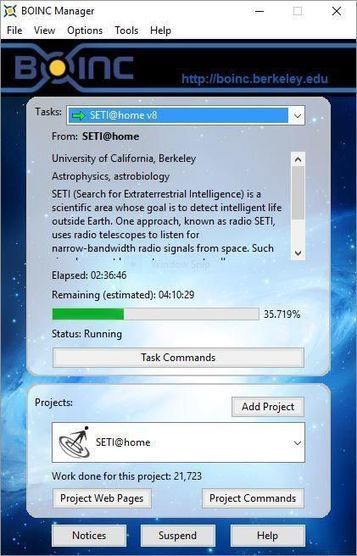
UC Berkeley’s SETI@home, one of the most significant citizen-science projects of the late 20th century, brought the search for intelligent life to PCs. It hasn’t yet found what it set out to, but there’s still hope.
|
|
Scooped by
Dr. Stefan Gruenwald
May 27, 2019 11:54 AM
|
Rice University researchers have simplified the synthesis of a unique, nearly two-dimensional form of iron oxide with strong magnetic properties that is easy to stack atop other 2-D materials. The material, epsilon iron(III) oxide, shows promise as a building block for exotic nanoscale structures that could be useful for spintronic devices, electronic or storage applications that take advantage of not only the charge of electrons but also their spin states. Researchers at Rice's Brown School of Engineering and Wiess School of Natural Sciences reported in the American Chemical Society journal Nano Letters that they had produced oxide flakes through simple chemical vapor deposition. The flakes are easily transferable from their growth substrates and retain their magnetic properties over the long term at room temperature. "Iron oxide is nothing new," said Rice materials scientist and co-principal investigator Jun Lou. "But this epsilon phase is very rare. In epitaxial growth (in which the crystal aligns with the atomic structure of the surface), the bonding is strong and crystals are hard to transfer. But one of the features of this crystal structure is that it has relatively weak interaction with the substrate. You can pick it up and put it on different things."
|
|
Scooped by
Dr. Stefan Gruenwald
May 25, 2019 2:16 AM
|
US scientist says it will be possible to rank embryos by ‘potential IQ’ within 10 years. Couples undergoing IVF treatment could be given the option to pick the “smartest” embryo within the next 10 years, a leading US scientist has predicted. Stephen Hsu, senior vice president for research at Michigan State University, said scientific advances mean it will soon be feasible to reliably rank embryos according to potential IQ, posing profound ethical questions for society about whether or not the technology should be adopted. Hsu’s company, Genomic Prediction, already offers a test aimed at screening out embryos with abnormally low IQ to couples being treated at fertility clinics in the US. “Accurate IQ predictors will be possible, if not the next five years, the next 10 years certainly,” Hsu told the Guardian. “I predict certain countries will adopt them.” Genomic Prediction’s tests are not currently available in the UK, but the company is planning to submit an application to the Human Fertilisation and Embryology Authority by the end of the year, initially to offer a test for risk of type 1 diabetes. The prospect of a new generation of genetically selected babies has prompted concerns about unintended medical consequences and the potential for deepening existing social inequalities. The science underpinning the claim that intelligence can be meaningfully predicted by genetic tests is also contentious. Peter Donnelly, a professor of statistical science at the University of Oxford, said any such IQ predictions should be treated with “huge caution”, adding: “I have grave misgivings about it on ethical grounds. I think it’s a really bad idea.”
|
|
Scooped by
Dr. Stefan Gruenwald
May 25, 2019 1:51 AM
|
The federal Food and Drug Administration has approved a gene therapy for a rare childhood disorder that is now the most expensive drug on the market. It costs $2.125 million per patient. But for those patients lucky enough to get it, it appears it can save their lives with a one-time treatment. Three-year-old Donovan Weisgarber is one of those patients. When he was born he seemed perfectly healthy. But within weeks, it became clear something was terribly wrong. "It was about when he was about one month old that when we started to notice some symptoms," says his mother, Laura Weisgarber, 32, of Columbus, Ohio. Donovan started getting really fussy, stopped squirming, and got weaker and weaker. Donovan had spinal muscular atrophy (SMA), a rare disorder caused by a defective gene; the illness destroys the nerves that control muscles. Babies with the most severe form of the disorder typically don't live past their second birthday. "We were devastated," Weisgarber says, recalling the diagnosis. "It was definitely the worst time of our lives." But then doctors told Laura and her husband, Matthew, about an experimental gene therapy that was being tested for SMA. So they agreed to let them infuse Donovan with genetically modified viruses carrying healthy copies of the gene he needed. Donovan slowly started to improve. Donovan still needs a wheelchair to get around and a feeding tube for nutrition. But otherwise he's doing well, his mother says. And Donovan isn't alone. The gene therapy — called Zolgensma — has been saving other babies with spinal muscular atrophy. "We saw just remarkable results for these kids," says David Lennon, president of AveXis,Inc., of Bannockburn, Ill., the company that developed Zolgensma. The company is owned by drug giant Novartis. In short: - One-time treatment with Zolgensma (onasemnogene abeparvovec-xioi) is designed to replace lifetime of chronic therapy for all pediatric patients with SMA
- Annualized cost of Zolgensma is USD 425,000 per year for 5 years: 50% less than multiple established value-based pricing benchmarks including the 10-year current cost of chronic SMA therapy[1]
- AveXis is working closely with payers to create 5-year outcomes-based agreements and novel pay-over-time options; Time is Neurons program to support rapid SMA treatment post-diagnosis
- Comprehensive OneGene ProgramTM provides dedicated, personalized support for Zolgensma patients
|
|
Scooped by
Dr. Stefan Gruenwald
May 23, 2019 2:37 PM
|
Do humans kill each other because it’s in our blood, or is it all based on our environment? The psychological, sociological and evolutionary roots of conspecific violence in humans are still debated, despite attracting the attention of intellectuals for over two millennia. Back in 2016, after studying more than 4 million murder records across 1,024 mammalian species, evolutionary biologists at the University of Granada found that humans are more vicious than most mammals but generally on par with our primate lineage. Moreover, though we are notorious for killing our own kind, we are not the only ones. In fact, among these 1,024 mammalian species, 60% don't kill their own species, but 40% do. Humans are 6 times more lethal than the average mammal. The average mammal kills 0.3% of its own kind. But what are roots of this conspecific violence? do we kill each other because it’s in our blood, or is it all based on our social organizations and environment?
|
|
Scooped by
Dr. Stefan Gruenwald
May 23, 2019 2:35 PM
|
Physicists developed a way to determine the electronic properties of thin gold films after they interact with light. Nature Communications published the new method, which adds to the understanding of the fundamental laws that govern the interaction of electrons and light.
“Surprisingly, up to now there have been very limited ways of determining what exactly happens with materials after we shine light on them,” says Hayk Harutyunyan, an assistant professor of physics at Emory University and lead author of the research. “Our finding may pave the way for improvements in devices such as optical sensors and photovoltaic cells.”
From solar panels to cameras and cell phones — to seeing with our eyes — the interaction of photons of light with atoms and electrons is ubiquitous. “Optical phenomenon is such a fundamental process that we take it for granted, and yet it’s not fully understood how light interacts with materials,” Harutyunyan says.
One obstacle to understanding the details of these interactions is their complexity. When the energy of a light photon is transferred to an electron in a light-absorbing material, the photon is destroyed and the electron is excited from one level to another. But so many photons, atoms and electrons are involved — and the process happens so quickly — that laboratory modeling of the process is computationally challenging.
For the Nature Communications paper, the physicists started with a relatively simple material system — ultra-thin gold layers — and conducted experiments on it.
“We did not use brute computational power,” Harutyunyan says. “We started with experimental data and developed an analytical and theoretical model that allowed us to use pen and paper to decode the data.”
|
|
Scooped by
Dr. Stefan Gruenwald
May 22, 2019 9:21 PM
|
What if drones and self-driving cars had the tingling “spidey senses” of Spider-Man? They might actually detect and avoid objects better, says Andres Arrieta, an assistant professor of mechanical engineering at Purdue University, because they would process sensory information faster. Better sensing capabilities would make it possible for drones to navigate in dangerous environments and for cars to prevent accidents caused by human error. Current state-of-the-art sensor technology doesn’t process data fast enough – but nature does. And researchers wouldn’t have to create a radioactive spider to give autonomous machines superhero sensing abilities. Instead, Purdue researchers have built sensors inspired by spiders, bats, birds and other animals, whose actual spider-like senses are nerve endings linked to special neurons called mechanoreceptors. In nature, ‘spider-senses’ are activated by a force associated with an approaching object. Researchers are giving autonomous machines the same ability through sensors that change shape when prompted by a predetermined level of force. The nerve endings – mechanosensors – only detect and process information essential to an animal’s survival. They come in the form of hair, cilia or feathers. “There is already an explosion of data that intelligent systems can collect – and this rate is increasing faster than what conventional computing would be able to process,” said Arrieta, whose lab applies principles of nature to the design of structures, ranging from robots to aircraft wings. “Nature doesn’t have to collect every piece of data; it filters out what it needs,” he said. Many biological mechanosensors filter data – the information they receive from an environment – according to a threshold, such as changes in pressure or temperature. A spider’s hairy mechanosensors, for example, are located on its legs. When a spider’s web vibrates at a frequency associated with prey or a mate, the mechanosensors detect it, generating a reflex in the spider that then reacts very quickly. The mechanosensors wouldn’t detect a lower frequency, such as that of dust on the web, because it’s unimportant to the spider’s survival.
|
|
Scooped by
Dr. Stefan Gruenwald
May 22, 2019 9:17 PM
|
University of Chicago scientists are part of an international research team that has discovered superconductivity—the ability to conduct electricity perfectly—at the highest temperatures ever recorded. Using advanced technology at UChicago-affiliated Argonne National Laboratory, the team studied a class of materials in which they observed superconductivity at temperatures of about minus-23 degrees Celsius (minus-9 degrees Fahrenheit)—a jump of about 50 degrees compared to the previous confirmed record. Though the superconductivity happened under extremely high pressure, the result still represents a big step toward creating superconductivity at room temperature—the ultimate goal for scientists to be able to use this phenomenon for advanced technologies. The results were published May 22 in the journal Nature; Vitali Prakapenka, a research professor at the University of Chicago, and Eran Greenberg, a postdoctoral scholar at the University of Chicago, are co-authors of the research. Just as a copper wire conducts electricity better than a rubber tube, certain kinds of materials are better at becoming superconductive, a state defined by two main properties: The material offers zero resistance to electrical current and cannot be penetrated by magnetic fields. The potential uses for this are as vast as they are exciting: electrical wires without diminishing currents, extremely fast supercomputers and efficient magnetic levitation trains. But scientists have previously only been able to create superconducting materials when they are cooled to extremely cold temperatures—initially, minus-240 degrees Celsius and more recently about minus-73 degrees Celsius. Since such cooling is expensive, it has limited their applications in the world at large.
|
|
Scooped by
Dr. Stefan Gruenwald
May 22, 2019 9:12 PM
|
University of British Columbia researchers have developed a specialized microscope that has the potential ability to both diagnose diseases that include skin cancer and perform incredibly precise surgery—all without cutting skin. The researchers describe the technology in a study published today in Science Advances. “Our technology allows us to scan tissue quickly, and when we see a suspicious or abnormal cell structure, we can perform ultra-precise surgery and selectively treat the unwanted or diseased structure within the tissue—without cutting into the skin,” said Yimei Huang, co-lead author of the study and a former postdoctoral fellow at the department of dermatology and skin science at UBC and BC Cancer. Huang co-led the study with Zhenguo Wu, a UBC PhD student. The device is a specialized type of multiphoton excitation microscope that allows imaging of living tissue up to about one millimeter in depth using an ultrafast infrared laser beam. What sets the researchers’ microscope apart from previous technology is that it’s capable of not only digitally scanning living tissue, but also treating the tissue by intensifying the heat produced by the laser. When applied to treating diseases of the skin, the microscope allows medical professionals to pinpoint the exact location of the abnormality, diagnose it and treat it instantly. It could be used to treat any structure of the body that is reached by light and that requires extremely precise treatment, including nerves or blood vessels in the skin, eye, brain or other vital structures. “We can alter the pathway of blood vessels without impacting any of the surrounding vessels or tissues,” said study co-author Harvey Lui, professor at the department of dermatology and skin science at UBC and the Vancouver Coastal Health Research Institute, and a dermatologist at BC Cancer. “For diagnosing and scanning diseases like skin cancer, this could be revolutionary.”
|
|
Scooped by
Dr. Stefan Gruenwald
May 22, 2019 9:05 PM
|
Curtin University researchers are part of an international project that will use a huge underwater neutrino telescope at the bottom of the Mediterranean Sea to help explain some of the most powerful and mysterious events in the universe. Located at two sites at depths of up to 3,500 meters, the KM3NeT telescope will occupy more than a cubic kilometer of water, and will comprise of hundreds of vertical detection lines anchored to the seabed and held in place by buoys when complete. Dr. Clancy James, from the Curtin Institute of Radio Astronomy and the International Centre for Radio Astronomy Research (ICRAR), said such a huge volume of water was required to surround the instruments because neutrinos were otherwise difficult to detect. "Neutrinos very rarely interact, however when a neutrino hits water it generates light, which the KM3NeT telescope is able to detect," Dr. James said. "The underwater telescope is bombarded by millions of different particles but only neutrinos can pass through the Earth to reach the detector from below so, unlike normal telescopes, it looks down through the Earth at the same sky viewed by upward-facing telescopes in Australia." Dr. James said KM3NeT needed to be incredibly sensitive because the light detected from neutrino interactions was about as faint as the light from a lightbulb in Sydney as seen from Perth. "Each line has 18 modules equipped with light sensors along its length and, in the darkness of the deep ocean, these sensors register the faint flashes of a special light that signals the interaction of neutrinos with the seawater," Dr. James said. "This project will help us answer some of the major questions around particle physics and the nature of our universe, potentially ushering in a new era in neutrino astronomy."
Dense rainforests, maple-blanketed mountains and sweeping coniferous forests demonstrate the growth and proliferation of trees adapted to specific conditions. The regional dominance of tree species we see on the surface, however, might actually have been determined underground long ago.
Princeton University researchers report that the organization of forests worldwide—such as conifers in northern boreal forests or the broad-leafed trees of the tropics—are based on the ancient relationships that plant species forged with soil-dwelling microbes such as fungi and bacteria. These tiny organisms, known as symbionts, enhance the roots' uptake of the crucial nutrients nitrogen and phosphorus.
Via Jean-Michel Ané
|