Your new post is loading...

|
Scooped by
Dr. Stefan Gruenwald
February 5, 2012 10:38 AM
|
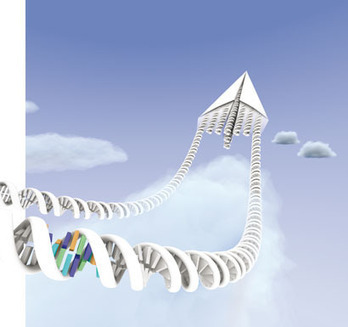
Automated genetic tinkering is just the start – this machine could be used to rewrite the language of life and create new species of humans Say hello to the evolution machine. It can achieve in days what takes genetic engineers years. So far it is just a prototype, but if its proponents are to be believed, future versions could revolutionise biology, allowing us to evolve new organisms or rewrite whole genomes with ease. It might even transform humanity itself.
|
|
Scooped by
Dr. Stefan Gruenwald
February 4, 2012 8:54 PM
|
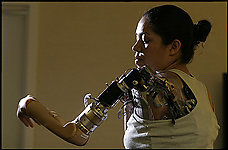
Claudia Mitchell, who lives in Ellicott City, is the fourth person -- and first woman -- to receive a "bionic" arm, which allows her to control parts of the device by her thoughts alone. The device, designed by physicians and engineers at the Rehabilitation Institute of Chicago, works by detecting the movements of a chest muscle that has been rewired to the stumps of nerves that once went to her now-missing limb.
|
|
Scooped by
Dr. Stefan Gruenwald
February 4, 2012 3:04 PM
|
Last month, a 114-year-old former schoolteacher from Georgia named Besse Cooper became the world's oldest living person. Her predecessor, Brazil's Maria Gomes Valentim, was 114 when she died. So was the oldest living person before her, and the one before her. In fact, eight of the last nine "world's oldest" titleholders were 114 when they achieved the distinction. Here's the morbid part: All but two were still 114 when they passed it on. Those two? They died at 115. Is 115 years the magical limit?
|
|
Rescooped by
Dr. Stefan Gruenwald
from BS2040: Bioinformatics
February 4, 2012 11:49 AM
|
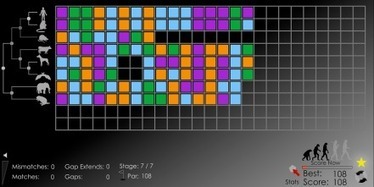
Roughly 17,000 registered players of the DNA sequencing game Phylo have helped solve more than 350,000 problems since November 2010. Read this blog post by Elizabeth Armstrong Moore on Health Tech.
Via Dr Richard Badge
|
|
Scooped by
Dr. Stefan Gruenwald
February 4, 2012 10:40 AM
|
New Hanover County, North Carolina, just rolled out Super Wi-Fi, which is its actual name, not just a patronizing euphemism I'm deploying because I think you can't handle "a new Wi-Fi standard operating in the 'white spaces' between 50-700Mhz, where previously only television stations were allowed to transmit."
|
|
Scooped by
Dr. Stefan Gruenwald
February 4, 2012 10:29 AM
|
The Faculty of 1000 (F1000), in London, has announced an experiment in online science publishing, aimed at sharing research results widely and rapidly, and using open peer review to check postings afterwards.
|
|
Scooped by
Dr. Stefan Gruenwald
February 4, 2012 10:17 AM
|
Currently being developed by DARPA researchers at Washington-based Innovega iOptiks are contact lenses that enhance normal vision by allowing a wearer to view virtual and augmented reality images without the need for bulky apparatus. Instead of oversized virtual reality helmets, digital images are projected onto tiny full-color displays that are very near the eye. These novel contact lenses allow users to focus simultaneously on objects that are close up and far away. This could improve ability to use tiny portable displays while sill interacting with the surrounding environment.
|
|
Rescooped by
Dr. Stefan Gruenwald
from Science News
February 4, 2012 10:03 AM
|
Mars may have been arid for more than 600 million years, making it too hostile for any life to survive on the planet's surface, according to researchers who have been carrying out the painstaking task of analysing individual particles of Martian...
Via Sakis Koukouvis
|
|
Scooped by
Dr. Stefan Gruenwald
February 4, 2012 9:55 AM
|
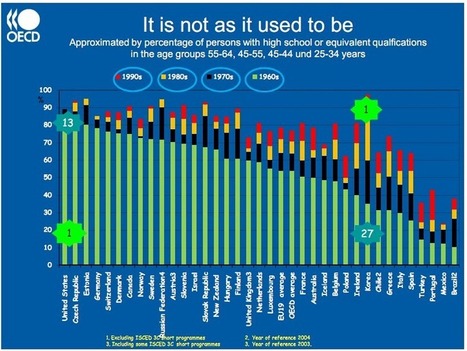
Life in this world is not like it used to be just a few decades ago, and the availability of world-class education on-demand, at almost no cost, is likely to help things change all the more as this century unfolds. YouTube now hosts more than 500,000 educational videos, on a wide variety of topics. The new mobile-friendly iTunes U also offers 500,000 educational resources and says that 60% of its viewership comes from outside the United States. This global consumption of U.S.-created online educational content may be the newest chapter in a radical transformation of global education over the past 50 years.
|
|
Scooped by
Dr. Stefan Gruenwald
February 4, 2012 12:44 AM
|
Colossal black holes with a mass of up to 50 billion suns could be lurking out there - but that's the limit. Giant black holes sit at the cores of virtually all galaxies, and are thought to have grown from smaller seed black holes that swallowed lots of matter. The biggest well-measured one resides in the galaxy Messier 87 and has the mass of 3 billion suns, a measurement based on the speed of the gas swirling around it.
|
|
Rescooped by
Dr. Stefan Gruenwald
from Tracking the Future
February 4, 2012 12:17 AM
|
Keep in mind that the first wave of driverless vehicles will be luxury vehicles that allow you to kick back, listen to music, have a cup of coffee, stop wherever you need to along the way, stay productive with connections to the Internet, make phone calls, and even watch a movie or two, for roughly the same price. If you think this vision is far off, think again. Over the next 10 years we will see the first wave of autonomous vehicles hit the roads, with some of the first inroads made with vehicles that deliver packages, groceries, and fast-mail envelopes.
Via Szabolcs Kósa
|
|
Rescooped by
Dr. Stefan Gruenwald
from Web 3.0
February 2, 2012 12:11 PM
|
It seems fitting that the Internet itself is rife with speculation about what form the successor to Web 2.0 will take. Are we nearing a new age for the Internet? Will Web 3.0 be a revolutionary shift and what exactly will its central features be?
Via Pierre Tran
|
|
Scooped by
Dr. Stefan Gruenwald
February 2, 2012 12:13 PM
|
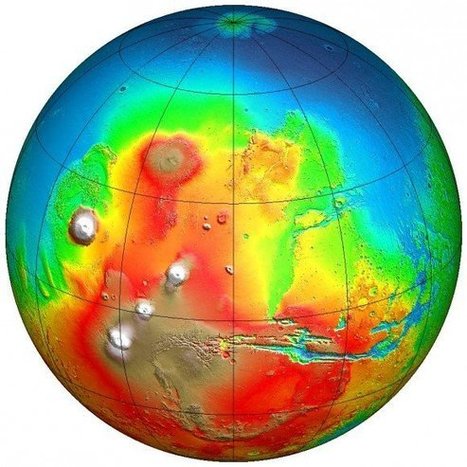
For a long time now, evidence has continued to indicate that Mars was once a water world – near-surface groundwater, lakes, rivers, hot springs and, according to some planetary models, even an ancient ocean in the northern hemisphere.
|
|
|
Scooped by
Dr. Stefan Gruenwald
February 5, 2012 11:01 AM
|
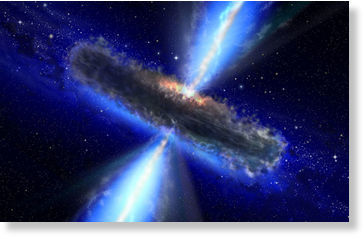
Two teams of astronomers have discovered the largest and farthest reservoir of water ever detected in the universe. Looking from a distance of 30 billion trillion miles away into a quasar - one of the brightest and most violent objects in the cosmos - the researchers, led by scientists at the California Institute of Technology (Caltech), have found a mass of water vapour that's at least 140 trillion times that of all the water in the world's oceans combined, and 100,000 times more massive than the sun. Because the quasar is so far away, its light has taken 12 billion years to reach Earth. The observations therefore reveal a time when the universe was just 1.6 billion years old.
|
|
Scooped by
Dr. Stefan Gruenwald
February 4, 2012 3:13 PM
|
Scientists believe that 80 percent of the volcanic eruptions on Earth take place in the ocean. Most of these volcanoes are thousands of feet deep, and difficult to find. But in May of 2009, scientists captured the deepest ocean eruption ever found. Nearly 4000 feet below the surface of the Pacific Ocean — in an area between Samoa, Fiji and Tonga - the West Mata volcano was discovered. The explosions of molten rock were spectacular. This volcano was producing Boninite lavas — believed to be among the hottest erupting on Earth.
|
|
Scooped by
Dr. Stefan Gruenwald
February 4, 2012 10:26 AM
|
PCM memory's true potential lies in its ability to store more than a single bit per cell. It can hold multiple states at once could mean digital information is about more than just 1s and 0s. The technology relies upon phase change materials (PCMs) that can hold information by switching between an amorphous state and a crystalline one. PCM memory can write and retrieve data 100 times faster than Flash memory, which is used in many consumer gadgets and computers. It is also extremely durable and can be reused at least 10 million times; Flash can cope with just 3000 uses.
|
|
Scooped by
Dr. Stefan Gruenwald
February 4, 2012 10:42 AM
|
Radiation from the Linac Coherent Light Source (LCLS), located at the Stanford Linear Accelerator Center (SLAC), at a cell containing neon gas, setting off an avalanche of X-ray emissions to create a new "atomic X-ray laser." The new laser fulfills a 1967 prediction, which proposed that X-ray lasers could be made by first removing inner electrons from atoms and then inducing electrons to fall from higher to lower energy levels, releasing a single color of light in the process.
|
|
Scooped by
Dr. Stefan Gruenwald
February 4, 2012 10:36 AM
|
Built from just the hardware in a commercially-available PogoPlug mini-computer, a few tiny antennae, eight gigabytes of flash memory and some 3D-printed plastic casing, the F-BOMB serves as 3.5 by 4 by 1 inch spy computer. Such a cheap gadget can be dropped from a drone, plugged inconspicuously into a wall socket, thrown over a barrier, or otherwise put into irretrievable positions to quietly collect data and send it back to the owner over any available Wifi network. With PogoPlugs currently on sale at Amazon for $25, O’Connor built his prototypes with gear that added up to just $46 each.
|
|
Scooped by
Dr. Stefan Gruenwald
February 4, 2012 10:21 AM
|
Scientists have succeeded in decoding electrical activity in the brain’s temporal lobe — the seat of the auditory system — as a person listens to normal conversation. Based on this correlation between sound and brain activity, they then were able to predict the words the person had heard solely from the temporal lobe activity. Stroke victims or paralyzed people unable to speak will someday be able to communicate via synthesizers that decode their internal speech and play it back.
|
|
Scooped by
Dr. Stefan Gruenwald
February 4, 2012 10:10 AM
|
Antarctica makes up more than 10 percent of the world's land mass, but it was long assumed that -- except for some hardy penguins -- it had virtually no life. With ice and snow blanketing virtually the entire continent, the environment was believed to be just too harsh and barren to support anything beyond occasional human visitors.
|
|
Rescooped by
Dr. Stefan Gruenwald
from Science News
February 4, 2012 9:58 AM
|
With the relentless rise of DNA nanotechnology's popularity, Emma Davies explores the role chemistry has played in its success. As a supramolecular chemist, Hanadi Sleiman found herself strongly drawn to manmade DNA structures. 'We think of DNA as the most programmable structure there is. I thought - if it is - let me try to incorporate it into regular supramolecular structures,' says the professor at McGill University, Montreal, Canada. She hasn't looked back. 'What is really beautiful about DNA structures is the fact that you can control every single aspect of them,' she exclaims.
Via Sakis Koukouvis
|
|
Scooped by
Dr. Stefan Gruenwald
February 4, 2012 1:06 AM
|
Sandia National Laboratories researchers have built a prototype of a four-inch-long, small-caliber bullet capable of steering itself towards a laser-marked target located approximately 2,000 meters (1.2 miles) away. Aided by little fins, the on-board guidance and control electronics use the information passed on by an optical sensor located in the nose to calculate the flight path.
|
|
Rescooped by
Dr. Stefan Gruenwald
from Tomorrow Now
February 4, 2012 12:24 AM
|
"Now we are in the 6th mass extinction event, which is a result of a competition for resources between one species on the planet – humans – and all others. The process towards extinction is mainly caused by habitat degradation, whose effect on biodiversity is worsened by the ongoing human-induced climate change."
Via Amanda Stoel
|
|
Rescooped by
Dr. Stefan Gruenwald
from Personal Genomics
February 2, 2012 1:29 PM
|
A collection of new studies on the genomes of two model organisms has moved the frontiers of biology forward, and hints at methods that may someday make (RT @ScienceChannel: Early reports from the dark matter of the genome: http://ow.ly/3uNoP)
Via Portable Genomics
|
|
Scooped by
Dr. Stefan Gruenwald
February 2, 2012 12:50 PM
|
'By this time next week, the world will have 7 billion people in it, and this population growth will fundamentally change the way populations use resources like energy, water and food'
|