Your new post is loading...

|
Rescooped by
Dr. Stefan Gruenwald
from singularity+
February 2, 2012 12:09 PM
|
Molecular imaging allows molecules in a living organism to be visualized, and provides a means of observing the distribution and behavior of molecules. “The biggest advantage of molecular imaging using positron emission tomography lies in its applicability to humans.” says Yosky Kataoka, team leader of the Cellular Function Imaging Laboratory at the RIKEN Center for Molecular Imaging Science. Molecular imaging using positron emission tomography (PET) is expected to contribute to the diagnosis of disease, as well as to our understanding of pathologic conditions and therapeutic effects, and to the development of new drugs. It is already being used to diagnose Alzheimer’s disease and cancer. In October 2009, Kataoka’s laboratory announced a groundbreaking achievement that could lead to the development of a diagnostic method for migraine. While many people suffer from migraine, no objective method for diagnosis or treatment has been found so far. Their achievement is attracting attention as a discovery that should dramatically change this situation.
Via Diana Cobbe
|
|
Scooped by
Dr. Stefan Gruenwald
February 2, 2012 11:59 AM
|
Do the principles of quantum mechanics apply to biological systems? Until now, both biologists and physicists have considered quantum systems and biological molecules to be like apples and oranges. Do the principles of quantum mechanics apply to biological systems? Newest research conducted in Germany, which appeared recently in Science, shows that a biological molecule -- DNA -- can discern between certain quantum states like spin.
|
|
Scooped by
Dr. Stefan Gruenwald
February 2, 2012 11:49 AM
|
The Food and Drug Administration approved an expensive new melanoma drug much faster than expected, giving a boost not only to that drug but also to other experimental products that may offer gene-based personalized medicine. Vemurafenib, with the brand name Zelboraf, treats patients with metastatic melanoma who have a certain genetic mutation called BRAF V600E. The drug inhibits the cancer-spreading action of that particular gene, which is held in about 50 percent of people who have metastatic melanoma. The FDA also approved a test for the genetic mutation BRAF V600E in the patient's tumor.
|
|
Scooped by
Dr. Stefan Gruenwald
February 2, 2012 11:43 AM
|
For the last decade cancer research has been guided by a common vision of how a single cell, outcompeting its neighbors, evolves into a malignant tumor. But recent discoveries have been complicating the picture with tangles of new detail. Cancer appears to be even more willful and calculating than previously imagined. Researchers are finding clues that pseudogenes lurking within the so-called "junk" DNA making up over 90% of the total genome play a very important role in cancer.
|
|
Scooped by
Dr. Stefan Gruenwald
February 2, 2012 11:38 AM
|
The company Kogeto Dot will enhance your iPhone into the next millennium, almost! It’s a camera add-on that lets you shoot video (and I take it it’s good for photos as well) in 360 degrees. It’s quite a cool thing, and it could definitely come in handy if you want to cover a whole party or any other event that usually you wouldn’t be able to capture in its full environment to include everyone around you. The price for this addition isn’t too bad either! For just $79, you will get the installation kit. Just snap it onto your iPhone and get ready to shoot! It just doesn’t get any easier than that.
|
|
Scooped by
Dr. Stefan Gruenwald
February 2, 2012 11:22 AM
|
EVER felt a little incoherent? Or maybe you've been in two minds about something, or even in a bit of delicate state. Well, here's your excuse: perhaps you are in thrall to the strange rules of quantum mechanics. We tend to think that the interaction between quantum physics and biology stops with Schrödinger's cat. Not that Erwin Schrödinger intended his unfortunate feline - suspended thanks to quantum rules in a simultaneous state of being both dead and alive - to be anything more than a metaphor. Indeed, when he wrote his 1944 book What is Life?, he speculated that living organisms would do everything they could to block out the fuzziness of quantum physics.
The Internet is so vast and interconnected that it would be impossible to destroy completely; however, there is much about it that could be ruined or lost.
Via Wildcat2030
|
|
Scooped by
Dr. Stefan Gruenwald
April 11, 2012 1:25 PM
|
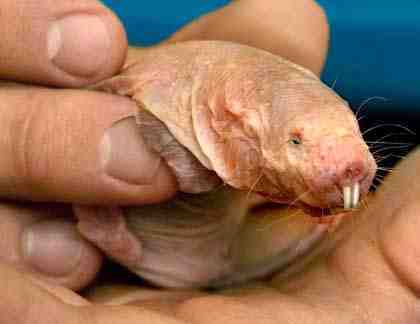
The naked mole rat (Heterocephalus glaber) is a strictly subterranean, extraordinarily long-lived eusocial mammal. Although it is the size of a mouse, its maximum lifespan exceeds 30 years, making this animal the longest-living rodent. Naked mole rats show negligible senescence, no age-related increase in mortality, and high fecundity until death. In addition to delayed ageing, they are resistant to both spontaneous cancer and experimentally induced tumorigenesis. Naked mole rats pose a challenge to the theories that link ageing, cancer and redox homeostasis. Although characterized by significant oxidative stress, the naked mole rat proteome does not show age-related susceptibility to oxidative damage or increased ubiquitination. Naked mole rats naturally reside in large colonies with a single breeding female, the ‘queen’, who suppresses the sexual maturity of her subordinates. They also live in full darkness, at low oxygen and high carbon dioxide concentrations, and are unable to sustain thermogenesis nor feel certain types of pain. Full genome sequencing and analysis of the naked mole rat genome reveals unique genome features and molecular adaptations consistent with cancer resistance, poikilothermy, hairlessness and insensitivity to low oxygen, and altered visual function, circadian rythms and taste sensing.
|
|
Scooped by
Dr. Stefan Gruenwald
February 1, 2012 7:09 PM
|
Researchers recently compared 29 genomes of different mammals in an effort to understand our own genomic mysteries. By looking across species, they have cast new light on the molecular components of all life and have taken an important step toward decrypting the information locked in our own DNA.
|
|
Scooped by
Dr. Stefan Gruenwald
February 1, 2012 6:54 PM
|
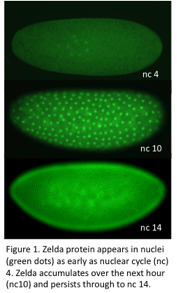
When a female fruit fly makes an egg, she packs it full of everything a developing embryo needs for the earliest stages of its life: a yolk to feed it, and proteins and RNAs to drive its vital cellular processes. Fueled by these maternally deposited molecules, development begins with a series of rapid cell divisions during which there is little, if any, activation of the embryo’s own genome. However, within a few hours, after around 14 cell divisions, the fertilized egg breaks free of its mother’s influence, at a period known as the maternal-to-zygotic transition (MZT). In Drosophila, the MZT is preceded by the transcription of a small number of genes that initiate sex determination, patterning, and other early developmental processes; and the zinc-finger protein Zelda (ZLD) plays a central role in their transcriptional activation.
|
|
Scooped by
Dr. Stefan Gruenwald
February 1, 2012 5:55 PM
|
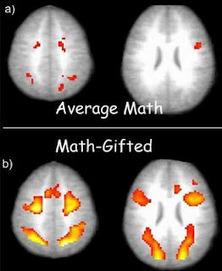
"Most mathematicians did not just take up math as a "job"...(most) get more pleasure out of mathematics than almost any other activity. And they often discovered this pleasure when they were young". While most people would agree that "math people" are not like "non-math people", it's not always easy for non-mathematical minds to recognize (and appropriately nurture) mathematical ones.
|
|
Scooped by
Dr. Stefan Gruenwald
February 1, 2012 4:42 PM
|
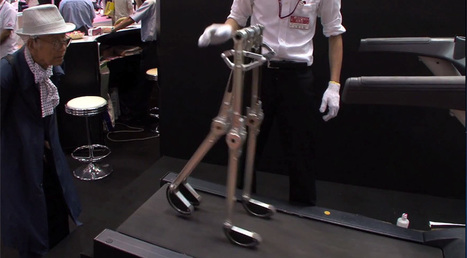
Today's groundbreaking entry into the Uncanny Valley is a pair of mechanical, robot legs that are propelled entirely by their own weight: they can walk with a human-like gait without motors or external control.
|
|
Rescooped by
Dr. Stefan Gruenwald
from Science News
February 1, 2012 4:37 PM
|
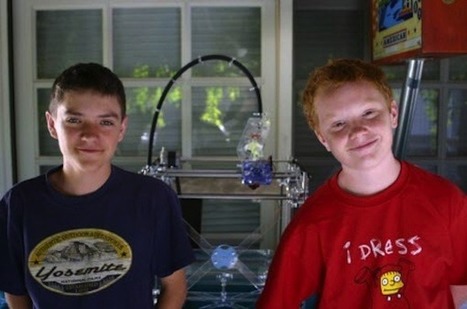
3D printing will be commonplace sooner than most think, says one expert. And kids like these eighth graders are already leading the charge.
Via Sakis Koukouvis
|
|
|
Rescooped by
Dr. Stefan Gruenwald
from The virtual life
February 2, 2012 12:08 PM
|
Editor’s Note: Markus Pössel is a theoretical physicist turned astronomical outreach scientist. He is the managing scientist at the Centre for Astronomy Education and Outreach “Haus der Astronomie” in Heidelberg, Germany.
Via Apmel
|
|
Scooped by
Dr. Stefan Gruenwald
February 2, 2012 11:53 AM
|
IBM's CTO predicts PCs are being replaced at the center of computing not by another type of device — though there's plenty of excitement about smartphones and tablets — but by new ideas about the role that computing can play in progress. It's becoming more and more clear that innovation flourishes best not on devices but in the social spaces between them, where people and ideas meet and interact. It is there that computing can have the most powerful impact on economy, society and people's lives.
|
|
Scooped by
Dr. Stefan Gruenwald
February 2, 2012 11:46 AM
|
For the first time ever, scientists are using computers and genomic information to predict new uses for existing medicines. “Bringing a new drug to market typically takes about $1 billion, and many years of research and development,” said Rochelle M. Long, Ph.D., who directs the NIH Pharmacogenomics Research Network. “If we can find ways to repurpose drugs that are already approved, we could improve treatments and save both time and money.”
|
|
Scooped by
Dr. Stefan Gruenwald
February 2, 2012 11:40 AM
|
A fundamental, previously unknown property of microbial nanowires in the bacterium Geobacter sulfurreducens allows electron transport across long distances. In the laboratory, Geobacter will grow on electrodes, producing thick, electrically conductive biofilms. In a series of studies with genetically modified strains, the researchers found the metallic-like conductivity in the biofilm could be attributed to a network of nanowires spreading throughout the biofilm.
|
|
Scooped by
Dr. Stefan Gruenwald
February 2, 2012 11:34 AM
|
Phase one of the world's first commercial spaceport, which will be the hub for Virgin's consumer spaceflights, is now 90 per cent complete. The 1,800-acre Spaceport America site, in Las Cruces, New Mexico, is the home base for Virgin Galactic, Richard Branson's most ambitious business venture yet. It already boasts a runway stretching to nearly two miles long, a futuristic styled terminal hanger, and a dome-shaped Space Operations Center.
|
|
Scooped by
Dr. Stefan Gruenwald
February 2, 2012 11:19 AM
|
Humans are storytelling machines. We don’t passively perceive the world – we tell stories about it, translating the helter-skelter of events into tidy narratives. This is often a helpful habit, helping us make sense of mistakes, consider counterfactuals and extract a sense of meaning from the randomness of life. But our love of stories comes with a serious side-effect: like all good narrators, we tend to forsake the facts when they interfere with the plot. We’re so addicted to the anecdote that we let the truth slip away until, eventually, those stories we tell again and again become exercises in pure fiction.
Researchers have succeeded in combining the power of quantum computing with the security of quantum cryptography and have shown that perfectly secure cloud computing can be achieved using the principles of quantum mechanics.
Via Annie Infinite
|
|
Scooped by
Dr. Stefan Gruenwald
February 1, 2012 7:13 PM
|
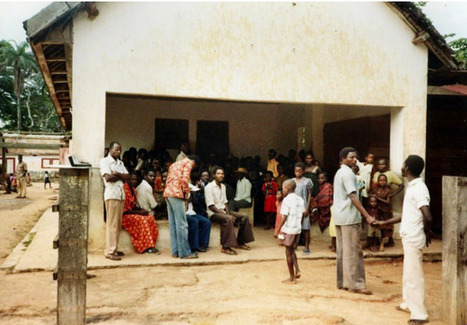
The story begins sometime close to 1921, somewhere between the Sanaga River in Cameroon and the Congo River in the former Belgian Congo. It involves chimps and monkeys, hunters and butchers, “free women” and prostitutes, syringes and plasma-sellers, evil colonial lawmakers and decent colonial doctors with the best of intentions. And a virus that, against all odds, appears to have made it from one ape in the central African jungle to one Haitian bureaucrat leaving Zaire for home and then to a few dozen men in California gay bars before it was even noticed — about 60 years after its journey began.
|
|
Scooped by
Dr. Stefan Gruenwald
February 1, 2012 7:02 PM
|
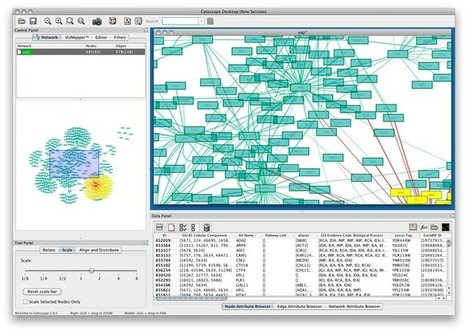
Cytoscape is an open source software platform for visualizing complex networks and integrating these with any type of attribute data. A lot of plugins are available for various kinds of problem domains, including bioinformatics, social network analysis, and semantic web.
|
|
Scooped by
Dr. Stefan Gruenwald
February 1, 2012 6:57 PM
|
Two potent human antibodies that can stop more than 90 percent of known global HIV strains from infecting human cells in the laboratory have been discovered. These antibodies could be used to design improved HIV vaccines, or could be further developed to prevent or treat HIV infection. Moreover, the method used to find these antibodies could be applied to isolate therapeutic antibodies for other infectious diseases as well.
|
|
Scooped by
Dr. Stefan Gruenwald
February 1, 2012 5:47 PM
|
For decades our options for interacting with the digital world have been limited to keyboards, mice, and joysticks. Now with a new generation of exciting new interfaces in the pipeline our interaction with the digital world will be forever changed. In this post we will look at some amazing demonstrations, mostly videos, that showcase new ways of interacting with the digital world.
|
|
Scooped by
Dr. Stefan Gruenwald
February 1, 2012 4:40 PM
|
Puzzles have this paradoxical appeal where no matter how much they give the human mind fits, people can’t seem to put them down. Part of this is a testament to the degree in which we pride ourselves as relentless problem-solvers. But for some of life’s most perplexing problems, it’s becoming more apparent that we’re better off handing them off to computers. A recent demonstration of this can be seen in a video released last week in which a smartphone-powered robot solved the legendary Rubik’s cube in 5.352 second flat, beating the world record of 5.66 seconds set by Feliks Zemdegs (a human).
|