Your new post is loading...

|
Scooped by
Dr. Stefan Gruenwald
September 11, 2016 7:29 PM
|
A giant petri dish exposes the evolutionary dynamics behind antibiotic resistance. For bacteria, practice makes perfect: Adjusting to ever higher levels of antibiotics preps them to morph into super resistant strains, and scientists can now watch it happen. A new device — a huge petri dish coated with different concentrations of antibiotics — makes this normally hidden process visible, microbiologist Michael Baym and colleagues report in the Sept. 9 2016 Science. The setup gives a step-by-step picture of how garden-variety microbes become antibiotic-resistant superbugs. “As someone who’s studied evolutionary biology for a long time, I think it has a real wow factor,” says Sam Brown, a microbiologist at the Georgia Institute of Technology in Atlanta who wasn’t involved in the study. The bacteria are “climbing this impossible mountain of antibiotics.” Scientists often study microbial evolution in flasks where everything is mixed together. “Inside that flask, in order for a new strain to evolve, the new mutant has to be more fit than everything around it,” says Baym, of Harvard Medical School. “But in nature, we see a second dynamic: You don’t necessarily need to be more fit than everything around you. You just need to make it into a new environment.” Baym and colleagues modeled those spatial dynamics using a giant dish more than a meter long instead of a standard palm-sized petri dish. That gave the bacteria more room to diversify and also let the researchers create a gradient of antibiotics on the plate. Low concentrations of trimethoprim or ciprofloxacin antibiotics at the edges ramped up to much higher levels in the middle. Then, the team put Escherichia coli bacteria on each end of the plate and watched the microbes multiply over the next week and a half. In general, as the E. coli mutated in ways that let them handle higher and higher levels of antibiotics, their descendants could press into new territory on the plate. The bacteria that made it to the middle could tolerate doses of antibiotics a thousand times higher than what was necessary to kill the original bacteria.
|
|
Scooped by
Dr. Stefan Gruenwald
September 11, 2016 7:24 PM
|
Researchers have defined what it means for time translation symmetry to be spontaneously broken in a quantum system, and show with analytical arguments and numerical simulations that this occurs in a large class of many-body-localized driven systems with discrete time-translation symmetry.
In 2012 Nobel laureate Frank Wilczek first proposed the idea of time crystals. He argued that these hypothetical objects can exhibit periodic motion, such as moving in a circular orbit, in their state of lowest energy, or their "ground state." Theoretically, objects in their ground states don't have enough energy to move at all.
Physicists from the University of California, Santa Barbara (UCSB) and Microsoft Station Q (a Microsoft research lab located on the UCSB campus) have demonstrated that it may be possible for time crystals to physically exist.
The physicists have focused on the implication of time crystals that seems most surprising, which is that time crystals are predicted to spontaneously break a fundamental symmetry called "time-translation symmetry." To understand what this means, the researchers explain what spontaneous symmetry breaking is.
If time crystals really do spontaneously break time-translation symmetry, then the laws of nature that govern time crystals wouldn't change with time, but the time crystals themselves would change over time due to their ground-state motion, spontaneously breaking the symmetry.
Although spontaneously broken time-translation symmetry has never been observed before, almost every other type of spontaneous symmetry breaking has been. One very common example of a spontaneously broken symmetry occurs in magnets. The laws of nature do not impose which side of a magnet will be the north pole and which will be the south pole. The distinguishing feature of any magnetic material, however, is that it spontaneously breaks this symmetry and chooses one side to be the north pole. Another example is ordinary crystals. Although the laws of nature are invariant under rotating or shifting (translating) space, crystals spontaneously break these spatial symmetries because they look different when viewed from different angles and when shifted a little bit in space.
|
|
Scooped by
Dr. Stefan Gruenwald
September 9, 2016 11:52 AM
|
China is preparing to unveil the world's largest telescope which is due to be put into operation at the end of September. Construction of the Five Hundred Meter Apeture Spherical Telescope, or FAST, has entered its final phase in Pingtang County, China's Guizhou province, reports the People's Daily Online. The giant dish, which took five years to build, is the size of 30 football fields, measuring 1,640 feet in diameter. The Chinese authority relocated 8,000 residents from the area to make room for the ambitious equipment, built to boost the global hunt for extra-terrestrial life. The provincial legislature passed a rule to guarantee the safe operation of the facility. The new rule will come into effect on September 25, according to the local Qiannan Observatory. FAST requires radio silence within a 10-kilometer radius (six miles). The new regulation bans activities such as hunting, wood gathering and land reclamation in the core area and also prohibits construction of irrelevant projects. The telescope is set to be involved in the search for extra-terrestrial life. With its sensitive telescope, it can detect weaker radio signals. It is also due to be used to study the Milky Way in more detail and look for the first shining stars. Despite its end of September start-date, the telescope will need an adjustment period. Peng Bo, director of the NAO Radio Astronomy Technology Laborator told reporters: 'In the first two or three years after its completion, the telescope will undergo further adjustment, and during that period Chinese scientists will use it for early-stage research. After that, it will be open to scientists worldwide'
|
|
Scooped by
Dr. Stefan Gruenwald
September 8, 2016 5:44 PM
|
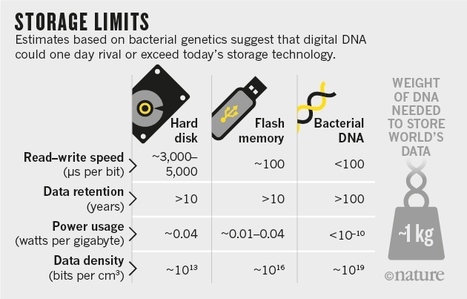
Modern archiving technology cannot keep up with the growing tsunami of bits. But nature may hold an answer to that problem already. For Nick Goldman, the idea of encoding data in DNA started out as a joke. It was Wednesday 16 February 2011, and Goldman was at a hotel in Hamburg, Germany, talking with some of his fellow bioinformaticians about how they could afford to store the reams of genome sequences and other data the world was throwing at them. He remembers the scientists getting so frustrated by the expense and limitations of conventional computing technology that they started kidding about sci-fi alternatives. “We thought, 'What's to stop us using DNA to store information?'” Then the laughter stopped. “It was a lightbulb moment,” says Goldman, a group leader at the European Bioinformatics Institute (EBI) in Hinxton, UK. True, DNA storage would be pathetically slow compared with the microsecond timescales for reading or writing bits in a silicon memory chip. It would take hours to encode data by synthesizing DNA strings with a specific pattern of bases, and still more hours to recover that information using a sequencing machine. But with DNA, a whole human genome fits into a cell that is invisible to the naked eye. For sheer density of information storage, DNA could be orders of magnitude beyond silicon — perfect for long-term archiving. “We sat down in the bar with napkins and biros,” says Goldman, and started scribbling ideas: “What would you have to do to make that work?” The researchers' biggest worry was that DNA synthesis and sequencing made mistakes as often as 1 in every 100 nucleotides. This would render large-scale data storage hopelessly unreliable — unless they could find a workable error-correction scheme. Could they encode bits into base pairs in a way that would allow them to detect and undo the mistakes? “Within the course of an evening,” says Goldman, “we knew that you could.” He and his EBI colleague Ewan Birney took the idea back to their labs, and two years later announced that they had successfully used DNA to encode five files, including Shakespeare's sonnets and a snippet of Martin Luther King's 'I have a dream' speech1. By then, biologist George Church and his team at Harvard University in Cambridge, Massachusetts, had unveiled an independent demonstration of DNA encoding2. But at 739 kilobytes (kB), the EBI files comprised the largest DNA archive ever produced — until July 2016, when researchers from Microsoft and the University of Washington claimed a leap to 200 megabytes (MB). The latest experiment signals that interest in using DNA as a storage medium is surging far beyond genomics: the whole world is facing a data crunch. Counting everything from astronomical images and journal articles to YouTube videos, the global digital archive will hit an estimated 44 trillion gigabytes (GB) by 2020, a tenfold increase over 2013. By 2040, if everything were stored for instant access in, say, the flash memory chips used in memory sticks, the archive would consume 10–100 times the expected supply of microchip-grade silicon3.
|
|
Scooped by
Dr. Stefan Gruenwald
September 8, 2016 1:56 PM
|
Researchers reporting in the journal Current Biology show catastrophic declines in wilderness areas around the world over the last 20 years. They demonstrate alarming losses comprising a tenth of global wilderness since the 1990s - an area twice the size of Alaska and half the size of the Amazon. The Amazon and Central Africa have been hardest hit. The findings underscore an immediate need for international policies to recognize the value of wilderness areas and to address the unprecedented threats they face, the researchers say. "Globally important wilderness areas—despite being strongholds for endangered biodiversity, for buffering and regulating local climates, and for supporting many of the world's most politically and economically marginalized communities—are completely ignored in environmental policy," says Dr James Watson of the University of Queensland in Australia and the Wildlife Conservation Society in New York. "Without any policies to protect these areas, they are falling victim to widespread development. We probably have one to two decades to turn this around. International policy mechanisms must recognize the actions needed to maintain wilderness areas before it is too late. We probably have one to two decades to turn this around." Watson says much policy attention has been paid to the loss of species, but comparatively little was known about larger-scale losses of entire ecosystems, especially wilderness areas which tend to be relatively understudied. To fill that gap, the researchers mapped wilderness areas around the globe, with "wilderness" being defined as biologically and ecologically intact landscapes free of any significant human disturbance. The researchers then compared their current map of wilderness to one produced by the same methods in the early 1990s. This comparison showed that a total of 30.1 million km2 (around 20 percent of the world's land area) now remains as wilderness, with the majority being located in North America, North Asia, North Africa, and the Australian continent. However, comparisons between the two maps show that an estimated 3.3 million km2 (almost 10 percent) of wilderness area has been lost in the intervening years. Those losses have occurred primarily in South America, which has experienced a 30 percent decline in wilderness, and Africa, which has experienced a 14 percent loss.
|
|
Scooped by
Dr. Stefan Gruenwald
September 8, 2016 1:52 PM
|
Although the Large Hadron Collider's enormous 13 TeV energy is more than sufficient to detect many particles that theorists have predicted to exist, no new particles have been discovered since the Higgs boson in 2012. While the absence of new particles is informative in itself, many physicists are still yearning for some hint of "new physics," or physics beyond the standard model. In a new paper published in Physical Review Letters, physicists Yu-Sheng Liu, David McKeen, and Gerald A. Miller at the University of Washington in Seattle have hypothesized the existence of a new particle that looks very enticing because it could simultaneously solve two important problems: the proton radius puzzle and a discrepancy in muon anomalous magnetic moment measurements that differ significantly from standard model predictions. "The new particle can account for two seemingly unrelated problems," Miller explains. "We also point out several experiments that can further test our hypothesis." The physicists describe the hypothetical new particle as an "electrophobic scalar boson." Currently there are five bosons in the standard model, only one of which is a scalar (the Higgs), meaning it has zero spin. All five bosons have been experimentally confirmed, and all are force carriers that play a role in holding matter together. One of the distinct features of the new hypothetical particle is that, although it is predicted to bind to protons and neutrons, it would bind very weakly or not at all to electrons, making it "electrophobic." The scientists showed that this electrophobic property would allow the particle to solve both the proton and muon problems. In the proton radius puzzle, the problem is that the proton radius seems to have a different size depending on what type of particle is orbiting it. Experiments have found that the proton radius is slightly larger when it is orbited by an electron than when it is orbited by a muon, which is identical to the electron except for being 200 times heavier. Assuming that the discrepancy is not due to measurement error (which it very well may be, considering how difficult it is to measure a particle that is less than a femtometer [10-15 meters] across), the results may point to the existence of a previously unknown fundamental force that pulls protons and muons closer together, but does not act between protons and electrons.
|
|
Scooped by
Dr. Stefan Gruenwald
September 8, 2016 1:49 PM
|
Unlike other immunotherapy treatments, IMM-101 is not thought to have any side-effects, which have been hugely debilitating for many patients and even led to long-term disability in some cases.
The patients who were given the new immunotherapy drug actually felt better than those who were on standard chemotherapy, said Angus Dalgleish, professor of oncology at St George’s, University of London, who led the research.
Dalgleish is excited by the potential of the immunotherapy drug, although the trial is relatively small, involving 110 people. Only 18% of patients with advanced pancreatic cancer are alive after one year and 4% after five years, so new treatments for the disease are badly needed.
|
|
Scooped by
Dr. Stefan Gruenwald
September 8, 2016 1:46 PM
|
Spider silk is well-known for its unusual combination of being both lightweight and extremely strong—in some cases, stronger than steel. Due to these properties, researchers have been developing spider-silk-inspired materials for potential applications such as durable yet lightweight clothing, bullet-proof vests, and parachutes. But so far, the acoustic properties of spider webs have not yet been explored. Now in a new study, a team of researchers from Italy, France and the UK has designed an acoustic metamaterial (which is a material made of periodically repeating structures) influenced by the intricate spider web architecture of the golden silk orb-weaver, also called the Nephila spider. "There has been much work in the field of metamaterials in recent years to find the most efficient configurations for wave attenuation and manipulation," coauthor Federico Bosia, a physicist at the University of Torino in Italy, explains. "We have found that the spider web architecture, combined with the variable elastic properties of radial and circumferential silk, is capable of attenuating and absorbing vibrations in wide frequency ranges, despite being lightweight." By modeling different versions of the new spider-web-inspired acoustic metamaterial, the researchers demonstrated that the new design is more efficient at inhibiting low-frequency sound and is more easily tuned to different frequencies than other sound-controlling materials. Combined with the stiffening mechanical properties and the heterogeneity of spider silk, the tunable acoustic properties demonstrated here suggest that spider-web-inspired metamaterials could lead to a new class of applications for controlling vibrations. Possibilities include earthquake protection for suspended bridges and buildings, noise reduction, sub-wavelength imaging, and acoustic cloaking. The acoustic advantages of the spider web arise, at least in part, from the concentric circles, or "rings," of the web. These rings resonate at a particular frequency when exposed to vibrations. Based on this natural architecture, the researchers designed the acoustic metamaterial to have square units containing resonating rings with supporting ligaments that radiate outward from the center of the rings. The design could be incorporated into many diverse man-made structures.
|
|
Scooped by
Dr. Stefan Gruenwald
September 7, 2016 7:15 PM
|
Tardigrades kept frozen for more than three decades have been successfully brought back to life. The 1mm long tardigrades were collected from a frozen moss sample in Antarctica in 1983, according to a new paper published in the journal Cryobiology. Japan’s National Institute of Polar Research stored the 8 legged, segmented critters at -4F for just over 30 years. They thawed and revived two of the animals, which are also known as water bears or moss piglets, in early 2014.
|
|
Rescooped by
Dr. Stefan Gruenwald
from DNA and RNA research
September 6, 2016 6:54 PM
|
In vivo, DNA and RNA double helices adopt different forms. The DNA double helix takes the well-known canonical B form discovered by Watson and Crick, while the RNA double helix takes the A form. The ribose ring adopts a more rigid conformation than deoxyribose, causing the double helix to become compressed and more rigid than the B form, with a wider helical diameter and base-pairs tilted relative to the helix axis and displaced from it. As a result, the B form of DNA is more flexible and deformable than the A form of RNA, which is critical for important processes such as genome compaction. While the canonical Watson-Crick (W-C) base pairs were presumed to be the only ones found in naked B-DNA, in 2011 researchers found that they actually exist in dynamic equilibrium with the uncommon alternative Hoogsteen (HG) base pairs. Discovered in the late ‘50s by Karst Hoogsteen in the crystal structure of paired modified bases, HG base pairing occurs when the purine base in a W-C base pair rotates ~180o around the glycosidic bond to adopt the syn instead of the anti conformation, resulting in a novel set of hydrogen bonds for base pairing. Although they are very transient and compose only a small fraction of the base pairs in naked B-DNA, HG base pairs predominate in DNA-protein complexes, where they are involved in DNA recognition, and in damaged DNA, where they are involved in DNA repair. The authors of that 2011 paper, Ioan Andricioaei at the University of California, Irvine, and Hashim Al-Hashimi at Duke University, then became interested in examining whether HG base pairs also exist in the A form of RNA double helices. Their recently published study in Nature Structural & Molecular Biology demonstrates that HG base pairs are greatly disfavored in A-RNA, a result that provides a possible mechanism for how post-transcriptional base modifications could disrupt RNA duplexes while explaining how B-DNA can accommodate the same modified nucleotides resulting from DNA damage without destabilizing its helical structure, a key advantage for storing genetic information.
Via Integrated DNA Technologies
|
|
Scooped by
Dr. Stefan Gruenwald
September 6, 2016 12:38 PM
|
NASA’s Juno spacecraft has sent back the first-ever images of Jupiter’s north pole, taken during the spacecraft’s first flyby of the planet with its instruments switched on. The images show storm systems and weather activity unlike anything previously seen on any of our solar system’s gas-giant planets. Juno successfully executed the first of 36 orbital flybys on Aug. 27 when the spacecraft came about 2,500 miles (4,200 kilometers) above Jupiter’s swirling clouds. The download of six megabytes of data collected during the six-hour transit, from above Jupiter’s north pole to below its south pole, took one-and-a-half days. While analysis of this first data collection is ongoing, some unique discoveries have already made themselves visible. “First glimpse of Jupiter’s north pole, and it looks like nothing we have seen or imagined before,” said Scott Bolton, principal investigator of Juno from the Southwest Research Institute in San Antonio. “It’s bluer in color up there than other parts of the planet, and there are a lot of storms. There is no sign of the latitudinal bands or zone and belts that we are used to -- this image is hardly recognizable as Jupiter. We’re seeing signs that the clouds have shadows, possibly indicating that the clouds are at a higher altitude than other features.” One of the most notable findings of these first-ever pictures of Jupiter’s north and south poles is something that the JunoCam imager did not see. “Saturn has a hexagon at the north pole,” said Bolton. “There is nothing on Jupiter that anywhere near resembles that. The largest planet in our solar system is truly unique. We have 36 more flybys to study just how unique it really is.” Along with JunoCam snapping pictures during the flyby, all eight of Juno’s science instruments were energized and collecting data. The Jovian Infrared Auroral Mapper (JIRAM), supplied by the Italian Space Agency, acquired some remarkable images of Jupiter at its north and south polar regions in infrared wavelengths. “JIRAM is getting under Jupiter’s skin, giving us our first infrared close-ups of the planet,” said Alberto Adriani, JIRAM co-investigator from Istituto di Astrofisica e Planetologia Spaziali, Rome. “These first infrared views of Jupiter’s north and south poles are revealing warm and hot spots that have never been seen before. And while we knew that the first-ever infrared views of Jupiter's south pole could reveal the planet's southern aurora, we were amazed to see it for the first time. No other instruments, both from Earth or space, have been able to see the southern aurora. Now, with JIRAM, we see that it appears to be very bright and well-structured. The high level of detail in the images will tell us more about the aurora’s morphology and dynamics.” Among the more unique data sets collected by Juno during its first scientific sweep by Jupiter was that acquired by the mission’s Radio/Plasma Wave Experiment (Waves), which recorded ghostly-sounding transmissions emanating from above the planet. These radio emissions from Jupiter have been known about since the 1950s but had never been analyzed from such a close vantage point. “Jupiter is talking to us in a way only gas-giant worlds can,” said Bill Kurth, co-investigator for the Waves instrument from the University of Iowa, Iowa City. “Waves detected the signature emissions of the energetic particles that generate the massive auroras which encircle Jupiter’s north pole. These emissions are the strongest in the solar system. Now we are going to try to figure out where the electrons come from that are generating them.”
|
|
Scooped by
Dr. Stefan Gruenwald
September 6, 2016 12:30 PM
|
Mammoth molecules: Pairs of cesium atoms (illustrated) can be bonded together into molecules the size of bacteria, like the E. coli – shown here for scale. The outermost electron in each atom has been boosted to high energy, creating a state known as a Rydberg atom. These giant molecules may be useful in future for the development of quantum computers. The molecules of unusual size are formed from pairs of Rydberg atoms — atoms with an electron that has been boosted into a high-energy state. Such electrons orbit far from their atom’s nucleus and, as a result, can feel the influence of faraway atoms. To create the molecules, researchers cooled cesium atoms nearly to absolute zero, hitting them with lasers to form Rydberg atoms that bound together in pairs. These molecules are about one thousandth of a millimeter in size — a thousand times the size of a typical molecule — scientists report August 19 in Physical Review Letters. “I think it’s fundamentally interesting and important because it’s such a curious thing,” says physicist David Petrosyan of the Institute of Electronic Structure & Laser at the Foundation for Research and Technology–Hellas in Heraklion, Greece. “The size of these molecules is huge.” This is not the first time such molecules have been created, but the previous evidence was not clear-cut. “Before, maybe it wasn’t clear if this is really a molecule in the sense that it’s vibrating and rotating. It could have been just two atoms sitting therewith very weak interactions or no interactions,” says Johannes Deiglmayr, a physicist at ETH Zürich and a coauthor of the study. Deiglmayr and collaborators measured the molecules’ binding energies — the energy that holds the two atoms together. Additionally, the scientists made detailed calculations to predict the molecules’ properties. These calculations were “extensive and seemed to match really well with their measurements,” says physicist Phillip Gould of the University of Connecticut in Storrs. The result has practical implications, Petrosyan notes. In quantum computers that use atoms as quantum bits, scientists perform computations by allowing atoms to interact. Rydberg atoms can interact with their neighbors over long distances, and when bound together, the atoms stay put at a consistent distance from one another — a feature that may improve the accuracy of calculations. Previously, researchers have used rubidium atoms to make another type of large molecule, formed from Rydberg atoms bonded with normal atoms. But these wouldn’t be useful for quantum computation, Petrosyan says, as they rely on a different type of bonding mechanism.
|
|
Scooped by
Dr. Stefan Gruenwald
September 6, 2016 12:24 PM
|
By modifying the composition of ultra-thin layers of dissimilar metal oxides that do not normally conduct electricity, scientists demonstrated how to generate and control an electrical current at the junction where the layers meet. The team made significant advances in one method used to characterize these materials. This work represents a major advance in the field of thin-film engineering. It shows that the properties of materials can be controlled at the level of the individual particles that constitute the materials. Some of the materials in the investigated structures are only one atomic layer thick, and yet their properties can be controlled.
|
|
|
Scooped by
Dr. Stefan Gruenwald
September 11, 2016 7:27 PM
|
From infancy, we learn by watching other people, then use those memories to help us predict outcomes and make decisions in the future. Now a UCLA-Caltech study has pinpointed the individual neurons in the brain that support observational learning. In a secondary finding, the research team also discovered that neurons in the same region fire in response to schadenfreude — the pleasure of seeing someone else make a blunder or lose a game. “Observational learning is the cornerstone for our ability to change behavior,” said senior author Dr. Itzhak Fried, a professor of neurosurgery and psychiatry at the David Geffen School of Medicine at UCLA and Semel Institute for Neuroscience and Human Behavior. “It’s human nature to want to learn from other people’s mistakes rather than commit your own.” Said lead author Michael Hill, a former UCLA and California Institute of Technology scientist now based at the Swiss National Science Foundation: “The ability to quickly learn from others can give humans a critical edge over other species. The skill also contributes to someone feeling he or she is a member of one culture versus another.”
|
|
Scooped by
Dr. Stefan Gruenwald
September 10, 2016 1:23 PM
|
Forty-eight million years ago, an iguana relative living in what’s now Germany scarfed down an insect with a shimmering exoskeleton. Soon thereafter the lizard’s luck changed—when a juvenile snake gulped it down headfirst. We know this happened because the snake had the spectacularly bad luck to end up in a death trap: the nearby Messel Pit near Frankfurt am Main, Germany, a volcanic lake with toxic deep waters and a possible knack for belching out asphyxiating clouds of carbon dioxide. It’s unclear if the lake poisoned or suffocated the snake, fates that more often befell the area’s aquatic and flying creatures. Most likely, it somehow died near the lake and was washed in. But no more than two days after eating the lizard, the snake lay dead on the lake floor, entombed in sediments that impeccably preserved it, its meal, and its meal’s meal. “It’s probably the kind of fossil that I will go the rest of my professional life without ever encountering again, such is the rarity of these things,” says Krister Smith, the paleontologist at Germany’s Senckenberg Institute who led the analysis and a National Geographic/Waitt Grant recipient. “It was pure astonishment.” “To see this kind of trophic scale recorded within the gut of a snake is a very cool thing,” says Jason Head, the University of Cambridge’s curator of vertebrate paleontology and an expert on ancient reptiles. He wasn’t involved with the study.
|
|
Scooped by
Dr. Stefan Gruenwald
September 9, 2016 11:45 AM
|
The most recent contribution to our knowledge of dark matter was made by the Large Underground Xenon (LUX) collaboration. LUX is a vessel consisting of a third of a ton of liquid xenon and it is the most powerful dark-matter detector ever constructed. Located at the Sanford Underground Research Facility (SURF), this dark-matter laboratory sits nearly a mile under the Black Hills, near Lead, South Dakota. It is designed to occasionally detect the vaporous wind of dark matter that is thought to waft through the solar system. And the result is, it didn't detect anything. That non-discovery is what's causing physicists to rethink how they think about dark matter. Dark matter is an answer to a nearly century-old problem. In the early 1930s, shortly after astronomers realized that the universe consisted of countless galaxies, scientists turned their attention to understanding the dynamics of how stars orbited within the galaxies — essentially, how galaxies rotate. Dutch astronomer Jan Oort applied Newton's laws of motion and gravity to the observed matter in our own Milky Way and found that our galaxy rotated faster than he had calculated. It appeared that the Milky Way had twice the mass that astronomers had estimated. Of course, this was in an era in which precise galactic astronomy was coming into existence and a disagreement between calculation and measurement of only a factor of two was considered excellent agreement. However, shortly after Oort's measurement, Bulgarian-Swiss astronomer Fritz Zwicky was studying the Coma Cluster, a large group of more than a thousand galaxies that were bound together by their mutual gravity in an enormous structure. When he measured the velocity of the galaxies, he found that they, too, were moving far too fast for gravity's gentle tug to hold them together. By all rights, the cluster should have torn itself apart. But it didn't. He calculated that the cluster held 400 times more matter than could be seen by ordinary telescopes. Modern measurements have reduced that number, but the discrepancy still is thought to be a factor of 100. Zwicky proposed that there was a type of unseen matter holding together the cluster that he called "dunkle Materie," or dark matter. Over the decades, several ideas have been proposed to explain an extensive array of astronomical mysteries, from the possibility that Newton's laws of motion might not apply when accelerations become small, to the idea that both Newton and Einstein were wrong about gravity. These hypotheses have not survived rigorous testing. Another idea was that perhaps there exist types of matter in the universe that do not emit electromagnetic energy … this was Zwicky's dark matter. We have never directly observed dark matter, but we know a great deal about what it must be: It must be massive (because it affects the rotation of galaxies); it must be electrically neutral (because we can't see it); it must be different from ordinary matter (because we see no evidence for it interacting with matter in the usual ways); and it must be stable (because it has existed since the dawn of the universe). These properties are unequivocal. However, we don't know exactly what it is. In the most popular generic theory, the dark-matter particle is called a WIMP, for weakly interacting massive particle. WIMPs are kind of like heavy neutrons (but definitely not neutrons), with a mass of 10 to 100 times heavier than a proton. They were created in great quantities during the Big Bang and a small relic remainder persists to this day. When cosmologists add the WIMP idea to their ideas of the Big Bang, they can calculate how it would interact. They find that in the earliest stages of the universe, WIMPs were a dominant form of matter, but, as the universe expands and cools and the interaction rate drops to zero, the relic amount of WIMPs is about five times as massive as ordinary matter. Combined with the fact that the WIMP idea can also explain a pressing theoretical mystery of why the Higgs boson particle has such a small mass, scientists call this the "WIMP miracle," in view of the fact that the WIMP idea seems to answer so many questions.
|
|
Scooped by
Dr. Stefan Gruenwald
September 8, 2016 5:33 PM
|
When two atoms are placed in a small chamber enclosed by mirrors, they can simultaneously absorb a single photon. So says an international team of researchers, which has found that the reverse process – two excited atoms emitting a single photon – is also possible. According to the team, this process could be used to transmit information in a quantum circuit or computer. Physicists have long known that a single atom can absorb or emit two photons simultaneously. These two-photon, one-atom processes are widely used for spectroscopy and for the production of entangled photons used in quantum devices. However, Salvatore Savasta of the University of Messina in Italy, together with colleagues at the RIKEN Institute in Japan, wondered if two atoms could absorb one photon. Savasta asked his PhD student at the time, Luigi Garziano, to simulate the process. When Garziano's simulation showed that the phenomenon was possible, Savasta was so excited that he "punched the wall," he explained. Their simulation found that the phenomenon occurs when the resonant frequency of the optical cavity containing the atoms is twice the transition frequency of an individual atom. For example, in a cavity whose resonant frequency is three times that of the atomic transition, three atoms can simultaneously absorb or emit a single photon. The optical-cavity's dimensions are determined by this resonant frequency, which must be a standing wave. According to the researchers' calculations, the two atoms would oscillate back and forth between their ground and excited states. Indeed, the atoms would first jointly absorb the photon, ending up in their excited states, before jointly emitting a single photon to return to their ground states. The cycle would then repeat. In addition, they found that the joint absorption and emission can occur with more than just two atoms. A two-atom, one-photon system could be used as a switch to transmit information in a quantum circuit, Savasta says. One atom would act as a qubit, encoding information as a superposition of the ground and excited states. To transmit the information outside of the cavity, the qubit would need to transfer the information to a photon in the cavity. The second atom would be used to control whether the qubit transmits the information. If the second atom's transition frequency is tuned to half the resonance frequency of the cavity, the two atoms could jointly absorb and emit a single photon, which would contain the encoded information to be transmitted. To ensure that the atoms do not re-adsorb the photon, the atom's resonant frequency can be changed by applying an external magnetic field.
|
|
Scooped by
Dr. Stefan Gruenwald
September 8, 2016 1:54 PM
|
Researchers at the University of Rochester have moved beyond the theoretical in demonstrating that an unbreakable encrypted message can be sent with a key that's far shorter than the message—the first time that has ever been done. Until now, unbreakable encrypted messages were transmitted via a system envisioned by American mathematician Claude Shannon, considered the "father of information theory." Shannon combined his knowledge of algebra and electrical circuitry to come up with a binary system of transmitting messages that are secure, under three conditions: the key is random, used only once, and is at least as long as the message itself. The findings by Daniel Lum, a graduate student in physics, and John Howell, a professor of physics, have been published in the journal Physical Review A. "Daniel's research amounts to an important step forward, not just for encryption, but for the field of quantum data locking," said Howell. Quantum data locking is a method of encryption advanced by Seth Lloyd, a professor of quantum information at Massachusetts Institute of Technology, that uses photons—the smallest particles associated with light—to carry a message. Quantum data locking was thought to have limitations for securely encrypting messages, but Lloyd figured out how to make additional assumptions—namely those involving the boundary between light and matter—to make it a more secure method of sending data. While a binary system allows for only an on or off position with each bit of information, photon waves can be altered in many more ways: the angle of tilt can be changed, the wavelength can be made longer or shorter, and the size of the amplitude can be modified. Since a photon has more variables—and there are fundamental uncertainties when it comes to quantum measurements—the quantum key for encrypting and deciphering a message can be shorter that the message itself. Lloyd's system remained theoretical until this year, when Lum and his team developed a device—a quantum enigma machine—that would put the theory into practice. The device takes its name from the encryption machine used by Germany during World War II, which employed a coding method that the British and Polish intelligence agencies were secretly able to crack.
|
|
Scooped by
Dr. Stefan Gruenwald
September 8, 2016 1:51 PM
|
Globular clusters are spherical collections of stars which orbit around a galactic centre such as our Milky-way galaxy. Using advanced computer simulations, the team at the University of Surrey were able to see the un-see-able by mapping a globular cluster known as NGC 6101, from which the existence of black holes within the system was deduced. These black holes are a few times larger than the Sun, and form in the gravitational collapse of massive stars at the end of their lives. It was previously thought that these black holes would almost all be expelled from their parent cluster due to the effects of supernova explosion, during the death of a star. "Due to their nature, black holes are impossible to see with a telescope, because no photons can escape", explained lead author Miklos Peuten of the University of Surrey. "In order to find them we look for their gravitational effect on their surroundings. Using observations and simulations we are able to spot the distinctive clues to their whereabouts and therefore effectively 'see' the un-seeable". It is only as recently as 2013 that astrophysicists found individual black holes in globular clusters via rare phenomena in which a companion star donates material to the black hole. This work, which was supported by the European Research Council (ERC), has shown that in NGC 6101 there could be several hundred black holes, overturning old theories as to how black holes form. Co-author Professor Mark Gieles, University of Surrey continued, "Our work is intended to help answer fundamental questions related to dynamics of stars and black holes, and the recently observed gravitational waves. These are emitted when two black holes merge, and if our interpretation is right, the cores of some globular clusters may be where black hole mergers take place." The researchers chose to map this particular ancient globular cluster due to its recently found distinctive makeup, which suggested that it could be different to other clusters. Compared to other globular clusters NGC 6101 appears dynamically young in contrast to the ages of the individual stars. Also the cluster appears inflated, with the core being under-populated by observable stars. More info about black holes:
|
|
Scooped by
Dr. Stefan Gruenwald
September 8, 2016 1:48 PM
|
The new device, presented in Scientific Reports, is an ultra-portable, wireless smartphone spectrometer that determines the properties of an object based on how it interacts with light. In this case, by measuring the UV florescence from chlorophyll in the apple’s skin during the ripening process.
The researchers are also releasing an open source platform that has all the information needed to replicate and further develop the device. It will be available here.
Lead author Anshuman Das explains: "The device is a smartphone based wireless spectrometer that is low-cost, low power, extremely portable and standalone. The spectrometer is basically a sensitive color sensor which can pick up subtle changes that may be impossible to distinguish visually. Chlorophyll, that is present in leaves and fruits, glows red when excited by UV or blue light. We can use this emission to study interesting aspects of growth, ripening and damage in plants."
|
|
Scooped by
Dr. Stefan Gruenwald
September 8, 2016 1:44 PM
|
Researchers have long recognized only a single species of giraffe, thought to be made up of several subspecies. However, a research collaboration has now identified four distinct species. Conservation biologist Julian Fennessy of the Giraffe Conservation Foundation, geneticist Axel Janke of the Senkenberg Research Institute, and their colleagues collected and analyzed samples from giraffes across the African continent. Their results appear in the journal Current Biology.
|
|
Scooped by
Dr. Stefan Gruenwald
September 7, 2016 7:07 PM
|
Scientists from the University of Sussex have discovered how an enzyme, known as PARP3, helps to accelerate the repair of DNA. In the body, mutations can arise from DNA damage that is not repaired properly, leading to disease, including cancer and neurodegenerative disease. New research funded by the MRC and Cancer Research UK, led by the laboratories of Professor Keith Caldecott and Professor Laurence Pearl at the University of Sussex’s Genome Damage and Stability Centre, has identified how the enzyme PARP3, short for poly(ADP-ribose) polymerase 3, recognises and signals the presence of broken DNA strands. Research has shown that the PARP3 enzyme is involved in the DNA repair process and helps to maintain the integrity of the genetic code, but until now the precise DNA repair activation mechanism triggered by the enzyme was unclear. Using multi-disciplinary expertise, Sussex scientists have identified the specific steps involved in activating the DNA repair process. When the PARP3 enzyme locates a specific site of DNA damage, it ‘marks’ the damaged DNA with a molecular signal. This signal is created via a chemical change, involving the addition of a molecule called ‘ADP-ribose’ to the DNA. The DNA is packaged up in a complex called ‘chromatin’ which contains proteins; the team found that the PARP3 enzyme adds the ‘ADP-ribose’ molecule to one of these proteins – ‘histone H2B’. By marking the precise site of damage the enzyme flags the problem up to specialized DNA repair enzymes that will move in to repair the damage, protecting the cell from potentially dangerous DNA breaks. The researchers believe this is a vital step towards understanding how DNA breaks are detected, signaled, and repaired, which could in the future enable scientists to create drugs which can better target certain cancers. PARP3 is one of a superfamily of enzymes that are targeted by PARP inhibitor drugs, a new class drugs used to treat hereditary cancer, including ovarian and breast cancer. Knowledge of how the PARP3 enzyme activates DNA repair will also contribute to improving the understanding, and targeting, of PARP inhibitor drugs. Further reading
|
|
Scooped by
Dr. Stefan Gruenwald
September 6, 2016 12:40 PM
|
Ice volcanoes, patches of water ice and a slew of hydrated minerals on Ceres paint a picture of the dwarf planet as a geologically active world — one where water has played a starring role. That’s the theme of recent findings by the Dawn spacecraft, described in six papers in the September 2 Science. A 4-kilometer-high mountain dubbed Ahuna Mons, with its bowl-shaped summit and ridged flanks, has the appearance of a cryovolcano — one that erupts water instead of magma. The relatively young Oxo crater also appears to be home to splotches of frozen water. Given that ice should last only tens of years on the surface of Ceres, the patches must be very recent additions, possibly exposed by a landslide or impact with a meteorite. And the surface of Ceres is slathered with a class of minerals known as phyllosilicates — silicon-bearing substances that form in the presence of water — which further support the idea that water has been present throughout Ceres’ history. Ceres is the largest body between Mars and Jupiter. Dawn has been orbiting Ceres since March 6, 2015, studying its geology and composition to better understand the formation of rocky worlds. The spacecraft will become a permanent satellite of Ceres after its mission ends in early 2017.
|
|
Scooped by
Dr. Stefan Gruenwald
September 6, 2016 12:34 PM
|
Accelerator experiments find no evidence to support popular particle physics theory known as supersymmetry. To find supersymmetric particles, LHC scientists search for particular signatures in their data. This collision, recorded by the ATLAS experiment at the LHC, was selected as a candidate in the search for supersymmetric particles. In this visualization, rectangles indicate components of the detector, and the five cones indicate “jets” or sprays of particles produced in the collision. The scientists ultimately didn’t find any evidence of the new particles. Since June 2015, the LHC, at the European particle physics lab CERN near Geneva, has been smashing protons together at higher energies than ever before: 13 trillion electron volts. Physicists had been eager to see if new particles would pop out at these energies. But the results have agreed overwhelmingly with the standard model, the established theory that describes the known particles and their interactions. It’s a triumph for the standard model, but a letdown for physicists who hope to expose cracks in that theory. “There is a low-level panic,” says theoretical physicist Matthew Buckley of Rutgers University in Piscataway, N.J. “We had a long time without data, and during that time many theorists thought up very compelling ideas. And those ideas have turned out to be wrong.” “If supersymmetry exists, it is not my parents’ supersymmetry,” says Buckley. “That kind of means it can’t be the most compelling version.” Still, many physicists are adopting an attitude of “keep calm and carry on.” They aren’t giving up hope that evidence for the theory — or other new particle physics phenomena — will show up soon. “I am not yet particularly worried,” says theoretical physicist Carlos Wagner of Argonne National Laboratory in Illinois. “I think it’s too early. We just started this process.” The LHC has delivered only 1 percent of the data it will collect over its lifetime. Hopes of quickly finding new phenomena were too optimistic, Wagner says. Experimental physicists, too, maintain that there is plenty of room for new discoveries. But it could take years to uncover them. “I would be very, very happy if we were able to find some new phenomena, some new state of matter, within the first two or three years” of running the LHC at its boosted energy, Tiziano Camporesi of the LHC’s CMS experiment said during a news conference at the International Conference on High Energy Physics, held in Chicago in August. “That would mean that nature has been kind to us.” But other LHC scientists admit they had expected new discoveries by now. “The fact that we haven’t seen something, I think, is in general quite surprising to the community,” said Guy Wilkinson, spokesperson for the LHCb experiment. “This isn’t a failure — this is perhaps telling us something.” The lack of new particles forces theoretical physicists to consider new explanations for the mass of the Higgs. To be consistent with data, those explanations can’t create new particles the LHC should already have seen. Some physicists — particularly those of the younger generations — are ready to move on to new ideas. “I’m personally not attached to supersymmetry,” says David Kaplan of Johns Hopkins University. Kaplan and colleagues recently proposed the “relaxion” hypothesis, which allows the Higgs mass to change — or relax — as the universe evolves. Under this theory, the Higgs mass gets stuck at a small value, never reaching the high mass otherwise predicted. Another idea, which Craig favors, is a family of theories by the name of “neutral naturalness.” Like supersymmetry, this idea proposes symmetries of nature that solve the problem of the Higgs mass, but it doesn’t predict new particles that should have been seen at the LHC. “The theories, they’re not as beautiful as just simple supersymmetry, but they’re motivated by data,” Craig says.
|
|
Scooped by
Dr. Stefan Gruenwald
September 6, 2016 12:26 PM
|
Renowned physicist Edward Witten recently suggested that consciousness might forever remain a mystery. But his words haven't discouraged other physicists from trying to unravel it. Yes, physicists. In the past, consciousness was almost entirely relegated to the musings of philosophers; it was too ethereal to be studied materially. But as science advanced, so too did our ability to examine the wispy intricacies of the waking mind. Biologists joined the pursuit, followed by neuroscientists with brain scanners in tow. It was only recently that select physicists shifted their attentions from concepts like the Big Bang, quantum information, and electrodynamics and instead began tendering their two cents on consciousness. Sir Roger Penrose, a mathematical physicist at Oxford University, has openly wondered if the minute interactions taking place within the subatomic world of quantum mechanics might give rise to consciousness. UC-Santa Barbara theoretical physicist and Nobel laureate David Gross has offered other ideas. As Ker Than wrote for LiveScience in 2005, Gross "speculated that consciousness might be similar to what physicists call a phase transition, an abrupt and sudden large-scale transformation resulting from several microscopic changes. The emergence of superconductivity in certain metals when cooled below a critical temperature is an example of a phase transition." Gross might be on to something. One of the leading theories of consciousness comes from neuroscientist Giulio Tononi at the University of Wisconsin. Similar to Gross' concept of a phase transition, Tononi suggests that as the brain integrates more and more information, a threshold is crossed. Suddenly, a new and emergent state arises: consciousness. According to the theory, only certain parts of the brain integrate all that information. Together, these regions constitute the seat of consciousness.
|