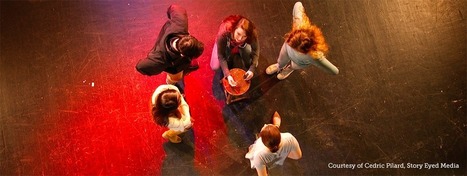
Do you like graphic novels or comic books? Are you interested in learning to code? If you answered, yes, then you'll love Dystopia 2153! This brand new, three-episode series teaches kids the basics of coding through a digital graphic novel. It connects 21st Century skills with the love of reading. Use code to solve puzzles that help the characters overcome obstacles and escape their dystopian world.
We know how hard it can be to write - we've all been paralyzed by the blank page. But the truth is, anyone can write well. It's just a question of process. We are a team of technologists, educators, designers and writers who have come together to democratize good writing. With clear steps and easy-to-use tools, WriteWell makes writing fun and engaging for everyone.
Quick tip: The new software package, Storyboarder, makes it 'easy to visualize a story as fast you can draw stick figures.' You can create a story idea without actually making a full-blown movie and see how it looks. Storyboarder is free. It's open source.
Preparing a story-driven presentation is much less bewildering if you have a framework to help you organize your thoughts, facts and data into a logical flow. A framework should guide you in three areas: your audience, your story arc and your big idea. All three of these exercises are performed before you build your first slide. This prep work ultimately saves time, because it makes the visual part of your presentation much more intuitive.
Despite what certain Silicon Valley companies might want you to believe, writing well, by hand, is one of the keys to a satisfying life and a healthy mind. Writing by hand and then publishing digitally on platforms like Medium is the perfect combination. You get the tactical feedback and ability to write things down manually, and then decide what parts of it you should publish into the digital ocean. Sidenote: when you do decided to publish into that digital ocean, please feel free to submit your piece to The Mission! If it’s a good fit, we’d love to help promote your work. November is national novel writing month (NanoWriMo) abroad, and locally at The Mission, it’s our Reading and Writing month all month long! Make sure you’re subscribed to our daily newsletter so you don’t miss any other ideas, tips, and tactics about reading and writing. Without further ado, here are 7 little known secrets from world class writers.
The book focuses on the development of a deeper understanding of the United Nations Sustainable Development Goals for 2030 and explores creative ways teachers can raise awareness of and promote these goals among our students.
This is a perfect way to approach 21 st Century skills. The book allows students to be aware of the current issues happening in the world. So that learners cñuld have a different perspective of what learning a new language involves. Moreover, I this book may be the perfect complement of a class based on Task Based Instruction. I think we as teacher can take some of the situations presented in the book and offer them to student as a task.
Begin your journaling each night before you go to bed. In your journal, write down ten to twelve experiences from your day. The experience could be anything. It could be something you experience yourself or something you observe.
"You might overhear an interesting conversation at a coffee shop. You might spill a full cup of coffee on your pants in the middle of a meeting. Maybe you witness a bout of road rage on your commute to work. Whatever it is, write it down. Avoid any kind of filtering.
"Once you complete your experiences, write down one to three thoughts you obsessed over during the day. What anxieties, worries or dreams occupied your mind? Maybe you’re angry at your spouse for taking the last piece of cake. Were you obsessing over a difficult conversation? Again, no filtering. Whatever the thought is, write it down. Do not judge the quality."
Are your characters dry, lifeless husks? Writing effective description is the secret to breathing new life into them. Author Rebecca McClanahan shares 11 secrets.
"You can see from the picture the parts of the flow map and its purpose. It’s very self-explanatory.
Why do I enjoy the use of these thinking maps for my inner city students? It is a visual way to organize writing. I want to tap into as many modalities as possible when I teach, this is one way to tap the strength of my visual learners."
"...let’s begin with argumentative writing, or persuasive writing, as many of us used to call it. This overview will be most helpful to those who are new to teaching writing, or teachers who have not gotten good results with the approach you have taken up to now. I don’t claim to have the definitive answer on how to do this, but the method I share here worked pretty well for me, and it might do the same for you. If you are an experienced English language arts teacher, you probably already have a system for teaching this skill that you like. Then again, I’m always interested in how other people do the things I can already do; maybe you’re curious like that, too."
At Digital Promise Global, our global engagement programs support educators to empower young people as creators and changemakers, harnessing emerging technology to make a difference in the world.
In the 360 Filmmakers Challenge, along with our partner Oculus, we’ve offered 360-degree production equipment to high schools across the United States to help young people and their teachers produce original, immersive 360° stories that make an impact. The results include powerful student-produced films, inspiring behind-the-scenes stories, and encouraging indicators of impact.
A year and a half after first launching the 360 Filmmakers Challenge, we are excited to publicly share a collection of tools and resources for 360° production designed for educators and youth. We created the 360 Filmmakers Challenge Production Guide with a few principles in mind:
Writing isn't that hard. We can all do it, one word after next, little baby steps until a whole thought is complete. Writing so people will care is pretty darn difficult though, especially in an age where we are constantly besieged by words and ideas on email, social media and whatever news sources are best at forcing themselves in front of our eyes.
Still, the need is there. In fact, there has perhaps not been a more important time for educators to share their stories.
I've been writing about teaching heavily for the last five years, and I've learned things. I've learned the things that have been the difference between having a few people read a piece and a few hundred thousand. I've learned about the honest desire from many to hear directly from teachers as well as the desire of some to use teacher voices for their own needs.
I've learned about haters, and I've learned how amazing it is to hear how you've impacted or supported a colleague you've never met before.
So, then, here are some quick lessons to think about when you are ready to share your stories and ideas more broadly, whether you are thinking of submitting to a website, starting your own blog, or sending in a letter to the editor. Let me know when they're done; I'd love to read and share them.
Last weekend, at the Journalism Interactive conference hosted by the University of Maryland, I presented a card game that I have been prototyping for the last year in classrooms from Northeastern to the Nieman Foundation. The game, in …
It is a great idea for advanced learners, very convinient for teachers who are pursuing creative writing, since it improves the language skills but at the same time gives a burst of innovation to the class and grouping techniques.
At our recent Ratio workshop in London we shared this sample page from a student work packet. It’s designed to help structure a student discussion about a text, though it could be adapted to any content. The idea is that it asks students to write a response to a discussion question before they discuss it. Then it asks them to take notes on the discussion in order to revise and improve their original idea. Then it asks students to revise their original response based on what they took from the discussion.
We think this is useful in building high Ratio classrooms–everyone answers the question in writing first. Thus students are more likely to participate in the discussion and are likely to have better ideas. Then their task during discussion is not to try to ‘win” the discussion by being proven “right” all along but to gather ideas that can help them refine their ideas. Then they finish the cycle by writing again.
We presented this to participants and asked for their feedback. What did they like and what might they adapt or improve about it.
Below you’ll find the example template we gave people. Below that you’ll see some of the useful feedback our participants gave us.
A short while before the summer 2017 break, Nick Jeans, Senior Consultant in Learning Technology at Sero Consulting, enquired in the Association for Learning Technology discussion list whether anyone had any recommendations for free comic-making software. I've collated the responses here. (Nobody in the discussion list has objected to my plan to do so.)
You'll need to check for yourself whether all of them are still working or free, but even if one or two have gone the way of all flesh, there is still a lot to choose from!
Hyphen—As the Chicago Manual of Style (CMOS) says, the hyphen “connects two things that are intimately related, usually words that function together as a single concept or work together as a joint modifier.” Examples include op-in, tax-free, one-third, and so on. Hyphens are very common in English, and the hyphen key is easy to find on the keyboard. The problem with hyphens arises when they are used where another mark—the en dash or em dash—might be more appropriate.
How to insert a hyphen in any program: Just hit the hyphen key on your keyboard, it’s on the top row between “0” and “=.”
En Dash—According to CMOS, en dashes (which are half the length of the em dash) “specify any kind of range, which is why they properly appear in indexes when a range of pages is cited (e.g., 147–48)” and this is also true for date ranges like the period 1948–1960.
In Word for PC, press [Ctrl+Minus] using the minus key on the numeric keypad. In Mac or PC you can also use the Insert/Advanced Symbol/Special Characters dialog and just pick it from the list. But easiest on Mac is the simple key combination [Option–hyphen].
Em Dash—That’s the long dash, and as Grammarist says, “Em dashes set apart parenthetical phrases or clauses in a sentence. In this use, em dashes are similar to commas and parentheses, but there are subtle differences. For example, em dashes are used when a parenthetical remark contains an internal comma or would otherwise sound awkward if enclosed by commas. Perhaps a useful way to think of the em dash is as a pause or parenthesis with somewhat more emphasis than a comma and somewhat less than parentheses.”
Writing good stories can be hard! In this article, learn ten secrets about how to write a story, and more importantly, how to write a story that's good.
More teachers are being asked to support student literacy in all content areas. For those trained in English language arts, this isn’t a big deal. But if you have spent your career learning best practices in science, social studies, physical education, music, math, or one of many other content areas, the idea of “teaching” students how to write on top of covering your own content may seem impossible.
Good news: It’s not all that complicated, and it doesn’t have to be time-consuming, either. You don’t need an English degree to get really good at helping students build writing proficiency in your content area. In this podcast episode, you’ll learn seven easy strategies (plus one bonus tip) to support student writing skills without having to stop teaching your content.
You can get this information by reading the cheat sheet below, listening to the 28-minute podcast, or reading the full transcript.
Quest is free to use. You can use it free via your web browser, or if you're a Windows user, you can download the free desktop version. And as open source software, Quest will always remain free.
Quest lets you make interactive story games. Text adventure games like Zork and The Hitchhiker's Guide to the Galaxy. Gamebooks like the Choose Your Own Adventure and Fighting Fantasy books. You don't need to know how to program. All you need is a story to tell. Your game can be played anywhere. In a web browser, downloaded to a PC, or turned into an app.
To get content containing either thought or leadership enter:
To get content containing both thought and leadership enter:
To get content containing the expression thought leadership enter:
You can enter several keywords and you can refine them whenever you want. Our suggestion engine uses more signals but entering a few keywords here will rapidly give you great content to curate.


 Your new post is loading...