


Stories can create change, both in ourselves and in our organizations. In this guest post, Matt Ragland shares five elements of powerful stories.
Via Ana Cristina Pratas

 Your new post is loading...
 Scoop.it! Stories can create change, both in ourselves and in our organizations. In this guest post, Matt Ragland shares five elements of powerful stories. Via Ana Cristina Pratas 
No comment yet.
Sign up to comment
Scoop.it!
Posted by Terry Heick
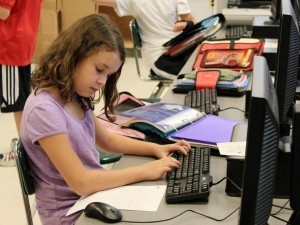
"In part 1 of this post we took a look at the writing process itself–the relative awkwardness of the process for many developing writers, and how live modeling can help support writer growth. In this part, we are focusing on using cloud-based word processing and general productivity suites like Adobe Buzzword and Google Docs. We also recently looked at 10 Ideas for Using Technology to Teach Writing.)"
Scoop.it!
From the website
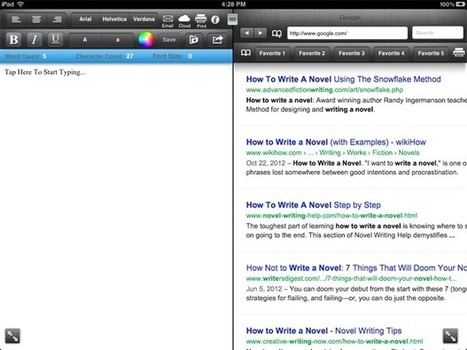
"There's no perfect formula for crafting a novel. In fact, some of the best tales that withstand the tests of time are the ones that break the rules and invent a new narrative. The simplest of ideas can blow up into 100,000 words of masterfully crafted storytelling with proper development. While the words are the most important part of any novel, what is a craftsperson without his or her tools? We've collected eight apps that will help you turn aspirations into novelizations. These come just in time to join the scribbling scribes participating in National Novel Writing Month (NaNoWriMo), so grab them and embrace your craving to compose some prose." Via Jon Samuelson

Katherine Conner's curator insight,
March 29, 2013 1:39 PM
Everyone, without exception, requires a tool to complete the task that they were employed to do. Often, when writing, people may not know where to begin. They may not have any idea as to how to organize their thoughts. The applications suggested by AJ Dellinger on Mac Life seem like an excellent way to structure not only the key points within your story, but also helps you structure your time in order to incorporate those key points. The application "Novel in 30" allows the user to set a word count target, and a deadline goal. It also allows you to sync the document between itunes and allows the use of Dropbox for easy access. "Writers App" helps structure all ideas dealing with plot, character, and setting. "MindNode"allows the user to create a literal map of their thoughts, and therefore allowing the user to re-create or continue their previous thought process at a later time. Other applications discussed in this article assist with research, brainstorming, timing, and even publication! I think these applications will prove to be powerful tools not only for aspiring novelists, but also authors who are veterans of the writing and publication processes. Each story that a person decides to tell is individual, so each journey to bring that story to an audience is just as individual.
Scoop.it!

From the website
"In "The Writing Revolution," Peg Tyre traces the problems at one troubled New York high school to a simple fact: The students couldn't write coherent sentences. In 2009 New Dorp High made a radical change. Instead of trying to engage students through memoir exercises and creative assignments, the school required them to write expository essays and learn the fundamentals of grammar. Within two years, the school's pass rates for the English Regents test and the global-history exam were soaring. The school's drop-out rate — 40 percent in 2006 — has fallen to 20 percent.
"The experiment suggests that the trend toward teaching creative writing was hurting American students. In a debate about Tyre's story, we asked a range of experts, from policymakers to Freedom Writers founder Erin Gruwell, to share their thoughts on Tyre's story. This page will be updated with new entries each day through mid-October."
Great collection of articles. -JL
Scoop.it!

Free online conference Nov. 12-Nov. 16. This event is always great! -JL
From the website
"We are pleased to announce the third annual Global Education Conference, a free week-long online event bringing together educators and innovators from around the world, will be held Monday, November 12 through Friday, November 16, 2012 (Saturday, November 17th in some time zones). The entire conference will be held online using the Blackboard Collaborate platform (formerly known as Elluminate/Wimba) with the support of iEARN worldwide as the conference founding sponsor, who will be running their annual international conference in conjunction with this event.
"The Global Education Conference is a collaborative, inclusive, world-wide community initiative involving students, educators, and organizations at all levels. It is designed to significantly increase opportunities for building education-related connections around the globe while supporting cultural awareness and recognition of diversity. Last year’s conference featured 340 general sessions and 18 keynote addresses from all over the world with over 10,000 participant logins. To attend this year's conference and to be kept informed of the latest conference news and updates, please join this network."
Scoop.it!

By Lynda Hall
"FlipSnack is a free online web tool that allows users to convert PDF documents into Flash page flip books for the purpose of sharing literary work (stories, poems) and/or visuals (pictures, graphs, charts). This very easy to use software only requires 3 simple steps: 1. Upload PDF files
"I really like this web tool because it encourages students to focus on the writing process as the finalized copy will actually be published for the rest of the world to see."
Scoop.it!

By Dean Takahashi
Stampsy "has come up with a different kind of interface for its media, dubbed a “stamp.” Viewing the content in the stamps is like browsing through a beautiful magazine you might have on a coffee table. To add content to the stamp, the author uses Stampsy’s tools, which can be touched, dragged and dropped on a mobile device. But you don’t have to know a programming language to craft and publish your content."
Scoop.it!

"From time to time people express amazement at how I can get so much done. I, of course, aware of the many hours I have idled away doing nothing, demur. It feels like nothing special; I don't work harder, really, than most people. Nonetheless, these people do have a point. I am, in fact, a fairly prolific writer.
"Part of it is tenacity. For example, I am writing this item as I wait for the internet to start working again in the Joburg airport departures area. But part of it is a simple strategy for writing you essays and articles quickly and expertly, a strategy that allows you to plan your entire essay as you write it, and thus to allow you to make your first draft your final draft. This article describes that strategy.
"Begin by writing - in your head, at least - your second paragraph (that would be the one you just read, above). Your second paragraph will tell people what your essay says. Some people write abstracts or executive summaries in order to accomplish this task. But you don't need to do this. You are stating your entire essay or article in one paragraph. If you were writing a news article, you would call this paragraph the 'lede'. A person could read just the one paragraph and know what you had to say.
"... there are four types of discursive writing. Each of these types has a distinct and easy structure, and once you know what sort of writing you are doing, the rest of the article almost writes itself. The four types of structure are: argument, explanation, definition, and description. So, as you think about writing your first paragraph, ask yourself, what sort of article are you writing. In this article, for example, I am writing a descriptive article."
Scoop.it!

By Katherine Schulten
"For our new “What’s Going On in This Picture” feature, we’ll collaborate weekly with Visual Thinking Strategies (V.T.S.). In this video, Philip Yenawine, one of the founders of the organization, conducts a live V.T.S. discussion about a work of art." ------------------------------------------
"How do you make sense of what you see when you look at an image, especially if that image comes with no caption, headline, links or other clues about its origins? What can constructing meaning from an image teach you?
"That’s what we hope students will figure out together through our new feature, one that focuses on Times photojournalism, visual literacy and critical thinking by asking viewers to think about one interesting photograph a week.
"Here’s how it will work:
Scoop.it!

In this post we distill the writing anchor standards to their simplest form to facilitate recall and assist instructional planning.
Scoop.it!

A vibrant story of curiosity and optimism by Dutch illustrator Wouter van Reek.
By Maria Popova
"Dutch painter Piet Mondrian (1872-1944) began as a landscape artist, but eventually arrived at the bleeding edge of abstraction. Shortly after his death, during the 1950s and 1960s, his work went on to influence everything from graphic design to architecture to fashion, and is even said to have inspired this classic 1934 dust jacket of Ulysses. And, now, it can shape the way little ones think about the future, life, and the boundless limits of the possible.
"Coppernickel Goes Mondrian (public library) by Dutch artist Wouter van Reek is an absolute treasure from my friends at Enchanted Lion Books, who previously gave us Albertine’s Little Bird, Blexbolex’s gems, and the charming Bear Despair. The story introduces Van Reek’s famous Coppernickel character — a quirky and endearing flightless bird in a red cape — and his dog Tungsten to Mr. Quickstep and his dog Foxtrot. Together, they embark upon a quest for the future, navigating Mondrian’s signature grids of primary colors as they make sense of the portal from reality to abstraction and back again, teaching young readers — and reminding those of us who have grown out of believing — that the road between what we dream up to what we actually experience is paved with nothing more and nothing less than self-transformation."
Scoop.it!

Jasper Visser: "To address the most important issue first: there is no such thing as digital storytelling. There’s only storytelling in the digital age, and frankly speaking this isn’t much different from storytelling in the age of hunters, gatherers, dinosaurs and ICQ" ... Via The Digital Rocking Chair, Digital Maverick, Louise Robinson-Lay

ChelseyMarie's curator insight,
January 18, 2013 8:10 PM
What the video! It's amazing. Book Burn Pary!!! YESSS.
Scoop.it!

Learn more about a powerful new integrated research tool available in Google Docs Via Susan Oxnevad, Lori Johnson
|
Scoop.it!

By Jeffrey R. Young,
"A new kind of university has begun to emerge: Call it Star Scholar U.
"Professors with large followings and technical prowess are breaking off to start their own online institutions, delivering courses with little or no backing from traditional campuses.
"Founding a university may sound dramatic, but in an era of easy-to-use online tools it can be done as a side project—akin to blogging or writing a textbook. Soon there could be hundreds of Star Scholar U's.
"Two recent examples are Marginal Revolution University, started by two economics professors at George Mason University, and Rheingold U, run by the author and Internet pioneer Howard Rheingold. To be clear, these professors are using the word "university" loosely—they award no credit and claim no spot on any college ranking. And they probably won't become rich through their teaching. But the gambit gives them full control over the content and delivery methods. And it offers their personal brands as a kind of credential."
Scoop.it!

By Haley Lee (HS student)
"As a high school student myself, I was intrigued by Peg Tyre's article about a Staten Island school's turnaround. Tyre shows the importance of writing skills to academic and professional success. She looks specifically at the new and improved curriculum at New Dorp High School, which emphasizes analysis over self-expression...
"I like to think about writing as a two-dimensional process. The first dimension, which Tyre hits upon, is the act of putting ideas onto paper. Mechanics are important in this regard: If a student grasps for a word and comes up empty-handed, it becomes impossible to move forward.
"But, in my experience, the best teachers don't just show their kids how to use nouns, verbs, and adjectives. They make their students aware of writing's second dimension: the dialogue between author and reader. It is the unearthly chill of witnessing a character die, the cementing (or dissolving) of a set of beliefs, or the thoughtful pause before flipping the page of a magazine, that epitomize the type of connection writing can ignite."
Scoop.it!

Posted by Katie Lepi
"If helping your students write papers is a part of your school day, you probably already know that there are enough issues to focus on without having to spend a lot of time teaching your students how to build a bibliography and correctly cite their sources. Your time is likely better spent helping create a focused, concise piece of work that uses excellent grammar and sentence structure.
"There are a lot of online bibliography tools out there that can help students learn to build bibliographies and ensure that their citations are correct, without them (and you) spending hours pouring over MLA, APA, or Chicago handbooks. The options include browser extensions, templates, and online citation builders (where you plug in your resource and the citation is generated for you." Via Louise Robinson-Lay
Scoop.it!

By Kim Fortson
"T.H.E. Journal asked eduTecher founder and FETC speaker Adam Bellow and Donna Criswell, an instructional integration specialist at the Sudbury (MA) Public School District, for the most creative storytelling apps available, and we did a little digging on our own, too. The results, listed below, turn students into novelists, artists, and moviemakers, with each tool bringing its own powerful mechanism for transforming the traditional narrative--both inside and outside the classroom."
Scoop.it!
|

|
Rescooped by
Jim Lerman
from :: The 4th Era ::
October 24, 2012 8:17 AM
|
Scoop.it!

Robin Good: Expressedly designed for journalists and newsrooms Spundge is a unique social news discovery, curation and syndication platform that facilitates the discovery, selection and distribution of news content across multiple channels.
Spundge works with topic-specific containers called "notebooks", which you can create and configure to work around any specific topic, event, company or issue you are interested in following.
Spundge taps into YouTube, Twitter, Instagram, Flickr, Soundcloud and Facebook to gather relevant content around your specified topics, as well as into RSS feeds and OPML files that you specify. All these can then be easily filtered (by keyword, time, location, and language) and curated manually before being published inside any topic-specific "notebook".
Notebooks can be made public or private and their contents can be shared on all major social media networks as well as being syndicated outside of Splundge in a number of different ways.
The PRO version of Spundge adds a number of useful features to the free base version, including:
Custom editor - create, write, format and edit your own multimedia posts integrating text, images and video clips with extreme ease.
Personal customized dashboards - these allow you to collect and organize in one page streams from different notebooks, traffic and social sharing data and more.
Syndication - syndicate to major socia platforms such as Twitter and Facebook as well as to Wordpress and Mialchimp.
Collaboration - invite co-editors, curators, newsmasters to complement your work or to fuel a common newsroom activity allowing everyone to track, review, comment and edit individual notebooks.
Embedding - standard embed code to publish/integrate any notebook inside any website or blog page.
Analytics - Acces to detailed traffic data.
Smart attribution - Spundge automatically tracks original sources from where you are picking content, images or video clips and automatically credits them.
Custom sources - plug-in private RSS feeds or your own API to feed unique proprietary content into your notebooks.
Free version available.
Read The Nieman Journalism Lab review of Spundge: http://www.niemanlab.org/2012/09/first-look-spundge-is-software-to-help-journalists-to-manage-real-time-data-streams/
For more info: http://www.spundge.com/
|
|
Rescooped by
Jim Lerman
from Into the Driver's Seat
October 21, 2012 1:49 AM
|
Scoop.it!

WHAT WOULD NORMAN DO? (LOOK CAREFULLY) Good lesson ideas here.-JL
Posted by Beth Holland
"In preparing for the New England Reading Association Conference and the NYSCATE Mobile Learning Summit, I decided to change my approach. Rather than structure my presentations by tool, or by app, or even by project, I organized myself around desired student outcomes – aka. what students can actually do.
"However, before addressing that question, I asked not only WHY iPads but WHY Technology? Because….
-I want my students to communicate in complex and modern ways.
-I want my students to make their thinking visible as an alternative assessment.
-I want my students to document their thinking as they work through a process.
-I want my students to have multiple ways through which to interact with learning objects.
"What does this tangibly look like in the classroom? One English teachers asked where to even begin, so we started with a set of content-specific learning objectives."
|
|
Rescooped by
Jim Lerman
from Writing Activities for Kids
October 19, 2012 3:33 PM
|
Scoop.it!
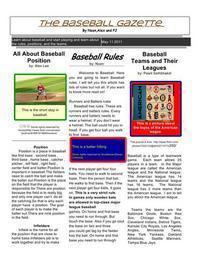
Great Ideas! Love the idea of uploading newspaper to Youblisher. Turns it into a flippable page newspaper.

Could replace monthly newsletter. Student written!

|
|
Scooped by
Jim Lerman
October 18, 2012 5:27 PM
|
Scoop.it!

By Shateek Palmer
"Below, an essay by Shateek Palmer, a student at Central Park East High School. It originally ran in Represent, a Youth Communication magazine by and for young people in foster care in New York City.
"Shateek explains how writing has helped him express his emotions and feel less “alone in the world” since he was 9 years old. We publish it as part of our celebration of the National Day on Writing this week."
|
|
Scooped by
Jim Lerman
October 16, 2012 9:51 AM
|
Scoop.it!

HOW SOCIAL LEARNING NETWORKS BUILD FOR EDUCATION DRIVE INNOVATION
Thursday, Oct 8 at 2 PM Eastern
Presented by:
Alan November of November Learning
Tim DiScipio of ePals
"How can principals, technology directors and curriculum coordinators ensure students and teachers are armed with the full suite of tools required for 21st century innovation? Join education thought leaders Alan November of November Learning and Tim DiScipio of ePals on October 18th for a discussion on how education networks honed through years of educator feedback are maximized to promote digital-era collaboration, content curation, streamlined workflow, and a generally efficient digital school ecosystem, in ways mainstream tools aren't designed to do."
FREE REGISTRATION
|
|
Rescooped by
Jim Lerman
from Into the Driver's Seat
October 15, 2012 2:09 PM
|
Scoop.it!

This site provides a easy to use platform to create branching stories. Add a new story thread at the touch of a button and you can even add images from the web. Preview your story as a map, publish online and share with the link with others.
http://ictmagic.wikispaces.com/English
|
|
Rescooped by
Jim Lerman
from Into the Driver's Seat
October 15, 2012 2:05 PM
|
Scoop.it!

Professor Word is a useful browser plugin to help you develop your vocabulary. It enables you to click on words in a text on any webpage and get a definition. It also shows related words. Good tool for vocabulary building.







