"Created by students for teachers, this movie shows students frustrated with the lack of visuals in the classroom. Teachers need to educate..." The power of the visual image and convincing argument for visual as well as verbal essays.
"NBC Learn, the education arm of NBC News, has launched an original video series called “Writers Speak to Kids,” featuring interviews with popular and award-winning children’s book authors. Answering questions from NBC News correspondent Jenna Bush Hager, the authors share their writing process and experiences, helping students learn more about the craft and techniques of creative writing."
Three leading writing educators respond to the question: What advice can you give to help teachers be more effective in helping students become better writers? Respondees include Mary Tedrow, Doug Fisher, and Nancy Frey. -JL
"One of the ongoing challenges for my composition students is the task of narrowing a broad, generalized topic into a more particular, focused topic for a short research essay. To help them develop this skill, I now prescribe a broad topic for everyone to use in the first research essay. Over several class sessions, we work collaboratively to explore the general topic, identify more particular subtopics, and develop research strategies to investigate these subtopics as possible subject matter.
"This semester I required all of the students to write about our city, Anderson, Indiana. In addition to all of the other “process” assignments I use to teach my students inquiry, research strategies and drafting techniques, I recently added an art project to the mix. The assignment was simple: create a poster that gives a “face” to the city of Anderson. I told the students to be creative in their design and to represent visually the key discoveries they’ve made about their specialized topics. I also encouraged them to suggest the focus and purpose for their essay through the content or design of the poster. I promised to give each student 30 seconds to offer comments about his or her poster to the class...."
"The posters students created in response to the assignment were impressive—not in their artistic design but in their clarity. Nearly every student was able to articulate an appropriately narrow focus AND a specific purpose for the essay project. Making the poster seemed to help them identify the key ideas or categories of information they would include in the paper."
" Thanks to the digital boom we are living in now , there are several apps that teachers can use to promote and enhance creative writing for their students. We have collected a great list of such apps and we want you to try some and see how they work with your students. These apps you can have access to a wide range of writing prompts, fun games, and activities to help your students write out of the box."
"Jan Worth-Nelson has specific and detailed workshop guidelines for her creative writing class: “begin by responding to what you think the essay is about;” “see if you can find a way to describe the ‘voice’ of the essay;” “when you say you like something, try to continue your commentary with something that suggests why you like it.”
"For years, though, despite telling her students exactly what to do, Nelson often felt the workshops fell short of her expectations.
"So when she and a few colleagues at the University of Michigan-Flint began researching the effect of clickers on student learning, she took the opportunity to reinforce workshop procedures.
"If their hypothesis proved true — that students would better retain information they learned using clickers — the quality of the writing workshops would improve."
Writing is one of the key literacy learning skills.
For many learners it can also be one of the most challenging.
The way learning Providers teach 'writing' has alot to do with their learners attitude; if they can find engaging and collaborative ways to teach writing then, their learners writing performance will be enhanced.
One strategy is to use technology.
For learners, generating ideas is often the most difficult phase of their writing process.
This is where Plinky can help.
Every day Plinky provides a new prompt (like a question, or a challenge), and everyone gets a chance to answer.
Users can... - add photos, maps, playlists and more. - easily share their Plinky answers on Facebook, Twitter, WordPress, Tumblr, and most major blogging services.
In their words... "We know you've got something interesting to say. Plinky is here to help you say it in a fun and compelling way."
David Rowan: 'Delegates at the event, on 5 October, came from ad agencies and design shops, from the Punchdrunk theatre company and the Library of Congress -- all drawn by a shared curiosity about "reinventing the way stories are told"' ...
Both high-tech innovations for learning and the inability of many American schoolchildren to write well have been major talking points in educational circles for quite some time, but oddly enough, one may offer a solution to helping remedy the other.
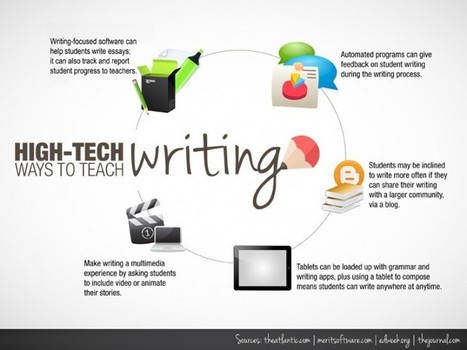
There are a variety of tech tools and methods out there for teaching writing that can make the process easier and more fun for both teachers and students. While not every high-tech way of teaching writing will work for every class or every student, there’s enough variety that there’s bound to be something for everyone.
Here, we offer just a few tech-focused ways to help students learn grammar, essay-writing, and, most importantly, why good writing is so important to their futures.
I am pretty sure as you introduce the idea to your students everyone will want to have a say in their next e-magazine. There is nothing much more rewarding to students then to have a proof of their hard work recognized in a publication of some sort.
Most of the tools cited here are easy to use and have user friendly interface and they will let you create your own e-magazine or newspaper in few simple steps. Yet I would recommend your discretion as you use them with your students.
"I've spent most of my professional career helping teachers find wiser ways of teaching writing. In the past few years I've become interested in how we might do a better job of engaging our boy writers. Empirical and anecdotal evidence suggests that boy writers are struggling. According to the most recent NAEP test results (2011) 38% of 8th grade girls scored "proficient" or above--only 18% of 8th grade boys scored proficient.
[I love the comment in this next paragraph, "Sometimes we may look at boys as defective girls....Try to notice what unique strengths boys bring to the table." -JL]
"Try to understand boy writers instead of judging them. Let's face it: elementary teachers, who are overwhelmingly female, may not always "get" boy writers and their quirks, strengths, and struggles. Sometimes we may look at boys as defective girls (I have done this myself) try to notice what unique strengths boys bring to the table.
"Boys and girls really are different, and I'm convinced that some of that difference is biological. A mother I know has two girls and two boys. She told me: "The boys made sound effects, almost from the moment when they could vocalize. My daughters never did that."
"Boy writing often differs from the writing created by girls. (For instance, in his book Why Gender Matters Leonard Sax points out that in their drawings, little girls draw nouns whereas little boys draw verbs/action.) Try to appreciate the difference."
"Educators share their advice in Larry Ferlazzo's blog post for helping students become better writers. Aimee Buckner, a consultant and author, suggests starting a writing workshop, giving students time each day to write and showing students how to eliminate unnecessary words in their writing. Writer and teacher Carolyn Coman suggests that teachers focus on their own writing and help students make connections to their writing, while Tanya Baker, director of National Programs for the National Writing Project, agrees that teachers need to write, write, write"
A wonderful post quoting 13 great writers on their daily routines. Great research by Maria Popova to pull this all together. Wonderful photos too (as evidenced by a young Maya Angelou, above). Just a warm and rich reading experience. -JL
"One area that many homeschoolers struggle with teaching is writing/composition. In my house, when some of my kids struggle with writing, it is especially difficult for me as someone who has been writing stories since as long as I could write words. Luckily, the Internet is full of ideas for writing activities and resources to help."
Amy Gallagher Critchett is on Learnist. Join Learnist share learnings with Amy Gallagher Critchett and others. - Lori Johnson
Critchett maintains a very rich and growing collection of resources for high school ELA teachers, keyed to the CCSS. This should be of considerable use to teachers now and going forward. -JL
"Sharon J. Washington, executive director of the National Writing Project, said, "The experience of these nine teachers reminds us of the central role they play in true education reform. It's teachers who are the technology drivers, seeking out digital tools, learning them, testing them and finally implementing them successfully in their classrooms. With the benefit of professional development from organizations like the National Writing Project, these pioneers are preparing their students for the digital world."
"The teachers featured in the report found that the use of such Web 2.0 tools as blogs, podcasts, wikis, and comics-creating software has heightened students' engagement and enhanced their writing and thinking skills—in all grade levels and across all subjects. Even as these teachers' students gain the skills to live and work in the 21st-century setting, too many times, the report found, their classrooms look like 20th-century models."
6 Ways Google Docs Supports Collaboration In The Writing Process (6 Ways Google Docs Supports Collaboration in the Writing Process http://t.co/Jl60W8sG @TeachThought #edchat #edtech #writing #engedu...)...
Check out Doodle Splash, a cool interactive from ReadWriteThink, that combines the process of drawing with analytical thinking about a text by pairing an online drawing space with writing prompts that encourage students to make connections between their visual designs and the text.
"This site is the most comprehensive library of IF games. Some IF interpreter programs have the ability to connect directly to this database to find and download new games, much like the Apple App Store.
"For other interpreters, you may need to download the game files separately and load them into your interpreter program.
A warning for teachers looking for games to use with your students: IF content spans all the genres of literature you would find in a major bookstore, including adult titles. Best to pre-select the games you want your students to play instead of sending them to the archives themselves."
To get content containing either thought or leadership enter:
To get content containing both thought and leadership enter:
To get content containing the expression thought leadership enter:
You can enter several keywords and you can refine them whenever you want. Our suggestion engine uses more signals but entering a few keywords here will rapidly give you great content to curate.


 Your new post is loading...