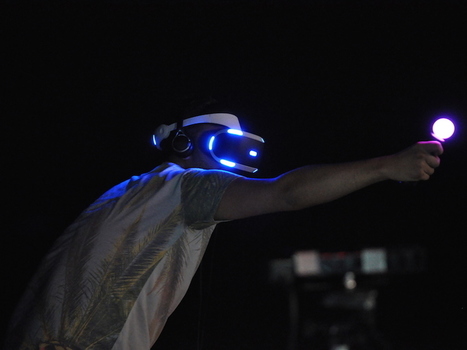
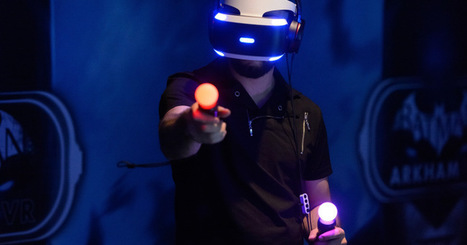
Virtual reality is big this year at Cannes Lions. Its presence makes itself known as demonstrations of the technology abound at stations all around the festival. Through these demonstrations, we’re experiencing firsthand what VR can do now. But through the discussions, we’re also learning what it will do in the future. During Lions Innovation, we heard from some of the pioneers in the field about where VR is heading, and what they’ve learned about making great immersive experiences. The rules of this medium are still being written, but here’s what we know so far:
In the research project led by Ph.D. candidate Gabriel Culbertson, 48 students were recruited to play two versions of the game. In one group, students were connected via a chat interface with another player who could, if they wanted, offer advice on how to play. The second group played a version of the game in which they were definitely required to collaborate on quests.
The research group found the students in the second so-called “high-interdependence” group spent more time communicating and, as a consequence, learned more words.
The research then expanded to a larger group of 186 Reddit users who were learning Japanese. After reviewing gameplay logs, interviews and Reddit posts, they found that those who spent the most time engaged in the game learned more new words and phrases.
At the IEEE VR conference this year, there was a pre-conference workshop about Immersive Analytics, which talked about how to use VR & multi-sensory interfaces to support analytical reasoning, decision making, and real-world analytics tasks by immersing users in their data. Data visualization expert Chris North gave the keynote for the Immersive Analytics workshop, and I had a chance to catch up with him to talk about the four different ways that intelligence analysts use space for Big Visualization, Big Cognition, Big Interaction, and Big Algorithms. Chris also explains why the principles of embodied cognition are causing intelligence analysts to look at how to use the body, physical movement, and the surrounding environment in order to support and amplify distributed cognition.
At of June 26, 2016 there are 293 entries on this list...not all of them are names. Yet, as raw data, this is pretty interesting and certainly rather useful.
Historically, when thinking of the types of media that have been world changing in the past created more places to connect with others. They created a shared culture. VR as it is imagined right now seems to lean toward being as escapist as possible. The viewer teleports to another world without their body leaving its static location. I am still at a point where I worry VR takes the student at the center too far by eliminating their ability to interact with the world right next to them. That being said, all of this is conjecture. VR as a mass market product is still emerging. I am enjoying following the conversation and playing with the headsets that use my smartphone as a screen. Despite the risks and worries, I am still excited to see how VR evolves and what educational experience might be designed for it.
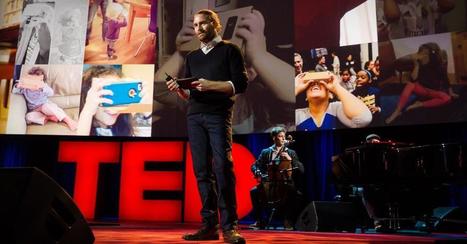
Chris Milk uses innovative technologies to make personal, interactive, human stories. Accompanied by Joshua Roman on cello and McKenzie Stubbert on piano, Milk traces his relationship to music and art — from the first moment he remembers putting on headphones to his current work creating breakthrough virtual reality projects. VR is the last medium for storytelling, he says, because it closes the gap between audience and storyteller. To illustrate, he brought the TED audience together in the world's largest collective VR experience. Join them and take part in this interactive talk by getting a Google Cardboard and downloading the experience at with.in/TED.
The next level of art is with the Google’s Tilt Brush wherein the user can turn the surroundings into a canvas to paint. Tilt Brush lets you paint in 3D space
Q. How do you find Google Cardboard versions of YouTube videos?
A. YouTube has a dedicated collection of 360-degree virtual reality videos on its site that you can watch on your smartphone with Google Cardboard or a similar virtual reality viewer. In the site’s search box, search for the hashtag “#360video” to get an idea of the panoramic virtual reality clips that are available. You can find nature scenes, a holiday tour of the White House and “The Hunger Games Virtual Reality Experience,” among the 360-degree offerings.
"What's interesting is watching where the other guys are going. They're going towards really high end expensive stuff. We've been focused on low cost and have always been focused on that. So getting these relationships in place with manufacturing and going through all these phases... Our manufacturing has been really important for us. Getting the Kickstarter glasses out and getting feedback and getting that tied into the new industrial design, the new ergonomics... What you saw there are the early Kickstarter glasses. The next generation is quite different. The ergonomics are completely different. The feature sets are going to be really different from that feedback. So from the hardware side, we're feeling really good about it," she explains.
Considering these recent findings, the use of VR in the study of language processes becomes even more reasonable. In fact, VR can be considered an “embodied technology” for its effects on body perceptions (Riva, 2002): it is possible to use VR to induce controlled changes to the experience of the body; furthermore, the virtual environment can be enriched to the extent that it can become a plausible copy of the real world.
Objective: Virtual reality-based assessment is a new paradigm for neuropsychological evaluation, that might provide an ecological assessment, compared to paper-and-pencil or computerized neuropsychological assessment.
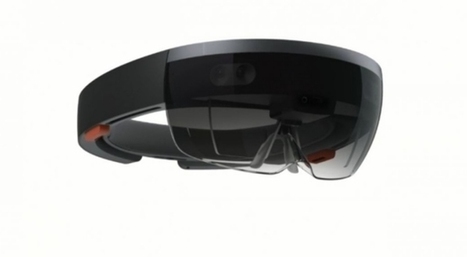
“ Microsoft has announced that their Windows Holographic Platform is opening up to developers, enabling them to not only build apps with augmented reality and virtual reality capabilities, but also to build their own AR and VR hardware that automatically works with Windows 10.”
Via Gary Hayes, Prometheus
VR makes the impossible possible by tricking your eyes, and brain, into thinking you're someplace else. The Oculus headset combines motion-sensing hardware, positional tracking and Pixar-level graphics to let you interact with and explore simulated worlds. To crank up the experience of climbing, the developers used photogrammetry – a scanning process through which they capture real surfaces (like the jagged cracks of a limestone perch) into a virtual space.
While companies like The New York Times have been producing and distributing what they call virtual reality, seen with inexpensive Google Cardboard viewers, their technology is more like VR-lite: 360-degree videos that keep you stuck in a fixed position as you crane around. The Rift lets you watch these too, but also has the power to deliver a truer VR experience – essentially, putting you inside a video game. You move, look and play just as in real life, except the world around you is computer-simulated. "What gives you that next layer of amazingness in VR is that you're the one in control," says neuroscientist David Eagleman. "You can look left and look right, and your brain gets the feedback it expects."
"How do people understand the everyday, yet intricate, behaviors that unfold around them? In the present research, we explored this by presenting viewers with self-paced slideshows of everyday activities and recording looking times, subjective segmentation (breakpoints) into action units, and slide-to-slide physical change. A detailed comparison of the joint time courses of these variables showed that looking time and physical change were locally maximal at breakpoints and greater for higher level action units than for lower level units. Even when slideshows were scrambled, breakpoints were regarded longer and were more physically different from ordinary moments, showing that breakpoints are distinct even out of context. Breakpoints are bridges: from one action to another, from one level to another, and from perception to conception
Published on Feb 18, 2016 While we've seen and used many virtual reality products aimed at consumers, there's also a lot of research in academia using virtual reality to study human psychology and behavior. We visit Stanford University's Virtual Human Interaction Lab to run through their VR demos and hear what researchers have learned from these VR experiments.
Thanks to Stanford's VHIL for sharing these demos with us. Learn more about their work at https://vhil.stanford.edu/
"Since it was founded in 2011, what Magic Leap has been working on has been shrouded in mystery. An augmented reality company that promises to do no less than change the world, the Florida-based startup and Google cash bucket has given some pretty amazing demonstrations. On Thursday at the Games for Change festival in New York City, Magic Leap’s Graeme Devine shared with an audience of developers and enthusiasts of “serious gaming” his predictions for how augmented reality will be integrated into regular peoples’ private lives — and gave everyone just a bit more insight into what will happen when the media starts integrating with reality."
Magic Leap seems to be heralded a bit like the coming of the Messiah...a mysterious force that will likely change the world. That's probably media overkill, but who knows, maybe they're right? Anyhow. the company is being watched very closely and this article summarizes its latest public communication, made June 23 at NYC's Games for Change festival.
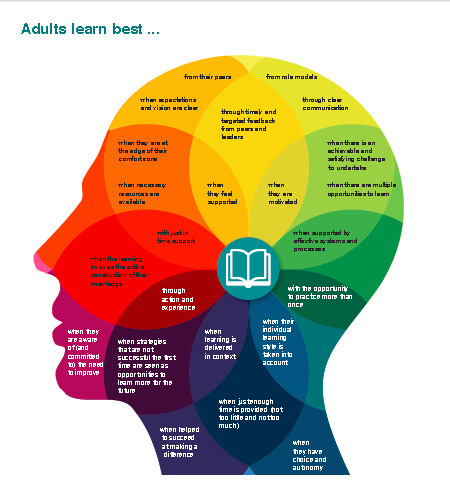
"Professional learning that is relevant, collaborative and future focused can have a highly positive impact on teacher quality. Here you will find resources that develop an understanding of effective professional learning as well as access to free online learning modules."
While many people are using virtual reality (VR) software to create more engaging media content in the form of movies and games, a team of researchers is using it to explore a hydrothermal vent that lies roughly a mile (1.6 kilometres) under the sea.
Before now, the task of exploring these hydrothermal vents - which are incredibly dangerous because they continuously spew boiling clouds of toxic elements into the surrounding waters - would have fallen on the shoulders of remotely controlled vehicles (ROVs).
Virtual reality is all the buzz nowadays. And why wouldn’t it be when analysts like Goldman Sachs make estimates that the industry is poised to surpass the TV market in annual revenue by 2025. That would make virtual reality bigger than TV in less than 10 years. These estimates are so massive because the breakthrough technology has the ability to extend itself into so many markets — gaming, education, productivity and even adult entertainment.
Estimates aside, one can often find the direction an industry is headed by following the money. In 2015 alone, virtual and augmented reality startups raised a total of $658 million in equity financing across 126 deals. Many of these companies backed include many virtual reality technologies you’ve already heard of, such as Leap Motion and Oculus.
But can we believe all the hype? Will these companies be the leaders by the time Goldman Sachs’ estimate comes around?
Having worked in the virtual reality space before it was a buzzword, I’ve seen a few things that lead me to believe there are three companies that will be as big, if not bigger, than some of the mainstream virtual reality names.
Now that tools are making it increasingly easy to alter the flow of how we watch films and television, viewers will also have power to change the plot and the characters of a show to suit their own tastes. We should look forward to a future that involves more cross-pollination, more crazy fan-theories, more creative misunderstandings, all of it enabled by new ways of consuming television, whether that means binge-watching, surfing clips on social media or even watching on fast-forward. We risk transforming, perhaps permanently, the ways in which our brains perceive people, time, space, emotion. And isn’t that marvelous?
For the past three years, Cris Miranda has been taking VR pioneers down the rabbit hole of thinking about the deepest philosophical implications of virtual reality on his Enter VR podcast. He has been seeking out the boundaries of our understanding of reality through these conversations, and much like Elon Musk concluded a few weeks ago, Cris has concluded that it’s most likely that we’re already living within a simulation.
I had a chance to sit down with Cris at the Silicon Virtual Reality Conference to explore some of these deeper thoughts about the nature of reality through simulation theory, our predictions for the future of VR, how artificial intelligence will be dismantling the structures of society, the role of VR in cultivating empathy and shared realities, and the overall information war over what the story of reality is and whether we’re going to take control over our own destiny or let someone else define it for us.
Just like anything else that involves human experience or interaction, the act of learning does not happen in a vacuum. It is at the intersection of prior knowledge, experience, perception, reality, comprehension, and flexibility that learning occurs. In years past, the traditional learning paradigms of behaviorism, cognitivism, and constructivism have been the benchmarks against which the learning process has been measured. What happens, though, when you throw into the mix all the technological advancements that have come about over the last 40-50 years? These theories certainly do not become obsolete by any means, but they do need to be used in a very different way to be able to incorporate the attributes of a 21st century learning environment. In today’s technology-rich society, it has become increasingly important to learn how to learn. Vail put it simply by declaring that learning must be a way of being (1996).
What interests me is how bits and atoms relate—the boundary between digital and physical. Scientifically, it's the most exciting thing I know. It has all sorts of implications that are widely covered almost exactly backwards. Playing it out, what I thought was hard technically is proving to be pretty easy. What I didn't think was hard was the implications for the world, so a bigger piece of what I do now is that. Let's start with digital.
Digital is everywhere; digital is everything. There's a lot of hubbub about what's the next MIT, what's the next Silicon Valley, and those were all the last war. Technology is leading to very different answers. To explain that, let's go back to the science underneath it and then look at what it leads to.
To get content containing either thought or leadership enter:
To get content containing both thought and leadership enter:
To get content containing the expression thought leadership enter:
You can enter several keywords and you can refine them whenever you want. Our suggestion engine uses more signals but entering a few keywords here will rapidly give you great content to curate.


 Your new post is loading...