


CRISPR-Cas9 is a powerful genome editing technology, yet with off-target effects.

 Your new post is loading...
 Scoop.it! CRISPR-Cas9 is a powerful genome editing technology, yet with off-target effects. 
No comment yet.
Sign up to comment
Scoop.it!
BigField GEG Tech's insight:
Here, the scientists provide a workflow for the use of lentiviral vectors as a flexible tool to generate antibody-producing cells. In particular, lentiviral vectors can be used to genetically engineer the cell types compatible with encapsulation devices protecting the implanted cells from the host immune system. Detailed methods are provided for the design and production of lentiviral vectors, optimization of cell transduction, as well as for the quantification and quality control of the produced recombinant antibody.
Scoop.it!
BigField GEG Tech's insight:
In this study, the authors use a lentiviral vectors expressing sh RNA which target the Toll-like receptor 4 (TLR4). They transduced human lens epithelial cell line HLEC and observed a decrease of proliferation and an extended cell cycle.
Scoop.it!
BigField GEG Tech's insight:
In this study, the authors used a lentiviral vector encoding a chimeric antigen receptor (CAR) that carries a composite CD28-CD3ζ domain for signaling and a CD19-specific scFv antibody fragment for cell binding (CAR 63.28.z). They used it to facilitate selective target-cell recognition and enhance specific cytotoxicity against B-cell acute lymphoblastic leukemia (B-ALL), we transduced CIK cells with. Their results demonstrate potent antileukemic activity of CAR-engineered CIK cells in vitro and in vivo, and suggest this strategy as a promising approach for adoptive immunotherapy of refractory pre-B-ALL.
Scoop.it!
BigField GEG Tech's insight:
In this work, the authors designed guide RNA (gRNA) to target gag, pol, and LTR of human immunodeficiency virus type 1 (HIV-1) and generated gRNA-expressing lentiviral vectors. Although they observed clear inhibition of the early phase of HIV-1 infection, the anti-HIV-1 potency in multiple rounds of wild type (WT) viral replication was insufficient due to either generation of resistant viruses or overcoming the activity of the WT virus. Thus, there are potential difficulties that must be addressed when considering anti-HIV-1 treatment with the CRISPR/Cas9 system alone.
Scoop.it!
BigField GEG Tech's insight:
Here the scientists used a lentiviral vector expressing the luciferase gene under control of an inducible NFkB-responsive promoter.to stably transduced bone marrow-isolated equine MSCs. Their results demonstrate that on demand transgene expression from the NFkB-responsive promoter using naturally occurring inflammatory cytokines can be induced in undifferentiated and chondrogenically differentiated equine MSCs.
Scoop.it!
BigField GEG Tech's insight:
Metachromatic leukodystrophy (a deficiency of arylsulfatase A [ARSA]) is a fatal demyelinating lysosomal disease with no approved treatment. the authors aimed to assess the long-term outcomes in a cohort of patients with early-onset metachromatic leukodystrophy who underwent haemopoietic stem-cell gene therapy (HSC-GT).
Scoop.it!

From
www

Regulators have given one of the world's largest drug companies approval to sell a new gene therapy.
BigField GEG Tech's insight:
The treatment is for an illness called ADA-SCID which prevents babies from fighting off everyday infections. This is the first approval for a genetic therapy granted to a large multinational drug company, GSK.
Scoop.it!
BigField GEG Tech's insight:
In this paper, the authors succinctly review these fast-paced developments and technologies, highlighting their relative merits and potential bottlenecks, when used as part of in vivo and ex vivo gene-editing strategies.
Scoop.it!
BigField GEG Tech's insight:
Toca FC (extended-release 5-fluorocytosine) and Toca 511 (vocimagene amiretrorepvec) are an investigational therapeutic combination for glioma, consisting of two parts: a prodrug that is inactive on its own and a modified virus that infects the tumor and delivers an enzyme, which then activates the drug and allows it to kill the glioma cells. Cloughesyet al. tested this therapy in 45 human patients with recurrent or progressive high-grade glioma and discovered that the treatment was well tolerated and improved survival compared to an external control group. In addition, the authors identified a gene signature that correlated with response to the treatment, which may help identify the patients most likely to benefit from this approach.
Scoop.it!
BigField GEG Tech's insight:
Based on early findings demonstrating the packaging of heterologous proteins into virus particles as part of the Gag and GagPol polypeptides, scientists have established lentiviral protein transduction for delivery of DNA transposases and designer nucleases. Here, the authors briefly describe intracellular restrictions that may affect lentiviral gene and protein delivery and review the current status of lentiviral particles as carriers of tool kits for genome engineering.
Scoop.it!
BigField GEG Tech's insight:
In this work, the authors generated genetically-modified NK cells by transduction with a lentiviral vector consisting of a secretion signal domain, a trimerization domain, and an extracellular domain of the TRAIL gene. These NK cells secreted a glycosylated form of TRAIL fusion protein that induced apoptotic death. Intraperitoneally-, but not intravenously-, injected NK cells effectively accumulated at tumor sites, infiltrated tumor tissue, induced apoptosis, and delayed tumor growth. These results shed light on the therapeutic potential of genetically engineered NK cells to treat peritoneal carcinomatosis.
Scoop.it!
BigField GEG Tech's insight:
In this article, the scientists report the generation of a versatile new set of 22 lentiviral vectors with broad applicability in multiple research areas. Their platform provides a choice between constitutive and/or conditional expression and six different C-terminal fusions. Furthermore, two compatible selection markers enable the easy derivation of stable cell lines co-expressing differently tagged transgenes in a constitutive or inducible manner.
|
Scoop.it!
BigField GEG Tech's insight:
The available different lentiviral vectors for conditional shRNA expression cassette delivery co-express additional genes that allow the use of fluorescent proteins for color-coded combinatorial RNAi or monitoring RNAi induction (pGLTR-FP), selection of transduced cells (pGLTR-S), and the generation of conditional cell lines using a one-vector system (pGLTR-X).
Scoop.it!
BigField GEG Tech's insight:
The method in this chapter describes the design of human immunodeficiency virus type 1 (HIV-1) integrase (IN)-fusion proteins which were developed to transport different proteins into the nuclei of lentiviral vector (LV)-transduced cells. The vectors can hence be used for various protein transduction needs. An outline of the necessary methods is also given to study the functionality of a chosen IN-fusion protein in a cell culture assay.
Scoop.it!
BigField GEG Tech's insight:
The CRISPR/Cas9 system offers the potential to make targeted genome editing accessible and affordable to the scientific community. This protocol is intended to demonstrate how to create viruses that will knockout a gene of interest using the CRISPR/Cas9 system, and then inject them stereotaxically into the adult mouse brain.
Scoop.it!
BigField GEG Tech's insight:
The aim of the present study was not only to assess the immunizing potential of a novel DC-targeted recombinant lentivirus expressing fusion antigen Ag85A-ESAT6 of Mtb, but also to compare it with a recombinant lentivirus with broad cellular tropism expressing the same antigen in mice. The findings demonstrated that this novel recombinant DC-targeted lentivector was able to successfully transduce and express the fusion antigen Ag85A-E6 in vitro and in vivo. Despite of these promising results, more attempts are required to elucidate the protective and therapeutic efficacy of this approach in future.
Scoop.it!
Targeted, homology-driven gene insertion in stem cells by ZFN-loaded ‘all-in-one’ lentiviral vectors
Targeted, homology-driven gene insertion in stem cells by ZFN-loaded ‘all-in-one’ lentiviral vectors | Building on previous work (Cai et al., 2014), HIV-derived lentiviral vectors are harnessed to insert user-defined genes into a safe locus in the genome of human stem cells.
BigField GEG Tech's insight:
Here, the scientists design non integrating lentiviral vectors (NILVs) "all in one" which contains ZFN that insert transgenes by a homology-driven mechanism into safe loci. This insertion mechanism is driven by time-restricted exposure of treated cells to ZFNs. They show targeted gene integration in human stem cells, including CD34+ hematopoietic progenitors and induced pluripotent stem cells (iPSCs). Notably, targeted insertions are identified in 89% of transduced iPSCs. Their findings demonstrate the applicability of nuclease-loaded ‘all-in-one’ NILVs for site-directed gene insertion in stem cell-based gene therapies.
Scoop.it!
BigField GEG Tech's insight:
In this work, the authors design lentiviral vectors expressing tyrosinase (TYR) driven by an optimized human telomerase reverse transcriptase (hTERT) promoter or a cytomegalovirus(CMV) promoter in the hopes of performing noninvasive and real-time tumor-specific imaging. Their data show that this optimized hTERT promoter-driving tyrosinase expression system might be a useful diagnostic tool for the detection of tumors using MR imaging.
Scoop.it!
BigField GEG Tech's insight:
In this review the authors discuss recent progress in our understanding of the interaction of LEDGF/p75 with its binding partners and focus on the first steps towards therapies targeting protein–protein interactions of LEDGF/p75.
Scoop.it!

From
labiotech
Cevec is joining forces with US-based Paragon. The objective is to make Cevec’s scalable CAP expression technology the industry standard for glycoproteins and viral vectors in gene therapies.
Scoop.it!
BigField GEG Tech's insight:
Lentiviral vector Hematopoietic stem/progenitor cell (HSPC) gene therapy generates a human hematopoietic system stably marked at the clonal level by vector integration sites (ISs). Using IS analysis, the scientists longitudinally tracked >89,000 clones from 15 distinct bone marrow and peripheral blood lineages purified up to 4 years after transplant in four Wiskott-Aldrich syndrome patients treated with HSPC gene therapy. They discovered that in-vitro-manipulated HSPCs retain the ability to return to latency after transplant and can be physiologically reactivated, sustaining a stable hematopoietic output. This study constitutes in vivo comprehensive tracking in humans of hematopoietic clonal dynamics during the early and late post-transplant phases.
Scoop.it!
BigField GEG Tech's insight:
Cancer immunotherapy using T cells engineered ex vivo with a chimeric antigen receptor (CAR) against CD19 is currently facing major breakthroughs in the treatment of B-cell malignancies. Successful therapeutic outcome depends on long-term expression of CAR transgene in T cells, which is achieved by delivering transgene using integrating gamma retrovirus (RV) or lentivirus (LV). However, uncontrolled RV/LV integration in host cell genomes has the potential risk of causing insertional mutagenesis. In this work, the authors have designed an episomal long-term cell engineering method using non-integrating lentiviral (NILV) vector containing a scaffold/matrix attachment region (S/MAR) element. After 12 days of T-cell expansion, the scientists found that LV(CD19CAR)- and NILV-S/MAR(CD19CAR)-transduced T cells retained similar levels of CAR expression as before expansion. To meet clinical requirements, the efficacy of NILV-S/MAR (CD19CAR)-engineered T cells to control tumor growth was examined in a xenograft mouse model with Karpas 422 tumors. Mice treated with NILV-S/MAR(CD19CAR)-engineered T cells or LV(CD19CAR)-engineered T cells exhibited similarly suppressed tumor growth. The survival of tumor-bearing mice was significantly prolonged when treated with CD19 CAR T cells compared to mock T cells Taken together, the data suggest that the therapeutic efficacy of NILV-S/MAR-engineered CD19 CAR T cells is similar to that of T cells engineered with a self-inactivating integrating LV vector. GEG Tech R&D develops also smart designs of lentiviral vectors for a safe and efficient delivery of CAR through Lenti-ONE Epi and Lenti-ONE Trans vectors.
To know more about the Article
To know more about Lenti-ONE & CAR T cells
To know more about Lenti-ONE Epi & Trans
Scoop.it!
BigField GEG Tech's insight:
Here, the authors demonstrate an electroporation/transduction co–delivery method that utilizes mRNA to express both Cas9 and mutant adenoviral E4orf6 and E1b55k helper proteins in association with AAV vectors expressing guide RNAs and recombination templates. By transiently enhancing target cell permissiveness to AAV transduction and gene editing efficiency, this novel approach promotes efficient gene disruption and/or gene targeting at multiple loci in primary human T–cells, illustrating its broad potential for application in translational gene editing.
Scoop.it!
BigField GEG Tech's insight:
This review compares published large-scale production and purification processes of LV and presents their process performances. Furthermore, developments in the domain of stable cell lines and their way to the use of production vehicles of clinical material will be presented.
|














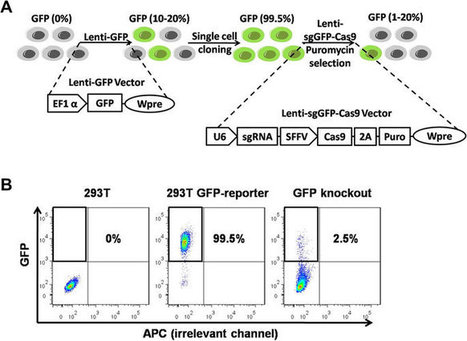
CRISPR-Cas9 is a powerful genome editing technology, yet with off-target effects. Truncated sgRNAs (17nt) have been found to decrease off-target cleavage without affecting on-target disruption in 293T cells. In this work, the authors showed that both 17nt and 20nt sgRNAs expressed by lentiviral vectors induce ~95% knockout (KO) in 293T cells, whereas the KO efficiencies are significantly lower in iPSCs (60–70%) and MSCs (65–75%). Furthermore, they observed a decrease of 10–20 percentage points in KO efficiency with 17nt sgRNAs compared to full-length sgRNAs in both iPSCs and MSCs. These results indicate the importance of balancing on-target gene cleavage potency with off-target effects: when efficacy is a major concern such as genome editing in stem cells, the use of 20nt sgRNAs is preferable.