 Your new post is loading...

|
Scooped by
Charles Tiayon
Today, 5:37 AM
|
Historian Ruchika Sharma emphasizes translating historical works into regional languages to combat misinformation effectively. "Translations of historical works into regional languages are crucial to counter misinformation on its own turf. While translations speak in the language of the people, propaganda, too, spreads most effectively in the language people consume daily, making it important that well-researched history is available in those very languages to challenge it, historian Ruchika Sharma said. Prof. Sharma was speaking at the release of ‘Karavaliya Charitreyalli Hyder Ali Mattu Tippu Sultan’ (Hyder Ali and Tipu Sultan in the History of Coastal Karnataka) by author and journalist Naveen Soorinje. IT/BT Minister Priyank Kharge, among others, was also present. “One of the key reasons for the growing communalisation of history is that good academic history is still in the shackles of English,” said Prof. Sharma, adding that freeing such work into languages like Kannada is essential to push back against distortions. Writing history in a language that people understand, she said, is a powerful way to counter “factless gibberish masquerading as history,” circulated through social media and messaging platforms. Turning to Tipu Sultan, Prof. Sharma highlighted some of the persistent claims around his rule, particularly on forced conversions. She said historical sources offer multiple, complex, and conflicting narratives on his rule. Beyond angles & demons She said Tipu Sultan was no exception and while, like other rulers of his time, he used force where he felt it was necessary, he also navigated a diverse society through patronage and political calculation. “The problem with popular history today is that it looks for angels and demons,” she said, stressing that monarchs must be understood within the nature of monarchy itself, with all its grey shades. While there were instances of forced conversion, Tipu’s engagement with Hindu institutions offers a sharply different narrative, she said. Prof. Sharma referred to the ransacking of the Sringeri Mutt by Maratha forces, and said it was Tipu who later extended financial support for the restoration of the shrine and the reinstallation of the idol. He also sought prayers for his reign at a time when Mysore faced multiple adversaries, including the British, the Marathas, and the Nizam of Hyderabad. Prof. Sharma further argued that present-day religious identities cannot be simply applied to the past. The term “Hindu,” she said, was not used in the way it is understood today and emerged later as a broad, external categorisation. At a different time in history, communities were divided along sectarian and caste lines in conflict with one another. Beyond social media Speaking at the event, Mr. Kharge said there is a growing trend of reshaping history to suit political narratives. Referring to Prof. Sharma’s point on misinformation circulating in WhatsApp groups, he said this has now expanded into mainstream platforms like cinema. “Earlier it was one forward in a resident welfare group. Now it is amplified through films and large-scale productions,” he said, citing Dhurandhar 2, The Kerala Story, and The Kashmir Files, among other recent movies based on historical themes. He added that he had no objection to individuals watching or appreciating such content, but is only worried about the larger concern of influence. Mr. Kharge said initiatives are under way to promote serious writing. Over the past two years, he said, efforts have been made to support new journals and publish books by young writers, with plans to expand this into an annual exercise. The aim, he said, is to build a body of credible, research-based work that can serve as a counter to “distorted history.” Published - March 30, 2026 12:27 am IST" https://www.thehindu.com/news/cities/bangalore/translations-of-historical-works-into-regional-languages-are-key-to-counter-misinformation-says-historian-ruchika-sharma/article70799904.ece #metaglossia #metaglossia_mundus

Are humans the only beings on the planet that use language to communicate?
"Burg Giebichenstein
Kunsthochschule Halle
“Language can only deal meaningfully with a special, restricted segment of reality. The rest, and it is presumably the much larger part, is silence.” George Steiner
Are humans the only beings on the planet that use language to communicate? Can we decipher the nonhuman world around us without harnessing it to our own socialization, syntax, and lexicon? Is interspecies communication even possible? Translation has been described as a precondition that underlies all (human) cultural transactions upon which communication is based. It also is inherently political and stands at the forefront of so many of today’s questions around identity, gender, post-colonial criticism, feminist critique, machine translation and canon creation, yet its connection within the context of the nonhuman turn, interspecies communication, and eco-criticism has not yet been fully explored.
Whether we are talking about classic linguistic and literary translation, or any number of related fields including: language and literature, cultural studies, performance, visual and media arts—the core question that translators and theorists of translation have been debating about for centuries remains the same: is it possible to translate without interpreting? Is linguistic and cultural equivalence even possible? These questions become all the more urgent in the limit-case of interspecies communication. Can we apply empathic modes of translation to nonhuman articulations, wherein translation involves a form of metamorphosis, not of text, but of the translator. As such, translators are something of a hybrid species with one foot in each culture and language, and whose very existence revolves around traveling between worlds. Translators have something of a mythical being about them, akin to a chameleon or centaur. In this course, we will not be engaging in a scientific exploration of interspecies communication, but examining theories around empathic translation-- a process that sees translation not merely as the transformation of a text, but of the translator themself.
Emerging and classical theories of translation can offer a paradigm for engaging with plant and animal articulation, not language as such, but different forms of articulation perceived through the senses, one in which our hearing and seeing,“once intertwined and attentive to the calls and cries of animals, all but disappeared with the invention of the alphabet, retreating into a kind of silence.”
In David Abram's words: “By giving primacy to perception we can see the natural world, not as inert and passive, but as dynamic and participatory. The winds, rivers and birds speak in their own way (if we listen), the sounds of nature not only have informed indigenous languages, but language in general--humans are but one being intertwined with other beings and ‘presences.’ This perspective sees the landscape as a sensuous field, and human perception as but one point of view that is in reciprocity, in expressive communication, with other points of view and ways of being.”
How can theories of translation help us make sense of this new view of a world teeming with language and sentience? What theories abound in reference to multiplicity of “language,” even as Walter Benjamin would argue for a “universal (human) language.” What practical tools does translation studies offer, and what bridges can it forge between the disciplines? The first half of the seminar focuses on key theoretical concepts relevant to the history and practice of translation. In the second half, students will engage in translation experiments that intersect with their own artistic/design practice. A final project should be considered a first draft of something that could develop later into a larger project.
The course will be taught in English and German.
This seminar is ideally suited to students interested in: Literature, Translation Theory / Translation / Cultural Studies / Critical Theory, Creative Writing/ Post-humanism, Trans-humanism, Eco-criticism, the More-than-Human Turn.
Teachers
Dr. Zaia Alexander"
https://www.burg-halle.de/en/course/l/talk-with-the-animals-translation-in-a-more-than-human-world
#Metaglossia
#metaglossia_mundus
#métaglossie

"Elon Musk announced that Grok has started automatically translating and recommending posts from other languages on X. The new capability is already delivering content from around the world directly into users’ timelines, with many English-speaking accounts noting a surge of engaging Japanese posts. Mr Musk wrote on X: “Grok automatically translating and recommending 𝕏 posts from other languages is starting to work.” The feature builds on X’s switch to Grok as its sole translation engine last year and aims to create a truly global conversation. Early reactions have been overwhelmingly positive, with users praising the fresh perspectives now appearing in their feeds. No further technical specifications have been released, but the rollout signals continued investment in breaking down language barriers on the platform."
https://share.google/azJTvoLxp1mng3fFE
#metaglossia #metaglossia_mundus

"By Jennifer Zhan, a Vulture social editor who also covers music, TV, and online culture
Mar. 27, 2026
Grammy-winning composer Lebohang Morake, known professionally as Lebo M, is suing a comedian who he claims was lyin’ about Lion King lyrics. The pair brought this matter to the court of public opinion earlier this month by posting Instagram videos to share their sides of the story. Will this battle now end up in an actual court? Here’s what to know about the $27 million lawsuit that comedian Learnmore Jonasi is crowdfunding to fight.
How did this start?
While appearing on the February 25 episode of the One54 Africa podcast, comedian Learnmore Jonasi (born Learnmore Mwanyenyeka) said that the chant in “Circle of Life” translates to “Look, there’s a lion. Oh my God.” When asked if he was joking, he doubled down: “That’s exactly what it means.” In a federal lawsuit filed in California on March 16 and reviewed by USA Today, Morake states that the chant — “Nants’ingonyama bagithi Baba” — is a line written in isiZulu and isiXhosa that actually translates to “All hail the king, we all bow in the presence of the king.” The lawsuit notes that ingonyama can translate to “lion” in Zulu but that this specific lyric is written in a form of royal-praise poetry that gives it a different significance.
Although Jonasi is not the first person to suggest that Morake’s lyric offers a very literal description of what’s happening in the opening scene of Disney’s 1994 animated classic, clips of his translation — which One54 Africa shared alongside the caption “POV: childhood ruined” — have gone viral over the past month and given the claim new life online. Morake alleged in his complaint that Jonasi has been performing this joke for the past eight years, continued to do so at comedy clubs after the clip went viral, and tried to monetize the bit with merch. Morake’s attorneys are arguing that all of that points to “actual malice” on Jonasi’s part. The lawsuit calls his translation “a fabricated, trivializing distortion, meant as a sick joke for unlawful self-profit and destruction of the imaginative and artistic work of Lebo M.” Morake is seeking $20 million in alleged damages and around $7 million in estimated disgorgement of profits.
How has Learnmore Jonasi responded?
Jonasi slammed the complaint as “unjust” in a GoFundMe campaign calling on supporters to donate so he can afford legal representation. “I am a passionate creator who never intended harm, but I now face overwhelming legal fees just to defend my right to speak and tell jokes,” he said in the crowdfunding campaign’s description. He is also selling “Look It’s a Lawsuit” merch depicting the moment he got served with lawsuit papers while recently performing onstage at the Laugh Factory in Los Angeles. (“Get your T-shirt now, You can really help me pay these legal fees 😅,” he wrote on Facebook.) In footage he shared on Instagram, Jonasi explains to the audience that he is being sued over a “joke” and adds, “Fuck The Lion King.” He ultimately finds some humor in the situation, quipping, “Listen, I now have a gluten allergy, anxiety, I got served … I’m now American!”
As of publication, Jonasi’s GoFundMe campaign has reached more than $16,000 of its $20,000 goal. “I am truly grateful for all your support and kindness,” he wrote in a March 26 thank-you message on the crowdfunding page. “Because of you, I now have a fighting chance with this lawsuit.”
Could this not have been resolved in a private conversation?
The pair already had a tense back-and-forth online earlier this month that clearly didn’t lead to any resolution. In a March 13 video, Jonasi claimed that Morake had reached out to say that he was disrespecting his work. According to Jonasi, he told Morake that he is a fan of his and that this was “just a joke.” The comedian recalled being ready to create a video with Morake about the lyric, admitting, “Personally, I had no idea that it had a deeper meaning.” However, he said his attitude changed after Morake allegedly called him a “self-hating Negro,” an “idiot,” and a “wannabe comedian.” After that, Jonasi said he felt there was no room for constructive conversation and affirmed that he has no interest in apologizing to someone he doesn’t believe he ever insulted.
Morake responded in a March 14 video which he began by apologizing “if anyone was offended” by the language he used to describe Jonasi. However, he maintained that the comedian had disrespected his work and his culture, claiming that Jonasi is continuing to chase virality “at my expense.” Morake added that hundreds of thousands of people did not take Jonasi’s translation as a joke, noting that the comment was made on a podcast while he did not appear to be doing stand-up. “[If] it was not meant to land that way, then that’s what you should have clarified instead of continuing to insult me and [encouraging] people to divide,” Morake said. “Comedy is to unite.”"
https://www.vulture.com/article/lion-king-comedian-circle-of-life-translation-lawsuit.html
#metaglossia #metaglossia_mundus

Ce compte-rendu d’Expressionismus im internationalen Kontext. Studien zur Europa-Reflexion, Übersetzungskultur und Intertextualität der literarischen Avantgarde de Mario Zanucchi (2023) met en lumière sa relecture des aspects internationaux de l’expressionnisme allemand au prisme de la traduction. Mario Zanucchi s’appuie sur une version complétée et corrigée de la bibliographie de Paul Raabe pour documenter l’auctorialité subversive de l’avant-garde allemande. Si la traduction est le vecteur d’une identité supranationale, elle témoigne également d’un idéal d’union des cultures européennes menacé par les nationalismes et la montée des fascismes. "expressionnisme allemand Translating Europe. International Politics and Poetics of the German avant-garde DOI: https://doi.org/10.58282/acta.20644 Mario Zanucchi, Expressionismus im internationalen Kontext. Studien zur Europa-Reflexion, Übersetzungskultur und Intertextualität der literarischen Avantgarde, Berlin : De Gruyter, coll. « Spectrum Literaturwissenschaft », 2023, 598 p., EAN 9783111010021. 1Mario Zanucchi, professeur à l’université de Fribourg-en-Brisgau, a fait paraître en 2023, chez l’éditeur berlinois De Gruyter, un essai intitulé Expressionismus im Internationalen Kontext. Studien über Europa-Reflexion, Übersetzungskultur und Intertextualität der literarischen Avantgarde [L’Expressionnisme en contexte international. Études sur la réflexion européenne, la culture de la traduction et l’intertextualité dans l’avant-garde littéraire]. Ce travail représente une contribution majeure pour l’étude des aspects internationaux de l’expressionnisme poétique, et ses nombreuses trouvailles bibliographiques devraient représenter des ressources précieuses pour toutes celles et ceux qui s’intéressent aux rapports entre littérature et politique au temps des avant‑gardes. 2La critique a en effet très tôt relevé la nature profondément internationale du mouvement expressionniste, qui s’étend à l’ensemble du monde germanophone jusqu’aux pays slaves, et qui s’est construit à travers ses rapports et échanges intenses avec le « réseau » (« Netzwerk », p. 1) européen des avant‑gardes du début du xxe siècle1. Tout en s’inscrivant dans la continuité de ces travaux, Mario Zanucchi met en valeur l’absence d’étude portant sur les formes de l’« intense réflexion » que la « génération expressionniste » (« die intensive Europa-Reflexion der expressionistischen Generation », p. 4) a menée sur l’Europe, et sur l’idée d’identité européenne, dans le creuset de la Première Guerre mondiale. Le chercheur ouvre une perspective nouvelle sur la question des aspects transnationaux de l’expressionnisme, en l’envisageant à travers l’étude des phénomènes de traduction et d’intertextualité constitutifs de sa poétique, domaine en effet peu exploré (p. 99). L’écriture de la traduction, qui se trouve à la source d’une poétique située entre les langues et les cultures, est le vecteur d’une identité supranationale, européenne, qui consiste en l’application esthétique d’un programme aux accents philosophiques et politiques, ancré dans une rhétorique antibourgeoise. Cette réflexion collective demeure néanmoins indissociable des tensions et affrontements qui traversent alors le continent et qui se reflètent dans les discours parfois contradictoires des membres de l’avant-garde expressionniste. En effet, ces contradictions — ou du moins cette hétérogénéité des opinions radicales, souvent teintées d’anarchisme, des écrivains étudiés — sont bien inhérentes à l’avant-garde allemande : certains chercheurs, comme Sébastien Hubier, préfèrent ainsi parler d’une multitude d’« expressionnismes », afin de mieux décrire ce qui est non pas « un mouvement unifié, mais bien plutôt un phénomène à la fois dynamique et polymorphe2 », dont les bornes chronologiques sont par ailleurs sujettes à débat3. Or c’est justement selon une démarche non systématique, à la croisée des approches théoriques, entre traductologie, stylistique et sociologie, que se construit l’objet de la recherche de Mario Zanucchi : soit la projection littéraire de rapports et échanges internationaux au sein d’un espace national contesté, appuyée sur une croyance en la capacité agissante de l’écriture, et matière à création esthétique. Le texte poétique lui-même, lieu où se construit et se consolide l’identité supranationale des expressionnistes, intègre l’idéal d’une communauté humaine. Par‑delà les frontières, une identité européenne 3Le prisme de la traduction permet au chercheur de relire et d’actualiser des aspects de l’expressionnisme par ailleurs bien connus. Le premier chapitre présente ainsi une mise au point sur les principaux traits de cette avant-garde, qui vise autant à s’adresser à un public de lecteurs et lectrices non‑initiés, qu’à en mettre en valeur la nature essentiellement subversive, et marginale — un effet concret de l’adhésion de ses membres à une identité internationale, sur lequel le chercheur reviendra tout au long de sa réflexion. Il convient de rappeler ces aspects en quelques mots. L’expressionnisme est une « contre‑culture » qui s’apparente à un mode de vie, et qui se caractérise par le jeune âge de ses participants ainsi que par leur posture contestataire (p. 9). L’essentiel de ses membres, nés entre 1885 et 1896, — sans oublier certaines figures tutélaires, plus âgées d’une dizaine d’années, comme les poètes Else Lasker‑Schüller ou Theodor Däubler — sont issus de milieux éduqués et ont eux-mêmes fait des études, pour la majorité en droit ou en médecine (p. 20). Cet arrière‑plan académique est important, non seulement en raison de la culture littéraire des membres de l’avant‑garde, ouverte sur l’étranger et attentive à certaines figures encore confidentielles, comme Rimbaud, qu’ils contribueront à faire connaître par leurs traductions en Allemagne, mais aussi par leur ralliement à un état d’esprit commun reposant sur des références partagées : la littérature française fait ainsi figure d’étendard générationnel dans l’Allemagne du début du siècle, encore profondément marquée par le souvenir de la guerre de 1870. Selon Mario Zanucchi, la francophilie des membres de l’avant-garde allemande, conjuguée à la judéité d’une large partie d’entre eux, renforce un sentiment de cohésion sociale et intellectuelle (p. 22) ; ce sentiment s’avère d’autant plus fort que ces individuso demeurent relégués à une marge, du fait de leur appartenance, en grande partie, à une minorité discriminée. Ces éléments expliquent leur commun rejet de l’État allemand récemment unifié, conduit sous la férule autoritaire de Guillaume II, et l’entretien d’une « distance critique » (« kritische Distanz », p. 23) à l’égard des normes dominantes. 4Contre la politique nationaliste menée par l’empereur, les expressionnistes revendiquent une appartenance internationale, qui se situe par‑delà les frontières et les langues. En s’appropriant néanmoins la langue allemande, ils subvertissent les fondements du discours nationaliste : une « Mischkultur » (p. 40), soit une société métissée, multiculturelle et polyglotte, se construit entre ces jeunes gens originaires de Hongrie, de Bohême, d’Ukraine, de Russie, ou encore d’Alsace et de Lorraine annexées, à l’image du mélange des cultures régnant alors dans le monde germanophone. L’idée même de frontière séparant les êtres et enfermant chaque individu dans sa spécificité culturelle et linguistique est réfutée. Comme l’écrit le poète bilingue, d’origine lorraine, Yvan (Iwan) Goll : « j’écris en allemand et en français mais je n’appartiens qu’à l’Europe » (lettre du 5 juin 1924 à Vladimir Maïakovski, citée p. 41). La revendication d’un statut d’étranger au sein de leur propre nation est par ailleurs intrinsèquement liée à l’affirmation d’une forme d’étrangeté esthétique dans le paysage culturel allemand, ce qu’évoque le terme « expressionnisme » lui‑même, un emprunt à la langue française et au lexique de la critique d’art du début du siècle (p. 9). Parler d’expressionnisme, dans l’Allemagne des années 1910, revient donc à désigner une esthétique qui s’oriente d’emblée vers la culture française — une subversion tout autant artistique que politique. 5En effet, l’ouvrage de Mario Zanucchi prend le soin de toujours souligner la nature effective du programme expressionniste, en raison de son inscription au sein d’un régime littéraire où l’écriture porte l’élan d’une force collective visant à bouleverser politiquement et esthétiquement le réel qui lui fait face4. La revendication d’une identité internationale est ainsi systématiquement perçue comme un élément de leur rhétorique contestataire, qui a depuis longtemps été étudiée par la critique5. Si les expressionnistes, par leur simple présence, incarnent une opposition aux discours nationalistes et antisémites dominants, leur poétique représente également une réaction au « canon officiel de la littérature » (« der offizielle Literaturkanon », p. 27) allemande et à la tradition. Des analyses particulièrement denses sont consacrées à la réinterprétation des figures d’écrivains, comme Homère, Schiller et Hölderlin, dans la poésie expressionniste, par ailleurs souvent réduite à sa description négative de la modernité et de l’environnement étouffant de la « grande ville » (« Großstadt »). Ces écrivains canonisés, passés au « filtre expressionniste » (« expressionistische Filter », p. 132) prennent eux-mêmes l’apparence d’étrangers, de figures aliénées et rejetées par la masse. Novalis est ainsi qualifié de « saint étranger » (« heiliger Fremdling ») par Georg Trakl, dans son poème « An Novalis » [« À Novalis »] (p. 30). Les poètes romantiques sont également associés à un imaginaire subversif : dans le poème de Gottfried Benn, « Der Räuber-Schiller » [« Schiller le Brigand »], Schiller apparaît comme un « monstrueux syphilitique » (« monströsen Syphilitiker », p. 35), qui évoque le portrait de Karl Moor, personnage de sa pièce Die Räuber [Les Brigands] (1782). Ces réinterprétations expressionnistes de la tradition littéraire allemande scellent un contre-panthéon national, tourné du côté de l’étranger, qui sert de fondement à une généalogie de la modernité. Si Jean‑Michel Gliksohn avait fait de l’expressionnisme, en raison de son ancrage international, un « élément constitutif de la poésie moderne en Europe6 », l’Europe apparaît ici comme un élément constitutif de la poétique et de l’identité expressionnistes. Luttes littéraires pour une Europe commune : les défis de l’unité 6Bien que les premières pages de l’ouvrage de Mario Zanucchi visent à donner un portrait‑type, donc synthétique et unifié, de l’écrivain expressionniste, la suite de l’argumentation donne la part belle à toutes ces nuances qui, dans leur diversité, constituent une pensée collective et « partagée7 ». Les chapitres se lisent ainsi comme des successions d’études de cas qui visent à montrer l’hétérogénéité des opinions et la multiplicité des réponses discursives et poétiques apportées aux problématiques abordées. Ce n’est que dans la troisième et dernière partie de l’ouvrage, consacrée au « dialogue intertextuel et intermédial » (« intertextuelle und intermediale Dialoge », p. 365) de la poétique expressionniste, découlant de l’activité de traduction, que ces études de cas seront traitées avec l’approfondissement et l’attention qu’elles méritent. 7Car en effet, l’enjeu du livre est bien de donner à lire à toute personne intéressée par ces questions un aperçu du bouillonnement artistique et intellectuel éprouvé par la génération expressionniste. La succession de ces (courtes) études crée un dialogue problématisé, nuancé, entre des figures dont le lien et la proximité ne sont pas toujours précisés, évitant la cacophonie des discours d’antan. Dans le cas de l’expressionnisme, cette cacophonie s’incarnait sans aucun doute dans la radicalité des discours partagés, mais aussi dans les circonstances historiques qui les ont provoqués. Un exemple intéressant de cette lutte discursive se situe dans les deux derniers chapitres de la première partie, successivement consacrés à la réception du modèle nietzschéen du « bon Européen » (« gute Europäer ») et à l’actualisation du concept de « Weltliteratur » [littérature monde] de Goethe8 dans le contexte de la Première Guerre mondiale et de ses suites. La guerre apparaît en effet comme un moment névralgique des débats sur l’identité européenne, en raison de la tension qu’elle opère au sein de l’idéal d’union internationale défendu par les avant‑gardes, mais aussi de la désunion interne qu’elle accentue. Le positionnement pacifique des revues, comme Die Aktion [L’Action] ou Der Sturm [La Tempête], qui s’insinue dans les mailles de la censure au nom du maintien d’un idéal fraternel entre les nations belligérantes, coexiste avec des lectures apologétiques de la guerre, comme dans certains écrits de Rudolf Leonhard, qui voit dans le conflit destructeur une force de régénérescence indispensable à un monde moderne en pleine décadence — sans exclure non plus une issue pacifiste. Mario Zanucchi nous révèle néanmoins que, par-delà la « polyphonie » (« Polyphonie », p. 40) de ces opinions, se pose en réalité la question du rôle de l’écrivain d’avant-garde, de la portée concrète de ses écrits et de sa responsabilité à l’égard de l’Europe : doit‑il s’affirmer en contre‑pouvoir, en prise avec les événements, ou maintenir une distance élitiste, inspirée notamment de la pensée de Nietzsche ? La réflexion sur le sort de l’Europe sert donc une expérience de définition de soi (« Selbstverständnis », p. 40) fondamentalement équivoque, que révèle par ailleurs la difficile définition du concept d’avant‑garde. 8Malgré l’ambivalence des discours que les expressionnistes portent sur l’Europe, leurs réflexions demeurent animées par une préoccupation commune. Une question sous‑jacente ressort en effet de la lecture de l’ouvrage : par quels moyens unir les nations européennes, par‑delà les nationalismes et leurs intérêts divergents ? Les analyses menées par Mario Zanucchi montrent que la littérature se voit conférée pendant la guerre une capacité agissante, chargée de réparer le lien rompu entre les nations européennes. Or la signature du Traité de Versailles semble remettre en cause la force performative de la littérature expressionniste. Les extraits du chapitre que nous traduisons sont intéressants pour, en filigrane, faire lire la désillusion qui semble progressivement s’emparer des avant‑gardes et mettre à mal leur parole poétique. En effet, si l’étranger demeure pour Franz Pfemfert, le directeur de la revue Die Aktion, un horizon concret qu’il s’agit de maintenir vivant malgré le conflit mondial, il redevient après‑guerre ce qu’il était autrefois aux yeux des écrivains du xixe siècle, soit une fiction teintée d’orientalisme, ce qui, pour Edward Said, rappelons‑le, est « une manière de s’arranger avec l’Orient fondée sur la place particulière que celui-ci tient dans l’expérience dans l’Europe occidentale9 ». Le poète Klabund entrevoit ainsi dans l’Asie, sur le modèle du philosophe Theodor Lessing, un « antipode pacifiste à un Occident belliciste » (« idealisierte Lessing […] Asien als friedlichen Antipoden des bellizistischen Westens », p. 91) et un remède mystique au désenchantement caractéristique des sociétés européennes modernes. Ses écrits, qui appellent ses compatriotes défaits et humiliés à se tourner vers un Extrême‑Orient miraculeux, résultent d’un processus d’interprétation chimérique qui fait l’impasse sur les tiraillements et conflits propres à ce continent. Cela a une double conséquence : si Klabund refuse de contempler l’Autre dans son altérité, c’est-à-dire selon ce qui lui est propre, il renonce également à y reconnaître les maux qui font écho à la propre réalité de l’Allemagne de l’après‑guerre. L’étranger est idéalisé au point de devenir un rêve, de nature toute intellectuelle, dont l’anthologie de 1922 Geschichte der Weltliteratur in einer Stunde [Histoire de la littérature mondiale en une heure] offre la mise en scène10. Cette virtualité de l’étranger n’ouvre pas la perspective d’un salut collectif qui unirait Orient et Occident ; au contraire, elle se tourne vers l’Allemagne elle‑même, dont elle vise le sursaut spirituel. L’immatérialité de la fiction asiatique de Klabund révèle ainsi un abîme : l’absence de toute solution concrète, possible, à la question de l’avenir de l’Allemagne que la parole poétique pourrait mettre en œuvre. La littérature perd dès lors sa capacité à faire acte et à fonder une réalité alternative — que ce soit par l’établissement d’un lien altruiste entre les individus ou par l’appel à la révolution, comme le tentèrent les expressionnistes internationalistes, à l’instar d’Yvan Goll (p. 69). 9Malgré l’intérêt de ces sources méconnues, qui sont lues pour elles seules, il convient de souligner que l’analyse aurait pu gagner en profondeur par le renvoi à des sources secondaires explicitant le contexte idéologique dans lequel ont été produits ces textes, qui déterminent le positionnement de leurs auteurs au sein d’un ordre international troublé. Le lecteur ressent en effet une certaine frustration face à la seule lecture des sources primaires, l’analyse manquant par endroits d’un arrière-plan critique solide, notamment sur la question de l’orientalisme. En tant qu’aspect important de la poétique des avant‑gardes11, qui engage un processus d’interprétation fondé sur un rapport de domination, elle ne peut se passer d’un commentaire dans le cadre d’une réflexion sur les échanges culturels internationaux réalisée d’un point de vue européen. De plus, il aurait certainement été judicieux, dans ce contexte, de renvoyer à la situation similaire des avant-gardes européennes, notamment russes12, qui, à la même époque, voient également se contredire sous leurs yeux impuissants utopie politique et réalité historique. Mario Zanucchi a néanmoins confiance en l’éloquence des textes et dans leur capacité à montrer que, comme dans la pensée freudienne de l’« inquiétante étrangeté » (« Unheimlichkeit »), la recherche de l’Autre menée par les expressionnistes n’aboutit finalement qu’à soi. Il suffirait ainsi de lire ces textes pour déceler « le rôle toujours dominant des discours nationaux, qui, même après la guerre, ont continué à teinter de nationalisme le concept transnational d’avant-garde » (« die weiterhin dominante Rolle der nationalen Diskurse, welche gerade auch in der Nachkriegszeit selbst die transnationalen Konzepte der Avantgarde im nationalen Sinne färbten », p. 95) : un risque majeur encouru par toute activité littéraire en temps de crise et dont la documentation et l’explicitation critique demeurent encore et toujours décisives. Un continent inexploré 10Un lien littéraire tangible demeure cependant, même après‑guerre, entre les langues et les cultures : la traduction qui, malgré les désillusions, permet de maintenir une relation tout sauf symbolique avec l’étranger. Mario Zanucchi se charge ainsi de relire, au prisme de cette écriture, qui débouche naturellement sur une poétique, la question des échanges culturels et littéraires entre avant‑gardes allemandes et européennes. Or son travail offre également un commentaire de ce qui apparaît bien comme tout un pan méconnu de la bibliographie expressionniste : les écrits traduits. 11En effet, cet ouvrage, qui se présente, nous l’avons dit, comme une étude de la réflexion européenne de l’expressionnisme à travers le prisme de la traduction, doit également être lu pour ce qu’il semble au premier abord : c’est-à-dire le dévoilement des résultats concrets d’une recherche d’une ampleur et d’une ambition remarquables, qui fait advenir aux lecteurs et lectrices des textes pour la plupart oubliés. Comme l’annonce le chercheur au début de la deuxième partie, la visée de son travail est bien de compléter un champ lacunaire, résultant du manque d’attention porté jusqu’alors sur les pratiques des traducteurs, à l’aide d’« une vue systématique (« systematische Sichtung ») et d’« un développement bibliographique » (« bibliographische Erschließung ») (p. 99). Mario Zanucchi s’octroie ainsi la tâche de corriger, d’actualiser et de commenter la bibliographie du chercheur Paul Raabe, établie en 198513. S’ajoute désormais aux 222 textes imprimés mentionnés dans cette bibliographie de référence une cinquantaine de titres, ce qui en porte le total à 275 (p. 124), auxquels il faut également ajouter les centaines de textes parus dans les revues expressionnistes et qui n’avaient encore jamais fait l’objet d’une recension complète (p. 285). Autrement dit, c’est un double continent inexploré que Mario Zanucchi nous donne à voir : au cours de la traversée d’une Europe en traductions jusqu’alors ignorée (et par-delà, l’analyse s’étendant en effet aux continents asiatique et nord-américain), se révèle une masse bibliographique commentée pour la première fois, qui vient documenter un aspect déterminant de l’« auctorialité » (« Autorschaft ») expressionniste (p. 99). 12La critique avait visiblement négligé le fait qu’auteurs et traducteurs expressionnistes partagent une même posture subversive et contestataire, fondée non seulement sur le rejet des discours nationalistes mais aussi sur la remise en cause d’un esprit bourgeois, conservateur et capitaliste instauré comme norme morale et politique. Ce partage d’éthos14 n’a rien d’étonnant, si l’on considère le fait que de nombreux écrivains expressionnistes, qui publient en livres ou en revues des textes signés en leur nom propre, sont également traducteurs : c’est notamment le cas de figures tout à fait majeures de l’avant-garde comme Albert Ehrenstein, Max Brod, Stefan Zweig, Yvan et Claire Goll, Klabund, Franz Werfel ou encore Alfred Wolfenstein. Mario Zanucchi souligne ainsi que les titres traduits par les expressionnistes constituent un « contre‑canon » (« Gegen‑Kanon ») qui est aussi, d’après les mots d’Adorno, un « canon des interdits » (« Kanon des Verbotenen », p. 118). Ces titres, pour la plupart issus des littératures de langues française et anglaise, mais aussi tchèque et russe, sont destinés à subvertir l’idée d’une « belle littérature » (« Schönen Literatur », p. 118) bourgeoise et formatée. Cela s’illustre par la traduction et la valorisation de « figures auctoriales rebelles » (« rebellischer Autorschaft », p. 214) comme Baudelaire, Rimbaud, Verlaine, Voltaire ou Péguy côté français, mais aussi Walt Whitman, Oscar Wilde, ou encore Percy Shelley pour les anglo‑saxons : tous ces écrivains possèdent un potentiel critique dans l’Allemagne du début du siècle. L’aspect subversif des traductions expressionnistes ne se justifie ainsi pas seulement par la nature contemporaine des auteurs traduits, voire par leur appartenance aux avant‑gardes européennes qui, de Marinetti à Apollinaire, font l’objet d’une soigneuse diffusion dans l’espace germanophone15. Les expressionnistes jouent également sur la vie et l’aura scandaleuse de certains écrivains traduits susceptibles, comme Wilde, de choquer un lectorat conservateur (p. 192). De façon générale, la traduction permet d’actualiser et d’inscrire les combats exprimés par les auteurs étrangers dans le contexte national allemand : le traducteur fait dès lors office de porte‑voix aux causes dans lesquelles il se reconnaît et adapte en ce sens le texte original à son présent. C’est ainsi que des textes anciens obtiennent une résonnance contemporaine, dans le contexte de la guerre et de ses suites notamment, et ne passent pas inaperçus des autorités. Mario Zanucchi évoque par exemple une traduction censurée du dialogue « Du Droit de la guerre16 » de Voltaire due à Alfred Wolfenstein en 191617 (p. 150). De la même manière, les textes extra‑européens sont dotés d’une coloration contestataire qui leur accorde la forme de paraboles destinées à être lues entre les lignes, ce qu’illustrent les traductions de la poésie chinoise par Klabund ou encore par Albert Ehrenstein18 (p. 264). 13Bien que la quantité de références bibliographiques traitée empêche la lecture suivie et attentive de l’ensemble des sources, qui sont pour la plupart survolées, Mario Zanucchi prend le temps de s’arrêter sur certains textes afin de mieux faire ressortir la poétique de la traduction mise en œuvre par les expressionnistes. Un exemple tout à fait parlant réside dans l’étude de trois traductions de Baudelaire par Hans Havemann (1920), Franz Hardekopf (1915) et Wilhelm Klemm (1916), qui entendent chacune constituer une « actualisation avant-gardiste » (« avantgardistische Aktualisierung », p. 104) des poèmes en jeu19. Le chercheur les compare avec les fameuses traductions des Fleurs du Mal publiées par le poète symboliste Stefan George en 1901. Les traducteurs visent en effet à « déconstruire » (« dekonstruieren », p. 109) l’idéalisme que S. George avait insufflé dans ses traductions de Baudelaire en faisant ressortir au sein du texte traduit les stylèmes propres à l’expressionnisme, caractérisé par une parole poétique violente et par la récurrence de motifs comme le cri, la solitude, l’aliénation métaphysique. Adapté à l’esthétique des avant-gardes, Baudelaire devient un « poète de la grande ville » (« Großtadt Dichter »), mais aussi un « ancêtre » (« Anherrn ») qui s’inscrit dans la tradition alternative, francophile, européenne, de l’expressionnisme (p. 111). Par‑delà ce geste généalogique, qui associe traduction et récriture du passé, se révèle l’auctorialité affirmée des traducteurs expressionnistes. Les interventions auctoriales dans le texte traduit prennent parfois des formes extrêmes : pensons au poème de Shelley, intitulé « Liberty » [« Liberté »], que traduit Alfred Wolfenstein en 10 vers, sur les 21 originaux, dans un style très proche de ses propres écrits20 (p. 217). Loin d’être une pratique mineure et secondaire, la traduction se révèle une modalité inhérente à la diction et à l’action expressionnistes : elle est constitutive d’une identité et d’une poétique qui se construisent à travers les langues et les cultures. Ainsi elle s’envisage également comme un paradigme du poème de la modernité, conscient de son appartenance transnationale et porteur d’un idéal d’union au sein de la communauté européenne des avant‑gardes. Une poétique internationale 14Alors que la guerre scelle l’échec du projet politique de l’expressionnisme, c’est dans l’œuvre d’art que se réfugie le rêve d’internationalisme poétique des avant-gardes. Le poème, mais aussi le film ou la pièce de théâtre, apparaissent comme autant d’espaces concrets dénués de frontières. C’est ainsi que Mario Zanucchi consacre la dernière partie de son ouvrage à des phénomènes d’intertextualité et de transmédialité propres à la poétique expressionniste à travers une série de cinq études de cas. Ces études sont d’abord consacrées à des exemples qui se situent dans la droite ligne des analyses précédentes, soit les réminiscences de l’œuvre d’Émile Verhaeren dans le célèbre poème « Der Krieg » [« La Guerre »] de Georg Heym et les sources baudelairiennes et nietzschéennes du poème « Untergrundbahn » [« Métropolitain »] de Gottfried Benn. Suivent ensuite des cas moins attendus, à travers lesquels la thématique de la traduction est traitée de manière secondaire, comme les mises en scène du théâtre de Strindberg et les adaptations graphiques et cinématographiques des romans de Dostoïevski. Dans ces pages se retrouve en effet l’ambition paradoxalement synthétique du livre qui, à travers la multiplicité des cas isolés, entend quadriller l’ensemble des pratiques poétiques de l’expressionnisme. 15Ce sont sur ces différents cas, qui se succèdent dans un ordre chronologique sans entretenir de lien thématique entre eux, que se clôt le livre. L’absence de conclusion, dommageable, accorde par conséquent à la réflexion générale l’apparence d’une série d’« études » (« Studien ») dont la cohérence globale est atténuée, et qui était peut-être déjà annoncée dans le titre. Si l’on devait néanmoins retenir un cas étudié au cours de la troisième partie qui synthétise la majeure partie des enjeux du livre, et qui aurait pu faire office de conclusion, ce serait la nouvelle méconnue d’Alfred Lemm, « Der Herr mit der gelben Brille » [« L’Homme aux lunettes jaunes »]21, étudiée pour son imprégnation des thèses du français Gustave Le Bon — mais aussi de Freud — sur la psychologie des foules. Ce court récit évoque le lynchage d’un homme ayant refusé de prendre part à l’ivresse patriotique des premières semaines de la Grande Guerre. Alfred Lemm, écrivain par ailleurs engagé au côté de Martin Buber dans le mouvement sioniste (p. 416), y convoque les principaux combats de l’expressionnisme. Le personnage principal, dont on sait seulement qu’il est jeune, et porte des lunettes jaunes, est en effet doublement visé par la foule : en raison de son rejet de la ferveur nationaliste mais aussi pour sa judéité supposée. Le positionnement pacifique d’Alfred Lemm s’associe ainsi à une critique de l’antisémitisme, qui se double à celle du capitalisme, laissant entrevoir une foule manipulée autant par la propagande belliciste que par la publicité (p. 437-438). Mario Zanucchi révèle la nature parodique de cette scène de lynchage, malgré sa démesure, en tournant en ridicule la dynamique nationaliste et son effet manipulateur sur la foule (p. 437). Abandonnant sa position de marginal, de « corps étranger » (« Fremdkörper », p. 428), qui l’identifiait au personnage principal de la nouvelle, l’écrivain adopte, par son ironie, une posture surplombante. Il s’érige comme le dernier « voyant » d’une société caractérisée par sa cécité (p. 426) — un voyant dont le lecteur perçoit néanmoins qu’il est prêt à payer cher sa lucidité. 16On ne peut par ailleurs s’empêcher de déceler dans la conclusion de cette nouvelle des échos tragiques. Mario Zanucchi rappelle en effet la postérité des thèses de Gustave Le Bon, sur lesquelles Alfred Lemm s’appuie dans sa description du mécanisme de la foule en furie, sur Mussolini et Hitler (p. 414). Cette référence française, qui deviendra l’argument des bourreaux, anticipe l’idée d’une culture européenne à laquelle il n’est plus possible d’accorder sa confiance et dans laquelle le lien à autrui est écrasé sous la pression des nationalismes. Ce que l’Histoire montrera en effet, contraignant la majeure partie des écrivains expressionnistes à fuir, ou à mourir, du fait d’une Allemagne hostile et de ses alliés, dont la nouvelle d’Alfred Lemm laisse déjà planer la menace. notes 1 Voir ainsi, parmi les travaux fondateurs cités par le chercheur : Jean-Pierre Meylan, « Les expressionnistes allemands et la littérature française : la revue Die Aktion », Études littéraires, no 3, 1970, p. 303-328 ; Helmut Gier, Die Entstehung des deutschen Expressionismus und die antisymbolistische Reaktion in Frankreich : die literarische Entwicklung Ernst Stadlers, Munich, Fink, 1977 ; Lothar Jordan, « “À travers l’Europe”. Französische Literatur in der Zeitschrift Der Sturm (1910-1920). Ein Abriß », dans L. J. und Bernd Kortländer (dir.), Interferenzen Deutschland-Frankreich. Literatur, Wissenschaft, Sprache, Düsseldorf : Droste, 1982, p. 104-110 ; Peter Demetz, Worte in Freiheit. Der italianische Futurismus und die deutsche literarische Avantgarde (1912-1934), Munich : Piper, 1990 ; Walter Grünzweig, Walt Whitman : Die deutschsprachige Rezeption als interkulturelles Phänomen, Munich : Fink, 1991 ; Valentin Belentschikow, Russland und die deutschen Espressionisten, Francfort sur le Main : Lang, 1993. 2 Sébastien Hubier, « Les Expressionnismes, entre modernité et avant-garde », dans Isabelle Krzywkowski, Cécile Millot (dir.), Expressionnisme(s) et avant-garde, Isabelle Krzywkowski, Cécile Millot (dir.), Expressionnisme(s) et avant-garde, Paris : L’Imposture, 2007, p. 284. 3 Il est en effet difficile d’établir les bornes chronologiques d’un « mouvement » qui est par essence mouvant, changeant et insaisissable. Si les premiers pas de l’expressionnisme poétique sont généralement associés à la fondation du Neue Club de Kurt Hiller à Berlin en 1909 (cercle qui deviendra l’année suivante le Cabaret néo-pathétique — Neo-pathetisches Cabaret — et qui réunit entre autres, autour de son créateur, les poètes Georg Heym et Jakob van Hoddis), sa date de fin demeure sujette à débats. Doit-on accepter 1921, comme le proposent Yvan Goll et Paul Hatvani, qui ont l’avantage de représenter un point de vue interne à l’avant-garde ? 1923, année de la tentative de putsch ratée d’Hitler ? 1924, comme l’indiquent les bornes chronologiques de la bibliographie de référence du chercheur, spécialiste de l’expressionnisme, Paul Raabe ? Dans tous les cas, la fin de l’expressionnisme est causée par un changement de mentalité dans l’Allemagne post‑Traité de Versailles, corrélative à l’échec des révolutions, à l’avènement du régime de la République de Weimar et à la consolidation de la société mécanisée. Ces temps de mutations, dans la première moitié des années 1920, donneront naissance à une sensibilité artistique nouvelle, la Nouvelle Objectivité (« Neue Sachlichkeit »). 4 En effet, pour Vincent Kaufmann, les avant-gardes, « loin de constituer un phénomène naturel, infiniment reproductible, sont, au contraire, l’effet ou la mise en acte d’une poétique spécifique du partage, historiquement datée. [Ses principaux aspects] procèdent d’une esthétique communautaire passée dans la réalité, ou cherchant du moins à y passer, à devenir effective. » (Poétique des groupes littéraires, Paris, P. U. F, 1997, p. 4) 5 Voir ainsi Thomas Anz, Literatur der Existenz : literarische Psychopathographie und ihre soziale Bedeutung im Frühexpressionismus, Stuttgart : J. B. Metzler, 1977. 6 Jean-Michel Gliksohn, L’Expressionnisme littéraire, Paris : P.U.F, 1990, p. 57. 7 Vincent Kauffmann, Poétique des groupes littéraires, op. cit., p. 4. 8 Voir ma traduction du chapitre. 9 Edward Said, L’Orientalisme. L’Orient créé par l’Occident [1978], Paris : Seuil, 2005, p. 30. 10 Pourtant fondée sur la connaissance profonde des littératures asiatiques, et notamment de la poésie chinoise, acquise par Klabund à travers son activité de traducteur, qui fait l’objet d’un long développement aux pages 267-281. 11 Pour une étude de l’intérêt que le surréalisme a porté à l’orientalisme, voir Guillaume Bridet, « Les avant-gardes françaises de l’entre-deux guerres face aux civilisations extra‑occidentales », Itinéraires, no 3, 2009, p. 57‑74. Disponible en ligne : https://doi.org/10.4000/itineraires.536 (consulté le 11 février 2026). 12 Voir ainsi Luba Jurgenson, « Les avant-gardes littéraires à l’épreuve de la Révolution », Revue des études slaves, vol. 90, no 1-2, p. 231‑239. Disponible en ligne : https://doi.org/10.4000/res.2700 (consulté le 11 février 2026). 13 Paul Raabe, Die Autoren und Bücher des Literarischen Expressionismus. Ein bibliographisches Handbuch [1985], Stuttgart : J. B. Metzler, 1992, p. 729-733. 14 Sur la question de l’éthos du traducteur, voir Pascale Roux, Éthos et style chez les traducteurs de poésie : Keats, Leopardi et Heine en français, Paris : Classiques Garnier, 2024. 15 Voir notamment le chapitre consacré aux traductions des futuristes italiens, aux pages 318-361. 16 Onzième dialogue de L’A, B, C, ou Dialogues entre A, B, C [1768]. Voir Voltaire, Œuvres complètes, tome 27, Paris : Garnier, 1879, p. 368-375. 17 François Marie Arouet de Voltaire, Vom Kriegsrecht, Iéna : Eugen Diederichs Verlag, 1916. 18 Voir ainsi Klabund, Dumpfe Trommel und berauschtes Gong. Nachdichtungen chinesischer Kriegslyrik, Leipzig, Insel, 1915 ; Albert Ehrenstein, China klagt. Nachdichtungen revolutionärer chinesischer Lyrik aus drei Jahrtausenden, Berlin : Der Malik-Verlag, 1924. 19 Il s’agit de « Correspondances », « Crépuscule du matin » et « L’Amour et le crâne ». 20 Percy Bysshe Shelley, Dichtungen, traduit par Alfred Wolfenstein, Berlin : Paul Cassirer, 1922, p. 69. En plus de ses nombreuses traductions des littératures anglaise (Poe, Shelley, Brontë…) et française (Nerval, Rimbaud, Hugo, Feydeau, Flaubert…), Alfred Wolfenstein est l’auteur de deux recueils de poèmes, Die Gottlosen Jahre [Les Années sans dieu] (1914) et Die Freundschaft [L’Amitié] (1917), ainsi que de plusieurs anthologies, de pièces de théâtre et d’un roman inachevé, Frank. Roman einer Jugend [Frank. Roman d’une jeunesse] (1937). Né en 1883 à Halle, il émigrera à Prague en 1934 avant de rejoindre la France. Réfugié tout d’abord en zone sud au début de l’Occupation, contraint à se cacher en raison de sa judéité, il mourra seul, dans l’indigence, à Paris en 1945. Son œuvre, très discutée dans les années 1910 et 1920, est aujourd’hui à redécouvrir. Voir Bernhardt Spring, Alfred Wolfenstein Lesebuch, Halle : Mitteldeutscher Verlag, 2011. 21 Alfred Lemm, « Der Herr mit der gelben Brille », Die Weißen Blätter, vol. 2, no 12, 1915, p. 1494–1501. résumés Ce compte-rendu d’Expressionismus im internationalen Kontext. Studien zur Europa-Reflexion, Übersetzungskultur und Intertextualität der literarischen Avantgarde de Mario Zanucchi (2023) met en lumière sa relecture des aspects internationaux de l’expressionnisme allemand au prisme de la traduction. Mario Zanucchi s’appuie sur une version complétée et corrigée de la bibliographie de Paul Raabe pour documenter l’auctorialité subversive de l’avant-garde allemande. Si la traduction est le vecteur d’une identité supranationale, elle témoigne également d’un idéal d’union des cultures européennes menacé par les nationalismes et la montée des fascismes. This review of Mario Zanucchi’s Expressionismus im internationalen Kontext. Studien zur Europa-Reflexion, Übersetzungskultur und Intertextualität der literarischen Avantgarde (2023) highlights his reinterpretation of the international aspects of German Expressionism’s through the lens of translation. Zanucchi relies on a corrected and expanded version of Paul Raabe’s bibliography to demonstrate the subversive authorship of the German avant-garde. Translation thus esthablishes a supranational identity bearing the ideal of a European cultural union, which remains under the threat of nationalism and the emerging fascisms. plan Par‑delà les frontières, une identité européenne Luttes littéraires pour une Europe commune : les défis de l’unité Un continent inexploré Une poétique internationale mots clés avant-gardes littéraires, expressionnisme allemand, nationalisme, Première Guerre mondiale, traduction german expressionnism, literary avant-gardes, nationalism, translation, World War I" https://www.fabula.org/revue/document20644.php #metaglossia #metaglossia_mundus
"Each year, only one in six Canadians read a book originally written in another language. As a majority English-speaking market, it’s not surprising that most of the books available to us are written by anglophone voices. However, it is a missed opportunity for many who never venture beyond that. Translated works open doors to worlds shaped by different cultures, histories, and ways of thinking. There are many amazing stories that have been told outside of the English language. Below are several outstanding novels available at Belleville Public Library, translated into English.
We are a bilingual country, yet most English-speaking readers do not read French literature. One timeless read is Alexandre Dumas’s The Count of Monte Cristo. Do not be turned away by its age and length, this is a thrilling adventure tale. Betrayed, imprisoned, and left for dead, Edmond Dantès overcomes hardship and loss to patiently and methodically extract revenge. The Count of Monte Cristo is available in print, eBook, and audiobook at the library.
Spanish is a rich and diverse language that is spoken in most of Central and South America, along with Mexico and Spain. One of the most celebrated and influential short story writers of the twentieth century was the Argentinian writer Jorges Luis Borges. What makes him great is his ability to write complex, philosophical ideas into very concise narratives. In just a few pages, Borges can create a world as rich and immersive as most full-length novels. Try one of his best story collections, Ficciones, available in eBook at the library.
Haruki Murakami is a Japanese author, with global popularity. One of his most acclaimed novels is The Wind-Up Bird Chronicle. The novel, it is a surreal tale, follows Toru Okada, an ordinary man whose quiet life in Tokyo begins to unravel when his wife disappears. As he searches for her, Toru is drawn into a strange, dreamlike world populated by enigmatic neighbors, psychic figures, and unsettling memories that blur the line between past and present. The Wind-up Bird Chronicle is available on eBook and as a CD audiobook at the library.
The Italian novel, My Brilliant Friend by Elena Ferrante was named in 2024 as the best book of the twenty first century by the New York Times. The novel follows the lifelong friendship between two girls growing up in a poor Naples neighborhood. Through Elena’s eyes, the brilliant and unpredictable Lila becomes both her closest companion and fiercest rival, shaping her identity as they navigate ambition and class in the 1950s. My Brilliant Friend is available in print, eBook, and CD audiobook.
Polish author Olga Tokarczuk hit mainstream popularity in 2018 when she won the Nobel Prize in Literature. Her most accessible novel Drive Your Plow Over the Bones of the Dead is a fantastic murder mystery. Janina is an eccentric, astrology-obsessed woman living in a remote Polish village. When a series of mysterious deaths begins, she becomes convinced the animals are taking revenge. Blending dark humor with philosophical mystery, the novel is a page turning read..."
Published Mar 26, 2026
https://www.intelligencer.ca/opinion/columnists/beyond-english-reading-in-translation
#metaglossia #metaglossia_mundus

That is exactly what the novel is: an ongoing exchange of reciprocal dialects, an interlingual and nonlinear demonstration of these women and their stories,” writes Johnson.
"UMass Translation Center discusses third novel in the Translated Book Club
Cecelia Johnson
By Cecelia Johnson, Collegian Staff
March 26, 2026
After walking into Herter Hall’s Translation Annex, you are greeted by a small metal book cart, sidelined in between the two double doors and filled to the brim with translated novels, short stories and poems.
One day, Ilse Meiler, a UMass graduate student with a Ph.D. in comparative literature, decided to stop and browse the shelves. On Mar. 10, she led the University of Massachusetts Translation Center’s third book club meeting based on a title she had picked up.
“Trash,” written by Sylvia Aguilar-Zéleny, has been translated into Spanish, English and French. Meiler’s favorite is the English version translated by Jadine Pluecker, but not for its lack of Spanish — rather, the very opposite.
“It shouts at you,” Meiler says. “You are constantly reminded of the fact that you’re reading a translation and that you’re not getting unmediated access to the text.”
The book club was co-founded earlier this year by Regina Galasso, Associate Director of the UMass Translation Center, and Breanna Lynch, a project manager at the center. The two aimed to shed light on the importance of translated works — which account for only three percent of the U.S. publishing market — through monthly meetings to read and discuss translated novels.
“It’s a good excuse to bring people together and help readers become more conscious of translation,” Galasso said. She described conversations she’d had in the past with people who loved to read but were unaware of the magnitude of translated works. “They’ll be reading Murakami, I’ll bring up something about translation and they’ll say, ‘Oh, I never really thought of it that way.’”
The club’s last book, “Human Acts,” touched on the topic of the 1980 Gwangju Uprising in South Korea. Lynch recalled being stunned by how direct the parallels felt to modern-day America, reading this around the time that Minnesota protests were occurring in response to ICE.
The leader of the last session, Toki Lee, provided her own personal translation of the first page, for readers to then compare to what the author had written. “The nice thing about these sessions is the people who lead them all speak the language,” Lynch added.
This month’s read, “Trash”, is set in Ciudad Juárez, a Mexican city that borders El Paso, Texas. Meiler, who has family from both regions, said this is what initially caught her eye and described her delight at finding a book that spoke to her, not just in terms of theme and language but also geography.
“So much of what’s talked about in Juárez is that it’s one of the most dangerous cities in North America to be a woman,” Meiler said, referring to the drug and gang violence that is prevalent within the region. “But the fact that [‘Trash’] makes it into something that is a secondary and not a primary plot is quite exciting to me.”
At the start of the meeting, each attendee was asked to rate the novel. Many agreed that it was interesting in terms of storyline, but what really distinguished it was the choices made in translation.
Characters are often referred to as mija (darling) and chiquitita (little one), or pendejas (stupid b*tches) and putas (whores) — often used interchangeably, as either a rebuke or term of endearment, which speaks to the complexity of these character dynamics. Natural fillers and sentence starters — mira (look), oye (hey), pues (well) — are interwoven within bouts of English exchanges. That is exactly what the novel is: an ongoing exchange of reciprocal dialects, an interlingual and nonlinear demonstration of these women and their stories.
“[‘Trash’] is an activist translation,” said Meiler. “It’s not pretending not to be. The translator is present and what they have done is make the book more accessible and rich and beautiful.” She describes it as a book that has “gained in translation.”
One member commented that she’d had to look multiple phrases up while she was reading, while another, Dona Kercher, flipped through pages and read passages she’d analyzed throughout the book, with flawless pronunciation and wore a name tag that read “I speak: Spanish/English.”
Kercher spoke about going abroad in college and falling in love with language. She has been teaching Spanish, film and women’s studies for over thirty years at Assumption University.
She was surprised that much of the discussion revolved around the book’s translation and was excited by the club’s premise. “It could really go either way. You could talk about politics and the border, femicides, class structure, the trans women, the marginality of the characters.”
Dalia Cristerna-Román, another attendee, is originally from Mexico City and recently moved to Amherst after living in Canada for eight years. She now works as a linguist with heritage Spanish speakers and families who have moved to the United States. Oftentimes, she says, families find themselves contending with the adjustment of learning English while trying to keep the Spanish alive at home.
“Their relationship with language is more emotional, but it’s also at odds with the majority,” Cristerna-Román said. “If you are in Mexico, it’s a given that English is what you should learn — it is what gets you further, gets you opportunities. But with a book like [‘Trash’], it’s almost a rebellion,” she added. “You have to put in some effort. It’s a symbolic border.”
After reading the Spanish translation first, she was interested in what people had to say about the English version. “Even people that haven’t read both come with a lot of knowledge,” she commented, which is a phenomenon that she describes as linguistic intuition. “You can learn some Spanish just from reading translated books.”
The club will host two more meetings: one in April, on the book “Neighbours,” written by Lília Momplé and translated by Richard Bartlett and Isaura de Oliveira, and one in May, “Heart Lamp: by Banu Mushtaq, translated by Deepa Bhasthi.
Cecelia Johnson can be reached at ceceliajohns@umass.edu."
https://dailycollegian.com/2026/03/why-translated-literature-matters/
#metaglossia #metaglossia_mundus

"AI didn’t kill creativity. It raised the bar
As AI use becomes ubiquitous, the real competitive edge shifts to human judgment, craft and context that make creative work truly resonate.
by Brian Carley, chief creative officer at Razorfish March 26 2026
For the past few years, the conversation around AI and creativity has been dominated by speed. Faster content. Faster iteration. Faster ways to fill feeds, banners and screens. The promise was efficiency at scale, and for a while, that was enough to get everyone’s attention. Across our work with global brands, we’ve seen this play out firsthand: AI initially arrives as a production accelerator before it fundamentally reshapes how creative teams think and operate.
But as the novelty wears off, a more interesting shift is underway. AI is no longer just accelerating creativity. It’s exposing where creativity actually comes from and why human craft, context and connection matter more than ever.
In 2026, the creative industry will stop asking how fast we can make things and start asking how well we understand the work we’re making.
From volume to value
AI has undeniably lowered the barrier to entry for creative execution and production workflows. Tools that once required specialized teams are now accessible to almost anyone. That democratization is powerful, but it also creates a paradox: When everyone can produce content quickly, speed stops being a differentiator.
Many of the brands we partner with are already confronting this shift. The conversation has moved quickly from “How do we use AI to produce more?” to “How do we ensure what we produce actually matters?”
What separates great work from forgettable work isn’t output. It’s judgment. In 2026, excellence will matter more than volume.
AI can generate options, remix patterns and surface probabilities. What it can’t do on its own is understand the nuance of a business, the unspoken tensions inside a brand or the cultural context that makes an idea resonate rather than simply exist. As production becomes easier, the value shifts to the people who know what to make, why to make it and when not to make anything at all.
The future of creativity isn’t about replacing humans with machines. It’s about using machines to raise expectations for human thinking.
Craft becomes the differentiator
As machines take on more executional tasks, creative roles expand upstream and downstream. The skill set shifts from making everything to knowing what matters.
At Razorfish, we increasingly see AI functioning as a creative partner, helping teams explore territories quickly while freeing up time for the deeper strategic work that gives ideas their meaning. It will help teams explore territories faster, test narratives earlier and pressure-test ideas before they ever reach an audience. That’s not a threat to creativity. It’s an invitation to be more intentional.
The real opportunity is craft.
Craft isn’t just how something looks. It’s how clearly an idea reflects an understanding of the brand behind it. That understanding often comes from being embedded deeply with client teams, connecting creative thinking to real business challenges. It’s the difference between work that feels interchangeable and work that feels inevitable. As AI handles more of the exploratory and repetitive tasks, creative teams will spend more time refining, editing and elevating ideas rather than racing to produce them.
This is where excellence becomes the differentiator, not as a buzzword, but as a standard. In a market saturated with AI-generated content, excellence becomes visible.
Why proximity matters more than ever
As creative ecosystems have become more distributed, teams often assemble fluidly across disciplines, partners and briefs, sometimes with little continuity or shared history. Without strong alignment and shared context, the work can struggle to compound.
AI won’t fix that problem. In fact, it makes it more visible.
As tools become more powerful, the teams that get the most value out of them will be the ones closest to the business. Proximity isn’t just about collaboration but about having access to the strategic context that allows creativity to compound over time. That context allows AI to function as a decision-support system rather than a decision-maker, strengthening judgment instead of bypassing it.
Creativity thrives on context. When teams understand not just what a brand does, but how it thinks, the work gets sharper. Ideas move faster, not because they’re rushed, but because fewer assumptions have to be made.
In an AI-enabled world, proximity isn’t inefficient. It’s leverage.
The new creative equation
At Razorfish, we believe the next phase of AI in creativity won’t be defined by novelty. It will be defined by orchestration — designing creative systems where different tools, teams and data signals work together across the entire lifecycle of an idea.
The brands that stand out won’t be defined by how much AI they use, but by how deliberately they guide it. They will be the ones designing systems where different tools work together across the creative lifecycle. One tool may help generate scripts or early concepts. Another may explore visual territories. Another may curate, adapt or refine content for different audiences. The value does not come from any single tool, but from how those tools are connected and guided by human intent.
Creativity has always been a balance between instinct and insight. AI doesn’t tip that balance. It sharpens it.
As the industry moves forward, the question won’t be whether AI can make creative work faster. It already can. The real question is whether we’re willing to slow down enough to make that work better.
Because in a world where anything can be made, what matters is why it should exist at all."
https://www.campaignlive.com/article/ai-didnt-kill-creativity-raised-bar/1952498
#metaglossia #metaglossia_mundus

"Les outils d’intelligence artificielle (IA) disponibles en Afrique fonctionnent presque tous en anglais ou en français ; ce décalage laisse des millions de locuteurs de langues locales, comme au Burkina Faso, sans accès aux technologies numériques. Le Burkina Faso engage désormais des travaux pour combler cette lacune.
Le 24 mars 2026 à Ouagadougou, un atelier organisé par le ministère en charge du numérique a réuni experts et praticiens autour de la formalisation linguistique et de la constitution de corpus en langues nationales. Quatre langues sont au centre des discussions : le mooré, le dioula, le fulfuldé et le gulmancema. La rencontre rassemble des enseignants-chercheurs, des linguistes, des journalistes et des spécialistes de l’IA. L’objectif est de produire des ressources structurées permettant d’entraîner des modèles capables de reconnaissance vocale, de traduction automatique et de synthèse vocale.
Le projet est mené en collaboration avec la Radiodiffusion Télévision du Burkina et plusieurs structures de recherche. Le ministère a précisé que l’atelier vise à bâtir « une intelligence artificielle inclusive, accessible et adaptée au contexte socioculturel » du pays. Les travaux s’inscrivent dans les douze chantiers de la transformation digitale à l’horizon 2030, notamment le chantier dédié à « une intelligence artificielle au service de tous les Burkinabè ».
Ce mouvement ne s’arrête pas aux frontières du Burkina Faso. D’autres pays africains avancent sur un terrain similaire. En septembre 2025, le Nigeria a officiellement lancé N-ATLAS v1, un modèle de langage open source construit sur l’architecture Llama-3 de Meta et entraîné sur plus de 400 millions de tokens multilingues. Ce modèle prend en charge le yoruba, le haoussa, l’igbo et l’anglais avec accent nigérian. Selon Dr Bosun Tijani, ministre nigérian des Communications, N-ATLAS « place les voix et la diversité africaines au fondement de l’IA ». Au Bénin, le projet JaimeMaLangue poursuit un travail analogue pour donner aux langues béninoises une existence dans les environnements numériques.
Les géants technologiques s’intéressent aussi à ce chantier continental. En février 2026, Google a lancé WAXAL, un programme de collecte de données vocales couvrant 21 langues africaines, dont le haoussa, le yoruba, le swahili, le luganda et le peul. Les données appartiennent aux institutions partenaires africaines, notamment l’université Makerere en Ouganda et l’université du Ghana, ce qui pose un modèle plus équitable de développement de l’IA.
Pour le Burkina Faso, la production de corpus fiables répond à une réalité démographique concrète. Le mooré est parlé par plus de la moitié de la population. Le dioula, le fulfuldé et le gulmancema couvrent l’essentiel des autres locuteurs. Sans données locales en quantité suffisante, aucun modèle d’IA ne peut produire des résultats utilisables dans ces langues. C’est précisément ce vide que les travaux engagés à Ouagadougou cherchent à combler.
Selon We Are Tech Africa, ce mouvement marque une rupture dans la posture des gouvernements africains face à l’IA. Le continent ne se contente plus de consommer des technologies conçues ailleurs. Il commence à les façonner selon ses propres réalités linguistiques et culturelles."
https://yop.l-frii.com/ia-en-afrique-apres-le-benin-le-burkina-faso-veut-lui-developper-son-propre-modele/
#metaglossia #metaglossia_mundus

"Début février, chez Arte, des représentants du collectif de traducteurs et traductrices qui travaillent aux sous-titres de la chaîne franco-allemande étaient venus sonner l’alerte : depuis le début de l’année 2025, leurs revenus étaient en forte baisse.
Depuis plus d’une décennie, la chaîne recourt à leurs services pour adapter les magazines et documentaires vers l’anglais, l’espagnol, le polonais, l’italien et le roumain.
Sur place, les responsables du programme multilingue de la chaîne ne s’en sont pas cachés, rapporte Mediapart : ils sont très satisfaits des résultats de leurs expérimentations de traduction automatisée, menées à partir de mai 2023 et généralisées un an plus tard. À terme, le recours à l’intelligence artificielle devrait devenir « inéluctable ».
Concrètement, cela leur permet de réduire de moitié la facture actuelle versée au prestataire d’Arte Transperfect. Pour un traducteur humain, cette facture s’élève à 10 euros la minute, dont 4 à 5 euros sont finalement reçus par le ou la traductrice. Pour ces derniers, en revanche, cela réduit la qualité du travail tout en réduisant les revenus.
Comme nous l’expliquait Margot Nguyen Béraud, membre du collectif En chair et en os, dans le dernier épisode d’Entre la chaise et le clavier, à l’ère de l’IA, le travail demandé aux professionnels de la traduction n’est plus de partir du texte initial pour l’adapter, mais d’une version « pré-mâchée » par le robot, qu’il s’agit ensuite de « post-éditer ».
L’effet sur les revenus est direct : quand bien même les principaux concernés estiment que ces post-éditions ne leur font pas tellement gagner de temps, Transperfect ne paye plus la minute que 2 ou 2,5 euros lorsqu’un système d’IA (ici, Claude d’Anthropic) est mobilisé.
Côté Arte, en revanche, l’économie permettrait de multiplier les traductions vers vingt-quatre langues à terme, et de mettre ces traductions à disposition en moins de 24 h pour les programmes d’actualité.
Pour les représentants de plusieurs syndicats et collectifs de traducteurs et traductrices, l’affaire est malheureusement « banale », le symptôme d’une tendance qui conduit de plus en plus de professionnels à quitter le métier.
Le public n’y gagne pas forcément, pointe la présidente de l’Association des traducteurs adaptateurs de l’audiovisuel (Ataa), avec des traductions médiocres dans lesquelles des marqueurs comme le tutoiement ou le vouvoiement sont mélangés, des mots intervertis, ou encore l’intégralité du texte retranscrite, alors que les experts du sous-titre tendent à proposer des élisions pour permettre au public de suivre."
Mathilde Saliou
Le 24 mars à 09h49
https://next.ink/brief_article/chez-arte-les-revenus-des-traducteurs-chutent-a-mesure-que-lia-est-adoptee/
#metaglossia #metaglossia_mundus
"L’impact du français du théâtre populaire au Cameroun sur le vivre-ensemble : enjeux et perspectives
Le français utilisé dans le théâtre populaire camerounais francophone constitue un phénomène linguistique particulier qui mérite une certaine attention. Le présent article examine comment les spécificités linguistiques de ce théâtre contribuent à la construction du vivre-ensemble au Cameroun. À travers une analyse sociolinguistique du langage théâtral, nous explorons les relations entre les variations linguistiques du français camerounais et la consolidation des liens sociaux dans un contexte multiculturel. Dans le contexte actuel où le vivre-ensemble constitue désormais une prescription gouvernementale, notre hypothèse est que l’usage d’un français « camerounisé » dans le théâtre populaire facilite la communication interculturelle et renforce la cohésion sociale.
Mots-clés éditeurs : français camerounais, impact, théâtre populaire, vivre-ensemble
Date de mise en ligne : 23/03/2026
https://doi.org/10.3917/oep.ndibn.2025.01.0197";
Par Marie-Thérèse Betoko Ambassa
Pages 197 à 205
Résumé
Auteur(e)s
Sur un sujet proche
https://shs.cairn.info/les-francais-dans-un-monde-multilingue--9782492327377-page-197?lang=fr
#metaglossia #metaglossia_mundus

"Premium search service Kagi has launched a humorous AI translation tool that converts everyday English into the distinctive self-promotional language commonly found on LinkedIn.
Mashable reports that Kagi, a paid search service that positions itself as an ad-free, privacy-focused alternative to Google, has introduced an English-to-LinkedIn translator as part of its free AI-based language translation offerings. The tool, launched on Wednesday, has gained significant attention on social media for its ability to transform ordinary statements into the earnest, jargon-heavy posts typical of the professional networking platform.
The translator is part of a broader collection of humorous internet subculture language options Kagi has added to its service. Other available translations include Reddit speak, which incorporates phrases like “weird-ass,” “cringe,” and “banana for scale,” as well as Pirate Speak and fictional languages such as Klingon. However, the LinkedIn translator has resonated particularly strongly with users, touching a nerve about the proliferation of artificial-sounding corporate speak in digital communication.
The translation service works in both directions. Users can convert plain English into LinkedIn-style language or decode lengthy LinkedIn posts back into straightforward English. For example, spending an afternoon in bed becomes “decided to prioritize a strategic recharge to optimize cognitive performance and long-term productivity” in LinkedIn speak. The tool can even transform critical feedback into professionally palatable language, converting “I hated this and I am dumber for reading it” into “While I’m always looking for ways to challenge my current mindset, this particular content reminded me of the importance of being intentional with the information we consume. Grateful for the learning opportunity!”
The translator serves as both entertainment and practical utility. It lampoons the tendency of LinkedIn users to frame every minor career development in hyperbolic, buzzword-laden language while simultaneously offering a genuine service for those who need to navigate or create content in this particular communication style.
The LinkedIn translator’s popularity reflects broader concerns about authentic human communication in an era increasingly dominated by AI-generated content. The tool connects with similar cultural commentary, including the “Your AI Slop Bores Me” phenomenon, which criticizes generic AI-generated text that lacks genuine human perspective or value.
LinkedIn’s distinctive communication style has long been a source of commentary and parody. The platform has developed its own vocabulary filled with terms like “thought leaders,” “growth mindset,” “personal branding,” and “hustle culture.” Users frequently celebrate minor professional achievements with earnest posts that employ specific linguistic patterns and hashtags, creating a recognizable dialect that the Kagi translator successfully mimics.
The game-like quality of the translator invites experimentation. Users have tested whether any human activity, no matter how mundane or inappropriate, can be reframed in positive LinkedIn language. The results suggest that the platform’s communication style can theoretically transform any scenario into an opportunity for professional growth and learning.
Wynton Hall, author of the new book Code Red: The Left, the Right, China, and the Race to Control AI, argues that it is vital for conservatives to avoid “cognitive offloading,” by handing over all thinking to AI. The fact that people are utilizing AI to poke fun at the peculiar language of LinkedIn, which itself is filled with AI slop posts, is an encouraging sign.
Senator Marsha Blackburn (R-TN), who was named one of TIME’s 100 Most Influential People in AI, praised CODE RED as a “must-read.” She added: “Few understand our conservative fight against Big Tech as Hall does,” making him “uniquely qualified to examine how we can best utilize AI’s enormous potential, while ensuring it does not exploit kids, creators, and conservatives.” Award-winning investigative journalist and Public founder Michael Shellenberger calls CODE RED “illuminating,” ”alarming,” and describes the book as “an essential conversation-starter for those hoping to subvert Big Tech’s autocratic plans before it’s too late.”
Lucas Nolan is a reporter for Breitbart News covering issues of free speech and online censorship."
https://www.breitbart.com/tech/2026/03/22/learn-to-speak-corporate-ai-translator-converts-english-into-satirical-linkedin-jargon/
#metaglossia #metaglossia_mundus
"€6.2m pledge to support Irish and Ulster Scots languages
THE Irish Government has confirmed funding of €6.2m for projects which support Irish and the Ulster Scots languages in Northern Ireland.
Minister for Rural and Community and Gaeltacht Development, Dara Calleary confirmed the amount this week, which comes under the government’s Shared Island Initiative.
“I am delighted to announce this significant capital funding today as part of the Government’s Shared Island Initiative to enhance co-operation, relationships and mutual understanding on the island of Ireland,” Minister Calleary said.
Minister Dara Calleary announced the government funding this week
“The funding will contribute to a range of projects that create lasting community and cultural benefits for the Irish-speaking and Ulster-Scots communities in Northern Ireland and the border counties.”
The announcement includes capital funding of up to €4.8m for An Ciste Infheistíochta Gaeilge.
That money, which will be rolled out over four years, will co-fund Irish-language community projects across Northern Ireland.
Also included in the total is over €1.4m for the North West Cultural Partnership, to co-fund delivery of the Cultural Embrace capital project in Derry City.
“It is important that we support organisations across the island who are working to bring people and communities together, including through the Irish language and Ulster Scots language, culture and heritage traditions,” Minister Calleary explained.
“I look forward to seeing the projects being developed by An Ciste Infheistíochta Gaeilge and North West Cultural Partnership come to fruition, enhancing local communities and our cultural connections across the island,” he added.
Projects due to be be progressed with the funding will support the “linguistic, social, economic and cultural enhancement of Irish language and Ulster-Scots communities in Northern Ireland and in border counties” a spokesperson for Minister Calleary’s office confirmed."
BY: Fiona Audley
March 24, 2026
https://www.irishpost.com/culture/e6-2m-pledge-to-support-irish-and-ulster-scots-languages-306328
#metaglossia #metaglossia_mundus

"Gibraltar launches round-the-clock British Sign Language interpretation service
New 24/7 video link service means deaf residents can access any government department within minutes using just a smartphone
SUR in English
Gibraltar's deaf community now has access to a round-the-clock British Sign Language interpretation service, following the launch this week of a new video interpretation platform by the Supported Needs and Disability Office (SNDO).
The service, introduced to coincide with BSL Week, is delivered in partnership with Convo, a UK-based company whose platform allows deaf users to connect via video call to a qualified BSL interpreter - typically within one minute - using nothing more than a smartphone or tablet and a QR code.
A built-in telephone directory feature allows users to select the department they need, with the interpreter then facilitating a three-way call: the user signs via video while the interpreter relays the message by voice to the relevant department. The key improvement over previous services available in Gibraltar is the 24/7 availability.
QR codes will shortly be distributed across all government departments, including public counters and meeting rooms, and staff training covering both technical support and deaf awareness will follow in the coming weeks.
Representatives from Convo visited Gibraltar this week to meet with key stakeholders, including the Gibraltar Health Authority's Neurodevelopment and Disability Office, Director General Paul Bosio and Medical Director Mark Garcia. Separate talks were also held with emergency services - including Civil Contingencies, 999, 111, Police, Fire and Ambulance - to explore integrating Convo into critical response pathways.
Importantly, the SNDO also held a dedicated session with BSL users and members of the Gibraltar Hearing Issues and Tinnitus Association (GHITA), giving people with lived experience the chance to learn about the service and feed back their views.
Minister for Equality Christian Santos said the launch represented "the next step in empowering deaf individuals to communicate independently and advocate for themselves, without relying on others." He added that the SNDO had already introduced SpeakSee in December and continues to work with SignCode, who provide in-person interpreters and pre-recorded BSL content for Gibraltar."
Monday, 23 March 2026 | Updated 24/03/2026 10:34h.
https://www.surinenglish.com/gibraltar/gibraltar-launches-roundtheclock-british-sign-language-interpretation-20260323131613-nt.html
#metaglossia #metaglossia_mundus

"Irish EU Presidency is opportunity to address lack of Irish interpreters in Brussels - MEP
One MEP wants the Irish government to increase the number of Irish language interpreters when Ireland holds the presidency of the EU Council this year.
A HIGH LEVEL EU delegation of officials is coming to Galway today with a mission – find conference interpreters with Irish to address a shortage in the EU Parliament in Brussels and its powerful committees which is leaving Irish speaking MEPs tongue-tied.
The delegation led by Juan Carlos Marin Jiminez, the Director General of the Directorate for Logistics and Interpreting or DG LINC, will visit the MA Course in Conference Interpreting in the University of Galway as well as pay visits to the Coimisinéir Teanga’s office in An Spidéal and Údarás na Gaeltachta in Conamara.
The shortage of interpreters at the European Parliament in Brussels is leaving Irish-speaking MEPs unable to use their language during important meetings.
Although Irish has been an official working language since 2022 - a development that came after a long campaign – it has yet to be placed on an equal footing with the other official working languages. The only other language in this situation is Maltese.
Interpretation is provided for the other 22 other working languages at every forum, but the same service is not available for Irish or Maltese. This stems from a vote taken during the European Parliament’s last mandate between 2019 and 2024.
As a consequence of that vote, Irish and Maltese will remain without an interpretation service on a par with the other languages until the end of the current mandate in 2029 at the earliest.
When Irish became a full official working language in 2022, the EU welcomed it, saying at the time that Irish was ‘at the same level‘ as other EU languages. While this is the EU’s official position, it is not what Irish-speaking MEPs such as the Ireland South representative are experiencing.
21:38According to Cynthia Ní Mhurchú, Fianna Fáil MEP for Ireland South, the shortage of interpreters is affecting her work as she represents her constituents across various committees and when speaking in parliament during its sittings in Brussels.
She is able to speak in Irish when parliament is meeting in Strasbourg — during plenary sessions — but this only occurs one week per month. Interpreters are provided for the one-minute speeches that MEPs deliver in the debating chamber on those occasions.
EU officials maintain, however, that the extension of the derogation was put in place due to a shortage of interpreters. Ní Mhurchú, for her part, believes that extending the derogation is failing to attract Irish speakers to pursue careers in interpretation.
“In practical terms, what this derogation means is that there is no team of interpreters employed in the Parliament for either Irish or Maltese,” the MEP said. “However, interpreters are employed in both the Council and the Commission.”
There is only one interpretation course in Ireland, at the University of Galway, and it accepts fifteen students each year. For many years there were difficulties in attracting Irish-speaking interpreters, as the existence of the derogation meant that their services were not considered necessary.
She acknowledged, however, that the Directorate-General responsible for ensuring the full Irish language service in the Parliament — DG LINC (Logistics and Interpretation for Conferences) — was doing its utmost to resolve the problem, a problem that Ní Mhurchú had raised as soon as she was elected in 2024, but that progress had not yet been made.
“I feel this shortage most acutely at committee level, because it is within the committees that legislation is scrutinised, examined and amended.
“I am very active on powerful committees such as IMCO (Internal Market) and TRAN (Transport).
“Committees hold enormous power as they are drafting and reforming legislation, and challenging the Commission.
“We receive legislation and proposals from the Commission and we must debate them, scrutinise them, examine them, critique them constructively, pull them apart and put them back together again as alternative proposals and legislation — to ensure that the new rules and laws are fit for our voters.”
She said it was deeply disappointing that matters stood as they did, given that Ireland would hold the Presidency of the Council of the European Union later this year, but that it also represented a significant opportunity. Sonnet 4.6
Ireland’s presidency falls in the middle of this term, which is deeply unfortunate given that the issues relating to the Irish language have not been resolved in any way whatsoever.
“The proposal is that interpreters could be seconded from the Commission, the Council, or the private sector (freelance interpreters) and placed in the Parliament for the duration of the Presidency.”
North's Irish language commissioner will not be distracted by efforts to undermine legislation
According to Ní Mhurchú’s own estimates, six translators and two assistants are needed, along with three interpreters.
“However, it would not be feasible to fill 11 new posts unless students, graduates and qualified professionals were aware that permanent employment would be available to them in the Parliament. They must be attracted to the roles and the pathway made easier for them to take up these newly created posts in the Parliament.”
She said she had been seeking this from various Government ministers, including Minister for Further Education James Lawless TD, Minister for the Gaeltacht Dara Calleary TD and Thomas Byrne TD, who holds responsibility for European Affairs, and had also raised it with Director-General of DG LINC Juan Carlos Jiménez Marín and Director-General of DG Translation Walter Mavrik, but that no solution had yet been found.
“I will now be making representations to Roberta Metsola — the President of the Parliament — asking her to resolve the problem.”
In response to an inquiry from The Journal, a spokesperson for the European Parliament confirmed that a majority of MEPs — 303 votes to 200 — voted to extend Rule 75, the rule which determines that an interpretation service on an equal footing will not be available for Irish and Maltese until July 2029.
“The European Parliament, along with other institutions, recognises that there are difficulties in providing language coverage for Irish due to a shortage of qualified conference interpreters and translators and, for that reason, derogations are applied to translation from Irish and to Irish interpretation,” the spokesperson said.
In a statement issued by a spokesperson for the Department of Foreign Affairs, under which Minister of State for European Affairs Thomas Byrne operates, it was said that “the Department is engaged in dialogue with the European Parliament to ensure that sufficient interpretation will be available for scheduled events during Ireland’s Presidency of the EU and will continue to engage with the European Parliament on this matter.”
The statement also noted that “guidelines have been developed by the Department of Foreign Affairs and Trade, in cooperation with the Department of Rural and Community Development and Gaeltacht Affairs, regarding the use of Irish during Ireland’s Presidency of the EU.”
This was said to reflect “Ireland’s commitment to multilingualism and the full integration of the Irish language in European affairs.”
The Journal’s Gaeltacht initiative is supported by the Local Democracy Reporting Scheme"
23 Mar 2026
https://www.thejournal.ie/irish-doesnt-have-full-working-and-official-language-status-in-the-eu-yet-6989908-Mar2026/
#metaglossia #metaglossia_mundus

"...ASL is the dominant sign language in the United States, but it is far from the only one. Across the world, hundreds of distinct sign languages have developed, each shaped by culture, geography, and community. A person who grew up in North Africa almost certainly did not grow up signing in ASL. Placing an ASL interpreter in front of them would be like greeting a French speaker with a Portuguese translator — technically a language, but not their language.
Our team reached out to the client’s family, both those already in the United States and those still abroad. We wanted to understand how this person communicated: Which sign language did they use? Did they lip-read? In what spoken language? What had worked for them before?
These conversations took time. They required sensitivity and humility. But they gave us what we needed: a clear picture of this individual’s unique communication needs.
Once we knew which sign language the client used, we began searching for a qualified interpreter fluent in that specific language. It wasn’t easy, but after extensive outreach, we found a university professor with exactly the expertise we needed.
By the time our client landed, everything was in place. The professor was at the airport to greet them and remained with them through their Domestic Health Assessment and their first primary care appointments. From the moment they arrived, they had someone who could truly understand them.
Inclusion is not a checkbox. It is not arranging “an interpreter” and moving on. It is asking whose interpreter, in which language, for which community. It is recognizing that disability, culture, and communication are inseparable and that no two people’s needs are the same, even when their diagnoses are.
This experience reaffirmed the core principle of our work: equity requires intentionality. Even within the disability community, communication and access needs are not uniform. Providing truly inclusive services means honoring each client’s unique cultural, linguistic, and disability-related experiences — ensuring they feel seen, understood, and supported from their very first moments in the United States."
https://refugees.org/no-two-hands-sign-the-same/
#metaglossia #metaglossia_mundus
"Bizarre moment UFC boss Dana White needs interpreter to translate English question
UFC boss Dana White bizarrely needed an interpreter to translate a question from a British journalist on Saturday night.
Following the MMA promotion's latest show in London, England, White was carrying out a post-fight press conference when the viral exchange with The Sun's Chisanga Malata occurred.
Amid the ongoing conflict in the Middle East, Malata asked the 56-year-old if the UFC has any plans to cancel its upcoming shows in Saudi Arabia or Abu Dhabi.
'Are you guys continuing to monitor the situation in the Middle East? Because obviously, we know you like to go to Saudi or Abu Dhabi in June or July, and then obviously the October show,' the reporter said. 'So are you guys monitoring that and potentially thinking of changing plans?'
White then turned to his American interpreter, who repeated the question nearly word for word in a strange moment.
'No. As of right now, no,' he eventually replied to Malata.
Dana White bizarrely needed an interpreter to translate a question from a British journalist
White then admitted: 'I know it's f***ing weird that I need a translator when you speak English, but I can't hear, my hearing's so bad. And if you have a slight accent, I'm really screwed.'
Fans were left baffled by his need for a translator, with one writing on X: 'If Dana White needs a translator from English into English he shouldn't be holding the press conferences'.
'Dana hang it up bro… enjoy retirement or boxing, needing an english to english translator…' said another.
A third joked: 'Man I really want to get a job as Dana White's English to English translator'.
While a fourth commented: 'Can’t lie, Dana White needing a translator for the #UFCLondon post fight presser was hilarious to me.'"
Oliver Salt
https://www.msn.com/en-gb/news/uknews/bizarre-moment-ufc-boss-dana-white-needs-interpreter-to-translate-english-question/ar-AA1ZaMUV
#metaglossia_mundus #metaglossia
"Mission Increase Partners With Wycliffe Bible Translators
Mission Increase, a Kingdom impact accelerator helping nonprofit leaders, donors and churches transform more lives for Jesus, has announced a dynamic new partnership with Wycliffe Bible Translators USA. Wycliffe serves with the global body of Christ to advance Bible translation so people can encounter God through His Word. It desires that people from every language will understand the Bible and be transformed.
As it joins forces with Wycliffe from now through the end of 2027, Mission Increase will provide its biblically-based curriculum to train global leaders in Francophone and Anglophone Africa, Asia, the Greater Pacific and the Americas on vital topics such as fundraising, leadership and communications. With a keen understanding of what it takes to build sustainable mission impact, Mission Increase will ensure Wycliffe's global leaders continue to advance Bible translation projects alongside language communities worldwide.
"The work of Bible translation is being done by thousands of partner organizations across the globe, and Wycliffe desires to see each one thrive and continue building capacity to carry out the missions to which God has called them. This partnership with Mission Increase allows Wycliffe to effectively scale its organizational-strengthening support services to this end," said Andrew Flemming, Chief Global Operations Officer for Wycliffe. "Our objective is for every person to have access to Scripture in a language and format they clearly understand and for communities to flourish as they engage with God's Word. As we collaborate to accomplish that, I look forward to seeing the impact of this expanded focus on building effective teams with robust leadership skills."
Top Videos: Iran pushes back on Trump's suggestions that an end to the war is close
"Helping nonprofits figure out what it takes to grow sustainably is one of the things Mission Increase does best," remarked Dan Davis, President of Mission Increase Foundation. "The rich legacy of success Wycliffe has in the area of Bible translation makes this an easy yes for us. We know they have a solid foundation for continued growth."
Scott Harris, Vice President of Church and Global Engagement at Mission Increase, agrees. "We're eager to share our training and tools with Wycliffe's global leaders and anticipate exciting outcomes from this partnership in the months and years to come."
To learn more about how Mission Increase helps nonprofit leaders, donors and churches transform more lives for Jesus, visit https://missionincrease.org/.
Contact:
Brianna Roberson
Mission Increase
marketing@missionincreas.org
423-460-7895
SOURCE: Mission Increase"
Newswire / March 23, 2026 /
https://www.mycarrollcountynews.com/online_features/press_releases/article_e9a01d56-1559-57a7-9743-e0ae81d6e79f.html
#metaglossia #metaglossia_mundus

"Porté par une dynamique démographique et éducative sans précédent, notamment en Afrique, le français s’impose désormais comme la quatrième langue la plus parlée au monde, avec près de 400 millions de locuteurs.
Une évolution qui dépasse le simple cadre linguistique pour s’inscrire dans une recomposition géopolitique et géoculturelle globale. Publié à l’occasion de la Journée internationale de la Francophonie du 20 mars 2026, le rapport quadriennal de l’Organisation internationale de la Francophonie (OIF) dresse un constat clair : le français est en pleine expansion. Il est aujourd’hui la deuxième langue étrangère la plus apprise dans le monde, avec environ 170 millions d’apprenants, preuve de son attractivité dans les systèmes éducatifs à travers les cinq continents. Mais c’est en Afrique que se joue l’essentiel de cette transformation. Le continent concentre déjà près de 65 % des locuteurs francophones, et cette proportion ne cesse de croître. D’ici à 2050, sur les 590 millions de francophones attendus, près de 90 % vivront en Afrique. Ce basculement démographique fait du continent le véritable centre de gravité de la Francophonie mondiale.
Au-delà des chiffres, cette progression traduit une mutation profonde. Le français n’est plus seulement une langue héritée de l’histoire coloniale ; il devient un outil d’intégration, d’éducation et d’insertion professionnelle. Dans de nombreux pays africains, il coexiste avec des langues nationales dans des contextes plurilingues dynamiques. Des initiatives comme les programmes éducatifs de l’OIF contribuent à renforcer cette complémentarité, en soutenant l’enseignement et la formation des enseignants. Sur le plan géopolitique, cette montée en puissance du français renforce le rôle de l’Afrique dans les échanges internationaux. Langue de travail dans de nombreuses organisations internationales, langue de diplomatie, de culture et d’affaires, le français constitue un levier stratégique. Il se classe déjà comme la troisième langue de l’économie mondiale, facilitant les échanges commerciaux et les partenariats entre continents.
Dans le domaine numérique, le français occupe également une place croissante, bien qu’il reste confronté à la domination de l’anglais. Les enjeux liés à l’intelligence artificielle et à la production de contenus numériques représentent à la fois une opportunité et un défi. Le développement de ressources francophones en ligne et leur meilleure visibilité seront déterminants pour consolider cette position. Ainsi, la renaissance du français s’inscrit dans une dynamique plus large : celle d’un monde multipolaire où les équilibres culturels et linguistiques évoluent. Au cœur de cette transformation, l’Afrique s’affirme non seulement comme un réservoir démographique, mais comme une véritable puissance géoculturelle. La Francophonie de demain sera africaine et, avec elle, une nouvelle manière de penser l’influence dans le monde.
Noël Ndong
23 Mars 2026
https://www.adiac-congo.com/content/langue-et-culture-lafrique-pilier-de-la-renaissance-du-francais-dans-le-monde-169544
#metaglossia #metaglossia_mundus

"Contesting Translation, a celebratory edited volume, honours Professor Mona Baker, one of the most influential scholars in translation, interpreting, and intercultural studies. The 11 original chapters were especially commissioned from scholars who have developed enduring personal, professional, and intellectual connections with Baker through her teaching and research.
The chapters are framed by a reflective introduction, and clustered into three inter-related sections: "Trajectories and Concepts", "Narratives and Corpora", and "Activism and Solidarity", which together map the routes and approaches that characterize Baker’s oeuvre. Individual chapters offer studies on topics ranging from literary translation, knowledge translation, journalistic translation, and museum translation to political and aspirational translation. Studies are situated in diverse temporal and geographical environments, extending from the seventeenth-century Low Countries to present-day Palestine. Chapters resonate with each other through critical scholarly engagement with the history, discourse, and politics of translation, and through a shared interest in the significance of the stories we tell each other and ourselves.
Relevant for students new to translation and interpreting studies as well as established and emerging scholars more familiar with the field’s contours, Contesting Translation is a landmark contribution to a dynamic discipline that has itself been significantly shaped by one of its most forthright and creative scholars.
Chapters: Chapter 4 of this book is freely available as a downloadable Open Access PDF at http://www.taylorfrancis.com under a Creative Commons [Attribution-Non Commercial-No Derivatives (CC BY-NC-ND)] 4.0 license."
Contesting Translation: Studies in Honour of Mona Baker - 1st Edition https://share.google/EYJO1ceNKwbG25xxA
#metaglossia #metaglossia_mundus
"
De : Patrimoine canadien
Communiqué de presse
YELLOWKNIFE, le 20 mars 2026
Les langues nous révèlent, nous aident à comprendre notre histoire et façonnent notre identité. Lorsqu’elles sont parlées, écrites et transmises de génération en génération, elles renforcent les collectivités et perpétuent leur héritage, leur culture et leurs connaissances. C’est pourquoi le gouvernement du Canada tient à soutenir les Premières Nations, les Inuit et les Métis dans leurs efforts pour se réapproprier, revitaliser, maintenir et renforcer leurs langues.
Aujourd’hui, l’honorable Marc Miller, ministre de l’Identité et de la Culture canadiennes et ministre responsable des Langues officielles, était à Yellowknife pour rencontrer des personnes représentant des organismes communautaires et des administrations locales et en apprendre davantage sur l’important travail accompli pour revitaliser les langues autochtones dans l’ensemble du territoire. Il a souligné l’affectation de 4,8 millions de dollars du gouvernement du Canada à 5 nouveaux projets dans les Territoires du Nord-Ouest. Ces projets ont été choisis dans le cadre de l’appel de candidatures des Premières Nations pour 2025-2026 du Programme des langues autochtones.
Ces projets créatifs et variés permettront d’améliorer considérablement l’accès aux activités linguistiques et aux rassemblements sociaux autochtones, d’accroître le nombre de programmes d’immersion destinés à la petite enfance et aux adultes, d’élargir l’offre de contenus multimédias en langues autochtones et d’augmenter le nombre de personnes qui parlent une langue autochtone dans l’ensemble du territoire.
Alors que la Décennie internationale des langues autochtones (2022-2032) bat son plein, ces projets reflètent la détermination du gouvernement du Canada à soutenir les peuples autochtones dans la réappropriation, la revitalisation, le maintien et le renforcement de leurs langues, tout en respectant leurs traditions et leur histoire. Le gouvernement du Canada a affecté des sommes sans précédent de plus de 1,4 milliard de dollars entre 2019-2020 et 2028-2029 pour soutenir la mise en œuvre de la Loi sur les langues autochtones, des projets de revitalisation linguistique menés par les Autochtones et la création du Bureau du commissaire aux langues autochtones, un organisme indépendant.
Bénéficiaires
Organisme Titre du projet Contribution
K’ahsho Development Foundation Dene Xǝdǝ: The path forward for K’asho Got’ine 2 217 990 $ sur 5 ans (2025-2030)
Native Communication Society of the N.W.T. Maintaining Indigenous Languages 1 280 000 $ sur 4 ans (2026-2030)
Délı̨nę Got’ı̨nę Government Délı̨nę Dene Kǝdǝ́ Department Strategic Planning and Implementation 1 052 345 $ sur 1 an (2025-2026)
Tłı̨chǫ Government Tłı̨chǫ Intergenerational Digital Storytelling Project 202 896 $ sur 1 an (2025-2026)
Sahtu Dene Council Part-time Language Coordinator 68 900 $ sur 1 an (2025-2026)
Citations
« Les langues sont au cœur de notre identité. Le gouvernement du Canada est fier de soutenir les organismes des Territoires du Nord-Ouest qui s’associent aux collectivités de tout le territoire pour se réapproprier, protéger et transmettre leurs langues aux générations futures. En investissant dans ces cinq projets menés par des Autochtones, nous soutenons non seulement la revitalisation des langues autochtones, mais nous rendons également hommage aux cultures et aux identités autochtones, le tout dans l’esprit de la réconciliation et de la Loi sur les langues autochtones. »
– L’honorable Marc Miller, ministre de l’Identité et de la Culture canadiennes et ministre responsable des Langues officielles
« Le soutien aux langues autochtones est un élément essentiel à la réconciliation. Grâce à ce financement, les gouvernements et les organismes autochtones auront un accès direct aux fonds nécessaires au travail de revitalisation de leurs langues et pourront faire ce travail à leur façon. Lorsque les langues sont dynamiques, les cultures sont dynamiques, et elles génèrent des collectivités plus dynamiques partout dans les Territoires du Nord-Ouest. »
– L’honorable Rebecca Alty, ministre des Relations Couronne-Autochtones
Faits en bref
La Loi sur les langues autochtones a reçu la sanction royale le 21 juin 2019. Le ministère du Patrimoine canadien continue de collaborer avec ses partenaires et les organismes autochtones pour mettre cette loi en œuvre.
Les Nations Unies ont décrété que la décennie de 2022 à 2032 serait la Décennie internationale des langues autochtones. Tout au long de cette décennie, le Canada reconnaît, fait connaître et célèbre toute la diversité des langues autochtones. Les principaux objectifs de la Décennie sont d’attirer l’attention sur la perte critique des langues autochtones et sur le besoin urgent de les préserver, de les revitaliser et de les promouvoir à l’échelle nationale et internationale.
Liens connexes
Loi sur les langues autochtones
Langues autochtones
Programme des langues autochtones
Décennie internationale des langues autochtones
Personnes-ressources
Pour de plus amples renseignements (médias seulement), veuillez communiquer avec :
Hermine Landry
Attachée de presse
Cabinet de la ministre de l’Identité et de la Culture canadiennes et ministre responsable des Langues officielles
hermine.landry@pch.gc.ca
Relations avec les médias
Patrimoine canadien
media@pch.gc.ca"
https://www.canada.ca/fr/patrimoine-canadien/nouvelles/2026/03/le-gouvernement-du-canada-soutient-la-revitalisation-des-langues-autochtones-dans-les-territoires-du-nord-ouest.html
#metaglossia #metaglossia_mundus

"TOKYO -- "You must start learning a foreign language young to master it."
Shinji Miyazaki, a 62-year-old translator is determined to challenge this assumption. He began to learn nine languages, including German, French and Chinese, just before turning 50. During these 13 years, which he describes as being "entirely focused on foreign language study," what new world has emerged, and what drives him to take on new languages?
Immersed in language learning from 49
"Kursi" (chair), "tangga" (stairs) ... These are Indonesian words written on his homemade vocabulary cards, a language he began studying last year. As he flips through the cards, he transcribes the words he has not fully memorized into his notebook.
When tackling a new language, Miyazaki focuses on memorizing basic words in categories like colors, numbers, days of the week and body parts. His notebook also features Korean words for facial parts written in Hangul alongside Indonesian vocabulary. Grouping words by category makes it easier to recall unfamiliar terms.
His daily routine starts at 6:30 a.m. with coffee at a hamburger chain, where he spends nearly two hours studying. He continues listening and practicing pronunciation on his way to breakfast at another eatery. He also attends face-to-face classes at foreign language schools three to four times a week.
Shinji Miyazaki's collection of foreign language books he has read is seen in Tokyo's Chuo Ward, Jan. 5, 2026. The book in the foreground is in Indonesian, a language he recently began studying. (Mainichi/Shun Kawaguchi)
For 13 years, he has dedicated about six hours daily to language study without taking a single day off. While the foreign languages he began learning around the age of 50, aside from English, have not reached native or interpreter-level fluency, he has achieved proficiency levels in exams that allow him to read newspapers and watch films in Chinese, and engage in daily conversations and social interactions in German, with the aim of further improvement.
Aspiring to become a translator
"My parents didn't read books, and there were no books at home. I also entered university through sheer exam effort, but I wasn't a reader," Miyazaki recalls. It was not until he enrolled at Aoyama Gakuin University in Tokyo that he began to engage with literature. Surrounded by avid readers, he dreamed of becoming a writer, realizing that "the world expands through printed words."
However, becoming an author was a high hurdle. Leveraging his proficiency in English, a skill he had excelled at since junior high, he aspired to become a translator. After graduating from university, he found work and became an industrial translator at 27. At 30, he moved to Britain to study linguistics in graduate school, aiming to develop "everlasting English skills."
After two years studying abroad, he became a publishing translator, fulfilling his dream of a writing career, albeit with risks. The publishing industry, driven by commercial concerns and hit by a downturn, canceled his translated works before publication one after another. He began to question the commercialism that prioritizes maximizing profits and started to ask himself, "What is true happiness for a human being?"
Shinji Miyazaki, who has learned nine languages since just before turning 50, is seen in Tokyo's Chuo Ward, Jan. 5, 2026. (Mainichi/Shun Kawaguchi)
Interested in the afterlife since his 20s, he turned to philosophy at 42.
Rediscovering the joy of learning
Studying philosophy through a Keio University correspondence course, he enjoyed exploring a realm "completely different from worldly values." While utilizing the strengths of affordable correspondence classes, he expanded his studies to law and commerce, earning five degrees in his 40s, including one from the University of London.
While studying at the University of London remotely, he encountered works that haven't been translated into Japanese. "I had an epiphany while reading assigned books. I read many wonderful books, and I realized it's something I could only experience because I could read a foreign language."
This joy of language learning, sparked by encounters with good books, was something he had not experienced during his 30s when he studied in Britain to get a degree. Approaching 50, he decided to broaden his horizons beyond Japanese and English, taking on multilingual studies. "My ultimate goal isn't speaking, but reading original works," he says.
An assigned book Shinji Miyazaki encountered during his studies in the University of London's correspondence course, which he describes as having been "eye-opening," is seen in Tokyo's Chuo Ward, Jan. 5, 2026. (Mainichi/Shun Kawaguchi)
In Miyazaki's office, which doubles as his home, the shelves are filled with books in various languages, including English titles as well as French works including "The Little Prince" and "The Phantom of the Opera."
After exploring European languages like German, French, Spanish and Italian, he sought different perspectives at 55, starting with Chinese and expanding to other Asian languages like Korean and Thai.
The benefits of multilingual learning
Learning a foreign language is challenging enough, but Miyazaki finds advantages in studying multiple languages simultaneously. Engaging in several hours of listening and vocabulary memorization daily enhances his memory and concentration. He also notes a unique benefit of multilingual learning: "Studying multiple languages seems to have made my mind more flexible."
He recalls an experience at a local dry cleaner. He inquired about a repair service, intending to pay extra, but the staff angrily denied his request. Reflecting, he realized the misunderstanding might have stemmed from the Japanese word "service," which can imply something is free. "I've learned to first consider, 'What do they mean?' I don't judge based solely on my interpretation, so I don't get angry suddenly in interpersonal situations."
His insights from multilingual learning led to the publication of his book, whose title translates to "Multilanguage study that softens the mind," in January, furthering his writing endeavors.
Shinji Miyazaki transcribes words he has yet to fully memorize into his notebook in Tokyo's Chuo Ward, Jan. 5, 2026. (Mainichi/Shun Kawaguchi)
Driven by a desire to contribute
Alongside his own studies, he began to desire to use what he learned not just for himself but also to benefit others who are studying foreign languages. He previously created vocabulary tests and held contests, and last year, he entered the "R-1 Grand Prix," a solo comedian competition in Japan, using foreign languages as material. Though he was eliminated in the first round, he jokes, "If I find a partner, I'll enter the 'M-1 Grand Prix' (for groups of comedians)."
His eagerness to take on challenges extends beyond language learning, as he also began playing the piano at age 60.
For middle-aged and older individuals considering a return to learning, he advises, "Motivation driven by external rewards or reputation doesn't last. It's important to find intrinsic motivation based on how you want to live.
Shinji Miyazaki plays the piano in Tokyo's Chuo Ward, Jan. 5, 2026. Practicing the piano, which he began at age 60, has now become a part of his morning routine. (Mainichi/Shun Kawaguchi)
"With intrinsic motivation, you won't face setbacks," he asserts. Miyazaki's drive has been fueled by a desire to contribute to society. Looking ahead, he aims to inspire others as a "senior star," demonstrating that new learning is possible at any age.
(Japanese original by Shun Kawaguchi, Digital News Group)
https://mainichi.jp/english/articles/20260319/p2a/00m/0na/052000c
#metaglossia #metaglossia_mundus

"To help preserve disappearing languages, 24-year-old robotics designer Danielle Boyer created Skobot, a wearable robot to teach young people Indigenous languages — beginning with her own, Anishinaabemowin.
Voiced by community members and powered by ethical AI, the robot is an extension of Boyer's efforts to make STEM education more accessible to Indigenous communities and kids, per American Indian Magazine.
You get a robot! You get a robot!
Boyer, who is Anishinaabe and a citizen of the Sault Ste Marie Tribe of Chippewa Indians, grew up the daughter of an electrical engineer father and an artist mother.
Her interest in robots began early, but opportunities were financially inaccessible.
Boyer taught herself to build robots, and began teaching STEM classes, later joining a high school robotics club.
At 18, Boyer launched the STEAM Connection — adding Art to STEM — a charity to make technical education accessible to youth through robotics.
STEAM's first initiative was EKGAR — Every Kid Gets a Robot — an app-controlled educational robotic car kit that costs less than $20 and goes to kids for free.
Meet Skobot the robot
While roughly 167 Indigenous languages are spoken in the US, it’s estimated that only 20 will remain by 2050.
Within her own community, Boyer saw rapid language loss and her grandmother was the only fluent Anishinaabemowin speaker in her family.
Uniting her passion for robotics with language preservation, Boyer created the Skobot.
The interactive robot responds to voice commands to teach users Anishinaabe-language dialects.
Recordings of children's voices — not synthetic ones — explain the meaning of words, and works without WiFi.
Made of recycled materials, the Skobot is designed by an Anishinaabe artist to look like woodland animals, and perches on the user's shoulder.
Given away for free to Indigenous organizations for kids to build themselves.
Skobot uses internally developed ethical AI software that maintains data sovereignty and control, and minimizes environmental impact.
Future Skobot models will respond to users in full sentences. Through the STEAM Connection Boyer plans to develop more initiatives to increase access to technical education for Indigenous communities.
Other language preservation projects
Michael Running Wolf co-founded First Languages AI Reality (FLAIR), designed to reverse the loss of North American Indigenous languages through community-centered AI.
The Dakota Language Project uses games to keep dialects alive.
Canada's FirstVoices enables users to share Indigenous languages.
Maybe that little green owl could learn a thing or two."
https://thehustle.co/news/rise-of-the-robots-to-revive-indigenous-languages
#metaglossia #metaglossia_mundus

"...Mettre à la disposition du lectorat arabophone des textes scientifiques traduits à partir de langues étrangères dans divers champs de connaissance pour contribuer à la diffusion du savoir contemporain en langue arabe et l’accès des chercheurs, notamment algériens, aux productions académiques internationales, a précisé la même source.
Traduction scientifique et recours à l’intelligence artificielle
Supervisée par la commission de traduction de l’Académie en collaboration avec des experts spécialisés, la série procède à la sélection d’articles scientifiques dans des revues et des publications internationales.
Les opérations de traduction s’appuient aussi sur les applications de l’Intelligence artificielle (IA) pour faciliter le travail des équipes de traduction et d’en améliorer l’efficacité, a ajouté l’Académie. Pour elle, cette initiative s’inscrit dans une démarche visant à contribuer à l’effort scientifique et civilisationnel en développant l’activité de traduction dans des domaines variés tels que l’intelligence artificielle, la traduction automatique, la cybersécurité, la médecine, l’éducation, l’économie ou le droit.
Des thématiques variées autour de l’enseignement des langues
L’Académie ambitionne également de contribuer à la réduction du déficit de ressources scientifiques disponibles en langue arabe et à renforcer la formation académique des chercheurs et étudiants intéressés par cette langue en leur permettant d’accéder aux dernières productions scientifiques internationales.
Le 4e numéro de la série rassemble plusieurs études consacrées à l’enseignement et à l’apprentissage des langues. Y figure une étude portant sur la définition des compétences des enseignants à l’ère des technologies de la réalité étendue et sur l’élargissement du cadre des compétences numériques pour un enseignement immersif.
D’autres articles abordent l’analyse des erreurs liées à l’usage des collocations lexicales dans les écrits universitaires d’étudiants non francophones, l’acquisition des expressions idiomatiques au-delà de la distance inter linguistique et la conception d’outils d’auto-formation destinés à soutenir la planification des activités lexicales dans l’enseignement primaire.
Le volume comprend des contributions portant sur l’évolution de l’enseignement des langues, notamment la question de la féminisation des appellations de métiers dans l’enseignement du français langue étrangère et l’étude des variations et asymétries sémantiques dans une approche comparative entre langues.
Une autre étude s’intéresse à la rétroaction corrective simultanée et à l’écriture collaborative en ligne, à partir des perceptions d’enseignants de français langue seconde.
L’ouvrage comporte par ailleurs un glossaire terminologique destiné à faciliter la compréhension des concepts scientifiques abordés et à contribuer à la constitution de répertoires terminologiques spécialisés dans plusieurs disciplines.Le 4e numéro sera mis à la disposition du public sur la plateforme numérique dédiée à cette publication à partir de la semaine prochaine, précise le communiqué de l’Académie.
Amine G."
https://www.horizons.dz/2026/03/culture-academie-algerienne-de-la-langue-arabe-parution-dun-numero-darouikat-el-ouloum/
#metaglossia #metaglossia_mundus
"UNESCO advanced global efforts for a more inclusive and multilingual Internet at the ICANN85 Community Forum, held from 7 to 12 March 2026 in Mumbai, India.
The meeting, hosted by the Internet Corporation for Assigned Names and Numbers (ICANN), strengthened collaboration between UNESCO and ICANN. It also helped move forward shared work to ensure the Internet functions across all languages and scripts.
As the Internet becomes central to daily life, gaps in Universal Acceptance (UA) remain a major challenge. Without UA, domain names and email addresses do not function properly in all languages and scripts. This creates barriers for users, especially those using Indigenous and under-resourced languages. It limits access to digital services, reduces participation, and deepens the digital language divide.
“We strive to make Universal Acceptance available everywhere so that Internet access is seamless across all devices, applications, websites and emails,” stressed Christine Arida, Vice Chair of the Governmental Advisory Committee (GAC), noting that Universal Acceptance is one of the Committee’s strategic objectives.
A key moment of UNESCO’s engagement was the presentation and consultation on a Joint Policy Brief on Universal Acceptance, developed with ICANN. Guilherme Canela, Director for the Division of Digital Inclusion and Policies and Digital Transformation at UNESCO, presented the draft document, entitled: “Advancing Universal Acceptance of All Domain Names and Email Addresses for a Multilingual Internet.”
In line with the Article 19 of the Universal Declaration of Human Rights and its Constitution, which promote the free flow of ideas by word and image, UNESCO implements the 2003 Recommendation concerning the Promotion and Use of Multilingualism and Universal Access to Cyberspace as a normative framework across education, media, science and digital technologies. Together with ICANN, UNESCO advances multilingualism online and promotes Universal Acceptance, ensuring that all scripts and languages function seamlessly in domain names, email and digital services.
Guilherme Canela
Director, Division for Digital Inclusion and Policies and Digital Transformation, UNESCO
Canela emphasized that Universal Acceptance (UA) is no longer a technical issue. It requires coordinated action across stakeholders. The policy brief outlines recommendations for governments, technical communities, academia, and the private sector. These include developing national strategies that integrate UA into digital inclusion and multilingualism efforts. They also call for stronger multistakeholder collaboration through platforms for dialogue, coordination, and joint initiatives.
The discussion also highlighted the importance of UA for linguistic diversity online. This is particularly critical for Indigenous and under-resourced languages. It aligns with UNESCO’s work for the International Decade of Indigenous Languages (2022–2032), which aims to ensure these languages are preserved, revitalized, and fully represented in digital spaces.
UNESCO and ICANN continue to build on their longstanding cooperation under the existing Memorandum of Understanding (MoU). Together, they support policies and technical solutions to address the digital language divide. This includes enabling all languages to function online. As part of this collaboration, UNESCO joins ICANN and partners worldwide in celebrating more than 30 UA Day events in 2026. These will take place between 25 March and 30 May across different regions. The events aim to raise awareness and strengthen capacity for UA adoption in technical systems.
Universal Acceptance is a key enabler of digital inclusion. As the Internet evolves, UNESCO and ICANN will continue working together. Their joint efforts will promote policies, standards, and capacity-building to ensure that every language and community can thrive online."
UNESCO
20 March 2026
https://www.unesco.org/en/articles/advancing-multilingual-internet-unesco-spotlights-universal-acceptance-icann85
#metaglossia
#metaglossia_mundus
French overtakes Arabic to become world's fourth most spoken language
"French now ranks ahead of Arabic as the fourth most widely spoken language in the world, according to a report published this week ahead of Friday's international day of the French language.
With 396 million speakers worldwide in 2025 compared to standard Arabic's 335 million, French comes in behind English, Mandarin Chinese and Spanish as one of the world's most used languages, according to figures from the International Organisation of Francophonie (OIF).
People in France make up only 66 million of the total, says the organisation, which is dedicated to promoting the French language and ties between French-speaking countries.
Nearly 65 percent of French speakers live on the African continent. The Democratic Republic of the Congo has the largest number, with just over 57 million French speakers, followed by Algeria with more than 15 million and Morocco with nearly 14 million...
By 2050, French is expected to be spoken by 590 million people, "nine out of ten of whom will live in Africa", the secretary-general of the OIF, Louise Mushikiwabo, writes in her introduction.
The report predicts the future of French "will no longer be shaped in Paris, but rather in Abidjan, Beirut, Brussels, Dakar, Kinshasa, Montreal, Port-au-Prince, Tunis or Yaoundé".
Why a changing French language is nothing to be afraid of
Learners' language
The vast majority of people who speak French use it alongside other languages. Only around 90 million have it as their mother tongue.
In contrast, it is the second most widely studied foreign language in the world – after English – with nearly 170 million learners worldwide.
While French remains a key language in diplomacy, tourism and international law, the report highlights a decline in the use of French in quantitative sciences, new technologies and higher education, where English largely dominates.
On the internet, where around 20 percent of content is in English, French is the fourth most present language. It accounts for about 3.5 percent of online content, a level comparable to Arabic, Hindi, Portuguese and Russian.
The last word: why half of the world's languages could vanish this century
Keep up to date with international news by downloading the RFI app
French has been steadily expanding its global footprint over recent decades. The OIF reported 220 million French speakers in 2010, and 321 million at its last count in 2022.
Since then, however, the organisation has changed the way it calculates the total. Its latest estimate includes children learning French from age six up, whereas previous counts started from age 10.
Using the old method puts the current number of French speakers at 348 million.
In comparison, some 559 million people speak Spanish, nearly 1.2 billion speak Mandarin and over 1.5 billion speak English"
20/03/2026
https://www.rfi.fr/en/france/20260320-french-overtakes-arabic-to-become-world-fourth-most-spoken-language
#metaglossia
#metaglossia_mundus
|


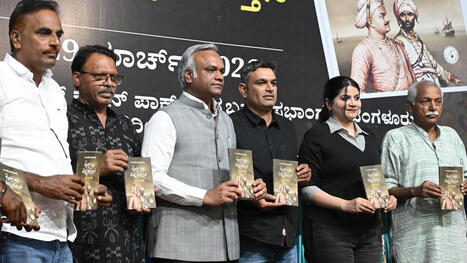







"Translations of historical works into regional languages are crucial to counter misinformation on its own turf. While translations speak in the language of the people, propaganda, too, spreads most effectively in the language people consume daily, making it important that well-researched history is available in those very languages to challenge it, historian Ruchika Sharma said.
Prof. Sharma was speaking at the release of ‘Karavaliya Charitreyalli Hyder Ali Mattu Tippu Sultan’ (Hyder Ali and Tipu Sultan in the History of Coastal Karnataka) by author and journalist Naveen Soorinje. IT/BT Minister Priyank Kharge, among others, was also present.
“One of the key reasons for the growing communalisation of history is that good academic history is still in the shackles of English,” said Prof. Sharma, adding that freeing such work into languages like Kannada is essential to push back against distortions. Writing history in a language that people understand, she said, is a powerful way to counter “factless gibberish masquerading as history,” circulated through social media and messaging platforms.
Turning to Tipu Sultan, Prof. Sharma highlighted some of the persistent claims around his rule, particularly on forced conversions. She said historical sources offer multiple, complex, and conflicting narratives on his rule.
Beyond angles & demons
She said Tipu Sultan was no exception and while, like other rulers of his time, he used force where he felt it was necessary, he also navigated a diverse society through patronage and political calculation.
“The problem with popular history today is that it looks for angels and demons,” she said, stressing that monarchs must be understood within the nature of monarchy itself, with all its grey shades.
While there were instances of forced conversion, Tipu’s engagement with Hindu institutions offers a sharply different narrative, she said. Prof. Sharma referred to the ransacking of the Sringeri Mutt by Maratha forces, and said it was Tipu who later extended financial support for the restoration of the shrine and the reinstallation of the idol. He also sought prayers for his reign at a time when Mysore faced multiple adversaries, including the British, the Marathas, and the Nizam of Hyderabad.
Prof. Sharma further argued that present-day religious identities cannot be simply applied to the past. The term “Hindu,” she said, was not used in the way it is understood today and emerged later as a broad, external categorisation. At a different time in history, communities were divided along sectarian and caste lines in conflict with one another.
Beyond social media
Speaking at the event, Mr. Kharge said there is a growing trend of reshaping history to suit political narratives. Referring to Prof. Sharma’s point on misinformation circulating in WhatsApp groups, he said this has now expanded into mainstream platforms like cinema.
“Earlier it was one forward in a resident welfare group. Now it is amplified through films and large-scale productions,” he said, citing Dhurandhar 2, The Kerala Story, and The Kashmir Files, among other recent movies based on historical themes.
He added that he had no objection to individuals watching or appreciating such content, but is only worried about the larger concern of influence.
Mr. Kharge said initiatives are under way to promote serious writing. Over the past two years, he said, efforts have been made to support new journals and publish books by young writers, with plans to expand this into an annual exercise. The aim, he said, is to build a body of credible, research-based work that can serve as a counter to “distorted history.”
Published - March 30, 2026 12:27 am IST"
https://www.thehindu.com/news/cities/bangalore/translations-of-historical-works-into-regional-languages-are-key-to-counter-misinformation-says-historian-ruchika-sharma/article70799904.ece
#metaglossia
#metaglossia_mundus