 Your new post is loading...

|
Scooped by
Charles Tiayon
March 24, 9:08 AM
|
One MEP wants the Irish government to increase the number of Irish language interpreters when Ireland holds the presidency of the EU Council this year. "Irish EU Presidency is opportunity to address lack of Irish interpreters in Brussels - MEP One MEP wants the Irish government to increase the number of Irish language interpreters when Ireland holds the presidency of the EU Council this year. A HIGH LEVEL EU delegation of officials is coming to Galway today with a mission – find conference interpreters with Irish to address a shortage in the EU Parliament in Brussels and its powerful committees which is leaving Irish speaking MEPs tongue-tied. The delegation led by Juan Carlos Marin Jiminez, the Director General of the Directorate for Logistics and Interpreting or DG LINC, will visit the MA Course in Conference Interpreting in the University of Galway as well as pay visits to the Coimisinéir Teanga’s office in An Spidéal and Údarás na Gaeltachta in Conamara. The shortage of interpreters at the European Parliament in Brussels is leaving Irish-speaking MEPs unable to use their language during important meetings. Although Irish has been an official working language since 2022 - a development that came after a long campaign – it has yet to be placed on an equal footing with the other official working languages. The only other language in this situation is Maltese. Interpretation is provided for the other 22 other working languages at every forum, but the same service is not available for Irish or Maltese. This stems from a vote taken during the European Parliament’s last mandate between 2019 and 2024. As a consequence of that vote, Irish and Maltese will remain without an interpretation service on a par with the other languages until the end of the current mandate in 2029 at the earliest. When Irish became a full official working language in 2022, the EU welcomed it, saying at the time that Irish was ‘at the same level‘ as other EU languages. While this is the EU’s official position, it is not what Irish-speaking MEPs such as the Ireland South representative are experiencing. 21:38According to Cynthia Ní Mhurchú, Fianna Fáil MEP for Ireland South, the shortage of interpreters is affecting her work as she represents her constituents across various committees and when speaking in parliament during its sittings in Brussels. She is able to speak in Irish when parliament is meeting in Strasbourg — during plenary sessions — but this only occurs one week per month. Interpreters are provided for the one-minute speeches that MEPs deliver in the debating chamber on those occasions. EU officials maintain, however, that the extension of the derogation was put in place due to a shortage of interpreters. Ní Mhurchú, for her part, believes that extending the derogation is failing to attract Irish speakers to pursue careers in interpretation. “In practical terms, what this derogation means is that there is no team of interpreters employed in the Parliament for either Irish or Maltese,” the MEP said. “However, interpreters are employed in both the Council and the Commission.” There is only one interpretation course in Ireland, at the University of Galway, and it accepts fifteen students each year. For many years there were difficulties in attracting Irish-speaking interpreters, as the existence of the derogation meant that their services were not considered necessary. She acknowledged, however, that the Directorate-General responsible for ensuring the full Irish language service in the Parliament — DG LINC (Logistics and Interpretation for Conferences) — was doing its utmost to resolve the problem, a problem that Ní Mhurchú had raised as soon as she was elected in 2024, but that progress had not yet been made. “I feel this shortage most acutely at committee level, because it is within the committees that legislation is scrutinised, examined and amended. “I am very active on powerful committees such as IMCO (Internal Market) and TRAN (Transport). “Committees hold enormous power as they are drafting and reforming legislation, and challenging the Commission. “We receive legislation and proposals from the Commission and we must debate them, scrutinise them, examine them, critique them constructively, pull them apart and put them back together again as alternative proposals and legislation — to ensure that the new rules and laws are fit for our voters.” She said it was deeply disappointing that matters stood as they did, given that Ireland would hold the Presidency of the Council of the European Union later this year, but that it also represented a significant opportunity. Sonnet 4.6 Ireland’s presidency falls in the middle of this term, which is deeply unfortunate given that the issues relating to the Irish language have not been resolved in any way whatsoever. “The proposal is that interpreters could be seconded from the Commission, the Council, or the private sector (freelance interpreters) and placed in the Parliament for the duration of the Presidency.” North's Irish language commissioner will not be distracted by efforts to undermine legislation According to Ní Mhurchú’s own estimates, six translators and two assistants are needed, along with three interpreters. “However, it would not be feasible to fill 11 new posts unless students, graduates and qualified professionals were aware that permanent employment would be available to them in the Parliament. They must be attracted to the roles and the pathway made easier for them to take up these newly created posts in the Parliament.” She said she had been seeking this from various Government ministers, including Minister for Further Education James Lawless TD, Minister for the Gaeltacht Dara Calleary TD and Thomas Byrne TD, who holds responsibility for European Affairs, and had also raised it with Director-General of DG LINC Juan Carlos Jiménez Marín and Director-General of DG Translation Walter Mavrik, but that no solution had yet been found. “I will now be making representations to Roberta Metsola — the President of the Parliament — asking her to resolve the problem.” In response to an inquiry from The Journal, a spokesperson for the European Parliament confirmed that a majority of MEPs — 303 votes to 200 — voted to extend Rule 75, the rule which determines that an interpretation service on an equal footing will not be available for Irish and Maltese until July 2029. “The European Parliament, along with other institutions, recognises that there are difficulties in providing language coverage for Irish due to a shortage of qualified conference interpreters and translators and, for that reason, derogations are applied to translation from Irish and to Irish interpretation,” the spokesperson said. In a statement issued by a spokesperson for the Department of Foreign Affairs, under which Minister of State for European Affairs Thomas Byrne operates, it was said that “the Department is engaged in dialogue with the European Parliament to ensure that sufficient interpretation will be available for scheduled events during Ireland’s Presidency of the EU and will continue to engage with the European Parliament on this matter.” The statement also noted that “guidelines have been developed by the Department of Foreign Affairs and Trade, in cooperation with the Department of Rural and Community Development and Gaeltacht Affairs, regarding the use of Irish during Ireland’s Presidency of the EU.” This was said to reflect “Ireland’s commitment to multilingualism and the full integration of the Irish language in European affairs.” The Journal’s Gaeltacht initiative is supported by the Local Democracy Reporting Scheme" 23 Mar 2026 https://www.thejournal.ie/irish-doesnt-have-full-working-and-official-language-status-in-the-eu-yet-6989908-Mar2026/ #metaglossia #metaglossia_mundus

Are humans the only beings on the planet that use language to communicate?
"Burg Giebichenstein
Kunsthochschule Halle
“Language can only deal meaningfully with a special, restricted segment of reality. The rest, and it is presumably the much larger part, is silence.” George Steiner
Are humans the only beings on the planet that use language to communicate? Can we decipher the nonhuman world around us without harnessing it to our own socialization, syntax, and lexicon? Is interspecies communication even possible? Translation has been described as a precondition that underlies all (human) cultural transactions upon which communication is based. It also is inherently political and stands at the forefront of so many of today’s questions around identity, gender, post-colonial criticism, feminist critique, machine translation and canon creation, yet its connection within the context of the nonhuman turn, interspecies communication, and eco-criticism has not yet been fully explored.
Whether we are talking about classic linguistic and literary translation, or any number of related fields including: language and literature, cultural studies, performance, visual and media arts—the core question that translators and theorists of translation have been debating about for centuries remains the same: is it possible to translate without interpreting? Is linguistic and cultural equivalence even possible? These questions become all the more urgent in the limit-case of interspecies communication. Can we apply empathic modes of translation to nonhuman articulations, wherein translation involves a form of metamorphosis, not of text, but of the translator. As such, translators are something of a hybrid species with one foot in each culture and language, and whose very existence revolves around traveling between worlds. Translators have something of a mythical being about them, akin to a chameleon or centaur. In this course, we will not be engaging in a scientific exploration of interspecies communication, but examining theories around empathic translation-- a process that sees translation not merely as the transformation of a text, but of the translator themself.
Emerging and classical theories of translation can offer a paradigm for engaging with plant and animal articulation, not language as such, but different forms of articulation perceived through the senses, one in which our hearing and seeing,“once intertwined and attentive to the calls and cries of animals, all but disappeared with the invention of the alphabet, retreating into a kind of silence.”
In David Abram's words: “By giving primacy to perception we can see the natural world, not as inert and passive, but as dynamic and participatory. The winds, rivers and birds speak in their own way (if we listen), the sounds of nature not only have informed indigenous languages, but language in general--humans are but one being intertwined with other beings and ‘presences.’ This perspective sees the landscape as a sensuous field, and human perception as but one point of view that is in reciprocity, in expressive communication, with other points of view and ways of being.”
How can theories of translation help us make sense of this new view of a world teeming with language and sentience? What theories abound in reference to multiplicity of “language,” even as Walter Benjamin would argue for a “universal (human) language.” What practical tools does translation studies offer, and what bridges can it forge between the disciplines? The first half of the seminar focuses on key theoretical concepts relevant to the history and practice of translation. In the second half, students will engage in translation experiments that intersect with their own artistic/design practice. A final project should be considered a first draft of something that could develop later into a larger project.
The course will be taught in English and German.
This seminar is ideally suited to students interested in: Literature, Translation Theory / Translation / Cultural Studies / Critical Theory, Creative Writing/ Post-humanism, Trans-humanism, Eco-criticism, the More-than-Human Turn.
Teachers
Dr. Zaia Alexander"
https://www.burg-halle.de/en/course/l/talk-with-the-animals-translation-in-a-more-than-human-world
#Metaglossia
#metaglossia_mundus
#métaglossie
"L’impact du français du théâtre populaire au Cameroun sur le vivre-ensemble : enjeux et perspectives
Le français utilisé dans le théâtre populaire camerounais francophone constitue un phénomène linguistique particulier qui mérite une certaine attention. Le présent article examine comment les spécificités linguistiques de ce théâtre contribuent à la construction du vivre-ensemble au Cameroun. À travers une analyse sociolinguistique du langage théâtral, nous explorons les relations entre les variations linguistiques du français camerounais et la consolidation des liens sociaux dans un contexte multiculturel. Dans le contexte actuel où le vivre-ensemble constitue désormais une prescription gouvernementale, notre hypothèse est que l’usage d’un français « camerounisé » dans le théâtre populaire facilite la communication interculturelle et renforce la cohésion sociale.
Mots-clés éditeurs : français camerounais, impact, théâtre populaire, vivre-ensemble
Date de mise en ligne : 23/03/2026
https://doi.org/10.3917/oep.ndibn.2025.01.0197";
Par Marie-Thérèse Betoko Ambassa
Pages 197 à 205
Résumé
Auteur(e)s
Sur un sujet proche
https://shs.cairn.info/les-francais-dans-un-monde-multilingue--9782492327377-page-197?lang=fr
#metaglossia #metaglossia_mundus

"Premium search service Kagi has launched a humorous AI translation tool that converts everyday English into the distinctive self-promotional language commonly found on LinkedIn.
Mashable reports that Kagi, a paid search service that positions itself as an ad-free, privacy-focused alternative to Google, has introduced an English-to-LinkedIn translator as part of its free AI-based language translation offerings. The tool, launched on Wednesday, has gained significant attention on social media for its ability to transform ordinary statements into the earnest, jargon-heavy posts typical of the professional networking platform.
The translator is part of a broader collection of humorous internet subculture language options Kagi has added to its service. Other available translations include Reddit speak, which incorporates phrases like “weird-ass,” “cringe,” and “banana for scale,” as well as Pirate Speak and fictional languages such as Klingon. However, the LinkedIn translator has resonated particularly strongly with users, touching a nerve about the proliferation of artificial-sounding corporate speak in digital communication.
The translation service works in both directions. Users can convert plain English into LinkedIn-style language or decode lengthy LinkedIn posts back into straightforward English. For example, spending an afternoon in bed becomes “decided to prioritize a strategic recharge to optimize cognitive performance and long-term productivity” in LinkedIn speak. The tool can even transform critical feedback into professionally palatable language, converting “I hated this and I am dumber for reading it” into “While I’m always looking for ways to challenge my current mindset, this particular content reminded me of the importance of being intentional with the information we consume. Grateful for the learning opportunity!”
The translator serves as both entertainment and practical utility. It lampoons the tendency of LinkedIn users to frame every minor career development in hyperbolic, buzzword-laden language while simultaneously offering a genuine service for those who need to navigate or create content in this particular communication style.
The LinkedIn translator’s popularity reflects broader concerns about authentic human communication in an era increasingly dominated by AI-generated content. The tool connects with similar cultural commentary, including the “Your AI Slop Bores Me” phenomenon, which criticizes generic AI-generated text that lacks genuine human perspective or value.
LinkedIn’s distinctive communication style has long been a source of commentary and parody. The platform has developed its own vocabulary filled with terms like “thought leaders,” “growth mindset,” “personal branding,” and “hustle culture.” Users frequently celebrate minor professional achievements with earnest posts that employ specific linguistic patterns and hashtags, creating a recognizable dialect that the Kagi translator successfully mimics.
The game-like quality of the translator invites experimentation. Users have tested whether any human activity, no matter how mundane or inappropriate, can be reframed in positive LinkedIn language. The results suggest that the platform’s communication style can theoretically transform any scenario into an opportunity for professional growth and learning.
Wynton Hall, author of the new book Code Red: The Left, the Right, China, and the Race to Control AI, argues that it is vital for conservatives to avoid “cognitive offloading,” by handing over all thinking to AI. The fact that people are utilizing AI to poke fun at the peculiar language of LinkedIn, which itself is filled with AI slop posts, is an encouraging sign.
Senator Marsha Blackburn (R-TN), who was named one of TIME’s 100 Most Influential People in AI, praised CODE RED as a “must-read.” She added: “Few understand our conservative fight against Big Tech as Hall does,” making him “uniquely qualified to examine how we can best utilize AI’s enormous potential, while ensuring it does not exploit kids, creators, and conservatives.” Award-winning investigative journalist and Public founder Michael Shellenberger calls CODE RED “illuminating,” ”alarming,” and describes the book as “an essential conversation-starter for those hoping to subvert Big Tech’s autocratic plans before it’s too late.”
Lucas Nolan is a reporter for Breitbart News covering issues of free speech and online censorship."
https://www.breitbart.com/tech/2026/03/22/learn-to-speak-corporate-ai-translator-converts-english-into-satirical-linkedin-jargon/
#metaglossia #metaglossia_mundus
"€6.2m pledge to support Irish and Ulster Scots languages
THE Irish Government has confirmed funding of €6.2m for projects which support Irish and the Ulster Scots languages in Northern Ireland.
Minister for Rural and Community and Gaeltacht Development, Dara Calleary confirmed the amount this week, which comes under the government’s Shared Island Initiative.
“I am delighted to announce this significant capital funding today as part of the Government’s Shared Island Initiative to enhance co-operation, relationships and mutual understanding on the island of Ireland,” Minister Calleary said.
Minister Dara Calleary announced the government funding this week
“The funding will contribute to a range of projects that create lasting community and cultural benefits for the Irish-speaking and Ulster-Scots communities in Northern Ireland and the border counties.”
The announcement includes capital funding of up to €4.8m for An Ciste Infheistíochta Gaeilge.
That money, which will be rolled out over four years, will co-fund Irish-language community projects across Northern Ireland.
Also included in the total is over €1.4m for the North West Cultural Partnership, to co-fund delivery of the Cultural Embrace capital project in Derry City.
“It is important that we support organisations across the island who are working to bring people and communities together, including through the Irish language and Ulster Scots language, culture and heritage traditions,” Minister Calleary explained.
“I look forward to seeing the projects being developed by An Ciste Infheistíochta Gaeilge and North West Cultural Partnership come to fruition, enhancing local communities and our cultural connections across the island,” he added.
Projects due to be be progressed with the funding will support the “linguistic, social, economic and cultural enhancement of Irish language and Ulster-Scots communities in Northern Ireland and in border counties” a spokesperson for Minister Calleary’s office confirmed."
BY: Fiona Audley
March 24, 2026
https://www.irishpost.com/culture/e6-2m-pledge-to-support-irish-and-ulster-scots-languages-306328
#metaglossia #metaglossia_mundus

"Gibraltar launches round-the-clock British Sign Language interpretation service
New 24/7 video link service means deaf residents can access any government department within minutes using just a smartphone
SUR in English
Gibraltar's deaf community now has access to a round-the-clock British Sign Language interpretation service, following the launch this week of a new video interpretation platform by the Supported Needs and Disability Office (SNDO).
The service, introduced to coincide with BSL Week, is delivered in partnership with Convo, a UK-based company whose platform allows deaf users to connect via video call to a qualified BSL interpreter - typically within one minute - using nothing more than a smartphone or tablet and a QR code.
A built-in telephone directory feature allows users to select the department they need, with the interpreter then facilitating a three-way call: the user signs via video while the interpreter relays the message by voice to the relevant department. The key improvement over previous services available in Gibraltar is the 24/7 availability.
QR codes will shortly be distributed across all government departments, including public counters and meeting rooms, and staff training covering both technical support and deaf awareness will follow in the coming weeks.
Representatives from Convo visited Gibraltar this week to meet with key stakeholders, including the Gibraltar Health Authority's Neurodevelopment and Disability Office, Director General Paul Bosio and Medical Director Mark Garcia. Separate talks were also held with emergency services - including Civil Contingencies, 999, 111, Police, Fire and Ambulance - to explore integrating Convo into critical response pathways.
Importantly, the SNDO also held a dedicated session with BSL users and members of the Gibraltar Hearing Issues and Tinnitus Association (GHITA), giving people with lived experience the chance to learn about the service and feed back their views.
Minister for Equality Christian Santos said the launch represented "the next step in empowering deaf individuals to communicate independently and advocate for themselves, without relying on others." He added that the SNDO had already introduced SpeakSee in December and continues to work with SignCode, who provide in-person interpreters and pre-recorded BSL content for Gibraltar."
Monday, 23 March 2026 | Updated 24/03/2026 10:34h.
https://www.surinenglish.com/gibraltar/gibraltar-launches-roundtheclock-british-sign-language-interpretation-20260323131613-nt.html
#metaglossia #metaglossia_mundus

"...ASL is the dominant sign language in the United States, but it is far from the only one. Across the world, hundreds of distinct sign languages have developed, each shaped by culture, geography, and community. A person who grew up in North Africa almost certainly did not grow up signing in ASL. Placing an ASL interpreter in front of them would be like greeting a French speaker with a Portuguese translator — technically a language, but not their language.
Our team reached out to the client’s family, both those already in the United States and those still abroad. We wanted to understand how this person communicated: Which sign language did they use? Did they lip-read? In what spoken language? What had worked for them before?
These conversations took time. They required sensitivity and humility. But they gave us what we needed: a clear picture of this individual’s unique communication needs.
Once we knew which sign language the client used, we began searching for a qualified interpreter fluent in that specific language. It wasn’t easy, but after extensive outreach, we found a university professor with exactly the expertise we needed.
By the time our client landed, everything was in place. The professor was at the airport to greet them and remained with them through their Domestic Health Assessment and their first primary care appointments. From the moment they arrived, they had someone who could truly understand them.
Inclusion is not a checkbox. It is not arranging “an interpreter” and moving on. It is asking whose interpreter, in which language, for which community. It is recognizing that disability, culture, and communication are inseparable and that no two people’s needs are the same, even when their diagnoses are.
This experience reaffirmed the core principle of our work: equity requires intentionality. Even within the disability community, communication and access needs are not uniform. Providing truly inclusive services means honoring each client’s unique cultural, linguistic, and disability-related experiences — ensuring they feel seen, understood, and supported from their very first moments in the United States."
https://refugees.org/no-two-hands-sign-the-same/
#metaglossia #metaglossia_mundus
"Bizarre moment UFC boss Dana White needs interpreter to translate English question
UFC boss Dana White bizarrely needed an interpreter to translate a question from a British journalist on Saturday night.
Following the MMA promotion's latest show in London, England, White was carrying out a post-fight press conference when the viral exchange with The Sun's Chisanga Malata occurred.
Amid the ongoing conflict in the Middle East, Malata asked the 56-year-old if the UFC has any plans to cancel its upcoming shows in Saudi Arabia or Abu Dhabi.
'Are you guys continuing to monitor the situation in the Middle East? Because obviously, we know you like to go to Saudi or Abu Dhabi in June or July, and then obviously the October show,' the reporter said. 'So are you guys monitoring that and potentially thinking of changing plans?'
White then turned to his American interpreter, who repeated the question nearly word for word in a strange moment.
'No. As of right now, no,' he eventually replied to Malata.
Dana White bizarrely needed an interpreter to translate a question from a British journalist
White then admitted: 'I know it's f***ing weird that I need a translator when you speak English, but I can't hear, my hearing's so bad. And if you have a slight accent, I'm really screwed.'
Fans were left baffled by his need for a translator, with one writing on X: 'If Dana White needs a translator from English into English he shouldn't be holding the press conferences'.
'Dana hang it up bro… enjoy retirement or boxing, needing an english to english translator…' said another.
A third joked: 'Man I really want to get a job as Dana White's English to English translator'.
While a fourth commented: 'Can’t lie, Dana White needing a translator for the #UFCLondon post fight presser was hilarious to me.'"
Oliver Salt
https://www.msn.com/en-gb/news/uknews/bizarre-moment-ufc-boss-dana-white-needs-interpreter-to-translate-english-question/ar-AA1ZaMUV
#metaglossia_mundus #metaglossia
"Mission Increase Partners With Wycliffe Bible Translators
Mission Increase, a Kingdom impact accelerator helping nonprofit leaders, donors and churches transform more lives for Jesus, has announced a dynamic new partnership with Wycliffe Bible Translators USA. Wycliffe serves with the global body of Christ to advance Bible translation so people can encounter God through His Word. It desires that people from every language will understand the Bible and be transformed.
As it joins forces with Wycliffe from now through the end of 2027, Mission Increase will provide its biblically-based curriculum to train global leaders in Francophone and Anglophone Africa, Asia, the Greater Pacific and the Americas on vital topics such as fundraising, leadership and communications. With a keen understanding of what it takes to build sustainable mission impact, Mission Increase will ensure Wycliffe's global leaders continue to advance Bible translation projects alongside language communities worldwide.
"The work of Bible translation is being done by thousands of partner organizations across the globe, and Wycliffe desires to see each one thrive and continue building capacity to carry out the missions to which God has called them. This partnership with Mission Increase allows Wycliffe to effectively scale its organizational-strengthening support services to this end," said Andrew Flemming, Chief Global Operations Officer for Wycliffe. "Our objective is for every person to have access to Scripture in a language and format they clearly understand and for communities to flourish as they engage with God's Word. As we collaborate to accomplish that, I look forward to seeing the impact of this expanded focus on building effective teams with robust leadership skills."
Top Videos: Iran pushes back on Trump's suggestions that an end to the war is close
"Helping nonprofits figure out what it takes to grow sustainably is one of the things Mission Increase does best," remarked Dan Davis, President of Mission Increase Foundation. "The rich legacy of success Wycliffe has in the area of Bible translation makes this an easy yes for us. We know they have a solid foundation for continued growth."
Scott Harris, Vice President of Church and Global Engagement at Mission Increase, agrees. "We're eager to share our training and tools with Wycliffe's global leaders and anticipate exciting outcomes from this partnership in the months and years to come."
To learn more about how Mission Increase helps nonprofit leaders, donors and churches transform more lives for Jesus, visit https://missionincrease.org/.
Contact:
Brianna Roberson
Mission Increase
marketing@missionincreas.org
423-460-7895
SOURCE: Mission Increase"
Newswire / March 23, 2026 /
https://www.mycarrollcountynews.com/online_features/press_releases/article_e9a01d56-1559-57a7-9743-e0ae81d6e79f.html
#metaglossia #metaglossia_mundus

"Porté par une dynamique démographique et éducative sans précédent, notamment en Afrique, le français s’impose désormais comme la quatrième langue la plus parlée au monde, avec près de 400 millions de locuteurs.
Une évolution qui dépasse le simple cadre linguistique pour s’inscrire dans une recomposition géopolitique et géoculturelle globale. Publié à l’occasion de la Journée internationale de la Francophonie du 20 mars 2026, le rapport quadriennal de l’Organisation internationale de la Francophonie (OIF) dresse un constat clair : le français est en pleine expansion. Il est aujourd’hui la deuxième langue étrangère la plus apprise dans le monde, avec environ 170 millions d’apprenants, preuve de son attractivité dans les systèmes éducatifs à travers les cinq continents. Mais c’est en Afrique que se joue l’essentiel de cette transformation. Le continent concentre déjà près de 65 % des locuteurs francophones, et cette proportion ne cesse de croître. D’ici à 2050, sur les 590 millions de francophones attendus, près de 90 % vivront en Afrique. Ce basculement démographique fait du continent le véritable centre de gravité de la Francophonie mondiale.
Au-delà des chiffres, cette progression traduit une mutation profonde. Le français n’est plus seulement une langue héritée de l’histoire coloniale ; il devient un outil d’intégration, d’éducation et d’insertion professionnelle. Dans de nombreux pays africains, il coexiste avec des langues nationales dans des contextes plurilingues dynamiques. Des initiatives comme les programmes éducatifs de l’OIF contribuent à renforcer cette complémentarité, en soutenant l’enseignement et la formation des enseignants. Sur le plan géopolitique, cette montée en puissance du français renforce le rôle de l’Afrique dans les échanges internationaux. Langue de travail dans de nombreuses organisations internationales, langue de diplomatie, de culture et d’affaires, le français constitue un levier stratégique. Il se classe déjà comme la troisième langue de l’économie mondiale, facilitant les échanges commerciaux et les partenariats entre continents.
Dans le domaine numérique, le français occupe également une place croissante, bien qu’il reste confronté à la domination de l’anglais. Les enjeux liés à l’intelligence artificielle et à la production de contenus numériques représentent à la fois une opportunité et un défi. Le développement de ressources francophones en ligne et leur meilleure visibilité seront déterminants pour consolider cette position. Ainsi, la renaissance du français s’inscrit dans une dynamique plus large : celle d’un monde multipolaire où les équilibres culturels et linguistiques évoluent. Au cœur de cette transformation, l’Afrique s’affirme non seulement comme un réservoir démographique, mais comme une véritable puissance géoculturelle. La Francophonie de demain sera africaine et, avec elle, une nouvelle manière de penser l’influence dans le monde.
Noël Ndong
23 Mars 2026
https://www.adiac-congo.com/content/langue-et-culture-lafrique-pilier-de-la-renaissance-du-francais-dans-le-monde-169544
#metaglossia #metaglossia_mundus

"Contesting Translation, a celebratory edited volume, honours Professor Mona Baker, one of the most influential scholars in translation, interpreting, and intercultural studies. The 11 original chapters were especially commissioned from scholars who have developed enduring personal, professional, and intellectual connections with Baker through her teaching and research.
The chapters are framed by a reflective introduction, and clustered into three inter-related sections: "Trajectories and Concepts", "Narratives and Corpora", and "Activism and Solidarity", which together map the routes and approaches that characterize Baker’s oeuvre. Individual chapters offer studies on topics ranging from literary translation, knowledge translation, journalistic translation, and museum translation to political and aspirational translation. Studies are situated in diverse temporal and geographical environments, extending from the seventeenth-century Low Countries to present-day Palestine. Chapters resonate with each other through critical scholarly engagement with the history, discourse, and politics of translation, and through a shared interest in the significance of the stories we tell each other and ourselves.
Relevant for students new to translation and interpreting studies as well as established and emerging scholars more familiar with the field’s contours, Contesting Translation is a landmark contribution to a dynamic discipline that has itself been significantly shaped by one of its most forthright and creative scholars.
Chapters: Chapter 4 of this book is freely available as a downloadable Open Access PDF at http://www.taylorfrancis.com under a Creative Commons [Attribution-Non Commercial-No Derivatives (CC BY-NC-ND)] 4.0 license."
Contesting Translation: Studies in Honour of Mona Baker - 1st Edition https://share.google/EYJO1ceNKwbG25xxA
#metaglossia #metaglossia_mundus
"
De : Patrimoine canadien
Communiqué de presse
YELLOWKNIFE, le 20 mars 2026
Les langues nous révèlent, nous aident à comprendre notre histoire et façonnent notre identité. Lorsqu’elles sont parlées, écrites et transmises de génération en génération, elles renforcent les collectivités et perpétuent leur héritage, leur culture et leurs connaissances. C’est pourquoi le gouvernement du Canada tient à soutenir les Premières Nations, les Inuit et les Métis dans leurs efforts pour se réapproprier, revitaliser, maintenir et renforcer leurs langues.
Aujourd’hui, l’honorable Marc Miller, ministre de l’Identité et de la Culture canadiennes et ministre responsable des Langues officielles, était à Yellowknife pour rencontrer des personnes représentant des organismes communautaires et des administrations locales et en apprendre davantage sur l’important travail accompli pour revitaliser les langues autochtones dans l’ensemble du territoire. Il a souligné l’affectation de 4,8 millions de dollars du gouvernement du Canada à 5 nouveaux projets dans les Territoires du Nord-Ouest. Ces projets ont été choisis dans le cadre de l’appel de candidatures des Premières Nations pour 2025-2026 du Programme des langues autochtones.
Ces projets créatifs et variés permettront d’améliorer considérablement l’accès aux activités linguistiques et aux rassemblements sociaux autochtones, d’accroître le nombre de programmes d’immersion destinés à la petite enfance et aux adultes, d’élargir l’offre de contenus multimédias en langues autochtones et d’augmenter le nombre de personnes qui parlent une langue autochtone dans l’ensemble du territoire.
Alors que la Décennie internationale des langues autochtones (2022-2032) bat son plein, ces projets reflètent la détermination du gouvernement du Canada à soutenir les peuples autochtones dans la réappropriation, la revitalisation, le maintien et le renforcement de leurs langues, tout en respectant leurs traditions et leur histoire. Le gouvernement du Canada a affecté des sommes sans précédent de plus de 1,4 milliard de dollars entre 2019-2020 et 2028-2029 pour soutenir la mise en œuvre de la Loi sur les langues autochtones, des projets de revitalisation linguistique menés par les Autochtones et la création du Bureau du commissaire aux langues autochtones, un organisme indépendant.
Bénéficiaires
Organisme Titre du projet Contribution
K’ahsho Development Foundation Dene Xǝdǝ: The path forward for K’asho Got’ine 2 217 990 $ sur 5 ans (2025-2030)
Native Communication Society of the N.W.T. Maintaining Indigenous Languages 1 280 000 $ sur 4 ans (2026-2030)
Délı̨nę Got’ı̨nę Government Délı̨nę Dene Kǝdǝ́ Department Strategic Planning and Implementation 1 052 345 $ sur 1 an (2025-2026)
Tłı̨chǫ Government Tłı̨chǫ Intergenerational Digital Storytelling Project 202 896 $ sur 1 an (2025-2026)
Sahtu Dene Council Part-time Language Coordinator 68 900 $ sur 1 an (2025-2026)
Citations
« Les langues sont au cœur de notre identité. Le gouvernement du Canada est fier de soutenir les organismes des Territoires du Nord-Ouest qui s’associent aux collectivités de tout le territoire pour se réapproprier, protéger et transmettre leurs langues aux générations futures. En investissant dans ces cinq projets menés par des Autochtones, nous soutenons non seulement la revitalisation des langues autochtones, mais nous rendons également hommage aux cultures et aux identités autochtones, le tout dans l’esprit de la réconciliation et de la Loi sur les langues autochtones. »
– L’honorable Marc Miller, ministre de l’Identité et de la Culture canadiennes et ministre responsable des Langues officielles
« Le soutien aux langues autochtones est un élément essentiel à la réconciliation. Grâce à ce financement, les gouvernements et les organismes autochtones auront un accès direct aux fonds nécessaires au travail de revitalisation de leurs langues et pourront faire ce travail à leur façon. Lorsque les langues sont dynamiques, les cultures sont dynamiques, et elles génèrent des collectivités plus dynamiques partout dans les Territoires du Nord-Ouest. »
– L’honorable Rebecca Alty, ministre des Relations Couronne-Autochtones
Faits en bref
La Loi sur les langues autochtones a reçu la sanction royale le 21 juin 2019. Le ministère du Patrimoine canadien continue de collaborer avec ses partenaires et les organismes autochtones pour mettre cette loi en œuvre.
Les Nations Unies ont décrété que la décennie de 2022 à 2032 serait la Décennie internationale des langues autochtones. Tout au long de cette décennie, le Canada reconnaît, fait connaître et célèbre toute la diversité des langues autochtones. Les principaux objectifs de la Décennie sont d’attirer l’attention sur la perte critique des langues autochtones et sur le besoin urgent de les préserver, de les revitaliser et de les promouvoir à l’échelle nationale et internationale.
Liens connexes
Loi sur les langues autochtones
Langues autochtones
Programme des langues autochtones
Décennie internationale des langues autochtones
Personnes-ressources
Pour de plus amples renseignements (médias seulement), veuillez communiquer avec :
Hermine Landry
Attachée de presse
Cabinet de la ministre de l’Identité et de la Culture canadiennes et ministre responsable des Langues officielles
hermine.landry@pch.gc.ca
Relations avec les médias
Patrimoine canadien
media@pch.gc.ca"
https://www.canada.ca/fr/patrimoine-canadien/nouvelles/2026/03/le-gouvernement-du-canada-soutient-la-revitalisation-des-langues-autochtones-dans-les-territoires-du-nord-ouest.html
#metaglossia #metaglossia_mundus

"TOKYO -- "You must start learning a foreign language young to master it."
Shinji Miyazaki, a 62-year-old translator is determined to challenge this assumption. He began to learn nine languages, including German, French and Chinese, just before turning 50. During these 13 years, which he describes as being "entirely focused on foreign language study," what new world has emerged, and what drives him to take on new languages?
Immersed in language learning from 49
"Kursi" (chair), "tangga" (stairs) ... These are Indonesian words written on his homemade vocabulary cards, a language he began studying last year. As he flips through the cards, he transcribes the words he has not fully memorized into his notebook.
When tackling a new language, Miyazaki focuses on memorizing basic words in categories like colors, numbers, days of the week and body parts. His notebook also features Korean words for facial parts written in Hangul alongside Indonesian vocabulary. Grouping words by category makes it easier to recall unfamiliar terms.
His daily routine starts at 6:30 a.m. with coffee at a hamburger chain, where he spends nearly two hours studying. He continues listening and practicing pronunciation on his way to breakfast at another eatery. He also attends face-to-face classes at foreign language schools three to four times a week.
Shinji Miyazaki's collection of foreign language books he has read is seen in Tokyo's Chuo Ward, Jan. 5, 2026. The book in the foreground is in Indonesian, a language he recently began studying. (Mainichi/Shun Kawaguchi)
For 13 years, he has dedicated about six hours daily to language study without taking a single day off. While the foreign languages he began learning around the age of 50, aside from English, have not reached native or interpreter-level fluency, he has achieved proficiency levels in exams that allow him to read newspapers and watch films in Chinese, and engage in daily conversations and social interactions in German, with the aim of further improvement.
Aspiring to become a translator
"My parents didn't read books, and there were no books at home. I also entered university through sheer exam effort, but I wasn't a reader," Miyazaki recalls. It was not until he enrolled at Aoyama Gakuin University in Tokyo that he began to engage with literature. Surrounded by avid readers, he dreamed of becoming a writer, realizing that "the world expands through printed words."
However, becoming an author was a high hurdle. Leveraging his proficiency in English, a skill he had excelled at since junior high, he aspired to become a translator. After graduating from university, he found work and became an industrial translator at 27. At 30, he moved to Britain to study linguistics in graduate school, aiming to develop "everlasting English skills."
After two years studying abroad, he became a publishing translator, fulfilling his dream of a writing career, albeit with risks. The publishing industry, driven by commercial concerns and hit by a downturn, canceled his translated works before publication one after another. He began to question the commercialism that prioritizes maximizing profits and started to ask himself, "What is true happiness for a human being?"
Shinji Miyazaki, who has learned nine languages since just before turning 50, is seen in Tokyo's Chuo Ward, Jan. 5, 2026. (Mainichi/Shun Kawaguchi)
Interested in the afterlife since his 20s, he turned to philosophy at 42.
Rediscovering the joy of learning
Studying philosophy through a Keio University correspondence course, he enjoyed exploring a realm "completely different from worldly values." While utilizing the strengths of affordable correspondence classes, he expanded his studies to law and commerce, earning five degrees in his 40s, including one from the University of London.
While studying at the University of London remotely, he encountered works that haven't been translated into Japanese. "I had an epiphany while reading assigned books. I read many wonderful books, and I realized it's something I could only experience because I could read a foreign language."
This joy of language learning, sparked by encounters with good books, was something he had not experienced during his 30s when he studied in Britain to get a degree. Approaching 50, he decided to broaden his horizons beyond Japanese and English, taking on multilingual studies. "My ultimate goal isn't speaking, but reading original works," he says.
An assigned book Shinji Miyazaki encountered during his studies in the University of London's correspondence course, which he describes as having been "eye-opening," is seen in Tokyo's Chuo Ward, Jan. 5, 2026. (Mainichi/Shun Kawaguchi)
In Miyazaki's office, which doubles as his home, the shelves are filled with books in various languages, including English titles as well as French works including "The Little Prince" and "The Phantom of the Opera."
After exploring European languages like German, French, Spanish and Italian, he sought different perspectives at 55, starting with Chinese and expanding to other Asian languages like Korean and Thai.
The benefits of multilingual learning
Learning a foreign language is challenging enough, but Miyazaki finds advantages in studying multiple languages simultaneously. Engaging in several hours of listening and vocabulary memorization daily enhances his memory and concentration. He also notes a unique benefit of multilingual learning: "Studying multiple languages seems to have made my mind more flexible."
He recalls an experience at a local dry cleaner. He inquired about a repair service, intending to pay extra, but the staff angrily denied his request. Reflecting, he realized the misunderstanding might have stemmed from the Japanese word "service," which can imply something is free. "I've learned to first consider, 'What do they mean?' I don't judge based solely on my interpretation, so I don't get angry suddenly in interpersonal situations."
His insights from multilingual learning led to the publication of his book, whose title translates to "Multilanguage study that softens the mind," in January, furthering his writing endeavors.
Shinji Miyazaki transcribes words he has yet to fully memorize into his notebook in Tokyo's Chuo Ward, Jan. 5, 2026. (Mainichi/Shun Kawaguchi)
Driven by a desire to contribute
Alongside his own studies, he began to desire to use what he learned not just for himself but also to benefit others who are studying foreign languages. He previously created vocabulary tests and held contests, and last year, he entered the "R-1 Grand Prix," a solo comedian competition in Japan, using foreign languages as material. Though he was eliminated in the first round, he jokes, "If I find a partner, I'll enter the 'M-1 Grand Prix' (for groups of comedians)."
His eagerness to take on challenges extends beyond language learning, as he also began playing the piano at age 60.
For middle-aged and older individuals considering a return to learning, he advises, "Motivation driven by external rewards or reputation doesn't last. It's important to find intrinsic motivation based on how you want to live.
Shinji Miyazaki plays the piano in Tokyo's Chuo Ward, Jan. 5, 2026. Practicing the piano, which he began at age 60, has now become a part of his morning routine. (Mainichi/Shun Kawaguchi)
"With intrinsic motivation, you won't face setbacks," he asserts. Miyazaki's drive has been fueled by a desire to contribute to society. Looking ahead, he aims to inspire others as a "senior star," demonstrating that new learning is possible at any age.
(Japanese original by Shun Kawaguchi, Digital News Group)
https://mainichi.jp/english/articles/20260319/p2a/00m/0na/052000c
#metaglossia #metaglossia_mundus

"To help preserve disappearing languages, 24-year-old robotics designer Danielle Boyer created Skobot, a wearable robot to teach young people Indigenous languages — beginning with her own, Anishinaabemowin.
Voiced by community members and powered by ethical AI, the robot is an extension of Boyer's efforts to make STEM education more accessible to Indigenous communities and kids, per American Indian Magazine.
You get a robot! You get a robot!
Boyer, who is Anishinaabe and a citizen of the Sault Ste Marie Tribe of Chippewa Indians, grew up the daughter of an electrical engineer father and an artist mother.
Her interest in robots began early, but opportunities were financially inaccessible.
Boyer taught herself to build robots, and began teaching STEM classes, later joining a high school robotics club.
At 18, Boyer launched the STEAM Connection — adding Art to STEM — a charity to make technical education accessible to youth through robotics.
STEAM's first initiative was EKGAR — Every Kid Gets a Robot — an app-controlled educational robotic car kit that costs less than $20 and goes to kids for free.
Meet Skobot the robot
While roughly 167 Indigenous languages are spoken in the US, it’s estimated that only 20 will remain by 2050.
Within her own community, Boyer saw rapid language loss and her grandmother was the only fluent Anishinaabemowin speaker in her family.
Uniting her passion for robotics with language preservation, Boyer created the Skobot.
The interactive robot responds to voice commands to teach users Anishinaabe-language dialects.
Recordings of children's voices — not synthetic ones — explain the meaning of words, and works without WiFi.
Made of recycled materials, the Skobot is designed by an Anishinaabe artist to look like woodland animals, and perches on the user's shoulder.
Given away for free to Indigenous organizations for kids to build themselves.
Skobot uses internally developed ethical AI software that maintains data sovereignty and control, and minimizes environmental impact.
Future Skobot models will respond to users in full sentences. Through the STEAM Connection Boyer plans to develop more initiatives to increase access to technical education for Indigenous communities.
Other language preservation projects
Michael Running Wolf co-founded First Languages AI Reality (FLAIR), designed to reverse the loss of North American Indigenous languages through community-centered AI.
The Dakota Language Project uses games to keep dialects alive.
Canada's FirstVoices enables users to share Indigenous languages.
Maybe that little green owl could learn a thing or two."
https://thehustle.co/news/rise-of-the-robots-to-revive-indigenous-languages
#metaglossia #metaglossia_mundus

"...Mettre à la disposition du lectorat arabophone des textes scientifiques traduits à partir de langues étrangères dans divers champs de connaissance pour contribuer à la diffusion du savoir contemporain en langue arabe et l’accès des chercheurs, notamment algériens, aux productions académiques internationales, a précisé la même source.
Traduction scientifique et recours à l’intelligence artificielle
Supervisée par la commission de traduction de l’Académie en collaboration avec des experts spécialisés, la série procède à la sélection d’articles scientifiques dans des revues et des publications internationales.
Les opérations de traduction s’appuient aussi sur les applications de l’Intelligence artificielle (IA) pour faciliter le travail des équipes de traduction et d’en améliorer l’efficacité, a ajouté l’Académie. Pour elle, cette initiative s’inscrit dans une démarche visant à contribuer à l’effort scientifique et civilisationnel en développant l’activité de traduction dans des domaines variés tels que l’intelligence artificielle, la traduction automatique, la cybersécurité, la médecine, l’éducation, l’économie ou le droit.
Des thématiques variées autour de l’enseignement des langues
L’Académie ambitionne également de contribuer à la réduction du déficit de ressources scientifiques disponibles en langue arabe et à renforcer la formation académique des chercheurs et étudiants intéressés par cette langue en leur permettant d’accéder aux dernières productions scientifiques internationales.
Le 4e numéro de la série rassemble plusieurs études consacrées à l’enseignement et à l’apprentissage des langues. Y figure une étude portant sur la définition des compétences des enseignants à l’ère des technologies de la réalité étendue et sur l’élargissement du cadre des compétences numériques pour un enseignement immersif.
D’autres articles abordent l’analyse des erreurs liées à l’usage des collocations lexicales dans les écrits universitaires d’étudiants non francophones, l’acquisition des expressions idiomatiques au-delà de la distance inter linguistique et la conception d’outils d’auto-formation destinés à soutenir la planification des activités lexicales dans l’enseignement primaire.
Le volume comprend des contributions portant sur l’évolution de l’enseignement des langues, notamment la question de la féminisation des appellations de métiers dans l’enseignement du français langue étrangère et l’étude des variations et asymétries sémantiques dans une approche comparative entre langues.
Une autre étude s’intéresse à la rétroaction corrective simultanée et à l’écriture collaborative en ligne, à partir des perceptions d’enseignants de français langue seconde.
L’ouvrage comporte par ailleurs un glossaire terminologique destiné à faciliter la compréhension des concepts scientifiques abordés et à contribuer à la constitution de répertoires terminologiques spécialisés dans plusieurs disciplines.Le 4e numéro sera mis à la disposition du public sur la plateforme numérique dédiée à cette publication à partir de la semaine prochaine, précise le communiqué de l’Académie.
Amine G."
https://www.horizons.dz/2026/03/culture-academie-algerienne-de-la-langue-arabe-parution-dun-numero-darouikat-el-ouloum/
#metaglossia #metaglossia_mundus
"UNESCO advanced global efforts for a more inclusive and multilingual Internet at the ICANN85 Community Forum, held from 7 to 12 March 2026 in Mumbai, India.
The meeting, hosted by the Internet Corporation for Assigned Names and Numbers (ICANN), strengthened collaboration between UNESCO and ICANN. It also helped move forward shared work to ensure the Internet functions across all languages and scripts.
As the Internet becomes central to daily life, gaps in Universal Acceptance (UA) remain a major challenge. Without UA, domain names and email addresses do not function properly in all languages and scripts. This creates barriers for users, especially those using Indigenous and under-resourced languages. It limits access to digital services, reduces participation, and deepens the digital language divide.
“We strive to make Universal Acceptance available everywhere so that Internet access is seamless across all devices, applications, websites and emails,” stressed Christine Arida, Vice Chair of the Governmental Advisory Committee (GAC), noting that Universal Acceptance is one of the Committee’s strategic objectives.
A key moment of UNESCO’s engagement was the presentation and consultation on a Joint Policy Brief on Universal Acceptance, developed with ICANN. Guilherme Canela, Director for the Division of Digital Inclusion and Policies and Digital Transformation at UNESCO, presented the draft document, entitled: “Advancing Universal Acceptance of All Domain Names and Email Addresses for a Multilingual Internet.”
In line with the Article 19 of the Universal Declaration of Human Rights and its Constitution, which promote the free flow of ideas by word and image, UNESCO implements the 2003 Recommendation concerning the Promotion and Use of Multilingualism and Universal Access to Cyberspace as a normative framework across education, media, science and digital technologies. Together with ICANN, UNESCO advances multilingualism online and promotes Universal Acceptance, ensuring that all scripts and languages function seamlessly in domain names, email and digital services.
Guilherme Canela
Director, Division for Digital Inclusion and Policies and Digital Transformation, UNESCO
Canela emphasized that Universal Acceptance (UA) is no longer a technical issue. It requires coordinated action across stakeholders. The policy brief outlines recommendations for governments, technical communities, academia, and the private sector. These include developing national strategies that integrate UA into digital inclusion and multilingualism efforts. They also call for stronger multistakeholder collaboration through platforms for dialogue, coordination, and joint initiatives.
The discussion also highlighted the importance of UA for linguistic diversity online. This is particularly critical for Indigenous and under-resourced languages. It aligns with UNESCO’s work for the International Decade of Indigenous Languages (2022–2032), which aims to ensure these languages are preserved, revitalized, and fully represented in digital spaces.
UNESCO and ICANN continue to build on their longstanding cooperation under the existing Memorandum of Understanding (MoU). Together, they support policies and technical solutions to address the digital language divide. This includes enabling all languages to function online. As part of this collaboration, UNESCO joins ICANN and partners worldwide in celebrating more than 30 UA Day events in 2026. These will take place between 25 March and 30 May across different regions. The events aim to raise awareness and strengthen capacity for UA adoption in technical systems.
Universal Acceptance is a key enabler of digital inclusion. As the Internet evolves, UNESCO and ICANN will continue working together. Their joint efforts will promote policies, standards, and capacity-building to ensure that every language and community can thrive online."
UNESCO
20 March 2026
https://www.unesco.org/en/articles/advancing-multilingual-internet-unesco-spotlights-universal-acceptance-icann85
#metaglossia
#metaglossia_mundus
French overtakes Arabic to become world's fourth most spoken language
"French now ranks ahead of Arabic as the fourth most widely spoken language in the world, according to a report published this week ahead of Friday's international day of the French language.
With 396 million speakers worldwide in 2025 compared to standard Arabic's 335 million, French comes in behind English, Mandarin Chinese and Spanish as one of the world's most used languages, according to figures from the International Organisation of Francophonie (OIF).
People in France make up only 66 million of the total, says the organisation, which is dedicated to promoting the French language and ties between French-speaking countries.
Nearly 65 percent of French speakers live on the African continent. The Democratic Republic of the Congo has the largest number, with just over 57 million French speakers, followed by Algeria with more than 15 million and Morocco with nearly 14 million...
By 2050, French is expected to be spoken by 590 million people, "nine out of ten of whom will live in Africa", the secretary-general of the OIF, Louise Mushikiwabo, writes in her introduction.
The report predicts the future of French "will no longer be shaped in Paris, but rather in Abidjan, Beirut, Brussels, Dakar, Kinshasa, Montreal, Port-au-Prince, Tunis or Yaoundé".
Why a changing French language is nothing to be afraid of
Learners' language
The vast majority of people who speak French use it alongside other languages. Only around 90 million have it as their mother tongue.
In contrast, it is the second most widely studied foreign language in the world – after English – with nearly 170 million learners worldwide.
While French remains a key language in diplomacy, tourism and international law, the report highlights a decline in the use of French in quantitative sciences, new technologies and higher education, where English largely dominates.
On the internet, where around 20 percent of content is in English, French is the fourth most present language. It accounts for about 3.5 percent of online content, a level comparable to Arabic, Hindi, Portuguese and Russian.
The last word: why half of the world's languages could vanish this century
Keep up to date with international news by downloading the RFI app
French has been steadily expanding its global footprint over recent decades. The OIF reported 220 million French speakers in 2010, and 321 million at its last count in 2022.
Since then, however, the organisation has changed the way it calculates the total. Its latest estimate includes children learning French from age six up, whereas previous counts started from age 10.
Using the old method puts the current number of French speakers at 348 million.
In comparison, some 559 million people speak Spanish, nearly 1.2 billion speak Mandarin and over 1.5 billion speak English"
20/03/2026
https://www.rfi.fr/en/france/20260320-french-overtakes-arabic-to-become-world-fourth-most-spoken-language
#metaglossia
#metaglossia_mundus

"Steven Biko’s 1977 book ‘I Write What I Like’ translated into isiXhosa
March 20, 2026 at 02:37 pm
Mpumzi Mshweshwe
Reporter
A new isiXhosa edition of Steve Biko’s seminal work I Write What I Like will be launched in Qonce on Saturday, marking a significant step in making the Black Consciousness leader’s ideas more accessible to African-language readers.
The book, originally published after Biko’s death in 1977, is a collection of writings and letters produced between 1969 and 1972, reflecting his philosophy of Black Consciousness and the need for psychological and political liberation under apartheid.
The new edition, titled Ndibhala Intando Yam, will be launched at the Steve Biko Centre on Human Rights Day, and will be the first time the work is available in Biko’s native language.
Biko’s son Nkosinathi said the translation is long overdue.
“I Write What I Like has already been translated into several international languages, including Portuguese and Italian, and discussions are under way with Indonesian publishers,“ he said.
“The time had long come for us to have the teachings of Biko available in African languages.”
I Write What I Like represents the creative thinkers of the Black Consciousness Movement of the 1970s through the pen of its overall leader, Steve Bantu Biko
— Dr Andile Afrika, Biko’s close friend
He said the isiXhosa edition forms part of a broader campaign to mark what would have been Biko’s 80th birthday, with plans to expand into other African languages.
“Conversations around a kiSwahili translation are already under way,” he said.
The book was translated by the late Prof Peter Mtuze, a respected language practitioner who also translated Nelson Mandela’s Long Walk to Freedom. Mtuze died in 2025.
Biko’s close friend, Dr Andile Afrika, said the translation is fitting and preserves the integrity of the original work.
“I Write What I Like represents the creative thinkers of the Black Consciousness Movement of the 1970s through the pen of its overall leader, Steve Bantu Biko,” Afrika said. “Its continued publication and increase in readership is testimony to its literary power and brilliance.”
Mtuze’s involvement strengthened the project, he said.
“Prof Mtuze’s choice by the publisher to translate I Write What I Like is a wise decision that has enhanced the recognition and use of African languages in South Africa.”
The University of Fort Hare’s Dr Mqhubi Given Mdliva, who holds a PhD in African languages, said the translation would help reintroduce Biko’s ideas to a wider audience, particularly younger generations.
“I think this move is great, in the sense that the book has been written by one of the greatest sons of the soil, Steve Biko, with a great mind to make us, as black people, find ourselves and identify ourselves,” Mdliva said.
Translation of this English version is a great job that I appreciate and commend, because it is one of the mechanisms to bring back adult readership of isiXhosa
— Dr Mqhubi Given Mdliva, University of Fort Hare
The isiXhosa version will support the preservation and development of the language, he said.
“Translation of this English version is a great job that I appreciate and commend, because it is one of the mechanisms to bring back adult readership of isiXhosa.”
The book can be shared across generations, he said. “In the process of reading that book, people would share knowledge through discussion with children and grandchildren, forming part of our heritage as amaXhosa.”
Afrika said the translation elevates the work and reinforces its cultural roots. “Globally this is a great step in the struggle for the recognition of African languages,” he said. “Biko was first and foremost a child of amaXhosa people. This celebration would have made him very proud.”
Nkosinathi said the family has been closely involved in the project and welcomed the initiative.
“The response has been very good and we expect a full house for the programme, which will start at 2.30pm,” he said..."
https://www.timeslive.co.za/politics/2026-03-20-steven-bikos-1977-book-i-write-what-i-like-translated-into-isixhosa/#google_vignette
#metaglossia
#metaglossia_mundus

"Why small language models may be the greener path for applied AI
The sustainability debate around AI still gravitates toward the same image: giant training runs, giant model sizes, and giant data centers drawing ever more power from already strained grids. That picture is real enough. The International Energy Agency says global electricity consumption from data centers is projected to double to around 945 TWh by 2030 in its base case, with growth running far faster than total electricity demand across other sectors. AI has moved well beyond the lab. It now sits inside the infrastructure question itself.
Yet the harder part of the sustainability argument now sits elsewhere. It sits in inference, repeated endlessly across millions of everyday tasks, many of which do not need a frontier model at all. A 2025 UNESCO and UCL report argued that practical changes, including the use of smaller and more task-specific models, could reduce energy demand by up to 90 percent in some settings without sacrificing useful performance. That shifts the conversation away from spectacle and toward fit.
A better match for ordinary workloads
Small language models, or SLMs, are becoming easier to justify because many business tasks are narrower than the market’s AI branding suggests. Summarizing internal documents, extracting structured fields, rewriting text, classifying tickets, or adding natural-language controls inside an existing application rarely requires the full weight of a giant general-purpose model. In those settings, smaller models can be a cleaner operational choice and, increasingly, a cleaner energy choice too. UNESCO’s report makes that point directly by recommending a move away from resource-heavy general-purpose systems, where more compact models will do.
That line of thinking is becoming more relevant as the economics of inference sharpen. Reuters reported this week that Nvidia now sees more than $1 trillion in AI chip revenue opportunity by 2027, with the company explicitly tying that outlook to growing demand for inference. Once the industry starts talking this openly about inference at scale, model efficiency stops looking like a niche concern. It becomes part of cost control, power planning, and product design.
Using devices that already exist
The strongest sustainability case for SLMs may be local deployment. Not every prompt needs a round trip to a memory- and processor-hungry cloud stack. Some can run on devices that users or companies already own, which changes both the cost structure and the infrastructure burden.
Google has been notably explicit about this direction. In March 2025, it introduced Gemma 3 1B for mobile and web, saying the model is only 529MB and small enough to download quickly, respond fast enough for production apps, and support a wide range of end-user devices. Google framed the advantages in practical terms: offline availability, no cloud bill for those features, lower latency, and privacy for data that should stay on the device. In May 2025, Google also expanded AI Edge support for small language models across Android, iOS, and the web, including multimodality, retrieval-augmented generation, and function calling.
Microsoft has taken a similar path with Phi Silica. Its developer documentation describes Phi Silica as an NPU-tuned local language model for Windows, capable of tasks such as summarisation, rewriting, chat, and table conversion directly on-device. Microsoft’s Ignite 2025 materials added that Phi Silica had moved to stable release with up to 40 percent faster performance for efficient text generation and summarisation. This does not mean every ageing laptop suddenly becomes a full AI workstation. In practice, some of these experiences are tied to newer Copilot+ hardware. Even so, the architecture direction is clear enough. More AI work can stay local when the workload is bounded, and the model is compact.
That opens a more practical path than the usual AI arms-race framing. A company can add useful language features without routing every interaction through a remote cluster. A mobile app can summarise or search in-app content locally. A field tool can continue to work when connectivity drops. A lightweight assistant can run on existing phones, laptops, kiosks, or embedded systems instead of depending on continuous cloud inference. The gain is not only lower energy per task. It is a more selective use of data center resources overall.
Why this may matter more in Asia
Asia may be one of the clearest proving grounds for this model. AI adoption across the region is accelerating, but infrastructure conditions are uneven. Electricity costs, cloud dependence, connectivity quality, device fragmentation, and procurement limits vary widely between markets. At the same time, the IEA expects data center electricity demand to keep rising sharply worldwide through 2030. In that environment, an AI strategy that assumes constant access to top-tier centralized compute will often be harder to scale commercially.
Smaller models fit more naturally into that reality. A multilingual assistant for frontline workers, an offline education tool, a compact enterprise copilot for internal knowledge tasks, or a mobile-first customer service layer can all become easier to deploy when the model can run nearer to the user and does not require a large remote system for every query. The sustainability angle and the access angle begin to overlap here. Efficient AI is often easier to distribute. Google’s edge strategy is part of the reason that argument now feels less theoretical than it did a year ago.
Where investors are placing bets
Recent funding signals suggest that investors see commercial value in efficiency, not only in scale.
Fastino is one example. TechCrunch reported in May 2025 that the startup raised $17.5 million in seed funding led by Khosla Ventures for a model architecture it describes as intentionally small and task-specific, trained on low-end gaming GPUs rather than massive clusters. That does not make Fastino the definitive winner in the category, but it does show investor appetite for AI companies built around a smaller-model premise.
Another useful indicator sits slightly lower in the stack. Reuters reported in February 2025 that EnCharge AI raised more than $100 million in Series B funding to commercialise inference chips aimed at making AI cheaper and more energy efficient. Efficient local or edge AI is not only a model story. It also depends on hardware designed for lower-cost inference outside the largest cloud footprints.
There is also a broader venture backdrop. Reuters reported in October 2025, citing PitchBook data, that AI startups raised $73.1 billion globally in the first quarter of 2025 alone, accounting for 57.9 percent of all venture capital funding in that period. Not all of that money will flow into the same strategy. Some will continue chasing frontier-scale labs. Some will move toward the companies trying to make inference cheaper, smaller, and easier to distribute.
The likely impact
The likely payoff is broader than emissions alone. Smaller models running locally or at the edge can reduce latency, cut cloud usage, keep more sensitive data on-device, and make AI features available in lower-connectivity environments. Those are product advantages first. They also align with a less wasteful compute model. Google has explicitly marketed local deployment in terms of lower latency, privacy, and no cloud cost for those features, while Microsoft has positioned Phi Silica as a practical route to efficient on-device text generation.
There are limits, of course. Efficiency does not guarantee lower total environmental impact if cheaper inference simply leads to much more usage. The rebound effect remains real. UNESCO and UCL do not present smaller models as a magic answer. Their argument is more grounded than that. Practical savings come from design choices, including when to use a smaller model, when to shorten outputs, and when a large model is genuinely warranted.
A more selective AI economy
The most useful lens may be architectural discipline. The sustainability future of AI will not be shaped only by hyperscaler announcements or fresh rounds of data center spending. It will also be shaped by quieter choices inside products, enterprise systems, and procurement roadmaps. Which workloads stay local? Which ones go to the cloud? Which models are matched to task value instead of marketing value?
Small language models are unlikely to replace frontier systems. That is not really the standard they should be judged against. Their stronger case is that they can make AI more selective, more affordable, and easier to deploy on the devices and environments people already have. At a time when AI’s environmental cost is under greater scrutiny, that may prove to be one of the market’s more consequential shifts."
March 20, 2026• AI, Opinion, TNGlobal Insider•By James Nguyen
https://technode.global/2026/03/20/why-small-language-models-may-be-the-greener-path-for-applied-ai/
#metaglossia
#metaglossia_mundus

"Lire et traduire en langues africaines : quelles difficultés, quels freins ?
Publié le : 19/03/2026
Pourquoi si peu de textes écrits en et traduits en langues africaines ? Si beaucoup de grands prix littéraires africains ont écrit en français, des écrivains comme Boris Boubacar Diop amorcent une dynamique en décidant d'écrire en wolof après avoir écrit en français...
Xavier Garnier, Michèle Rakotoson, et Charles Binam Bikoi. © Pascal Paradou / RFI
Michèle Rakotoson, écrivaine et traductrice. Elle est née de deux parents intellectuels, francophones. Elle écrit en français et en malagasy. Elle a récemment traduit Le journal d'Anne Franck (Ny Diarin'i Anne Frank) en malagasy. Ce journal est un best-seller qui est celui d’une jeune fille juive allemande exilé aux Pays-Bas qui va vivre cachée pendant deux ans avec sa famille avant d’être arrêtée et déportée par les Nazis. Elle mourra en 1945 dans les camps à l’âge de 15 ans. Je voulais faire connaitre ce livre à la communauté malgache car c'est un livre qui est vraiment d'actualité, c'est un livre optimiste malgré le thème. Il aborde la résilience.
Pour l'autrice, la traduction a été difficile car la langue malagasy est une langue collective dans laquelle on n'utilise pas «je». C'est aussi « qui ne heurte pas, qui ne va pas direct au but ». Par exemple dans la version en français, Anne Franck regarde son sexe dans un miroir, et ça, en malgache, cela ne se dit pas ! Il a fallu trouver un détournement !
Pour Michèle Rakotoson, il manque des outils pour faire connaître la langue malagasy. « Des maisons d'édition, des structures pour les faire entendre ».
Faire exister les langues africaines
Xavier Garnier, professeur de Littérature africaine à la Sorbonne nouvelle. Auteur de Quels lieux pour les littératures en langues africaines ? publié chez Khartala. Il traduit également depuis le swahili. « Il y a une grande tradition poétique swahilie qui remonte à plusieurs siècles, une littérature orale et écrite en caractères arabes ». Il existe un corpus de textes très important. Julius Nyerere, président de la Tanzanie dans les années 60-70, a beaucoup soutenu la littérature en swahili et a lui même traduit en swahili deux pièces de Shakespeare (Le Marchand de Venise et Jules César). Il existe malheureusement assez peu de traductions d'œuvres françaises vers le swahili.
Aujourd'hui, des auteurs comme Boris Boubacar Diop écrivent directement en wolof, après avoir écrit en français.
« L'oralité précède la scripturalité »
Charles Binam Bikoï du Cerdotola (Centre International de Recherche et de Documentation sur les Traditions et les Langues Africaines), un organisme panafricain basé au Cameroun créé dans les années 70. Charles Binam Bikoï a également traduit depuis Le prince de la grande rivière, une épopée mythique tirée de la tradition orale du Sud-est du Cameroun. Il a d'abord reconstitué et transcrit le texte de l'oral à l'écrit, puis l'a traduit du douala vers le français. Ce travail lui a pris une quinzaine d'années. À partir des textes oraux, on peut produire des textes universels, nous explique le chercheur.
Il rappelle que les écrits des auteurs africains qui écrivent en français sont complètement déconnectés des peuples. Les grands prix littéraires africains qui sont attribués à des auteurs qui écrivent en français, « c'est bien pour la francophonie mais ça ne dit rien sur la vérité des littératures africaines »."
https://rfi.my/CXgP
#metaglossia
#metaglossia_mundus

"Cet essai propose une lecture de deux articles importants de Benjamin sur le langage : "Sur le langage en général et sur le langage de l'homme" et "La tâche du traducteur". Il s'attache à expliciter les tours et détours de ces textes. Partant de l'hypothèse fondamentale de Benjamin, selon laquelle le langage n'est pas d'abord un moyen d'expression et de communication, il examine son rapport à la linguistique et son refus de réduire le langage à un ensemble de signes, déplie la lecture qu'il propose des trois premiers chapitres de la Genèse, dans lesquels le langage joue un rôle déterminant, pour s'interroger finalement sur les conséquences d'une telle conception du langage sur la traduction. Le livre s'achève sur une série de dix-huit thèses qui, tout en synthétisant les conceptions de Benjamin, appellent à une exploration toujours singulière des textes de cet auteur.
—
Docteur en histoire et sémiologie du texte et de l’image, Gilles Hanus enseigne la philosophie dans le secondaire et dirige les Cahiers d’études lévinassiennes. Il est l’auteur de Échapper à la philosophie ? Lecture de Lévinas (2012); Benny Lévy, l’éclat de la pensée (2013) ; Penser à deux ? Sartre et Benny Lévy face à face (2013); Sans images ni paroles: Spinoza face à la révélation (2018); Relief de la mémoire. Théorie des trous de mémoire (2022); Éloge du tact (2023) et Une langue unique. Rousseau, Babel et la civilisation (2024).
Url de référence :
https://eliotteditions.fr/71-la-parente-des-langues/";
Gilles Hanus, La parenté des langues. Langage et traduction selon Walter Benjamin
Montreuil, Eliott, coll. "L'Éclectique", 2026
EAN : 9782493117731
116 pages
Prix : 13 EUR
Date de publication : 20 Mars 2026
https://www.fabula.org/actualites/133460/gilles-hanus-la-parente-des-langues-langage-et-traduction-selon-walter-benjamin.html
#metaglossia
#metaglossia_mundus

"In a world of AI text, speech still reigns supreme
I remember the first time I attended a linguistics lecture as an undergraduate in Argentina. The lecturer asked a simple question: where does language come from? My instinctive answer was: books.
After four decades researching language and linguistics, that response now seems almost absurd. But it reflects a common bias among those of us raised in text-based cultures. We tend to view written language as the ultimate form of expression, knowledge transmission and even thinking itself.
Yet linguists know that speech comes first – historically, developmentally and cognitively.
Writing is a relatively recent technological invention layered on top of something much older and more fundamental. Swiss linguist, semiotician and philosopher Ferdinand de Saussure puts it best:
Language and writing are two distinct systems of signs; the second exists for the sole purpose of representing the first.
The heart of language
In sociolinguistics – the study of language in society – the most valued form of language is what researchers call the vernacular: the way people speak naturally when they are not paying attention to how they sound.
The pioneering sociolinguist William Labov famously argued that “the history of a language is the history of its vernacular”. In other words, languages vary and change through everyday speech, not through formal writing.
Because of this, sociolinguists focus on capturing naturally occurring conversation. The gold standard is storytelling – moments when speakers become so engaged they forget they are being recorded, pay little attention to their speech, and slip into their most naturalistic type of interaction.
In my own research with Glenys Collard, we use yarning, an Indigenous cultural form of storytelling and conversation, to gather spoken Aboriginal English. Yarning is not just a research method. It is also a culturally grounded way of sharing knowledge that respects the protocols and safety of the communities involved in sociolinguistic research.
Why are we so preoccupied with writing?
If speech is central to language, why do modern societies treat writing as the ultimate form of knowledge?
Part of the answer lies in why humans invented writing systems in the first place. Writing allowed information to be recorded for posterity, freed memory from having to carry everything around, and enabled administrative and scientific systems to expand.
Writing also became a tool of power – from the management of empires to the spread of colonial governance. For instance, the so-called “conquest” of the Americas by Spain was greatly facilitated by the publication, in 1492, of Nebrija’s Grammar of Castilian which facilitated the task of imposing the Spanish language to the detriment of Indigenous ancestral languages.
Over time, Western institutions came to treat written language as the primary vehicle of knowledge. Universities, bureaucracies and courts all operate through documents. Written scholarship became the gold standard of learning and authority.
Even our most famous dictionaries relied on writing. The Oxford English Dictionary was built through generations of volunteers who read texts and submitted written examples of words in use.
Education followed the same model. Students read books, wrote essays and were assessed through written exams. From medieval monastic libraries such as the Old Library at All Souls College, Oxford to modern universities, writing became synonymous with thinking.
The challenge of generative AI
Today, that model is under significant pressure.
The emergence of large language models has unsettled longstanding assumptions about writing and learning. If a machine can generate coherent essays in seconds, how can educators be sure students are doing the intellectual work themselves?
This has sparked renewed interest in something linguists have always considered to be primary: speech.
Some scholars now argue universities should place greater emphasis on oral assessment – conversations, presentations and live examinations – where students explain their thinking in real time. Once that understanding is demonstrated, AI tools could still assist with shaping the final written output.
In this sense, new technology may be pushing education back toward one of the oldest forms of knowledge exchange: spoken dialogue.
Orality can broaden who gets heard
A renewed emphasis on speech may have other benefits too.
Written academic English often acts as a gatekeeper, particularly for multilingual students whose most dominant language is not English. Many people can think, analyse and debate complex ideas more effectively in their first language than in the global language of academia.
Emerging technologies increasingly allow students to brainstorm orally in their own language, then translate or refine their ideas into written English. In theory, this could make academic spaces more linguistically inclusive.
According to some, artificial intelligence may end up amplifying something deeply human: our capacity to think through conversation.
Returning to the spoken word
None of this means writing will disappear. Written records remain essential for preserving knowledge, building scholarship and communicating across time and distance.
But it may be time to rebalance our assumptions.
Speech is where daily language lives. It is where stories are told, identities negotiated and new linguistic forms emerge. For millennia, humans have thought together by talking.
As technology reshapes how we write, we may rediscover something linguists have long known; to understand language – and perhaps even thinking itself – we need to start with the spoken word.
Through a complex combination of privilege, prestige and standardisation, written language has occupied a prime position in Western societies for the past few centuries. Yet spoken language remains the foundation on which writing rests. Large language models have disrupted this longstanding hierarchy, but speech remains. Let the spoken word be our guide as we walk together through rapidly changing times."
March 18, 2026
Celeste Rodriguez Louro, The University of Western Australia
https://theconversation.com/in-a-world-of-ai-text-speech-still-reigns-supreme-278654
#metaglossia
#metaglossia_mundus
"Farhat Advanced Interpreting Receives 2026 Consumer Choice Award for Translation and Interpreting Services in Columbus
Newswire / March 19, 2026 / Farhat Advanced Interpreting, LLC has received the 2026 Consumer Choice Award in the Translators and Interpreters category, recognizing its work providing language access services to organizations across Columbus and the state of Ohio. Farhat Advanced Interpreting delivers professional interpretation and translation services for public, private, and institutional clients. Its work supports a wide range of sectors, including courts, law enforcement, healthcare organizations, educational institutions, government offices, religious organizations, and corporate clients. The company provides verbal interpretation services in both in-person and virtual settings, along with written translation services across multiple languages. Farhat Advanced Interpreting also supports large-scale and specialized projects, including conference interpreting, multilingual voice-over production, and subtitle development for media and digital content. Services are structured to support accurate communication in environments where clarity, cultural understanding, and reliability are essential. Projects are managed to meet the specific requirements of each client, whether for daily operational needs or large multilingual initiatives. "This recognition reflects the scope of our work and the importance of providing dependable language access across different sectors," said the team at Farhat Advanced Interpreting. "Our focus remains on delivering professional interpreting and translation services that support clear communication." The 2026 Consumer Choice Award marks the company's continued presence serving organizations in Columbus and surrounding communities. About Farhat Advanced Interpreting, LLC Farhat Advanced Interpreting, LLC is a language services provider based in Columbus, Ohio. The company offers professional interpretation and translation services across multiple industries, including government, healthcare, education, legal, and corporate sectors. Farhat Advanced Interpreting supports in-person and virtual interpretation, written translation, conference services, and multilingual media projects. For more information, visit www.farhatai.com. About Consumer Choice Award Consumer Choice Award has been recognizing and promoting business excellence in North America since 1987. Its rigorous selection process ensures that only the most outstanding service providers in each category earn this prestigious recognition. Visit www.ccaward.com to learn more. Contact Information Sumi Saleh Communications Manager ssaleh@ccaward.com SOURCE: Consumer Choice Award
https://www.thenewstribune.com/press-releases/article315111063.html
#metaglossia
#metaglossia_mundus

"L'équipe de McGill remporte la 20e édition des Jeux de la traduction!
Très belle nouvelle : après avoir été 2e l'an dernier, l'équipe de McGill a remporté la 20e édition des Jeux de la traduction, compétition interuniversitaire canadienne ! Un grand bravo à Noah Bourdon (capitaine), Alexandre Baraton, Jeanne Bergeon, Rose Langlois, Raphael Schmieder-Gropen, Austin Witter et Catherine Zich, qui étudient au Département des littératures de langue française et à l'École d'Éducation Permanente.
L'équipe a admirablement tiré son épingle du jeu dans plusieurs épreuves :
Équipe gagnante au classement général
Équipe gagnante pour l'épreuve de relais (EN-FR, FR-EN)
1ère place - Épreuve individuelle (EN-FR) : Rose
1ère place - Bandes dessinées (FR-EN) : Austin et Noah
1ère place - Réseaux sociaux (FR-EN) : Alexandre et Jeanne
1ère place - Audiovisuel (EN-FR) : Austin, Noah et Rose
2e place - Publicité (EN-FR) : Raphaël et Rose
2e place - Chanson (FR-EN) : Alexandre, Jeanne et Raphaël
3e place - Chanson (EN-FR) : Alexandre, Jeanne et Raphaël
Karolina Roman, doctorante au DLLF, et les professeures Audrey Coussy et Catherine Leclerc ont aidé l’équipe à s’entraîner. Cette 20e édition s'est tenue à l’Université du Québec à Trois-Rivières, du 13 au 15 mars 2026."
Catégorie:
Départ. de langue et littérature françaises
Dernière mise à jour : mer, 03/18/2026 - 21:34
Site de source:
/litterature"
https://www.mcgill.ca/litterature/fr/channels/news/lequipe-de-mcgill-remporte-la-20e-edition-des-jeux-de-la-traduction-372014
#metaglossia
#metaglossia_mundus
#métaglossie

What constitutes language - and what doesn't
What do we mean when we talk about language? And how do we differentiate ourselves from animals and plants – and from artificial intelligence? A linguist, a biologist and a digital humanities researcher provide answers.
"The marine biologist David Gruber recently told the New York Times that he and his team had managed to decipher a kind of alphabet of sperm whales, and that this alphabet was also accompanied by a whale-specific version of words. If this is true, then Gruber's particular research interest is understandable: deciphering these words, this language that is inaccessible to us, with the help of artificial intelligence. The biologist is hoping for nothing less than a new Copernican revolution, "the realisation that we are not the only beings with a rich inner and communal life".
Language requires conscious understanding
There is no question in today's research that animals and even plants communicate with each other. But whether the exchange of information that takes place should and may actually be called language continues to give rise to controversy – with people sometimes getting quite emotional about the issue. Matthias Erb from the Institute of Plant Sciences at the University of Bern, a specialist in the effects of plant scents, has made a clear decision in this regard: “I never talk about 'language' in connection with plants, I don't use the word.” For him, language is a “complex communication system”. The communication part, yes, he allows that that also applies to plants. This basically just requires a transmitter that “sends” information in order to trigger something in the recipient. Consciousness is not necessarily required on either side.
Espionage instead of cooperation
Erb's reticence is not only due to philosophical considerations. He still remembers the “talking trees”, a popular science phenomenon that took an all too rapid and rather unfortunate turn towards the esoteric in the 1990s. “This put a halt on our field of research for almost 20 years; communication via scents was a taboo subject.” Erb is therefore rather critical of the fact that communication among trees is currently experiencing a small renaissance thanks to the work of bestselling author and forester Peter Wohlleben and his "Wood Wide Web" . In general, the scene has a tendency to thoroughly misunderstand some signal paths. You often hear the example of trees “warning” their neighbours through chemical signals when a pest infestation occurs. Erb has a completely different view of this process: this would actually put trees at a competitive disadvantage, “I would rather call it espionage”. Finding out about the infestation of the neighbouring tree would therefore give the neighbour a knowledge advantage that the originator of the signal would have preferred to avoid. For this reason, Erb is convinced that this is not a deliberate act of communication; nature finds ways to make the best possible use of information, regardless of any intention to send it. It is good at it, you could say it is in its nature.
«Trees don't use chemical signals to warn their neighbours of pest infestations - I would rather call it espionage.»
- Matthias Erb
Communication, understood in this rather broad manner, can take surprising forms. The colour of flowers, for example: for Erb, there is definitely something like an “intention to send information”, even if it only manifests itself evolutionarily, over long periods of time. The colour pigments are produced explicitly for this purpose, which reminds him of the scent molecules he investigates in his research. However, in order to be able to call this “language”, the biologist believes that conscious understanding is required. And here we would probably still be rather cautious in general: who would be prepared to attribute consciousness to plants?
Language models merely generate character strings
In the meantime, the issue has become rather muddled in another, related area: who would be prepared to attribute consciousness to machines? After all, they are proving that they are now capable of language. GPT and its consorts, who have only been around for a good five years, deliver texts in all tones and for all situations with an almost rage-inducing naturalness. Tobias Hodel, Professor of Digital Humanities at the Walter Benjamin Kolleg since the summer of 2025 and a specialist in texts and artificial intelligence, insists on a small but crucial difference: “large language models produce text, not language.” He calls what an AI generates character strings, meaningful sequences of “tokens”, as they are called in technical jargon. But there is still something missing for it to be deemed proper language, Hodel believes. The language model only pretends to produce language. And what about us? We are only too happy to accept the illusion. Hodel calls it “positionality”, our access to language is always linked to a “social and cultural experience”. Language is therefore not simple, it is always received by a certain entity, and this is undoubtedly a detail that is of little interest to language models in their stubborn and zealous reproduction of patterns.
«Our access to language is always linked to a social and cultural experience.»
- Tobias Hodel
So is there a fundamental misunderstanding here? Erb is also bothered by the fact that we make use of human concepts to describe something that has little to do with human language. The biologist believes that we are also using projections. The primary aim should be to “understand nature better”, and he sees no reason why a forest should function in a similar way to a human community: “trees are completely different to us, they don't have a central nervous system, it all works in a 'wonderfully modular' way.” Unfortunately, this line of thought only leads further down the slippery slope when it comes to language models: could it perhaps be that we are not projecting anything into the machines at all, because we – oh shock! – function in a similar way to these famous neural networks? That our brain black boxes harbour similar secrets to the AI black boxes, of which no one can say exactly how they do what they do? What if our language, in essence, is nothing more than “strings of characters”, if our thoughts are magically “produced” when we speak, as Kleist once described it?
Is the world made of language?
When it comes to such distinctions (or indistinguishability), we inevitably end up reaching for the dusty old philosophical tool box at some point. We find ourselves once again facing big questions that have long been considered obsolete, or at least are hardly discussed in recent philosophical discourse. Is the world made of language? Can we even gain an understanding of the world beyond language? The Austrian philosopher Ludwig Wittgenstein was categorical on this point: “The limits of my language mean the limits of my world.” And can we really define consciousness – and its relationship to language – clearly? One thought experiment among many, again using the example of colours: language models could speak very eloquently about colours, but they could never gain a real understanding of “blue” or “green”, it is often said, because they lack the sensory experience to do so.
Zur Person
Prof. Dr. Tobias Hodel
ist ausserordentlicher Professor für Digital Humanities am Walter Benjamin Kolleg der Universität Bern.
Kontakt
This, though, is an argument that blind people must see as an affront – they also have a multifaceted understanding of colours and gain it through language. Ask yourself what proportion of “world knowledge” you have acquired yourself and what proportion you have acquired indirectly through language (be it in conversations or through texts). It is therefore only logical that Silicon Valley started talking about “reasoning models” a year or two ago. With language comes the ability for machines to reason, as if by magic – Hegel would not necessarily have disagreed. But Hodel does: “all these promises, general artificial intelligence (AGI), reasoning, that ultimately comes from advertising language.” This is also not without strange logic: language also potentially always means manipulation, deception and exaggeration. Silicon Valley may just be falling for its own magic tricks.
Linguistically gifted animals that can express what they want
Either way, we are currently experiencing a strange and, for many, disconcerting moment in human history. Our position of “human exceptionalism” is being contested from two sides. Are we the only living beings that can speak? And what if machines are suddenly more than just “stochastic parrots”, as an influential paper from the Google ethics department puts it (a publication which earned the author Timnit Gebru no thanks, but a termination of her employment)? Is language still suitable as a distinguishing feature? As what ultimately sets humans apart? The question can also be turned around to the most pragmatic definition of language: it is the tool that only people have at their disposal. It is what shapes us, our interactions, our knowledge, our emotions. We may be animals, but we are the linguistically gifted ones.
Magazine uniFOKUS
Language
This article first appeared in uniFOKUS, the University of Bern print magazine. Four times a year, uniFOKUS focuses on one specialist area from different points of view. Current focus topic: Language.
Subscribe to uniFOKUS free of charge
This has been the axiom for centuries in the history of philosophy, and no one really dared to seriously object. Linguist and Director of the Institute of Linguistics, Linda Konnerth, puts it this way: “human languages are communication systems with which we can express everything we want to express.” This includes, in particular, fictional or long-past events. It is not just about exchanging information, but also about emotions, attitudes to what is being said and the fact that “we often want to remain vague and not communicate everything explicitly”.
More than an evolutionary advantage?
There is no doubt that language represents an evolutionary advantage. What is in doubt, however, is where this advantage lies exactly: is it the ability to coordinate and divide up foraging and other tasks? Or to strengthen the relationship between children and parents? And did the development of language really run parallel to the development of sapience? It is also debated whether animal sounds are intentional communication or simply an expression of alarm or fear. Meerkats, for example, easily become so excited that they emit their warning call even when no other meerkats are nearby. Chimpanzees, on the other hand, curb their alarm calls when they see that the group has already spotted the danger.
«Human languages are communication systems with which we can express everything we want to express.»
- Linda Konnerth
In any case, once the language was there, it proved to be a success story. It spread and diversified: “there are around 7,000 languages in the world today,” says Konnerth, and not all of them are documented. This is why a lot of research is being carried out in general linguistics on indigenous minority languages far away from the political centres; the University of Bern is establishing close cooperation with universities in the Global South in order to sustainably expand basic linguistic research.
Researching languages before they disappear
And language is dynamic. New language forms are still emerging today – sociolects, contact varieties, Konnerth calls them. But more is needed before you can call it a new language: the language form must be used for all purposes and passed on as the native language. In this respect, another dynamic is much more significant: “in general, the number of languages is falling rapidly.” The reasons for this are an increase in communication infrastructure and the resulting language contact. It is obviously that the socio-economic interest of parents to have their children grow up with a national language or other majority languages, which increases the pressure on minority languages. Estimates suggest that a quarter of today's languages will no longer be spoken by 2100 and that the rate of language extinction is likely to triple. It is therefore a race against time: “the main thing is that we want to understand how different languages are and how these differences develop.”
Zur Person
© zvg
Prof. Dr. Linda Konnerth
ist Assistenzprofessorin für historische Sprachwissenschaft und geschäftsführende Direktorin des Instituts für Sprachwissenschaft der Universität Bern.
Kontakt
Viewed as a whole, today and in evolutionary terms, “small” languages with up to 100,000 speakers are the norm and therefore of particular interest to linguists. In this respect, Switzerland is a small paradise for a linguist, with all its living dialects. Konnerth thus sees an ethical dimension to her research. She recalls, for example, indigenous North American languages, which can be “revitalised” thanks to linguistic documentation due to their significant importance for the descendants of these speaker communities.
Researching languages with the help of AI
Konnerth also sees great potential in the use of AI – but for the time being, the technology is mainly helping with the more tedious, routine tasks in research. Because linguists primarily work with spoken language, the bottleneck lies in transcribing the audio recordings, and this is where AI is getting better and better. This is where Konnerth and Hodel's approaches are similar. For the AI expert, automatic text extraction also represents a “huge opportunity”. Literary research projects could now deal with unimagined volumes of text, “we can suddenly analyse 5,000 books instead of 50”. However, he is still a little cautious when it comes to the future hopes of language models: at the moment, specific AI models are still better than the general models, and as a researcher you also have to ask yourself what it costs to train and operate such giant models, “also ecologically”. In this respect, for him the use of language models is also a “question of decency”, especially for a literary connoisseur. It's also about an awareness of how many different text genres and tonalities there actually are – not just the “plastic texts” spewed out by the machine. And he compares it to furniture handmade by an artisan carpenter versus IKEA mass-produced products. Hodel is convinced that this is ultimately not a bad thing for the humanities and that they will become more relevant: “after all, it is the domain of the humanities to make it clear how different kinds of knowledge stand in the world.”
Protection against language?
Matthias Erb also expects positive developments for his field of research: there will certainly be some breakthroughs in the next few years, especially at the molecular level. The mechanisms still need to be investigated, for example on the receptor side: how exactly do the fragrance molecules get into the plants, where do they dock, what happens next? Research may primarily uncover chemical phenomena and abstract correlations, but Erb is aware that it also has to deal with language – and that a little caution is always required, especially when “selling” the results: “human language has its limits, of course, but we have to use it to communicate our results effectively.”
Zur Person
Prof. Dr. Matthias Erb
ist Leiter der Sektion Biotische Interaktionen am Institut für Pflanzenwissenschaften der Universität Bern.
Kontakt
Which brings us back to language and manipulation, a topic that we are currently grappling with in connection with fake news and the vulnerability of democracies. In this context, linguistic competence also means competence with fact and fiction. The fact that anything can actually be told, that we also love being told something, leads Hodel to wonder whether we might need “protective layers against language” – “because now we realise how impressionable we are”. But doesn't language always reflect its own limits and ambiguity in a playful way? A unique moment on the beach, a beautiful experience that will stay with us forever: we find it “indescribable”, and that itself is the best description.
Words that decay like musty mushrooms
At the beginning of the 19th century, Kleist put an optimistic spin on it in his essay “On the gradual formation of thoughts during speech”: “language is then no longer a fetter, like a brake on the wheel of the mind, but like a second wheel on its axis, running parallel to it.” A hundred years later, Hofmannsthal wrote in the Chandos letter: “I have completely lost the ability to think or speak coherently about anything. [...] the abstract words, which the tongue must naturally use in order to express any kind of judgment, decayed in my mouth like musty mushrooms.” Language as the wheel that keeps the cart turning, versus language that is forever in our way – words that decay like musty mushrooms: there is no better way to illustrate the great rift that language means to us. If you want to boil this topic down to a more concise form, please contact the language AI you trust.
About the author
Roland Fischer is a freelance science journalist.
Keywords
uniFOKUS Language
This article is part of the category The online magazine of the University of Bern."
What constitutes language - and what doesn't https://share.google/LBjI0nHGuT4S7ybCd

"A new analysis of genetic studies proposes that the cognitive capacity for language was already present at least 135,000 years ago, with language likely becoming a social tool around 100,000 years ago.
The study challenges long-standing debates about the timing of language emergence.
The research was conducted by a team led by Shigeru Miyagawa, a linguist at the Massachusetts Institute of Technology (MIT), alongside Rob DeSalle and Ian Tattersall from the American Museum of Natural History (AMNH).
Genetics and human language evolution
Previous attempts to determine the origins of language have relied on fossil records, cultural artifacts, or linguistic reconstruction. This study took a different approach.
The team examined genetic evidence to trace the earliest known divergence of human populations, reasoning that all human languages likely share a common origin.
“The logic is very simple. Every population branching across the globe has human language, and all languages are related,” Miyagawa explained.
“I think we can say with a fair amount of certainty that the first split occurred about 135,000 years ago, so human language capacity must have been present by then, or before.”
The study systematically reviewed 15 genetic studies conducted over the past 18 years.
These studies included: Y chromosome analysis (which traces paternal lineage), mitochondrial DNA studies (which track maternal ancestry), as well as whole-genome studies (which examine broader genetic variation).
Human populations branched out
Together, these genetic studies suggest that human populations began splitting around 135,000 years ago, meaning that before this divergence, Homo sapiens was a single, undivided population.
Since every group that branched out maintained the ability to communicate through language, this strongly suggests that language had already developed by this time.
A 2017 study attempted a similar genetic approach but had access to fewer datasets. With more recent genetic research available, the current study provides a more precise estimate for when language capacity was present.
“Quantity-wise, we have more studies, and quality-wise, it’s a narrower window [of time],” said Miyagawa, who is also affiliated with the University of São Paulo.
Language as a unique human trait
Miyagawa has long argued that all human languages share fundamental similarities, making it likely that they evolved from a common source.
His past research has explored unexpected linguistic connections, such as similarities between English, Japanese, and Bantu languages.
Some scholars propose that language capacity dates back millions of years, based on the vocal abilities of primates.
However, Miyagawa believes this perspective is flawed. He emphasizes that human language is unique, not just because of vocal ability, but because of its combination of words and grammar, which creates an infinitely generative system of communication.
“Human language is qualitatively different because there are two things – words and syntax – working together to create this very complex system,” he explained.
“No other animal has a parallel structure in their communication system. And that gives us the ability to generate very sophisticated thoughts and to communicate them to others.”
From thought to communication
The study also suggests that language did not begin as a social tool but instead may have first developed as an internal cognitive system.
“Language is both a cognitive system and a communication system,” Miyagawa said. “My guess is that prior to 135,000 years ago, it did start out as a private cognitive system, but relatively quickly that turned into a communications system.”
Human use of social language
If language was cognitively present before 135,000 years ago, when did it become an active part of human social life? The archaeological record offers clues.
Around 100,000 years ago, early humans began engaging in symbolic activities, such as making meaningful markings on objects and using fire to produce ocher, a decorative red pigment.
Such behaviors suggest that humans were using symbols to convey meaning – a crucial aspect of language.
These findings reinforce the argument that language was the driving force behind the emergence of modern human behavior.
“Behaviors compatible with language and the consistent exercise of symbolic thinking are detectable only in the archaeological record of Homo sapiens,” the authors said.
A catalyst for human advancement
One of the study’s co-authors, Ian Tattersall, has previously proposed that language played a transformative role in human evolution.
He argues that once language emerged, it triggered a cascade of innovations, from symbolic art to more complex social structures.
“Language was the trigger for modern human behavior. Somehow, it stimulated human thinking and helped create these kinds of behaviors,” Miyaga notes.
“If we are right, people were learning from each other [due to language] and encouraging innovations of the types we saw 100,000 years ago.”
However, not all researchers agree. Some scholars propose a gradual development of complex behaviors, arguing that language was just one of many factors shaping human evolution.
Others believe that cultural changes – such as tool use and social coordination – may have influenced linguistic development rather than the other way around.
The origins of human language
Despite the ongoing debate, Miyagawa and his colleagues believe their study marks an important step forward in understanding how and when language emerged.
“Our approach is very empirically based, grounded in the latest genetic understanding of early Homo sapiens,” Miyagawa concluded.
“I think we are on a good research arc, and I hope this will encourage people to look more at human language and evolution.”
By integrating genetic evidence with archaeological findings, this research provides a clearer timeline for when language capacity emerged.
While many questions remain, the study reinforces the idea that language was central to shaping human history, allowing our ancestors to develop complex cultures, communicate across generations, and ultimately, create the societies we live in today.
The study is published in the journal Frontiers in Psychology."
03-17-2026
ByEric Ralls
Earth.com staff writer
https://www.earth.com/news/when-humans-created-the-first-language-and-communication-skills/
#metaglossia
#metaglossia_mundus
|


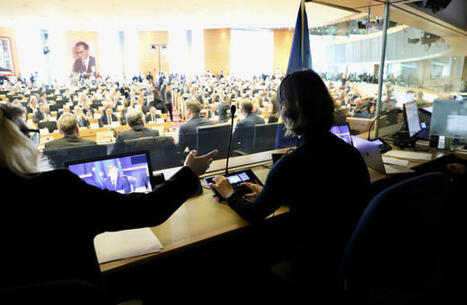







"Irish EU Presidency is opportunity to address lack of Irish interpreters in Brussels - MEP
One MEP wants the Irish government to increase the number of Irish language interpreters when Ireland holds the presidency of the EU Council this year.
A HIGH LEVEL EU delegation of officials is coming to Galway today with a mission – find conference interpreters with Irish to address a shortage in the EU Parliament in Brussels and its powerful committees which is leaving Irish speaking MEPs tongue-tied.
The delegation led by Juan Carlos Marin Jiminez, the Director General of the Directorate for Logistics and Interpreting or DG LINC, will visit the MA Course in Conference Interpreting in the University of Galway as well as pay visits to the Coimisinéir Teanga’s office in An Spidéal and Údarás na Gaeltachta in Conamara.
The shortage of interpreters at the European Parliament in Brussels is leaving Irish-speaking MEPs unable to use their language during important meetings.
Although Irish has been an official working language since 2022 - a development that came after a long campaign – it has yet to be placed on an equal footing with the other official working languages. The only other language in this situation is Maltese.
Interpretation is provided for the other 22 other working languages at every forum, but the same service is not available for Irish or Maltese. This stems from a vote taken during the European Parliament’s last mandate between 2019 and 2024.
As a consequence of that vote, Irish and Maltese will remain without an interpretation service on a par with the other languages until the end of the current mandate in 2029 at the earliest.
When Irish became a full official working language in 2022, the EU welcomed it, saying at the time that Irish was ‘at the same level‘ as other EU languages. While this is the EU’s official position, it is not what Irish-speaking MEPs such as the Ireland South representative are experiencing.
21:38According to Cynthia Ní Mhurchú, Fianna Fáil MEP for Ireland South, the shortage of interpreters is affecting her work as she represents her constituents across various committees and when speaking in parliament during its sittings in Brussels.
She is able to speak in Irish when parliament is meeting in Strasbourg — during plenary sessions — but this only occurs one week per month. Interpreters are provided for the one-minute speeches that MEPs deliver in the debating chamber on those occasions.
EU officials maintain, however, that the extension of the derogation was put in place due to a shortage of interpreters. Ní Mhurchú, for her part, believes that extending the derogation is failing to attract Irish speakers to pursue careers in interpretation.
“In practical terms, what this derogation means is that there is no team of interpreters employed in the Parliament for either Irish or Maltese,” the MEP said. “However, interpreters are employed in both the Council and the Commission.”
There is only one interpretation course in Ireland, at the University of Galway, and it accepts fifteen students each year. For many years there were difficulties in attracting Irish-speaking interpreters, as the existence of the derogation meant that their services were not considered necessary.
She acknowledged, however, that the Directorate-General responsible for ensuring the full Irish language service in the Parliament — DG LINC (Logistics and Interpretation for Conferences) — was doing its utmost to resolve the problem, a problem that Ní Mhurchú had raised as soon as she was elected in 2024, but that progress had not yet been made.
“I feel this shortage most acutely at committee level, because it is within the committees that legislation is scrutinised, examined and amended.
“I am very active on powerful committees such as IMCO (Internal Market) and TRAN (Transport).
“Committees hold enormous power as they are drafting and reforming legislation, and challenging the Commission.
“We receive legislation and proposals from the Commission and we must debate them, scrutinise them, examine them, critique them constructively, pull them apart and put them back together again as alternative proposals and legislation — to ensure that the new rules and laws are fit for our voters.”
She said it was deeply disappointing that matters stood as they did, given that Ireland would hold the Presidency of the Council of the European Union later this year, but that it also represented a significant opportunity. Sonnet 4.6
Ireland’s presidency falls in the middle of this term, which is deeply unfortunate given that the issues relating to the Irish language have not been resolved in any way whatsoever.
“The proposal is that interpreters could be seconded from the Commission, the Council, or the private sector (freelance interpreters) and placed in the Parliament for the duration of the Presidency.”
North's Irish language commissioner will not be distracted by efforts to undermine legislation
According to Ní Mhurchú’s own estimates, six translators and two assistants are needed, along with three interpreters.
“However, it would not be feasible to fill 11 new posts unless students, graduates and qualified professionals were aware that permanent employment would be available to them in the Parliament. They must be attracted to the roles and the pathway made easier for them to take up these newly created posts in the Parliament.”
She said she had been seeking this from various Government ministers, including Minister for Further Education James Lawless TD, Minister for the Gaeltacht Dara Calleary TD and Thomas Byrne TD, who holds responsibility for European Affairs, and had also raised it with Director-General of DG LINC Juan Carlos Jiménez Marín and Director-General of DG Translation Walter Mavrik, but that no solution had yet been found.
“I will now be making representations to Roberta Metsola — the President of the Parliament — asking her to resolve the problem.”
In response to an inquiry from The Journal, a spokesperson for the European Parliament confirmed that a majority of MEPs — 303 votes to 200 — voted to extend Rule 75, the rule which determines that an interpretation service on an equal footing will not be available for Irish and Maltese until July 2029.
“The European Parliament, along with other institutions, recognises that there are difficulties in providing language coverage for Irish due to a shortage of qualified conference interpreters and translators and, for that reason, derogations are applied to translation from Irish and to Irish interpretation,” the spokesperson said.
In a statement issued by a spokesperson for the Department of Foreign Affairs, under which Minister of State for European Affairs Thomas Byrne operates, it was said that “the Department is engaged in dialogue with the European Parliament to ensure that sufficient interpretation will be available for scheduled events during Ireland’s Presidency of the EU and will continue to engage with the European Parliament on this matter.”
The statement also noted that “guidelines have been developed by the Department of Foreign Affairs and Trade, in cooperation with the Department of Rural and Community Development and Gaeltacht Affairs, regarding the use of Irish during Ireland’s Presidency of the EU.”
This was said to reflect “Ireland’s commitment to multilingualism and the full integration of the Irish language in European affairs.”
The Journal’s Gaeltacht initiative is supported by the Local Democracy Reporting Scheme"
23 Mar 2026
https://www.thejournal.ie/irish-doesnt-have-full-working-and-official-language-status-in-the-eu-yet-6989908-Mar2026/
#metaglossia #metaglossia_mundus