Your new post is loading...

|
Scooped by
Charles Tiayon
October 16, 2021 1:09 AM
|
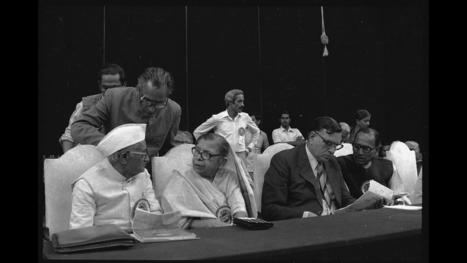
Review: My Family by Mahadevi Varma, translated by Ruth Vanita Ruth Vanita’s translation from Hindi of Mahadevi Varma’s autobiographical work Mera Parivaar will be loved by those for whom the idea of a chosen family embraces not just humans but birds and animals too Mahadevi Varma at the Hindi Sammelan on 30 October 1983. (Virendra Prabhakar/HT Photo) Published on Oct 15, 2021 05:14 PM IST Known for her scholarship and fiction highlighting stories of queer love, Ruth Vanita has now translated poet and prose writer Mahadevi Varma’s autobiographical work Mera Parivaar (1972) from Hindi to English. Titled My Family, this book will be most loved by those for whom the idea of a chosen family is not limited to fellow humans; it also embraces birds and animals. n the introduction, Vanita writes, “Mera Parivaar (My Family) has never before been translated into English. It is the most neglected of her works, hardly mentioned by biographers and critics.” It seems quite unusual that such a profound and heartwarming piece of literature authored by someone who is “commonly acknowledged as the greatest 21st century woman poet in Hindi” has remained obscure. Her rediscovery and translation is, therefore, nothing short of a public service. Varma had built an aviary to house the birds and animals she looked after. Ruth Vanita writes, “Mahadevi’s concern for entrapped, hunted, and tortured animals is related to a concern for all those who are oppressed and exploited. The 19th century was the period that gave rise to modern movements for laws to prevent cruelty to several groups and to win rights for them. These groups include women, children, manual labourers, factory workers, prisoners, the poor, the mentally ill, and animals.” The book is divided into seven chapters. Each of the first six chapters focuses on one particular bird or animal in Varma’s chosen family – her peacock Neelkanth, her squirrel Gillu, her doe Sona, her rabbit Durmukh, her cow Gaura, and her dog Neelu. The seventh chapter is about three creatures – Varma’s mongoose Nikki, her dog Rosie, and her mare Rani. Before these chapters comes Varma’s moving preface, which tells the story of how she came to rescue birds and animals in the first place. Varma spent her formative years at a boarding school in Allahabad. One of her favourite activities was to linger in an orchard of mango, guava, lime and jackfruit trees. Soon after the day’s classes were over, she would sit on the boughs of the mango tree with a book in hand. Gradually, she began interacting with the woman gardener and her children. The gardener looked after a speckled goat and a yellow-beaked white hen who became Varma’s playmates. She was thrilled when there were five new chickens. Describing her joy, she writes, “I saw the white hen, with puffed-out wings, accompanying her five children who looked like balls of silk-cotton. Like most Hindu homes, ours had never reared hens, so those chicks were such a novelty to me that I forgot my other companions and centred my attention on them.” When one of these chickens is taken away to be cooked, she cries inconsolably and reports the matter to the school matron. Varma writes, “That day, I got the baby chicken back and returned him to his mother. But after that, a nameless fear took hold of me. If I could not keep track of the numbers and identifying marks of my non-human friends, anyone could take them away. I had no other way to prove that I was their protector.” The chicken was named Munga (Coral) and that day onwards, the child Mahadevi began writing down the names, colours, special marks and traits of all the animals and birds that she cared for. The author’s affinity for animals and birds is evident throughout the book. She considers their lives to be as precious as that of humans, and is willing to go to great lengths to ensure their safety. This book is reminiscent of a verse from Shantideva’s 8th century text Bodhicharyavatara (A Guide to the Bodhisattva’s Way of Life translated by Raji Ramanan): “Gladly do I rejoice/ In the virtue that relieves the misery/ Of all those in unfortunate states/ And that gives happiness to the suffering.” Mahadevi Varma in a photograph dated 15 August 2001 (HT Photo) It is touching to note that Padma Vibhushan and Jnanpith awardee Varma, who was one of the four pillars of the Chhayavad movement in Hindi poetry, took this inventory-keeping very seriously as a genre of writing. “All my memoirs have sprouted, budded, and bloomed from this childhood prose expression of mine,” she writes. Each creature is not only her child but also her muse. She does not use the language of “animal rights” in this book but her portraits of these beings are so loving that it would be almost impossible for any reader to not view them with respect and kindness. About Sona, the doe who arrived at Varma’s doorstep as an orphaned baby in a near-dead condition, she writes, “After collecting a milk bottle, glucose, goat’s milk and so on, the difficult enterprise of raising her began. Her mouth was so small that the nipple of the bottle would not fit into it. Also, she did not know how to drink. Gradually, she learnt not only to drink but also to recognize the bottle.” Over time, Sona learnt to snuggle up to the leg of Varma’s bed every night. Vanita’s introduction provides the the philosophical and intellectual context of Varma’s actions. She reveals that Varma once considered and rejected the option of becoming a Buddhist nun but she became a devoted follower of MK Gandhi. Vanita writes, “Gandhi’s thinking about animals was shaped by Hindu and Jain philosophy but also by his association with vegetarian and anti-vivisection movements when he was a student in London.” Varma was the principal, and later the vice chancellor, of the Prayag Mahila Vidyapeeth. Most of the birds and animals that she had rescued were from Allahabad itself. Neelkanth, the peacock, was freed from a cage in a market when he was a baby. Gillu, the squirrel, was found in a flowerpot. It was a baby that had fallen out of a nest and two crows were wounding him with their beaks. Durmukh, the rabbit, was brought to Varma’s house by a gardener who had saved him from being eaten by a cat. Varma could not have done the work of caregiving all by herself. She mentions Bhaktin, her housekeeper, in the book. Varma also employed others for various tasks, especially when she travelled outside Allahabad for work or went on pilgrimages to different holy sites in India. As Ruth Vanita mentions in the introduction, all these workers were also considered as part of Varma’s family. She did not enjoy housework but she occasionally liked making snacks for herself and her visitors. The book has a few lovely black-and-white illustrations by Antra K to help you visualize all these creatures but Varma’s word-pictures will make you feel a profound tenderness for each of them. For instance, she describes how Neelu, her dog, used to take care of sparrow babies that fell to the ground during their unsuccessful attempts to fly. She writes, “Sometimes, to get very small nestlings restored to their nest, he would bring them to me, holding them gently in his mouth.” It is particularly amusing to see how Varma records the interactions between the inmates of the aviary. About Neelkanth, the peacock, she writes, “His love for these creatures was just as extraordinary as his punitive measures. He would often sit down in the dust with his wings spread out, and they all would play catch-as-catch-can in his long tail and thick wings.” Once, Neelkanth even saved a rabbit from being killed by a snake, and became the hero of the aviary. Readers who are inclined to pick up this book for the cuteness factor should know that she also writes about how the animals met their end. These are not sanitized tales. Ruth Vanita (Courtesy the publisher) This book also mentions Varma’s cats Chitra and Godhuli, her dogs Hemant and Basant, her peahen Radha, and her dog Flora, but they do not have entire chapters dedicated to them. They make guest appearances, giving readers a broader sense of the chosen family that Varma had created. Readers who are curious about how Varma came to have this unconventional family will find their answers in Ruth Vanita’s introduction: “Her father conformed to the custom of his community by marrying her off when she was nine, mainly because he wanted to fulfill his dying father’s wish to see her married.” As a child bride, Varma wept continuously at the few days she spent with her in-laws, so they sent her home before she was expected to leave. She was jubilant. As an adult, she was supposed to go and live with the in-laws once again. Varma refused to participate in the gauna ceremony being organized for her departure. Her father was struck with remorse. He told his daughter that, if she wanted to divorce her husband and get remarried, he would support that move. Vanita writes, “Christians and Muslims could legally divorce at the time, but Hindus could not.” Her father offered to convert along with her but she did not want to remarry. This book could serve as a source of strength and inspiration to those who want to remain single or have families that do not fit into the moulds that they have been conditioned to see as normative. Through her introduction and her translation, Vanita does a commendable job of bringing readers this fascinating literary document of Varma’s “happy single life”, which was blessed by an astonishing variety of creatures who nurtured her as much as she nurtured them. Chintan Girish Modi is a writer, educator and researcher. He is @chintan_connect on Twitter.

"Charles Tiayon, cartographer of the translation world
Charles Tiayon is a translator, lecturer and consultant whose Scoop.it activity reflects the professional universe named in his bio: translation, terminology, lexicography and intercultural issues. Through METAGLOSSIA, his public selection tracks language as a field of work, a field of rights, and a field being altered by AI.
A systems view of language
Tiayon looks at translation as a living system. His selections connect interpreters, translators, dictionary makers, universities, publishers, language activists and software companies, rather than treating them as separate worlds.
Technology with memory
AI is a recurring concern, but it is not treated as the whole story. Real-time speech translation, OCR and voice AI appear alongside older and slower forms of linguistic work: dictionaries, terminology, literary translation and language education.
A multilingual compass
The geographic spread is notably international, with attention to French, Spanish, Chinese, Arabic, Maltese, Breton, Ukrainian, Filipino, Indigenous languages in Canada and Indian language politics. No single country dominates the map.
What defines this selection
Archive-scale attention
With 99,235 posts analysed in a single topic, this is a long-running, high-volume observatory of the translation world. The account dates back to 2011, giving the selection the feel of an archive as much as a live feed.
A broad professional lens
The material moves easily between AI translation tools, national dictionaries, literary translation, terminology work, market news and language policy. That range reflects a professional view of language work as both craft and infrastructure.
Mixed-source reliability
The sources span institutions, universities, technology companies, mainstream media and regional outlets. UNESCO, university sites, DeepL, Mistral, CBC, Ouest-France and other sources create a mixed diet of policy, research, product news and local reporting.
Specialist reach, public scale
The audience numbers are substantial, with more than 567,000 views and over 424,000 unique visitors across all topics. The reach suggests sustained interest beyond a narrow specialist circle.
Topics
◍
Metaglossia: The Translation World
This flagship topic covers translation, interpreting, intercultural communication, terminology and lexicography as they unfold in public life. It is especially strong on AI language tools, institutional language policy, minority languages, literary translation and dictionaries.
99.2K posts
en
Deep dives
Where language becomes infrastructure
Charles Tiayon’s main topic reads like a newsroom for the language professions, but with a wider lens than trade news alone. Translation, interpreting, terminology and lexicography appear beside minority-language rights, literary circulation, dictionaries, competitions, and the fast-moving world of AI speech and OCR tools.
Metaglossia: The Translation World
The strongest thread is the collision between language as culture and language as system. A new Maltese digital dictionary, a Doha historical dictionary with text-to-speech, UNESCO and Unicode cooperation, and First Nations language translation all sit in the same frame as DeepL, Mistral OCR, and real-time speech models.
Metaglossia: The Translation World
His editorial voice is not silent aggregation. The analysis points to regular INSIGHT notes, often substantial and quote-based, with an explanatory tone and occasional sharper framing when language politics or AI consequences are at stake. The result is a practical map of a field being reshaped by institutions, software, markets and communities at once."
Courtesy
Scoop.it
06.07.2026
#metaglossia_mundus
#metaglossia

" Local large language AI models are closing the gap with cloud-based models in professional computer-assisted language translation, according to a new study from the University of Georgia that also sheds light on how large language models (LLMs) learn to translate.
The findings could give professional translators a practical alternative to cloud-based AI, particularly in fields where sensitive documents must remain offline and secure.
“There is a niche area of the translation market where translation must be done offline,” said Yuri Balashov, a professor in the Franklin College of Arts and Sciences Department of Philosophy and a faculty fellow in the Institute for Artificial Intelligence, who led the project. “In security, military, and patent-related translation projects, you need to shut down your internet. You cannot work online. But you can still run local models, so we wanted to explore how well they perform.”
The research team, including three graduate students who took Balashov’s seminar on translation technologies, compared nine locally run AI language models with leading commercial machine translation systems. To test the systems, they used a set of multilingual medical translations built from professionally translated versions of the Christopher and Dana Reeve Foundation’s paralysis resource guide.
“It was translated into several languages, including Japanese, Chinese, Russian, German, French, Brazilian Portuguese, and Hindi,” Balashov said. “With the foundation’s permission, we aligned some of them with the English original, sentence by sentence, and that is how we created our corpus.”
The study found that the strongest local models, including Translate Gemma and Mistral, performed competitively in translation quality with larger cloud-based language models such as ChatGPT and Claude, although leading commercial machine translation engines (DeepL for English to German, Russian, and Japanese; Baidu for English to Chinese) still produced the highest-quality translations overall.
“They are still behind, but the gap is narrowing and the field is changing very rapidly,” Balashov said.
The bigger question
Why can large language models translate so well despite never being explicitly trained as translators? Balashov argues that the answer lies in how the models learn. Rather than relying on a single source of information, they develop translation abilities through two concurrent methods: by studying pairs of matched sentences in two languages, and by reading large collections of text in each language separately. Gradually, he suggests, the model builds connections between languages despite not being taught explicit translation rules.
“Both processes are integral to the development of translation abilities of LLMs,” Balashov said. “They both contribute to it but maybe to different extents.”
Rethinking translation
To reach his conclusions, Balashov referred to one of machine translation’s oldest ideas: Interlingua, which holds that translation is not just about converting words from one language into another but capturing meaning behind phrases and sentences, before expressing that same idea in a different language. Once that meaning is encoded in a language-neutral form, it can be expressed in any language without losing the message.
Some researchers believe today’s LLMs may have revived this idea, which dates to early machine translation systems in the 1950s and 60s, through internal language-independent representations. But Balashov remains skeptical.
Translation is more flexible and context-dependent than Interlingua theories suggest, he said. There is no doubt that language models learn cross-lingual representations from exposure to multilingual data during training and fine-tuning. However, they remain dependent on the particular mix of languages used in training. Real-life translation is messy, opportunistic, and much less systematic than is assumed in any interlingual account.
“Your brain almost immediately outputs an equivalent of a shorter phrase in a target language,” Balashov said. “But there’s also another way to translate for us humans. We often slow down and reflect on a more complicated sentence. We try to understand what it really says in the source language, and then we try to transfer that meaning to a target language.”
For Balashov, that same interplay between fast pattern recognition and slower, context-driven reasoning may help explain not only how humans translate but also how LLMs acquire translation abilities.
Humans in the loop
The research is intended to help professional translators and smaller translation agencies adapt to a rapidly changing profession.
“Our target audience in a recent series of papers is human translators and smaller translation agencies, not high-tech labs like Google or Anthropic,” he said. “We think our audience could benefit from what I call translation analytics.”
Balashov describes translation analytics as a combination of “automatic evaluation of translation quality, human evaluation and lightweight statistical analysis” used to assess translation performance.
While AI continues to reshape the translation profession, he added, the role of human translators is evolving rather than disappearing.
“I would like to think that there will always be a need for professional translators. There are areas where the proverbial human expert in the loop is sorely needed,” Balashov said. “But the nature of the work that translators need to perform is changing very rapidly. Those who want to continue working in this area need to adapt very fast.”"
By Moses U. Okocha
https://research.uga.edu/news/how-can-ai-translate-without-being-trained-as-a-translator/
#metaglossia
#metaglossia_mundus

I'm 94 and still work five days a week. Six decades in, I still have no plans to retire
Marta Barany has been an interpreter and translator for over 60 years. There's a reason she keeps working
"I'm now 94 years old, interpreting and translating in both the private and public sectors (including Centrelink), and have no plans to retire soon.
A natural path
Becoming an interpreter was always a natural progression for me; I speak a few languages, and I love dealing with people.
I was born and raised for the first 12 years of my life in Hungary. But in 1945, near the end of World War Two, my parents and I fled as refugees to Germany after the Soviet Red Army invaded and occupied our country.
I already knew Hungarian, but I learnt German, English, Latin and French through my six years of schooling in Germany, which have been very helpful to know.
I arrived in Melbourne with my family in January 1951, after 65 days of travel, as displaced persons from the war.
I was 18 years old and still remember feeling a heat I had never experienced in my life when we were taken to Bonegilla, an ex-army camp near Albury in northern Victoria that was then used as a camp to process post-war European migrants.
Because the camp was full, we were put in an army tent — and that is how I started my life in Australia.
Finding my purpose
It wasn't until the late 1950s, when I was in my late 20s, a mother and working an admin role, that my interpreting career began.
The 1956 Hungarian Revolution brought a wave of Hungarian migrants to Australia in the years that followed. But there was no community interpreter service here at the time, and people needed help.
So I stepped forward as an interpreter. I believe it's important to be understood as a person — to say what you want to say and be able to express yourself. And if you don't speak the language of a place, that's very hard to do.
One memory that stands out in my career was working with the Department of Immigration's telephone interpreter service, when a phone call from a hospital somewhere in rural Western Australia came through late one evening.
A young woman was in labour, and I had to interpret for her and the medical team: telling her when to push, when not to push and that she was going to get through it.
Then, when she had given birth, I had to tell her husband he was a father to a "lovely baby boy".
It was a special moment, and I felt privileged that my work let me be a part of it.
As a 'clog wog', Australians didn't know I was a migrant, so they confided their racism
Across my six-decade-long career, I’ve also been involved in starting several of Australia's interpreting and translating services.
I was one of the founding members of the Telephone Community Interpreting Service and Australian Institute of Interpreters and Translators, and I helped set up the National Accreditation Authority for Translators and Interpreters — as well as the Hungarian branch of Catholic aid organisation Caritas.
It's been a privilege to help others feel understood, and I especially feel connected with the Hungarian communities both here and abroad.
Some Hungarian Australians have somewhat adopted me as their mother, which is a role I'm happy to fulfil.
I also chaired the Hungarian Olympic Committee during the 2000 Sydney Games and served as the Ethnic Affairs Commissioner of NSW. And I have been awarded the British Empire Medal, Order of Australia Medal, and this year, the Interpreters and Translators Medal.
If my mind works, I still work
At 94, I'm still working five days a week — usually three or four hours a day. I don't have any plans to stop working, but I know it'll be time to do so when my mind gives up.
I try to work as much as I can and feel energised by it.
If my mind works, I will still work.
I used to travel a lot for work as I mostly interpreted onsite. I worked in Cairns, Townsville and Brisbane in Queensland; in the courts in Adelaide; in Broken Hill and Lightning Ridge in rural NSW — all over the place.
But these days, I mostly work over the phone. I still drive, so I work onsite if I can find a parking spot — otherwise I do a lot of telephone and video call interpreting.
Although German was like a mother tongue to me, it's become rusty; so, I now only interpret in Hungarian and English Hungarian.
I get a pension and my freelance work does mean extra income — not as much as when I worked full-time, but it's still very good.
And my work keeps me busy.
In all truth, I wouldn't know what to do with my mind if I stopped working.
And I know that I'm good at my job and I'm needed."
5 August 2026
Marta Barany
https://www.sbs.com.au/news/insight/article/im-94-and-still-work-five-days-a-week-six-decades-in-i-still-have-no-plans-to-retire/s3e0ptjcb
#metaglossia
#metaglossia_mundus

Rights Complaint Filed Over Lack of Interpreters for Foreign Workers at Labor Board
"A complaint has been filed alleging that regional and central labor relations commissions discriminated against a foreign worker's right to equality by conducting hearings without providing interpretation, in a case where the worker had sought relief for unfair dismissal.
Korean Lawyers for Public Interest and Human Rights, known as Duroon, said on the 4th that it submitted a complaint to the National Human Rights Commission of Korea on the 3rd of this month. The complaint requested a recommendation that "the Labor Relations Commission improve its practices and systems to provide interpretation when investigating, deliberating on, and questioning foreigners, and to take active measures such as guaranteeing the participation of a person in a relationship of trust and extending the duration of hearing sessions."
According to Duroon, two Sri Lankan foreign workers who had worked as welders at a shipyard in Ulsan filed for relief from unfair dismissal with the Ulsan Regional Labor Relations Commission in June last year after being dismissed from their jobs.
However, Duroon explained that the Ulsan commission did not provide interpretation to the workers, who were not proficient in Korean, at a hearing session held in August of the same year. As a result, a fellow worker with no professional interpreting experience served as the interpreter, making it difficult to adequately represent their positions. "The commissioners spoke in long and complex sentences without considering interpretation, used legal terms without separate explanation, and often continued speaking before interpretation was completed," Duroon said.
Duroon also claimed that it requested an extension of the hearing session time in consideration of the time required for consecutive interpretation, but the request was not accepted. As a result, in a hearing session that lasted about one hour and 20 minutes, actual questions and answers accounted for less than half of the time. According to Duroon, interpretation was likewise not provided and the hearing time was not extended during the National Labor Relations Commission's review procedure conducted in February this year.
Duroon said, "Because the Labor Relations Commission's unfair dismissal relief procedure is a preliminary procedure to administrative litigation and effectively has the character of a trial, interpretation support and time extensions that take this into account are necessary to guarantee foreign parties a substantive right to participate, just as in criminal and civil procedures.""
https://en.sedaily.com/society/2026/08/04/rights-complaint-filed-over-lack-of-interpreters-for
#metaglossia
#metaglossia_mundus

Amberscript associe la transcription par IA à une couche de contrôle humain
"La transcription et l’analyse de textes sont des tâches courantes dans divers secteurs. Pensez aux interviews pour les journalistes, aux comptes rendus de consultations médicales ou aux documents juridiques. Les outils de transcription vous offrent une solution en un clic pour ce processus chronophage.
Nous testons des alternatives européennes aux divers outils de transcription indispensables à notre rédaction. Notre oreille attentive a déjà analysé le Good Tape danois et le Gladia français ; c’est maintenant au tour du néerlandais Amberscript.
Langue maternelle
Amberscript a été fondée en décembre 2017 à Amsterdam, avec pour premier produit une fonction de reconnaissance vocale en néerlandais. En 2018, un service de transcription et de sous-titrage manuel a suivi. Entre-temps, l’entreprise propose plus de 90 langues différentes, des transcriptions automatiques et professionnelles, ainsi que du sous-titrage.
Un premier point positif : l’entreprise est basée aux Pays-Bas. En tant que journalistes, nous traitons régulièrement des transcriptions en néerlandais. Nous nous attendons donc à ce que la qualité de l’outil néerlandais soit élevée, surtout par rapport à Gladia qui a obtenu un score légèrement inférieur pour notre langue maternelle.
Lors d’un premier test avec Amberscript, nous remarquons que la transcription en néerlandais est très précise. Sur le test linguistique, l’outil obtient d’ores et déjà un dix sur dix.
Automatique versus professionnel
Amberscript propose deux options de transcription. Vous pouvez faire transcrire des fichiers audio automatiquement ou faire appel à un professionnel humain. Pour notre domaine d’application, à savoir la transcription d’interviews, la transcription automatique est suffisante.
Simple et direct
L’outil est simple et direct. Vous cliquez sur « Télécharger un fichier » et choisissez ensuite parmi différents formats de fichiers, tels que mp3, mp4, wav, m4a, m4v, mov et bien d’autres encore. C’est un avantage important : les transcriptions sont souvent enregistrées via Microsoft Teams ou un enregistreur, ce qui produit un format mp3 ou mp4.
Amberscript prend en charge différents formats de fichiers. Source : Amberscript
Dès que le fichier est chargé, vous recevez une notification par e-mail indiquant qu’il est prêt dans l’éditeur. Ce tableau de bord est également très clair. Dans le menu supérieur, vous pouvez modifier l’heure de début, la durée ou la vitesse. Vous pouvez également avancer ou reculer dans la transcription. De plus, vous avez la possibilité d’attribuer automatiquement des locuteurs ou d’en ajouter de nouveaux.
Dans l’éditeur, vous pouvez écouter et modifier les transcriptions. Source : Amberscript
En outre, vous pouvez également marquer des passages importants dans le texte, ou modifier ou remplacer des mots dans l’ensemble du document. Un petit détail qui nous manque ici est la possibilité d’ajouter des notes ou des commentaires aux passages marqués.
Traduire
Par ailleurs, vous pouvez faire traduire vos textes au sein du tableau de bord. Une fois que vous avez sélectionné une traduction, un menu déroulant apparaît, vous permettant de basculer facilement entre les langues. Cela peut être utile, par exemple, lorsque vous enregistrez une conversation de réunion en anglais, mais que la rédaction du compte rendu se fait en néerlandais. Vous pouvez ainsi vérifier certaines déclarations en anglais.
Prix par heure
Pour notre période d’essai, nous avons utilisé les dix minutes de transcription gratuites. Si vous voulez vraiment utiliser l’outil, vous devrez souscrire un abonnement. L’abonnement est à chaque fois basé sur le nombre d’heures de transcription. Le forfait Starter revient à 19 euros par mois et comprend 300 minutes. L’abonnement Pro offre 600 minutes pour 29 euros par mois, et l’abonnement Power (49 euros/mois) comprend 1 500 minutes de transcription.
Pour vous donner une idée : l’abonnement Starter revient à 3,8 euros par heure. Il comprend des fonctionnalités telles que plus de 90 langues, l’identification automatique des locuteurs et des options d’édition. Mais aussi :
Exportation des transcriptions en Word, JSON, TXT, CSV
Exportation des sous-titres en SRT, VTT, EBU-STL et plus
Certifié ISO27001 & ISO9001
Traitement et stockage des données sur des serveurs de l’UE conformément au RGPD
Le prix de l’abonnement d’entrée de gamme (Starter) est légèrement plus élevé que celui d’autres outils que nous avons examinés. Ainsi, le montant mensuel de l’abonnement le moins cher chez Notta s’élève à 11,69 euros, et à 16 euros pour Good Tape.
L’excellence en néerlandais
Outre la qualité de la transcription, nous visons également une approche européenne. Amberscript promet un traitement sécurisé des données. Ainsi, la plateforme est conforme au RGPD, certifiée ISO27001 et ISO9001, et possède le label TPN pour une excellente sécurité des données.
Cet outil de transcription amstellodamois possède toutes les fonctions nécessaires pour transcrire et traiter des interviews. Les abonnements sont plutôt onéreux, mais vous bénéficiez en échange d’une qualité locale.
Pro's
Transcriptions précises (néerlandais)
Convivial & clair
Traduction en temps réel
Contra's
Un peu plus cher
Notes impossibles
ITdaily teste des alternatives européennes et open source aux outils logiciels américains populaires que nous utilisons quotidiennement. Vous souhaitez découvrir plus de logiciels européens ? Grâce à cet aperçu, vous retrouverez tous les avis."
https://itdaily.fr/tests/logiciel/avis-sur-amberscript-transcription-impeccable-dans-les-frontieres-de-lue/
#metaglossia
#metaglossia_mundus

"La cérémonie de montée des couleurs organisée le lundi 3 août à la Cour suprême, à Porto-Novo, a été marquée par l’exécution de l’hymne national en langue dendi. Cette interprétation a été assurée par la chanteuse Amy-Mako, déjà remarquée pour la même prestation lors du défilé du 66ᵉ anniversaire de l’indépendance à Cotonou, le 1er août.
Selon les informations communiquées par le quotidien de service public La Nation, cette initiative prolonge une pratique instaurée depuis plusieurs années consistant à faire interpréter « L’Aube Nouvelle » dans les langues nationales à chaque premier lundi du mois.
Une nouvelle langue à l’honneur
À l’origine de cette initiative, le président de la Cour suprême, Victor Dassi Adossou, qui a souhaité inviter Amy-Mako après sa prestation lors des festivités de l’indépendance. Jusqu’à présent, l’hymne était régulièrement chanté en fon au sein de l’institution, tandis que l’apprentissage d’autres langues nationales se poursuit.
Le magistrat a expliqué que cette démarche vise à encourager une plus grande place des langues béninoises dans les cérémonies officielles. Selon lui, il est souhaitable de « parler nos langues nationales » et de « chanter en langue nationale », afin de renforcer leur usage dans la vie publique.
L’indépendance associée à l’identité nationale
Profitant de cette cérémonie, Victor Dassi Adossou est revenu sur la portée de la célébration du 1er août 1960. Il a rappelé que l’indépendance ne se limite pas à un anniversaire institutionnel, mais renvoie aussi à la capacité des citoyens à construire leur avenir en s’appuyant sur leurs propres ressources.
Selon le président de la Cour suprême, « être indépendant, c’est penser par nous-mêmes ». Il a également évoqué la nécessité de promouvoir les productions nationales, les langues locales ainsi que les expressions culturelles béninoises.
Un rappel du rôle de la justice
Le discours a également porté sur les missions de la justice dans le fonctionnement de l’État. D’après Victor Dassi Adossou, le choix du Bénin en faveur de la démocratie pluraliste depuis la Conférence nationale des forces vives repose sur l’existence d’un État de droit soutenu par une justice indépendante et efficace.
Le président de la Cour suprême a estimé que les magistrats contribuent à la cohésion nationale en rendant des décisions conformes au droit. À ses yeux, « travailler pour le bien collectif » constitue l’une des traductions concrètes de l’indépendance.
Le dendi rejoint ainsi les langues déjà utilisées lors de cette cérémonie mensuelle. Le Bénin compte plus d’une cinquantaine de langues et variétés linguistiques parlées sur son territoire. Depuis plusieurs années, les pouvoirs publics et certaines institutions multiplient les initiatives destinées à promouvoir ce patrimoine linguistique dans les espaces officiels, aux côtés du français, langue officielle du pays."
04/08/2026
Armel TOGNON
https://lanouvelletribune.info/2026/08/benin-lhymne-national-chante-en-dendi-a-la-cour-supreme-apres-le-1er-aout/
#metaglossia
#metaglossia_mundus
"In Praise of the Translators Who Transport Us Across the Globe
In Feature Articles by Olivia SnaijeJuly 29, 20262 Comments
Literary translations are investments in cultural infrastructure, a public good that can be applied to all publishing markets, no matter the language territory.
By Olivia Snaije, Contributing Editor
Much ink has been spilled this summer about Christopher Nolan’s blockbuster based on Homer’s The Odyssey. Nolan has said that he was inspired by Emily Wilson’s 2017 novel translation, the first into English by a woman, and one that is resolutely modern. (Wilson is halfway through a re-translation of The Odyssey in which she says she won’t confine herself to the same number of lines as the original, even if it will still be in iambic pentameter.)
Since the release of Nolan’s film, Wilson’s translation of The Odyssey shot to No. 3 on Amazon’s bestseller list and No. 11 on Barnes & Noble’s, and sales in the U.S. have reportedly surpassed one million copies. This is a rare occurrence for a translator. Before publication, it took the classicist five years and considerable prowess to translate the work. She has said she never imagined such success.
‘Unsung Heroes’
Translators are like sculptors, chipping away at a block of stone, choosing one particular word out of several, immersed in the source language and dialogues which will certainly reflect a dialect or the country among many possible countries. They will draw on political, historical, social, cultural and even personal considerations, while dealing with grammatical quirks, layered, ambiguous plots, and distinct writing styles. They may even experience secondhand trauma when the subject of a book is particularly grim.
Then consider the practical hurdles: not only do translators often act as scouts and agents combined (sometimes pitching a book for years), but they deal with long working hours and poorly paid commissions.
Meanwhile, there has been much justified concern about the impact of AI on translation. Following a survey in 2024 by the U.K. Translators Association (part of the Society of Authors) a number of translators reported losing work to generative AI, and 50% said that AI had decreased their income. Three-quarters of translators said that AI would negatively impact their future income.
The Society of Authors has called for industry solidarity with human translators. After all, once a book in translation has been published, the reader is magically transported to another country, and sometimes to another world. But, behind the magic, are years of skill, sacrifice, and often brilliance.
Translators are, and have traditionally been, the unsung heroes who have remained in the shadows—even if many changed the world throughout history. In recent years, they have begun to emerge from the shadows to some extent—awards such as the International Booker Prize and the Dublin Literary Award have done much for translators’ exposure. But it’s not nearly enough.
‘The Vanguard of Literary Change’
Perhaps what our story-loving societies need are more stories about translators themselves, and their craft. In the July issue of the new magazine Now Voyager, for example, a longform article by Makana Eyre takes a deep dive into the woes of a young literary translator and a contemporary Russian novel. Eyre tells the story of Bela Shayevich, who hadn’t yet translated a major novel but was commissioned by an editor at Farrar, Straus and Giroux (FSG), who felt she had all the necessary skills to translate Ludmila Ulitskaya’s 2010 novel, The Big Green Tent.
Bela Shayevich (credit: University of Iowa).
Ulitskaya’s literary agents, Yulia Dobrovolskaya and Alexander Klimin at Elkost were skeptical. They wanted a better-known translator. But Shayevich was backed by Ulitskaya’s editor. Then, he left FSG and the book was assigned to a different editor. Shayevich finished the translation under tremendous pressure, and an excerpt was even published in The New Yorker in May 2014.
But one of Ulitskaya’s agents, Klimin, continued to have misgivings due, in part to Shayevich’s more contemporary approach to the translation. Ulitskaya was apparently happy with Shayevich’s translation.
Eyre quotes Shayevich on her approach to translation:
“‘If I say bread, depending on where you’re from, you’re going to see something really different,’ she told me, alluding to a passage in Walter Benjamin’s essay “The Task of the Translator.” A Russian might visualize a loaf of black bread, a French person might see a baguette, an American might see Wonder Bread. ‘Even calling bread bread is a mistranslation,’ Shayevich said.”
In the end, FSG commissioned the more experienced Polly Gannon, a professor with a Ph.D. in Russian literature, to translate a second version of The Big Green Tent which was published in November 2015. Shayevich’s translation only exists in the form of review copies sent out beforehand.
Shayevich, however, was eventually vindicated in 2018 when she won the inaugural TA First Translation Prize for her translation of Svetlana Alexievich’s Secondhand Time. Jacques Testard of Fitzcarraldo Editions had commissioned Shayevich in 2015 for the translation (before Alexievich won the Nobel Prize in Literature later that year) and when Secondhand Time was published in 2016 her translation was highly praised.
Daniel Hahn (credit: Camila França Photography).
The TA First Translation Prize was established in 2017 with help from the award-winning translator Daniel Hahn, who donated half of his winnings from the Dublin Literary Award from that same year for his translation from Portuguese of José Eduardo Agualusa’s A General Theory of Oblivion.
Hahn wrote about setting up the prize in an article in The Guardian. His title was “Translators are the vanguard of literary change: we need better recognition.”
In between his translations, Daniel Hahn published a book this past spring which is an investigation of how Shakespeare’s plays are translated for global audiences, and the skillfull wordplay used by translators across the world. It involved extensive interviews with approximately 14 translators working in languages from Hungarian and Danish or Swahili to Tswana, Māori, and Bangla.
If This Be Magic: The Unlikely Art of Shakespeare in Translation, is an ode to his fellow translators. In a recent interview with Anil Sarvepalli, the host of Harshaneeyam, one of the most dynamic and well-researched podcasts about literary translation today, Hahn said that when translating a writer as good as Shakespeare, nothing in his writing is accidental. So when translating Shakespeare—or any writer whose work is highly kinetic—you want to keep everything.
But keeping everything requires keeping all the properties of the writing, which poses several challenges. “Every language works differently, and you have to notice everything in the first place,” said Hahn. In the end, “you need to preserve everything to keep Shakespeare as Shakespeare,” he explained. “But as all translators know, keeping everything also means changing everything.”
For Lin King, the translator of Yáng Shuāng-zǐ’s, Taiwan Travelogue which won this year’s International Booker Prize, it was her first time translating a full-length novel, a project that grew out of her masters thesis.
Author Yáng Shuāng-zǐ, and translator Lin King, during the International Booker Prize 2026 ceremony (credit: Booker Prize Foundation).
King was also interviewed on Harshaneeyam before the book won the prize, as well as on another podcast about translation, It’s Lit in Translation, run by translator and bookseller Evelyn Heis. In both interviews King describes the multi-layered opacity of the book, which is a fictional account disguised as a translation of a rediscovered work by a Japanese author. Thus, the translation required knowing not only Mandarin and Hokkien (spoken in Taiwain) but Japanese and archaic Japanese terms.
On the contractual side, Lin told Heis that Taiwan Travelogue received several offers from publishers in the U.K, but one of the reasons Shuāng-zǐ and King chose to go with And Other Stories was because, like their U.S. publisher, Graywolf, they put translators names on the cover of their books, which many publishers still do not do. That kind of support—acknowledging the role of a translator with cover credit, is an essential recognition.
An Investment in ‘Cultural Infrastructure’
As a 2026 ThinkPub study on Books in Translation in the European Publishing Market stressed, literary translations are more than commercial transactions, they are investments in cultural infrastructure.
“Translation must be understood both as a market activity and as a public good,” the ThinkPub report concluded. “Commercial logic alone is not sufficient to sustain linguistic diversity, particularly for works from smaller languages or less commercially dominant regions. Public support mechanisms—including translation grants, publisher subsidies, and international cooperation programmes—emerge as decisive factors in maintaining diversity and ensuring long-term cultural circulation. Indeed, the idea that translation is a public good can applied to all publishing markets, no matter the language territory.
With fall book fair season right around the corner, the LitAg Center at the Frankfurter Buchmesse will soon be buzzing with agents buying and selling translation rights. Which makes now the perfect time to recognize—and praise—the vital, multidimensional work of literary translators and their enduring cultural contributions. And more to the point, how we can better support them.
Olivia Snaije
https://publishingperspectives.com/2026/07/in-praise-of-the-translators-who-transport-us-across-the-globe/
#metaglossia
#metaglossia_mundus

"New York : la ville aux 700 langues
New York est la ville où l’on parle le plus de langues sur la planète. Cette nouvelle Babel parviendra-t-elle à sauver les dialectes les plus rares du monde ?
Apportant avec eux les langues de leur pays natal, les immigrants débarqués par bateau sur Ellis Island attendent les contrôles officiels et l’approbation des autorités pour atteindre leur destination : la ville de New York, qu’ils aperçoivent déjà.
Le seke est une langue peu usitée que l’on parlait à l’origine dans cinq villages du nord du Népal. Mais son avenir pourrait dépendre d’une poignée de villages d'un nouveau genre : des immeubles du centre de Brooklyn, quartier de la ville de New York.
Comment cette langue, peu documentée et seulement parlée par moins de 700 personnes dans les sommets de l’Himalaya, en vient à être entendue dans cette jungle de béton ? Rasmina Gurung, âgée d'une vingtaine d'années, est l’une des plus jeunes personnes à parler le seke. Sa grand-mère le lui a appris, dans son village, mais elle a déménagé tôt dans la capitale, Katmandou, pour finalement arriver à New York. Elle estime qu’un quart de son peuple habite la ville. Ils rejoignent ici des locuteurs de dizaines d’autres langues en danger de tout l’Himalaya. Tous forment de nouvelles communautés où ils communiquent dans un mélange de népalais, de tibétain, d’anglais et de leur propre langue maternelle en danger.
Mais New York, la ville où l’on parle le plus de langues dans l’histoire du monde, pourrait avoir atteint son pic de diversité. Les plus de 700 langues qui y sont parlées représentent plus de 10 % de toutes celles utilisées dans le monde. Bien qu’elles soient en grande partie invisibles, et inaudibles, aux étrangers, les langues parlées à New York proviennent des quatre coins du monde. De nombreux immigrants sont arrivés de points névralgiques linguistiques au cours des dernières décennies. Des zones comme l’Himalaya, l’Afrique de l’Ouest, l’Asie du Sud-Est insulaire, ou encore d’Amérique Latine. Cependant, les forces qui ont réuni ces personnes commencent aujourd’hui à les séparer.
À travers ses cinq quartiers, la riche diversité linguistique de New York est impossible à ne pas voir dans ses rues, boutiques et arts de rue. D’annonces publicitaires en arabe ou en hindi, à des fresques murales où le mot « liberté » est écrit en bengali, chinois et espagnol.
À travers ses cinq quartiers, la riche diversité linguistique de New York est impossible à ne pas voir dans ses rues, boutiques et arts de rue. D’annonces publicitaires en arabe ou en hindi, à des fresques murales où le mot « liberté » est écrit en bengal, chinois et espagnol.
Au vu de l’accélération de la perte des langues, même au sein de leur contrée natale, des menaces qui pèsent sur l’immigration et de la hausse des coûts d’une vie en ville, le temps pourrait venir à manquer.
La remarquable convergence des langues à New York et dans les villes similaires pourrait rapidement disparaître, avant même que l’on ait le temps de la documenter ou de la soutenir. L’urgence est le moteur de l’Alliance des langues en danger, organisation que je co-dirige, qui a commencé à cartographier cet environnement linguistique.
Un ensemble sans précédent d’opportunités culturelles, scientifiques, éducationnelles et même économiques, est en jeu. C’est la première fois que les linguistes et les locuteurs sont si bien positionnés pour documenter les langues pour lesquelles peu de trace existe, si elles existent. Les possibilités artistiques, musicales et culinaires sont tout aussi exceptionnelles car des points de vue de toute la planète se mêlent dans un même espace.
Irwin Sanchez, chef cuisinier et poète du Queens, qui parle le nahuatl, auparavant la langue des Aztèques, cuisine des tacos, des moles et des tamales en gardant à l’esprit les significations originales de ces mots. Husniya Khujamyorova, qui parle le wakhi du Tadjikistan, écrit les tout premiers livres pour enfants à destination des locuteurs de six langues pamiries, aujourd’hui toutes représentées le long de la propre route de la Soie de Brooklyn. Ibrahima Traore, qui a fait tout le chemin depuis la Guinée jusqu’au Lower East Side, enseigne le n’ko, un système pionnier d’écriture d’Afrique de l’Ouest, et encourage son usage dans toutes les nouvelles technologies. Boris Sandler, locuteur yiddish et écrivain né en Moldavie, contribue à sa façon, roman après roman, à la renaissance miraculeuse du yiddish à New York.
Le lenape, la langue d’origine du lieu où s’est élevée New York, renaît également de ses cendres, contre toute attente. Depuis sa dernière place forte, dans la campagne de l’Ontario, où seul un seul locuteur natif subsiste, une nouvelle génération d’activistes présente la langue à une plus large audience. L’une d’elle était Karen Mosko qui, avant sa mort, se rendait à Manhattan, « l’île aux nombreuses collines » en lenape, une fois par mois pour enseigner la langue.
Et puis il y a Rasmina Gurung, la jeune locutrice du seke. Durant sept ans elle a documenté la langue à la fois au Népal et à New York, grâce à des dizaines d’heures d’enregistrement, dont beaucoup ont été transcrits et traduits, ainsi qu’un dictionnaire qui continue de s’agrandir. Mais à présent, ses aînés disparaissent peu à peu et emportent leur langue avec eux. Les questions sur l’immigration et l’asile pendent comme une épée de Damoclès au-dessus de la communauté. Les loyers deviennent de plus en plus chers et leur cohésion, pareille à celle d’un village, pourrait ne pas durer.
Au cours de la dernière décennie, par hasard, le quartier gurung de Brooklyn est devenu un lieu où des personnes des quatre coins du monde établissent des associations de leur pays natal, des institutions religieuses, des restaurants et une variété d’autres commerces et espaces. Cela donne lieu à la formation de lieux radicalement différents, qui cohabitent les uns à côté des autres. À quelques minutes du « village » seke, on peut entendre des Ghanéens en route vers l’église parler en Twi, des coiffeurs azerbaidjanais parler juhuri et des chauffeurs Uber se réunir autour de kebabs en papotant en ouzbek. Les langues africaines, asiatiques, européennes, caraïbéennes et sud-américaines résonnent dans les carrosseries, les navettes informelles ou « dollar vans », les mosquées, et les bars.
Pour tout son potentiel inutilisé, Babel, non pas le mythe biblique mais la réalité contemporaine, s’est réalisé dans les villes telles que New York, à une échelle inimaginable. Il est maintenant temps de le comprendre, l’apprécier et le défendre.
De Ross Perlin
Linguiste et auteur de Language City: The Fight to Preserve Endangered Mother
30 juil. 2026
Cet article a initialement paru dans le magazine National Geographic de juillet 2025."
https://www.nationalgeographic.fr/histoire/linguistique-la-nouvelle-babel-new-york-la-ville-aux-700-langues
#metaglossia
#metaglossia_mundus
Language on a prescription label deserves the same regulatory scrutiny given to the drugs themselves
"According to Blank, the language on a prescription label deserves the same regulatory scrutiny given to the drugs themselves.
Drug Topics: Why do you believe that “language on a prescription label deserves the same zero-tolerance standard the industry already demands for the drug itself,” and how does the industry get to that point?
Sharon Blank: The industry would never accept ‘close enough’ on the controlled substance count or an active ingredient’s potency. They both have to be exact and verified. The instructions telling a patient how to take that same drug should be held to the same standard. Let’s take a simple example: if 1 teaspoon 3 times a day gets mistranslated as 3 tablespoons once daily, a single 5-milliliter dose turns into a 45-milliliter dose, 9 times what the prescriber intended, that can very seriously harm a patient.
Getting there takes 4 things. First, the translation has to be checked by a licensed pharmacist who actually speaks the language, not just a general translator or an AI tool. Then second, it should come from a controlled library, so not just typing a string of text but instructions need to be pre-approved. Third, it needs to be built right into the pharmacy software. As I mentioned, this will significantly lessen the burden on the pharmacy flow. And lastly, it has to cover the languages patients really speak, not just a handful that look good in a brochure but that really cover any pharmacy’s language population.
Drug Topics: What support are pharmacists primed to deliver to improve language barriers, and what kind of support is needed on a grander scale that pharmacists aren’t yet positioned to address?
Sharon Blank: Pharmacists are very well positioned to notice the gaps and to counsel. They’re the ones at the counter and watching the patient take the pill bottle from them and just kind of nodding along, knowing full well that there’s very limited comprehension and understanding. [Pharmacists] see that, they notice it, it’s happening, but what they’re not positioned to do, and shouldn’t be expected to do, is to generate a validated translation in real time themselves. It’s not fair to ask of someone who’s first off extremely busy and tight on time but also just not in their area of expertise.
The bigger fix has to come from technology, having a verified translation that gets built right into the pharmacy system, so the correct answer is just what prints on the label. There is no need to think and second guess or question what is being delivered and printed. It also needs industry-wide alignment. We need a solution validated under one state’s framework so it’s not being piecemealed from pharmacy to pharmacy, location by location, chain by chain, but rather having total state mandated adherence."
July 29, 2026
Author(s)Brian Nowosielski, Sharon Blank
https://www.drugtopics.com/view/should-translation-technology-become-a-pharmacy-standard-
#metaglossia
#metaglossia_mundus

Selecting a medical translation company for specialized content
"Language Scientific Addresses What Life Sciences Teams Need From a Medical Translation Company
"La GSMA, en partenariat avec plusieurs gouvernements, universités, opérateurs télécoms et entreprises technologiques, a lancé ATLAS Umoja, une initiative panafricaine destinée à accélérer le développement de modèles d’intelligence artificielle entraînés sur les langues africaines. L’objectif est de combler le retard du continent dans ce domaine en produisant des jeux de données, des modèles linguistiques et des outils capables de mieux comprendre les réalités culturelles et linguistiques africaines. Équipementde communication
Aujourd’hui, la majorité des modèles d’IA générative sont principalement entraînés sur des contenus en anglais, en chinois ou dans d’autres langues largement représentées sur Internet. Cette situation limite leur pertinence pour des centaines de millions d’Africains qui utilisent quotidiennement des langues locales. En développant des ressources ouvertes dédiées aux langues africaines, l’alliance espère favoriser l’émergence de services d’IA mieux adaptés à des secteurs tels que l’éducation, la santé, l’agriculture ou encore les services publics.
Au-delà de la dimension technologique, l’initiative porte un enjeu de souveraineté numérique. Les données linguistiques constituent aujourd’hui une ressource stratégique pour entraîner les modèles d’intelligence artificielle de demain. En encourageant leur production et leur gouvernance sur le continent, la GSMA et ses partenaires souhaitent permettre à l’Afrique de participer davantage au développement de l’IA plutôt que d’en rester un simple marché d’utilisation."
par AITN
29 juillet 2026
https://afriqueitnews.com/intelligence-artificielle-ia/gsma-lance-alliance-pour-developper-ia-en-langues-africaines/
#metaglossia
#metaglossia_mundus
PhD study develops AI to detect misinformation in South African languages
Dr Seani Rananga, a former NWU PhD student, is developing multilingual AI that can detect misinformation across English, isiZulu and Sepedi
."...The research demonstrates that multilingual AI can identify misleading information across the three languages while highlighting the importance of improving machine translation for low-resource African languages. The study provides a framework that can be adapted to combat misinformation during elections, public emergencies and other events where false information can have serious consequences.
Dr Rananga, a lecturer at the University of Pretoria, said the research was driven by the need to ensure that speakers of South Africa’s indigenous languages are not left behind as AI becomes increasingly important in identifying misinformation.
“South Africa is one of the most linguistically diverse countries in the world, yet most AI systems for detecting misinformation are developed primarily for English. This leaves speakers of indigenous languages at a disadvantage when it comes to identifying false or misleading information online,” she said.
Building trustworthy technologies
Her PhD research used misinformation surrounding the Covid-19 pandemic as a pilot case study to test the multilingual framework.
The pandemic illustrated how quickly false information can spread and the consequences it can have for people’s lives, according to Dr Rananga. While the initial research focused on health misinformation, the methods were designed to be applied across multiple sectors where misinformation presents a public risk.
The study found that multilingual AI can effectively detect misinformation in English, isiZulu and Sepedi while showing that the quality of machine translation plays a significant role in improving AI performance for low-resource languages.
“The framework provides a foundation for building more inclusive and trustworthy AI technologies for South African languages,” Dr Rananga said.
She said the findings could support government departments, fact-checking organisations, social media platforms and communities by enabling earlier detection of misleading information, improving access to credible information and helping people make informed decisions.
Standing proud on the world stage
The study has attracted international recognition. Dr Rananga received the Google PhD Fellowship, one of the world’s leading awards supporting doctoral research in AI. Her work also received the Best Poster Award at the 2025 Deep Learning IndabaX South Africa, earning her funding to present the research at the 2026 Deep Learning Indaba at Pan-Atlantic University in Lagos, Nigeria in August this year.
“Receiving the Google PhD Fellowship was a tremendous honour and a strong validation of the importance of conducting AI research for African languages. It reinforced my commitment to developing technologies that address challenges faced by multilingual and low-resource communities while also creating opportunities to collaborate with leading researchers around the world,” she said.
Dr Seani Rananga is passionate about languages and identifying misinformation. Photo: Supplied
Looking ahead, Dr Rananga plans to expand the research to include more South African languages. Future work will focus on misinformation shared on social media during elections, public emergencies and other high-impact events. She also intends to extend the research to address emerging challenges such as AI-generated deepfakes, hate speech and other forms of harmful online content.
Beyond detection, Dr Rananga aims to develop trustworthy multilingual AI systems, including large language models, retrieval-augmented generation systems and knowledge graphs that can support sectors such as healthcare, education, agriculture, governance and public services.
“My long-term vision is to ensure that African languages are fully represented in the next generation of AI technologies while contributing to safer and more reliable digital spaces for everyone.”"
https://www.citizen.co.za/potchefstroom-herald/news/2026/07/29/phd-study-develops-ai-to-detect-misinformation-in-south-african-languages/
#metaglossia
#metaglossia_mundus

"Avant leur déclin, jusqu’à 75 000 langues auraient coexisté dans le monde
Si nous communiquons aujourd’hui grâce à environ 7 500 langues à travers le monde, une étude suggère qu’il existait bien plus de langues parlées entre l’an 1000 avant notre ère et 1000 de notre ère avant d’amorcer un déclin, notamment avec l’expansion des grands États et empires multinationaux. Cette période, qualifiée d’« âge d’or » linguistique, aurait vu exister entre 20 000 et 75 000 langues différentes.
Le nombre de langues parlées et leur diversité dans le monde diminuent depuis des centaines d’années et continuent de décliner. Les experts estiment qu’au moins quatre langues disparaissent chaque année et que jusqu’à 1 500 langues connues pourraient disparaître d’ici la fin du siècle.
Certaines hypothèses ont avancé que le déclin actuel des langues pourrait être lié à l’essor du colonialisme européen il y a environ 500 ans. Une nouvelle étude suggère cependant que ce déclin s’est déjà produit bien avant. L’étude démontrerait entre autres qu’il faut bien moins que des puissances coloniales pour expliquer le déclin de la diversité linguistique.
« D’une certaine manière, le langage est éphémère — une phrase prononcée disparaît dans les ondes sonores — et pourtant, nos travaux démontrent que nous pouvons utiliser des schémas linguistiques pour reconstituer de grands événements démographiques sur des millénaires », explique Claire Bowern, professeur de linguistique à la Faculté des arts et des sciences de l’université de Yale et co-auteur de l’étude.
Identifier les différents facteurs qui ont façonné notre diversité linguistique actuelle est en effet essentiel pour la compréhension de l’histoire, de la culture et de la cognition humaine. « Nous montrons que le langage n’est pas isolé des courants politiques et que cette dynamique fait partie intégrante de l’histoire humaine depuis bien plus longtemps qu’on ne le pensait. Les courants politiques ne sont pas nécessairement unidirectionnels. L’extinction des langues menacées n’est pas inévitable », ajoute-t-elle dans un communiqué.
Une apogée linguistique entre 1000 av. J.-C. et 1000 apr. J.-C.
Comme il n’existe pas de preuves directes de l’existence de langues avant l’invention de l’écriture il y a environ 6 000 ans, Bowern et ses collègues ont estimé la diversité linguistique au cours de l’Holocène (il y a environ 12 000 ans à aujourd’hui) en combinant des données ethnographiques à des estimations de la taille des populations préhistoriques pour effectuer des modélisations statistiques et socio-informatiques.
Des données ethnographiques provenant de 171 sociétés de chasseurs-cueilleurs et de pêcheurs ont été utilisées pour évaluer la répartition et la taille des populations avant l’essor de l’agriculture et de l’élevage. Ces communautés ont été sélectionnées parce qu’elles sont considérées comme ayant relativement peu changé dans leurs modes de vie et leur mobilité au contact de populations agricoles. Les chercheurs ont également combiné ces estimations avec des analyses indépendantes suggérant que la population humaine mondiale il y a 12 000 ans se situait entre 4,4 et 7 millions d’individus environ.
En supposant que le nombre de langues au début de l’Holocène correspondait au nombre de groupes de langues distincts que la population humaine totale pouvait accueillir à cette époque, les modélisations ont indiqué qu’entre 4 500 et 6 200 langues étaient parlées il y a 12 000 ans.
« Le monde qui a précédé l’agriculture n’était probablement pas exceptionnellement riche en langues », explique Damián Blasi, auteur principal de l’étude et professeur à l’Institut catalan de la recherche et des études avancées (ICREA) et au Centre pour le cerveau et la cognition de l’Université Pompeu Fabra de Barcelone, en Espagne. « Il y avait très probablement moins de langues qu’aujourd’hui. La diversité linguistique s’est ensuite développée parallèlement à la population humaine pendant des milliers d’années. »
Afin d’estimer comment cette diversité a évolué à mesure que les populations augmentaient, les chercheurs ont modélisé des milliers de trajectoires possibles. Mis à part la croissance démographique, l’équipe a également pris en compte l’influence de différents facteurs tels que les guerres, les épidémies et les innovations technologiques.
Les modélisations indiquent systématiquement un « âge d’or » linguistique se situant entre 1000 avant notre ère et 1000 de notre ère, période durant laquelle entre 20 000 et 75 000 langues auraient été parlées dans le monde. « Un résultat surprenant est la relative proximité de ce pic », indique Bowern au Smithsonian Magazine. « La période de plus grande diversité linguistique pourrait ne pas se situer au Paléolithique, mais plutôt à l’époque de l’expansion des États et des premiers empires. »
Carte des langues actuellement parlées et signées dans le monde, colorées selon leur statut de menace. © Blasi et al.
Un âge d’or s’achevant avec l’essor des empires multinationaux
Cet âge d’or se serait achevé avec l’essor des États et des empires multinationaux, les populations dominantes ayant propagé leurs langues et leurs cultures à des populations initialement indépendantes. Le colonialisme européen aurait accentué ce déclin, sans toutefois en être la cause principale, précise l’étude.
D’après Russell Gray, co-auteur de l’étude et directeur du département d’évolution linguistique et culturelle de l’Institut Max Planck d’anthropologie évolutionniste de Leipzig : « les langues que nous connaissons aujourd’hui sont les survivantes d’un goulot d’étranglement historique massif et extrêmement sélectif. »
En effet, une caractéristique linguistique peut être répandue non pas nécessairement parce qu’elle est plus efficace ou plus adaptée à la communication, mais parce qu’elle serait plutôt propagée par des populations en expansion. Les résultats de l’étude sont publiés dans la revue Science.
Source : Science"
Valisoa Rasolofo • 28 juillet 2026
https://trustmyscience.com/avant-leur-declin-jusqua-75-000-langues-auraient-coexiste-dans-le-monde/
#metaglossia
#metaglossia_mundus
Summary
Recent advances in AI inspire visions of universal models of biology. Yet living systems are evolved, emergent processes whose behaviors cannot be inferred from their parts alone. We propose grounding AI in canonical biological processes, constructing data-driven world models with explicit mechanistic links across molecules, cells, and their dynamics in space and time...
Effective datasets for AI on biological processes should reflect the structure of the processes they seek to model. Such datasets must characterize multiple biological scales at an appropriate resolution. Components should ideally be captured within their native context, rather than in isolated experimental settings. For example, genomic regulatory elements are best studied within their epigenomic context and cells within their native tissues. Because canonical processes unfold in space and
Modeling processes by linking multi-scale mechanisms for causal inference
Canonical processes not only structure biological data, but they also invite a synthesis between AI and mechanistic reasoning. Combining AI with causal, perturbation-informed frameworks could allow the construction of process-based “world models”13 of biology. Solving such models will require new computational frameworks14 that integrate modules capable of super-human deduction with those that formalize a “systems biology” approach to biological function and dynamics.15 The goal is not to
Multi-scale computational biology world models: Suggested principles
Biological world models are an open challenge for the coming years. Early insights from current approaches suggest some guidelines for the transformation of building blocks working at one scale into multi-scale frameworks via distillation, standardization, and reconnection. Distillation in the biological domain may be used to reduce redundant and correlative model features and enhance their causal robustness. For example, current genomic transformers that perform well in tasks of predicting
Teaching AI to speak biology
In conclusion, we argue here that scaling in biology will require data and learning tasks anchored in principles and mechanisms that reach beyond current AI success stories. AlphaFold represents only the simplest building block in a hierarchy of models that are needed for approaching the deeper problem of biological computation. Higher-order biological functions should be computed within and around captured canonical processes...
Yonatan Stelzer
Amos Tanay
Cite
https://doi.org/10.1016/j.cell.2026.07.003
https://www.sciencedirect.com/science/article/abs/pii/S0092867426008019
#metaglossia
#metaglossia_mundus
"2,000 languages use the same patterns of lexical economy—a study published in *Nature Human Behaviour*
Jamie Wright, a researcher at the Namur Digital Institute at UNamur, participated in a study conducted by Pompeu Fabra University (UPF) in Barcelona and published in the prestigious journal *Nature Human Behaviour*. The study shows that languages around the world tend towards lexical economy, reusing words to denote different concepts when doing so does not lead to communicative confusion.
The study was led by Professor Thomas Brochhagen, a researcher in the Computational Linguistics and Linguistic Theory (COLT) group within the Department of Translation and Language Sciences at UPF Barcelona. Co-authors include Xixian Liao (Barcelona Supercomputing Center - Centro Nacional de Supercomputación, BSC-CNS), Jamie D. Wright (Namur Digital Institute, University of Namur and Vrije Universiteit Brussel) and Carmen Saldana (affiliated with UPF and the University of Barcelona).
“My main contribution to the Nature Human Behaviour study was in data analysis and computational modelling. The study is a large-scale, cross-linguistic investigation of how communicative pressures shape language evolution. By analysing data from nearly 2,000 languages, we examined how languages balance two competing pressures: the efficiency gained by reusing the same or similar word forms and the need to avoid ambiguity when concepts could be confused in communication”, explains Jamie Wright.
Jamie Wright’s work with Prof. Katrien Beuls at the Namur Digital Institute forms part of the HERMES programme. This research also examines the communicative pressures that shape language evolution, but from a complementary perspective.
Researchers from Namur have just published another article in the “Journal of Language Evolution”
“While the Nature Human Behaviour article identifies broad patterns across a large sample of existing languages, our recent article in the Journal of Language Evolution uses an agent-based model to study language evolution at the level of interacting agents. In these simulations, artificial agents develop and use shared languages through repeated communicative exchanges. This allows us to investigate how population-level linguistic conventions emerge from local interactions and why such conventions can make languages more robust, easier to learn and more cognitively efficient.”
The two studies therefore address closely related questions at different levels and with different methodological approaches. The Nature Human Behaviour study shows the large-scale cross-linguistic consequences of communicative pressures, while the Journal of Language Evolution agent-based study helps explain how such patterns can emerge dynamically through interactions between language users."
Created on 29 Jul 2026
https://www.unamur.be/en/newsroom/2000-languages-use-the-same-patterns-publication-in-nature-human-behaviour
#metaglossia
#metaglossia_mundus

"July 28, 2026 ATC Blog, News, ISO Standards
Welcome to the latest ATC ISO News! In this article, we give you a comprehensive tour of ISO standards for spoken language interpreting and what’s currently under development...
20228 Legal Interpreting Under Review
A revised draft standard for legal interpreting is now open for public comment. For language service providers, interpreters, and legal institutions, this is a development worth paying close attention to. ISO/DIS 20228:2026, Interpreting Services — Legal Interpreting — Requirements, is the second edition of ISO 20228:2019. The draft is currently in its DIS (Draft International Standard) ballot stage, with the public commenting window running from 10 June to 3 August 2026...
20109 Simultaneous Interpreting Equipment Under Review
ISO 20109 is the international standard for simultaneous interpreting equipment. Its 2025 edition sets out requirements for the systems used to deliver audio and video to interpreters and audiences whether everyone is in the same room, participating remotely, or working in a hybrid setup. Amendment 1 to this standard is now open for public comment via your National Body, with a comment window running from 6 July to 29 August 2026...
18884 Interpreting Services Under Review
ISO 18841 specifies basic requirements for the provision of interpreting services. It is currently undergoing review at the Draft International Standard DIS stage to replace the previous 2018 edition...
21998 Healthcare Interpreting Under Development
ISO 21998 currently under development in its early working drafts specifies requirements and recommendations for healthcare interpreting services in spoken and signed communication, intended for interpreting service providers and healthcare interpreters...
23155 Conference Interpreting
ISO 23155 from 2022 specifies requirements and recommendations for the provision of conference interpreting services. It is primarily addressed to conference interpreters and conference interpreting service providers...
13611 Community Interpreting
ISO 13611 from 2024 specifies requirements and recommendations for the provision of community interpreting services. It establishes the foundational principles and practices necessary to ensure quality community interpreting services for all language communities (spoken and/or signed), for end users, as well as for clients, and for community interpreters...
6253 Training Programmes in Community Interpreting Under Development
ISO 6253 for requirements and recommendations for training programmes in community interpreting is currently under development in the committee draft stage to replace the earlier technical specification..."
July 28, 2026 ATC Blog, News, ISO Standards
Read more👇🏿👇🏿👇🏿
https://atc.org.uk/atc-iso-news-focus-on-interpreting/
#metaglossia
#metaglossia_mundus

How Translating Korean Literature Made Me a Better Fiction Writer
Lizzie Buehler on Incorporating Techniques From Literary Translation Into Her Writing Practice
There is one conversation I remember most distinctly from my MFA in literary translation. I was chatting with a nonfiction student about the novel I was translating at the time when she said with a slight air of amazement, “I could never be a translator. I’m too selfish.”
“What do you mean?” I asked, confused. I had no idea what translating had to do with selflessness.
“I want what I’m writing to be mine,” she replied.
I’ve thought about this conversation frequently in the years since, first as a translator who didn’t think I had an interest in writing my own prose, and later as a soon-to-be novelist. There is the obvious fact that, as a translator, our names are never going to come first on the book cover. It will be in small letters underneath the author’s name, if it’s there at all. Translators will also always have to share the text that we’ve worked so hard on. We may have come up with all the English words on the page, but many readers won’t see what we’ve created as our own, because they don’t realize that translation involves a lot more effort than one-to-one correspondence of vocabulary.
If translating a novel felt like hanging drywall in a newly framed house, writing a novel felt like framing the whole house myself.
In my view, though, the point of translation is that the text is never one single person’s work: it’s always a collaboration, between the author and the translator, or even multiple translators. (I’ve noticed that co-translations are much more common than co-authored prose, perhaps directly reflecting the openness to working in community that is inherent to the translator’s ethos.)
So, no, you can’t be so selfish as a translator that you want the text all to yourself. But if you wanted that, why be a translator at all? And honestly, why be a writer?
My favorite way to begin the writing process is to jot down observations from daily life in my journal, be it a funny phrase overheard at the grocery store or an interaction noticed between two strangers waiting at a crosswalk. It feels like scrapbooking, using specific moments as the tokens I’m trying to remember, and when I have enough moments swirling around in my head, they combine into a specific story. This is a common way for writers to approach fiction—from parts to the whole, rather than beginning with a predetermined story—but I didn’t think about story building in this way until I became a translator, and specifically a translator of the Korean writer Yun Ko-eun.
I’ve now worked with Yun on two novels and one short story collection. I’ve talked with her at length about her creative process, participating in interviews where she discussed the inspiration for her dystopian climate novel The Disaster Tourist, the absurdist story collection Table for One, and her more recent art-world satire Art on Fire. Yun describes specific moments that grow from seeds into a full plot: weird little things that she sees, or questions she has about everyday occurrences. She sums up her way of thinking in the following description of The Disaster Tourist’s protagonist: “Yona was always wondering about…unknown information—like where rocks that fell off the side of a mountain ended up. And what about the scales removed from a filleted fish, or unwanted potato sprouts, or even bullets?”
Would I, too, have learned to wonder like Yona, and to channel this into my own writing, without spending hundreds of hours intently focused on Yun Ko-eun’s words? Maybe, but the apprenticeship via translation certainly helped the process. And beyond the specificities of Yun as a writer, there are so many more general Korean literary details I’ve come to know and appreciate as a translator that have made me think What’s stopping me from doing this in English? Korean doesn’t have English’s fear of repeating the same word over and over—instead of immediately seeing this as clunky, I’ve come to appreciate the rhythm that repetition can enable. There’s also the Korean tendency to anonymize characters or locations in literature by referring to them as A, or B City, or C University—a habit I find oddly charming. Having access to a specific language’s literary quirks is like opening a second toolbox for your own writing.
So rather than seeing a translation practice as selfless, I’d argue that it’s a bit selfish. By translating, you gain so much confidence and experience as a writer. When I was revising my debut novel The Obsessed, I struggled with the opening, rewriting the chapter multiple times before scrapping it and creating an entirely new scene. The experience was daunting—how was I supposed to throw away all the words I’d written and come to feel comfortable with? What if the sentences I wrote to replace them were worse than the originals?
Now that I’d written my own novel, I returned to translation with a new level of belief in my stylistic decisions.
But I’d had this experience before. When translating The Disaster Tourist, I too struggled most with the opening scene, rearranging, deleting, and replacing my rendition of Yun’s sentences multiple times. It was painful, but eventually I found the right arrangement of English words to match Yun’s Korean.
My translation practice doesn’t serve only to benefit my writing; the inspiration and benefits go both ways. Translation requires you to come up with creative reworkings of preexisting ideas; you move these ideas between languages and cultures, but for the most part, you don’t come up with plot yourself. Writing, on the other hand, forces a sense of self-confidence that one can sometimes avoid when translating. That was what really scared me at the beginning of my own novel-writing process. When translating, I trusted that the plot of the story was good, because it had already been published in the source language—vetted by the “experts.” But my novel hadn’t been published in any language; it was still a draft. I had only my own belief in my writing to lean on. My close friends and family who read early versions of The Obsessed reacted positively, but can you really trust the people who love you to tell you if the creative work you’ve invested so much in is terrible? If translating a novel felt like hanging drywall in a newly framed house, writing a novel felt like framing the whole house myself.
But now that I know how to install the foundation on my own—having leaned on the toolbox of skills offered to me by my translation practice—I am able to go back and affix the drywall, too, with greater confidence than ever. The later stages of novel revisions felt like I was back to translation editing; I was no longer being asked to rearrange scenes, change timelines, or cut out and add entire plotlines, but rather to focus on the way paragraphs flowed between each other, and how dialogue embodied certain voices. At the time, I was also simultaneously translating my fourth book from Korean (and my third book by Yun Ko-eun), the novel Art on Fire. Every new translation provides its own challenges—Yun’s new book is a parody of the art world, a sphere about which I don’t know much—but as much as is possible, I was able to translate the novel with a newfound confidence. Now that I’d written my own novel, I returned to translation with a new level of belief in my stylistic decisions.
Jumping between edits on my translation and edits on my own novel was dizzying, but doing so allowed me to see how the two work in tandem together. Being a good translator—knowing when to trust your gut, when to accept edits, when to reject them—means being a good writer. I can only hope—selfishly or not—that the two skills will continue to build upon each other in my future as a translator and author.
____________________________
The Obsessed by Lizzie Buehler is available from G.P. Putnam’s Sons, an imprint of Penguin Publishing Group, a division of Penguin Random House, LLC.
Craft Advice fiction writing G.P. Putnam's Sons Korean literature literary translation Lizzie Buehler novel writing Penguin Publishing Group Penguin Random House Putnam The Obsessed translating
Lizzie Buehler
Lizzie Buehler is the translator of The Disaster Tourist (winner of the CWA Dagger for crime fiction in translation), Art on Fire, and Table for One by Yun Ko-eun, and Korean Teachers by Seo Su-jin. She holds an MFA in literary translation from the University of Iowa and has studied comparative literature at Harvard and Princeton. The Obsessed is her debut novel."
Lizzie Buehler
Lit Hub Daily
July 28, 2026
https://lithub.com/how-translating-korean-literature-made-me-a-better-fiction-writer/
#metaglossia
#metaglossia_mundus

"The Passion Translation is under scrutiny. As a Bible translator, here’s my view on the controversy
By Rev Dr David Instone-Brewer27 July 20263 min read
The Passion Translation (TPT) has enjoyed significant popularity in charismatic and Pentecostal circles. But in recent weeks a number of influential pastors and churches have been quietly distancing themselves from the project, citing alledged plagiarism and disputed translation methodology. Rev Dr David Instone-Brewer, who sits on the NIV translation committee, takes a look at the issues and shares his own perspective
Many people love The Passion Translation (TPT) of the Bible and many hate it.
I would love it, but only if the name changed to The Passion Paraphrase. It is written to bring out the passion of the text and has sold over one million copies, but it has also provoked a lot of passionate criticism.
Asking different questions
I’ve just returned from Nashville. Instead of listening to bands, I spent the week in a committee room from 8.30am until evening, enjoying a rather unusual form of Bible study with some of the world’s leading Hebrew and Greek scholars.
This NIV Bible translation committee meet every year to discuss possible improvement to the NIV. It’s expensive to bring scholars together from Africa, India, Australia and Europe to examine a translation that we all agree is already excellent. Every decision has to be almost unanimous, and the discussions are painstakingly detailed. I remember spending half an hour debating a comma. A few of us were unconvinced that it represented the flow of the Hebrew, so nothing changed. Sometimes, as on that occasion, a representative from Biblica, who own the text and fund the committee, sits in on the discussions. I remember glancing at him guiltily, wondering what he was thinking. He didn’t seem concerned.
The Passion Translation has no committee to challenge individual interpretations or theological leanings. On the NIV committee, I’ve never heard anyone argue: “This shows God’s sovereignty”, or “We need to avoid/emphasise egalitarianism.” I’m not even sure who would be on which side of such issues, because our discussions are never about promoting a theological viewpoint. They are simply about expressing, as accurately as possible, what the text says. What I do hear are comments such as, “That isn’t in the Hebrew,” “Leave that for commentaries,” “The Greek is ambiguous, so we need a footnote,” or “But how does that translate into natural English?”
Brian Simmons, the author of TPT, appears to be asking himself different questions: “How can I convey the passion implied in this verse?”, “Can I include this word’s other meanings?”, and “Can I help the reader interpret this?” These are all good aims – but they belong only to a paraphrase, not to a translation. That approach has produced valuable works such as The Message, The Amplified Bible, and The Living Bible. These Bibles are proud to be paraphrases: engaging, explorative, expansive and enlivening. TPT, however, misleadingly describes itself as a “translation of the Hebrew and Greek”.
Misleading
One interesting experiment in TPT is including insights from the early translations of the New Testament into Syriac. The Syriac-speaking church was established in Antioch from where (according to tradition) Thomas was sent to India and Thaddaeus to Turkey. They translated and merged the Gospels as the Diatessaron, only a century after they were written. Because Syriac is somewhat similar to the Aramaic spoken by Jesus, these early translations might preserve clues as to how his words were originally understood.
Unfortunately, TPT presents this in a misleading way, with footnotes such as “The Aramaic literally states…”, implying that the later Syriac translation preserves the original Aramaic wording. Many of these are very similar to notes in Victor Alexander’s self-published Aramaic Bible. Simmons has not acknowledged this, which has resulted in accusations of plagiarism. It is very difficult to translate the Bible without using phrases found in other translations, and, he has, as might be expected, done this – although perhaps too often from The Message.
The extent and creativeness of his paraphrase is clear in a familiar passage such as Matthew’s version of the Lord’s prayer. Here are two paraphrases, from TPT and The Message. Which do you think is which?
Our Beloved Father, dwelling in the heavenly realms, may the glory of your name be the center on which our lives turn. Manifest your kingdom realm, and cause your every purpose to be fulfilled on earth, just as it is in heaven. We acknowledge you as our Provider of all we need each day. Forgive us the wrongs we have done as we ourselves release forgiveness to those who have wronged us. Rescue us every time we face tribulation and set us free from evil. For you are the King who rules with power and glory forever. Amen. Our Father in heaven, Reveal who you are. Set the world right; Do what’s best— as above, so below. Keep us alive with three square meals. Keep us forgiven with you and forgiving others. Keep us safe from ourselves and the Devil. You’re in charge! You can do anything you want! You’re ablaze in beauty! Yes. Yes. Yes.
You’ve probably guessed that the shorter version is from The Message – though The Message often also expands the text (eg Acts19:2). I’ve underlined words in TPT that are not implied by the Greek. I do like some of its interpretations – for instance, unpacking the Jewish idiom of ‘debt’ and ‘debtors’ as referring to being wronged and offering forgiveness. However, I don’t like the way the prayer asking for daily food has become an expectation as if we will never go hungry; or the lack of a prayer for Jesus to “come” again – although alternatives are acknowledged in the footnotes. Its footnotes also mention that “evil” could refer to “the evil one”, as in The Message.
The problem with puns
Simmons likes ‘playing’ with words, rather like the rabbis did. In a footnote he says: “The Aramaic for ‘name’ is shema… It can also be translated as ‘light’, ‘sound’ or ‘atmosphere’ …”. I suspect he is referring to similarities between the Hebrew words shem (‘name’), shama (‘to hear’) and shemayim (‘heavens’) and punning these in a playful way. In that case, this is factually problematic because these similarities do not work in Aramaic; and I don’t find the resulting interpretation helpful.
The ending of the Lord’s prayer is omitted in the earliest Greek manuscripts, rather like a dictated letter might end simply with “Yours etc”. Scribes added a suitable ending in the later manuscripts that were available to the King James Bible translators. Modern translators usually follow the earlier Greek manuscripts which do not include this doxology, just like the Syriac translations in the Diatessaron and early Peshitta. However, a footnote in TPT misleadingly states that the ending is “translated from the Aramaic”, even though only the later Syriac manuscripts have included it. I suspect that Simmons inserted this doxology in an attempt to satisfy readers who prefer the traditional ending.
Overall, I do like the liveliness of the TPT – but I don’t regard it as a translation. Simmons himself sometimes described it as a paraphrase in interviews. The accusation of plagiarism should be addressed by acknowledging the work Alexander and perhaps others in the introduction. Also, the description of its “translation philosophy” must be revised, since comparing it with translations such as the NIV are misleading.
Nevertheless, I congratulate Simmons for the creativity of his paraphrase, which encourages readers to re-explore the implications of the Bible text and brings passion to their devotional reading. But please stop calling it a ‘translation’ of the Bible.
Rev Dr David Instone-Brewer
Rev Dr David Instone-Brewer is a retired Baptist minister and Cambridge scholar. He has authored several books, mostly on the Jewish background to the New Testament, and is a member of the Committee for Bible Translation (NIV). He is also a regular columnist for Premier Christianity. See articles and videos on more topics, which you can share and comment on, at BibleContexts.com"
https://www.premierchristianity.com/theology/the-passion-translation-is-under-scrutiny-as-a-bible-translator-heres-my-view-on-the-controversy/21906.article
#metaglossia
#metaglossia_mundus

"Google seems to be testing a major redesign for the Google Translate app on Android.
The new layout moves language selectors to the top, adds a redesigned bottom navigation bar, and reorganizes translation tools for more efficient use.
Google Translate has rapidly evolved over the past few years. What started as a straightforward app for translating words and phrases now also lets you hold multilingual conversations and even practice new languages. Despite these new capabilities, Translate’s home screen and overall app design have barely changed and have started to feel dated compared to Google’s other Android apps. Now, it looks like Google is finally giving Translate a much-needed refresh.
You’re reading an Authority Insights story. Authority Insights brings you all the latest exclusive reports, app teardowns, leaks, and in-depth tech coverage from the Android Authority team that you won’t find anywhere else.
While digging through version 10.25 of the Google Translate app for Android, we found a redesigned home screen that modernizes the interface and better highlights the app’s growing list of features. Google has also reorganized translation tools throughout the app, and although the redesign isn’t live yet, it looks like the company is actively working on this new look.
Google Translate New Home Screen
The first thing you’ll notice is a new navigation bar at the bottom of the screen. Instead of using a traditional full-width bottom bar with tabs like many other Google apps, Translate is getting a pill-shaped bottom bar with four sections:
Translate for the main translation screen.
Live for real-time conversations.
Camera for visual translation.
Practice for language learning.
Another major change is that the language selectors have been moved to the top of the interface. This gives the translation area more room and makes the layout feel cleaner and less cramped.
Meanwhile, the translation input box is moving to the bottom, rather than a large text field dominating the center of the screen. The card includes quick actions, including a three-dot menu for additional options, a Paste shortcut, and a mic button for voice input.
Above the input card, Google also surfaces some contextual shortcuts. If you’ve recently been practicing a language, you’ll see a card to continue your practice. Likewise, recent conversations can be resumed through a “Jump back into conversation” shortcut that takes you directly into Live Translate.
Another small but noticeable change can be seen in the top-left corner. The old standalone Saved shortcut has been removed and replaced by a traditional hamburger menu. This will likely give Google more room to organize additional options in the future without crowding the main interface.
Tapping the hamburger icon now opens a new “Your activity” screen that brings together your translation history, saved translations, and saved transcripts in one place. Previously, saved transcripts were stored in the account switcher, while translation history could be accessed by swiping down on the home screen or in the account switcher menu. Consolidating everything into a dedicated activity page should make it much easier to revisit past translations and conversations.
Google has also moved a couple of secondary tools into the new translation input card. The three-dot menu on the left side of the input box now houses the Translation model picker, allowing you to switch between available translation models, along with the Handwriting option for writing text instead of typing or speaking it. This keeps the main interface cleaner while ensuring these features remain only a tap away.
Google Translate New Translate Screen
The redesign doesn’t stop at the home screen. Google has also refreshed the text input screen that appears when you start typing a translation.
Compared to the current interface, the new screen looks much more modern, with several UI elements repositioned to better use the available space. The language selectors remain pinned to the top, while the translation area now takes the form of a large, rounded card that matches the rest of the redesigned interface. Your recent translations now also appear directly in the input card while you’re typing.
Google is also redesigning the screen that appears after you’ve translated something.
Compared to the current interface, the new translation results page adopts the same rounded card-based design seen throughout the redesigned app. Instead of displaying the source text and translated text directly on the page, each now lives in its own card, giving the screen a cleaner, more organized look.
The layout has been shuffled around as well. Several action buttons have been repositioned, while the language picker remains pinned to the top, allowing you to quickly swap languages or start another translation without leaving the page.
Google has also decluttered the top bar by moving some options into the overflow menu. Previously, History and Save had dedicated icons in the app bar. In the new interface, both options have been tucked into the three-dot menu alongside actions like Reverse translate, Share, Choose text translation model, and Send feedback."
By Adamya SharmaAssembleDebug
Jul 6, 2026 — 11:30 PM ET
https://www.androidauthority.com/google-translate-redesign-3684635/
#metaglossia
#metaglossia_mundus

"'I would be ashamed to have written any part of this script'
British American classicist Emily Wilson's translation of Homer's The Odyssey made waves when it was released in 2017, marking the first time a woman translated the ancient Greek epic to English.
It also served as an inspiration for British American director Christopher Nolan. In early publicity for his recently released The Odyssey, Nolan cited Wilson's controversial opening line — "Tell me about a complicated man" — as a reference point for main character Odysseus.
But Wilson's feelings about Nolan's take, which has so far made more than $600 million US since its release just over a week ago, appear more mixed, according to a new essay published online Monday in the London Review of Books (notably titled "An Uncomplicated Man").
"I was humbled to learn that Nolan has read at least the first line of my translation," she wrote. "But I would be ashamed to have written any part of this script."
Nolan film lacks depth, narrative: Wilson
The essay took issue with nearly every aspect of The Odyssey aside from its entertainment value, which is credited to the source material — "impossible to mess up entirely," wrote Wilson, who is also a classical studies professor at the University of Pennsylvania.
But the film's narrative and emotional depth is at about the same level as "an elaborate Fourth of July fireworks display," she wrote.
The movie doesn't have a through line pulling together the multitude of ideas it presents, she argued, nor does she believe it develops its characters enough to deliver a clear message.
Emily Wilson, who translated The Odyssey into English, breaks down Christopher Nolan's blockbuster version that has everyone talking about Homer this summer. Wilson spoke with Megan Williams, guest host of CBC Radio's The Sunday Magazine. CORRECTION (July 27, 2026): A previous title of this video suggested the word "slave" was not used in Christopher Nolan's The Odyssey. In fact, the term is referenced in the film.
"Nolan's Odyssey lacks many of the elements that make the poem great," the essay reads. The main couple, Odysseus and Penelope (Matt Damon and Anne Hathaway, respectively), have neither chemistry nor a deep connection, she wrote, while Tom Holland does well playing their son, Telemachus, as a man aged "20 going on 12."
Of the leading performers, meanwhile, Damon's Odysseus is "lummoxy," "neither a master storyteller nor a flirt," while Hathaway's Penelope "looks beautiful and mysterious" but is given little to do but yearn for Odysseus "for reasons unknown."
Chief among her objections was that she didn't feel the film had a clear message. When Odysseus defies the gods, for example, the act is portrayed as noble and brave, but when his second-in-command Eurylochus does the same, it is "stupid and greedy," she wrote.
An epic stretch — Christopher Nolan tries to conquer The Odyssey
Does it really matter how you watch The Odyssey? Film-lovers are divided
On a larger scale, the Trojan War, which Odysseus helps start, is portrayed as being horrifying, with innocent civilians subjected to violence and terror. But at the same time, the final scene, where Odysseus massacres Penelope's suitors, is presented as a series of "action-movie sequences in which the reluctant warrior finally gets his hands on his bow and the blood starts flowing."
She also challenged Nolan's decision to film part of the movie in the Moroccan-occupied territory of Western Sahara, which she said "[normalized] the ongoing violence against the indigenous Sahrawi people."
Wokeness allegations
Both Nolan's and Wilson's takes on The Odyssey have received similar criticism from some right-wing users, who charge them with diverting from the source material for political means. Wilson, in particular, has received so much backlash that she has included a separate contact form on her website for "misogynistic trolling."
The war against her translation focused on her "complicated man" opening line. "Complicated" was her interpretation of the ancient Greek word polytropos, an unusual term that has in other versions been translated to "skilled in all ways," or "man of twists and turns."
For her part, Wilson defended the choice on her Substack, saying that other phrases didn't fit her meter- and pacing-related constraints, nor did she feel they were as evocative. But online critics fought back, calling it "vandalism," "condescending" and even an "assault on a foundation of Western culture" with a "clear feminist woke agenda."
The Odyssey the film also garnered its own share of racist and transphobic backlash even before its release, due to its casting of Lupita Nyong'o, who is of Kenyan descent, as Helen of Troy, and Elliot Page, who is trans.
The Odyssey is nearly 3,000 years old. But its message about seeking home resonates today
In her review, Wilson didn't take issue with the race-neutral casting itself but said there was "nothing progressive about" it, noting that most of the non-white actors' roles resembled the "Black best friend," referring to the trope of Black characters being reduced to supporting roles for (often) white leads, with no lives of their own.
Even still, she concluded that the film's release was "an event to celebrate," bringing audiences back to theatres and potentially sparking new interest in ancient Greek and the humanities.
She acknowledged that it helped propel sales of her own book and that Nolan was doing his best to "get the general public reading again." Besides, her teenagers had a good time.
Hanna Lee
Copy Editor
Jul 27, 2026 3:12 PM EDT
https://www.cbc.ca/news/entertainment/emily-wilson-the-odyssey-nolan-review-9.7286280
#metaglossia
#metaglossia_mundus

"Translation troubles: saving penalties
From goalie day to nutmegging, these are the sporting translation conundrums that have got us thinking this week
Valen Iricibar
June 23, 2024
We’ve already had banderazo and the unfortunate LTA as football translation troubles. Still, since we watched the Argentina-Canada match at the fourth Herald Night on Thursday and the Copa América is officially in full swing, I thought we’d dedicate this week’s columns to some football-related phrases.
Día del arquero
As Fernando wrote, “An old Argentine adage says that when a debt is likely to go unpaid, the creditor will get their due ‘on goalkeeper’s day.’” We’re not sure where it comes from but in Argentina, it’s a way of referring to a distant, impossible future — the idea being that it’s never goalie day. A little bit like “till kingdom come” or “until the cows come home.”
That, however, was before 2011, the year Argentina got an official Goalkeeper’s Day in honor of Amadeo Carrizo’s birthday. And before Argentina won the World Cup with Dibu Martínez. What underappreciated job do you reckon we should use instead?
Meter un caño
This was a double translation trouble in the newsroom: someone asked what meter un caño meant and when I answered “nutmeg” the indignant answer was “Why the hell is it called ‘nutmegging’?”
For those unfamiliar, both terms refer to kicking the ball through someone’s legs and making off with it. In Argentina, the move might come with a gleeful cry of “Caño!” because it’s fun if you manage it and embarrassing when it’s done to you. Caño means pipe (also called túnel in other Spanish-speaking countries). Germany, Italy, Portugal, Denmark, Sweden, and Norway apparently use similar words to denote that you have “tunneled” through your opponent’s legs.
As for the English version, there are several theories as to why “nutmeg” was the chosen word (as far as I can tell other linguistic variations of the practice don’t include the spice). They include 1940s Cockney rhyming slang for “leg,” an allusion to the, er, nuts of a player, and a nod to swindling practices in the nutmeg trade. Whatever its origins, we decided against Amy’s literal translation of nuezdemoscadeó.
You may also be interested in: Your guide to the nicknames of Argentina’s 10 most popular football clubs
Atajando penales
I’m including this turn of phrase because I love it and can’t say it in English which is bizarre given the prominence that football — and penalties specifically — has in both British and Argentine culture. As anyone who’s watched penalty shootouts, especially World Cup-defining shootouts, they’re stressful and the uncertainty can be nauseating.
The closest translation I’ve come up with is “putting out fires.” You’re “saving penalties” when you’re being called to step up to the plate (or multiple spinning plates, to mix metaphors), having to lunge suddenly and quickly one way to the other to stop the ball from getting into the net.
I use it a fair bit to describe how my afternoon shift went after a hectic day of editing multiple urgent stories. Do let me know if there’s a football-related idiom or phrase in English that captures the sentiment!"
https://buenosairesherald.com/culture-ideas/translation-troubles-saving-penalties
#metaglossia
#metaglossia_mundus

"...the Hebrew Bible has been translated hundreds of times into dozens of languages. Each translation — even the most faithful ones — inherently add connotations, remove context and subtly change the original text’s meaning.
So which of the many, many official Biblical translations have our state legislators decided is most appropriate to display for our schoolchildren?
None of them, actually.
Graven images in the Supreme Court version of the Bible
Turns out, the Louisiana legislators adopted their version of the Ten Commandments not from the original Hebrew, nor from one of the 64 official Christian Biblical translations available, but from a 2005 U.S. Supreme Court case: Van Orden v. Perry.
That case argued the constitutionality of displaying a Ten Commandments monument on the Texas State Capitol grounds. The stone monument in question was donated by the Fraternal Order of Eagles in 1961, and it’s not readily apparent which translation they used.
For example, in the King James Version, Exodus 20:4 in full reads:
Thou shalt not make unto thee any graven image, or any likeness of any thing that is in heaven above, or that is in the earth beneath, or that is in the water under the earth.
Meanwhile, in Louisiana’s law, it simply reads:
Thou shalt not make to thyself any graven images.
That version of the verse excludes crucial context about not fashioning false gods from natural phenomena (a reminder that the Israelites clearly needed, given their past with the Golden Calf).
Essentially, our Louisiana legislators are canonizing an entirely new translation of the Bible that exists largely within our country’s court records. It doesn’t bother with accuracy or consistency to the Hebrew, and excises entire sentences from the holy words of the divine.
How can Louisiana students be expected to take in the Ten Commandments as intended when they’re not even getting a full and accurate translation of the text in question?
Are the Ten Commandments “foundational” to Louisiana politics?
If the state is truly committed to the idea that public schoolchildren should deeply value the Ten Commandments, let’s lean into that, too.
Why not use the Ten Commandments to teach kids how to interrogate and interpret primary sources? Let’s educate them on how different translations can reflect the priorities and values of the societies from which they originate, and how contemporary governments who claim to use the Ten Commandments as “foundational documents” actually put them into practice.
For example, if the Ten Commandments teach us not to bear false witness, then how can Louisiana’s legislators claim that there isn’t enough money in the state budget to require public school buses to provide air conditioning?
...
Lara Crigger
https://stljewishlight.org/opinion/im-a-louisiana-jew-the-ten-commandments-get-lost-in-translation-in-the-new-law/
#metaglossia
#metaglossia_mundus

"Courts Service considers implementing AI translators in bid to save money
The Courts Service is considering implementing an AI translation service to save money and speed up hearings.
The service spends approximately €4m on translation and interpretation services annually.
The AI alternative is at a “proof-of-concept” stage, and the Courts Service says further “development and evaluation is required”.
Testing is underway “to measure accuracy”.
A digital audio recording AI assistant project has already passed initial testing and will be rolled out in a controlled deployment during September and October, “subject to readiness”."
Mon, 27 Jul, 2026 - 06:00
Ann Murphy
https://www.irishexaminer.com/news/arid-41886148.html
#metaglossia #metaglossia_mundus

"...In the age of artificial intelligence, foreign language education must pivot from rote memorization and mechanical grammar exercises toward cultivating critical thinking, cultural empathy and self-directed learning.
Additionally, they said students should engage in genuine dialogue with texts, critically evaluate AI-generated content and take ownership of their own learning.
Chen Zehang, a professor at Beijing Normal University's School of Foreign Languages and Literature, said the fundamental value of reading lies in genuine dialogue with a text — questioning, challenging, imagining and empathizing.
"AI can help students understand what a text says, but it cannot help them experience the real meaning of reading," she said. "We are not spending time on reading to memorize words or translate sentences. We are reading to build minds that can question, infer and connect — and that is exactly what AI cannot do."
As AI increasingly handles grammar and other surface-level language tasks, teachers' roles must also evolve, Chen said. Rather than serving primarily as language instructors, teachers should become designers of thinking experiences and facilitators of transferable reading strategies.
For example, instead of asking students to identify grammatical mistakes in AI-generated content, teachers can encourage them to evaluate its accuracy, fairness and appropriateness, she said.
"Teachers are irreplaceable guides to meaning, judgment and curiosity," Chen added.
Yang Luxin, dean of Beijing Foreign Studies University's School of English and International Studies, said AI can also support learning when designed with clear educational objectives.
She has been piloting task-specific AI agents in writing classes, allowing students to receive personalized, text-specific feedback while drafting and continue revising over multiple rounds of interaction.
"The advantage is not that the AI has better professional judgment than the teacher," Yang said. "It is that every student can receive individualized feedback while still drafting."
"In a class of 19 to 27 students, I could not sustain that kind of immediate dialogue with everyone at once," she added.
To prevent students from simply copying AI-generated answers, Yang's team designed the agents with explicit pedagogical limits. They are instructed to diagnose problems before offering corrections, focus only on the current learning objective and ask guiding questions rather than rewrite an entire passage.
Students are required to complete their first draft independently before consulting the AI, decide for themselves what revisions to make and submit a record explaining how they used the AI during the writing process.
Student feedback has been generally positive, with many reporting reduced writing anxiety, greater confidence and stronger motivation.
"We present the AI not as a 'robot teacher' replacing the human teacher, but as a patient writing partner available during drafting and after class," Yang said. "The teacher remains the designer and final professional authority."
Cheng Liying, dean of the School of Education at City University of Macau, said learning a foreign language opens a window — or a door — to understanding different ways of seeing the world.
"The most important thing is that humans are curious and should not sit at the bottom of a well," she said, referring to the Chinese idiom describing people with a narrow outlook.
Cheng said her school's educational philosophy places nurturing at its core.
"We require our postgraduate students to respect others, take responsibility and show resilience," she said. While AI can be a helpful learning companion and mentor, she stressed that it "cannot care for you".
Addressing concerns that memorization and grammar instruction may become obsolete in the AI era, Cheng said mastering the fundamentals remains indispensable.
"If people do not understand basic concepts, they cannot recognize or process information beyond that level," she said. "Having AI does not mean we stop learning basics. The fundamentals still need to be learned; AI can just help us learn them faster."
zoushuo@chinadaily.com.cn"
https://global.chinadaily.com.cn/a/202607/27/WS6a66ae58a310986e2b46761a.html
#metaglossia
#metaglossia_mundus

New Testament translated into English from Greek
"500th anniversary of the first printed English New Testament. This is the story …
Quincentenary
This year marks the quincentenary, or 500th anniversary, of William Tyndale’s New Testament, which was published in 1526. Not only was it the first time that the New Testament had been translated into English from Greek, but it was also the first time that the New Testament had been printed in English.
Up to that point, there was an old fourteenth-century New Testament which had been translated from Latin by Wycliffe and his followers, but it had to be laboriously copied by hand. English had changed so much since it was made about 150 years before that comparing Wycliffe’s translation to Tyndale’s is akin to comparing the English of Chaucer with the English of Shakespeare.
Five hundred years ago, in 1526, England was very different. Henry VIII was on the throne and the Catholic Church held sway. Church services were in Latin, and the Bible in English was illegal. It is hard for us to imagine today, when you can walk into most bookstores and buy a copy of the Bible, but owning an English New Testament was dangerous, and copies had to be smuggled in.
The Reformation
William Tyndale was born in southern Gloucestershire, in the west of England, probably in 1490 or 1491, and studied at Oxford University. He graduated aged 24 and was ordained as a priest in 1515, just before the Reformation began.
Meanwhile, in Europe, Erasmus was collecting and collating Greek manuscripts, and in 1516 he published his Greek New Testament alongside a fresh translation into Latin, which highlighted some of the issues with the standard Latin Vulgate text.
The following year, in 1517, a German Augustinian monk called Martin Luther pinned his protests against the Catholic Church onto the castle church door in Wittenberg. The printing presses copied them and disseminated them across the Holy Roman Empire, and they chimed with so many people that they triggered the Reformation.
Then, using Erasmus’s Greek text, Luther was able to translate the New Testament directly from Greek into German, which was published in 1522. Jacques Lefèvre d’Étaples then did the same, translating the New Testament from Greek into French, which was published in 1524.
Tyndale’s New Testament
Somewhere around this time, Tyndale got a copy of Erasmus’s Greek New Testament and Luther’s German New Testament and decided England also needed a translation into her language.
He did not like the ignorance which the common people, and even the priests, had of the Bible. They often practised a religion which was more ceremony, tradition and superstition than faith, but many did not know the difference.
According to John Foxe, Tyndale pledged to a priest, “I will cause the boy who driveth the plough to know more of the Scriptures than thou dost.” He dreamt of a time when ordinary people would engage with the Bible in their own language, and he set out to achieve it.
Tyndale in London
There was an old law in England dating from 1407, which was a reaction to the Peasants’ Revolt, stating that a person needed the permission of a bishop to translate the Bible into English.
For Tyndale, the bishop who seemed like the obvious man to ask was Cuthbert Tunstall, Bishop of London, who was a friend of Erasmus and had helped him with his printed Greek New Testament.
Tyndale left Little Sodbury in southern Gloucestershire, where he had been living and where he had likely already started to translate. With a letter of introduction, he went to London and asked the bishop.
Perhaps recalling the Peasants’ Revolt which followed Wycliffe’s translation and observing events in Germany, the bishop was reluctant to give permission. However, without his permission, which never came, no printer in London would print the translation, which would be considered illegal without it.
Tyndale Continues in Europe
So Tyndale left London aboard a merchant’s ship for Hamburg, and thence up the River Elbe to Wittenberg, where he likely studied Greek and Hebrew under Philipp Melanchthon and was inspired by Luther.
In 1525, he headed to Cologne, where friends helped him to print the completed English New Testament, which was modelled on Luther’s. His plan was discovered by less sympathetic authorities, and he escaped and travelled further up the River Rhine to Worms, where he started again.
The First English New Testament
In 1526, Tyndale published the first New Testament in English, which he called The Newe Testamente, such were the spellings then.
Copies were smuggled into England by traders of the Hanseatic League. Copies were confiscated and burnt in London, and today only three copies of this original 1526 New Testament are known to exist.
There is a copy at the British Library, which they bought for over a million pounds in 1994. The only pristine copy is in the State Library in Stuttgart, and there is a nearly complete copy in St Paul’s Cathedral.
Impact
The language in Tyndale’s translation has influenced the way we speak, and the words and phrases he coined and first put into print are now part of everyday language.
His translation of the New Testament, in a slightly edited form, ended up in the King James Version and, in modernised and updated forms, is still recognisable in the Revised Standard Version, the New King James Version, the New Revised Standard Version, and the English Standard Version, which very much preserve Tyndale’s phraseology and terminology.
Exhibitions
The British Library copy was on display recently in its Treasures room, the St Paul’s copy is currently on display at an exhibition at the Cathedral, and the Stuttgart copy is going on loan back to Worms, where it was printed, for an exhibition there starting in September.
There are currently other exhibitions at Tewkesbury Abbey and Scarborough, with others planned at Oxford and the Faith Museum in Bishop Auckland. Some conferences are also going to mark the anniversary.
The Tyndale Society has its own conference at Oxford in October.
Events
Churches, cathedrals and other groups are slowly catching the vision of the 500th anniversary, which gives an opportunity to tell the story of the English Bible, reflect on our history, and remind ourselves that there are still places where the Bible does not exist in the local language and still places where it is smuggled in.
There have been events all over the country, with more to come. Many churches are holding special services or having talks at church groups.
At the forefront of these events has been the Tyndale Society, which was founded in 1995 and kicked off the 500th anniversary event with a conference in Antwerp in 2025.
The Tyndale Society has supplied speakers, helped organise, or advertised many events, which are listed on the website.
Walks and Trails
With the growing popularity of pilgrimages - no longer to obtain time off in Purgatory, but redeemed by Protestants as walking in the footsteps of history - you can now walk in the footsteps of Tyndale on the Gloucestershire Tyndale Trail, the London Tyndale Trail, or the Stinchcombe Heritage Walk.
For those with energy, you can even walk or cycle down the River Rhine from Cologne to Worms.
Website
The Tyndale Society holds a monthly online “Tyndale Talk” about Tyndale and his impact, which can be found on Eventbrite and which are posted to the “Tyndale Talks” YouTube channel.
To find out more, for facts and information, to see if there is an event near you, or to get help holding an event, see the Tyndale Society website or join the Facebook page."
https://www.christiantoday.com/news/celebrating-500-years-of-the-english-new-testament
#metaglossia
#metaglossia_mundus
|