Investors piled into the stocks of small real-estate companies during the first quarter, an indication that the improving economy is encouraging investors to take on more risk.
...
Timber REITs, companies that grow and harvest the trees used to produce lumber used for home building, also were strong performers during the quarter, benefiting from perceptions that the housing industry is on the cusp of a recovery that will eventually prompt builders to ramp up construction. The three companies that make up the timber sector had an average total return of 8.65%, according to the Dow Jones index.
Forestry and emergency response teams are getting ready for what could be the most dangerous wildfire season northwestern Wisconsin has seen in years.
Dry, tall grass is standing up because of the lack of snow this winter. Mix that with a quarter million acres of downed timber in six counties from a severe windstorm last July, and DNR Forester Steve Runstrom says conditions are perfect for devastating fires.
Wisconsin-based investment firm Capital Innovations has launched the Capital Innovations Inflation Fund, blending the agribusiness, timber and infrastructure strategies of the firm’s three existing funds.
Launched in February with “multi-million dollar mandates” from two existing CI pension clients, the Capital Innovations Inflation Fund will use tactical asset allocation to invest in infrastructure, timber and agriculture in a variety of ways—including equities, REITs and master limited partnerships—CI chief investment officer (and co-founder) Mike Underhill told FINalternatives during a recent phone interview.
Timbervest, LLC, headquartered in Atlanta, Georgia, was formed in 1995 to manage timberland, timberland-related investments, and Crossover Assets™ for public and corporate pension plans, corporations, foundations, endowments, and high net worth individuals.
Timbervest currently manages approximately 825,000 acres of timberland, timber-related assets, and investments with a market value in excess of $1.8 Billion as of December 31, 2011. Timbervest's portfolio assets are located in most major regions of the United States...
[Editor's note: our "Featured TIMO" series does not imply an endorsement of the subject organization. It is presented only to help educate readers about this corner of the Timberland Investment space.]
North American pulp and paper railroad freight traffic in the latest week ending March 17 was up 1.8% from a year ago to 9,383 carloads, the Assn of American Railroads reported. Volume through 11 weeks of 2012 at 105,422 carloads was down 1.2% from 2011.
The first national forest was established on March 30, 1891 in northwest Wyoming -- the Shoshone National Forest. The bill, passed by Congress, was signed into law by President Benjamin Harrison. It preserved some 2.5 million acres of pristine territory.
...
Across the U.S., there are over 206 million acres of timberland in the national forest system. Alaska, California and Idaho have the largest amounts.
“This fuel passed the most stringent specification tests we could throw at it (such as thermal stability) under some conditions where conventional jet fuels would fail. This fuel is definitely worth further evaluation,” said Tim Edwards of the fuels branch of the Air Force Research Laboratory. The development is further evidence that viable biofuels can be produced from non-food biomass instead of sources like corn and sugar cane that are now used extensively for biofuel production.
Both of these assets classes exhibit characteristics that hold particular appeal during times of economic turmoil. Not only have assets in both sectors outperformed the majority of traditional investment instruments, but also, investment returns are driven by factors and variables that bear little impact from turmoil and volatility in traditional equity markets. Trees continue to grow to valuable timber whatever the economic weather, and increasing demand for resources from China, India and other fast-growing emerging economic drives up the price of sustainably sourced commercial timber and demand outstrips supply.
Prentiss & Carlisle, an 88-year-old forest management firm headquartered in Bangor, Maine, recently announced the opening of a new branch in Rhinelander.
According to Vice President William Miller, Rhinelander is the economic hub for a large part of northern Wisconsin, and the office's geographic location will enable Prentiss & Carlisle to better serve that region as well as Michigan's upper peninsula and Minnesota.
"Prentiss & Carlisle's new office brings the firm and its services to key players in one of the region's most powerful economic engines - the forest industry," Miller said. "Major investment landowners, equipment manufacturers, conversion facility owners, and state and federal agency employees regularly pass through Rhinelander."
Timber REITs are unique animals and they perhaps can be considered alternative investments to some extent because their balance sheets––i.e. trees––keep growing even when the economy tanks. Operationally speaking, this makes them less risky than many publicly-traded companies.
The global paper and forest products industry remains a risk for investors as falling demand threatens profits at several companies in Canada and abroad, says a new report from Moody’s Investors Service.
“Our negative outlook is based on our expectation that the industry’s overall operating income will decrease over the next 12 to 18 months as demand and pricing weaken for most grades of paper and forest products,” said Ed Sustar, a vice president and senior credit officer at Moody’s in Toronto.
Is the forest area of the U.S. shrinking or expanding? Does annual tree growth exceed harvest? Is the amount of wood in our forests increasing or decreasing? Are our forests sustainable? The answers to these and related questions contain “good news” as well as some “not so good news.”
Carlton Owen, president and CEO of the U.S. Endowment for Forestry and Communities, told the crowd that typical problems such as project finance or feedstock availability, are simply local weather events. Those events, he said, are not the real challenges facing the industry...
The American Forest & Paper Association released its annual US capacity survey this afternoon. The survey forecasts that industry-widecapacity across all grades will decline 1.2% in 2012 and then rebound slightly in 2013 & 2014. Of course, the out-yr numbers need to be regarded with skepticism as closures are seldom telegraphed 2-3yrs in advance. The only category with significant capacity additions is Tissue, where capacity is forecasted to increase 1.2%/yr in the years 2012-14, including a 3.9% in 2013. In other categories, most Printing & Writing grades are seeing capacity shrink, while packaging grades are seeing very modest growth. Noneof this should be terribly surprising...
With positive signs that the housing market is starting to recover and the possibility of higher inflation in the coming years, income investors should take a look at REITs specializing in timber.
With strong US and Asian demand pushing up prices, stocks such as Weyerhaeuser (WY), Rayonier (RYN), and Plum Creek Timber (PCL) will be big winners. An alternative to purchasing individual stocks in this sector is buying shares of the Guggenheim Timber ETF (CUT). Here is a discussion of each timber stock.
COQUILLE, OR -- Coos County racked up $1.9 million from its annual timber sale this month, injecting much-needed revenue into county coffers.
...
County forester Lance Morgan said rising fuel prices affected this year's sale, dampening demand from distant mills. 'Everyone's kind of afraid of that fuel cost," Morgan said. 'That fuel cost makes a huge difference for someone."
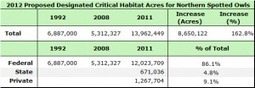
On March 8, the United States Fish and Wildlife Service (USFWS) posted its proposed revisions to the designated critical habitat for the northern spotted owl. In this latest revision, USFWS proposes to increase the area designated as “critical habitat’ in three states—Washington, Oregon and California. Under the proposed rule, the number of acres will increase by a whopping 163 percent, from 5,312,327 acres to 13,962,449 acres.
The magnitude of the increase is not the only surprise in this proposed revision, however. This proposal includes privately owned land for the first time.
Barry Bryant, managing director at Dahab Associates and consultant to the retirement fund, confirmed that the pension fund committed $5 million to Hancock Timber Resource Group in February.
Jeremy Wolfson, Chief Investment Officer who currently manages the $8 billion dollar Los Angeles Water and Power Employees' Retirement Plan, speaks about how he has been able to grow the fund's alternatives allocation...
The fund's current long-term asset allocation: 51% in public equity (US, international, and emerging markets), and 33% in fixed-income. Alternatives consist of private equity at 1.5% of the portfolio with a 5% target, real estate at 2.4% with a 5% target, and real returns at a 6% total -- its purpose being to help hedge inflation. The fund is also pursuing commodities with the board's recent approval of timber, Wolfson says.
To get content containing either thought or leadership enter:
To get content containing both thought and leadership enter:
To get content containing the expression thought leadership enter:
You can enter several keywords and you can refine them whenever you want. Our suggestion engine uses more signals but entering a few keywords here will rapidly give you great content to curate.


 Your new post is loading...