Your new post is loading...

|
Scooped by
Prentiss & Carlisle
June 8, 2012 9:21 AM
|
Four years ago, as the economy was entering a devastating recession, swaths of rural Pennsylvania were booming. ... In the spring of 2008, a gas company offered Josh Fox’s family almost $100,000 to drill on its Wayne County property, inspiring Fox, a filmmaker, to make the anti-fracking documentary Gasland. The Oscar-nominated film, which shows water from a faucet catching fire, was shown on HBO and helped foment broader opposition to fracking. ... While many residents blame Fox for their troubles, he says they were naive to think drilling would ever be allowed in such an environmentally critical area. He faults the gas companies for dangling money in front of farmers without warning them of the potential problems. “It was all sweetness and light,” he says. “‘You’ll make so much money.’ That’s exploitation, not prosperity. This was a bubble.”
|
|
Scooped by
Prentiss & Carlisle
June 8, 2012 9:06 AM
|
A construction rebound is coming, but it will be a soft rebound, leading to a mild recovery in wood products demand. Although somewhat better times are coming, businesses need to be prepared for the challenges that improved sales bring—it’s not all beer and skittles.
The rebound has to come because our recent level of construction has been unsustainably low. Our population is growing, albeit not as fast as when we attracted lots of foreign immigrants. The increased population triggers a demand for homes, stores, offices and other places to work.
|
|
Scooped by
Prentiss & Carlisle
June 8, 2012 9:00 AM
|
Timber harvesting in Scotland reaches its highest level on record, according to Forestry Commission Scotland. ...
|
|
Scooped by
Prentiss & Carlisle
June 8, 2012 8:56 AM
|
For what seems to be generations now, we have been talking about bioenergy. The threats; the opportunities; the subsidies; the oversupply; the undersupply; the pending legislation; the grandfat... ... For pellet entrepreneurs and timberland owners who wish this market would develop quickly, I am sorry to say that this wish will not be granted. Why? Simply said, there are still too many risks that cannot be measured. If risk cannot be measured, it cannot be quantified. If it cannot be quantified, it cannot be priced. If it cannot be priced, projects will not be financed, leaving a market of all equity players and a much smaller pool of participants.
|
|
Scooped by
Prentiss & Carlisle
June 6, 2012 9:06 AM
|
|
|
Scooped by
Prentiss & Carlisle
June 6, 2012 8:43 AM
|
It would be fair to say the existing managers have been disappointing – net asset value has fallen by a third since the fund was launched five years ago. To some extent, they have been accident-prone but it looks as though there might be a problem with the business model as well.
|
|
Scooped by
Prentiss & Carlisle
June 4, 2012 10:12 AM
|
China has agreed to re-open its market to imports of Virginia logs, reversing a yearlong trade barrier. Bans by the Chinese government on poultry and logs from Virginia have proven to be ongoing challenges for the state’s agriculture, forestry and shipping sectors.
|
|
Scooped by
Prentiss & Carlisle
June 4, 2012 10:04 AM
|
New Mexico State Investment Council, Santa Fe, will consider approving investment policies for the infrastructure, timberland and farmland suballocations in its 10% long-term real asset portfolio, said Charles Wollmann, spokesman for the $15 billion investment council.
The exact suballocations are still in the discussion stages, but infrastructure and timberland could each be allocated 30% of the real asset portfolio, Mr. Wollmann said.
|
|
Scooped by
Prentiss & Carlisle
June 1, 2012 9:49 AM
|
Western wood chip prices are declining rapidly in response to an oversupply of fiber.
The big story is the current disparity in wood chip prices between the US South and the Pacific Northwest (see Figure). In April 2012, the total delivered fiber cost for Pacific Northwest wood chips was nearly 50 percent higher than delivered fiber cost in the US South, when compared on a bone dry ton basis. Prices in the two regions came as close as 10 percent in early 2010, when a lengthy period of wet weather in the South tightened chip accessibility while Northwest mills had abundant supply. This relative parity was short-lived though, as Northwest prices rose sharply during late 2010 and prices in the South moderated with improved conditions.
|
|
Scooped by
Prentiss & Carlisle
May 31, 2012 5:29 PM
|
Regions Timberland Group operates as a business unit partner of Regions Financial Corporation. Based in Atlanta, Georgia, the group was created in 1981 and was a pioneer in timberland investing when it started one of the first commingled timberland funds for institutional investors.
Today, we manage separate accounts and commingled funds with more than $2.2 billion in timberland assets. Clients include corporate and public pension funds, endowments and foundations, and high net-worth individuals.
[Editor's note: our "Featured TIMO" series does not imply an endorsement of the subject organization. It is presented only to help educate readers about this corner of the Timberland Investment space.]
|
|
Scooped by
Prentiss & Carlisle
May 31, 2012 5:03 PM
|
Ohio Police & Fire Pension Fund, Columbus, plans to make an additional $175 million in commitments to timber in the coming months...
The $11.8 billion pension fund created a 3% target allocation to timber in March 2010. The fund in January hired its first timberland managers — Forest Investment Associates and Hancock Timber Resource Group — to run $100 million each.
|
|
Scooped by
Prentiss & Carlisle
May 31, 2012 8:41 AM
|
[Editor: Interesting tidbit from DB's report on its recent investor Timber & Forest Products Tour] ... Capital flows into timberland appear to be rebounding. At the same time, valuations on timberland in the private market appear very strong as the discount rates used in pricing private deals appear to be approaching trough levels. This topic is apt to get more attention in the coming weeks. Based on numerous discussions with well-informed trade sources, DB believes a very large private timber transaction (the largest in 5-6yrs) could be pending. We suspect a large & well-priced deal could create a short-term flurry for publicly-traded timber REIT's. Every public timberland executive acknowledged a disparity between public & private market timber values. If the public/private valuation disparity persists and private-mkt capital flows strengthen, more timber assets could migrate from public to private hands.
|
|
Scooped by
Prentiss & Carlisle
May 30, 2012 11:29 AM
|
A Singapore-born teenager who recently moved to Canada won a national science award Tuesday for her groundbreaking work on the anti-aging properties of tree pulp, officials said.
Janelle Tam, 16, won the $5,000 award in the 2012 Sanofi BioGENEius Challenge Canada for showing that cellulose, the woody material found in trees that enables them to stand, also acts as a potent anti-oxidant.
Tam's work involved tiny particles in the tree pulp known as nano-crystalline cellulose (NCC), which is flexible, durable, and also stronger than steel.
A pulp and paper mill that opened in January in Quebec now serves as the world's first large-scale NCC production plant.
|
|
|
Scooped by
Prentiss & Carlisle
June 8, 2012 9:12 AM
|
...it pays to take a close look at the components of cash flow from operations, to make sure that the cash flows are of high quality. What does that mean? To me, it means they need to be real and replicable in the upcoming quarters, rather than being offset by continual cash outflows that don't appear on the income statement (such as major capital expenditures). ... When I say "questionable cash flow sources," I mean items such as changes in taxes payable, tax benefits from stock options, and asset sales, among others. That's not to say that companies booking these as sources of cash flow are weak, or are engaging in any sort of wrongdoing, or that everything that comes up questionable in my graph is automatically bad news.
With 44.5% of operating cash flow coming from questionable sources, Deltic Timber investors should take a closer look at the underlying numbers. Within the questionable cash flow figure plotted in the TTM period above, other operating activities (which can include deferred income taxes, pension charges, and other one-off items) provided the biggest boost, at 31.9% of cash flow from operations. Overall, the biggest drag on FCF came from capital expenditures, which consumed 72.3% of cash from operations.
|
|
Scooped by
Prentiss & Carlisle
June 8, 2012 9:03 AM
|
I don't mean that Weyerhaeuser will be the last timber REIT ever! It's just the last one I've written about. It was also the last one formed. I've never been a large fan of Weyerhaeuser (WY). It's the only timber REIT I don't own. Although WY has long been a leading timber company, beginning in about 1900, its actions over the last 10 to 15 years have not made me an admirer. ... Weyerhaeuser is trading at a P/E of about 48.3. In my opinion, earnings need to improve quite a bit to justify this valuation. However, its timber assets are well worth the current price. For the time being, I'm going to remain on the sidelines as far as adding WY to my portfolio. I'd like to see better earnings, cash flow, and a higher dividend, but see no way for this to happen until home construction rebounds considerably.
|
|
Scooped by
Prentiss & Carlisle
June 8, 2012 8:59 AM
|
Could opening up to foreign investment improve Burma’s forest protection – or will it fuel the same industries that have contributed to the country’s rampant deforestation?
|
|
Scooped by
Prentiss & Carlisle
June 6, 2012 9:20 AM
|
What do the vineyards and wineries in California have in common with over half of the country’s forestland? They are owned by family businesses, and there will be a huge ownership or generational transition—probably in the next 10 years.
For the most part, though, millions of dollars in capital in these businesses is tied up in the land itself. This illiquid asset does not generate a big income or cash flow, so it doesn’t allow a family to carry out the generational transfer techniques most businesses use. ...
“Certainly there are financial and tax aspects to the timberland planning process,” Watson says. “But it’s really about the timber and the resource, and who in the family has the knowledge to manage it. And it’s about the family history and the attachment to it, and it’s about the family dynamic for that particular family.
“You’re really passing on more than a financial asset,” he says, “and you really need to do the proper planning for it.”�
|
|
Scooped by
Prentiss & Carlisle
June 6, 2012 8:54 AM
|
The dreams of wood pellets plants in the U.S. shipping millions of tons of biomass to Europe's power plants may be on life support now. Although the EU will not abandon its renewable energy goals, government support for subsidies of biomass is slipping. Without these subsidies, the biomass industry has little reason to undertake the intensive capital investments to use biomass as a fuel source. In return, ports and shippers in the US and Europe will need to take a serious look at what kind of volumes to expect for biomass in the next 5 - 10 years.
|
|
Scooped by
Prentiss & Carlisle
June 4, 2012 10:15 AM
|
Three environmental groups filed a lawsuit Thursday, alleging state timber harvests violate federal law by killing and harassing marbled murrelets, a bird protected by the Endangered Species Act.
The lawsuit comes as Oregon land managers are implementing a plan to increase logging on the 93,000-acre Elliott State Forest between Reedsport and Coos Bay.
|
|
Scooped by
Prentiss & Carlisle
June 4, 2012 10:08 AM
|
As the country is well-blessed with an abundance of rainforest and land, the steady supply of trees and logs highlight the importance of this resource-based sector, ranking it among the likes of agriculture, oil and gas, mining and manufacturing.
Presently, Malaysia is among the world’s largest exporter of tropical logs, plywood, sawn-timber and furniture to international markets. Specialists concur that this industry will not likely become redundant anytime soon.
|
|
Scooped by
Prentiss & Carlisle
June 4, 2012 10:01 AM
|
Pope Resources (NASDAQ: POPE) announced today a quarterly distribution of $0.45 per unit, effective for unitholders of record on June 15, 2012 and payable on June 29, 2012. This represents a $0.10, or 29%, increase from the prior quarterly distribution of $0.35 per unit. "We are pleased to announce this increase in our distribution payout, which recognizes confidence in our cash flow generating capabilities and the continued improvement in all of our markets," said David L. Nunes, President and CEO.
|
|
Scooped by
Prentiss & Carlisle
June 1, 2012 9:40 AM
|
Unsuspecting woodland owners selling timber often fall victim to a practice known as "high-grading"—cutting the best trees and leaving the rest.
"It’s like a rancher selling a prize-winning bull and keeping the losers for breeding," said Hank Stelzer, University of Missouri Extension state forestry specialist. "You’re cashing in your best assets and investing in your worst." ... High-grading sometimes happens under different names. The practice of "diameter-limit cutting" removes trees above a certain diameter. If that limit is too low, you’ll end up sparing many slow-growing trees while prematurely harvesting fast-growing, top-quality trees. "Selective cutting" is a term used by foresters to describe a sustainably sound method of harvesting trees. "Unfortunately, many loggers and landowners alike confuse high-grading with selective cutting," Stelzer said.
|
|
Scooped by
Prentiss & Carlisle
June 1, 2012 9:22 AM
|
Cambian Global Timberland has completed the sale of 13,810 acres of land in Florida.
Estimated proceeds net of transaction costs and a loan prepayment fee will be $15.4m, representing 97% of the 31 October third-party appraisal.
|
|
Scooped by
Prentiss & Carlisle
May 31, 2012 9:55 AM
|
Two forces are pulling America's timber industry in opposite directions. One is the nascent recovery in the U.S. housing market. The other is a drop in Chinese demand. ... U.S. exports of timber and saw-mill products to China came to $1.8 billion last year, from $1.1 billion in 2010 and $511 million in 2009, according to the Commerce Department. But this year, that demand is getting kicked away. In the first quarter, these wood exports fell 16%. ... Considering what's happening in China, it is understandable that investors haven't been all that enthusiastic about timber producers, despite the uptick in housing. Shares of timber real-estate investment trusts like Plum Creek and Potlatch have seen the gains they made early in the year whittled away. ... But the housing market, if it continues to improve, could fill any hole, and then some, that China leaves. So far this year, housing starts have been running at an annual pace of about 714,000 versus 609,000 last year. Back of the envelope, that would be enough to make up for a halving in Chinese demand.
|
|
Scooped by
Prentiss & Carlisle
May 31, 2012 8:26 AM
|
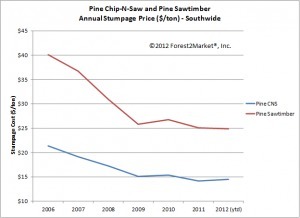
As Figure 1 reveals, sawlog prices (both Pine CNS and Pine Sawtimber) appear to have found a new bottom and stayed there. ... We do not expect a drastic increase in 2012, though the first few months of this year provide reason for optimism. Stumpage prices in March and April of 2012 increased from earlier in the year, a pattern that we did not see in the same period of 2011. These higher prices are due in part to higher demand for lumber, as housing starts have increased this year. ... Based on these numbers, we expect to see a gradual recovery in sawtimber prices. There is one rather large caveat, however. Because timberland owners held their timber off the market since the recession started, the overgrowth of sawtimber may lead to a flood of supply on the market as soon as we see any increases in price. If this happens, the price recovery will be muted.
|