Your new post is loading...

|
Scooped by
Prentiss & Carlisle
August 30, 2012 6:36 PM
|
Based on our analysis of probable mid-cycle EBITDA ($330-340MM) and a 6.5X multiple, we believe that $14 represents reasonable “fair value”. LPX is NA’s largest producer of OSB with ~20% mkt share. It’s possible to make an argument for a higher valuation based on more disciplined behavior by OSB producers. However, given the disappointing financial record of the OSB industry (including LPX) over time, we believe that investors should take such arguments with a grain of salt. At current levels, we think LPX stock is fairly valued. Downgrade from Buy to Hold.
|
|
Scooped by
Prentiss & Carlisle
August 30, 2012 6:32 PM
|
Those who have despaired of ever seeing the timber industry and environmental groups find common ground in the forest have reason to celebrate. Not only have the two sides agreed on a major timber sale, but they've done it with the cooperation of the Bureau of Land Management — not the Forest Service.
Witness the Vine Maple timber sale in the BLM's Butte Falls Resource Area. The sale will auction 6.75 million board feet of timber Sept. 13.
The sale is part of the Friese Camp ecological forestry project, which covers more than 2,000 acres and eventually could produce 20 million board feet of timber.
Not only that, but much of that timber is of a size that fits the capacity of local mills, which are no longer equipped to handle really big logs. The largest old-growth trees will be left alone, which pleases the environmentalists, but the trees that will be cut are ideal for local mills, which pleases the industry and supports local jobs.
|
|
Scooped by
Prentiss & Carlisle
August 27, 2012 10:52 PM
|
Money doesn't grow on trees, but a recovery in America's depressed housing market could produce lots of it for timber giant Weyerhaeuser .
Suddenly, signs of a nascent pickup in housing are everywhere, from rising building permits and housing starts to improved sentiment among builders. Add higher lumber prices to the list, along with a powerful liftoff in the shares of home builders such as Toll Brothers (ticker: TOL) and PulteGroup (PHM).
Weyerhaeuser's stock (WY) has been no slouch, either. It shot up 50% in the past year, to a 52-week high of $24.62, and the rally could be in the early innings. The shares, which topped $85 in 2007, look rich at 29 times next year's expected earnings of 85 cents a share, but the P/E ratio is misleading, as it is based on trough earnings.
|
|
Scooped by
Prentiss & Carlisle
August 27, 2012 10:27 PM
|
Fire crews continue to fight wildfires in central Washington, south and central Oregon and southern Idaho. Some residents of Cle Elum and Ellensburg, Washington are just trying to get back home. Others don’t have a home to come back to. Forestry experts say these types of large wildfires could become more common across the West in the coming years.
|
|
Scooped by
Prentiss & Carlisle
August 23, 2012 1:27 PM
|
Unionists have protested as forward timber rotations in the south-east of South Australia are sold to a consortium led by The Campbell Group.
|
|
Scooped by
Prentiss & Carlisle
August 21, 2012 9:08 AM
|
Last August, we predicted that the US South was on a new trend line for wood fuel prices. Now, one year later, data from the first half of 2012 appears to be further substantiating our claim.
US South wood fuel prices have been on a decline since peaking in 3Q2010 (Figure 1). After accounting for the BCAP effect* in 2H2009-1H2010 and inflation, wood fuel prices have been steadily declining since 1Q2009 with few exceptions. One of these exceptions occurred in 2Q2012. Real wood fuel prices, after declining in 1Q2012, gained $0.12 per ton in 2Q2012 are now back on par with 4Q2011. Nominally, price increased $0.05 per ton to average $19.62 per ton.
|
|
Scooped by
Prentiss & Carlisle
August 20, 2012 7:08 PM
|
Massachusetts is expected to disqualify many wood-fired power plants from certain green-energy programs, starting Friday, because of concerns about their emissions.
Many U.S. biomass facilities, which burn wood and other plant matter to generate electricity, have received grants and other state and federal benefits aimed at encouraging alternative energy sources. The new rules seek to ensure that biomass plants produce less net greenhouse gas than plants that burn fossil fuels.
Biomass, like solar, hydroelectric and wind power, has long been considered by many government agencies to be renewable, based on the fact that wood can be regrown. But there has been debate over some biomass plants because of their emission of smoke and other pollutants. ... The state plans to exclude plants with efficiency rates of less than 50%—that is, plants that turn less than half of the energy created from burning into electricity—from the renewable-energy certificate program. Many biomass plants now turn only about 25% of the energy released by burning into electricity. The wood used in these plants comes from logging and mill waste, and also, in some cases, from whole trees. ... As many as 20 plants in New England and New York state that can sell power in Massachusetts could be affected by the new rules, which will require them to boost their efficiency if they want to claim state renewable-energy credits, says Bob Cleaves, president of the Biomass Power Association, a trade group. Mr. Cleaves says none of the currently operating biomass plants in New England would qualify as renewable under the new rules, and some might have to close.
|
|
Scooped by
Prentiss & Carlisle
August 15, 2012 11:07 AM
|
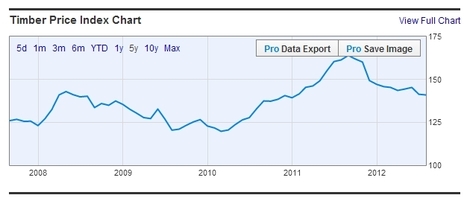
Timber Price Index historical data, charts, stats and more. Timber Price Index is at a current level of 140.94, down from 141.34 last month and down from 161.34 one year ago.
|
|
Scooped by
Prentiss & Carlisle
August 13, 2012 10:18 AM
|
The state pension fund of Massachusetts, with nearly $50 billion in assets, posted just about flat performance for the year ended June 30, as losses on stocks and natural resources offset gains on bonds and other investments.
The Pension Reserves Investment Trust, which invests on behalf of state workers and teachers, lost 0.08 percent for the year, according to a report released on Friday. That was far below the 8.25 percent rate the fund set as its targeted return. ... The Massachusetts fund's global equities portfolio, with 43 percent of assets, lost 5.88 percent for the year, and a 4 percent allocation to timber and other natural resources dropped 7.95 percent.
By contrast, core fixed income gained 8.10 percent and value-added fixed income gained 3.71 percent. But together, the two categories made up less than one-quarter of the fund's assets.
|
|
Scooped by
Prentiss & Carlisle
August 13, 2012 10:23 AM
|
The timber industry in the vast forests of Russia's Kirov region, far from prying eyes in Moscow, has long been easy prey for unscrupulous businessmen.
Locals say it is so murky that the country's most charismatic opposition leader Alexei Navalny will have a hard time fending off charges levied last week of stealing wood from a state company while advising the governor there in 2009.
Navalny says politics lie behind the case, which may also tarnish the governor, Nikita Belykh, a liberal whose appointment by then-President Dmitry Medvedev may grate with the more conservative previous and current Kremlin leader Vladimir Putin. ... Outside Kirov, a city of 500,000 named after a Bolshevik revolutionary whose assassination in 1934 was used by Soviet dictator Josef Stalin as a pretext to purge his opponents, the river winds into forests that stretch as far as the eye can see.
The region, which is bigger than Hungary, covers 120,000 square km and almost two thirds is state-owned forests.
"We have so much woodland that it's simply impossible to closely control it all. Somebody just starts chopping timber somewhere, takes it and that's it," said Vladimir Zhuravlyov, a member of the local parliament who works closely with Putin's ruling United Russia party.
"The forest in Kirov is like oil in the rest of Russia. It's stable and easy money, you just come in and take it. It's also quick money, you can make fortunes on it in no time at all."
|
|
Scooped by
Prentiss & Carlisle
August 13, 2012 9:49 AM
|
The West Coast's beleaguered timber industry is making a comeback, boosting the economies of rural towns that remain otherwise hard hit by the economic downturn. ... The revival comes as California timber harvests and revenue rise for the third straight year, according to state data and timber companies. Timber harvests are up by 20% or more—and revenue is growing by a substantially higher margin—since a post-housing-bust slump sent harvests to a record low in 2009. ... The recovery is due in part to steady demand from overseas. From 2008 to 2011, RISI data show, overseas wood shipments more than doubled. Industry analysts say it's unclear how long that demand will continue. ... "Compared to two years ago, things are a little better," says Ken Cooper, manager of the Chinese Camp mill. Still, he says the industry remains a shadow of what it was 30 years ago, with the 2011 harvest less than one-third of the state's 1988 peak.
|
|
Scooped by
Prentiss & Carlisle
August 10, 2012 9:21 AM
|
The Australian sawn timber industry is experiencing a temporary threat from imports as a result of a strong dollar and a global surplus of timber following the Global Financial Crisis, according to leading independent economic forecaster and industry analyst, BIS Shrapnel. In the two years to 2011, imports have increased by 30 per cent.
However, imports are not a significant long term threat, as they are still well below the historical levels of 20 years ago. According to BIS Shrapnel’s Sawn Timber in Australia, 2012 to 2026 report, in the last two decades there has been a significant reduction in sawn timber imports, as domestic production capacity has expanded. At the same time, exports have grown rapidly in the past five years.
The report projects that the demand for sawn timber in Australia during the next decade will be driven by sharp growth in the building and construction sector. Due to the current undersupply of residential dwellings in Australia, BIS Shrapnel forecasts the residential construction sector, which uses more than 70 per cent of the sawn timber produced locally, will grow particularly strongly during 2014 and 2015.
|
|
Scooped by
Prentiss & Carlisle
August 10, 2012 9:12 AM
|
It is estimated that institutional investors now own more than 25 million acres of U.S. forests, worth more than US$30 billion. Investors are allocating part of their portfolios to forestland as they seek diversification, inflation protection, and potentially higher rates of return than the bond or equity markets.
The evolving nature of this unique asset class, and its potential for protecting both income and conservation values, is the subject of our annual “Who Will Own the Forest?” conference series. Speakers discuss and debate issues pertaining to the economy, forestland valuations, investing overseas, regulatory, tax and lending drivers, and emerging values such as carbon, biomass, and environmental credits. This 2½ day conference offers both networking and educational benefits, including continuing education credits for certified foresters, appraisers, attorneys, and CPAs.
|
|
|
Scooped by
Prentiss & Carlisle
August 30, 2012 6:34 PM
|
|
|
Scooped by
Prentiss & Carlisle
August 30, 2012 6:28 PM
|
Stocks had yet another low volume session and ended up going nowhere for the most part of the day. ... Hurricane Isaac remained the focus of much of the commodity world, as the storm made landfall on the Louisiana coast. Energy trading was mixed as WTI crude fell by about 1.3%, while natural gas added 2.1% on the day. ... One ETF that saw a great deal of volume in today's session was the PowerShares Dynamic Oil & Gas Services Fund ( PXJ ) . This product usually does about 30,000 shares in volume a day but saw a spike to just over 780,000 shares, a nearly 20x increase. ... Another ETF that saw an unusual amount of volume today was the Guggenheim Timber Fund ( CUT ) . This product usually does about 40,000 shares in a normal day but saw roughly 3x this level today.
A large reason for this outsized trading could also be the hurricane and its impact on timberlands in the path of the storm as well as housing demand after the damage is realized. Probably, the storm isn't as bad as everyone feared, at least from this angle, sending shares of CUT down about 0.8% on the day.
|
|
Scooped by
Prentiss & Carlisle
August 27, 2012 10:39 PM
|
West Fraser Timber Co. (WFT.TO) and Western Forest Products Inc. (WEF.TO) are leading Canadian lumber producers to the biggest combined profit since 2006 as mills run at five-year highs to feed a U.S. housing rebound and near-record Chinese demand, Bloomberg reported.
It said lumber mills in British Columbia, Canada's leading forestry region, ran at 86%t of production capacity in the five months through May, compared with 82% for all of 2011, according to the Western Wood Products Association. Lumber futures rose to a 15-month high on Aug. 15 on the Chicago Mercantile Exchange.
The industry is recovering from losses and mill closures during the four-year U.S. housing bust amid resurgent new-home sales and building activity south of the border. Some producers are also capitalizing on orders from China for imported Canadian lumber even as the Asian country's economy slows.
|
|
Scooped by
Prentiss & Carlisle
August 23, 2012 1:32 PM
|
Protestors stormed Labor's city headquarters yesterday after news the rights to harvest timber in the South East will be sold to The Campbell Group.
The workers for timber firm Carter Holt Harvey initially gathered at the Crowne Plaza Hotel in Hindmarsh Square at 12.15pm, where Premier Jay Weatherill was due to address a luncheon. ... It has been reported The Campbell Group put forward the highest bid, of about $620 million. The group, which was founded in 1981 and manages more than 1.2 million hectares or about $5.2 billion of timber assets, represents a number of investors, including Australia's Future Fund. ... Ultimately, the conditions of sale will form part of a binding legal contract with the successful bidder, which will include regular reporting, compliance monitoring and sanctions for not meeting those conditions. Ownership of the land, water and carbon rights will remain with the Government.
|
|
Scooped by
Prentiss & Carlisle
August 21, 2012 9:12 AM
|
Timber REIT Weyerhaeuser's (NYS: WY) stock is booming, hitting a 52-week high despite slow growth from a rebounding housing market. While long-term shareholders of this century-old company have reaped bountiful profits from the trend, will Weyerhaeuser keep giving investors more of what they want -- or is it headed for a downturn? ... Overall, investors may want to take a cautious approach to investing in Weyerhaeuser. The company should perform well with a rebounding housing market and growing demand for wood products, but cautious investors could probably find stronger offerings. Timber rival Rayonier sports exceptional financial stats and a dividend that considerably beats Weyerhaeuser's, appealing to value and income investors alike.
|
|
Scooped by
Prentiss & Carlisle
August 20, 2012 7:15 PM
|
The Northwest was largely built on the timber industry's fortunes, but for years the logging and saw mill business has been in decline. Tightened environmental regulations first wreaked havoc on the industry, and then along came the demand-killing recession. According to the Wall Street Journal, though, a West Coast timber "revival" is under way. ... Carol Johnson, executive director of the North Olympic Timber Action Committee, an advocacy group for the timber industry on the Olympic Peninsula, says she's noticed a telling sign of increased timber sales at the Port Angeles port. "More logging ships have arrived in our port in the last two years than we've had in the last 10 years." The ships, she says, are taking logs to Asia. ... ... the Chinese economy got so heated that, in the last year, the government decided to slow things down, for fear of having its bubble burst, American-style. That's meant that timber exports to China, which peaked in 2010 and 2011, have slowed somewhat. ... Here, the timber business has been quietly chugging on, diminished but not vanquished, sometimes doing better and sometimes doing worse. It's had a few good years of late, but not of the old baron-making variety. "The industry is still pretty edgy," says Bryon Monohon, mayor of the once mighty logging town Forks. "We have some mills operating, but nobody's getting rich on them."
|
|
Scooped by
Prentiss & Carlisle
August 15, 2012 12:55 PM
|
The American Forest Resource Council (AFRC) and a broad group of national and regional interests filed suit today in Washington, D.C. to overturn the new Forest Service Planning Rule adopted last April. According to the Complaint, the new Rule violates the statutory requirements Congress has given the agency to prepare forest plans to provide for multiple uses of outdoor recreation, range, timber, watershed, and wildlife and fish. The Rule instead elevates the vague concepts of “ecological sustainability” and “ecosystem services” such as carbon storage and spiritual values above all else which will lead to years of lawsuits over new forest plans and forest management projects.
|
|
Scooped by
Prentiss & Carlisle
August 15, 2012 10:36 AM
|
Herbicide has become a crucial tool for the state's $13 billion timber industry. But in spite of precautions, lab results suggest that harmful chemicals are finding their way into residents' bloodstreams.
|
|
Scooped by
Prentiss & Carlisle
August 13, 2012 10:26 AM
|
State forestry officials say Georgia’s ongoing drought is hurting Georgia’s timber industry by putting pine trees at risk.
Rangers with the Georgia Forestry Commission tell WALB-TV that the drought is making pine trees more susceptible to disease and insects.
Pine beetles feed on trees that are left in bad shape as result of dry weather. The insects can penetrate the bark and kill the tree.
Officials say Timber in Georgia is valued at more than $500 million a year.
|
|
Scooped by
Prentiss & Carlisle
August 13, 2012 9:53 AM
|
Malaysian companies exporting timber to the United Kingdom and European Union (EU) countries must produce documentation tracking shipments through their supply chain back to source from March 3 next year, or be subject to legal sanctions for non-compliance.
In a statement today, the Malaysia External Trade Development Corp (Matrade) said the new law prohibits the placing of illegal timber and products derived from such timber on the EU market with operators needing to exercise "due diligence" when selling timber products there.
"For Malaysian exporters, these measures may include additional information requests on the products' details, origin, and legality and so on and certification requests for systems that allow for some legality verification, such as the Forest Stewardship Council and the Programme for the Endorsement of Forest Certification or equivalent verification scheme as certified timber products represent lower risk for EU operators and buyers.
|
|
Scooped by
Prentiss & Carlisle
August 10, 2012 10:56 AM
|
Most private equity fund sponsors that are out raising money this year know it's an investor's market and are cutting fees to attract capital. ... Limited partners are receiving a greater share of the fees that portfolio companies pay to general partners, and they're demanding — often successfully — that GPs delay collecting any profit as portfolio companies are sold until investors are paid back their investments.
|
|
Scooped by
Prentiss & Carlisle
August 10, 2012 9:17 AM
|
State officials say logging companies harvested a record amount of timber on Idaho's endowment lands in the past year.
According to the Idaho Department of Lands, 330 million board feet of timber worth about $50 million was harvested during the fiscal year that ended June 30. The agency said Wednesday the harvest from state lands represented more than a third of the total timber cut in Idaho.
|