
Timberland Investment
144.0K views |
+0 today


Timber Industry | Deals & Transactions | Investment Rationale | Financial Performance | Investors | Asset Managers
Curated by
Prentiss & Carlisle
 Your new post is loading...
 Scoop.it! 
Domtar Corporation (NYSE: UFS) (TSX: UFS) today announced the culmination of a precedent-setting two-year partnership process that saw 55 landowners in the Texarkana area achieve Forest Stewardship Council™ (FSC®) group certification. With the Ashdown Mill's strong support, the Four States Timberland Owners Association (FSTOA) was successful in receiving FSC Forest Management Certification on 70,000 acres of forestland.
*** "We have raised the bar for private land certification in the south, and we look forward to seeing the model built in Ashdown being replicated and expanded on throughout our mill system," added Lewis Fix, Domtar's Vice-President of Pulp Sales and until recently, the company's Vice-President of Sustainable Business and Brand Management. "This is a perfect example of how our longstanding collaboration with the Rainforest Alliance continues to help us deliver on our promise of socially and environmentally responsible paper manufacturing." 
Scoop.it!

State officials are poised to complete two big land transactions in northern Wisconsin that will protect more than 8,600 acres of forest land. The deals in Burnett and Douglas counties will add more acreage to the state's inventory of public land, which is open for fishing, hunting and other recreational uses and sustainable forestry. The Douglas County land complements a blockbuster deal announced in March where the state is adding more than 67,000 acres to its inventory of protected land. The seven-member Natural Resources Board will review the projects Wednesday in Madison. Highlights of the two projects: In Burnett County, the Department of Natural Resources would swap land parcels with the county, with the state getting 6,362 acres - much of it environmentally important pine barrens habitat. In exchange, Burnett County would get 5,672 acres of industrial forest land and $660,750 in cash. In Douglas County, the DNR would purchase a conservation easement from FutureWood Corp. of Hayward - paying slightly more than $1 million for 2,267 acres that includes forest land and six lakes and ponds. FutureWood would continue to own the land, but the easement prohibits any subdividing for recreational and commercial purposes.
Scoop.it!

In the age of Google and the iPad, change in America's papermaking heartland is swift, turbulent and perhaps irreversible. In Wisconsin, mills that produce publishing-grade paper have been closing at an average of one a year since 2006. Each shutdown means a loss of 300 to 600 jobs, in turn draining hundreds of millions of dollars from the region and creating an economic drag that rivals the days of automaker shutdowns in Michigan. An industry that thrived for generations on a tight, homegrown loop - from the forest to the mill to the printer and often back to the mill for recycling - finds itself at the mercy of Wall Street hedge funds and equally unforgiving global economic and political forces. Investors see a bleak bottom line, a world in which paper is losing its value to laptops and tablets; they aim to squeeze out profit while they can. China, meanwhile, is pouring government money into new mega-mills and machines, betting it can win by flooding the world market with low-cost paper. Mill workers in Wisconsin, the nation's top papermaking state, have fought off the digital threat for years. The threat posed by China is just now becoming clear.
Scoop.it!
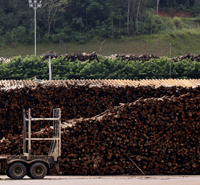
Pulp mills and sawmills in Brazil became more competitive in 2012 mostly thanks to a weakening Brazilian Real. Pine sawlog prices in Brazil, in US dollar terms, fell 22 percent in just one year, and prices in the 2Q/12 have been at a level below where they were just before the financial crisis that hit in 2008, according to the Wood Resource Quarterly (www.woodprices.com). *** The recent dramatic price reductions of pulpwood have had the result that the wood costs for Brazilian pulpmill now are among the lowest of all regions tracked by the WRQ, as compared to a year ago when wood fiber costs in Brazil were above the Global Wood Fiber Price Indices (SFPI and HFPI). Since wood fiber costs accounted for about 70 percent of the production costs for pulp mills in Brazil in the 2Q/12, the substantial reduction in pulpwood prices has made the country’s pulp mills more competitive in 2012 relative to other pulp producers around the world.
Scoop.it!

This is the first in a two-part series summarizing implications to timber REIT shareholders from expiry of the current tax provisions specific to dividend income.
Scoop.it!

Part I of Timber REITs and the “Dividend Tax” Cliff summarized, in words, the implications to shareholders of publicly-traded timberland-owning REITs if the current dividend tax rate expires on December 31, 2012. This post quantifies the implications and puts into context the impact of changing tax rates on timber REIT shareholders relative to shareholders of non-timber REITS or other dividend-paying stocks in the United States. The bottom line: timber REIT equities retain a tax-advantaged status in a post-tax cliff environment.
Scoop.it!

The Ontario Securities Commission is accusing Ernst and Young of failing in its audits of troubled Chinese forestry company Sino-Forest Corp., which has since collapsed amid allegations of being a massive fraud. The provincial regulator accused Ernst and Young on Monday of failing to conduct their audits of the company in accordance with industry standards. The OSC has also accused the accounting firm of failing to do enough to verify the existence of Sino-Forest's most significant assets and conduct their audits with a "sufficient level of professional skepticism." *** The OSC allegations came as Ernst and Young agreed to a settlement that will resolve the potential civil claims against the firm in connection with its audits of Sino-Forest without any admission of liability. "Upon approval, the settlement will reduce the uncertainty and future burden on our business, and allow us to focus on our people and our clients," Ernst and Young said in a statement. *** Sino-Forest, once the most valuable forestry company on the Toronto Stock Exchange, valued at more than $6 billion, has since filed for bankruptcy protection and is working to restructure itself under the Companies' Creditors Arrangement Act.
Scoop.it!

With Thanksgiving and hunting season behind us, loggers are beginning to look forward to the winter logging season in the Lake States. The window for timber production has continued to shorten with evolving public perception and increasing regulations, making winter a critical time for efficient logging production. Most of the Lake States have seen some snow, and ground conditions are beginning to firm up. After a brief warm-up into the 50’s around the beginning of December, the forecast through the start of the new year looks favorable for logging conditions. While weather is certainly an important factor for production, demand is an equally critical component. Most pulpwood inventories are healthy, and some mills are beginning to limit deliveries as we head into 2013. Since pulpwood deliveries are such an important part of the Lake States economy, the ability to move pulpwood affects overall wood production, particularly hardwood sawlogs.
Scoop.it!

On December 3, the U.S. Supreme Court will consider who is best suited to set national environmental policy – the experienced scientists and regulators at the Environmental Protection Agency or activist trial lawyers.
Northwest Environmental Defense Center (also known as Decker v. NEDC) the justices will review a 2011 Ninth Circuit Court of Appeals decision that overturned 35 years of EPA Clean Water Act regulation of the logging industry, the source of 2.5 million American jobs. The high court will decide between two theories of regulation: (1) the law tells states (as the EPA insists) to regulate runoff from logging roads via “Best Management Practices” (which are flexible, federally supervised standards tailored to local conditions, that activists cannot challenge in court); or (2) the law requires (as the Ninth Circuit says) “point source” permits usually reserved for factories, mines and chemical plants, and subject to court challenges. This arcane technical dispute has real-world consequences. Under the Ninth Circuit ruling, a permit could be demanded for every drain and ditch that directs water from a logging road to a fish-bearing stream. The U.S. Forest Service estimates that getting all its roads fully certified could take as much as a decade. The state of Washington has said that, on average, it will need one permit per mile for all 55,000 miles of its eligible roads, with, by some estimates, the cost of processing a single permit running $2,800. And, unlike BMPs, permits will be subject to activists’ lawsuits. Senator Ron Wyden (D-Oregon) has warned that upholding the Ninth Circuit decision will “bury private, state and tribal forest lands in a wave of litigation.” More like a tsunami.

Timothy Baginski's curator insight,
April 13, 2019 4:24 PM
It should not have to go to court on such an important topic. We need to prevent any type of runoff into the local watersheds and other places. It it only going to destroy the thriving ecosystems in that area. Its as if deforestation wasn't bad enough.
Scoop.it!

Three separate tracts total more than 18,000 acres for sale by auction December 4th 2012. One of the last remaining large blocked privately held timber/recreation/hunting properties in Oregon.Timber is predominantly, Ponderosa Pine, with some Doug Fir as well. Excellent year round roads, making it accessible throughout the entire year no matter the season.
*** The property also includes a well-built cabin, used by the owner and outfitter, with two separate sleeping areas, kitchen, living room, and porches front and back.
Scoop.it!

A federal judge has put 11 Oregon forest timber sales on hold while she considers a lawsuit contending they threaten the survival of the marbled murrelet, a protected seabird that nests in old-growth forests. The preliminary injunction issued last week is a blow to the new endangered species conservation policy adopted by the state to produce more timber from state lands. *** In issuing the order, U.S. District Judge Ann Aiken in Eugene wrote that conservation groups have shown they are likely to win the lawsuit on its merits, and leaving the sales open to logging could cause irreparable harm. At issue is whether the state's logging goals on the three forests violate the Endangered Species act by destroying habitat for the marbled murrelet, a threatened species. The bird lives at sea, but it flies up to 50 miles inland to lay its eggs on the large, mossy branches of mature and old-growth trees. *** The Oregon Department of Forestry estimated the withdrawal of the 10 sales on the Elliott would cost the Common School Fund $9.85 million in lost income next year. Unlike other state forests, the Elliott is controlled by the State Land Board, with logging proceeds going to the Common School Fund.
|
Scoop.it!

Provincial taxpayers are the new owners of more than 220,000 hectares of forest land worth more than $100 million, part of a deal that will fund the pensions of former Bowater Mersey Paper Co. employees and eventually see Emera own Brooklyn Power Corp. Premier Darrell Dexter announced the deal with Resolute Forest Products Inc. of Montreal and the Washington Post early Monday evening in a news release. *** It is not as simple as a straight purchase of the land, valued at $117.7 million. Resolute wanted a clean break from the Queens County paper mill, which it closed in June, and wanted to dispose of the assets in one sale. After close to six months of negotiations, the province has bought Bowater Mersey Paper Co. for $1, excluding the Oak Hill, Lunenburg County, sawmill. The company comes with assets and liabilities. The only money that changes hands other than the $1 is an $18-million debt repayment, which Bowater owed to Resolute. The liabilities also include $100 million to cover pension costs of union and non-union employees, plus another $18.4million in other employee costs and liabilities. *** Resolute had been the largest private landowner in the province, with the 220,000 hectares representing an area a bit bigger than Yarmouth County. The biggest portions of the land are in Annapolis County (89,200 hectares) and Queens County (63,100 hectares). A portion of the land will be protected. Under provincial accounting rules, the $117.7-million land value is added to the provincial debt. The land value works out to $535 a hectare, well below the $2,350 per hectare average for 10,100 hectares it bought in January as part of a deal to keep the mill running. *** The province expects to earn about $4 million annually in stumpage fees from the land within a couple of years, which would be enough to cover the increased debt-servicing costs. The province has also purchased Brooklyn Power Corp., a 24-megawatt biomass facility valued at $25 million. It plans to sell it to Emera Inc., the parent of Nova Scotia Power, for that price. That purchase will have to be reviewed by the provincial Utility and Review Board, Dexter said. The mill site itself is valued at $5 million. The province plans to turn that into a bioenergy and clean energy centre and will make an announcement with new tenants Wednesday.
Scoop.it!

Pension executives and other institutional investors are split between raising allocations to real assets or maintaining their allocations amid concerns about equity market volatility and inflation, a Pensions & Investments' survey shows. The survey of P&I's Research Advisory Panel showed 51% respondents plan to maintain their current target allocation to real assets in the next three to five years, while 46% plan to increase their targets. (The remaining 3% plan to decrease targets.) *** The attraction of real assets focuses on risk-protection characteristics. Among the respondents:
For real assets investors, performance has been in line with expectations. But 10% said real assets have performed above expectations, while 21% said they have performed below expectations. *** Bernard McNamara, executive director, global real assets, J.P. Morgan Investment Management Inc., New York, predicts allocations to real assets “could rise to as high as 25% or more of overall portfolios,” which should be diversified over a wide swath of the real assets spectrum. *** Mr. McNamara defines real assets as “large-scale, long-life, tangible, productive, capital-intensive investments like real estate or infrastructure ... whether it's regulated utilities like natural gas distribution or electricity distribution or water or waste water management, transportation assets ... ports, airports, toll roads, contracted power generation timber, farmland.” *** “The whole idea is to do better than bonds,” Mr. Forestner said. “Right now for core assets, it's high-single-digit type of numbers, something in the neighborhood of 8% is doable. That's pretty attractive. ... When people are looking at a bond universe that offers fairly paltry returns, looking at something (real assets) in that 6% to 8% range for core assets looks really good.
Scoop.it!

After a second consecutive year of only 1% growth in 2012, world paper and board demand is predicted to rise 3% in 2013. Accelerating economic growth will be a significant factor in this positive forecast, although we are showing only a modest acceleration. More important will be our assumption that consumer inventories will stabilize, or even rise, as underlying consumption improves. Also, we are expecting that the graphic paper share losses to electronic alternatives will relent to some degree next year. Therefore, growth in global paper and board demand will move closer to the increase in the general economy compared to 2011-2012. *** The growth engines for the world paper and board industry will continue to be tissue and packaging. World tissue consumption is forecast to increase 4.5% in 2013, or slightly above the annual pace of the previous three years, and will be 6 million tonnes above its 2007 level or 22% higher. Global containerboard demand is predicted to rise 4% in 2013, following 2.5% annual growth in 2011-2012, with the growth relative to 2007 being 23 million tonnes or an 18% gain. Other paper and board usage, led by boxboard and specialty papers, is also expected to advance 4% in 2013, compared to 2% annual increases in 2011-2012. Other paper and board demand will be 9 million tonnes above 2007 in 2013, translating into an 11% rise.
Scoop.it!

Representatives of Idaho's forest industry reacted positively to U.S. Forest Service Chief Tom Tidwell's announcement that timber harvest on federal land would increase by 20 percent over the next couple of years.
*** ***
Scoop.it!

Professor Mark Perry of the Carpe Diem blog summarizes the latest numbers from the major home price indices: There’s a pretty strong consensus among economists and analysts that U.S. home prices bottomed in 2011 and have been gradually rising in 2012 as the housing market entered a new period of recovery this year. The chart above summarizes eight key home price indicators, which are all showing strong, positive increases in home prices (or asking prices) through either September or October on a year-over-year basis.
Scoop.it!

Welcome to the pretzel logic of liberal environmental protection: In order to “save” owls, the Obama administration is going to shoot them dead. *** Over the Thanksgiving holiday, the White House released a big, fat policy turkey: its final critical habitat rule for the endangered northern spotted owl. The Obama plan will lock up 9.6 million acres of land (mostly, but not all, federal) in Oregon, Washington and northern California. This is nearly double the acreage set aside by the Bush administration. *** And despite two decades of massive government intervention and the near-destruction of the Northwest timber industry, the furry bird is vanishing faster than ever. According to the Smithsonian magazine, “(T)imber harvest on 24 million acres of federal land had dropped 90 percent from its heyday” by the year 2000. Yet, northern spotted owls are now “disappearing three times faster than biologists had feared.” *** One root cause: habitat loss (thanks in part to raging wildfires resulting from poor forest management and green opposition to thinning/controlled burns). The other major, nonhuman culprit: the barred owl. The U.S. Fish & Wildlife Service reports that the larger, more aggressive and more adaptable birds “are known to displace spotted owls, disrupt their nesting and compete with them for food.” Barred owls are more prolific breeders, less finicky about their food and less picky about where they live. They are brutal predators known to slam into spotted owls, slicing them with their talons and decapitating them in their nests. But instead of admitting failure and letting nature take its course, command-and-control bureaucrats have appointed themselves Mother Nature’s judges, juries and executioners. Their “main priority” is “reducing competition from barred owls.” How? By gunning them down. Final details are still in the works.
Scoop.it!

China’s growing appetite for rosewood dining sets, hardwood floors, plywood and printer paper is helping propel a booming trade in illegally harvested timber and spurring the destruction of fragile ecosystems across the globe, a British environmental organization said in a report released on Thursday.
Related The organization, the Environmental Investigation Agency, said the Chinese government has largely turned a blind eye as wood importers and furniture makers, some of them state-owned enterprises, have profited from a $4 billion industry that harvests wood illegally from Myanmar, Mozambique, Indonesia and other countries with weak law enforcement and widespread corruption. “Illegal logging and the trade in stolen timber are among the most destructive environmental crimes occurring today and directly threaten the world’s vital forests,” the report said. *** Last year China was the destination for roughly 30 percent of all the logs traded on the world market, making it the top importer of raw timber. The value of that wood was $9.3 billion, a nearly 30 percent increase over 2010, the report said. The group estimated that at least 10 percent of China’s timber imports were illegally harvested, an amount that would fill 200,000 shipping containers. It said state-owned enterprises were responsible for purchasing nearly half the tropical wood imported into the country. *** Beijing’s apparent tolerance for illicit timber imports stands in marked contrast to its domestic restrictions, which environmental groups say have effectively halted the clear-cutting of Chinese forests in recent years. The government has been credited with an ambitious $31 billion tree planting program that, over four years ending in 2008, increased forest cover to more than 20 percent of the country.
Scoop.it!

The improved housing market in the US the past four months has resulted in both higher lumber production in the US and in increased importation of lumber.
*** So far this year, housing starts have been at their highest levels since 2008, and market analysts expect the next 12 months to be bumpy but still upward-trending. The improved housing market has been good news for many sawmills in North America, reports the Wood Resource Quarterly. Lumber production has been higher throughout the continent, with an increase of 7.3 % in August year-over-year in the US, and of 6.3 % in Canada over the same time period. The US Northwest and the province of Quebec have been the regions with the biggest increases in production the past year. The sawmills in Quebec have really ramped up production, with output in August being 30 percent higher than in August last year. It is also interesting to note that for the first time in two years, sawmills in the Western US produced as much lumber as the mills in the US South in August. *** The improved US housing market has resulted not only in higher domestic lumber production, but also in an increase in the importation of lumber. Softwood lumber imports in the 3Q/12 were up nine percent from the previous quarter, which was the highest quarterly import volume since the 2Q/10. The higher lumber demand has pushed lumber prices substantially upward this fall. In November, Southern pine prices were 48 percent higher year-over-year, while Western hemlock prices were up 32 percent over the same period, according to Random Lengths. As reported in the Wood Resource Quarterly, sawlog prices have not yet gone up as a result of the improved lumber market. Pine log prices across the US South have been practically unchanged for almost two years, and sawlog prices in the US Northwest have been surprisingly flat for more than a year. However, in early November, there was increased upward pressure on sawlogs prices in the West from Chinese log buyers that were more active in the market than earlier in the year.
Scoop.it!

South Africa has seen miners’ strikes, the Marikana massacre, vineyards set ablaze in Western Cape farm strikes, and now timber industry experts warn that protests, strikes and violence could beset the sector where the stakes are high, and the working conditions are desperate. Warning bells are ringing for the forestry industry,with labour experts and forestry insiders saying that this could be the next local sector to suffer protests and strikes, if not violence and asset destruction, unless the worker issues are addressed. Forestry researcher and social assessment specialist Jeanette Clarke recently warned the timber industry that events at Marikana illustrated the potentially disastrous consequences of ignoring ongoing violations of workers’ basic needs and rights. *** Clarke warns that labour instability, coupled with poor worker conditions in the industry, could put timber assets at risk. “The big thing with forests is that they burn, and there are all these fires in the industry. But we have no figures so we don’t know what percentage of these are as a result of actual labour unrest or worker dissatisfaction, but you can be sure that a proportion of them are. It is difficult for forest workers to organise because they are very scattered,” she added.
Scoop.it!

The Pension Protection fund (PPF) has appointed seven farmland and timberland fund managers. Some managers will be funded immediately, while others are appointed for deferred investment. The selected managers are Brookfield Asset Management, Dasos Capital Oy, GMO Renewable Resources, Hancock Timber Resource Group, Macquarie, New Forests Pty, and Stafford Timberland. *** PPF executive director for financial risk Martin Clarke said: “We now have an investment portfolio worth more than £12bn and the size of our assets means that we can take advantage of a broader range of investment opportunities. “Investing in farm and timberland will complement our existing alternative investment portfolio, allow us to diversify our investments more widely and make our portfolio more resilient. “But we do need to be aware that there are some risks in these asset classes, for instance land price risk. Therefore, our approach will be to invest conservatively – which is consistent with our overall low-risk strategy.” The proportion of PPF assets allocated to farm and timberland will vary over time and depend on the opportunities available now and in the future, the fund said. All managers are appointed for four years, with the flexibility for two extensions of up to two years.
|






