


62 of the British population cannot speak any other languages apart from English according to a survey by the British Council, by contrast the…

 Your new post is loading...
 Scoop.it! 62 of the British population cannot speak any other languages apart from English according to a survey by the British Council, by contrast the… 
No comment yet.
Sign up to comment
Scoop.it!
Charles Tiayon's insight:
Different stakeholders in the education sector have welcomed the move by the Ministry of Education to rescind a recent policy directive that instruction be exclusively done in Kinyarwanda for the first three years of education. The latest change, that concerns lower primary classes (primary one to primary three), was announced on December 2, during a consultative meeting between the education ministry and legal representatives of private primary schools. Besides the legal representatives, the meeting was also attended by head teachers from the same schools. This new policy, which now instructs all public and private schools to use English as the language of instruction throughout primary school, will come into effect at the start of the 2020-2021 academic year. Instruction in Kinyarwanda in lower primary school came into force in 2015 as part of the competency-based curriculum, which required schools – public and private – to teach other languages as subjects. But the directive had faced resistance, especially in private schools and had hardly been implemented, despite being in place for four years. “We are very impressed by the adjustment, which is very positive to us, parents and children as well,” Charles Mutazihana, Principal of Kigali Parents School, told The New Times. He added: “It wouldn’t have been easy for us and children to abruptly switch from the medium of instruction we were familiar with.” Some parents say that the change will benefit more the learners by opening them to better opportunities in the future, saying that Kinyarwanda will always be taught as a subject and spoken at home. “The move came as an answer to our concerns as parents; we had been confused about what to do because our children were to be victims of the change,” said William Bundungu, a parent whose son is in lower primary. Alternative curriculum In response to the change, some private schools had proposed to parents to choose whether their children could continue with the national curriculum or go for Cambridge programme in the 2020-2021 year of study. Cambridge Assessment International Education is the world’s largest provider of international education programmes and qualifications for 5 to 19-year-olds. Schools like Kigali Parents School had actually introduced the Cambridge programme that would run parallel with the national curriculum starting next academic year to offer parents an alternative to the exclusive instruction in Kinyarwanda. However, for parents like Jackline Mukamunana, who have a child at Kigali Parents School and had already enlisted her primary three daughter into the new programme, there was a risk of schools that are allowed to run the programme increasing fees due to overwhelming numbers. “Many parents, including me, had chosen Cambridge programme because we want our children to be competitive by knowing several languages at a young age,” Mukamunana told The New Times. She also noted that: “We appreciated the decision because, though the Cambridge programme would be better, it would in the future lead to increased school fees; a burden to parents.” Some teachers also express relief having previously feared possible loss of jobs. Théogène Nshimiyimana, a teacher in lower primary classes at Ecole Sainte Angeline les pigeons, said that: “As teachers, we were happy after learning of the changes, because some of us would have lost our jobs as a result of using Kinyarwanda as the medium of instruction.” He added: “This is so because some parents had decided to take their children to schools that offer international curriculum, which would have forced some of our schools to close shop or reduce on the number of teachers.”
Scoop.it!

Advancements in machine translation technology are helping consumers, gamers and small businesses Money talks, and soon it will be easier to understand. Language barriers can hinder international commerce, but that problem is increasingly being solved by machine-based translation programs, which are becoming sophisticated enough to enable people in different countries to communicate as if they spoke the same language. Lily Chen, a sales manager with electronic-forklift company Taixing Jichuan Hydraulic Machinery Co. Ltd. in China, said she’s used Alibaba Group Holding Ltd.’s BABA, +0.01% built-in translation tools to communicate with buyers in Europe and the U.S. In an interview with MarketWatch using the technology, she explained that her English was “not very good” when she began as a salesperson and the translation software first helped her conduct professional communications with a customer in Germany and, later, with other buyers. “I was a little nervous at first, but from the customer’s reply, the customer fully understood the meaning of the translation, which made me feel very confident,” Chen said. She deemed the software able to handle “the professional vocabulary of electric forklifts,” including fork width, loading capacity and after-sale service. Translation programs aren’t yet tracked specifically by economists, but they have the potential to boost international trade, which stood at $19.5 trillion last year according to World Trade Organization estimates. E-commerce’s international expansion One big opportunity exists in e-commerce, where the giants of online shopping are already beginning to incorporate translation technology into their businesses. Take eBay Inc. EBAY, +0.98%, the San Jose, Calif.-based online marketplace, which quickly learned that while the internet has made it easy to connect buyers and sellers, international expansion wouldn’t be particularly effective if shoppers weren’t able to understand product listings from abroad. The result is a system that enables shoppers to make search queries in their preferred language and receive translated product listings, while also taking into account the context of a customer’s request. Machine translation has to be smart enough to adjust its behavior based on whether someone is looking for a Galaxy Note 10 smartphone or a galaxy-print sweatshirt, for example, since the branded product doesn’t need to be rendered into a different language. “Anything that supports cross-border trade so that someone from outside the U.S. is capable of engaging in e-commerce is where the power of global trade lives,” said Sanjeev Katariya, an eBay vice president who focuses on artificial intelligence. EBay’s push for machine translation has helped the company increase Latin American exports by nearly 20%, according to researchers from the Massachusetts Institute of Technology, and illustrates the potential for increased commercial activity as translation technologies gain wider adoption in business. “By embedding translation tools, you’re fostering the most critical thing in trade: trust.”John Caplan of Alibaba The positive impact from translation ties into the “gravity” theory of trade, explains MIT professor Erik Brynjolfsson, in that trade between countries is usually dependent on how close they are geographically. “You can reduce transportation costs and make the world smaller by 20% or you can introduce translation and have the same effect,” he said in an interview. Machine translation vs human translation The stakes are high for retailers as e-commerce gets more global. In order to be accessible in the places where 90% of the world’s online spending happens, businesses must offer support on their sites for the 15 most economically beneficial languages, according to Donald DePalma, the chief research officer at Cambridge, Mass.-based CSA Research. Just four years ago, they would have only needed to feature 11 languages. To reach even more spenders -- 99% of the online marketplace -- today requires support for 56 languages. Yet many sites offer support for far fewer. CSA looked at some 2,800 of the most trafficked sites globally and found that only 63% were multilingual. Those featured support for 7.8 languages, on average, in addition to the main language. There’s a big gap between the average number of languages supported and the full scope of those that offer businesses some economic interest. “Machine translation provides some way for companies to get to more people,” DePalma said. This is particularly true in instances where companies may want to use human translation for the most critical parts of their sites but rely on computers to handle the rest. CSA’s research didn’t capture how many of the top sites incorporated machine translation rather than human translation in their customer-facing presence, and in general it can be difficult to determine how many companies are making use of the technology due to the various ways it gets incorporated into businesses. Small-business benefits While eBay is among the online retailers that have offered machine translation for several years, a budding opportunity exists in business-to-business e-commerce, a market that U.S. government estimates say could be six times as large as the consumer-facing e-commerce market. Here, the technology has the potential to enable business conversations that were once nearly impossible due to language barriers. While larger enterprises can afford to hire human translators if they wish to work with a foreign partner, smaller operations don’t always have that luxury. A cornerstone of Alibaba’s commercial platform is a real-time translation tool that lets small businesses communicate with suppliers overseas. Some 100,000 buyers exchange a total of 2 billion translated text messages every week on the Alibaba.com global-trade platform, and the company plans to introduce live video-chat translations later this year. The idea behind Alibaba’s offering is that small businesses hesitate to look globally for suppliers because of language barriers but may be open to international commerce if they could effectively communicate. Translation technology lets companies “operate like multinational companies but do so from wherever it is they do business,” said John Caplan, Alibaba’s head of North American B2B operations. “By embedding translation tools, you’re fostering the most critical thing in trade, which is trust, because if you can understand the person you’re doing business with and communicate clearly, you both can make informed decisions.” Virtual lingua franca for gamers For gamers, it’s easy enough to find people on the other side of the world willing to play at any given time, but communication problems have long kept players confined to what Microsoft MSFT, +0.02% Distinguished Engineer Arul Menezes calls “language zones.” His company’s Translator product is now embedded in the chat function of games from Machine Zone, a Palo Alto, Calif.-based developer. “If you were a Polish player, you could go online and there might be no other Polish players there,” Menezes said. “This basically globalized their product.” Microsoft is also building Translator into its core offerings, such that speakers can give a PowerPoint presentation at a conference and allow those in the room who speak other languages to follow along with written translations on their own devices. The technology opens up the content of a presentation to people who ordinarily wouldn’t have been able to understand it. Airbnb automatically translates communications between guests and hosts prior to arrival, so recent college graduate Julia Peña was surprised to get to her rental outside Los Angeles only to discover that her host didn’t speak any English. While Julia was there, however, the host made use of a “conversation” function on Google Translate GOOG, -0.10% GOOGL, -0.15% to ask Peña about her day and even offer to make her breakfast before a big job interview. “It was definitely more comfortable being able to talk to each other,” Peña said of Google’s conversation function, which lets both parties speak into their mobile devices in their own languages and hear translated versions of what the other said. ‘Huge demand’ While natural-language processing may never be able to capture the nuance and culture of a specific place, MIT’s Brynjolfsson said it’s easy to imagine a world in which we talk the way we normally would, only with little headphones that render the words into another tongue. An early attempt at reaching that end game comes from Chinese mobile gaming company Cheetah Mobile Inc. CMCM, +3.46% , which is using Microsoft Translator in a small hand-held device meant to help tourists purchase items when they head abroad. “Chinese travelers are one of the biggest groups of international travelers but when they go overseas, very few people speak Chinese,” said Menezes, who founded the Microsoft Translator product. “There’s huge demand for this kind of technology.” In general, online habits tend to lead offline habits, according to Brynjolfsson, so the future of machine translation promises more physical-world applications for the technology. While machine translation is getting smarter, many consumers still have memories of the humorous, incorrect outputs they’ve gotten from Google Translate and other programs while trying to send emails or complete homework assignments. For businesses and customers to trust the technology in a commercial setting, users need to feel more secure about the results since their cash is on the line. “The forgiveness factor drops in monetary transactions,” eBay’s Katariya said. Shoppers who buy the wrong product because the description got lost in translation might abandon a retailer forever. But Microsoft’s Menezes believes machine translation is near a point where it will be indistinguishable from human translation. He said the company’s research product, a more academic version of its translation system, is already “at parity” with output from human translators. Microsoft is working to scale that research technology so that it’s suitable for consumer and business use cases. “You know you’ve really achieved success when a technology becomes invisible and fades into the background,” he said. “We’re on the cusp of the point where people take translation for granted because it just works.”
Charles Tiayon's insight:
Money talks, and soon it will be easier to understand. Language barriers can hinder international commerce, but that problem is increasingly being solved by machine-based translation programs, which are becoming sophisticated enough to enable people in different countries to communicate as if they spoke the same language. Lily Chen, a sales manager with electronic-forklift company Taixing Jichuan Hydraulic Machinery Co. Ltd. in China, said she’s used Alibaba Group Holding Ltd.’s BABA, +0.01% built-in translation tools to communicate with buyers in Europe and the U.S. In an interview with MarketWatch using the technology, she explained that her English was “not very good” when she began as a salesperson and the translation software first helped her conduct professional communications with a customer in Germany and, later, with other buyers. “I was a little nervous at first, but from the customer’s reply, the customer fully understood the meaning of the translation, which made me feel very confident,” Chen said. She deemed the software able to handle “the professional vocabulary of electric forklifts,” including fork width, loading capacity and after-sale service. Translation programs aren’t yet tracked specifically by economists, but they have the potential to boost international trade, which stood at $19.5 trillion last year according to World Trade Organization estimates. E-commerce’s international expansion One big opportunity exists in e-commerce, where the giants of online shopping are already beginning to incorporate translation technology into their businesses. Take eBay Inc. EBAY, +0.98%, the San Jose, Calif.-based online marketplace, which quickly learned that while the internet has made it easy to connect buyers and sellers, international expansion wouldn’t be particularly effective if shoppers weren’t able to understand product listings from abroad. The result is a system that enables shoppers to make search queries in their preferred language and receive translated product listings, while also taking into account the context of a customer’s request. Machine translation has to be smart enough to adjust its behavior based on whether someone is looking for a Galaxy Note 10 smartphone or a galaxy-print sweatshirt, for example, since the branded product doesn’t need to be rendered into a different language. “Anything that supports cross-border trade so that someone from outside the U.S. is capable of engaging in e-commerce is where the power of global trade lives,” said Sanjeev Katariya, an eBay vice president who focuses on artificial intelligence. EBay’s push for machine translation has helped the company increase Latin American exports by nearly 20%, according to researchers from the Massachusetts Institute of Technology, and illustrates the potential for increased commercial activity as translation technologies gain wider adoption in business. “By embedding translation tools, you’re fostering the most critical thing in trade: trust.”John Caplan of Alibaba The positive impact from translation ties into the “gravity” theory of trade, explains MIT professor Erik Brynjolfsson, in that trade between countries is usually dependent on how close they are geographically. “You can reduce transportation costs and make the world smaller by 20% or you can introduce translation and have the same effect,” he said in an interview. Machine translation vs human translation The stakes are high for retailers as e-commerce gets more global. In order to be accessible in the places where 90% of the world’s online spending happens, businesses must offer support on their sites for the 15 most economically beneficial languages, according to Donald DePalma, the chief research officer at Cambridge, Mass.-based CSA Research. Just four years ago, they would have only needed to feature 11 languages. To reach even more spenders -- 99% of the online marketplace -- today requires support for 56 languages. Yet many sites offer support for far fewer. CSA looked at some 2,800 of the most trafficked sites globally and found that only 63% were multilingual. Those featured support for 7.8 languages, on average, in addition to the main language. There’s a big gap between the average number of languages supported and the full scope of those that offer businesses some economic interest. “Machine translation provides some way for companies to get to more people,” DePalma said. This is particularly true in instances where companies may want to use human translation for the most critical parts of their sites but rely on computers to handle the rest. CSA’s research didn’t capture how many of the top sites incorporated machine translation rather than human translation in their customer-facing presence, and in general it can be difficult to determine how many companies are making use of the technology due to the various ways it gets incorporated into businesses. Small-business benefits While eBay is among the online retailers that have offered machine translation for several years, a budding opportunity exists in business-to-business e-commerce, a market that U.S. government estimates say could be six times as large as the consumer-facing e-commerce market. Here, the technology has the potential to enable business conversations that were once nearly impossible due to language barriers. While larger enterprises can afford to hire human translators if they wish to work with a foreign partner, smaller operations don’t always have that luxury. A cornerstone of Alibaba’s commercial platform is a real-time translation tool that lets small businesses communicate with suppliers overseas. Some 100,000 buyers exchange a total of 2 billion translated text messages every week on the Alibaba.com global-trade platform, and the company plans to introduce live video-chat translations later this year. The idea behind Alibaba’s offering is that small businesses hesitate to look globally for suppliers because of language barriers but may be open to international commerce if they could effectively communicate. Translation technology lets companies “operate like multinational companies but do so from wherever it is they do business,” said John Caplan, Alibaba’s head of North American B2B operations. “By embedding translation tools, you’re fostering the most critical thing in trade, which is trust, because if you can understand the person you’re doing business with and communicate clearly, you both can make informed decisions.” Virtual lingua franca for gamers For gamers, it’s easy enough to find people on the other side of the world willing to play at any given time, but communication problems have long kept players confined to what Microsoft MSFT, -0.03% Distinguished Engineer Arul Menezes calls “language zones.” His company’s Translator product is now embedded in the chat function of games from Machine Zone, a Palo Alto, Calif.-based developer. “If you were a Polish player, you could go online and there might be no other Polish players there,” Menezes said. “This basically globalized their product.” Microsoft is also building Translator into its core offerings, such that speakers can give a PowerPoint presentation at a conference and allow those in the room who speak other languages to follow along with written translations on their own devices. The technology opens up the content of a presentation to people who ordinarily wouldn’t have been able to understand it. Airbnb automatically translates communications between guests and hosts prior to arrival, so recent college graduate Julia Peña was surprised to get to her rental outside Los Angeles only to discover that her host didn’t speak any English. While Julia was there, however, the host made use of a “conversation” function on Google Translate GOOG, -0.10% GOOGL, -0.15% to ask Peña about her day and even offer to make her breakfast before a big job interview. “It was definitely more comfortable being able to talk to each other,” Peña said of Google’s conversation function, which lets both parties speak into their mobile devices in their own languages and hear translated versions of what the other said. ‘Huge demand’ While natural-language processing may never be able to capture the nuance and culture of a specific place, MIT’s Brynjolfsson said it’s easy to imagine a world in which we talk the way we normally would, only with little headphones that render the words into another tongue. An early attempt at reaching that end game comes from Chinese mobile gaming company Cheetah Mobile Inc. CMCM, +3.46% , which is using Microsoft Translator in a small hand-held device meant to help tourists purchase items when they head abroad. “Chinese travelers are one of the biggest groups of international travelers but when they go overseas, very few people speak Chinese,” said Menezes, who founded the Microsoft Translator product. “There’s huge demand for this kind of technology.” In general, online habits tend to lead offline habits, according to Brynjolfsson, so the future of machine translation promises more physical-world applications for the technology. While machine translation is getting smarter, many consumers still have memories of the humorous, incorrect outputs they’ve gotten from Google Translate and other programs while trying to send emails or complete homework assignments. For businesses and customers to trust the technology in a commercial setting, users need to feel more secure about the results since their cash is on the line. “The forgiveness factor drops in monetary transactions,” eBay’s Katariya said. Shoppers who buy the wrong product because the description got lost in translation might abandon a retailer forever. But Microsoft’s Menezes believes machine translation is near a point where it will be indistinguishable from human translation. He said the company’s research product, a more academic version of its translation system, is already “at parity” with output from human translators. Microsoft is working to scale that research technology so that it’s suitable for consumer and business use cases. “You know you’ve really achieved success when a technology becomes invisible and fades into the background,” he said. “We’re on the cusp of the point where people take translation for granted because it just works.”
Scoop.it!

Le département des sciences du langage et de la communication de l’Université Alassane Ouattara de Bouaké a organisé la troisième édition du colloque international dénommé Atelier d’Abidjan pour les langues Négro-africaines et la Grammaire Générative (ABILANG). Le thème de cette édition est « la structure du nom, du syntaxe nominal et de la phrase dans les langues Volta-Congo (Gur, Kru, Kwa) et Mandé: aspects génétiques et typologiques ». C’est le campus 2 de l’UAO de Bouaké qui a abrité la célébration, les 8 et 9 août 2018.
Scoop.it!

Facebook to launch Inuktut edition in 2019
Charles Tiayon's insight:
NB: With reference to a 2016 census, the Inuktut population is 35,200, according to Ethnologue (https://www.ethnologue.com/language/ike) ... What lessons for other minority community languages?
Scoop.it!

Transcription du discours du Président de la République à l'Institut de France pour la stratégie sur la langue française.
Charles Tiayon's insight:
"....lorsque je parle du français comme une langue d’échange, je ne peux pas ne pas parler de plurilinguisme et de traduction. Au fond, nous sommes le seul pays de la Francophonie qui ne vit qu’en français. La Francophonie, si elle nous dit quelque chose – et je ne me suis pas essayé ici, sous le contrôle de plus experts que moi, à essayer de dire qui était Francophone ou pas –, mais celles et ceux qui parlent en langue française ont une richesse, ils ont plusieurs langues. Il n’y a que les Français qui n’ont que le Français. Et la Francophonie nous enseigne une chose, c’est que nous n’existons que dans ce plurilinguisme. Notre force, c’est de penser ces passages. Notre force – et c’est peut-être là où nous retrouvons par une forme de ruse de l’Histoire le rêve d’HUGO –, notre force, c’est que nous sommes toujours et avant tout une langue de traduction. C’est ce qu’Umberto ECO disait en parlant de la langue de l’Europe qui serait la traduction et c’est pourquoi nous devons sur ce plan poursuivre, accroître nos efforts.

Charles Tiayon's curator insight,
March 21, 2018 4:06 PM
Sur la traduction: "....lorsque je parle du français comme une langue d’échange, je ne peux pas ne pas parler de plurilinguisme et de traduction. Au fond, nous sommes le seul pays de la Francophonie qui ne vit qu’en français. La Francophonie, si elle nous dit quelque chose – et je ne me suis pas essayé ici, sous le contrôle de plus experts que moi, à essayer de dire qui était Francophone ou pas –, mais celles et ceux qui parlent en langue française ont une richesse, ils ont plusieurs langues. Il n’y a que les Français qui n’ont que le Français. Et la Francophonie nous enseigne une chose, c’est que nous n’existons que dans ce plurilinguisme. Notre force, c’est de penser ces passages. Notre force – et c’est peut-être là où nous retrouvons par une forme de ruse de l’Histoire le rêve d’HUGO –, notre force, c’est que nous sommes toujours et avant tout une langue de traduction. C’est ce qu’Umberto ECO disait en parlant de la langue de l’Europe qui serait la traduction et c’est pourquoi nous devons sur ce plan poursuivre, accroître nos efforts.
Scoop.it!

Le Jedek n'est pas la seule langue découverte ces dernières années. En 2013, des chercheurs ont trouvé 800 personnes dans l'État indien d'Arunachal Pradesh parlant une langue tibéto-birmane inconnue appelée Koro. Toujours en 2013, des linguistes australiens ont découvert que 350 résidents de la ville isolée de Lajamanu parlaient une langue qu'ils appellent Light Warlpiri, un mélange d'anglais et de deux dialectes locaux. Cette langue est une évolution récente et la plupart des locuteurs ont moins de 40 ans, ce qui signifie qu'elle s'est développée au cours des dernières décennies, les travailleurs de la communauté s'exprimant de plus en plus en anglais et travaillant dans les ranchs, amenant de nouveaux mots qu'ils enseignent à leurs familles.
Scoop.it!

In an effort to keep the Internet alive and interesting for a billion Indians, search giant Google has announced the launch of multiple Indian languages support across its products.
Scoop.it!

Should you use Transcreation or Marketing Translation? This article explains each term and helps you make the right choice for your creative translation.
Scoop.it!

Learn about Translation options in PowerPoint 2010 for Windows.
Scoop.it!

How linguists use sign languages to understand universal grammar
Kathryn Davidson discusses her research Photograph by Jim Harrison FOR THE FIRST TIME in more than two decades, Harvard began offering an American Sign Language (ASL) course last fall. Assistant professor of linguistics Kathryn Davidson, who works on sign languages, happened to join the linguistics department in 2015—at the same time that students were calling for ASL classes—and signed the paperwork to get the course approved. When she was a graduate student at the University of California, San Diego, Davidson says, sign language researchers were everywhere; at Harvard, ASL is much less visible, and she hopes, through ASL classes and interpretations at events, to make sign language “a more natural part of what’s going on.” But she doesn’t teach the class, and language instruction has little to do with her research. She isn’t a signer of ASL—most linguists who conduct research on a language aren’t necessarily fluent speakers. Davidson is a semanticist, which means she’s interested in how human beings can hear (or see, in the case of sign languages) infinitely many new sentences they’ve never heard before and understand them. She gesticulates in excitement when she talks about language, almost flailing: “What is this thing that we’re so good at?” Even for the educated public, understanding what linguists do can be an ordeal. The simplest definition—that linguistics is “the scientific study of language”—does not say much. We all use language, so what could be so complicated about studying it? People often assume that linguists are concerned with enforcing prescriptive rules about language—one shouldn’t end a sentence with a preposition, use a split infinitive, and so on—but linguists actually have no interest in top-down rules. (At a dinner party, an especially bellicose linguist might point out that both of those “rules” were forcibly imported by nineteenth-century grammarians and have nothing to do with English grammar.) What they find much more interesting are the naturally occurring rules of language that people pick up effortlessly as small children. People’s innate capacity for language might also explain why it’s hard to understand what linguists study: we’re so good at internalizing the rules of language that it’s difficult to surface them as rules that even need studying. But Davidson finds that when she tells people she works with sign language, they get it: “Somehow that gives people the signal that you’re interested in the brain and how different languages differ.” Davidson’s work on sign languages spans the divide between applied and theoretical linguistics, contributing to both abstract debates about language in the mind and questions with immediate impacts on people’s lives. Harvard’s small but formidable linguistics department thrives on its interest in the union of theory and empirical research. “Our department retains its ties to languages, plural, in a way that a lot of other modern linguistics departments don’t,” Davidson says. “We definitely have strong theorists…but all of them are really also strongly tied to working on specific languages that aren’t English.” To explain the human capacity for language, MIT linguist Noam Chomsky, JF ’55, LL.D. ’00, supposed that there must be a uniquely human language “organ” embedded in the DNA, with neural hardware devoted specifically to acquiring and processing language. Chomsky composed the now-famous sentence, “Colorless green ideas sleep furiously,” as an example of an utterance that makes no sense semantically, and yet any native English speaker could recognize it as a grammatically valid English sentence. He proposed the language organ to account for our ability to assimilate new sentences, regardless of their semantic content. Drawing on Chomsky, Johnstone family professor of psychology Steven Pinker popularized the concept of language as a discrete endowment in his 1994 book, The Language Instinct. Whether such an endowment really exists remains an open question within linguistics. At the other extreme, some academics argue that language is merely a consequence of humans having a lot of gray cells—that it does not differ fundamentally from any other learned skill, like adding numbers or playing the piano. Those who believe the latter tend to come from fields outside linguistics, says Diebold professor of Indo-European linguistics and philology Jay Jasanoff. “Linguists are infinitely appreciative of how unique and special this language capacity is,” he adds, and tend to take for granted that a language organ, in some form, exists. Jay Jasanoff Photograph by Jim Harrison In the twentieth century, linguists recognized that ASL and other sign languages werelanguages in their own right, rather than just attempts to gesture in lieu of real language (see “Social Justice in Linguistics”). That difference—between a full or “natural” language and any other system of communication—isn’t a trivial one. A natural language has to be acquirable by children during the critical period for language acquisition, up to around age 12. It also must be able to say anything that a person might want to say. So the Bible, for example, can be—and has been—translated into Cherokee, or ASL, or any other language. (In the introductory linguistics course that she teaches, Davidson recalls students discussing whether emoji are a language. They aren’t, because they can’t unambiguously communicate anything that a speaker wants to say: you can’t write the Bible in emoji.) Sign languages are fertile territory for answering questions about human language capacity, because they stretch the medium of language transmission from the auditory to the visual. They’re often used by people who had limited aural language input as children. While she was postdoctoral fellow at the University of Connecticut, Davidson studied the English abilities of deaf children with cochlear implants. Many deaf children born in the United States are given such implants early to restore their hearing, with variable rates of success, and often their parents are advised to focus on English and avoid sign language. “The medical community has expressed repeated concern about ‘visual takeover,’” Davidson explains. “Under this view, if you’re exposed to sign language, your brain will not put the effort into using the cochlear implant to process speech because sign language is just too easy in comparison.” (Within the organized deaf community, cochlear implantation is an issue of some debate: restoring the hearing of deaf children allows them to communicate with the rest of society, without the use of an interpreter, but it also threatens the survival of deaf culture, of which sign language is a central part.) To determine whether fears of a “visual takeover” could be supported, Davidson and her coauthors Diane Lillo-Martin and Deborah Chen Pichler focused on a group of deaf children with cochlear implants, born into deaf families, who had regular exposure to both ASL from their parents and spoken English from outside the home. She gave them standardized English tests—for comprehension, articulation, basic vocabulary, and literacy—and compared the group’s results to a control group of hearing children born to deaf adults, who also grew up signing ASL with their parents and using English elsewhere. The deaf children performed just as well as the hearing group; in fact, they did better than deaf children with cochlear implants who lack exposure to ASL typically do. Those findings appear to confirm Chomsky’s intuition about language capacity. “Early ASL input was doing whatever bilingualism would naturally do, but it wasn’t putting [the deaf children] at any disadvantage for learning spoken language,” Davidson says. “They were processing English phonology very well. They were on the high end of cochlear implant users, and they did much better than would be predicted by their age of implantation and other factors about their implants. You might conclude that this is becausethey had sign language, not in spite of it.” The worry that a visual language could “take over” the aural realm, making deaf children unable to process spoken language, seems consistent with what the medical community already knows about the brain. In deaf and blind people, for example, neuroplasticity allows the parts of the brain normally used for auditory or visual processing to be used to process other senses instead. If language is just another learned skill processed through the senses, then allowing a deaf child to use sign language could encourage her visual capacity to eclipse the auditory realm, making it harder for her to understand spoken language via cochlear implants. Davidson’s findings, and those of the linguistic community in general, provide evidence of a generalized capacity for language—a language organ—which is exercised with sign languages just as it is with spoken ones. Sign language doesn’t appear to take over space used for processing spoken language. In fact, early exposure to ASL may aid processing of spoken English. Because early language exposure is central to children’s language acquisition, depriving deaf children of ASL input early in life, before they get implants, Davidson suggests, does much more harm to their language ability later.
The Chomskyan programA CENTRAL ASSUMPTION of the Chomskyan paradigm is not just a language organ but a universal grammar: a notion that all natural languages must have a common, underlying structure in order to be processed by the language faculty. Linguists use the term universal grammar more or less interchangeably with language organ or language instinct to refer to the theoretical language blueprint innate to humans. Pre-Chomskyan linguistics, which arose from the work of Swiss linguist Ferdinand de Saussure, was concerned with the structure of languages: how they combine different sounds and pieces of words to form utterances. Saussure was also interested in how languages change over time, and made the important observation that words are arbitrary. Linguists are still invested in language change over time and the structure of individual languages, but those questions have been in significant part displaced by the debate over Chomskyanism. In his review of Chomsky’s foundational book Syntactic Structures, the study that would begin a paradigm shift in linguistics, MIT linguist Robert Lees wrote that its approach would elevate linguistics to an abstract science with explanatory power, rather than a catalog of the world’s languages and their grammars. “If you really believe strong claims about universal grammar,” Jasanoff says, “you’re not going to take a particularly generous view of research on the semantics of words relating to human relationships in a language of the Amazon. You’re going to say that’s all low-level stuff that doesn’t concern the main questions.” Linguists now can name many things that all languages have in common, and many things that no language is able to do, but they remain far from understanding what the universal grammar actually consists of. Recently, more researchers from linguistics and other fields have come to doubt that a language instinct even exists, pointing out, for example, that it takes children years to successfully acquire a language, and they pick up the rules piecemeal, not systematically. The theory of a language organ, they argue, is so vague as to be unfalsifiable. Chomsky had famously refuted Harvard behaviorist B.F. Skinner’s view of language as a form of behaviorist learning, where children merely learn to associate words with meanings. Like structural linguistics, behaviorist psychology was concerned only with behavior outside the mind, because mental processes weren’t empirically observable. Now, Chomsky’s opponents worry that linguistics has swung too far in the opposite direction, that his purely computational theory can’t account for the role of learning in language. The more interesting views fall somewhere along the spectrum: “I think it’s vain and arrogant to suppose that we’re really at the point of being able to figure out exactly what the language organ is, and that our language abilities are due 100 percent to the language organ and 0 percent to generalized gray matter,” Jasanoff says. “I think it’s clear that there is some universal grammar, something that we are endowed with that apes don’t have, but there’s a great continuum between having an extremely structured view of what this is and having the view that it’s nothing.” Jasanoff completed his undergraduate training in linguistics at Harvard in 1963, a few years after Chomsky published Syntactic Structures. The object of study in the Chomskyan tradition, also called generative linguistics, became not individual language systems but the human mind. Significant resistance to Chomsky emerged among the old guard of linguists—“violent anti-Chomskyanism,” as Jasanoff calls it—but it never animated Harvard’s linguistics department the way it did some institutional peers. It maintained good relations with MIT’s department and remained generative in its outlook. At Columbia, once one of the strongest U.S. linguistics departments, the faculty was so unable to cope with the Chomskyan wave that it eventually disintegrated.
Linguistics at HarvardHARVARD’S DEPARTMENT remains one of the most distinguished linguistics programs in the nation, reflecting the strength of its faculty and its ability to draw on the University’s language and area-studies programs and psychology department. But even at Harvard, linguistics suffered a crisis in the decades after Chomsky. Nearly all the department’s current faculty members arrived during the last two decades; the department fell into disrepair in the 1980s and 1990s, during what Jasanoff calls a “perfect storm” of dysfunction among senior professors and low morale among junior faculty, who at the time lacked a straightforward path to tenure. “There was a contagion among Ivy League deans to save money by doing away with linguistics,” Jasanoff says. (Linguistics was also nearly eliminated at Yale in the early 1990s.) By 1993, Harvard had announced it would eliminate its department: “The two senior professors who were leading [it] were called into the dean’s office and told that a committee would be appointed to study ways of covering linguistics at Harvard without a department.” My fascination with linguistic evolution exactly paralleled my fascination with biological evolution; the historical mutation of language forms into others is exactly like the historical mutation of a fin into a tetrapod limb. Recalling that period, the Slavic department’s Michael S. Flier, Potebnja professor of Ukrainian philology, writes, “I immediately wrote a letter of concern to Jeremy Knowles [then dean of the Faculty of Arts and Sciences], emphasizing how important it was for Harvard to have a strong representation in linguistics.” And the following summer, the department was placed into a kind of receivership under Flier, who was charged with putting it back in order. Linguistics was permitted to make new appointments (among them Jasanoff, who started in 1998 as the department’s Indo-Europeanist), and to move, as Flier puts it, “out of its claustrophobic space in the basement of Grays Hall.” The department now has three full-time tenured professors and a fourth shared with the classics department, and, during a period of general austerity for the humanities at Harvard, is conducting a search for a new senior colleague. For years, Jasanoff has taught “Introduction to Indo-European,” an entry-level historical linguistics course in which students reconstruct Proto-Indo-European, the parent language of the languages of Europe and parts of Central and South Asia, probably spoken more than 5,000 years ago. It has typically enrolled 20 to more than 30 students; when last he offered it, in spring 2015, 35 students signed up. This spring, 68 students did—so many that he moved the class to Boylston Hall’s Fong Auditorium as “an emergency measure.” Jasanoff attributes the growth to Harvard’s new General Education system, which lets students take any linguistics course to satisfy the arts and humanities requirement. (Previously, linguistics courses didn’t satisfy any Gen Ed requirements.) “The reason this is popular,” he says, “is this stuff is extremelyinteresting. It piques the interest of a lot of kids. For a lot of students, when they first take linguistics, scales fall from their eyes.” For historical and bureaucratic reasons, linguistics is wedged into the Faculty of Arts and Science’s arts and humanities division, but methodologically, it isn’t a straightforward fit anywhere. There’s little interpretive work in what Jasanoff does, he says, using old written records to reconstruct, for example, the accent pattern in a Slavic language. He first became aware of historical change in language in high school, a process he viewed with a scientist’s eye: “My fascination with linguistic evolution exactly paralleled my fascination with biological evolution; the historical mutation of language forms into others is exactly like the historical mutation of a fin into a tetrapod limb.” Generative linguistics relies on formal logic to model meaning. Davidson entered linguistics through mathematics, thinking that she’d be a math professor. She stumbled into the field in college at Penn, through a general education requirement. (Had she gone to Harvard in that era, she might never have found it.) “A very common entry into linguistics in the post-Chomsky era is people who have really math-y and analytical minds and like to think about cognitive science, how you model mental processes, how you translate from one language to another,” she says. “Those are questions that don’t involve any lab science, but still scientific questions you could approach with a mathematical apparatus.” Plenty of students enter the field through humanistic passions, too, like a love of language, or anthropology. Entire subfields are devoted to the social and political dimensions of language, though they have a lesser presence at Harvard than elsewhere. Davidson points out that Harvard attracts the kinds of undergraduates who don’t like to be limited by the arbitrary boundaries between disciplines; for them, linguistics can feel liberating, allowing them to draw on many different intuitions. “Harvard students in particular were good at learning all their high-school languages and were taking advanced calculus,” she says. “It’s natural for those kinds of people to be excited about linguistics.”
The birth of a languageWHEN SHE WAS in college at Wellesley, Annemarie Kocab (now a psychology graduate student who will be a postdoctoral fellow in Davidson’s lab next year) worked with Jennie Pyers, a psychologist who studies Nicaraguan Sign Language (NSL), a language that emerged in Managua in the 1980s, and today has more than 1,000 native speakers. For linguists interested in language emergence, NSL offers a rich and rare natural experiment. “[I]t’s the first and only time that we’ve actually seen a language being created out of thin air,” Steven Pinker has said. NSL’s origins trace to an attempt by the Nicaraguan government in the late 1970s to establish a special-education school that drew dozens of deaf students. The program initially tried to teach them Spanish through techniques like lip-reading; these largely failed. What followed was much more interesting: the children began to use gestures with one another that weren’t comprehensible to their teachers. Within several years, it became clear that this was the birth of a new language. American academics have been traveling to Nicaragua since the late 1980s to gain insight into how languages emerge. In spoken language, the closest analogy to NSL’s emergence might be pidgins and creoles. Pidgins arise in situations of cross-cultural contact, like trade or colonialism, where adults speaking two different languages must find a way to communicate. The resulting pidgin, a makeshift mixture of both languages, lacks the grammar and vocabulary of a natural language. When a new generation of children acquires the pidgin, they rapidly fill in semantic and syntactic gaps, producing creoles: full, stable languages, like Haitian Creole. Annemarie Kocab Photography by Jim Harrison A similar pattern emerged in Nicaragua. The first cohort of NSL signers, from approximately the late 1970s through the mid 1980s, began to converge on a common vocabulary and sentence structure. “The first cohort tends to sign more slowly, at a more measured pace, and they don’t consistently use what we would call grammatical ‘space,’” Kocab explains. (In sign languages, the space in front of the signer is used systematically to communicate grammatical information. A signer might introduce someone in a particular location, for example, and refer back to that location to talk about that person.) The next cohort began to sign faster and more fluently, and made grammatical use of space. More than 30 years have passed since the emergence of the first cohort of speakers, allowing Kocab and other researchers to begin to make generalizations about the language’s development. Kocab is interested in how NSL signers develop ways of communicating about complex topics, like events ordered in time. In one study, she and her coauthors, psychology professors Ann Senghas of Barnard and Jesse Snedeker of Harvard, showed signers videos of events in different times and asked them to discuss them. Participants were drawn from the first cohort, the second cohort, who entered the signing community in the late 1980s, and the third cohort, who entered in the 1990s. All of them began signing as young children, and today are adults in their twenties, thirties, and forties. Some of the findings seem intuitive: signers from all three cohorts successfully described simple, linear successions of events, like a woman drinking from a bottle, then buttoning a coat, then hanging a picture. The more complex tasks asked signers to describe overlapping actions that took place at the same time, but started and ended at different times—events that in English would require words like while and during. The first-cohort signers had the most difficulty completing the task, successfully communicating the events less than half the time; they tended to use words like stop, wait, and next to signal divisions between the actions. Second- and third-cohort signers were more likely to express overlap and simultaneity through dual use of hands, a technique common to sign languages that uses each hand to describe a different event. The technique may take time to develop because of the cognitive difficulty of using the hands asymmetrically. But, strikingly, NSL speakers appear to have taken only a few generations to converge on an effective means of conveying complex temporal language. William Stokoe, the linguist who first suggested ASL was its own language, believed that human language in general, both spoken and signed, emerged out of hand gestures. Gesture evolved into sign language, he argued, and only after this did language become primarily spoken. Any big-bang theory of language emergence is difficult to test empirically, but NSL might be instructive. A key assumption in linguistics is that words are arbitrary: there’s nothing inherent in the word pen that resembles a pen. Iconic words, on the other hand, do resemble the things they represent. In spoken language, iconicity is observed in onomatopoeic words like meow. Because words in sign languages exist in the same space as objects in the real world, they exhibit much more iconicity than spoken languages. ASL uses movement with the hands, for example, to discuss movement in the world. There’s an active, heavily debated line of research, in fact, into whether NSL began as a system of hand gestures that evolved into a full language, Kocab explains. Before deaf children in Nicaragua came together to form NSL, they used their own “home sign” systems: gestural systems that are used to communicate with parents and caretakers. The first cohort of signers developed a language distinct from each of their home signs, she explains, though the words frequently display iconicity. Over time, NSL words appear to have become less iconic, suggesting that a greater degree of abstraction develops after a word has been coined. There are important limitations to using NSL as a window into language emergence. It arose within the confines of an institution. Whatever the barriers to their language acquisition, the deaf children who formed NSL still grew up in a contemporary society, with access to modern notions like time. And, of course, because NSL signers are deaf, they don’t necessarily model how pre-lingual hearing humans would have behaved.
Language and mindMUCH LINGUISTIC RESEARCH today, like Davidson’s work on deaf children and Kocab’s on language emergence, contributes in some way to understanding how language functions in the mind. It’s odd, then, Davidson says, that linguists are so often asked to justify why their research is of any use to society. “Language is basically as complex as memory, and it can be hard to live a good human life if you’re struggling with language or memory,” she continues. “But no one asks computational neuroscientists, ‘Why are you coming up with a model of how memory works in the brain?’ even if it’s not immediately applicable to medical research. We’re doing the same thing with language.” Building a model of how language works in the mind will in turn enable linguists to understand how human problems like language disorders work. More ambitiously, it could contribute to better and more human-like translation algorithms. Other branches of linguistics, like Jasanoff’s research into the mutations languages underwent hundreds of years ago, have even less obvious applications. Why might that work matter? Jasanoff probably speaks for many linguists when he replies acerbically, “Because we’re human beings and we like to know stuff.” Knowledge of language represents another way of understanding human history and the human experience. Another answer comes from Saussure, who famously wrote, “[O]f what use is linguistics? Very few people have clear ideas on this point…there is no other field in which so many absurd notions, prejudices, mirages and fictions have sprung up…the task of the linguist is, above all else, to condemn them and to dispel them as best he can.” The study of language has shown, for example, that there is no need to discriminate against people who use signed languages rather than spoken ones, because sign languages, too, offer the full range of human expression. Much as Saussure and the early linguists couldn’t have known the social contributions their field would make, today’s linguists can only imagine what social problems the study of language has yet to answer. Marina N. Bolotnikova ’14 is an associate editor of this magazine.
Scoop.it!

Stanley Baldwin, the United Kingdom’s Prime Minister in 1924, while addressing the congress that same year, emphasised that the preservation of the individuality of the mother tongue is essential to every type of race and if the differences are smoothed out then the great gift is lost out. “Uniformity of languages is a bad thing,†he said.
Scoop.it!
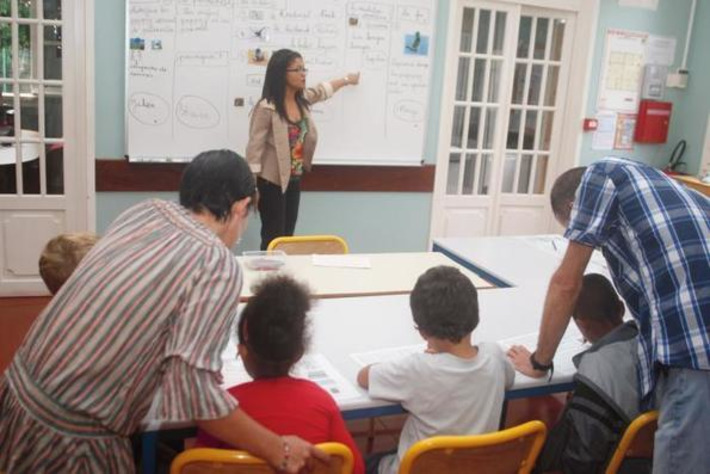
ENSEIGNEMENT. À la fin de cette semaine, se tient à l’Université du Moufia (Saint-Denis, amphithéâtre 200.1) un colloque
Scoop.it!

From
paper

On translation, interpreting, terminology, lexicography and intercultural communication / Traduction, interprétation, terminologie, lexicographie et communication interculturelle by Charles Tiayon
Scoop.it!

South Korea’s Electronics and Telecommunications Research Institute has developed voice recognition-based translation technology for nine languages, the institute announced on April 18. A user first chooses one of nine languages: Korean, English, Japanese, Chinese, Spanish, French, German, Russian and Arabic. When a phrase is spoken in Korean, text appears in both Korean and the chosen language. A
Scoop.it!

Watch this interview.
Scoop.it!

L’invention de l’écriture représente une avancée technologique majeure ayant révolutionné la pensée humaine. Elle a rendu possible la confection de listes et de tableaux, une moindre sollicitation de la mémoire, l’émergence de la pensée scientifique. Pour cela, l’humain a dû se doter d’une forme de représentation conventionnelle de la langue par écrit.
Scoop.it!

Maximilian Dörrbecker's map of the writing systems of our world is fascinating. Check it out. Via Dot MacKenzie
Scoop.it!

LD OnLine is the leading website on learning disabilities, learning disorders and differences. Parents and teachers of learning disabled children will find authoritative guidance on attention deficit disorder, ADD, ADHD, dyslexia, dysgraphia, dyscalculia, dysnomia, reading difficulties, speech and related disorders. LD OnLine works in association with Learning Disabilities Association of America, International Dyslexia Association, Council for Exceptional Children, Schwab Foundation for Learning, and the Coordinated Campaign for Learning Disabilities.
Scoop.it!

It may appear that those who turn the air blue with four-letter words are less concerned about social rules like telling the truth and not hurting people.
Scoop.it!

Learn the method and hacks extraordinary language learners use
Scoop.it!

This is a time of rapid vocabulary expansion. Read more about your 6- to 7-year-old’s language explosion.
Scoop.it!

Eric Topol says we'll soon use our smartphones to monitor our vital signs and chronic conditions. At TEDMED, he highlights several of the most important wireless devices in medicine's future -- all helping to keep more of us out of hospital beds.
Scoop.it!
No one can possibly ignore the role that the Arabic language plays in the science of Linguistics and rhetoric, considering that i
Scoop.it!

How wonderful it would be if these books were in African languages too: 30 TOP #AFRICAN #LITERATURE RELEASES 2016https://t.co/BkEVN7KNBT
|

Curated by Charles Tiayon
Translator,
Lecturer and Consultant in Translation, Terminology, Lexicography and Intercultural Issues Founder and CEO, METAGLOSSIA Other Topics

Metaglossia: The Translation World
News about translation, interpreting, intercultural communication, terminology and lexicography - as it happens

The African Proverb Translation Portal
Focus on endogenous African language proverbs as translated in the news across the world.

The World of Indigenous Languages
Updates and resources on/in individual languages the world over

Translational communication jobs
Job opportunities for translators, interpreters, terminologist, and the like...

Word News
The World of Words: dictionaries, glossaries, lexicography and terminology
|






