Your new post is loading...

|
Scooped by
dromius
April 26, 2018 8:10 AM
|
Giess et al, 2018 5-methylcytosine (5mC) and its oxidized derivatives are regulatory elements of mammalian genomes involved in development and disease. These nucleobases do not selectively modulate Watson-Crick pairing, preventing their programmable targeting and analysis by traditional hybridiza-tion probes. Transcription-activator-like effectors (TALEs) can be engineered for use as programmable probes with epi-genetic nucleobase selectivity. However, only partial selectivi-ties for oxidized 5mC have been achieved so far, preventing unambiguous target binding. We here overcome this limitation by destroying and re-inducing nucleobase selectivity in TA-LEs via protein engineering and chemoselective nucleobase blocking. We engineer cavities in TALE repeats and identify a cavity that accommodates all eight human DNA nucleobases. We then introduce substituents with varying size, flexibility and branching degree at each oxidized 5mC. Depending on the nucleobase, substituents with distinct properties effectively block TALE-binding and induce full nucleobase selectivity in the universal repeat. Successful transfer to affinity enrichment in a human genome background indicates that this approach now enables the fully selective detection of each oxidized 5mC in complex DNA samples by programmable probes.
|
|
Scooped by
dromius
April 21, 2018 8:52 AM
|
(via T. Schreiber) Denance et al, 2018 - Xanthomonas transcription activator‐like effectors (TALEs) are injected inside plant cells to promote host susceptibility by enhancing transcription of host susceptibility genes. TALE‐encoding (tal) genes were thought to be absent from Brassicaceae‐infecting Xanthomonas campestris (Xc) genomes based on four reference genomic sequences.
- We discovered tal genes in 26 of 49 Xc strains isolated worldwide and used a combination of single molecule real time (SMRT) and tal amplicon sequencing to yield a near‐complete description of the TALEs found in Xc (Xc TALome).
- The 53 sequenced tal genes encode 21 distinct DNA binding domains that sort into seven major DNA binding specificities. In silico analysis of the Brassica rapa promoterome identified a repertoire of predicted TALE targets, five of which were experimentally validated using quantitative reverse transcription polymerase chain reaction. The Xc TALome shows multiple signs of DNA rearrangements that probably drove its evolution from two ancestral tal genes. We discovered that Tal12a and Tal15a of Xcc strain Xca5 contribute together in the development of disease symptoms on susceptible B. oleracea var. botrytis cv Clovis.
- This large and polymorphic repertoire of TALEs opens novel perspectives for elucidating TALE‐mediated susceptibility of Brassicaceae to black rot disease and for understanding the molecular processes underlying TALE evolution.
|
|
Scooped by
dromius
April 2, 2018 9:21 AM
|
(via T. Schreiber, thx) Duan et al, 2018 Xanthomonas citri ssp. citri (Xcc) is an important plant‐pathogenic bacterium that causes citrus canker disease worldwide. PthA, a transcriptional activator‐like (TAL) effector, directs the expression of the canker susceptibility gene CsLOB1. Here, we report our recent progress in the functional characterization of CsLOB1. Subcellular localization analysis of CsLOB1 protein in citrus protoplast revealed that CsLOB1 is primarily localized in the nucleus. We showed that CsLOB1 expression driven by dexamethasone (DEX) in CsLOB1‐GR transgenic plants is associated with pustule formation following treatment with DEX. Pustule formation was not observed in DEX‐treated wild‐type plants and in non‐treated CsLOB1‐GR transgenic plants. Water soaking is typically associated with symptoms of citrus canker. Weaker water soaking was observed with pustule formation in CsLOB1‐GR transgenic plants following DEX treatment. When CsLOB1‐GR‐transgenic Duncan grapefruit leaves were inoculated with Xcc306ΔpthA4 and treated with DEX, typical canker symptoms, including hypertrophy, hyperplasia and water soaking symptoms, were observed on DEX‐treated transgenic plant leaves, but not on mock‐treated plants. Twelve citrus genes that are induced by PthA4 are also stimulated by the DEX‐induced expression of CsLOB1. As CsLOB1 acts as a transcriptional factor, we identified putative targets of CsLOB1 via bioinformatic and electrophoretic mobility shift assays. Cs2g20600, which encodes a zinc finger C3HC4‐type RING finger protein, has been identified to be a direct target of CsLOB1. This study advances our understanding of the function of CsLOB1 and the molecular mechanism of how Xcc causes canker symptoms via CsLOB1.
|
|
Scooped by
dromius
March 20, 2018 9:03 AM
|
Yoshida & Treen, 2018 Targeted mutagenesis of genes-of-interest is a powerful method of addressing the functions of genes. Genome editing techniques, such as transcriptional activator-like effector nucleases (TALENs) and clustered regularly interspaced short palindromic repeats (CRISPR)/Cas9 systems, have enabled this approach in various organisms because of their ease of use. In the ascidian, Ciona intestinalis, recent studies show that TALEN-based knockout can be applied to establishing both mutant lines and tissue-specific knockout for addressing gene functions. Here, we introduce recent updates to the TALEN toolkit that facilitate detailed functional analysis of genes in ascidians.
|
|
Scooped by
dromius
February 21, 2018 5:02 AM
|
Urnov 2018 Genome editing with engineered nucleases, a powerful tool for understanding biological function and revealing causality, was built in a joint effort by academia and industry in 1994–2010. Use of CRISPR-Cas9 is the most recent (2013–), and facile, implementation of the resulting editing toolbox. Principles and methods of genome editing from the pre-CRISPR era remain relevant and continue to be useful.
|
|
Scooped by
dromius
February 10, 2018 4:38 AM
|
(via T. Schreiber, thx) Tran et al, 2018 Most Xanthomonas species translocate Transcription Activator-Like (TAL) effectors into plant cells where they function like plant transcription factors via a programmable DNA-binding domain. Characterized strains of rice pathogenic X. oryzae pv. oryzae harbor 9-16 different tal effector genes, but the function of only a few of them has been decoded. Using sequencing of entire genomes, we first performed comparative analyses of the complete repertoires of TAL effectors, herein referred to as TALomes, in three Xoo strains forming an African genetic lineage different from Asian Xoo. A phylogenetic analysis of the three TALomes combined with in silico predictions of TAL effector targets showed that African Xoo TALomes are highly conserved, genetically distant from Asian ones, and closely related to TAL effectors from the bacterial leaf streak pathogen Xanthomonas oryzae pv. oryzicola (Xoc). Nine clusters of TAL effectors could be identified among the three TALomes, including three showing higher levels of variation in their repeat variable diresidues (RVDs). Detailed analyses of these groups revealed recombination events as a possible source of variation among TAL effector genes. Next, to address contribution to virulence, nine TAL effector genes from the Malian Xoo strain MAI1 and four allelic variants from the Burkinabe Xoo strain BAI3, thus representing most of the TAL effector diversity in African Xoo strains, were expressed in the TAL effector-deficient X. oryzae strain X11-5A for gain-of-function assays. Inoculation of the susceptible rice variety Azucena lead to the discovery of three TAL effectors promoting virulence, including two TAL effectors previously reported to target the susceptibility (S) gene OsSWEET14 and a novel major virulence contributor, TalB. RNA profiling experiments in rice and in silico prediction of EBEs were carried out to identify candidate targets of TalB, revealing OsTFX1, a bZIP transcription factor previously identified as a bacterial blight S gene, and OsERF#123, which encodes a subgroup IXc AP2/ERF transcription factor. Use of designer TAL effectors demonstrated that induction of either gene resulted in greater susceptibility to strain X11-5A. The induction of OsERF#123 by BAI3Δ1, a talB knockout derivative of BAI3, carrying these designer TAL effectors increased virulence of BAI3Δ1, validating OsERF#123 as a new, bacterial blight S gene.
|
|
Scooped by
dromius
February 6, 2018 2:56 AM
|
(via T. Lahaye, thx) Becker et al, 2018 Genetic switches must alternate between states whose probabilities are dependent on regulatory signals. Classical examples of transcriptional control in bacteria depend on repressive DNA loops anchored by proteins whose structures are sensitive to small molecule inducers or co-repressors. We are interested in exploiting these natural principles to engineer artificial switches for transcriptional control of bacterial genes. Here, we implement designed homodimeric DNA looping proteins (‘Transcription Activator-Like Effector Dimers’; TALEDs) for this purpose in living bacteria. Using well-studied FKBP dimerization domains, we build switches that mimic regulatory characteristics of classical Escherichia coli lactose, galactose and tryptophan operon promoters, including induction or co-repression by small molecules. Engineered DNA looping using TALEDs is thus a new approach to tuning gene expression in bacteria. Similar principles may also be applicable for gene control in eukaryotes.
|
|
Scooped by
dromius
January 8, 2018 2:52 AM
|
Gochez et al, 2018 Xanthomonas citri, a causal agent of citrus canker, has been a well-studied model system due to recent availability of whole genome sequences of multiple strains from different geographical regions. Major limitations in our understanding of the evolution of pathogenicity factors in X. citri strains sequenced by short-read sequencing methods have been tracking plasmid reshuffling among strains due to inability to accurately assign reads to plasmids, and analyzing repeat regions among strains. X. citri harbors major pathogenicity determinants, including variable DNA-binding repeat region containing Transcription Activator-like Effectors (TALEs) on plasmids. The long-read sequencing method, PacBio, has allowed the ability to obtain complete and accurate sequences of TALEs in xanthomonads. We recently sequenced Xanthomonas citri str. Xc-03-1638-1-1, a copper tolerant A group strain isolated from grapefruit in 2003 from Argentina using PacBio RS II chemistry. We analyzed plasmid profiles, copy number and location of TALEs in complete genome sequences of X. citri strains. We utilized the power of long reads obtained by PacBio sequencing to enable assembly of a complete genome sequence of strain Xc-03-1638-1-1, including sequences of two plasmids, 249 kb (plasmid harboring copper resistance genes) and 99 kb (pathogenicity plasmid containing TALEs). The pathogenicity plasmid in this strain is a hybrid plasmid containing four TALEs. Due to the intriguing nature of this pathogenicity plasmid with Tn3-like transposon association, repetitive elements and multiple putative sites for origins of replication, we might expect alternative structures of this plasmid in nature, illustrating the strong adaptive potential of X. citri strains. Analysis of the pathogenicity plasmid among completely sequenced X. citri strains, coupled with Southern hybridization of the pathogenicity plasmids, revealed clues to rearrangements of plasmids and resulting reshuffling of TALEs among strains. We demonstrate in this study the importance of long-read sequencing for obtaining intact sequences of TALEs and plasmids, as well as for identifying rearrangement events including plasmid reshuffling. Rearrangement events, such as the hybrid plasmid in this case, could be a frequent phenomenon in the evolution of X. citri strains, although so far it is undetected due to the inability to obtain complete plasmid sequences with short-read sequencing methods.
|
|
Scooped by
dromius
December 3, 2017 1:29 PM
|
(via T. Schreiber, thx) Huang et al, 2017 Many Xanthomonas bacteria use transcription activator-like effector (TALE) proteins to activate plant disease susceptibility (S) genes, and this activation contributes to disease. We recently reported that rice basal transcription factor IIA gamma subunit, OsTFIIAγ5, is hijacked by TALE-carrying Xanthomonas oryzae infecting the plants. However, whether TFIIAγs are also involved in TALE-carrying Xanthomonas-caused diseases in other plants is unknown. Here, molecular and genetic approaches were used to investigate the role of TFIIAγs in other plants. We found that TFIIAγs are also used by TALE-carrying Xanthomonas to cause disease in other plants. The TALEs of Xanthomonas citri pv. citri (Xcc) causing canker in citrus and Xanthomonas campestris pv. vesicatoria (Xcv) causing bacterial spot in pepper and tomato interacted with corresponding host TFIIAγs as in rice. Transcriptionally suppressing TFIIAγ led to resistance to Xcc in citrus and Xcv in pepper and tomato. The 39th residue of OsTFIIAγ5 and citrus CsTFIIAγ is vital for TALE-dependent induction of plant S genes. As mutated OsTFIIAγ5V39E, CsTFIIAγV39E, pepper CaTFIIAγV39E, and tomato SlTFIIAγV39E also did not interact with TALEs to prevent disease. These results suggest that TALE-carrying bacteria share a common mechanism for infecting plants. Using TFIIAγV39E-type mutation could be a general strategy for improving resistance to TALE-carrying pathogens in crops.
|
|
Scooped by
dromius
November 21, 2017 3:47 AM
|
Perez Quintero et al, 2017 Transcription activator-like effectors (TALEs) are proteins found in the genus Xanthomonas of phytopathogenic bacteria. These proteins enter the nucleus of cells in the host plant and can induce the expression of susceptibility S genes, triggering disease. TALEs bind the promoter region of S genes following a specific code, which allows the prediction of binding sites based on TALEs’ amino acid sequence. New candidate susceptibility genes can then be discovered by finding the intersection between genes induced in the presence of TALEs and genes containing predicted effector binding elements (EBEs). By contrasting differential expression data and binding sites predictions across different datasets, patterns of TALE diversification and/or convergence may be unveiled, but this requires the seamless integration of different genomic and transcriptomic data. With this in mind we present daTALbase, a curated relational database that integrates TALE-related data including: bacterial TALE sequences, plant promoter sequences, predicted TALE binding sites, transcriptomic data of host plants in response to TALE-harboring bacteria, and other associated data. The database can be explored to uncover candidate new susceptibility genes, as well as to study variation in TALE repertories and their corresponding targets. The first version of the database here presented includes data for Oryza sp. - Xanthomonas pv. oryzae interactions. Future versions of the database will incorporate information for other pathosystems involving TALEs. daTALbase is accessible at http://bioinfo-web.mpl.ird.fr/cgi-bin2/datalbase/home.cgi
|
|
Scooped by
dromius
November 2, 2017 12:05 PM
|
(via T. Lahaye, thx) Curtin et al, 2017 Processing of double-stranded RNA precursors into small RNAs is an essential regulator of gene expression in plant development and stress response. Small RNA processing requires the combined activity of a functionally diverse group of molecular components. However, in most plant species, there are insufficient mutant resources to functionally characterize each encoding gene. Here, mutations in loci encoding protein machinery involved in small RNA processing in soybean and Medicago truncatula were generated using the CRISPR/Cas9 and TAL-effector nuclease (TALEN) mutagenesis platforms. An efficient CRISPR/Cas9 reagent was used to create a bi-allelic double-mutant for the two soybean paralogous Double-stranded RNA-binding2 (GmDrb2a and GmDrb2b) genes. These mutations, along with a CRISPR/Cas9-generated mutation of the M. truncatula Hua enhancer1 (MtHen1) gene, were determined to be germ-line transmissible. Furthermore, TALENs were used to generate a mutation within the soybean Dicer-like2 gene. CRISPR/Cas9 mutagenesis of the soybean Dicer-like3 gene and the GmHen1a gene were observed in the T0 generation, but these mutations failed to transmit to the T1 generation. The irregular transmission of induced mutations and the corresponding transgenes was investigated by whole genome sequencing to reveal a spectrum of non-germline targeted mutations and multiple transgene insertion events. Finally, a suite of combinatorial mutant plants were generated by combining the previously reported Gmdcl1a, Gmdcl1b and Gmdcl4b mutants with the Gmdrb2ab double mutant. Altogether, this study demonstrates the synergistic use of different genome engineering platforms to generate a collection of useful mutant plant lines for future study of small RNA processing in legume crops.
|
|
Scooped by
dromius
October 15, 2017 3:33 AM
|
Xu et al, 2017 Plant-pathogenic Xanthomonas infects a wide variety of host plants and causes many devastating diseases on crops. Transcription activator-like effectors (TALEs) are delivered by a type III secretion system (T3SS) of Xanthomonas into plant nuclei to directly bind specific DNA sequences (TAL effector-binding elements, EBEs) on either strand of host target genes with an unique modular DNA-binding domain and to bidirectionally drive host gene transcription. The target genes in plants consist of host susceptibility (S) genes promoting disease (ETS) and resistance (R) gene triggering defense (ETI). Here we generally summarized the discovery of TALEs in Xanthomonas species, their functions in bacterial pathogenicity in plants and their target genes in different host plants, and then focused on the newly revealed modes of protein action in triggering or suppressing plant defense.
Full PDF:
|
|
Scooped by
dromius
October 6, 2017 5:33 PM
|
(via T. Schreiber & T. Lahaye, thx) Cui et al, 2017 Bacterial blight, caused by Xanthomonas oryzae pv. oryzae (Xoo), is the most important bacterial disease in rice (Oryza sativa L.). Our previous studies have revealed that the bacterial blight resistance gene Xa23 from wild rice O. rufipogon Griff. confers the broadest-spectrum resistance against all the naturally occurring Xoo races. As a novel executor R gene, Xa23 is transcriptionally activated by the bacterial avirulence (Avr) protein AvrXa23 via binding to a 28-bp DNA element (EBEAvrXa23) in the promoter region. So far, the evolutionary mechanism of Xa23 remains to be illustrated. Here, a rice germplasm collection of 97 accessions, including 29 rice cultivars (indica and japonica) and 68 wild relatives, was used to analyze the evolution, phylogeographic relationship and association of Xa23 alleles with bacterial blight resistance. All the ~ 473 bp DNA fragments consisting of promoter and coding regions of Xa23 alleles in the germplasm accessions were PCR-amplified and sequenced, and nine single nucleotide polymorphisms (SNPs) were detected in the promoter regions (~131 bp sequence upstream from the start codon ATG) of Xa23/xa23 alleles while only two SNPs were found in the coding regions. The SNPs in the promoter regions formed 5 haplotypes (Pro-A, B, C, D, E) which showed no significant difference in geographic distribution among these 97 rice accessions. However, haplotype association analysis indicated that Pro-A is the most favored haplotype for bacterial blight resistance. Moreover, SNP changes among the 5 haplotypes mostly located in the EBE/ebe regions (EBEAvrXa23 and corresponding ebes located in promoters of xa23 alleles), confirming that the EBE region is the key factor to confer bacterial blight resistance by altering gene expression. Polymorphism analysis and neutral test implied that Xa23 had undergone a bottleneck effect, and selection process of Xa23 was not detected in cultivated rice. In addition, the Xa23 coding region was found highly conserved in the Oryza genus but absent in other plant species by searching the plant database, suggesting that Xa23 originated along with the diversification of the Oryza genus from the grass family during evolution. This research offers a potential for flexible use of novel Xa23 alleles in rice breeding programs and provide a model for evolution analysis of other executor R genes.
|
|
|
Scooped by
dromius
April 26, 2018 8:08 AM
|
Rathi et al, 2018 The epigenetic DNA nucleobases 5-methylcytosine (5mC) and N4-methylcytosine (4mC) coexist in bacterial genomes and have important functions in host defence and transcription regulation. To better understand the individual biological roles of both methylated nucleobases, analytical strategies for distinguishing unmodified cytosine (C) from 4mC and 5mC are required. Transcription-activator-like effectors (TALEs) are programmable DNA-binding repeat proteins, which can be re-engineered for the direct detection of epigenetic nucleobases in user-defined DNA sequences. We here report the natural, cytosine-binding TALE repeat to not strongly differentiate between 5mC and 4mC. To engineer repeats with selectivity in the context of C, 5mC and 4mC, we developed a homogeneous fluorescence assay and screened a library of size-reduced TALE repeats for binding to all three nucleobases. This provided insights into the requirements of size-reduced TALE repeats for 4mC binding and revealed a single mutant repeat as a selective binder of 4mC. Employment of a TALE with this repeat in affinity enrichment enabled the isolation of a user-defined DNA sequence containing a single 4mC but not C or 5mC from the background of a bacterial genome. Comparative enrichments with TALEs bearing this or the natural C-binding repeat provides an approach for the complete, programmable decoding of all cytosine nucleobases found in bacterial genomes.
|
|
Scooped by
dromius
April 2, 2018 9:23 AM
|
(via T. Schreiber, thx) Wang et al, 2018 Transcription activator‐like effector (TALE)‐dependent dominant disease resistance (R) genes in plants, also referred to as executor R genes, are induced upon infection by phytopathogenic bacteria of the genus Xanthomonas harbouring the corresponding TALE genes. Unlike the traditional R proteins, the executor R proteins do not determine the resistance specificity and may function broadly in different plant species. The executor R gene Bs4C‐R in the resistant genotype PI 235047 of the pepper species Capsicum pubescens (CpBs4C‐R) confers disease resistance to Xanthomonas campestris pv. vesicatoria (Xcv) harbouring the TALE genes avrBsP/avrBs4. In this study, the synthetic genes of CpBs4C‐R and two other Bs4C‐like genes, the susceptible allele in the genotype PI585270 of C. pubescens (CpBs4C‐S) and the CaBs4C‐R homolog gene in the cultivar “CM334” of Capsicum annum (CaBs4C), were characterized in tobacco (Nicotiana benthamiana) and rice (Oryza sativa). The Bs4C genes induced cell death in N. benthamiana. The functional Bs4C‐eCFP fusion proteins were localized to the ER membrane in the leaf epidermal cells of N. benthamiana. The Xa10 promoter‐Bs4C fusion genes in transgenic rice conferred strain‐specific disease resistance to Xanthomonas oryzae pv. oryzae, the causal agent of bacterial blight in rice, and were specifically induced by the Xa10‐incompatible Xoo strain PXO99A(pHM1avrXa10). The results indicated that the Bs4C proteins from the pepper species function broadly in rice and the Bs4C protein‐mediated cell death from the ER is conserved between dicotyledonous and monocotyledonous plants, which can be utilized to engineer novel and enhanced disease resistance in heterologous plants. This article is protected by copyright. All rights reserved.
|
|
Scooped by
dromius
March 20, 2018 9:08 AM
|
Ballantyne 2018 Livestock animals are an ancient, vital renewable natural resource. Many livestock species have the ability to convert inedible crops and waste food into food fit for human consumption, in the form of meat, eggs and dairy products. As the global demand for high value animal protein is ever increasing, the livestock market continues to play a major role in worldwide economics. Animal disease has the potential to be a huge burden on the livestock industry, impacting both welfare and production. Major outbreaks of transboundary diseases, such as foot and mouth disease, rinderpest and classical swine disease, have resulted in devastating global economic losses. As a result, scientific research is engaged in lowering this impact by generating effective preventative measures and treatments. One way to reduce livestock disease is to select animals that are genetically resistant, traditionally carried out through selective animal breeding programs; however, this is a time- consuming process and requires that appropriate genetic variation exists within the population. Advances in genome engineering technologies offer us an alternative approach, with the capability to make genetic improvements in livestock within a single generation. It is hypothesised that resilience to a disease, known as African swine fever (ASF), could be genetically engineered into the domestic pig. ASF is a highly contagious disease of domestic pigs and is a re- emerging global threat to the swine industry. It is a lethal haemorrhagic disease caused by a virus, known as the African swine fever virus (ASFV). At present, there is no vaccine or treatment for ASF, and disease control relies on rapid diagnosis, quarantine and the mass slaughter of animals. Unlike the domestic pig, swine indigenous to Sub-Saharan Africa, such as the warthog, show no clinical signs of disease following infection with ASFV. A comparative study was carried out to identify host genetic variation that could underlie the difference in response to ASFV, with candidate genes selected based on their potential involvement with the viral protein A238L, involved in immune evasion. Functional polymorphisms where identified in the porcine RELA gene, encoding RelA, a subunit of the NF-κB transcription factor family. This evolutionary conserved protein family plays a vital role in mediating inflammatory and immune responses. The specific RELA polymorphisms identified alter potential phosphorylation sites within the C-terminal transactivation domain of RelA which have been found to modulate NF-κB transcriptional activity in vitro. We set out to investigate whether genome editing tools could be employed to engineer the RELA sequence of domestic pigs. Initial attempts targeted the final exon of RELA, producing animals with a truncatedRelA protein; modified animals lack the final 60 amino acids of the C-terminal transactivation domain. The aim of this thesis was to genotype and characterise the effects of this RELA modification at a molecular, cellular, morphological and whole organism level. The ultimate goal of this project was to investigate whether this RELA modification altered the domestic pig’s response to ASFV in vitro and in vivo. Unlike rela-/ -mice which have an embryonic lethal phenotype, these RELA-edited pigs were born healthy and were fully viable when housed in a typical farm environment. Phenotypic analysis of lymphoid tissues from the RELA-edited pigs demonstrated no significant anatomical or histological changes compared to unmodified counterparts. Pigs homozygous for the RELA mutation had a significantly lower body weight compared to wild-type pigs. Molecular studies of samples from, these pigs have shown that the modified RelA has an altered activity; however, the RELA modified pigs do develop the characteristic disease phenotype when challenged with ASFV. Finally, genome editors have been developed to introduce a specific warthog allele into the domestic pig RELA locus, these editors are currently being taken forward to produce a novel pig line.
|
|
Scooped by
dromius
March 15, 2018 9:41 AM
|
Waryah et al, 2018 The completion of genome, epigenome, and transcriptome mapping in multiple cell types has created a demand for precision biomolecular tools that allow researchers to functionally manipulat
|
|
Scooped by
dromius
February 21, 2018 4:55 AM
|
Char et al, 2018 Bacterial blight of rice, caused by the bacterial pathogen Xanthomonas oryzae pv. oryzae (Xoo) in rice, represents one of the most well-studied crop diseases and is also well-known as a model for studying host/microbe interaction. TALEs (transcription activator-like effectors), as a group of pathogenesis factors and once translocated into the host cells from pathogen, recognize and activate host genes to condition disease susceptibility and also trigger host resistance responses dependent on the nature of target genes in plants. TALEs and their target genes have become the foci of the molecular battles between Xoo and rice. The continuing battles have led to incredibly diverse virulence mechanisms in pathogen and counteracting defense mechanisms in rice. Extensive efforts have been made to understand the TALE biology, identify host target genes, and elucidate their interaction and resulting physiological relevance to rice blight and other crop diseases. This review aims to summarize how much we have learned about TALEs and their role in bacterial blight of rice, as well as associated susceptibility and resistance genes in the host. The review also intends to provide a prospect of engineering genetic resistance by applying precise genome editing of TALE-associated target genes in rice.
|
|
Scooped by
dromius
February 6, 2018 5:31 AM
|
Heiderscheidt et al, 2018 Transcription factors (TFs) reprogram cell states by exerting control over gene regulatory networks and the epigenetic landscape of a cell. Artificial transcription factors (ATFs) are designer regulatory proteins comprised of modular units that can be customized to overcome challenges faced by natural TFs in establishing and maintaining desired cell states. Decades of research on DNA-binding proteins and synthetic molecules has provided a molecular toolkit for ATF design and the construction of genome-scale libraries of ATFs capable of phenotypic manipulation and reprogramming of cell states. Here, we compare the unique strengths and limitations of different ATF platforms, highlight the advantages of cooperative assembly, and present the potential of ATF libraries in revealing gene regulatory networks that govern cell fate choices.
|
|
Scooped by
dromius
January 9, 2018 6:21 AM
|
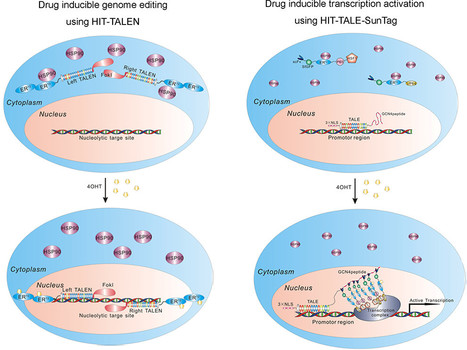
(via T. Lahaye, thx) Zhao et al, 2018 Inducible modulation is often required for precise investigations and manipulations of dynamic biological processes. Transcription activator-like effectors (TALEs) provide a powerful tool for targeted gene editing and transcriptional programming. We designed a series of chemical inducible systems by coupling TALEs with a mutated human estrogen receptor (ERT2), which renders them 4-hydroxyl-tamoxifen (4-OHT) inducible for access of the genome. Chemical inducible genome editing was achieved via fusing two tandem ERT2 domains to customized transcription activator-like effector nuclease (TALEN), which we termed “Hybrid Inducible Technology” (HIT-TALEN). Those for transcription activation were vigorously optimized using multiple construct designs. Most efficient drug induction for endogenous gene activation was accomplished with minimal background activity using an optimized inducible TALE based SunTag system (HIT-TALE-SunTag). The HIT-SunTag system is rapid, tunable, selective to 4-OHT over an endogenous ligand, and reversible in drug induced transcriptional activation. Versatile systems developed in this study can be easily applied for editing and transcriptional programming of potentially any genomic loci in a tight and effective chemical inducible fashion.
|
|
Scooped by
dromius
December 5, 2017 5:51 PM
|
(via T. Lahaye, thx) Lowder et al, 2017 Previously, we have shown transcriptional activation of endogenous genes in plants using dCas9-VP64. Here, we develop a second generation of vector systems for enhanced transcriptional activation in plants. We tested multiple strategies for CRISPR-Cas9 based transcriptional activation. Simultaneous recruitment of VP64 by dCas9 and a modified guide RNA scaffold gRNA2.0 (designated CRISPR-Act2.0) yielded stronger transcriptional activation than our first generation dCas9-VP64 activators. In addition, we have built a multiplex transcription activator-like effector activation (mTALE-Act) system for simultaneous activation of up to four genes in plants. Our results suggest that mTALE-Act is even more effective than CRISPR-Act2.0. Moreover, we explored tissue specific gene activation using positive feedback loops. Interestingly, our study revealed that certain endogenous genes are more amenable than others to transcriptional activation, and tightly regulated genes may cause target gene silencing when perturbed by activation probes. Hence, these new tools may be used to investigate gene regulatory networks and their control mechanisms. Assembly of multiplex CRISPR-Act2.0 and mTALE-Act systems are both based on streamlined and PCR-independent Golden Gate and Gateway cloning strategies. The systems will enable transcriptional activation applications in both dicots and monocots, and the vectors in this new toolbox are publicly available to the research community through Addgene.
|
|
Scooped by
dromius
November 21, 2017 8:27 AM
|
(via T. Schreiber, thx) Toegel et al, 2017 Binary expression systems have revolutionised genetic research by enabling delivery of loss-of-function and gain-of-function transgenes with precise spatial-temporal resolution in vivo. However, at present, each existing platform relies on a defined exogenous transcription activator capable of binding a unique recognition sequence. Consequently, none of these technologies alone can be used to simultaneously target different tissues or cell types in the same organism. Here, we report a modular system based on programmable transcription activator-like effector (TALE) proteins, which enables parallel expression of multiple transgenes in spatially distinct tissues in vivo. Using endogenous enhancers coupled to TALE drivers, we demonstrate multiplexed orthogonal activation of several transgenes carrying cognate variable activating sequences (VAS) in distinct neighbouring cell types of the Drosophila central nervous system. Since the number of combinatorial TALE–VAS pairs is virtually unlimited, this platform provides an experimental framework for highly complex genetic manipulation studies in vivo.
|
|
Scooped by
dromius
November 18, 2017 4:32 AM
|
Scheibner et al, 2017 Pathogenicity of the Gram-negative plant-pathogenic bacterium Xanthomonas campestris pv. vesicatoria depends on a type III secretion (T3S) system which translocates effector proteins into plant cells. Effector protein delivery is controlled by the T3S chaperone HpaB, which presumably escorts effector proteins to the secretion apparatus. One intensively studied effector is the transcription activator-like (TAL) effector AvrBs3, which binds to promoter sequences of plant target genes and activates plant gene expression. It was previously reported that type III-dependent delivery of AvrBs3 depends on the N-terminal protein region. The signals that control T3S and translocation of AvrBs3, however, have not yet been characterized. In the present study, we show that T3S and translocation of AvrBs3 depend on the N-terminal 10 and 50 amino acids, respectively. Furthermore, we provide experimental evidence that additional signals in the N-terminal 30 amino acids and the region between amino acids 64 and 152 promote translocation of AvrBs3 in the absence of HpaB. Unexpectedly, in vivo translocation assays revealed that AvrBs3 is delivered into plant cells even in the absence of HrpF, which is the predicted channel-forming component of the T3S translocon in the plant plasma membrane. The presence of HpaB- and HrpF-independent transport routes suggests that the delivery of AvrBs3 is initiated during early stages of the infection process, presumably before the activation of HpaB or the insertion of the translocon into the plant plasma membrane.
|
|
Scooped by
dromius
October 31, 2017 9:04 AM
|
Gautron et al, 2017 Using a TALEN-mediated gene editing approach, we have previously described a process for the large-scale manufacturing of “off the shelf” CART cells from third-party donor T cells by disrupting the gene encoding TCRα constant chain (TRAC). Taking advantage of a previously described strategy to control TALEN-targeting based on the exclusion capacities of non-conventional RVDs, we have developed highly efficient and specific nucleases targeting a key T-cell immune checkpoint, PD-1, to improve engineered CAR T-cells functionalities. Here, we demonstrate that this approach allows combined TRAC and PD-1 TALEN processing at the desired locus while eliminating low frequency off-site processing. Thus, by replacing few RVDs, we provide here an easy and rapid redesign of optimal TALEN combinations. We anticipate that this method can greatly benefit multiplex editing which is of key importance especially for therapeutic applications where high editing efficiencies need to be associated with maximal specificity and safety.
|
|
Scooped by
dromius
October 13, 2017 4:47 AM
|
(via T. Schreiber, thx) Zhang et al., 2017 DNA recognition by transcription activator-like effector (TALE) proteins is mediated by tandem repeats that specify nucleotides through repeat-variable diresidues. These repeat-variable diresidues form direct and sequence-specific contacts to DNA bases; hence, TALE–DNA interaction is sensitive to DNA chemical modifications. Here we conduct a thorough investigation, covering all theoretical repeat-variable diresidue combinations, for their recognition capabilities for 5-methylcytosine and 5-hydroxymethylcytosine, two important epigenetic markers in higher eukaryotes. We identify both specific and degenerate repeat-variable diresidues for 5-methylcytosine and 5-hydroxymethylcytosine. Utilizing these novel repeat-variable diresidues, we achieve methylation-dependent gene activation and genome editing in vivo; we also report base-resolution detection of 5hmC in an in vitro assay. Our work deciphers repeat-variable diresidues for 5-methylcytosine and 5-hydroxymethylcytosine, and provides tools for TALE-dependent epigenome recognition.
|