Your new post is loading...

|
Scooped by
dromius
November 12, 2013 7:13 AM
|
(via T. Lahaye, thx) Cheng et al, 2013 We have developed a method for the generation of conditional knockouts in Caenorhabditis elegans by expressing transcription activator–like effector nucleases (TALENs) in somatic cells. Using germline transformation with plasmids encoding TALENs under the control of an inducible or tissue-specific promoter, we observed effective gene modifications and resulting phenotypes in specific developmental stages and tissues. We further used this method to bypass the embryonic requirement of cor-1, which encodes the homolog of human severe combined immunodeficiency (SCID) protein coronin, and we determined its essential role in cell migration in larval Q-cell lineages. Our results show that TALENs expressed in the somatic cells of model organisms provide a versatile tool for functional genomics.
|
|
Scooped by
dromius
November 12, 2013 7:08 AM
|
(via T. Lahaye, thx) Lillico et al, 2013 Here we demonstrate for the first time that both TALEN and ZFN injected directly into pig zygotes can produce live genome edited pigs. Monoallelic as well as heterozygous and homozygous biallelic events were identified, significantly broadening the use of genome editor technology in livestock by enabling gene knockout in zygotes from any chosen mating.
|
|
Scooped by
dromius
November 11, 2013 4:54 PM
|
Here, we report isolation of telomeres by engineered DNA-binding molecule-mediated chromatin immunoprecipitation (enChIP) using a transcription activator-like (TAL) protein recognizing telomere repeats. Telomeres recognized by the tagged TAL protein were immunoprecipitated with an antibody against the tag and subjected to identification of telomere-binding molecules. enChIP-mass spectrometry (enChIP-MS) targeting telomeres identified known and novel telomere-binding proteins. The data have been deposited to the ProteomeXchange with identifier PXD000461. In addition, we showed that RNA associated with telomeres could be isolated by enChIP. Identified telomere-binding molecules may play important roles in telomere biology. enChIP using TAL proteins would be a useful tool for biochemical analysis of specific genomic regions of interest.
|
|
Scooped by
dromius
November 8, 2013 4:13 AM
|
(via T. Schreiber, thx) Zhang et al, 2013 Transcriptional activator-like effector nucleases (TALENs) have become a powerful tool for genome editing. Here we present an efficient TALEN assembly approach in which TALENs are assembled by direct Golden Gate ligation into Gateway® Entry vectors from a repeat variable di-residue (RVD) plasmid array. We constructed TALEN pairs targeted to mouse Ddx3 subfamily genes, and demonstrated that our modified TALEN assembly approach efficiently generates accurate TALEN moieties that effectively introduce mutations into target genes. We generated “user friendly” TALEN Entry vectors containing TALEN expression cassettes with fluorescent reporter genes that can be efficiently transferred via Gateway (LR) recombination into different delivery systems. We demonstrated that the TALEN Entry vectors can be easily transferred to an adenoviral delivery system to expand application to cells that are difficult to transfect. Since TALENs work in pairs, we also generated a TALEN Entry vector set that combines a TALEN pair into one PiggyBac transposon-based destination vector. The approach described here can also be modified for construction of TALE transcriptional activators, repressors or other functional domains.
|
|
Scooped by
dromius
November 6, 2013 3:40 AM
|
(via T. Schreiber, thx) Kato et al, 2013 Recently developed transcription activator-like effector nuclease (TALEN) technology has enabled the creation of knockout mice, even for genes on the Y chromosome. In this study, we generated a knockout mouse for Sry, a sex-determining gene on the Y chromosome, using microinjection of TALEN RNA into pronuclear stage oocytes. As expected, the knockout mouse had female external and internal genitalia, a female level of blood testosterone and a female sexually dimorphic nucleus in the brain. The knockout mouse exhibited an estrous cycle and performed copulatory behavior as females, although it was infertile or had reduced fertility. A histological analysis showed that the ovary of the knockout mouse displayed a reduced number of oocytes and luteinized unruptured follicles, implying that a reduced number of ovulated oocytes is a possible reason for infertility and/or reduced fertility in the KO mouse.
|
|
Scooped by
dromius
November 5, 2013 9:22 AM
|
(via T. Lahaye, thx) Lo et al, 2013 Exploitation of custom-designed nucleases to induce DNA double-strand breaks (DSBs) at genomic locations of choice has transformed our ability to edit genomes, regardless of their complexity. DSBs can trigger either error-prone repair pathways that induce random mutations at the break sites or precise homology-directed repair pathways that generate specific insertions or deletions guided by exogenously supplied DNA. Prior editing strategies using site-specific nucleases to modify the Caenorhabditis elegans genome achieved only the heritable disruption of endogenous loci through random mutagenesis by error-prone repair. Here we report highly effective strategies using TALE nucleases and RNA-guided CRISPR/Cas9 nucleases to induce error-prone repair and homology-directed repair to create heritable, precise insertion, deletion, or substitution of specific DNA sequences at targeted endogenous loci. Our robust strategies are effective across nematode species diverged by 300 million years, including necromenic nematodes (Pristionchus pacificus), male/female species (Caenorhabditis species 9), and hermaphroditic species (C. elegans). Thus, genome-editing tools now exist to transform nonmodel nematode species into genetically tractable model organisms. We demonstrate the utility of our broadly applicable genome-editing strategies by creating reagents generally useful to the nematode community and reagents specifically designed to explore the mechanism and evolution of X chromosome dosage compensation. By developing an efficient pipeline involving germline injection of nuclease mRNAs and single-stranded DNA templates, we engineered precise, heritable nucleotide changes both close to and far from DSBs to gain or lose genetic function, to tag proteins made from endogenous genes, and to excise entire loci through targeted FLP-FRT recombination.
|
|
Scooped by
dromius
November 3, 2013 5:59 PM
|
They are novel DNA-changing techniques that blur the lines around what is and what isn't genetic engineering. Our agency, the Environmental Protection Authority, has decided that a technique using a type of ZFN in tandem with TALENs falls into a category that is exempt from our GM regulations, putting New Zealand at the forefront of this debate.
|
|
Scooped by
dromius
October 31, 2013 6:01 PM
|
(via T. Lahaye, thx) Wefers et al, 2013 Genetically engineered mice are instrumental for the analysis of mammalian gene function in health and disease. As classical gene targeting, which is performed in embryonic stem (ES) cell cultures and generates chimeric mice, is a time-consuming and labor-intensive procedure, we recently used transcription activator–like (TAL) effector nucleases (TALENs) for mutagenesis of the mouse genome directly in one-cell embryos. Here we describe a stepwise protocol for the generation of knock-in and knockout mice, including the selection of TALEN-binding sites, the design and construction of TALEN coding regions and of mutagenic oligodeoxynucleotides (ODNs) and targeting vectors, mRNA production, embryo microinjection and the identification of modified alleles in founder mutants and their progeny. After a setup time of 2–3 weeks of hands-on work for TALEN construction, investigators can obtain first founder mutants for genes of choice within 7 weeks after embryo microinjections.
|
|
Scooped by
dromius
October 25, 2013 10:12 AM
|
(via T. Schreiber) Tsuji et al, 2013 Transcription activator-like effectors (TALEs) are convenient tools for genome engineering at specific genomic sites. However, their use is constrained because most TALE binding sites are preceded by a highly conserved 5′ terminal T nucleotide (5′-T). To remove the 5′-T constraint, we substituted tryptophan 232 in the repeat-1 loop region of the dHax3 N-terminal domain for other amino acids. Furthermore, we randomized four amino acid residues of the hairpin loop region of repeat-1. Although point mutation was insufficient to remove the 5′-T constraint, directed evolution from the randomized library yielded repeat-1 mutants with unbiased targeting sites for 5′-bases. Our result indicates that the repeat-1 loop region of dHax3 is important for 5′-base accommodation, and that molecular evolution of repeat-1 of TALEs is an efficient strategy to remove the 5′-T constraint and thus allow targeting of any DNA sequences.
|
|
Scooped by
dromius
October 17, 2013 3:36 AM
|
(via T. Schreiber, thx) Takada et al, 2013 Mice are among the most valuable model animal species with an enormous amount of heritage in genetic modification studies. However, targeting genes in mice is sometimes difficult, especially for small genes, such as microRNAs (miRNAs) and targeting genes in repeat sequences. Here we optimized the application of TALEN system for mice and successfully obtained gene targeting technique in mice for intergenic region and series of microRNAs. Microinjection of synthesized RNA of TALEN targeting each gene in one cell stage of embryo was carried out and injected oocytes were transferred into pseudopregnant ICR female mice, producing a high success rate of the targeted deletion of miRNA genes. In our condition, TALEN RNA without poly(A) tail worked better than that of with poly(A) tail. This mutated allele in miRNA was transmitted to the next generation, suggesting the successful germ line transmission of this targeting method. Consistent with our notion of miRNAs maturation mechanism, in homozygous mutant mice of miR-10a, the non- mutated strand of miRNAs expression was completely diminished. This method will lead us to expand and accelerate our genetic research using mice in a high throughput way.
|
|
Scooped by
dromius
October 15, 2013 3:26 AM
|
(via T. Schreiber, thx) Hisano et al, 2013 Zebrafish is a model vertebrate suitable for genetic analysis. Recently, new gene targeting technologies, such as the transcription activator-like effector nucleases (TALEN) and clustered regularly interspaced short palindromic repeats (CRISPR)/Cas9 systems, have been developed: that can directly introduce genome modifications at the targeted genomic locus. Here, we summarize these new and powerful genome editing techniques for the study of zebrafish.
|
|
Scooped by
dromius
October 10, 2013 3:41 AM
|
(via T. Lahaye, thx) Nyquist et al. (2013) Androgen receptor (AR) target genes direct development and survival of the prostate epithelial lineage, including prostate cancer (PCa). Thus, endocrine therapies that inhibit the AR ligand-binding domain (LBD) are effective in treating PCa. AR transcriptional reactivation is central to resistance, as evidenced by the efficacy of AR retargeting in castration-resistant PCa (CRPC) with next-generation endocrine therapies abiraterone and enzalutamide. However, resistance to abiraterone and enzalutamide limits this efficacy in most men, and PCa remains the second-leading cause of male cancer deaths. Here we show that AR gene rearrangements in CRPC tissues underlie a completely androgen-independent, yet AR-dependent, resistance mechanism. We discovered intragenic AR gene rearrangements in CRPC tissues, which we modeled using transcription activator-like effector nuclease (TALEN)-mediated genome engineering. This modeling revealed that these AR gene rearrangements blocked full-length AR synthesis, but promoted expression of truncated AR variant proteins lacking the AR ligand-binding domain. Furthermore, these AR variant proteins maintained the constitutive activity of the AR transcriptional program and a CRPC growth phenotype independent of full-length AR or androgens. These findings demonstrate that AR gene rearrangements are a unique resistance mechanism by which AR transcriptional activity can be uncoupled from endocrine regulation in CRPC.
|
|
Scooped by
dromius
October 9, 2013 10:27 AM
|
(via T. Schreiber, thx) Tan et al, 2013 We have expanded the livestock gene editing toolbox to include transcription activator-like (TAL) effector nuclease (TALEN)- and clustered regularly interspaced short palindromic repeats (CRISPR)/Cas9-stimulated homology-directed repair (HDR) using plasmid, rAAV, and oligonucleotide templates. Toward the genetic dehorning of dairy cattle, we introgressed a bovine POLLED allele into horned bull fibroblasts. Single nucleotide alterations or small indels were introduced into 14 additional genes in pig, goat, and cattle fibroblasts using TALEN mRNA and oligonucleotide transfection with efficiencies of 10–50% in populations. Several of the chosen edits mimic naturally occurring performance-enhancing or disease- resistance alleles, including alteration of single base pairs. Up to 70% of the fibroblast colonies propagated without selection harbored the intended edits, of which more than one-half were homozygous. Edited fibroblasts were used to generate pigs with knockout alleles in the DAZL and APC genes to model infertility and colon cancer. Our methods enable unprecedented meiosis-free intraspecific and interspecific introgression of select alleles in livestock for agricultural and biomedical applications. Here we report precise, high-frequency editing of 15 genes in pig, goat, and cattle genomes. In many cases, the gene edits are indistinguishable from alleles that exist within a species or clade and represent the first demonstration of marker-free, nonmeiotic allele introgression. This work demonstrates that precise, high-efficiency gene editing can be achieved in commercially important loci in livestock for agricultural or biomedical purposes.
|
|
|
Scooped by
dromius
November 12, 2013 7:10 AM
|
(via T. Lahaye, thx) Beumer et al, 2013 Zinc-finger nucleases (ZFNs) have proved successful as reagents for targeted genome manipulation in Drosophila melanogaster and many other organisms. Their utility has been limited, however, by the significant failure rate of new designs, reflecting the complexity of DNA recognition by zinc fingers. Transcription activator-like effector (TALE) DNA-binding domains depend on a simple, one-module-to-one-base-pair recognition code, and they have been very productively incorporated into nucleases (TALENs) for genome engineering. In this report we describe the design of TALENs for a number of different genes in Drosophila, and we explore several parameters of TALEN design. The rate of success with TALENs was substantially higher than for ZFNs, and the frequency of mutagenesis was comparable. Knockout mutations were isolated in several genes in which such alleles were not previously available. TALENs are an effective tool for targeted genome manipulation in Drosophila.
|
|
Scooped by
dromius
November 12, 2013 7:06 AM
|
Here, we extend an existing TALE assembly system by a dual set of expression vectors for efficient application of TALEN technology in hPSCs. This is characterized by improved TALEN architecture as well as antibiotic resistance and fluorescent reporter cassettes, thus enabling enrichment for transfected cells.Improved functionality of the combined system was demonstrated by targeted disruption of the HPRT1 gene to create isogenic disease models of Lesch-Nyhan-Syndrome. Using female hPSCs, homozygous disruption of HPRT1 occurred at efficiencies of up to 15 %. Differentiating isogenic knock-out cells both into central nervous system (CNS) as well as into sensory-like neurons recapitulated previously described phenotypes based on patient-specific induced PSCs and extended these findings to non-CNS neurons, respectively. The combined vector system allows for flexible and affordable generation of knock-out hPSCs lines, thus enabling investigation of developmental processes as well as the generation of isogenic disease models without the need for patient material.
|
|
Scooped by
dromius
November 11, 2013 4:51 PM
|
(via T. Schreiber & T. Lahaye, thx) Kim et al, 2013 Various technical tools have been developed to probe the functions of microRNAs (miRNAs), yet their application has been limited by low efficacy and specificity. To overcome the limitations, we used transcription activator–like effector nucleases (TALENs) to knock out human miRNA genes. We designed and produced a library of 540 pairs of TALENs for 274 miRNA loci, focusing on potentially important miRNAs. The knockout procedure takes only 2–4 weeks and can be applied to any cell type. As a case study, we generated knockout cells for two related miRNAs, miR-141 and miR-200c, which belong to the highly conserved miR-200 family. Interestingly, miR-141 and miR-200c, despite their overall similarity, suppress largely nonoverlapping groups of targets, thus suggesting that functional miRNA-target interaction requires strict seed-pairing. Our study illustrates the potency of TALEN technology and provides useful resources for miRNA research.
|
|
Scooped by
dromius
November 8, 2013 3:06 AM
|
Wei et al, 2013 Although evolutionary studies of gene function often rely on RNA interference, the ideal approach would use reverse genetics to create null mutations for cross-species comparisons, and forward genetics to identify novel genes in each species. We have used TALENs to facilitate both approaches in Caenorhabditis nematodes. First, by combining golden gate cloning and TALEN technology, we can induce frame-shifting mutations in any gene. Second, by combining this approach with bio-informatics we can predict and create the resources needed for forward genetic analysis in species like C. briggsae. Whereas developing genetic model organisms used to require years to isolate marker mutations, balancers and tools, with TALENs, these reagents can now be produced in months. Furthermore, the analysis of nonsense mutants in related model organisms allows a directed approach for making these markers and tools. When used together, these methods could simplify the adaptation of other organisms for forward and reverse genetics.
|
|
Scooped by
dromius
November 5, 2013 9:26 AM
|
(via T. Lahaye, thx) Over three years following the discovery of the TAL code, artificial TAL effector DNA binding domains have emerged as the premier platform for building site-specific DNA binding polypeptides for use in biological research. Here, we provide an overview of TAL effector and alternative modular DNA binding domain (mDBD) technologies, focusing on their use in established and emerging architectures for building site-specific endonucleases for genome engineering applications. We also discuss considerations for choosing TAL effector/mDBD or alternative nuclease technologies for genome engineering projects ranging from basic laboratory gene editing of cultured cell lines to therapeutics. Finally, we highlight how the rapid pace of development of mDBD-based, such as monomeric TALENs (I-TevI-TAL), and more recently RNA-guided nucleases (CRISPR-Cas9) has led to a transition in the field of genome engineering towards development of the next generation of technologies aimed at controlling events that occur after targeted DNA breaks are made.
|
|
Scooped by
dromius
November 5, 2013 9:07 AM
|
Wells (2013) Since livestock were first domesticated, humans have been selecting particular phenotypes as mating stock for each new generation. As a result, humans have been selecting for combinations of alleles that result in animals that better meet our needs: increased production, disease resistance, docility, and so forth. As purpose-bred animals became standard in animal agriculture, breeds began to diverge such that a mating produced between differently purposed breeds (dairy vs. beef, layers vs. broilers) resulted in offspring that were less desirable than individuals from either breed. As causative mutations are discovered that affect agriculturally important traits, their utility is limited if they are exclusive to a singly purposed breed. As an example, a disease resistance gene from a beef-type breed is limited to beef animals because the loss of milk production in a dairy-type breed prevents the crossbred animal from being economically viable. In PNAS, Tan et al. remedy this problem from a technical point of view (1). However, do technical views really matter? The impact of Tan et al. depends on perceptions.
|
|
Scooped by
dromius
November 1, 2013 2:14 PM
|
|
|
Scooped by
dromius
October 25, 2013 10:15 AM
|
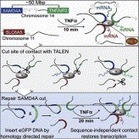
(via T. Lahaye, thx) Fanucchi et al, 2013 Transcription of coregulated genes occurs in the context of long-range chromosomal contacts that form multigene complexes. Such contacts and transcription are lost in knockout studies of transcription factors and structural chromatin proteins. To ask whether chromosomal contacts are required for cotranscription in multigene complexes, we devised a strategy using TALENs to cleave and disrupt gene loops in a well-characterized multigene complex. Monitoring this disruption using RNA FISH and immunofluorescence microscopy revealed that perturbing the site of contact had a direct effect on transcription of other interacting genes. Unexpectedly, this effect on cotranscription was hierarchical, with dominant and subordinate members of the multigene complex engaged in both intra- and interchromosomal contact. This observation reveals the profound influence of these chromosomal contacts on the transcription of coregulated genes in a multigene complex.
|
|
Scooped by
dromius
October 24, 2013 7:04 AM
|
(via T. Schreiber, thx) Voit et al, 2013 Tal-effector nucleases (TALENs) are engineered proteins that can stimulate precise genome editing through specific DNA double-strand breaks. Sickle cell disease and β-thalassemia are common genetic disorders caused by mutations in β-globin, and we engineered a pair of highly active TALENs that induce modification of 54% of human β-globin alleles near the site of the sickle mutation. These TALENS stimulate targeted integration of therapeutic, full-length beta-globin cDNA to the endogenous β-globin locus in 19% of cells prior to selection as quantified by single molecule real-time sequencing. We also developed highly active TALENs to human γ-globin, a pharmacologic target in sickle cell disease therapy. Using the β-globin and γ-globin TALENs, we generated cell lines that express GFP under the control of the endogenous β-globin promoter and tdTomato under the control of the endogenous γ-globin promoter. With these fluorescent reporter cell lines, we screened a library of small molecule compounds for their differential effect on the transcriptional activity of the endogenous β- and γ-globin genes and identified several that preferentially upregulate γ-globin expression.
|
|
Scooped by
dromius
October 15, 2013 3:31 AM
|
(via T. Lahaye, thx) Wan et al, 2013 Molecular dynamics (MD) simulations are employed to study two crystal structures of an 11.5-repeat TALE, in the presence and absence of DNA, respectively. The simulated results indicate that the specific binding of RVDs (repeat-variable diresidues) with DNA leads to the markedly reduced fluctuations of tandem repeats, especially at the two ends. In the DNA-bound TALE system, the base-specific interaction is formed mainly by the residue at position 13 within a TAL repeat. Tandem repeats with weak RVDs are unfavorable for the TALE-DNA binding. These observations are consistent with experimental studies. By using principal component analysis (PCA), the dominant motions are open-close movements between the two ends of the superhelical structure in both DNA-free and DNA-bound TALE systems. The open-close movements are found to be critical for the recognition and binding of TALE-DNA based on the analysis of free energy landscape (FEL). The conformational analysis of DNA indicates that the 5′ end of DNA target sequence has more remarkable structural deformability than the other sites. Meanwhile, the conformational change of DNA is likely associated with the specific interaction of TALE-DNA. We further suggest that the arrangement of N-terminal repeats with strong RVDs may help in the design of efficient TALEs. This study provides some new insights into the understanding of the TALE-DNA recognition mechanism.
|
|
Scooped by
dromius
October 11, 2013 6:23 PM
|
|
|
Scooped by
dromius
October 10, 2013 3:31 AM
|
(via T. Lahaye, thx!) Maeder et al, 2013 Here we describe an approach for efficient targeted demethylation of specific CpGs in human cells using fusions of engineered transcription activator–like effector (TALE) repeat arrays and the TET1 hydroxylase catalytic domain. Using these TALE-TET1 fusions, we demonstrate that modification of critical methylated promoter CpG positions can lead to substantial increases in the expression of endogenous human genes. Our results delineate a strategy for understanding the functional significance of specific CpG methylation marks in the context of endogenous gene loci and validate programmable DNA demethylation reagents with potential utility for research and therapeutic applications.
|