Your new post is loading...

|
Scooped by
dromius
July 23, 2014 11:46 AM
|
Chen et al, 2014 PIWIL2 is widely expressed in various tumours and implicated in playing a role in tumourigenesis. For a more thorough study of PIWIL2 functions in tumour cells, we aimed to establish PIWIL2-specific transcript knock-down/knockout HepG2 cell lines using transcription activator-like effector nuclease (TALEN) technology. Furthermore, we proposed to use the cell models to explore PIWIL2 functions in TGF-β signalling in HepG2 cells. HepG2s are human hepatocellular carcinoma cells. MATERIALS AND METHODS: We established PIWIL2 knock-down or knock-out cell lines in HepG2 using TALEN technology. Next, we sought to use the cell line models to investigate effects of full length PIWIL2-specific transcripts in cell proliferation induced by TGF-β. RESULTS: First, we established PIWIL2-specific transcript mono-allele and bi-allele knockout HepG2 cell lines. By using the cell line models, we found that specific transcript knockdown of full length PIWIL2 can suppress cell proliferation, while ectopic expression of PIWIL2 enhanced proliferation of HepG2 by suppressing the TGF-β pathway. Furthermore, we demonstrated that PIWIL2 can interact with HSP90 to prevent formation of HSP90-TβR complexes, which promote degradation of TβRs. CONCLUSIONS: Taken together, our study revealed critical negative regulation of TGF-β signalling by PIWIL2 in HepG2 tumour cells, and provided an effective strategy to study specific gene transcript functions in cells.
|
|
Scooped by
dromius
July 17, 2014 3:52 AM
|
(via T. Schreiber, thx) Yasue et al, 2014 Since the establishment of embryonic stem (ES) cell lines, the combined use of gene targeting with homologous recombination has aided in elucidating the functions of various genes. However, the ES cell technique is inefficient and time-consuming. Recently, two new gene-targeting technologies have been developed: the transcription activator-like effector nuclease (TALEN) system, and the clustered regularly interspaced short palindromic repeat (CRISPR)/CRISPR-associated protein (Cas) system. In addition to aiding researchers in solving conventional problems, these technologies can be used to induce site-specific mutations in various species for which ES cells have not been established. Here, by targeting the Fgf10 gene through RNA microinjection in one-cell mouse embryos with the TALEN and CRISPR/Cas systems, we produced the known limb-defect phenotypes of Fgf10-deficient embryos at the F0 generation. Compared to the TALEN system, the CRISPR/Cas system induced the limb-defect phenotypes with a strikingly higher efficiency. Our results demonstrate that although both gene-targeting technologies are useful, the CRISPR/Cas system more effectively elicits single-step biallelic mutations in mice.
|
|
Scooped by
dromius
July 16, 2014 3:25 AM
|
(via T. Lahaye, thx) Tsai & Joung 2014 Targeted genome editing using engineered nucleases can reliably generate defined genetic mutations, although the range of off-target lesions caused by these techniques is unclear. Recent papers in Cell Stem Cell perform high-coverage whole-genome sequencing to demonstrate the feasibility of obtaining correctly targeted pluripotent stem cell clones with minimal unintended modifications.
|
|
Scooped by
dromius
July 15, 2014 4:17 AM
|
Suzuki et al, 2014 The utility of genome editing technologies for disease modeling and developing cellular therapies has been extensively documented, but the impact of these technologies on mutational load at the whole-genome level remains unclear. We performed whole-genome sequencing to evaluate the mutational load at single-base resolution in individual gene-corrected human induced pluripotent stem cell (hiPSC) clones in three different disease models. In single-cell clones, gene correction by helper-dependent adenoviral vector (HDAdV) or Transcription Activator-Like Effector Nuclease (TALEN) exhibited few off-target effects and a low level of sequence variation, comparable to that accumulated in routine hiPSC culture. The sequence variants were randomly distributed and unique to individual clones. We also combined both technologies and developed a TALEN-HDAdV hybrid vector, which significantly increased gene-correction efficiency in hiPSCs. Therefore, with careful monitoring via whole-genome sequencing it is possible to apply genome editing to human pluripotent cells with minimal impact on genomic mutational load.
|
|
Scooped by
dromius
July 14, 2014 3:18 AM
|
(via T. Schreiber, thx) Cheng & Alper 2014 The increase in quality, quantity, and complexity of recombinant products heavily drives the need to predictably engineer model and complex (mammalian) cell systems. However, until recently, limited tools offered the ability to precisely manipulate their genomes, thus impeding the full potential of rational cell line development processes. Targeted genome editing can combine the advances in synthetic and systems biology with current cellular hosts to further push productivity and expand the product repertoire. This review highlights recent advances in targeted genome editing techniques, discussing some of their capabilities and limitations and their potential to aid advances in pharmaceutical biotechnology.
|
|
Scooped by
dromius
June 29, 2014 7:28 AM
|
(via T. Lahaye, thx) Booher & Bogdanove 2014 TAL effectors are transcription factors injected into plant cells by pathogenic bacteria during infection. They find their specific DNA targets via a string of contiguous, structural repeats that individually recognize single nucleotides (with some degeneracy) by virtue of polymorphisms at residue 13. The number of repeats and sequence of the amino acids at position 13 determine the nucleotide sequence of the DNA target. Due to this modularity, TAL effectors are readily engineered and have been used alone or as molecular fusions for targeted gene activation, gene repression, chromatin modification, chromatin tagging, and most broadly, for genome editing as TAL effector nucleases (TALENs). Several moderate and high-throughput cloning methods are in place for assembling TAL effector-based genetic constructs. Targeting is complicated to an extent by a general requirement for thymine to precede the DNA target, a requirement of TALENs to bind paired opposing sites separated by a defined range of distances, differential contributions of different repeat types to overall affinity, and a polarity to mismatch tolerance. Several computational tools are available online to aid in design and the identification of candidate off-target binding sites, as well as assembly and implementation. These tools vary in their approaches, capabilities, and relative utility for different types of TAL effector applications. Accuracy of off-target prediction is not well characterized yet for any of the tools and will require a better understanding of the qualitative and quantitative variation in the nucleotide preferences of individual repeats.
|
|
Scooped by
dromius
June 24, 2014 6:20 AM
|
(via T. Lahaye, thx) Chen et al, 2014 Human induced pluripotent stem cells (iPSC) can be used to understand the pathological mechanisms of human disease. These cells are a promising source for cell-replacement therapy. However, such studies require genetically defined conditions. Such genetic manipulations can be performed using the novel Transcription Activator-Like Effector Nucleases (TALENs), which generate site-specific double-strand DNA breaks (DSBs) with high efficiency and precision. Combining the TALEN and iPSC methods, we developed two iPS cell lines by generating the point mutation A5768G in the SCN1A gene, which encodes the voltage-gated sodium channel Nav1.1 [agr] subunit. The engineered iPSC maintained pluripotency and successfully differentiated into neurons with normal functional characteristics. The two cell lines differ exclusively at the epilepsy-susceptibility variant. The ability to robustly introduce disease-causing point mutations in normal hiPS cell lines can be used to generate a human cell model for studying epileptic mechanisms and for drug screening.
|
|
Scooped by
dromius
June 18, 2014 8:30 AM
|
(via T. Lahaye, thx) Zhang et al, 2014 Recent effective use of TAL Effectors (TALEs) has provided an important approach to the design and synthesis of sequence-specific DNA-binding proteins. However, it is still a challenging task to design and manufacture effective TALE modulators because of the limited knowledge of TALE–DNA interactions. Here we synthesized more than 200 TALE modulators and identified two determining factors of transcription activity in vivo: chromatin accessibility and the distance from the transcription start site. The implementation of these modulators in a gain-of-function screen was successfully demonstrated for four cell lines in migration/invasion assays and thus has broad relevance in this field. Furthermore, a novel TALE–TALE modulator was developed to transcriptionally inhibit target genes. Together, these findings underscore the huge potential of these TALE modulators in the study of gene function, reprogramming of cellular behaviors, and even clinical investigation.
|
|
Scooped by
dromius
June 12, 2014 4:11 AM
|
(via T. Lahaye, thx)Vojtas and Gao 2014Plant agriculture is poised at a technological inflection point. Recent advances in genome engineering make it possible to precisely alter DNA sequences in living cells, providing unprecedented control over a plant's genetic material. Potential future crops derived through genome engineering include those that better withstand pests, that have enhanced nutritional value, and that are able to grow on marginal lands. In many instances, crops with such traits will be created by altering only a few nucleotides among the billions that comprise plant genomes. As such, and with the appropriate regulatory structures in place, crops created through genome engineering might prove to be more acceptable to the public than plants that carry foreign DNA in their genomes. Public perception and the performance of the engineered crop varieties will determine the extent to which this powerful technology contributes towards securing the world's food supply.
|
|
Scooped by
dromius
June 2, 2014 3:29 AM
|
(Via T. Lahaye, thx) Daboussi et al, 2014 Diatoms, a major group of photosynthetic microalgae, have a high biotechnological potential that has not been fully exploited because of the paucity of available genetic tools. Here we demonstrate targeted and stable modifications of the genome of the marine diatom Phaeodactylum tricornutum, using both meganucleases and TALE nucleases. When nuclease-encoding constructs are co-transformed with a selectable marker, high frequencies of genome modifications are readily attained with 56 and 27% of the colonies exhibiting targeted mutagenesis or targeted gene insertion, respectively. The generation of an enhanced lipid-producing strain (45-fold increase in triacylglycerol accumulation) through the disruption of the UDP-glucose pyrophosphorylase gene exemplifies the power of genome engineering to harness diatoms for biofuel production.
|
|
Scooped by
dromius
May 27, 2014 10:55 AM
|
(via T. Lahaye, thx) Hommelsheim et al, 2014 Designer transcription-activator like effectors (TALEs) is a promising technology and made it possible to edit genomes with higher specificity. Such specific engineering and gene regulation technologies are also being developed using RNA-binding proteins like PUFs and PPRs. The main feature of TALEs, PUFs and PPRs is their repetitive DNA/RNA-binding domains which have single nucleotide binding specificity. Available kits today allow researchers to assemble these repetitive domains in any combination they desire when generating TALEs for gene targeting and editing. However, PCR amplifications of such repetitive DNAs are highly problematic as these mostly fail, generating undesired artifact products or deletions. Here we describe the molecular mechanisms leading to these artifacts. We tested our models also in plasmid templates containing one copy versus two copies of GFP-coding sequence arranged as either direct or inverted repeats. Some limited solutions in amplifying repetitive DNA regions are described.
|
|
Scooped by
dromius
May 26, 2014 6:59 AM
|
(via T. Lahaye, thx) Matsubara et al, 2014 X-linked severe combined immunodeficiency (SCID-X1) caused by mutations in interleukin 2 receptor gamma (IL2RG) gene threatens the survival of affected boys during the first year of life unless hematopoietic stem cell transplantation is provided. Although viral vector-mediated gene therapy has been successfully performed in patients with no HLA-matched donors, leukemia caused by vector-mediated insertional mutagenesis has been reported in some individuals. Transcription activator-like effector nuclease (TALEN) is an artificial sequence-specific endonuclease that is expected to revolutionize the precise correction of disease-causing mutations and eliminate the risk of insertional mutagenesis. Here, we report TALEN-mediated genome editing of the IL2RG locus. We transfected TALENs along with a targeting vector into Jurkat cells, and we confirmed the precise introduction of the exogenous gene into the IL2RG locus. In addition, we found that the length of homology arm in the targeting vector influenced the efficiency of TALEN-mediated homologous recombination.
|
|
Scooped by
dromius
May 21, 2014 3:37 AM
|
Cellectis (Paris:ALCLS), the global genome engineering specialist, announces the issuance by the USPTO of a 4(th) US patent (US 8,697,853) directed to TAL-effector nucleases. On April 15, 2014, the USPTO issued a fourth patent to the University of Minnesota and the Iowa State University for the TALEN(TM) technology developed by Cellectis. This patent US 8,697,853 is more particularly drawn to the genomic sequences encoding TAL-effector nucleases. These proteins developed jointly by researchers at the University of Minnesota and Iowa State University can "read" DNA and make pinpoint cuts in targeted genes. This fourth issued patent, like the previous ones, is part of a patent portfolio owned by the Regents of the University of Minnesota and Iowa State University Research Foundation and licensed exclusively to Cellectis as per a license agreement of January 2011.
|
|
|
Scooped by
dromius
July 21, 2014 12:07 PM
|
Wang et al, 2014 Sequence-specific nucleases have been applied to engineer targeted modifications in polyploid genomes1, but simultaneous modification of multiple homoeoalleles has not been reported. Here we use transcription activator–like effector nuclease (TALEN)2,3 and clustered, regularly interspaced, short palindromic repeats (CRISPR)-Cas9 (refs. 4,5) technologies in hexaploid bread wheat to introduce targeted mutations in the three homoeoalleles that encode MILDEW- RESISTANCE LOCUS (MLO) proteins6. Genetic redundancy has prevented evaluation of whether mutation of all three MLO alleles in bread wheat might confer resistance to powdery mildew, a trait not found in natural populations7. We show that TALEN-induced mutation of all three TaMLO homoeologs in the same plant confers heritable broad-spectrum resistanceto powdery mildew. We further use CRISPR-Cas9 technologyto generate transgenic wheat plants that carry mutations inthe TaMLO-A1 allele. We also demonstrate the feasibility of engineering targeted DNA insertion in bread wheat through nonhomologous end joining of the double-strand breaks caused by TALENs. Our findings provide a methodological framework to improve polyploid crops.
|
|
Scooped by
dromius
July 17, 2014 3:30 AM
|
Tol & van der Zaal, 2014 The transcriptional regulation of endogenous genes with artificial transcription factors (TFs) can offer new tools for plant biotechnology. Three systems are available for mediating site-specific DNA recognition of artificial TFs: those based on zinc fingers, TALEs, and on the CRISPR/Cas9 technology. Artificial TFs require an effector domain that controls the frequency of transcription initiation at endogenous target genes. These effector domains can be transcriptional activators or repressors, but can also have enzymatic activities involved in chromatin remodeling or epigenetic regulation. Artificial TFs are able to regulate gene expression in trans, thus allowing them to evoke dominant mutant phenotypes. Large scale changes in transcriptional activity are induced when the DNA binding domain is deliberately designed to have lower binding specificity. This technique, known as genome interrogation, is a powerful tool for generating novel mutant phenotypes. Genome interrogation has clear mechanistic and practical advantages over activation tagging, which is the technique most closely resembling it. Most notably, genome interrogation can lead to the discovery of mutant phenotypes that are unlikely to be found when using more conventional single gene-based approaches.
|
|
Scooped by
dromius
July 15, 2014 4:07 AM
|
Stella et al, 2014 In a search for putative DNA-binding domains, BurrH, a protein that recognizes a 19 bp DNA target, was identified. Here, its apo and DNA-bound crystal structures are reported, revealing a central region containing 19 repeats of a helix-loop-helix modular domain (BurrH domain; BuD), which identifies the DNA target by a single residue-to-nucleotide code, thus facilitating its redesign for gene targeting. New DNA-binding specificities have been engineered in this template, showing that BuD-derived nucleases (BuDNs) induce high levels of gene targeting in a locus of the human haemoglobin (HBB) gene close to mutations responsible for sickle-cell anaemia. Hence, the unique combination of high efficiency and specificity of the BuD arrays can push forward diverse genome-modification approaches for cell or organism redesign, opening new avenues for gene editing.
|
|
Scooped by
dromius
July 1, 2014 3:50 AM
|
(via T. Schreiber, thx) Flechsig, 2014 A simple force-probe setup is employed to study the mechanical properties of transcription activator-like effector (TALE) proteins in computer experiments. It is shown that their spring-like arrangement benefits superelastic behaviour which is manifested by large-scale global conformational changes along the helical axis, thus linking structure and dynamics in TALE proteins. As evidenced from the measured force-extension curves the dHax3 and PthXo1 TALEs behave like linear springs, obeying Hooke's law, for moderate global structural changes. For larger deformations, however, the proteins exhibit nonlinearities and the structures become stiffer the more they are stretched. Flexibility is not homogeneously distributed over TALE structure, but instead soft spots which correspond to the RVD loop residues and present key agents in the transmission of conformational motions are identified.
|
|
Scooped by
dromius
June 27, 2014 8:32 AM
|
(via T. Lahaye, thx) Senecal et al, 2014 Transcription is a stochastic process occurring mostly in episodic bursts. Although the local chromatin environment is known to influence the bursting behavior on long timescales, the impact of transcription factors (TFs)—especially in rapidly inducible systems—is largely unknown. Using fluorescence in situ hybridization and computational models, we quantified the transcriptional activity of the proto-oncogene c-Fos with single mRNA accuracy at individual endogenous alleles. We showed that, during MAPK induction, the TF concentration modulates the burst frequency of c-Fos, whereas other bursting parameters remain mostly unchanged. By using synthetic TFs with TALE DNA-binding domains, we systematically altered different aspects of these bursts. Specifically, we linked the polymerase initiation frequency to the strength of the transactivation domain and the burst duration to the TF lifetime on the promoter. Our results show how TFs and promoter binding domains collectively act to regulate different bursting parameters, offering a vast, evolutionarily tunable regulatory range for individual genes.
|
|
Scooped by
dromius
June 21, 2014 5:34 AM
|
(via T. Lahaye, thx) Law & Sargent 2014 TALEN-based inactivation of the zebrafish pak4 gene resulted in embryos and adult fish that appear normal and fertile. This is in contrast to our previously published studies which were based on the use of antisense morpholino oligonucleotides (MOs). We have excluded potential explanations such as gene duplication, alternate splicing, cryptic initiation of translation, and translation-independent RNA function. Our conclusion is that pak4 is dispensable in zebrafish, and that even when corroborated by robust controls, such as RNA rescue, MOs may elicit misleading pseudophenotypes that do not correspond to results obtained by genetic mutations, and should thus be used with caution.
|
|
Scooped by
dromius
June 18, 2014 3:29 AM
|
Ye et al, 2014 Individuals homozygous for the C-C chemokine receptor type 5 gene with 32-bp deletions (CCR5Δ32) are resistant to HIV-1 infection. In this study, we generated induced pluripotent stem cells (iPSCs) homozygous for the naturally occurring CCR5Δ32 mutation through genome editing of wild-type iPSCs using a combination of transcription activator-like effector nucleases (TALENs) or RNA-guided clustered regularly interspaced short palindromic repeats (CRISPR)-Cas9 together with the piggyBac technology. Remarkably, TALENs or CRISPR-Cas9–mediated double-strand DNA breaks resulted in up to 100% targeting of the colonies on one allele of which biallelic targeting occurred at an average of 14% with TALENs and 33% with CRISPR. Excision of the piggyBac using transposase seamlessly reproduced exactly the naturally occurring CCR5Δ32 mutation without detectable exogenous sequences. We differentiated these modified iPSCs into monocytes/macrophages and demonstrated their resistance to HIV-1 challenge. We propose that this strategy may provide an approach toward a functional cure of HIV-1 infection.
|
|
Scooped by
dromius
June 4, 2014 6:45 PM
|
(via T. Lahaye, thx) Gao et al 2014 Background Transcription activator-like effectors (TALEs) are effector proteins secreted by certain plant pathogenic bacteria when infecting their hosts. Upon translocation, TALEs bind via a well-deciphered recognition code to specific sequences in the promoter region of targeted host genes, thereby activating expression of those targeted genes. Gene activation induced by artificially designed TALEs (dTALEs) has been studied in multiple organisms, but is yet to be demonstrated in green algae, such as Chlamydomonas reinhardtii, a well-known model organism for fundamental biological studies, as well as for biofuel production. Results We chose two endogenous Chlamydomonas genes, ARS1 and ARS2, as the targets of dTALE induced activation. Both genes encode a periplasmic arylsulfatase (ARS), and are located in an apparent tail-to-tail inverted duplication on chromosome 16. dTALEs independently targeting ARS1 and ARS2 promoters were generated and successfully expressed in Chlamydomonas. Both target genes exhibited noticeably increased expression induced by their respective dTALEs at the transcript level as well as the protein level, which was confirmed at the protein activity level by ARS colorimetric assays. The level of induced target gene activation was closely correlated with the dTALE transcript abundance. Conclusions Our work demonstrates robust gene-specific activation induced by artificially designed TALEs in the green alga Chlamydomonas. The frequency and efficiency of the induced expression demonstrate dTALEs as powerful tools for targeted gene activation in Chlamydomonas. The pattern of activation shown here provides insights into the mechanism of TALE induced expression, and also confirms the activity of the activation domain of naturally occurring TALEs in another organism. Our success with dTALE-induced activation in Chlamydomonas may open a new avenue to fast, high throughput gene manipulation in other related organisms, such as green algae and crop plants.
|
|
Scooped by
dromius
May 28, 2014 9:29 AM
|
(via T. Lahaye, thx) Wang and Nakagaki 2014 The silk gland of Bombyx mori represents an established in vivo system for producing recombinant proteins. However, low yields of recombinant proteins have limited the system’s further development because endogenous silk proteins were present. Transcription activator–like effector nucleases (TALENs) tool which work in pairs to bind and cleave DNA at specific sites, have recently been shown to be effective for genome editing in various organisms, including silkworms. To improve the yield of recombinant proteins synthesized in the silkworm by eliminated competition with endogenous fibroin synthesis, the Heavy chain (H-chain) gene was knocked out using Transcription activator–like effector nucleases (TALENs). A pair of TALENs that targets the 1st exon in the H-chain gene was synthesized and microinjected into silkworm embryos; the injected silkworms were screened for H-chain gene knock out (H-KO) based on their sericin cocoon-making characteristics. Sequence analysis revealed that the H-chain of the mutation was successfully edited. The TALENs was very efficent in editing the genome DNA of silkworm. By being eliminated competition with the H-chain, the production of recombinant proteins would be expected to increase markedly if this H-KO system is used.
|
|
Scooped by
dromius
May 27, 2014 8:40 AM
|
(via T. Lahaye, thx) Watanabe et al 2014 Hemimetabolous, or incompletely metamorphosing, insects are phylogenetically basal. These insects include many deleterious species. The cricket, Gryllus bimaculatus, is an emerging model for hemimetabolous insects, based on the success of RNA interference (RNAi)-based gene-functional analyses and transgenic technology. Taking advantage of genome-editing technologies in this species would greatly promote functional genomics studies. Genome editing using transcription activator-like effector nucleases (TALENs) has proven to be an effective method for site-specific genome manipulation in various species. TALENs are artificial nucleases that are capable of inducing DNA double-strand breaks into specified target sequences. Here, we describe a protocol for TALEN-based gene knockout in G. bimaculatus, including a mutant selection scheme via mutation detection assays, for generating homozygous knockout organisms.
|
|
Scooped by
dromius
May 21, 2014 10:36 AM
|
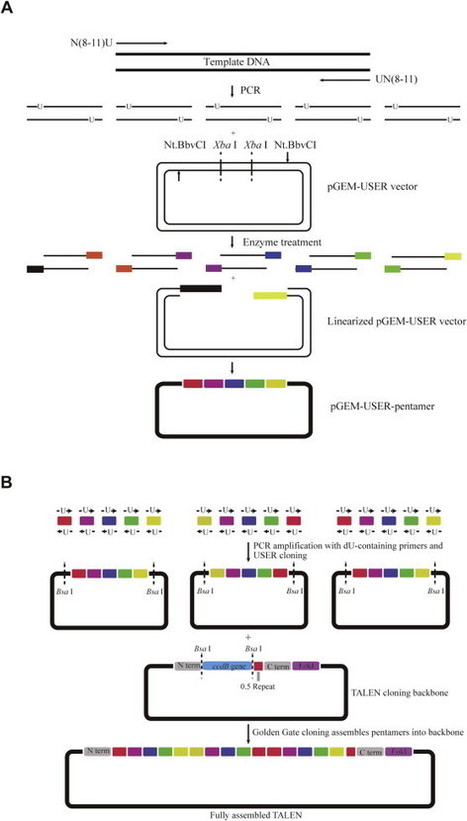
(via T. Lahaye, thx) Wang et al, 2014 Transcription activator-like effectors (TALEs) that were related to bacteria immune system have lately been employed in a promising approach of precise gene targeting. Because of the repetitive characteristics of transcription activator-like effectors (TALEs), existing TALE assembly methods are either very complicated, time-consuming, or too tricky to be handled in common labs. Here, we reported a rapid, efficient and easy method for TALE assembly. This method takes advantage of uracil-specific excision reagent (USER), an enzyme that can cleave DNA constructs and create long, unique single-strand DNA overhangs. Upon USER treatment, the overhangs on each individual TALE repeat unit can be rejoined hierarchically to form pentamers in a ligation-independent manner. Eventually, three pentamers are assembled into a full TALE construct by Golden Gate cloning. TAL effector nucleases (TALENs) generated with this method exhibit high genome-editing activity in human cells such as HEK293FT cells. Using this method, we have successfully synthesized three TALEN pairs targeting endogenous Tet1 locus, and proved that all can specifically target Tet1 gene, though in various degree. Comparing to other methods of TALEN assembly, this one is much less labor intensive and fairly faster, and positive clones can be obtained at high efficiency within only two days. We thus contributed to an easier approach for effective TALENs synthesis, which may highly facilitate the wide application of TALEN technology in genome editing, especially for human cells that require precise targeting.
|