|
|
Rescooped by
Clairelouise
from Tools for Teachers & Learners
April 26, 2013 7:21 AM
|
Your new post is loading...
Amadeu Marin's comment,
April 27, 2013 2:48 PM
Well, erm... I would never dream of contradicting Nik, I just wanted to put forward some doubts of mine... What do YOU think?
Amélie Silvert's comment,
April 28, 2013 2:46 AM
An initiative from French Students, probably explains the grammar mistakes.... An initiative to widen collaborative studying. Check out http://www.journaldunet.com/web-tech/start-up/unishared.shtml
Nik Peachey's comment,
April 29, 2013 3:08 AM
It's true, they are asking for a lot of access, but I do believe they are a legitimate company. You can read their terms of service here: https://videonotes.uservoice.com/tos
Sign up to comment
Jess Deady's curator insight,
May 4, 2014 4:04 PM
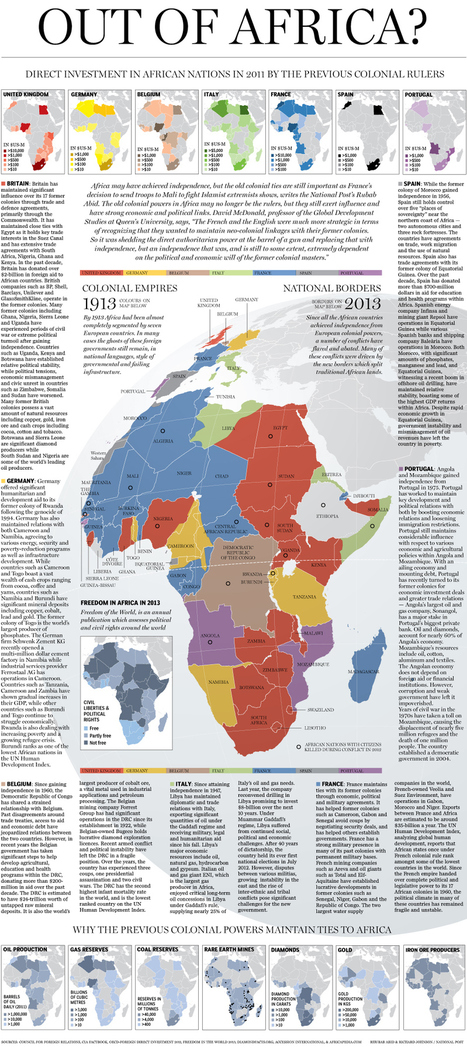
Colony powers are still located within Africa. Just because Africa is technically independent doesn't mean that British Colonial power isn't still in place.
Felix Ramos Jr.'s curator insight,
March 26, 2015 11:08 AM
This article reminds us all of the growth-stunt that colonialism in Africa brought to the continent. It is not surprising to see that most African countries still depend heavily on their old colonial masters for survival. People who may casually follow African politics might think that colonialism started with the Berlin Conference and ended in 1990 or so, but one could argue that it hasn't ended due to the urgent dependency African countries still have on their old colonizers. Africa might be the most beautiful continent in the world but has the worst story of any in the world.
Mary Patrick Schoettinger's curator insight,
April 18, 2013 9:39 AM
There are so many facets to geography and the United States has certainly benefitted from all of them; from location to abundant natural resources to cultural histories. I think this is a good introduction to the topic.
Louis Culotta's comment,
April 18, 2013 12:41 PM
I would think that the united states treats Canada a lot better at than in Mexico because of the border issues that exist because of people trying to smuggle drugs or people into America from Mexico continues to be abig problem with the US goverment.
Maegan Connor's curator insight,
December 17, 2013 1:48 PM
I think the very last paragraph of this article is one of the truest statements about America that I have ever read. "There's so much good America can do in the world." This is absolutely true because as the author covered, the U.S. is very good at getting involved in foreign affairs and we are extremely lucky to have the borders that we do. We're safe on this side of the globe, a world away from the places that have suffered religious and political turmoil for centuries. However, the citizens of the U.S. often remain marginally uneducated about out foreign affairs because of the portrayals by the media and the many covered up mistakes that the U.S. has made. The author of this piece noted America's three major faults as pragmatism, idealism, arrogance and ambivalence. The United States is ultimately the most conceited country in the world but it's not entirely the fault of its citizens. U.S. media's job is not necessarily to report the truth but report the fractions of truth that will continue to inspire nationalism, even if that means leaving out the fact that many problems around the world have been increased due to America's participation. The author of this piece pointed out America's habit of only joining in when it is beneficial for our country, even if it is not in the best interest of the people we are helping. We offered assistance to the reformers in Egypt but ignored problems raging in Bahrain. The U.S. has only limited understanding of many of the old, traditional cultures that reign in parts of the Middle East but that does not stop the country from trying to help and often, looking foolish or inciting more unrest. We have grown to feel very safe in on our side of the planet and regardless of the few attacks that have penetrated America's defense, we still have a very limited world view because there are no threats from our neighbors and it is okay to be whomever you'd like to be (technically speaking because racism, sexism, and homophobia are still rampant in this country) without threats from people around you. It would be in our country's best interest to educate ourselves on world events and other cultures to be well rounded and less offensive to those who suffer in other regions. The author called America's belief that the problems between Israeli's and Palestinians would resolve with a classic Hollywood happy ending a part of America's problem with idealism and not understanding what it is like to have neighbors who want to dive in during the midst of horrible wars and take whatever they can get their hands on. Having the borders that it does, it was never a real threat that the U.S. faced. I think this article is spot on with the problems in U.S. foreign policy and how geography affects our culture and our ideas of how the world works.
Paul Nicoara's curator insight,
May 5, 2013 5:05 PM
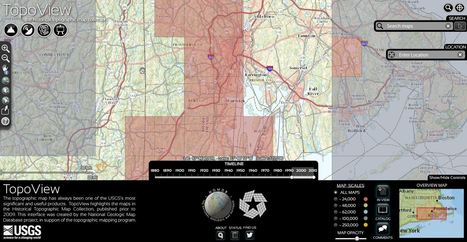
The National Geologic Map Database is a simple interactive tool to find USGS topographic maps that you can dowload. Users can search for current or historic maps.
Alec Castagno's curator insight,
December 17, 2014 11:14 PM
It is sad to see the many different ways the poverty stricken and uneducated regions of the world are exploited, especially the children. Nepal is so poor that most of the recruiters for the predatory foreign networks are often locals who either take their relatives or abductees sent back to find a replacement. The animation helps add clarity and approachability to a bleak and difficult topic.
Chris Costa's curator insight,
November 30, 2015 9:33 AM
It's heartbreaking to see the plight children living in other parts of the globe, making me all the more appreciative of my uneventful upbringing in the US. Child labor is a practice that many Americans associate with the 19th century, but it continues to be widespread in many parts of the world, as is the case in Nepal. Educational opportunities are few and far in between for many Nepalese, who's short-term financial struggles rob their children of long-term opportunities for success. Many are kidnapped from their homes, or sold by their families to pay off debt with skyrocketing interest rates. The same also holds true for young female sex workers, who suffer an enormous amount of physical and psychological harm at the hands of their kidnappers and their clients. Economic pitfalls and a lack of access to education helps to perpetuate this cycle of abuse, as people are unaware of their rights in addition to lacking the education to advance economically in their societies. The Nepalese national government and several international rights groups are hard at work to combat these harmful practices, but they are fighting an uphill battle against an illicit institution that has ingrained itself in Nepalese society and culture. Great strides are being made, but much still has to be done for the youth of Nepal.
BrianCaldwell7's curator insight,
April 5, 2016 8:22 AM
Teaching about human trafficking and child slavery can be very disconcerting and uncomfortable. How much of the details regarding these horrific situations is age-appropriate and suitable for the classroom? The BBC is reporting on events with sensitive stories to both give a human face to the story, while protecting the identity of under-aged victims (to read about the production of this comic, read Drawing the News.) I encourage you to use your own discretion, but I find this comicbook format an accessible, informative and tasteful way to teach about human trafficking in South Asia to minors. It is a powerful way to teach about some hard (but important) aspects of globalization and economics. As geographer Shaunna Barnhart says concerning this comic, "It moves from trafficking to child labor to pressures for migration for wage labor and the resulting injustices that occur. There's differential access to education, gender inequality, land, jobs, and monetary resources that leads to inter- and intra-country trafficking of the vulnerable. In the search for improved quality of life, individuals become part of a global flow of indentured servitude which serves to exploit their vulnerabilities and exacerbate inequalities and injustice. Nepali children 'paid' in food and cell phones that play Hindi music in 'exchange' for work in textile factories - cell phones that are themselves a nexus of global resource chains and textiles which in turn enter a global market - colliding at the site of child labor which remains largely hidden and ignored by those in the Global North who may benefit from such labor." Tags: Nepal, labor, industry, economic, poverty, globalization, India.
Tori Denney's curator insight,
May 27, 2015 5:04 PM
Central Place Theory - This PowerPoint is the best representation of Christaller's Central Place Theory that I've seen! It does a great job at showing its hexagonal layout, along with describing urban hierarchy and sizes, and range that a person will go to buy certain goods.
Cohen Adkins's curator insight,
February 6, 2016 3:43 PM
I believe the central place theory is very important for Business owners who want to set up a commercial building because it shows the amount of competition that the business owner would have if they desire to settle somewhere. - C.Adkins
Chelsie Rogers's curator insight,
March 7, 2016 4:29 PM
The Central Place Theory is a model that is not used much today in academic geography, but given it's explicitly spatial nature, it is used in many geography curricula (including AP Human Geography) to show systems thinking and spatial patterns. This powerpoint goes over the main ideas of the theory developed by Walter Christaller as well as some examples.
Tags: APHG, models, spatial. |
Matthew DiLuglio's curator insight,
October 12, 2013 6:14 PM
Commercials don't always try to sell you stuff, they try to appeal to you. Heroism appeals to people, but people are trying to sell you shirts that advertise comicbooks in a trinity of marketing efforts. Social appeal, by referring to heros, sales by selling the shirt, and advertising comics. I like comics, but I would rather spend money on comic books, or go into the world and make a difference and BE a hero (or eat a hero at a hoagie hut) than buy one of those shirts. My spiritual beliefs are open to allowing the sales of these shirts, but my preference does not incline me to actually purchase one. I am 'free' in this country to buy or not to buy a shirt. I'm a long-time supporter of art, and I like the idea the shirt puts forward- supporting heroism and comic books, belief in scifi/fantasy art and concepts, and I agree that someone should buy that shirt... but I feel that I could do more by actually being a hero than telling people to be heros. By using comic book heros, the advertisers say that nobody on this world is a hero, because they 'aren't real,' but also that anybody can be a hero by striving towards virtue of the pure ideal idols in the comics.
Ana Cristina Gil's curator insight,
November 6, 2013 9:15 PM
Companies before they put any product in the market they do research first for example; what people are buying, they take in consideration gender and culture. And why is that? Because they are not going to create a product that no one is going to buy. The impact that this type of messages like this have on a society’s culture. No matter how many laws are make in favor woman equality are created we are being perceived as the weak sex, that we need the help of a man to do anything. Sadly but true this type of campaign it was sales
Michele Baker's curator insight,
March 12, 2014 11:39 AM
This is a really depressing trend, and one that, as the parent of a daughter, I am all too aware of. It's way past time we start rethinking the way we dictate gender roles in children.
Paige Therien's curator insight,
April 26, 2014 12:04 AM
China is attributing the disappearance of over 50 percent of their country's rivers to inaccurate sources; more effective technologies today give an accurate picture of China's waterways compared to the former data based off of sources from the 1950's. While it is probably true to some extent that previous numbers were off, there still needs to be much concern for the state of China's current waterways and why waterways that once existed have disappeared.
Tracy Galvin's curator insight,
May 3, 2014 4:48 PM
Cutting corners in safety and cleanliness has caused pollution in the rivers. All the money they saved cutting corners now has to be invested in diverting clean water to northern areas of the country. I hope someday they realize that you cannot do things super cheaply without paying for it in another area.
Jess Deady's curator insight,
May 4, 2014 9:41 PM
What has happened to these rivers? Are they purposely being depleted from China? How do they expect to supply water for their residents if they are building things over these used-to-be rivers?
Marissa Roy's curator insight,
November 19, 2013 10:16 AM
Most Americans had never heard Chechnya before the Boston bombing in April 2013. Now, most think that it is full of America-hating terriosts. However, Chechnya is so very complex and diverse a place, that it is ludacris to think that. Over 100 languages are spoken in the country. The southern half speaks languages such as Georgian, Svan and Mingrelian. Turkish, Iranian and Chechens are the languages you will probably hear in the North. Another misconception is that there are many Christians in Chechnya as well as Muslims. This country is made up of so many different groups, it is incredible.
Elizabeth Bitgood's curator insight,
March 3, 2014 9:27 AM
It is amazing to consider such a small area (the size of New England) could hold such a vast area of languages. The mountainous region certainly helps in creating such diversity as it isolated villages from each other in the ages before modern communication and travel.
Samuel D'Amore's curator insight,
December 15, 2014 6:46 PM
This map does a fantastic job of highlighting the cultural diversity within Russia and the former Soviet states. Understanding how these cultural regions overlap one another is paramount in understanding the region's tensions and the repercussions that result including Chechen terrorism in Russia and even in America (Boston bombings).
Alyssa Dorr's curator insight,
December 11, 2014 8:16 PM
I feel as though marriage can be complicated in China due to the one child policy. The amount of males outweigh the females. Therefore, there will not be as many marriages because there are not enough females to go around. Grooms have to put out so much for their brides. For example, in this article, her groom is unable to even get in the room to see her unless he puts up a chunk of money first. This is a typical ordeal for Chinese weddings. People describe it as a negotiation process. He must do whatever is told of him before seeking her hand in marriage. The "bride price" is when the groom gives the brides family a fair amount of money. A typical amount for an ordinary family to give is around $10,000. This is so much to get married and on top of all this, gender roles are typically unbalanced. In order to get married in China, you best make sure your a man ready to fulfill every request of your bride.
Elle Reagan's curator insight,
March 22, 2015 5:53 PM
I always heard that men were more desirable in China because they are the ones that carry out the family name and provide for the family. Women, however, are seen as much weaker and are treated as lesser. For the newly wed couple in the article, they hope to have a baby girl because it is much cheaper when she gets married. I never thought of it this way but having a girl would be much cheaper as the parents would not have to pay the "bride price" or for the apartment in which their daughter will be living in.
Bella Reagan's curator insight,
May 27, 2015 12:48 AM
Unit 3 Culture Cultural Practices Cultural practuces in China are changing, but old customs are staying the dame. An old tradition is still being help up, called the "bride price.;This is a price that men must pay in order to marry. In China the male to female ratio is vey off, with 117 men to every 100 women. Insight Women are still being given a price on their head. It's a little different than it is in America.The culture behind the bride price is still going on in China and with China's ways of remembering traditions. China is a very traditional place with cultures following old traditions. The One Child policy, resulting in many males compared to females, and the strong traditions in China all result in why their customs stay for so long.
Kristen McDaniel's curator insight,
March 15, 2013 11:12 AM
Infographic looking at what goes on inside the Conclave. |