


45 percent think the U.S. should intervene, but only half can identify the country.

 Your new post is loading...
 Scoop.it! 45 percent think the U.S. should intervene, but only half can identify the country. 
Scoop.it!

"An earlier GeoCurrents post on Chechnya mentioned that the Chechens were deported from their homeland in the North Caucasus to Central Asia in February 1944. However, the Chechen nation was not the only one to suffer such a fate under Stalin’s regime."

Alec Castagno's curator insight,
December 12, 2014 1:43 PM
The Soviet Union forced vast amounts of people and ethnic groups out of their historical homelands to settle new areas during the early and mid 20th century. Many of those forced into resettlement died, and today some consider it a genocide or crime against humanity. As ethnic groups were moved out, ethnic Russians were moved in to take their places, and explains why many places outside of Russia (Ukraine) have populations that still maintain strong Russian identities. It also explains why places like Chechnya have such a long history of insurgency and extremism against Russian authority and power. 
Matt Ramsdell's curator insight,
November 25, 2015 2:37 PM
This graph represents the areas where many of the Chechnes had been displaced to in the era of Stalins regime. Many of these people were displaced from their homes and forced to move. Many of them either had to leave family behind of they were forced to move together and had no initial home to live in. 
Martin Kemp's curator insight,
December 17, 2015 1:51 PM
i see this as history retelling itself. for some reason throughout history terrible men think that their race is better than another, this is not true and if a person wants to think this that is their prerogative, but some men think it to such an extent that they seek to eliminate the entire other people. nothing good can come of this and it turns into mass conflict every time. it destroys countries and breeds hate on all sides.
Scoop.it!

More often than we care to admit, we feel the absence of foes as strongly as we do their presence.
We often create images—especially of other people—that are exaggerated stereotypes of the real thing. And in no respect is that more true than when it comes to the enemy. Via Seth Dixon
Scoop.it!

From
twitter

"Dust blows from what was once the Aral Sea floor. Tragic mismanagement of a natural resource."

Jess Deady's curator insight,
April 30, 2014 8:36 PM
The Aral Sea Basin has been a topic of conversation throughout geography for many reasons. What used to be filled with water is now blowing dust because its that dry? This basin is no longer a natural resource. 
Gene Gagne's curator insight,
November 18, 2015 3:30 PM
Here is a question. Do you think perhaps in the future this could happen to lake Mead in Nevada/Arizona? With all the non-stop building and no rain perhaps one day could it run dry or do we have a way to stop it.
Gene Gagne's curator insight,
December 1, 2015 7:17 PM
Once there is less water in a lake there is less water in the air therefore less rain. The long term consequences is that the fishing industry is destroyed where once upon a time there were 61000 workers and now there are under 2000. The water is more saltier. The lands are now ill suited and unbuildable. Also the people there are prone to health problems.
Scoop.it!
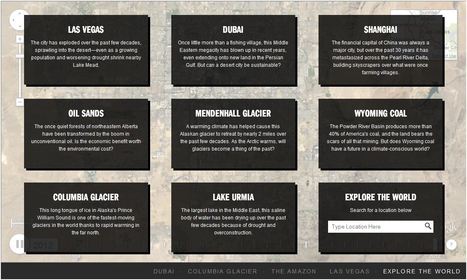
Exclusive timelapse: See climate change, deforestation and urban sprawl unfold as Earth evolves over 30 years.

Lauren Moss's curator insight,
May 10, 2013 1:17 PM
The impact of global urbanization, deforestation, and resource depletion are expressed in dramatic satellite imagery and timelapse video of a changing earth. These depictions show the massive scale of the environmental impact of climate change, rising sea levels and urban growth, and underscore the need to develop a viable plan for addressing these issues. Many thanks to Seth Dixon for sharing this resource. 
Ishola Adebayo's comment,
July 31, 2013 9:07 AM
good day Sir, pls need help on fixing scan line errors on lansat7 ETM images from 2003 using for example ArcMap9.3 or ENVI4.5 or.........thank you so much

Courtney Barrowman's curator insight,
May 27, 2015 10:55 AM
summer work KQ2 key concepts: remote sensing, deforestation, desertification, land use, geospatial
Scoop.it!

From
io9
Original Greek statues were brightly painted, but after thousands of years, those paints have worn away. Find out how shining a light on the statues can be all that's required to see them as they were thousands of years ago.
Although it seems impossible to think that anything could be left to discover after thousands of years of wind, sun, sand, and art students, finding the long lost patterns on a piece of ancient Greek sculpture can be as easy as shining a lamp on it. A technique called ‘raking light' has been used to analyze art for a long time. A lamp is positioned carefully enough that the path of the light is almost parallel to the surface of the object. When used on paintings, this makes brushstrokes, grit, and dust obvious. On statues, the effect is more subtle. Brush-strokes are impossible to see, but because different paints wear off at different rates, the stone is raised in some places – protected from erosion by its cap of paint – and lowered in others.
Ultraviolet is also used to discern patterns. UV light makes many organic compounds fluoresce. Art dealers use UV lights to check if art has been touched up, since older paints have a lot of organic compounds and modern paints have relatively little. On ancient Greek statues, tiny fragments of pigment still left on the surface glow bright, illuminating more detailed patterns.
Once the pattern is mapped, there is still the problem of figuring out which paint colors to use. A series of dark blues will create a very different effect than gold and pink. Even if enough pigment is left over so that the naked eye can make out a color, a few thousand years can really change a statue's complexion. There's no reason to think that color seen today would be anything like the hues the statues were originally painted.
There is a way around this dilemma. The colors may fade over time, but the original materials – plant and animal-derived pigments, crushed stones or shells – still look the same today as they did thousands of years ago. This can also be discovered using light.
Click headline to read more-- Via Chuck Sherwood, Former Senior Associate, TeleDimensions, Inc

Jose Reyes's curator insight,
September 29, 2013 1:24 PM
This new technology could reveal the true colors of statues,and make you belive how wiered the bright colors looked on statues
Scoop.it!

Recently, NPR launched a new blog entitled Code Switch to examine the "frontiers of race, culture and ethnicity." Blog host Gene Demby explains: "We're looking at code switching a little more broadly. Many of us subtly, reflexively change the way we express ourselves all the time. We're hop-scotching between different cultural and linguistic spaces and different parts of our own identities -- sometimes within a single interaction."
Daily, teens confront the challenges and opportunities of code switching in digital spaces, at home and at school. Code switching is not easy to do and can bring coping fatigue, confusion, missteps and distractions.
The rules of the game of digital engagement vary from one space to the next. At school, often no cell phone use is permitted during the school day. Yet the moment a student steps foot off campus, texting begins. Literally, the switch is turned on, and linguistic patterns shift to abbreviated, often indecipherable text-speak. Then, in the same breath, an adult approaches a teen -- maybe a parent, guardian or coach -- and the teen code switches from phone language to face-to-face conversation, utilizing a different set of speech patterns and tones.
In classrooms, code switching presents challenges in working with teens, who have a hard time moving out of established patterns of communication cemented at home and with peers outside of school. For example, during class project work time on a device like a laptop or iPad, a student veers off topic to find a silly video he had seen at home. The student does what he would do at home or with his friends -- he emails the video to a friend. At home and with his friends, this is the behavioral norm. But at school, this behavior is not acceptable and breaches classroom norms of engagement, focus and community. Yet the student is confused, having acted on impulse, forgetting the classroom "code." To go back to Gene Demby's explanation, the student has "reflexively" changed the way he expresses himself in the classroom.
Click headline to read more--
Via Chuck Sherwood, Former Senior Associate, TeleDimensions, Inc
Scoop.it!

May-Britt and Edvard I. Moser are exploring the way the brain records and remembers movement in space, which they speculate may be the basis of all memory.
Scoop.it!

Silicon Valley companies and their executives, who want to hire foreign-born engineers, are waging a sophisticated lobbying campaign in support of an immigration overhaul.
Scoop.it!

Twenty years ago, Iran introduced a birth-control policy that provided citizens with access to contr Via Janet Espinosa
Scoop.it!

Here's a three-step model for supporting literacy, close reading and Common Core skills. Via Darren Burris
|
Scoop.it!
Scholars Online Videos feature top scholars answering a specific question in his or her field of expertise. These brief and informative videos are designed to supplement the Choices Program curricula.

Mark Hathaway's curator insight,
October 20, 2015 7:15 AM
Afghanistan's current borders are the result of political maneuvering between empires. Afghanistan's Wakhan Corridor is a result of this political maneuvering. The corridor was created in order to prevent the Russian Empire and British India from sharing a common border. While many afghans may decry the notion, Afghanistan has been shaped by foreign influence. The same can be said for almost every other nation on the globe. Almost all borders are determined by some from of political maneuvering. Our borders with Mexico and Canada have been determined through treaties and wars. 
Chris Costa's curator insight,
October 21, 2015 12:24 PM
As I have learned more about the world, it's been interesting to see how arbitrary national borders can sometimes be. I think we are taught in school to associate "nations" with "nationalism," and although that is generally the case for most industrialized nations (whose citizens generally feel they are "nationals" within their own borders), it is not always true for the rest of the world. We see this in the numerous ethnic disputes in African nations, in the violent Yugoslav wars in Europe, and today with the Kurd uprising in Syria and Iraq- we see ill-defined borders that do not meet the needs of their peoples, nations that do not encompass the same sentiments of nationalism. As a result, we see indifference between these various peoples at best, or open conflict between varying ethnic and ideological groups at worst. Afghanistan as we know it today is not the result of self-determination or a sense of nationalism, but geopolitical jockeying between Russia and the United Kingdom. It is not a nation, but a political buffer. As a result, Afghanistan does not act as a single nation- it may have a central government, but that government is incredibly weak, and people in remote areas often do not even know of its existence. Afghanistan is a series of small city-states and even more isolated settlements clumped together behind arbitrarily drawn lines, living their lives in much the same manner their ancestors did 1,000 years ago. This has made the mountainous, isolated regions of the nation a haven for terrorists and religious extremism, posing a serious issue in the region that, despite billions of dollars and a decade of fighting, the US has been unable to find a solution for. Divided amongst itself, Afghanistan is a nation in name only, something that the West likes to place on the map because of a dispute between two global powers nearly 2 centuries ago.

Katie Kershaw's curator insight,
March 15, 2018 3:28 PM
People often wonder why Afghanistan is so conflict ridden and point fingers at one thing or another. This video sheds some light on why Afghanistan actually is what it is today. The country did not get to chose its own borders and so cultural groups were thrown together that may not necessarily like to be associated. The modern borders were set up as a buffer zone between the Soviet Union and the British Empire in India and Pakistan, which is why there is one small land strip known as the Wahkan Corridor sticking off of Afghanistan. The border between modern-day Pakistan and Afghanistan was set up in the late 1800s in order to stop British troops from invading Afghan territory and prevent the Afghans from assisting Pakistani rebels. This explains why the present borders of Afghanistan exist, but the establishment of these borders doesn’t seem to be very fair to Afghanistan, who were basically forced by imperial powers to comply. Another imperial power that changed Afghanistan was the Persian Empire, hundreds of years ago. The Persian influence is more cultural. Afghanistan’s New Year was adopted from the Persian New Year so they’re celebrated on the same day. Additionally one of the recognized languages in Afghanistan is a dialect of Farsi, which the Persian language. All of this predates any of the influences of Islam, which shows what a hodgepodge of cultures Afghanistan has become. This video briefly touches upon American involvement in the region during the Cold War, which escalated tensions even farther and left behind both Soviet and American influences. The geographical changes that have occurred in the region for centuries has shaped Afghanistan’s history.
Scoop.it!

The end to extreme poverty might very well be within reach. But is the bar too low?
The World Bank aims to raise just about everyone on Earth above the $1.25-a-day income threshold. In Zambia, an average person living in such dire poverty might be able to afford, on a given day, two or three plates of cornmeal porridge, a tomato, a mango, a spoonful each of oil and sugar, a bit of chicken or fish, maybe a handful of nuts. But he would have just pocket change to spend on transportation, housing, education and everything else.

Jacquie Rintoul's comment,
June 20, 2013 10:08 PM
I agree with Sarah. While many people think that poverty can be eradicated, the world's economy simply cannot hold up every single country. Even if it was able to, countries would probably get into debt and end up poorer than before.

Hannah Campbell's curator insight,
July 20, 2013 10:29 PM
I do not think it is crazy to think we can eridacte poverty, but the world's richest and most developed countries need to support the developing countries. 
JH Tan's curator insight,
January 19, 2014 7:52 AM
It is extremely hard to eradicate poverty in the world as most people in the world is still living below the $1.25 a day income.However, if gorverments from developed countries are willing to support the developing countries,I believe we will be able to hit the target set by the world bank to raise just about everyone on earth above the $1.25 a day income.
Scoop.it!

Seth Dixon's curator insight,
May 10, 2013 10:33 AM
This ESPN article feels as if it is describing more than just a different time, but a different world. Cultures, values, norms and societies are constantly being reshaped. Sports culture might be one of the most hyper-masculine, heteronormative arenas in mainstream society, but even the locker room is not impervious to change. But the world is far from perfect in terms on simply being nice to everyone as this map of tweets with hate speech demonstrates.
Scoop.it!
|

|
Scooped by
Clairelouise
May 11, 2013 8:56 AM
|
Scoop.it!
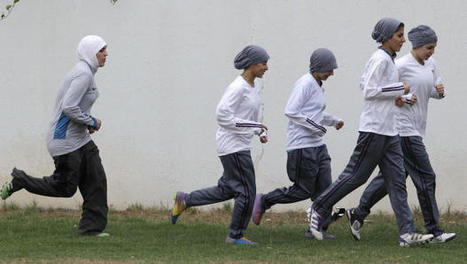
"Private girls' schools are now allowed to hold sports activities in accordance with the rules of Shariah, or Islamic law. Students must adhere to 'decent dress' codes and Saudi women teachers will be given priority in supervising the activities, according to the Education Ministry's requirements. The decision makes sports once again a stage for the push to improve women's rights, nearly a year after two Saudi female athletes made an unprecedented appearance at the Olympics." This news comes at a time when Saudi Arabia has allowed women to ride bikes (sort of).
Tags: Saudi Arabia, culture, gender, religion, Middle East.

I was happy to see an article like this. It's about time that these women are being given equal opportunities. Although they have a long way to go this is a step in the right direction. Saudi Arabian girls are being allowed to have sport related activities within their private schools. This did surprise me a little just because Saudi women's rights are very limited but this is a simple improvement just to the general health and well being of these girls. Two females competed in the last years summer Olympics representing Saudi Arabia and their efforts were not shown on Saudi TV. These women competing has opened a few doors to allowing more than just men to engage in these activities. Usually sports were only for the elite women who could afford gym memberships or attend well known colleges. Even though women cannot compete internationally or sign up for clubs or leagues this is a step in the right direction.

This is an interesting article about slowly allowing women in Saudi Arabia to participate in sports. While playing soccer or swimming or running may not seem so important to us in the West, it is a big deal for Saudi women. Saudi Arabia has some of the strictest laws in the Middle East regarding women's rights, and so even a very partial and gradual allowance for women to engage in sports is a big step. It shows perhaps a slight softening of adherence to Shariah law, which would hopefully eventually allow women more freedom in the realms of education and work, as well as in everyday life.
Too often are people quick to judge and characterize other cultures or religions by the most extreme examples. While it is true that laws in Saudi Arabia are extremely restrictive to women, progress such as this, though small, may well act as a stepping stone for increased freedoms for women. People outside of Saudi Arabia and Islamic culture must realize that this kind of progress does happen and is, in fact, happening right now. To simply dismiss Saudi culture as misogynistic and oppressive is to write the whole culture off. While progress is slow and less than ideal, we should look to Saudi Arabia's Islamic neighbors and see that many of them are not so oppressive to women. Allowing Saudi women to participate in sports, therefore, may be setting up the country to increase women's rights and join its relatively more liberal neighbors. This is certainly a sign of positive change, and one that should not be ignored.
I was quite shocked to hear of this story. There is no denying, that this is a step forward for the women of Saudi Arabia. However, women are far from free in this country. The activates still have to be in accordance with Islamic Law. The strict dress code also remains in effect for the girls. The Sports themselves, must be overseen by women teachers. I would not call this initiative the Saudi equivalent of title nine, but it is a step forward. Every little inroad, is a step towards more equality. The government of Saudi Arabia appears to be at least slightly altering its view of women. Hopefully this will be the first step in movement to gain Saudi women more rights. In generations to come, hopefully Saudi women will look back on this development as the start of a cultural revolution in Saudi Arabia.
|
|
Scooped by
Clairelouise
May 11, 2013 8:53 AM
|
Scoop.it!

Investigate for yourself the mechanisms of global trade

This more clearly shows the regional restructuring of the global economy than just about anything I've ever seen, especially manufacturing. The 8 largest and busiest ports in the world are all in East or Southeast Asia (and 11 of the top 13). A quick glance at the historical charts will show that most of these were relatively minor ports that have exploded in the last 20 years.
New Jersey at 24
Tags: transportation, globalization, diffusion, East Asia, industry, economic.

This more clearly shows the regional restructuring of the global economy than just about anything I've ever seen, especially manufacturing. The 8 largest and busiest ports in the world are all in East or Southeast Asia (and 11 of the top 13). A quick glance at the historical charts will show that most of these were relatively minor ports that have exploded in the last 20 years.
Tags: transportation, globalization, diffusion, East Asia, industry, economic.

|
|
Scooped by
Clairelouise
May 5, 2013 12:50 PM
|
Scoop.it!
A typology of political opinion which adds a social dimension to the usual economic classification of left and right
|
|
Rescooped by
Clairelouise
from Schools + Libraries + Museums + STEAM + Digital Media Literacy + Cyber Arts + Connected to Fiber Networks
May 5, 2013 12:35 PM
|
Scoop.it!

I vividly remember being disappointed during my first year of teaching: my students weren’t nearly as excited about primary source documents as I was. Primary source documents, as you know, offer readers a unique, real-world perspective, and I thought my kids would love delving into them.
I soon learned that my disappointing results weren’t due to the documents that I’d selected, but rather how I was having students use them. That first year, they weren’t doing anything but reading them.
Today, Web-based tools enable students to discover more primary sources than ever before and engage them in dynamic ways. The following items are some of my favorites.
Click headline to read more--
|
|
Scooped by
Clairelouise
May 5, 2013 12:29 PM
|
Scoop.it!

Put away that old Rand McNally map — it's time for a new way to see what America really looks like.
|
|
Scooped by
Clairelouise
May 5, 2013 7:48 AM
|
Scoop.it!

Researchers are heading to Dharavi, Mumbai, to study the impact of slum tours on the residents.

I don’t find nothing right about tourist visiting the slum, I feel that the tourist are violating there privacy. They are human being not some historical landmark. If the tourist are not helping this people why are they going? If you are going to visit this places do it because you want to help them, not because you think is interesting their way of living.

Moral questions are always fun. Personally I don't think going to see slums is all that exploitative in itself, but I would make a distinction between guided tours that cost money, and self-directed tours though. In a guided tour you are paying money to walk through a community and view what life is like for those people, but in a self-directed tour you are just another person walking down the streets and viewing whatever you stumble upon. There are plenty of tours within neighborhoods of different economic value the world over, but these tours are scrutinized because the people touring are as wealthy, or less wealthy, than the people living there. I don't think that a poor community changes this dynamic in an immoral way, as the perceptions of which group is superior come from the own minds of those who feel uncomfortable with it.

This article rises in interesting question. Are tours of slums exploitive or beneficial to the slum dwellers? On the one hand the tours could feel like exploitation and the tourist is viewing attractions at a “zoo”, on the other hand it brings people far removed from slum life in contact with it and can change people’s point of view on the slums. It can be beneficial if the tour guides donate money to the slums or jobs are sought by slum dwellers to become tour guides. The question is should slums be hidden away from view or opened up to tourists so that they can see the hardships first hand. I think that this is an issue that is not clearly black or white; there are many shades of gray involved in this issue.
|
|
Rescooped by
Clairelouise
from Government and Economics
May 1, 2013 2:02 PM
|
Scoop.it!

The Obama administration is running one of the most consequential political experiments in history. The early results will unnerve many who think they know how Washington works.
|
|
Scooped by
Clairelouise
May 1, 2013 2:00 PM
|
Scoop.it!
Facebook COO Sheryl Sandberg looks at why a smaller percentage of women than men reach the top of their professions -- and offers 3 powerful pieces of advice to women aiming for the C-suite.








j'aime ça