


A rice enriched with beta-carotene promises to boost the health of poor children around the world. But critics say golden rice is also a clever PR move for a biotech industry driven by profits, not humanitarianism.

 Your new post is loading...
 Scoop.it! A rice enriched with beta-carotene promises to boost the health of poor children around the world. But critics say golden rice is also a clever PR move for a biotech industry driven by profits, not humanitarianism. 
Scoop.it!

Drug Testing Index; A map of the U.S. depicting overall drug test positive rates
Scoop.it!
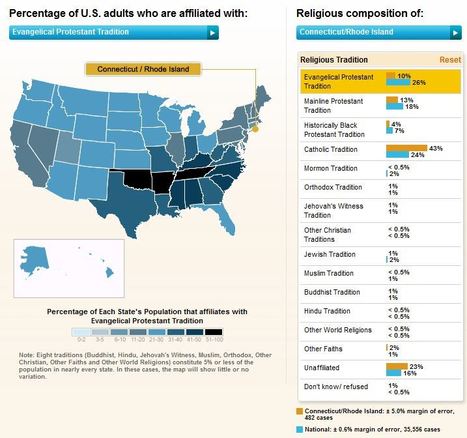
The Pew U.S. Religious Landscape Study religion map diagrams which religions have the highest populations in each state.

Hye-Hyun Kang's curator insight,
January 10, 2014 12:13 AM
This shows how different religions have affected different states in the U.S. This affects certain areas in the states and their culture. 
Rishi Suresh's curator insight,
January 16, 2014 12:36 PM
Khanh Fleshman's insight: This relates to Key Issue #1 because it shows the distribution of religions on a national scale. It also highlights the dominance of Christianity and Protestantism in the US.
Graham Shroyer's insight: This relates to key issue 1 because it shows the prevalence of christianity, a universalizing religion, in the US.
Vinay Penmetsa: This relates with the section, showing how Christianity is an universalizing religion, and its distribution in America.
Zahida Ashroff's Insight: This relates to Key Issue #1 because it shows the distribution and density of Protestants in the U.S. This map shows that the highest density of Protestants occur oin the South-Eastern region of the U.S.
Rishi Suresh: This relates to the distribution of denominations within America. It shows how the distribution is related to the patterns left by the original settlers. 
Miles Gibson's curator insight,
December 26, 2014 12:00 AM
Unit 3 culture This demographic relates to unit 3 because it shows how religions develop in different areas over time and pressures individual movements. It shows group organization throughout the u.s. and this is a cultural aspect of unit 3 that is very well touched upon. It is an overall demonstration of unit 3
Scoop.it!

eHistory at OSU, World History, US Civil War - Over 120,000 pages of Official Records, soldier's letters, memoirs, books, original articles and informative databases, Reviews, Primary Sources
Scoop.it!

Full text of Franklin Delano Roosevelt's The Four Freedoms
Scoop.it!
The deadliest workplace accident in New York's history changed American factories forever.
Scoop.it!
Clairelouise's insight:
Clash of Cultures 1910's and 1920's
Scoop.it!

But that may be because they generally see their mothers first. A look at the results of an in-depth study of 30 middle-class families.
Clairelouise's insight:
cultural anthropology class
Scoop.it!

Free online tool allows students to record responses to a primary source, and e-mail or print their work. Prompts help students to observe, reflect, question and further investigate the primary source.
|
Scoop.it!

Want to know where the poor live? Look at where the light isn’t.
"Satellite photos of Earth’s artificial lights at night form a luminescent landscape. But researcher Chris Elvidge of NOAA and colleagues from the University of Colorado and the University of Denver realized that they could also illuminate something much darker: the magnitude of human poverty. By comparing the amount of light in a particular area and its known population, they realized that they could infer the percentage of people who are able to afford electricity and the level of government spending on infrastructure development. This allowed them to extrapolate levels of human development—a measure of well-being that includes such factors as income, life expectancy and literacy."

Shelby Porter's curator insight,
November 4, 2013 10:12 AM
This political cartoon is just another great example of how different cultures are across the globe. Here in America, we are told that the appropriate swimwear to wear to the beach only covers about a third of our body. Where as in the Middle East, wearing a burka is what they are told is the right type of clothing to wear. Whether it be for religious, cultural, or fashionable reasons, women wear all types of clothing and I don't believe it is directly due to male influence. There are many things that could cause this influence such as the church, family, or the media. Yet as the cartoon says, each woman thinks the men in that country are forcing them into wearing clothes like that and their culture is dominated by men. I guess it just shows the different perspectives each culture can have. 
megan b clement's comment,
December 16, 2013 12:51 AM
This cartoon depicts the cultural differences between two different cultures. On the right you have a woman in a traditional burka that covers all but her eyes. On the left you have a woman in a bikini which is what is apropriate to wear on the beach or to bed. Two totally different societies and beliefs and they both look at one another and see the other person as inapropriate. This is not the first time another country has looked at the USA and turned their nose up to something that we do differently.

Jacqueline Landry's curator insight,
December 16, 2013 6:31 PM
when I look at this the first thought that comes to mind is it is easy for other people to judge. just by there comments they have no idea what the others beliefs are,. This is a classic judging a book by it's cover. The are both assuming it has to do with a male dominating world. I think it has to do with what you are comfortable with.
Scoop.it!
Infographics on the distribution of wealth in America, highlighting both the inequality and the difference between our perception of inequality and the actua...
Scoop.it!

Full text and audio and video of Dwight D. Eisenhower's Farewell Address
Scoop.it!

Eighty years ago, in July 1925, the mixture of religion, science and the public schools caught fire in Dayton, Tenn. The Scopes trial — or "Monkey Trial," as it was called — dominated headlines across the country.
Scoop.it!

From
www

Until recently, our brains' way of connecting food with love and a sense of well-being was purely a good thing. But in a world where it's possible to feast every day, it can be a problem.
Clairelouise's insight:
cultural anthropology class
Scoop.it!

Couples who don't have a system for household tasks can get really resentful, really quickly. A look at the results of an in-depth study of middle-class families.
Clairelouise's insight:
cultural anthropology class
Scoop.it!
Refers to the violent deaths of 20 people, 11 of them children, during an attack by the Colorado National Guard on a tent colony of 1,200 striking coal miner...
Scoop.it!

Faith Ladd is drawn to the BP logo mostly because it's bright, colorful and resembles a flower. So when the spirited 5-year-old and her father were driving to grab some food on Sunday, she spotted the sign and asked if someone designed the logo.
|









I thought this NPR broadcast was a great out of class referece to listen too. As it explaine all the work and research that was being done with GMOs, it also exposed them for there flaws and what the real motives behind them are. While this ex source of rice with extra vitman A will deffenitly provid more nutitonal value then regular rice, it also provides higher profit margins for the bioengneer compaines that make it. So its almost hard to say weather GMOs are a bad or good thing beacuse they do have benifts, but one thing is clear there not just being made to help the poor, there being made for big profit possibilities.
Alright this is a reason GMF's can be used for good. Asian children do not get enough vitamin a. "When children are weaned, they're often weaned on a rice gruel. And if they don't get any beta-carotene or vitamin A during that period, they can be harmed for the rest of their lives,".
This is a great podcast that emphasizes various geographic themes including agriculture, development and economics. This new genetically-modified rice was designed to provide vitamin A (something no natural rice provides) to impoverished diets. Skeptics point out that the history of the industry shows that the goal is to enrich a select number of corporations while some are hailing this as a major advancement that will benefit the poor. Where people side on this is often ideological, so those that are firmly against genetically modified foods find the flaw in the plan and vice versa. What do you think? How might this change food production and consumption worldwide and at a local scale?
Tags: GMOs, development, NGOs, Food, agriculture, agribusiness, unit 5 agriculture.