Matthew Taylor explores the meaning of 21st century enlightenment, how the idea might help us meet the challenges we face today, and the role that can be pla...
"Freedom House has been at the forefront in monitoring threats to media independence since 1980. A free press plays a key role in sustaining and monitoring a healthy democracy, as well as in contributing to greater accountability, good government, and economic development. Most importantly, restrictions on media are often an early indicator that governments intend to assault other democratic institutions."
This interactive map shows some intriguing spatial patterns about the freedom of press internationally. What other patterns to you see in matching up with the most free presses in the world (in green)? How does a free (or not free press) influence the cultural and political values of a country?
TED Talks Patricia Kuhl shares astonishing findings about how babies learn one language over another -- by listening to the humans around them and "taking statistics" on the sounds they need to know.
LAOS, a poor country of 6m people wedged between Vietnam and Thailand, has no openings to the sea and few routes to world attention. But it is now enjoying a rare...
The death of newspapers – by cutbacks, outright disappearance, or morphing into lean websites – means a reduction of watchdog reporting and less local information. Some say it has caused a drop in civic participation.
Jeff Bercovici: "If there was still any debate about whether serious photojournalism can take place in the context of camera phones and cutesy retro filters, it’s over now" ...
Cecilia Kang: "Kids spend more time than ever in front of screens beyond the living room television. Advertisers have responded with sophisticated ad campaigns that can start on the TV and then move to apps, social media sites and online games" ...
Crowdsourcing (the process of using an open call contest or a 'crowd' of people to get something done) is a buzz word that was coined in Wired Magazine by author Jeff Howe in 2006, but the process of crowdsourcing was invented as early as 1714. ...
Via k3hamilton
This is an excellent video for population and demographic units, but also for showing regional and spatial distinctions (since terms like 'overpopulation' and 'carrying capacity' inherently have different meanings at different scales).
This video shows how the populations of each country are increasing and decreasing in a very unique way. It explains how the populations are increasing and decreasing as the years go on. It also shows that the death rates and the birth rates are being combined to make the true populations as accurate as possible.
This video is good at helping people better visualize population because you can easily see the difference of each continent. It shows how the population started small and rapidly expanded because of the agricultural and industrial revolution and decrease in deaths making it and the births unstablized. It even goes on to talk about the future population and how it is believed that the population won't continue to grow rapidly but once again stabalize.
I've used similar videos in my classes and students are usually quite shocked to see how a city like Bangkok, Thailand operates. I've used this as a 'hook' for lessons of population growth, urbanization, economic development, sustainability, megacities and city planning.
On the one hand this disturbed me. All I kept thinking when I saw the people go back on the tracks is that they could easily be killed.In fact, I wonder how many accidents have ever occurred near this area. All it would take is some sort of malfunction on the train in which the horn wasn’t sounding to provide ample warning or someone gets in another person’s way so there isn’t enough time to close down the shop. On the other hand, this made me realize just how efficient a population could become at using space. Everything was timed so that the entire area moved out of the way without an issue. So rather than let any land go to waste, the area uses it despite the risk to its population. Though it really isn't like the population has a choice though. So in instances where there is such overpopulation, it is interesting to see how well the society can adapt to the phenomenon. I do wonder what would happen if the country becomes more developed and the population declines. Would this type of land continue in the future or be disband? I know that in our country there are many laws that would make this illegal, but our country also has the space avoid developing the land in such a manner. When comparing it to the laws of the United States, I would think the country would eventually drift away from this use of land when possible. However, now that I watch the video, I have a new appreciation for maximizing land and I hope that the efficient could continue. Just in a less scary manner.
Talk about using every inch of space available to you. I find this video crazy not only because of the safety hazards, but just how people seem to go about this like it is normal. This would never take place in America!
An absolute amazing dynamic is seen in this video. To say that Bangkok is trying to use most of its open space up would be an understatement. In developed countries, you would not only never see this happen but you would not even see a thought of doing something like this. There are violations every where you look.
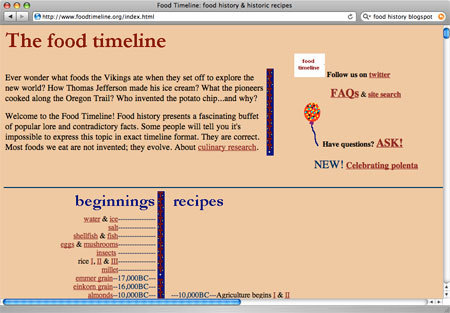
Food Timeline: free food history reference & research service...
"Hidden between the layers of fat on the Web are some juicy morsels that serious researchers will find worthwhile. One site in particular, "The Food Timeline,"offers both the scholar and student of food history a very nice collection of links to a wide variety of primary and secondary sources in food history across time. The site, launched in 1999 by New Jersey librarian Lynne Olver, is a continually updated and growing collection of links to a variety of food-related topics and historical recipes, organized on a timeline on the main page." For more quotes from this extensive review, see: http://www.common-place.org/web-library/2009-10.shtml
TED Talks Over the past few centuries, Western cultures have been very good at creating general prosperity for themselves. Historian Niall Ferguson asks: Why the West, and less so the rest?
TED Talks "Babies and young children are like the R&D division of the human species," says psychologist Alison Gopnik. Her research explores the sophisticated intelligence-gathering and decision-making that babies are really doing when they play.
For the most part in American culture, intellectual struggle in school children is seen as an indicator of weakness, while in Eastern cultures it is not only tolerated, it is often used to measure emotional strength.
This week is Media Literacy Week and Media Smarts http://www.medialiteracyweek.ca/en/default.htm and the theme is privacy matters. In addition to teaching our kids to think critically, and understand that media does not ...
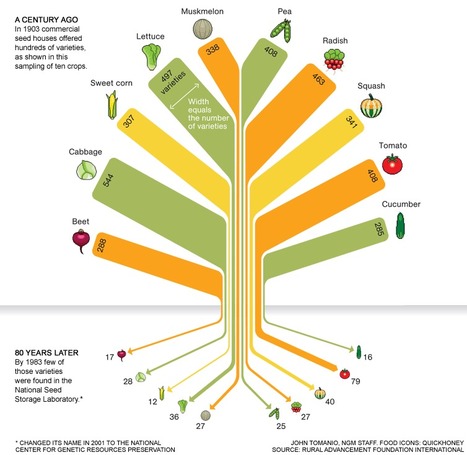
"As we've come to depend on a handful of commercial varieties of fruits and vegetables, thousands of heirloom varieties have disappeared. It's hard to know exactly how many have been lost over the past century, but a study conducted in 1983 by the Rural Advancement Foundation International gave a clue to the scope of the problem. It compared USDA listings of seed varieties sold by commercial U.S. seed houses in 1903 with those in the U.S. National Seed Storage Laboratory in 1983. The survey, which included 66 crops, found that about 93 percent of the varieties had gone extinct. More up-to-date studies are needed."
To show the other side of the issue, include this minor, yet crucial part of the article: "A 30-year-old plant pathologist named Norman Borlaug traveled to Mexico in 1944 to help fight a stem rust epidemic that had caused widespread famine. Crossing different wheat varieties from all over the world, he arrived at a rust-resistant, high-yield hybrid that helped India and Pakistan nearly double their wheat production—and saved a billion people from starvation. This so-called green revolution helped introduce modern industrialized agriculture to the developing world."
This article is based on a study done by the Rural Advancement Foundation in 1983. Over the past century, it is hard to know what foods were lost and how many of each. But this study done by RAF gave us some information to solve the problem. It compared USDA listings of seed varieties sold by commercial U.S. seed houses in 1903 with those in the U.S. National Seed Storage Laboratory in 1983. The survey, which included 66 crops, found that about 93 percent of the varieties had gone extinct. 93 percent of these crops have gone extinct. That is a huge chunk that could be used as resources. This tree starts off with ten crops on it. The tree included: beet, cabbage, sweet corn, lettuce, muskmelon, peas, radish, squash, cucumbers, and tomatoes. In 1903, all these numbers were up, up, up. The lowest starting with beet at 288 ranging up to the highest with lettuce at 497. However, 80 years later in 1983, numbers dropped. The highest then shifted to tomatoes at 79 and the lowest shifted to sweet corn at 12.
From a scientific view point it almost seems like we are making ourselves into specialists in an ecological / dietary way. Limiting our available food resources and hoping against the odds that we don't suffer the same fate as other specialist species of the past.
An array of different sexual messages of varying degrees of subtlety have been used over the years in advertising, but which ads really changed the game when it came to sexual content?
Via k3hamilton
January and February are sweet times for most Chinese — they enjoy family reunions during the spring festival, which this year fell on January 23, and they celebrate Valentine’s Day, which is well-liked in China.
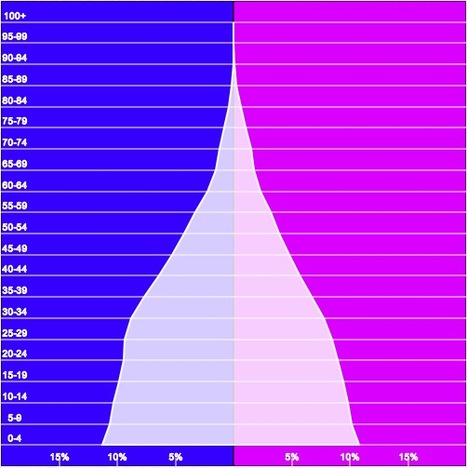
Gender roles in cultural norms change from country to country. What also needs to be understood is how the demographic situation of a given country influences these patterns.
Being 27 years old and unmarried in China considers you to be an old maid? I had to do a double take when I saw this. In the United States, 27 years old is around the average age a couple decides to get married. In China, Valentine's day is a really well liked holiday. Therefore, you would think that there would be excessive amounts of marriages, especially around this time. However, we know about the one child policy put into place at China. I can imagine that this might play a role because of the gender imbalances. As horrible as this sounds, in China, they call the women who are thirty and single "leftovers". During the season of the Chinese New Year and Valentine's Day, the "leftovers" just get questioned about their relationship status or go to matchmaking parties. However, the "leftovers" are said to have three good things; good career, good education and good looks. This is interesting because if they had all these good qualities, why would they still be single at 30 years old? As the article continues, we talk about true love and believe it or not, some "leftovers" still believe in true love and that they may experience that one day.
The fact that success relatively young women are seen as leftovers in China is a completely foreign idea to me. n the United States we are seeing that more and more women are marrying later in life after they have received an education, higher education and have been established in a career. Emily Liang is an extremely successful women who should be proud of her accomplishments, yet has to declare herself as "divorced" in order for men to think something isn't "wrong" with her. It is extremely obvious that the role and view of women in China is significantly distorted.
Gender roles in many countries in the world are still a huge problem. In China, the gender roles are really bad and it shows that although the country is rapidly advancing in many ways it still sticks to its old roots where the women are not as respected as the men.
This is a clip from the TV show West Wing (Season 2-Episode 16) where cartography plays a key role in the plot. In this episode the fictitious (but still on Facebook) group named "the Organization of Cartographers for Social Justice" is campaigning to have the President officially endorse the Gall-Peters Projection in schools and denounce the Mercator projection. The argument being that children will grow up thinking some places are not as important because they are minimized by the map projection. While a bit comical, the cartographic debate is quite informative even if it was designed to appear as though the issue was trivial.
Questions to Ponder: Why do map projections matter? Is one global map projection inherently better than the rest?
According to Money Magazine, Carmel, IN is the “best place to live” in America. Its mayor says that’s because he’s looked to Europe for urban inspiration.
To get content containing either thought or leadership enter:
To get content containing both thought and leadership enter:
To get content containing the expression thought leadership enter:
You can enter several keywords and you can refine them whenever you want. Our suggestion engine uses more signals but entering a few keywords here will rapidly give you great content to curate.


 Your new post is loading...


 Scoop.it!