Your new post is loading...

|
Scooped by
Loïc Lepiniec
November 6, 2016 4:40 PM
|
While in the movie Deadpool it is possible for a human to recreate an arm from scratch, in reality plants can even surpass that. Not only can they regenerate lost parts, but also the whole plant body can be reborn from a few existing cells. Despite the decades old realization that plant cells pos- sess the ability to regenerate a complete shoot and root system, it is only now that the underlying mechanisms are being unraveled. De novo plant regeneration involves the initiation of regenera- tive mass, acquisition of the pluripotent state, reconstitution of stem cells and assembly of regula- tory interactions. Recent studies have furthered our understanding on the making of a complete plant system in the absence of embryonic positional cues. We review the recent studies probing the molecular mechanisms of de novo plant regeneration in response to external inductive cues and our current knowledge of direct reprogramming of root to shoot and vice versa. We further discuss how de novo regeneration can be exploited to meet the demands of green culture indus- tries and to serve as a general model to address the fundamental questions of regeneration across the plant kingdom.
|
|
Scooped by
Loïc Lepiniec
November 6, 2016 2:54 AM
|
|
|
Scooped by
Loïc Lepiniec
November 6, 2016 2:17 AM
|
|
|
Scooped by
Loïc Lepiniec
November 5, 2016 3:44 AM
|
Identification and reconstitution of the rubber biosynthetic machinery on rubber particles from Hevea brasiliensis
|
|
Rescooped by
Loïc Lepiniec
from Plant Sciences
November 5, 2016 3:38 AM
|
The organisms and ecosystems highlighted in the 37 projects selected for the 2017 Community Science Program (CSP) of the US Department of Energy Joint Genome Institute (DOE JGI), a DOE Office of Science User Facility, 'exploit DOE JGI's experimental and analytical 'omics' capabilities and build our portfolio in key focus areas' and reflect the breadth and depth of interests researchers are exploring to find solutions to energy and environmental challenges.
Via Saclay Plant Sciences
|
|
Scooped by
Loïc Lepiniec
November 4, 2016 2:10 PM
|
Abstract
Small proteins have long been overlooked due to their poor annotation and the experimental challenges they pose. However, in recent years, their role in various processes has started to emerge, opening new research avenues. Here, we present the isolation and characterization of two allelic mutants, twisted seed1-1 (tws1-1) and tws1-2, which exhibit an array of developmental and biochemical phenotypes in Arabidopsis (Arabidopsis thaliana) seeds. We have identified AT5G01075 as the subtending gene encoding a small protein of 81 amino acids localized in the endoplasmic reticulum. TWS1 is strongly expressed in seeds, where it regulates both embryo development and accumulation of storage compounds. TWS1 loss-of-function seeds exhibit increased starch, sucrose, and protein accumulation at the detriment of fatty acids. TWS1 is also expressed in vegetative and reproductive tissues, where it is responsible for proper epidermal cell morphology and overall plant growth. At the cellular level, TWS1 is responsible for cuticle deposition on epidermal cells and organization of the endomembrane system. Finally, we show that TWS1 is a single-copy gene in Arabidopsis, and it is specifically conserved among angiosperms.
|
|
Scooped by
Loïc Lepiniec
November 4, 2016 1:17 PM
|
The large, unbranched cultivated carrot (Daucus carota subspecies sativus) is a popular vegetable with high sugar and dietary provitamin A carotenoid contents. The orange-coloured one is best known, but there are also white, yellow, red, and purple varieties. By contrast, the wild carrot Daucus carota subspecies carota (commonly referred to as Queen Anne's Lace) is a weedy plant that does not accumulate any detectable levels of carotenoid pigments in roots i. When visiting the museums of his native country in the late 1950s, the Dutch agronomer Otto Banga started to ponder the question on the origin of the modern carrot. He observed that paintings from the Dutch Golden Century (∼17th century) show an enormous diversity of carrots: white, red, yellow, and orange versions (Figure 1A). However, he noticed the orange carrot featuring more prominently on pictures that were painted later in the 17th century. He concluded that the orange carrot as we currently know it, appeared in the late 16th to early 17th century, and that it was likely first cultivated in The Netherlands [1]. Here, in view of the recent carrot genome assembly [2], we noncomprehensively discuss the origin of the carrot, explain how art can help in our understanding of its development, and elaborate upon some of the molecular mechanisms and underlying genetic network responsible for the observed colour differences.
|
|
Scooped by
Loïc Lepiniec
November 3, 2016 3:21 AM
|
|
|
Scooped by
Loïc Lepiniec
November 2, 2016 3:08 AM
|
|
|
Scooped by
Loïc Lepiniec
November 1, 2016 10:01 AM
|
The root cap supports root growth by protecting the root meristem, sensing gravity and interacting with the rhizosphere through metabolite secretion and cell dispersal. Sustained root cap functions therefore rely on balanced proliferation of proximal stem cells and regulated detachment of distal mature cells. Although the gene regulatory network that governs stem cell activity in the root cap has been extensively studied in Arabidopsis , the mechanisms by which root cap cells mature and detach from the root tip are poorly understood. We performed a detailed expression analysis of three regulators of root cap differentiation, SOMBRERO , BEARSKIN1 and BEARSKIN2 , and identified their downstream genes. Our results indicate that expression of BEARSKIN1 and BEARSKIN2 is associated with cell positioning on the root surface. We identified a glycosyl hydrolase 28 (GH28) family polygalacturonase (PG) gene as a direct target of BEARSKIN1. Overexpression and loss-of-function analyses demonstrated that the protein encoded by this PG gene facilitates cell detachment. We thus revealed a molecular link between the key regulators of root cap differentiation and the cellular events underlying root cap-specific functions.
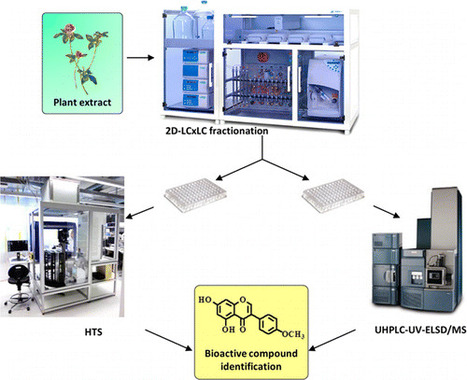
To identify natural bioactive compounds from complex mixtures such as plant extracts, efficient fractionation for biological screening is mandatory. In this context, a fully automated workflow based on two-dimensional liquid chromatography (2D-LC × LC) was developed, allowing for the production of hundreds of semipure fractions per extract. Moreover, the ELSD response was used for online sample weight estimation and automated concentration normalization for subsequent bioassays. To evaluate the efficiency of this protocol, an enzymatic assay was developed using AMP-activated protein kinase (AMPK). The activation of AMPK by nonactive extracts spiked with biochanin A, a known AMPK activator, was enhanced greatly when the fractionation workflow was applied compared to screening crude spiked extracts. The performance of the workflow was further evaluated on a red clover (Trifolium pratense) extract, which is a natural source of biochanin A. In this case, while the crude extract or 1D chromatography fractions failed to activate AMPK, semipure fractions containing biochanin A were readily localized when produced by the 2D-LC×LC-ELSD workflow. The automated fractionation methodology presented demonstrated high efficiency for the detection of bioactive compounds at low abundance in plant extracts for high-throughput screening. This procedure can be used routinely to populate natural product libraries for biological screening. Paul Coulerie†‡, Yann Ratinaud†, Sofia Moco†, Loraine Merminod†, Martine Naranjo Pinta†, Julien Boccard‡, Laurent Bultot†, Maria Deak†, Kei Sakamoto†, Emerson Ferreira Queiroz‡, Jean-Luc Wolfender‡, and Denis Barron*† DOI: 10.1021/acs.jnatprod.6b00628 Publication Date (Web): October 28, 2016
Via NatProdChem
|
|
Scooped by
Loïc Lepiniec
October 29, 2016 3:20 AM
|
|
|
Scooped by
Loïc Lepiniec
October 28, 2016 3:33 AM
|
Abstract The plant epidermis is crucial to survival, regulating interactions with the environment and controlling plant growth. The phytocalpain DEFECTIVE KERNEL1 (DEK1) is a master regulator of epidermal differentiation and maintenance, acting upstream of epidermal-specific transcription factors, and is required for correct cell adhesion. It is currently unclear how changes in DEK1 lead to cellular defects in the epidermis and the pathways through which DEK1 acts. ..... These findings significantly advance our understanding of the role of the epidermal cell walls in growth regulation and establish a new role for DEK1 in pathways regulating epidermal cell wall deposition and remodelling.
|
|
|
Rescooped by
Loïc Lepiniec
from Plant Sciences
November 6, 2016 10:11 AM
|
The Paris Agreement, adopted in December 2015, represents a new beginning in the global effort to stabilize the climate before it is too late. It recognizes the importance of food security in the international response to climate change, as reflected by many countries focusing prominently on the agriculture sector in their planned contributions to adaptation and mitigation. To help put those plans into action, this report identifies strategies, financing opportunities, and data and information needs. It also describes transformative policies and institutions that can overcome barriers to implementation.
Via Saclay Plant Sciences
|
|
Scooped by
Loïc Lepiniec
November 6, 2016 2:23 AM
|
Oilseed crops, especially soybean (Glycine max) and canola/rapeseed (Brassica napus), produce seeds that are rich in both proteins and oils and that are major sources of energy and nutrition worldwide
|
|
Rescooped by
Loïc Lepiniec
from Plant and Seed Biology
November 5, 2016 3:55 AM
|
To respond to environmental changes, such as drought, plants must regulate numerous cellular processes. Working in the model plant Arabidopsis , Song et al. profiled the binding of 21 transcription factors to chromatin and mapped the complex gene regulatory networks involved in the response to the plant hormone abscisic acid. The work provides a framework for understanding and modulating plant responses to stress.
Science , this issue p. [598][1]
[1]: http://www.sciencemag.org/content/354/6312/aag1550.full
|
|
Scooped by
Loïc Lepiniec
November 5, 2016 3:42 AM
|
Researchers apply for a licence to carry out a trial of a genetically modified wheat crop in a small field in Hertfordshire.
|
|
Scooped by
Loïc Lepiniec
November 4, 2016 4:25 PM
|
Inhibition of FUSCA3 degradation at high temperature is dependent on ABA signaling and is regulated by the ABA/GA ratio. Plant Signaling & Behavior. Accepted 7 October 2016. doi: 10.1080/15592324.2016.1247137
|
|
Scooped by
Loïc Lepiniec
November 4, 2016 2:06 PM
|
|
|
Scooped by
Loïc Lepiniec
November 4, 2016 3:40 AM
|
|
|
Scooped by
Loïc Lepiniec
November 3, 2016 2:58 AM
|
As gene editing opens doors, plant researchers are hamstrung by the need for better ways to slip their molecular tools into cells.
|
|
Scooped by
Loïc Lepiniec
November 1, 2016 10:03 AM
|
|
|
Scooped by
Loïc Lepiniec
November 1, 2016 4:02 AM
|
The mechanism for T-DNA integration, a critical step of Agrobacterium-mediated transgenesis, remains elusive.
|
|
Scooped by
Loïc Lepiniec
November 1, 2016 3:32 AM
|
Finding causal relationships between genotypic and phenotypic variation is a key focus of evolutionary biology, human genetics and plant breeding. To identify genome-wide patterns underlying trait diversity, we assembled a high-quality reference genome of Cardamine hirsuta, a close relative of the model plant Arabidopsis thaliana. We combined comparative genome and transcriptome analyses with the experimental tools available in C. hirsuta to investigate gene function and phenotypic diversification. Our findings highlight the prevalent role of transcription factors and tandem gene duplications in morphological evolution. We identified a specific role for the transcriptional regulators PLETHORA5/7 in shaping leaf diversity and link tandem gene duplication with differential gene expression in the explosive seed pod of C. hirsuta. Our work highlights the value of comparative approaches in genetically tractable species to understand the genetic basis for evolutionary change.
|
|
Scooped by
Loïc Lepiniec
October 28, 2016 7:10 AM
|
Plants are responsive to temperature, and can distinguish differences of 1°C. In Arabidopsis , warmer temperature accelerates flowering and increases elongation growth (thermomorphogenesis). The mechanisms of temperature perception are however largely unknown. We describe a major thermosensory role for the phytochromes (red light receptors) during the night. Phytochrome null plants display a constitutive warm temperature response, and consistent with this, we show in this background that the warm temperature transcriptome becomes de-repressed at low temperatures. We have discovered phytochrome B (phyB) directly associates with the promoters of key target genes in a temperature dependent manner. The rate of phyB inactivation is proportional to temperature in the dark, enabling phytochromes to function as thermal timers, integrating temperature information over the course of the night.
|