Your new post is loading...

|
Scooped by
mhryu@live.com
August 25, 12:56 AM
|
Soil pollution poses a profound threat to ecosystem and human health. This review proposes a novel framework centered on engineering biological interaction networks for efficient and sustainable soil decontamination, moving beyond the traditional single-species paradigm. We dissect the architecture and dynamics of key interactions, including plant–plant, plant-microbe, and microbe-microbe interactions, within remediation contexts, elucidating how mechanisms like mutualism, competition, and cross-kingdom signaling govern the fate of heavy metals, organic pollutants, and complex mixtures. Crucially, we explore how these natural networks can be actively engineered through strategies such as targeted bioaugmentation, precision biostimulation, and rational plant community assembly to enhance remediation outcomes. Furthermore, we highlight how cutting-edge multi-omics, synthetic ecology, and computational modeling are transitioning the field from descriptive ecology to predictive network design, enabling the decoding of the soil black box and the rational construction of tailored, resilient remediation consortia. Finally, we discuss the ecological challenges of introducing designed networks and outline a future road map toward precision restoration ecology, where theory-guided interaction network management enables effective, stable, and ecologically sound soil clean-up. This network-centric paradigm represents a fundamental shift from experience-based trial-and-error to a principled design approach for restoring soil health.
|
|
Scooped by
mhryu@live.com
August 25, 12:28 AM
|
Aspergillus species are ecologically diverse and deeply entangled with human health and industry. A. fumigatus and A. flavus are the two principal species of invasive aspergillosis. A. niger and A. oryzae, on the other hand, are responsible for global enzyme production, organic acid production, and koji-based fermentation industries. The question of whether these similar phenotypes share the same genomic mechanisms across the genus is not yet understood. To address this, we constructed per-species pangenomes for the four Aspergillus species (929 initial genomes filtered to 210 ANI-verified, high-quality assemblies for a total of 88 A. fumigatus, 70 A. flavus, 33 A. oryzae, and 19 A. niger assemblies) alongside a genus-level pangenome of 15,163 orthogroups, and conducted phenotype-labeled pan-genome-wide association studies (pan-GWAS) with kinship correction across all species. Pan-GWAS identified up to 117 significant orthogroup presence/absence associations per species-phenotype comparison. However, convergence analysis showed that among the 92 and 62 distinct gene families significant for human pathogenicity in A. fumigatus and A. flavus respectively, the two species seldom agreed on whether the pathogenicity was associated with the enrichment or the depletion of a specific gene family. Convergence analysis of the functional annotations also yielded zero significant results at FDR < 0.05. A literature-curated gene panel analysis also showed that a species labeled pathogenic and another labeled GRAS carried the same aflatoxin and virulence genes, suggesting that gene presence alone cannot readily explain their phenotypic differences. Instead, we propose that niche adaptation operates through the use of the pangenomic rare genome. Reclassifying rare genes by homology identified truly rare subsets (156 to 391 orthogroups per species) distinct from paralogs and gene fragments. Human-pathogenic strains showed significant rare genome expansion of 2.44-fold for both A. fumigatus and A. flavus (kinship corrected, p = 6.6 e-08). Conversely, industrial strains showed rare genome contraction where both A. niger and A. oryzae industrial strains carried 0.57-fold (kinship corrected, p = 0.015) fewer rare genes than their non-industrial counterparts. Hence, we claim that Aspergillus niche evolution proceeds through directional rare genome changes, where there is expansion under pathogenic selection, and contraction under industrial domestication. The rare genome, often discarded as noise, may represent the primary evolutionary source for clinical and biotechnological adaptation in this genus.
|
|
Scooped by
mhryu@live.com
August 25, 12:19 AM
|
Budding yeast Saccharomyces cerevisiae and various non-conventional species are widely applied in the production of diverse industrial products, including pharmaceuticals, biofuels, biochemicals, and biomaterials, due to their rich natural and engineered biodiversity. This review summarizes recent advances in harnessing yeast biodiversity for industrial applications, including natural yeast diversity derived from ecological adaptation and genetic variation across diverse environments, and artificial diversity generated through adaptive laboratory evolution, metabolic or epigenetic engineering, and synthetic biology. We highlight the establishment of strain-level culture libraries and extremophilic yeasts as models for stress adaptation. In addition, we emphasize that the integration of multi-omics analysis, AI-assisted enzyme and strain engineering, and process optimization strategies are critical for the fully exploration and utilization of yeast biodiversity for efficient bioproduction.
|
|
Scooped by
mhryu@live.com
August 25, 12:09 AM
|
Mitigating reactive nitrogen losses is essential for sustainable agriculture. However, predicting the benefits of substituting synthetic fertilizers with organic amendments remain unreliable because conventional approaches treat soil nitrogen processes in isolation. Here, we adapt a synchrony metric from community ecology to quantify the coordination among nitrogen processes. Using 2,235 global paired observations (organic vs. synthetic), we find that the synchrony metric predicts nitrous oxide (N2O) and ammonia (NH3) emissions more accurately than individual processes alone. Specifically, synchrony deviations in nitrification and denitrification account for half of global N2O variability, while synchrony deviations in mineralization and immobilization explain over one-third of NH3 variability. Projections indicate that leveraging organic substitution could achieve the greatest N2O reductions in European croplands (−40.7%) and the highest NH3 mitigation in Africa croplands (−46.1%). These findings establish process synchrony as a mechanistic framework for improving nitrogen gas loss models and inform targeted organic amendment strategies. Across global croplands, this study shows that replacing synthetic fertilizer with organic inputs improves coordination among soil nitrogen processes, helping reduce nitrous oxide and ammonia emissions.
|
|
Scooped by
mhryu@live.com
August 24, 11:33 PM
|
Gene length is a peculiar genomic feature that exhibits minimal variation within domains of life, suggesting universal underlying constraints. The length of a gene is primarily influenced by its function, expression level, and mutation risk. Interestingly, many of these factors vary depending on whether the gene is located on the leading or lagging strand of DNA replication. Studies in bacterial species E. coli and B. subtilis have shown that genes tend to be shorter on the lagging strand, potentially reflecting selection to minimize head-on encounters between the replication and transcription machinery. However, the universality of strand-specific constraints on gene length and the evolutionary basis remain unexplored. Here, using comparative genomics, we analyzed gene lengths in the bacterial domain and revealed a non-neutral distribution of gene lengths across leading and lagging strands. Genes and operons are consistently shorter on the lagging strand, irrespective of essentiality or functionality. The length restriction was more pronounced in bacterial species with a dual DNA polymerase mode of replication, which may experience severe head-on collisions between replication and transcription. Remarkably, we found that with increasing length of transcription units, substitution rates increased in the promoters on the lagging strand rather than the coding sequences, revealing a length-dependent and lagging strand-specific cis-regulatory mutational susceptibility. Together, we uncovered a pervasive selection pressure that optimizes gene lengths in a DNA strand-specific manner across bacteria to preserve the genetic integrity of promoters.
|
|
Scooped by
mhryu@live.com
August 24, 4:35 PM
|
Saccharomyces cerevisiae occurs predominantly in the diploid state in nature, limiting genetic analyses of wild populations. Here, we establish a haploid collection from 32 Taiwanese S. cerevisiae isolates through targeted HO disruption. This resource spans predomesticated Asian wild lineages and enables the investigation of reproductive isolation and ecological trait variation. Although all pairwise hybridizations formed zygotes, many yielded reduced spore viability, revealing strong postzygotic barriers. Genome analyses associated reduced hybrid fertility with lineage-specific structural variation, including elevated levels of intra-chromosomal inversions in H413-8/TW1 and inter-chromosomal rearrangements in PD35A/CHN-V, rather than sequence divergence alone. Phenotyping revealed ecological differentiation, with TW1 favoring cooler growth and a natural hybrid exhibiting heterosis with expanded thermotolerance. Most wild strains grew poorly on maltose, whereas anthropogenic strains displayed enhanced utilization linked to MAL+ regulatory alleles and maltose-specific transporters. Together, this haploid collection links structural variation and metabolic divergence to ecological and reproductive differentiation in wild S. cerevisiae.
|
|
Scooped by
mhryu@live.com
August 24, 4:23 PM
|
CRISPR-associated transposons (CASTs) are Tn7-like elements that have co-opted RNA-guided CRISPR effectors for targeted DNA insertion. CASTs have been adapted as genome editing tools for programmable, site-specific integration. Among them, the type I-F system from Pseudoalteromonas (PseCAST) shows exceptionally robust activity in human cells, yet its mechanistic basis remains poorly understood. Here, we present structural and biochemical analysis of the PseCAST transposase TnsAB. Biochemical reconstitution of transposon DNA excision defines key characteristics of the transposition mechanism. Cryogenic electron microscopy (cryo-EM) structures of PseTnsAB paired-end complexes reveal molecular determinants of transpososome assembly, transposon end recognition and cleavage. We validate these findings using biochemical and in vivo assays of structure-based transposase mutants, and provide mechanistic insights into the enhanced activity of a laboratory-evolved TnsAB variant. Together, our studies highlight molecular features underlying the efficiency of natural and engineered type I-F transposases and establish a mechanistic framework for their continued rational optimization. CRISPR-associated transposons mediate RNA-guided DNA integration, but the molecular basis of transposase function remains poorly understood. Here, the authors uncover the mechanism of a highly active type I-F transposase, informing the engineering of programmable DNA insertion tools.
|
|
Scooped by
mhryu@live.com
August 24, 3:09 PM
|
Methanol is an attractive single-carbon feedstock for scalable bioprocesses that avoids the consumption of agricultural products. Native yeast methylotrophy relies on alcohol oxidase (Aox), which dissipates reducing power and limits carbon conversion efficiency. Here, we replace Aox with the native, NAD+-dependent alcohol dehydrogenase 2 and eliminate the methanol dissimilatory branch by deleting formaldehyde dehydrogenase (Fld) in the yeasts Komagataella phaffii and Ogataea parapolymorpha. Engineered strains of both species sustain methylotrophic growth despite each modification being individually growth-defective. FLD deletion eliminates competition for cytosolically produced formaldehyde and enforces flux coupling between methanol utilization and NADH formation. Adaptive laboratory evolution over 30–50 generations yielded growth rates comparable to industrial yeast strains. In methanol-limited chemostats, evolved Adh-Δfld strains reduced specific CO₂ production 2-fold while increasing biomass yield 1.4-fold. The biomass-per-methanol yields of 0.48 g g−1 for K. phaffii and 0.43 g g−1 for O. parapolymorpha are the highest reported for each species. The Adh-based metabolic framework also enabled gram-per-liter itaconic acid production with higher product yield and lower CO₂ evolution than Aox-based strains, underscoring its utility for growth-coupled bioproduction. Adh-coupled methanol oxidation represents a generalizable strategy to increase carbon efficiency in other C1 utilization pathways and yeast species, providing a foundation for more sustainable biomanufacturing processes with yeasts.
|
|
Scooped by
mhryu@live.com
August 24, 12:48 PM
|
Streptomyces is a genus of Gram-positive bacteria renowned for its remarkable ability to produce a diverse array of secondary metabolites (SMs), many of which possess significant pharmaceutical and agricultural value. Unlocking the full biopotential of Streptomyces is increasingly important in the quest for new therapeutics and sustainable solutions to global challenges, such as antibiotic resistance and food security. This review paper aims to bridge gaps in the literature by providing a comprehensive, integrative overview of recent advances in Streptomyces strain improvement. It discusses optimization of SM production in Streptomyces through a multidisciplinary approach. It also highlights the integration of traditional methods with modern genetic and metabolic engineering techniques to improve biosynthetic pathways, as well as adaptive laboratory evolution for strain development, systems, and fermentation, aiming to maximize the production of valuable bioactive compounds. While previous studies have explored individual aspects of strain optimization, this review presents a unified perspective on how these strategies can be applied effectively. This review not only enhances the understanding of Streptomyces biopotential but also addresses the need for a holistic framework that considers both established and emerging techniques in strain improvement. By filling these gaps, this review contributes to a more complete understanding of how to optimize Streptomyces for the production of valuable bioactive compounds, guiding future innovations and applications in biotechnology and pharmaceuticals.
|
|
Scooped by
mhryu@live.com
August 24, 12:45 PM
|
In recent years, tremendous advances have been made in predicting protein structures and protein–protein interactions, but progress on RNA structure, alone or in complex with other macromolecules, has lagged behind despite recent methodological developments. It remains unclear whether reported gains in accuracy generalize to novel RNA structures. Here, we benchmark 10 deep learning methods on an independent, non-redundant dataset of monomeric RNAs and RNA complexes. For monomeric RNA, AlphaFold3 and Boltz-1 achieve the best overall performance, but accuracy depends greatly on similarity to the training set: predictions are reliable mainly for RNAs with well-defined or recurring folds, such as L-shaped and simple loop structures, while structurally divergent RNAs remain poorly modelled. Extending the evaluation to RNA complexes, AlphaFold3 and Boltz-1 substantially outperform HelixFold3 and RosettaFoldNA, with no statistically significant difference between the two leading methods on most measures. Together, these results show that current methods are constrained by limited, structurally biased training data and recognize recurring motifs rather than generalize to novel RNA folds.
|
|
Scooped by
mhryu@live.com
August 24, 12:32 PM
|
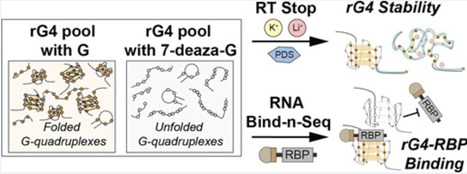
RNA G-quadruplexes (rG4s) have been implicated as important regulators of RNA metabolism and are promising targets for RNA-targeted therapeutics. rG4s typically require a canonical (G≥2N1–7)4 motif, but the sequence features that affect rG4 stability and recognition by RNA-binding proteins (RBPs) and rG4-binding ligands are not fully understood. To interrogate sequence-level drivers of rG4 folding, we applied a reverse-transcriptase stop sequencing strategy to a library of ∼3000 synthetic rG4s with varied G-tract lengths, loop lengths, and loop compositions, permitting massively parallel quantification of rG4 stability. Our data confirm known sequence-level features and characterize novel combinatorial impacts of these features. We also assessed systematically mutagenized natural rG4s, revealing unexpected mutations that significantly affect rG4 stability, including contributions from flanking sequences outside of the rG4. We further used our strategy to assess rG4 recognition preferences of the model rG4 ligand pyridostatin, revealing a preferential stabilization of rG4s containing mixed-length G-tracts. We additionally demonstrated the potential for large-scale protein-binding assays with our library to reveal rG4 features recognized by RBPs, specifically G3BP1 and FMRP. Our approach and data provide a generalizable framework to study sequence-level drivers of rG4 stability, binding by RBPs, and ligand interactions, defining basic principles of rG4 formation and downstream biology.
|
|
Scooped by
mhryu@live.com
August 24, 12:05 PM
|
Machine learning has emerged as a powerful accelerator for identifying PET-hydrolyzing enzymes (PETases). Yet, published models are often evaluated on benchmark performance alone, leaving their biological validity unexamined. Here we present InterPET, a curated benchmark and ablation study addressing both issues. We aggregated sequences from four datasets (PlasticDB, PAZy, PlasticEnz, PEZY-miner), removing duplicate sequences, and filter data leakage, yielding a training set of 937 sequences and a benchmark of 139 sequences. Eight model configurations were trained and evaluated, spanning three embeddings (ESM-2, ProtT5, classical AAC/CTD descriptors), two tree-based classifiers (XGBoost, Random Forest), and two GraphSAGE variants differing in sequence-only and sequene plus 3D structure data. ESM-2 + XGBoost achieved the best performance (F1 = 0.91, AUC = 0.99, MCC = 0.90). SHAP-based feature attribution linked top-ranked AAC/CTD features (proline content, solvent accessibility, hydrophobicity) to known determinants of PETase activity, and cross-representation correlation showed that embedding-based models implicitly re-encode much of the same biophysical signal. However, in-silico mutagenesis revealed that the top-ranked M1 recovered only 0.5/3 catalytic-triad residues. These findings demonstrate that representation choice, classifier architecture, and evaluation criteria interact in ways a single leaderboard metric cannot capture. https://github.com/indiraprakoso/interpet/
|
|
Scooped by
mhryu@live.com
August 24, 12:00 PM
|
Colibactin is a bacterial genotoxin that damages DNA and is linked to colorectal cancer. It is implicated in interbacterial competition but its role in natural microbiomes is unclear. Here we show that Frischella perrara, a colibactin-producing symbiont restricted to honeybee guts, lowers bee lifespan but increases survivorship following challenge with the opportunistic bee pathogen Serratia marcescens. F. perrara mutants lacking colibactin production fail to improve survivorship following challenge. The symbiont reduces pathogen loads by causing colibactin-dependent DNA damage and prophage induction. Colibactin is toxic to the pathogen under anoxic conditions, reflecting the bee gut. clbS, a gene conferring protection from colibactin, is ubiquitous among bacteria restricted to bee guts but absent from opportunistic colonizers, including pathogens. Indeed, F. perrara colonization representing colibactin pressure had limited impact on the bee gut microbiome where strains encode clbS. Our findings suggest that colibactin functions in interbacterial competition and protects against pathogens while permitting co-evolved symbionts to persist. A colibactin-producing symbiont in honeybee guts defends against opportunistic pathogens and confers protection.
|
|
|
Scooped by
mhryu@live.com
August 25, 12:38 AM
|
A large fraction of the uncharacterized proteome consists of microproteins. Viruses, rich in microproteins with potent activities, provide a unique system for exploring their functions and evolution. Here, we systematically annotate viral microproteins through a phenotype-first approach: construction of a >50,000-element small ORF library spanning the microprotein-coding potential of human-infecting viruses, followed by broad screens that enrich candidates for high-resolution profiling by Perturb-seq, mass spectrometry, AI-guided structure prediction, and mechanistic studies. This atlas identified >2,000 active microproteins that modulate host pathways through diverse mechanisms, including molecular mimicry, hijacking of key regulators, and altering subcellular localization. We further show the oncogenic potential of BNLF2b, an uncharacterized Epstein-Barr virus microprotein linked to nasopharyngeal carcinoma. Three principles emerge: viral microproteins are diverse and often multifunctional, show widespread convergence toward shared functions, and serve as reservoirs of evolutionary innovation. These findings elucidate how viral microproteins occupy a large functional landscape, establish them as versatile tools for host manipulation, and provide a framework for functional annotation of uncharacterized proteins, contributing toward predictive systems virology.
|
|
Scooped by
mhryu@live.com
August 25, 12:21 AM
|
Over the past three decades, Saccharomyces cerevisiae has gone from being the first eukaryote to have its genome fully sequenced to one of the most studied biological systems. Advances in sequencing technologies, functional genomics, and population genomics have expanded the scope of study from a single laboratory reference genome to thousands of natural isolates, and the species-wide pangenome. These advances have revealed vast genetic and structural diversity, shaped by evolution, ecology, and domestication, while large-scale experimental resources have made yeast a model organism of choice in systems biology. In this review, we trace this transition from a reference genome view to an understanding of diversity at the population level, highlighting how telomere-to-telomere assemblies, graph-pangenome, and multi-omics approaches are transforming our ability to link genomic variation to phenotype. Together, these advances place S. cerevisiae at the forefront of efforts to understand and predict genotype–phenotype relationships in eukaryotes.
|
|
Scooped by
mhryu@live.com
August 25, 12:17 AM
|
To enable real-world protein-ligand affinity prediction, not only out-of-distribution generalization but also robustness to variable structural availability and quality should be considered in model design. We present AlignNet, a hierarchical representation alignment framework that mitigates intra- and inter-molecular heterogeneity to learn robust protein-ligand embeddings for generalizable affinity prediction, even from sequence-level inputs. Its intra-molecular module projects unimodal and multimodal features into a unified space, aligning augmented multimodal views for feature fusion and unimodal with multimodal embeddings to distill multimodal priors for structure-agnostic inference. Its inter-molecular module aligns protein and ligand embeddings for cross-molecular integration. Extensive experiments show that AlignNet (i) achieves highly competitive performance, with up to a 20.4% gain in SCC on the challenging LBA 30% split under sequence-only settings, suggesting improved out-of-distribution generalization; and (ii) learns well-separated affinity-related clusters, supporting reliable structure-independent prediction.t
|
|
Scooped by
mhryu@live.com
August 25, 12:04 AM
|
Multicellular assemblies can sense and respond to biochemical and biophysical cues. They can also self-regulate and self-organize, giving rise to emergent behaviors over time. These features make cellular assemblies interesting therapeutic tools for applications such as tissue regeneration and immunomodulation. In this Review, we discuss the design space for therapeutic cellular assemblies, outlining hierarchical building blocks, including single cells and linear, planar and volumetric units, as well as physical and biological toolboxes for their fabrication and functional programming. We examine the biological features of hierarchical cell assemblies, analysing their potential therapeutic benefits, when benchmarked in relation to free-cell suspensions and dispersed cells delivered in biomaterials. Finally, we highlight applications of cellular assemblies in regenerative medicine, immunomodulation and production of biological mediators and discuss translational considerations, including scalable manufacturing, longitudinal characterization and predictive modelling approaches required to engineer cellular assemblies with programmable biological functions. Multicellular assemblies can be programmed to exhibit emergent behaviors that make them promising therapeutic tools, particularly for tissue regeneration and immunomodulation. This Review outlines the design principles, biological advantages and translational requirements for engineering hierarchical cellular assemblies with programmable functions and emphasizes the need for benchmarking them against single-cell and biomaterial-based approaches.
|
|
Scooped by
mhryu@live.com
August 24, 11:09 PM
|
Shiga toxin-producing E. coli (STEC) presents a therapeutic dilemma because antibiotic treatment induces prophage-encoded Shiga toxin expression. Galtier et al. engineer phage-derived particles with programmable cell specificity, genetic cargo, and CRISPR guide RNAs that destroy stx while killing STEC in animal models.
|
|
Scooped by
mhryu@live.com
August 24, 4:29 PM
|
Protein–nucleic acid interactions are fundamental to various biological processes, and accurately identifying nucleic acid binding sites on proteins is essential for understanding gene regulation mechanisms and advancing drug design. Here, we present DeepPANB, an effective deep learning model for the issue. DeepPANB is built upon the Polarizable Atom Interaction Neural Network (PaiNN) architecture, an E(3)-equivariant graph neural network, which explicitly couples scalar and vector channels through lightweight message passing, thereby enabling effective modeling of the direction- and distance-dependent residue interactions. DeepPANB integrates multiple feature types including sequence embeddings from the Ankh pretrained model, residue–nucleotide pairwise propensity extracted by us from the large-scale datasets, as well as residue intrinsic disorder, physicochemical properties, and structural descriptors. To our best knowledge, PaiNN and Ankh are first introduced here for protein–nucleic acid binding site prediction. On the protein–DNA test set, DeepPANB achieves state-of-the-art performance, outperforming the existing methods. On protein–RNA test set, DeepPANB, fine-tuned with the feature types unchanged, shows competitive performance. Overall, DeepPANB demonstrates robust and generalizable performance, providing an effective tool for protein–nucleic acid binding site prediction. Freely available at https://github.com/ChunhuaLab/DeepPANB.
|
|
Scooped by
mhryu@live.com
August 24, 3:33 PM
|
Molecular docking is a pillar of structure-based drug design and shows advantages over co-folding by providing physical insights into small-molecule ligand–target interactions, independent of ligand and pocket novelty. Here, we describe substantial improvements of our docking algorithm Attracting Cavities, which is widely used through the SwissDock webserver. AC 3.0 includes enhanced sampling features, new functionalities, and technical improvements. These lead to better sampling at lower execution times and higher versatility. Comparison with AutoDock Vina demonstrates better docking results on multiple test sets.
|
|
Scooped by
mhryu@live.com
August 24, 3:02 PM
|
Aspergillus features numerous species with diverse characteristics, and efforts to identify the genes responsible for these traits are ongoing worldwide. Advanced multi-gene knockout technologies are required to analyze the functions of these genes. Although CRISPR/Cas9-based gene disruption methods have become widely used in many organisms, conventional homologous recombination remains the most reliable method for multiple-gene disruption in Aspergillus species. Here, we report the development of a novel marker recycling cassette for Aspergillus spp. This system enables highly efficient gene disruption and marker recycling by combining a doxycycline-inducible Cre/loxP system with a uracil biosynthesis pathway and counterselection using uracil analogs. Using the model filamentous fungi Aspergillus nidulans and the human pathogen Aspergillus fumigatus, we disrupted genes involved in conidial pigment biosynthesis and amino acid and vitamin biosynthesis. This system is expected to facilitate and accelerate functional genomic analyses in Aspergillus spp.
|
|
Scooped by
mhryu@live.com
August 24, 12:46 PM
|
Metagenomics offers a powerful framework for authentic, interdisciplinary learning, yet it remains underrepresented in undergraduate education due to technical and infrastructural barriers. We hypothesized that a research-based, learning-by-doing metagenomics workshop supported by accessible bioinformatics tools could enhance students’ perceived skills, self-efficacy, and conceptual understanding of metagenomic analysis. To test this hypothesis, we designed and evaluated a hybrid hands-on workshop in which undergraduate and postgraduate students analyzed real environmental shotgun metagenomic datasets generated from soil samples collected during a citizen science initiative. Using the graphical workflow platform KBase, participants completed an end-to-end metagenomic analysis, from quality control and assembly to genome reconstruction, taxonomic classification, functional annotation, and scientific presentation of results. Educational outcomes were assessed through validated retrospective pre-post questionnaires, self-efficacy scales, and an open-ended conceptual understanding task. Participants showed significant increases in perceived metagenomic skills and confidence in performing metagenomic analyses, while gains in perceived learning showed a positive trend. Conceptual understanding improved across educational levels, particularly among participants with limited prior experience. Together, these findings demonstrate that authentic, data-driven metagenomics activities can effectively lower barriers to computational biology and foster meaningful learning through hands-on research experiences. mag, metagenome
|
|
Scooped by
mhryu@live.com
August 24, 12:35 PM
|
The cytoplasmic antiviral sensor MDA5 is activated by double-stranded RNAs. Endogenous double-stranded RNAs are modified by the A-to-I RNA-editing ADAR family to prevent activation of MDA5. In vivo, cytoplasmic ADAR1p150 is critically required to suppress MDA5 activation, yet the editing signature of all ADAR isoforms is strongly overlapping in mice. Further, it is not clear how A-to-I modifications in dsRNA prevent MDA5 activation. Here we show that 3′ UTRs harboring inverted repeats activate MDA5 in vitro and in cells. In vitro editing by either ADAR isoform leads to editing at overlapping hotspot regions and prevents MDA5 activation in vitro and in cells. Remarkably, only inosines introduced by RNA editing are capable of suppressing MDA5 activation, while replacing guanosines with inosines during in vitro transcription has no impact on MDA5 activation. A comparison of inosines introduced by ADAR1p150 in vitro, in cells, and in vivo suggests that a small number of A-to-I conversions may be critically required to suppress MDA5 activation. As those critical editing events are predominantly altering A:U basepairs into I:U wobble basepairs, we suggest that the helical distortion introduced by those wobble pairs may prevent MDA5 polymerization and thus downstream activation of the type I interferon response.
|
|
Scooped by
mhryu@live.com
August 24, 12:15 PM
|
Plant bioengineering has generated tens of thousands of genotype-to-phenotype relationships, but this knowledge remains fragmented across narrative literature and difficult to use computationally. Inconsistent descriptions of DNA constructs, host species, and traits, including variable species names, omitted regulatory elements, and inconsistent gene symbols, impede data reuse, comparative analysis, and design-build-test-learn cycles. Here, we present the Plant Bioengineering Atlas, a literature-mined, ontology-grounded knowledge base assembled using an artificial intelligence (AI)-aided extraction pipeline. A large language model parsed open-access primary research articles to generate structured, provenance-anchored records of engineered genes, modification types, promoter-gene-terminator constructs, host species, target traits, and reported phenotypes, with every record traceable to its source. The current release contains 14,358 curated records encompassing 6,998 distinct genes across 436 plant species from 6,452 papers published between 2000 and 2026. Corpus analysis reveals that experiments are concentrated in a small group of model and crop species, disease and pathogen resistance is the most frequently engineered trait class, and constitutive regulatory parts (particularly the CaMV 35S promoter and NOS terminator) remain pervasive. Two in five records omit one or both flanking regulatory elements (i.e., promoter and terminator), while only 23.4% describe cassettes in which both elements resolve to named part classes, exposing a systematic reproducibility gap. We organize these data into a knowledge graph linking genes, constructs, species, and traits; provide access through an interactive web portal; and propose an AI-compatible documentation standard for AI-ready reporting. The Plant Bioengineering Atlas provides a foundation for data-driven hypothesis generation and AI-aided plant biodesign.
|
|
Scooped by
mhryu@live.com
August 24, 12:01 PM
|
Genome editing is maturing from a one-size-fits-all system into a highly specialized ecosystem that includes a dizzying array of tools. In this Comment, we discuss the current and future use of Cas-induced homology-directed repair for precise genetic modification, as it complements an ever-expanding genome editing toolbox. This Comment discusses the uses of Cas-induced homology-directed repair in the evolving landscape of highly specialized genome editing tools.
|