 Your new post is loading...

|
Scooped by
mhryu@live.com
September 22, 3:53 PM
|
RNA function is tied to secondary structure, operating through dynamic and heterogeneous structural ensembles. While current analysis tools typically output single static structures or averaged contact maps, chemical probing methods like DMS capture nucleotide-resolution signals representing the full structural ensemble, which remain difficult to interpret structurally. To address this, we present MERGE-RNA, a framework that describes and outputs RNA as a structural ensemble. By modeling the physics of the experimental pipeline, MERGE-RNA learns a small set of transferable and interpretable parameters, enabling the integration of measurements across different molecules, probe concentrations, and replicates in a single optimization to improve robustness. Our model employs a maximum-entropy principle to predict thermodynamic populations, with the minimal adjustments necessary to align the ensemble with experimental data. We validate MERGE-RNA on diverse RNAs, showing that it achieves structural accuracy surpassing standard pseudo-free-energy methods and yields ensembles better recapitulating measured DMS reactivity. Applied to the Vibrio vulnificus adenine riboswitch, MERGE-RNA recovers the NMR-resolved conformations and their ligand-induced rearrangement, with population shifts matching the NMR-derived . In a designed RNA construct for which we report new DMS data, MERGE-RNA deconvolves mixed states to reveal transient intermediate populations involved in strand displacement, dynamics invisible to methods based on enumerating a small number of structures.
|
|
Scooped by
mhryu@live.com
September 22, 3:05 PM
|
Protein--protein interactions (PPI) underpin a wide range of biological functions in living organisms. Experimental identification of new PPIs is expensive and time-consuming. The experimental bottleneck has implied an imbalance in terms of data availability: while certain species have been screened exhaustively, other species have not been sufficiently examined. An AI driven protocol for PPI prediction that leverages the massive data accumulated for certain species means a decisive boost for so far understudied species. We present ANIMA (Artificial Neural Interaction Model for Animals), an AI supported cross-species PPI prediction model trained on popular species to predict PPIs in under-researched species. Our experiments demonstrate that our model, when trained on 200 diversely selected animal species, can successfully predict PPIs in other species: ANIMA achieves 95.3% accuracy on other animal species, 91.1% on other eukaryotes, and 82.5% on non-eukaryotes. For a more fine-grained evaluation of the model, we stratify performance rates by the evolutionary distance of test to training sets. We also stratify results by a novel, alignment based score ("representation score") which allows for fine-grained evaluation in terms of its capacity to generalize to unseen interactions. As expected, results demonstrate increasing performance on increasing evolutionary similarity and on increasing identity of interacting proteins, while still showing excellent performance on proteins entirely lacking counterparts in the training set. In comparison with the state of the art, ANIMA demonstrates substantial superiority in terms of performance rates.
|
|
Scooped by
mhryu@live.com
September 22, 1:09 PM
|
Efficient DNA delivery remains one of the greatest barriers to engineering non-conventional yeasts, limiting their genetic domestication and exploitation as next-generation microbial cell factories. Here, we present BRIDGE (Bacteria-to-yeast Rapid Interkingdom DNA Gene Exchange), an integrated synthetic biology platform for broad-host interkingdom DNA delivery. BRIDGE is centred on a compact 6-kb Pan/ARS-oriT broad-host BRIDGE vector, enabled by a super-conjugative helper plasmid (pSC5). Using BRIDGE, we expanded interkingdom DNA transfer from representatives of four genera accessible using pSC5 alone to ten phylogenetically diverse yeast genera, including Saccharomyces, Maudiozyma, Starmerella, Kazachstania, Yarrowia, Zygosaccharomyces, Lachancea, Kluyveromyces, Pichia and Komagataella. To demonstrate the versatility of BRIDGE, we engineered a 16-kb visual reporter carrying a synthetic five-gene violacein biosynthetic pathway from Chromobacterium violaceum. Individual transcriptional units were first constructed using the YeastFab modular cloning system and subsequently assembled into the complete pathway by single-step in vivo homologous recombination in Saccharomyces cerevisiae, followed by rapid plasmid recovery using the EASY-C platform. The reporter was successfully delivered to all ten yeast genera, demonstrating BRIDGE-mediated transfer of complete multigene synthetic pathways. Robust violacein production was observed across all six Saccharomyces species tested, providing a rapid visual marker for transformant identification, while modest functional pathway expression was also detected in Kazachstania and Kluyveromyces. Successful pathway transfer, albeit without visible pigmentation, was achieved in the remaining genera, indicating that regulatory compatibility, rather than DNA transfer, is the principal determinant of heterologous pathway expression in distantly related yeasts. Collectively, BRIDGE establishes an integrated Design-Build-Recover-Deliver workflow that combines modular in vitro construction of transcriptional units, single-step in vivo assembly of multigene pathways, rapid plasmid recovery using the EASY-C platform and broad-host interkingdom DNA delivery. This versatile framework enables the rapid genetic modification of previously intractable microorganisms, expanding the synthetic biology toolbox for sustainable biomanufacturing and industrial biotechnology.
|
|
Scooped by
mhryu@live.com
September 22, 1:21 AM
|
The genetic code is conserved across all domains of life and is often described as universal. Nevertheless, many exceptions to the “universal” code have now been documented, most of these through manual or semiautomated inspection of highly conserved genes. Modern bioinformatics tools improved our ability to find alternative genetic codes but remain computationally expensive, preventing widespread use on thousands of new species identified by sequencing environmental samples. Here, I report a >100-fold accelerated method for inferring the genetic code directly from assembled genomes and apply it to thousands of previously uncharacterized assemblies from archaea and bacteria. I describe three candidate genetic code variations, one of which, an alternative genetic code used by a family of Asgard archaea, is a unique example of sense codon reassignments for this domain. Identifying genetic code variations is important for understanding evolution of the standard code and improving accuracy of protein databases and open reading frame identification.
|
|
Scooped by
mhryu@live.com
September 22, 1:12 AM
|
Bacteria emit volatile organic compounds (VOCs) that can be targeted for disease detection. Biological olfactory systems have keen senses of smell, can detect VOCs at low concentrations, and are naturally adapted to classifying mixtures of VOCs as odors. Here, we employed locust (Schistocerca americana) olfactory neural circuitry to differentiate biofilm and planktonic cultures of Pseudomonas aeruginosa and Staphylococcus aureus using their odors. In vivo extracellular neural recordings were taken from the second-order olfactory processing center (antennal lobe) of locusts. The VOCs from biofilm cultures evoked distinct spiking responses compared to the planktonic cultures for both bacterial species. By analyzing the population neuronal responses, we classified individual bacterial biofilm vs. planktonic odors with up to 96% accuracy. The neural responses were highly discriminatory within the first couple of seconds of odor presentation and our analysis was conducted on less than five seconds of data, highlighting the potential of our biological sensor for real-time biofilm detection. Extracellular neural recordings from the locust olfactory system, specifically the antennal lobe, were used to differentiate biofilm and planktonic bacterial cultures of Pseudomonas aeruginosa and Staphylococcus aureus.
|
|
Scooped by
mhryu@live.com
September 22, 12:34 AM
|
GlycoViz is an open-source algorithm and software tool designed to address critical bottlenecks in the post-identification workflow of mass spectrometry-based glycoproteomics. Current glyco search engines excel at glycopeptide identification but there is a lack of tools for robust post-identification validation, global glycan composition statistics, and reliable site-specific analysis, particularly concerning false positives and quantification distortion due to shallow detection depth. GlycoViz offers an alternative solution with a novel glycopeptide validation algorithm that is compatible with data from multiple search engines. Analysis of N-linked glycans is fully supported whereas O-linked glycan data analysis is limited primarily to visualization and non-optimized validation.
|
|
Scooped by
mhryu@live.com
September 21, 11:56 PM
|
The CRISPR-Cas system, which originated as an adaptive immune system in bacteria and archaea, has been repurposed as a precise and programmable tool for genetic manipulation in both prokaryotes and eukaryotes. Its applications in bacteria include targeted genome modifications, antimicrobial resistance studies, functional genomics studies, and the development of engineered strains for industrial and synthetic biology applications. Therefore, the understanding of technical aspects of CRISPR systems and their underlying molecular mechanisms is essential for experimental accuracy, reproducibility, and biosafety. CRISPR editing introduces several challenges in bacteria, including off-target effects, DNA repair limitations, cytotoxicity of Cas nucleases, and host-specific restriction-modification barriers. In addition to these specific challenges, metabolic burden, sgRNA design, and delivery challenges further introduce limitations. Such issues compromise editing efficiency, genomic stability, and cell viability. Recent studies have focused on improved guide RNA design, alternative Cas variants, refined delivery strategies, and host-adapted engineering as promising directions to enhance editing. This review discusses the principal barriers to CRISPR-Cas9 genome editing of bacteria, evaluates the current strategies for addressing these barriers, and highlights emerging approaches aimed at improving the efficiency, reliability and precision in bacterial genome engineering. Graphical abstract
|
|
Scooped by
mhryu@live.com
September 21, 11:28 PM
|
Microbiome studies increasingly indicate that disease-associated shifts cannot be understood from compositional changes alone. The functional architecture of microbial communities—encoded in patterns of association among microbial gene families—may reveal how these systems reorganize across biological conditions. Here, we present a network-based framework for characterizing microbiome rewiring across conditions. The approach combines condition-specific network inference, differential network analysis, and pathway-level network analysis to identify associations that are gained, lost, or altered between groups, with a specific focus on sex-dependent differences. We apply the framework to inflammatory bowel disease, type 2 diabetes, and atherosclerotic cardiovascular disease (ACVD), comparing male and female-specific microbial gene family networks within each disease context. Across these settings, differential networks flag large numbers of candidate rewired associations; however, permutation testing (sex labels shuffled, group sizes preserved, 500 permutations for gene-family networks, and 1000 for pathway networks) shows that the global amount of apparent rewiring is not greater than expected under the null at the global or edge level in any cohort, and that most edges exclusive to one group are induced by group-specific feature filtering rather than by a genuine change in association
|
|
Scooped by
mhryu@live.com
September 21, 10:41 PM
|
In bacteria with circular chromosomes, genes near the replication origin (oriC) are replicated earlier and consequently attain higher copy numbers than genes near the terminus (ter), particularly during rapid growth. Hence, mutations altering a gene’s chromosomal position can affect its expression level and be subject to selection. Two non–mutually exclusive hypotheses regarding the target of this selection have been proposed. The mean expression hypothesis (MEH) posits that the target is a gene’s average expression across environments, whereas the growth-dependent expression hypothesis (GEH) proposes that the target is the growth dependence of gene expression, quantified by the expression slope—the change in expression level per unit change in growth rate. To test these hypotheses and assess their relative support, we analyze eight multi-environment protein expression datasets from three bacterial species, as well as E. coli promoter strengths measured in two environments. Consistent with both MEH and GEH, we observe a significant decrease in both mean expression and expression slope from oriC to ter in six and four of the eight datasets, respectively. In regression models predicting gene position, the relative contributions of the two hypotheses differ across species. However, even when combined, the two hypotheses explain only a small fraction of chromosomal gene positioning, in part because the replication-dose effect is incompletely offset by compensatory evolution of individual promoter strengths. The positional gradients in mean and growth-dependent expression are disproportionately contributed by genes involved in translation and transcription. We conclude that patterns of bacterial chromosomal gene positioning are consistent with moderate effects of selection on both mean and growth-dependent expression.
|
|
Scooped by
mhryu@live.com
September 21, 5:05 PM
|
Microbial carbon use efficiency (CUE) governs soil carbon persistence under warming, with its magnitude highly dependent on how microbial metabolism adapts to varying substrates. How agricultural management mediates this response in agroecosystems remains poorly understood. To address this, we coupled 18O-H2O tracing of community-level CUE with 13C-probing of substrate utilization efficiency (SUE) from substrates differing in apparent bioavailability after 11 years of experimental warming under conventional and conservation agriculture, using glucose as a readily available carbohydrate and vanillin as a less accessible lignin-derived aromatic substrate. Warming stimulated glucose SUE under both management regimes, whereas vanillin SUE declined by 20% exclusively under conservation agriculture. This shift in relative anabolic efficiency (RAE, SUEglucose/SUEvanillin) was associated with warming-induced changes in CUE, primarily through changes in vanillin rather than glucose SUE. Concurrently, conservation agriculture improved substrate quality under warming, reflected by a reduced litter lignocellulose index. In response, microbial communities exhibited distinct functional adaptations, shifting toward copiotrophic taxa with higher rRNA operon copy numbers and a 16% increase in the anabolic-to-catabolic gene ratio, indicating enhanced microbial growth potential and greater investment for labile-carbon processing. Structural equation modeling further showed that shifts in substrate quality were a primary driver of RAE, mediated by changes in microbial life-history strategies under conservation agriculture. Together, these results provide a genome-resolved mechanistic framework showing that conservation agriculture enhances soil carbon persistence under warming by reshaping microbial relative anabolic efficiency and metabolic strategies, highlighting metabolic adaptation as a key mechanism regulating soil carbon stability in warming agroecosystems.
|
|
Scooped by
mhryu@live.com
September 21, 4:59 PM
|
Azospirillum is a genus of nitrogen‑fixing alpha‑proteobacteria whose genomes consist of a chromosome and several large secondary replicons. The organization and evolution of these replicons remain poorly understood. We analyzed 22 complete Azospirillum genomes, containing six to ten replicons, and characterized their gene composition, replication, segregation, and dimer resolution systems. The largest replicon contains most of the essential genes and is the chromosome. Other replicons can be classified based on gene composition, similarity of the plasmid replication protein RepA, and similarity of the ParAB segregation proteins. Overall, groups obtained using different approaches agree with each other. Analysis of gene composition also identified fusions or splits of secondary replicons. None of the large secondary replicons of Azospirillum strains contain the repABC replication system, and all of them are iteron plasmids. For all groups of replicons, the RepA box motifs and the structure of the plasmid replication origin oriV were predicted. Most replicons use the ParABS system for segregation. In rare cases, the replicon contains repA from one group and parAB from another. The position of the parAB operon relative to the replication origin is determined by the parAB group, and not by repA. Most secondary replicons apparently use an FtsK‑dependent pathway for dimer resolution, relying instead on the chromosomally encoded XerCD proteins. In most cases, the identified dif motifs do not distinguish groups of replicons.
|
|
Scooped by
mhryu@live.com
September 21, 4:02 PM
|
Recent advances in genome editing allow easy genetic manipulation of bacteria, providing them with new traits, some of which could be hazardous, e.g. enhanced virulence or extended resistance to antibiotics. The ability to detect artificially modified bacteria is crucial for identifying potential bio-threats. However, malicious genome editing could be challenging to trace due to the natural exchange of genes among bacteria through horizontal transfer. After curating extensive datasets including natural genomes and simulated edited genomes, we utilized a natural language processing approach to detect edited genomes. We developed a transformer-encoder-based machine-learning classifier that, instead of analyzing words in sentences, models gene families in genomes. After training the model on our datasets, it is able to accurately detect genes artificially added to bacterial genomes due to their unnatural context. Our approach provides a scalable method for identifying engineered sequences without relying on specific marker genes, with potential applications in biosecurity, agriculture, GMO regulation and more.
|
|
Scooped by
mhryu@live.com
September 21, 3:59 PM
|
Root volatiles mediate diverse belowground interactions among plants, microbes, and invertebrates, but biological and environmental conditions strongly influence their production, movement, perception, and ecological effects. This review synthesizes current knowledge through an integrative conceptual framework linking five dimensions: (1) chemical diversity and biosynthesis; (2) regulation by biotic and abiotic factors; (3) plant internal signaling and resource allocation; (4) ecological adaptation and reciprocal evolutionary interactions with soil organisms; and (5) implications for agricultural management. Key roles include defense against herbivores and pathogens, recruitment of beneficial microbes and natural enemies, plant recognition, allelopathy, systemic signaling between roots and shoots, and coordination across multitrophic networks. The synthesis examines how volatile identity and concentration, soil properties, microbial transformation, and plant genotype influence signal transmission and ecological outcomes. Comparisons across taxa, compounds, and experimental systems clarify which mechanisms are broadly supported and which remain context-dependent. Priorities include resolving molecular pathways, tracing volatile transport and persistence in soil, distinguishing volatile effects from those of nonvolatile exudates, and validating functions under field conditions. A deeper mechanistic and ecological understanding of root volatiles is therefore essential for developing resilient crop protection strategies, reducing dependence on agrochemical inputs, advancing sustainable agroecology, and sustaining long-term soil health.
|
|
|
Scooped by
mhryu@live.com
September 22, 3:46 PM
|
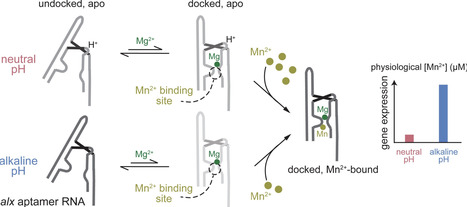
The widespread yybP-ykoY riboswitches control bacterial manganese (Mn) homeostasis by activating exporter expression in response to intracellular Mn2+ levels. The E. coli alx riboswitch distinctively couples Mn2+ sensing to cytoplasmic alkalinity, but the mechanism is unknown. We show that pH tunes the alx aptamer’s conformational sampling to modulate Mn2+ sensitivity. Single-molecule FRET reveals that Mn2+ stabilizes a docked three-way-junction conformation, and alkaline pH shifts this equilibrium to sensitize metal-dependent folding. Molecular dynamics simulations identify a loop whose low-pH-induced base pairing perturbs the adjacent helix, predicted to allosterically disrupt the Mn2+-binding state. In vivo reporters indicate that both this loop and the Mn2+-binding core are required for optimal pH-dependent translational activation: replacing the core with the non-pH-responsive mntP sequence abolishes activation. These results define how RNA allosterically integrates orthogonal metal and proton cues to enable combinatorial environmental sensing during alkaline stress.
|
|
Scooped by
mhryu@live.com
September 22, 3:03 PM
|
Advances in machine learning (ML) have enabled the de novo design of synthetic proteins and peptides tailored for specific structural or functional properties. As ML becomes a central tool in forward design, we suggest that its value extends beyond optimizing known objectives. It can also lead to what we term here in this work as silicon exaptation, revealing unexpected functional properties that were never part of the original design goals. This reflects a principle common in biology, that repurposes traits where features evolved for one role can later enable unforeseen functions. In this context, these accidental findings are not constrained by preconceptions but arise from latent function emergence and the algorithm's gradual drift, a new process that can co-evolves with human curiosity, intuition, and interpretive reasoning, which can be used to recognize unexpected patterns and transform them into new discoveries. In this study, we discovered a set of peptides through silicon exaptation, in which the ML pipeline was originally optimized for structural characteristics unrelated to any antimicrobial functionalities. The peptides were originally designed to adopt defined secondary structures in response to environmental stimuli, with no antimicrobial properties intended or included in the training objectives. We systematically evaluated the antimicrobial potential of these peptides using broth microdilution assays and membrane integrity tests, identifying several candidates with potent and selective antibacterial activity without detectable cytotoxicity toward mammalian cells.
|
|
Scooped by
mhryu@live.com
September 22, 1:24 AM
|
Reproducible data analysis and visualization are essential for reliable biological and biomedical research, yet creating high-quality, publication-ready figures often requires moving data and results between multiple analysis, visualization, and graphics tools. This fragmented, multi-layered process can make it difficult to trace how individual figure panels were generated, preserve the underlying analytical decisions, and reproduce them later. Here, we introduce MakeMyFigure, a free and open-source platform for data visualization, analysis, and creation of multi-panel scientific figures. MakeMyFigure integrates data processing, statistical analysis, visualization, and figure assembly within a single workflow. It supports a range of quantitative data formats and structures, including feature-by-sample matrices and precomputed statistical results, and provides data-aware visualization recommendations to help users select appropriate plots from a library of 38 visualization types. These capabilities allow researchers to move directly from experimental measurements to commonly used statistical analyses and graphical representations without requiring programming expertise. Eighteen statistical procedures are implemented, and their results are drawn directly onto the plot families that support statistical annotation, keeping analytical results linked to the panels they generate. Importantly, MakeMyFigure uses machine-readable JSON specifications to record the identity and checksum of the source data, the processing steps, visualization settings, and statistical parameters used to generate each figure panel. It can also save a figure as a portable package, freezing the specifications together with the data. This allows figures to be regenerated from their recorded specifications and source data, or from the package alone on another computer, rather than relying on manually reconstructed workflows. Using published datasets from several biological fields, independent statistical validation in R, and a comparison with 15 representative analysis, visualization, and figure-generation tools, we show that MakeMyFigure combines accessible, code-free figure creation with panel-level computational reproducibility. Overall, MakeMyFigure provides a unified approach for creating, documenting, and reproducing scientific figures. Source code and documentation are available at https://github.com/surPoudel/make-my-figure , https://github.com/surPoudel/make-my-figure/releases/tag/v1.1.0 .
|
|
Scooped by
mhryu@live.com
September 22, 1:16 AM
|
Drought stress threatens the ecological functions and economic value of grasses, posing a major challenge to their sustainable production. Plants co-evolve with rhizosphere microbial communities, sometimes described as the plant's second genome, that can contribute to drought adaptation. Drought alters root architecture, hormonal and redox regulation and belowground carbon allocation, thereby modifying the quantity and composition of root exudation and reshaping the rhizosphere environment. This review uses the rhizosphere dialogue as an integrative framework to link these plant responses with microbial recruitment and subsequent feedback to the host. We summarise three linked stages of this dialogue: drought-induced changes in root exudation; microbial recruitment and colonization through chemotaxis, attachment, biofilm formation, and root colonisation; and microbiome-mediated feedback that improves plant water relations, hormonal and redox homoeostasis, nutrient acquisition, and root function. We highlight microbial extracellular polymeric substances, 1-aminocyclopropane-1-carboxylate deaminase, and microbial volatile organic compounds as key mediators of drought alleviation. We then discuss how this framework may inform rational synthetic microbial community (SynCom) design, microbiome-informed breeding, artificial intelligence and machine-learning assisted strain prioritisation, rhizosphere legacy effects, and real-time monitoring. Future work should distinguish active exudate-mediated recruitment from drought-driven environmental filtering and integrate multi-omics, plant genetics, functional validation, and multi-location field trials to determine whether rhizosphere dialogue can become a predictive framework for climate-resilient grass production.
|
|
Scooped by
mhryu@live.com
September 22, 12:52 AM
|
The chemical complexity of multimaterial plastic products, which are traditionally manufactured with many polymer types of different chemical composition to deliver desired lifetime performance, requires demanding processing conditions and potentially complicates end-of-life (EoL) recycling. Emerging mono-material product design, which we define as the engineering (by processing, molecular, or physical approaches, or a combination of these approaches) of a polymer derived from a single monomer or comonomer combination to achieve the performance of diverse polymer types without altering its chemical composition or speciation, drastically reduces the chemical complexity of plastics and has the potential to improve the EoL recycling of some materials. Here, we identify methods that can be applied to design mono-material polymers, including processing (orientation and crystallization), physical (homologous blending) and molecular (stereomicrostructure, topology and architecture engineering as well as monomer design) methods, all of which can be used to create mono-material products. We discuss the application of these methods to existing multimaterial products (such as multilayer films) using conventional plastics such as polyolefins, current industrial examples of mono-material products as well as emerging polymeric materials, their potential use and laboratory-scale mono-material prototypes. Overall, this Review aims to demonstrate how innovations in material design can be leveraged to achieve mono-materialization and provide insights into how this approach can improve EoL processing of plastic waste. Mono-material products, which are made up of one polymer type derived from a single monomer or comonomer combination, may help to solve the sustainability problems associated with multimaterial plastic products. This Review discusses advances in engineering processes towards mono-materials and the remaining technical challenges surrounding mono-materialization.
|
|
Scooped by
mhryu@live.com
September 22, 12:01 AM
|
Targeted, genome-scale gene perturbation screens using CRISPRi and activation CRISPRa have revolutionized eukaryotic genetics, advancing medical, industrial, and basic research. Although CRISPRi knockdowns have been broadly applied in bacteria, options for genome-scale gene overexpression face key limitations. Here, we develop a facile approach for genome-scale overexpression in bacteria we call CRISPR transposition and overexpression (CRISPRtOE). We first create a platform for comprehensive gene targeting using CRISPR-associated transposons (CASTs) and show that transposition occurs at a higher frequency in non-transcribed DNA. We then demonstrate that CRISPRtOE can upregulate gene expression in Proteobacteria with medical and industrial relevance by integrating synthetic promoters of varying strength upstream of target genes. Finally, we employ CRISPRtOE screening at the genome scale in the model bacterium Escherichia coli and the non-model biofuel producer Zymomonas mobilis, recovering known and novel antibiotic and engineering targets. We envision that CRISPRtOE will be a valuable overexpression tool for antibiotic mode of action, industrial strain optimization, and gene function discovery in bacteria.
|
|
Scooped by
mhryu@live.com
September 21, 11:55 PM
|
Ribosome-inactivating proteins (RIPs), a group of biological toxins that depurinate a critical residue within the 28S rRNA, exhibit one of the most potent and elegant mechanisms of cellular toxicity. Examples of RIPs include ricin and Shiga toxin, which are amongst the most notorious toxins produced by plants and bacteria, respectively. Here, we discuss RIPs in the Bacteria domain. We review the biology of Shiga toxin and its role as a transformational virulence factor for some of the most virulent E. coli and Shigella pathotypes, as well as recent work identifying an assortment of RIP toxins deployed by Spiroplasma endosymbionts to protect their host from parasitic attack. We further shed light on the expansive but poorly understood arsenal of proteins with the conserved RIP functional domain that can be found in the genomes of diverse bacterial species, including proteins with complex domain architectures thought to occur only in eukaryotic RIP toxins. Based on the impressive arsenal of RIPs found in Streptomyces, as well as the ubiquitous presence of this genus in the niches where many of the other organisms that produce RIPs are found, we speculate that Actinomycetes such as Streptomyces might have been the evolutionary origin of the RIP domain and hypothesize that Streptomyces has played a central role in the spread of RIPs throughout the biosphere.
|
|
Scooped by
mhryu@live.com
September 21, 11:21 PM
|
The establishment of the infant gut microbiome is strongly linked to health outcomes throughout life. Recently, Mueller et al. reported that the majority of strains shared between a mother and an infant are gut-derived, as opposed to vaginally derived, and strain sharing could be observed into the second year of life.
|
|
Scooped by
mhryu@live.com
September 21, 10:23 PM
|
Recent advances in artificial intelligence have transformed protein structure prediction and design. However, protein function is governed not only by static structures but also by the conformational dynamics that allow proteins to access distinct functional states. Predicting these dynamic transitions, central to many biological processes, remains challenging due to the scarcity of high-resolution experimental data, which limits the training of machine-learning models for dynamic and energetic property prediction. Here, we present AlloPool, a graph neural network (GNN)-based framework that interprets molecular dynamics simulations by iteratively pruning residue–residue interactions to uncover minimal, time-resolved interaction networks that govern protein conformational dynamics and structural responses to chemical or mechanical perturbations, collectively known as allostery. By integrating temporal attention with graph aggregation, AlloPool learns evolving interaction graphs from equilibrium and non-equilibrium molecular dynamics simulations, enabling accurate reconstruction of dynamic trajectories and the interaction networks that drive conformational transitions. Validated across diverse dynamic protein systems, including binding domains, mechanosensors, signaling receptors, and enzymes, AlloPool maps allosteric communication pathways, predicts the effects of ligand binding, mechanical forces, and mutations, discovers transient dynamic states and outperforms existing machine-learning approaches in dynamic trajectory reconstruction. This advance provides a general framework for interpreting protein dynamics with broad implications for drug discovery, synthetic biology, and protein engineering.
|
|
Scooped by
mhryu@live.com
September 21, 5:02 PM
|
Dryland ecosystems rely on infrequent rainfall pulses to activate soil microbial communities, yet the fraction and identity of microbes resuscitating after hydration remain unclear. We applied bioorthogonal non-canonical amino acid tagging coupled with fluorescence-activated cell sorting (BONCAT-FACS) and 16S rRNA gene sequencing to identify translationally active bacteria in early- (L-BSC) and late (D-BSC) successional cyanobacteria-dominated biocrusts subjected to 3 mm simulated rainfall under light and dark conditions. Our results reveal that only a small subset of the microbial community resumes activity within six hours, with higher active cell abundances in mature crusts. Microbial activity patterns were largely independent of light exposure and showed partial decoupling from total community composition, indicating that presence does not predict short-term function. These findings suggest that biocrust maturity shapes microbial activation dynamics and that functional responses to precipitation pulses are governed by a conserved pool of fast responders, informing predictions of dryland soil microbiome resilience under changing precipitation regimes.
|
|
Scooped by
mhryu@live.com
September 21, 4:49 PM
|
Widespread and chronic heavy metal pollution resulting from industrial activities has compromised the sustainability of soil ecosystems. Increasing and stabilizing soil carbon storage is central to soil development, but how remediation reshapes soil carbon cycling processes during the mitigation of heavy-metal contamination remains unclear. Here, we tracked genome-scale microbial metabolism, community turnover, and phenotype-level physiological responses during a 120-day remediation of heavy metal-contaminated soils with several decades of pollution histories and resolved their dynamic interplay with microbial carbon use efficiency (CUE) and CO2 emissions. We found that heavy-metal stress accelerated microbial respiratory carbon loss from soils, with contaminated soils exhibiting significantly higher cumulative CO₂ emissions than both nearby uncontaminated and remediated soils. Metagenomic profiles were enriched in oxidative-stress defense and metal-detoxification functions, consistent with elevated maintenance costs that may contribute to enhanced respiration. In contrast, remediation significantly reduced soil CO₂ emissions while increasing microbial growth rate and CUE, indicating a shift toward greater soil carbon storage potential. Raman-based in situ monitoring further showed that biomolecules associated with microbial growth, including phospholipids, nucleic acids, and proteins, increased progressively throughout the remediation process. Structural equation modelling further revealed that microbial physiological traits, particularly metabolic activity and intracellular biomolecular composition, exerted stronger direct effects on CUE than community traits, including community stability and life-history strategy. These results identify microbial physiological traits as a key link between environmental stress and soil carbon cycling. Together, these findings suggest that remediating heavy metal-contaminated soils may represent an underappreciated pathway for enhancing terrestrial carbon sequestration.
|
|
Scooped by
mhryu@live.com
September 21, 4:00 PM
|
A central goal of biology is to understand how genome sequence, content and organization give rise to living systems with specific traits. Achieving this goal requires understanding which genes are collectively required for life and for particular traits, how their products work together and how the organization of these genes in the genome affects cellular function. At a broader scale, it also means determining the mechanisms that generate inherited phenotypic diversity and enable adaptation and speciation. Synthetic chromosome assembly in the budding yeast Saccharomyces cerevisiae provides a tractable platform for probing these relationships in a model eukaryote by allowing chromosomes to be designed, built and tested directly in living cells. By making chromosome-scale genome architecture an experimental variable, chromosome synthesis differs from approaches that describe organisms as they occur in nature or test the effects of one or a few genes at a time. This review traces the emergence of yeast synthetic chromosomes as tools for genome biology and identifies advances needed to make chromosome-scale design more predictive.
|









Input: RNA sequence, chemical probing (DMS-MaP) reactivity data: per-nucleotide mutation counts/rates from sequencing, at one or more probe (DMS) concentrations, ideally with replicates