 Your new post is loading...

|
Scooped by
mhryu@live.com
September 23, 5:00 PM
|
Peptidoglycan (PG) is a near-universal and essential feature of bacterial cell walls and a major antimicrobial target. Although archaea generally lack PG, a PG-like polymer (pseudomurein or archaeal PG) was described decades ago in a major clade of methanogenic archaea, yet it has remained poorly characterized, owing to the lack of dedicated analytical tools. Here we identify and characterize ArmA from Methanobrevibacter smithii, a dominant member of the human gut microbiome, as the first glycosyl hydrolase specific for archaeal PG. ArmA-mediated digestion reveals an unexpected architecture that revises the prevailing model of archaeal PG. The glycan backbone comprises N-acetylglucosamine/N-acetylgalactosamine linked to a previously undescribed sugar, which we name N-acetylarmosamine. Glycan strands alternate β(1,4) and β(1,3) linkages, and the stem peptide is attached by means of an amide bond to the N-acetylarmosamine succinyl group. ArmA has dual enzymatic activity, cleaving both glycosidic linkages and peptide crosslinks. Phylogenetic analyses show that ArmA homologues are restricted to PG-bearing archaea, and we confirm activity across diverse methanogens. We further demonstrate that ArmA is required to complete cytokinesis, cleaving archaeal PG at the site of cell division. Together, these findings overturn a 50-year-old paradigm on archaeal PG structure and establish ArmA as a critical tool that parallels the impact of muramidases in bacteria, enabling biochemical and genetic interrogation of methanogen cell-wall biology. Finally, given the ecological and biotechnological importance of methanogens, our results open new avenues for targeted intervention. ArmA from Methanobrevibacter smithii, a dominant member of the human gut microbiome, is identified and characterized as a glycosyl hydrolase specific for cleaving the cell wall of methanogens, revealing an unsuspected chemical structure of archaeal peptidoglycan that includes a previously unidentified sugar.
|
|
Scooped by
mhryu@live.com
September 23, 2:18 PM
|
Effective biomarker detection is critical for timely and accurate clinical disease diagnosis. However, conventional analytical methodologies are often constrained by laborious procedures, reliance on specialized equipment, and an inherent inability to perform continuous in situ monitoring. To circumvent these limitations, synthetic biology has pioneered the development of genetically encoded biosensors as a rapid, highly sensitive, and cost-effective alternative. This review specifically focuses on transcriptional regulation-based biosensors, primarily those utilizing allosteric transcription factors (aTFs) and two-component systems (TCSs). By integrating these regulatory sensing modules into engineered microbial chassis, researchers can achieve continuous, real-time biomarker monitoring even within complex and otherwise inaccessible physiological environments. This review particularly focuses on microbial chassis rather than mammalian systems due to their highly tractable genetics, rapid response kinetics, and their unique potential to be deployed as autonomous living probiotics for in situ theranostics. Furthermore, coupling these sensors with engineered actuator genes enables the construction of intelligent therapeutic genetic circuits. This closed-loop theranostic paradigm facilitates simultaneous, real-time diagnosis and autonomous, localized therapeutic interventions, paving the way for personalized and dose-adaptive precision medicine. Finally, we summarize recent advancements in these biosensor platforms, explore their applications in targeted disease interventions, and discuss the contemporary challenges alongside future perspectives for their clinical translation.
|
|
Scooped by
mhryu@live.com
September 23, 1:20 PM
|
Hadal trenches, plunging beyond six kilometers depth, harbor a dynamic yet enigmatic microbial biosphere. From ~10 km depth Kermadec Trench sediments, we integrated metagenomics, in situ metatranscriptomics, and phylogenetics to reconstruct 300 prokaryotic species and 186,496 viral populations. In hadal sediment metagenomes analyzed here, we detect distant horizontal gene transfer (DHGT) across phyla/domains and estimate that it contributes on average ~13% of each genome and accounting for >46.7% of multi-copy gene expansions, with four phyla acquiring more than 30% of their genes via DHGT. These DHGT genes encode critical adaptations, including reactive oxygen species detoxification, aromatic compound degradation, and fatty acid/heme biosynthesis, which help microbes survive extreme pressure, low temperatures, and oligotrophy. While classical mechanisms such as conjugation (~0.27%), transduction (~2.1%), and transformation account for a fraction of events, additional potential gene flow conduits are proposed: magnetotaxis-mediated encounters by magnetotactic bacteria (~17.4% of DHGT events), possibly increasing opportunities for gene exchange. These findings suggest that DHGT can contribute substantially to metabolic diversification in the hadal genomes, representing an evolutionary mode distinct from gradualist Darwinian inheritance and consistent with the idea that episodic acquisition of functional modules can contribute to rapid metabolic diversification. This study uses metagenomics and in situ metatranscriptomics to explore microbial ecology from deep sea hadal trenches. They find that viruses and magnetotactic bacteria possibly help distant phyla share functional genes to survive extreme pressure and starvation.
|
|
Scooped by
mhryu@live.com
September 23, 12:49 PM
|
Plants deploy a two-layered immune system, comprising pattern-triggered immunity (PTI) and effector-triggered immunity (ETI), to defend against pathogens. Although PTI and ETI pathways converge on similar downstream responses, they are activated by distinct molecules at the cell surface and in the cytoplasm, respectively. Here, we report that the harpin-like effector RipW from Ralstonia solanacearum localizes to both the apoplastic and intracellular compartments, where it acts as a dual elicitor capable of activating PTI-like and ETI-like responses. We show that RipW triggers PTI-like responses through the receptor-like kinase RLK902 and its associated downstream signaling kinase BRASSINOSTEROID-SIGNALING KINASE1 (BSK1), while it physically interacts with the COP9 signalosome subunit 5 (CSN5), which contributes to the full activation of RipW-triggered ETI-like responses. Despite their roles in immune activation, knockdown of either RLK902 or CSN5 did not alter plant resistance against bacterial wilt caused by wild-type R. solanacearum because other type III effectors from the pathogen interfere with the two immune signaling pathways triggered by RipW. We further demonstrate that RLK902-mediated PTI-like responses are compromised by effectors RipAJ and RipG1, while CSN5-mediated ETI-like responses are suppressed by RipAF1 and RipN, respectively. Our findings reveal a unique pathogenic tactic, wherein a single effector triggers dual immune layers, and a corresponding virulence strategy, wherein the pathogen employs ancillary effectors to neutralize this elicited immunity.
|
|
Scooped by
mhryu@live.com
September 23, 12:32 PM
|
Viral development links gene expression and genome replication to particle formation within a cell. Here we construct virtual viruses in a JCVI-syn3A-based spatial minimal cell. For mycoplasma virus P1, molecular events connect expression and replication to coarse-grained packaging, followed by a spatial reconstruction of membrane opening and particle release. Individual finite-size particles coexist, move across the boundary and undergo partial crossings and returns before complete exit. In contrast, Acholeplasma phage MV-L1 (L1) expresses its genes and accumulates genomes as the host continues to grow and develops a constricted shape. The coexistence of viral activity and continued host growth is qualitatively consistent with the non-lytic biology of group 1 acholeplasmaviruses. These reconstructions extend the virtual cell to the viruses that develop within it, linking molecular activity, particle behavior and host growth.
|
|
Scooped by
mhryu@live.com
September 23, 12:18 PM
|
Type III CRISPR systems utilize a complex containing Cas10, additional Cas proteins and a crRNA to detect foreign transcripts. Upon detection, Cas10 synthesizes cyclic oligoadenylates (cOA), signaling molecules that coordinate interference by stimulating downstream enzymes with DNase, RNase, protease or other activities. Type III systems possess properties well-suited to their deployment as molecular diagnostics: specific detection and activation of a cascade of multi-turnover enzymatic reactions that can be harnessed for signal generation. We answered key questions concerning the structure and function of Serratia Cas10-Csm to facilitate its use in molecular diagnostics. We determined that Serratia Cas10-Csm (SerrCas10-Csm) synthesizes predominantly cA3 molecules and this synthesis is sensitive to mismatches in the crRNA-target RNA duplex adjacent to Cas10. To understand how Cas10 senses the presence of a bound target RNA, we determined the structure of SerrCas10-Csm unbound and bound to target RNA identifying conformational changes associated with target binding. We programmed SerrCas10-Csm with a crRNA recognizing a single nucleotide polymorphism that occurs in the human HBB transcript and is associated with sickle cell disease. We demonstrate that when the polymorphism occurs in the +1 position of the crRNA-target duplex, SerrCas10-Csm can distinguish it indicating an additional role for type III CRISPR systems in point-of-care diagnostics in low-resource settings.
|
|
Scooped by
mhryu@live.com
September 23, 9:51 AM
|
Synthetic endosymbiosis, the deliberate introduction of bacteria into eukaryotic host cells, provides a tractable model for how endosymbiotic relationships become established, and a route to cells with new metabolic capabilities that never evolved naturally in that lineage. Current methods for introducing bacteria into mammalian cells rely on microinjection, engineered invasion, listeriolysin-mediated phagosomal escape, or naturally permissive hosts. These methods are invasive, low-throughput, or costly, and most require the prospective endosymbiont to be genetically tractable, which excludes endosymbiotic bacteria which are of great interest as potential organelle precursors. Here we describe a protocol based on polyethylene glycol (PEG), long used to fuse mammalian cells, that delivers E. coli into HeLa cells without genetic modification of either partner or the use of specialized equipment. We optimized the governing parameters in two stages: first, bacterial density, gentamicin concentration, and PEG molecular weight and concentration were optimised; then, medium composition and the timing of fusion and recovery. Across four parameters screened, 10% PEG-3350 applied for 4 min to HeLa cells 12 h after seeding, followed by 4 h in gentamicin-containing medium, gave the most consistent delivery. Under these conditions, confocal microscopy and z-stack reconstruction detected mCherry-tagged E. coli inside HeLa cells. Applying the same protocol to Candidatus Kinetoplastibacterium crithidii, a naturally occurring β-proteobacterial endosymbiont of the trypanosomatid Angomonas deanei, we observed the endosymbiont inside the HeLa cells. This protocol offers an accessible entry point for constructing artificial endosymbioses.
|
|
Scooped by
mhryu@live.com
September 23, 12:27 AM
|
β-galactosidase is a naturally occurring and widely distributed glycosyl hydrolase known for its ability to specifically hydrolyze β-glycosidic bonds in lactose and other oligosaccharides. Beyond its robust hydrolytic activity, it also exhibits superior transglycosylation activity, making it indispensable in the industrial production of galacto-oligosaccharides. Its transglycosylation capacity is further characterized by broad substrate specificity. This enzyme can also catalyze glycosylation of various carbohydrate and non‑carbohydrate acceptors, yielding several novel galactosylated products. These products often exhibit enhanced chemical/physical properties, such as improved solubility, stability, and bioactivity, compared to those of their non‑glycosylated precursors. This review summarizes the synthesis of lactose‑derived oligosaccharides by β-galactosidase, as well as the modification of diverse carbohydrates and non‑carbohydrates using β-galactosidases from different sources, highlighting their excellent transglycosylation performance. It also discusses improvements in characteristics and the acquisition of new biological activities following glycosylation. Therefore, it provides a useful reference for developing novel high‑performance glycosylated products and for promoting broader application of β-galactosidase in the food and pharmaceutical industries.
|
|
Scooped by
mhryu@live.com
September 23, 12:03 AM
|
Accurate variant detection using nanopore long-read transcriptome data remains challenging. Here we present NanoTS—a deep learning-based tool for single nucleotide polymorphism detection from diverse types of nanopore transcriptome sequencing data. NanoTS outperforms existing methods, achieving F1 scores above 0.980 and 0.966 on nanopore direct RNA and cDNA sequencing data, respectively, for single nucleotide polymorphisms with at least five supporting reads. Notably, NanoTS shows strong improvements over existing methods for allelically imbalanced variants. We also demonstrate that NanoTS enables accurate detection and genotype calling of pathogenic variants underlying Mendelian disorders, highlighting its potential clinical utility. NanoTS facilitates nanopore long-read transcriptome sequencing based SNP detection and genotype calling using deep learning.
|
|
Scooped by
mhryu@live.com
September 22, 11:21 PM
|
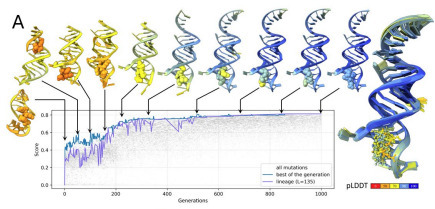
Emergence and evolution of functional RNA and protein structures are the central problems for understanding the origin of life. Although it is well known that catalytically active RNA elements, ribozymes, can catalyze many reactions, including peptide bond formation, the specifics of the transition from the hypothetical, primordial RNA world to protein-based life centered at the translation system remain enigmatic. We developed AMES, Atomistic Molecular Evolution Simulator, and employed it to perform computer simulations of the evolution of short RNA molecules and RNA-peptide complexes. Comparison of the evolutionary trajectories and the structures of RNA molecules and RNA-peptide complexes emerging in these simulations shows that short random peptides accelerate RNA evolution, stabilize RNA folds, and boost the structural diversity of evolving RNA molecules, potentially enabling a broader range of activities. We hypothesize that the RNA world was, actually, an RNA-peptide world, in which, from the earliest stages of evolution, evolving RNA molecules interacted with short random peptides synthesized in a non-templated manner. These interactions could drive the evolution of diverse RNA structures and activities, and eventually, of the translation machinery.
|
|
Scooped by
mhryu@live.com
September 22, 10:52 PM
|
Biofertiliser formulations, comprising free-living and symbiotic bacteria, mycorrhizal and saprotrophic fungi, and associated microfauna (protozoa and bacterivorous nematodes), offer a viable alternative to synthetic fertilisers for restoring soil health, yet field efficacy remains inconsistent. Competitive exclusion from native microbiota, abiotic stress, and colonization failure together constitute the central barrier to commercial adoption. This review evaluates whether multi-omics technologies and functional genomics can close this translational gap, where translational maturity denotes how far a technology has progressed from computational or laboratory demonstration to validated performance in the field. This is a structured narrative review rather than a formal systematic review: the search strategy, eligibility criteria and screening procedure were specified in advance in a protocol registered on the Open Science Framework (DOI: 10.17605/OSF.IO/4A6RD), but no formal quality appraisal or quantitative synthesis was undertaken, and both are reserved for the companion systematic review. On that basis, 71 peer-reviewed studies published between 2015 and 2025 and retrieved from Web of Science, Scopus and PubMed were stratified by translational maturity. Genomic strain screening is partially integrated into commercial pipelines; transcriptomics, proteomics, and metabolomics remain at proof-of-concept stage; and few studies address field-relevant conditions. Genome editing, synthetic biology, and microbiome engineering remain largely at proof-of-concept or aspirational stages, limited by ecological uncertainty and by regulatory and commercialisation barriers that differ across jurisdictions. Artificial intelligence shows promise for omics pattern recognition, though externally validated field models are scarce. Meta-analytic estimates place mean yield responses between about 8.5% in continental climates and 20% in dry climates, and commercial co-inoculation of soybean in Brazil shows that field-scale translation is achievable, yet no published trial demonstrates that omics-guided strain selection outperforms conventional selection. We propose minimum reporting standards for biofertiliser field trials and outline the multi-site designs needed to bridge laboratory characterisation and agricultural impact. industry
|
|
Scooped by
mhryu@live.com
September 22, 10:41 PM
|
The Tat system is a general translocation machinery responsible for the transport of folded proteins across biological membranes that are energized by a proton or sodium motive force at these membranes. Protein substrates are characterized by usually amino-terminal signal peptides harboring a conserved twin-arginine sequence motif. Phylogenetic analyses suggest that a Tat system was already present in the last universal common ancestor (LUCA). Today, Tat systems are found in bacteria, archaea, and bacteria-derived organelles. Minimally, Tat systems are composed of one TatC-family component and one TatA/B-family component, with multiple copies of these components forming the functional translocon, while more complex Tat systems exist that require additional homologs of TatA/B or TatC. Due to its ability to translocate folded proteins with bound cofactors, the Tat system is essential for a wide range of important physiological pathways, such as many anaerobic respirations or photosynthesis. With a focus on evolutionary aspects, and by including recent structural and mechanistic insights, we herein review our current knowledge on this mechanistically unique translocation pathway.
|
|
Scooped by
mhryu@live.com
September 22, 4:07 PM
|
Bacteria encode diverse antiphage defense systems triggered by invader-specific molecular cues. Here, we report that the compact type III-A Druantia system recognizes exposed single-stranded DNA to block phage replication and drive phage clearance. Using representative systems from E. coli, we show that the two encoded proteins, DruE and DruH, together clear restriction-sensitive or recombination-prone phages without affecting cell growth or viability. DruE dimerizes and engages DNA at exposed single-stranded regions to unwind DNA with 3′-to-5′ directionality, resorting to unique molecular lock, wedge, and clamp elements that aid strand separation and processive translocation. DruH is a monomer in isolation and indirectly interacts with DruE and other host proteins under uninfected conditions, with an infection resulting in the dissociation of the complex. Taken together, our results reveal that exposed single-stranded DNA can trigger bacterial immunity through the directional helicase activity of type III-A Druantia.
|
|
|
Scooped by
mhryu@live.com
September 23, 4:37 PM
|
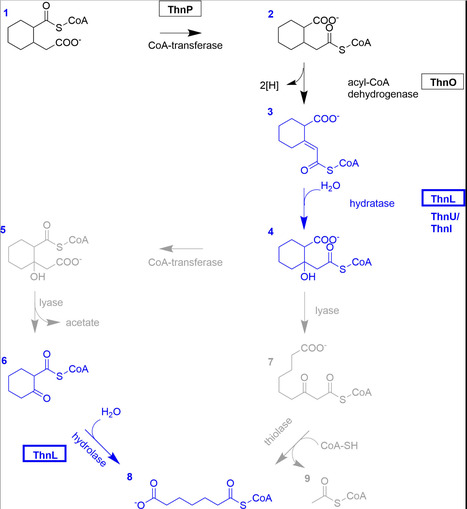
Anaerobic degradation of polycyclic aromatic hydrocarbons (PAHs) proceeds through CoA-activated intermediates and β-oxidation-like reactions; however, the enzymes responsible for key hydration and hydrolytic steps remain insufficiently defined. In the sulfate-reducing enrichment culture N47, the thn operon encodes multiple putative hydratases and hydrolases proposed to participate in anaerobic naphthalene degradation. Here, we cloned, heterologously expressed, and purified six candidate enzymes (ThnA, ThnH, ThnI, ThnL, ThnM, and ThnU) to elucidate their substrate specificities. Among them, ThnL showed robust activity toward 2-carboxycyclohexylideneacetyl-CoA, catalyzing rapid hydration of the enoyl-CoA double bond to form the tertiary alcohol 1-(1-hydroxy-2-carboxycyclohexyl)acetyl-CoA. ThnL exhibited kinetic parameters of Kₘ = 0.11 mM and Vₘₐₓ = 350 µmol min⁻¹ mg⁻¹. Two additional hydratases, ThnU and ThnI, converted the substrate only weakly (0.26% and 0.08% of ThnL activity), indicating promiscuous rather than physiological roles. ThnL also catalyzed the hydrolytic C1–C2 ring cleavage of 2-oxocyclohexane-1-carbonyl-CoA to pimelyl-CoA, revealing a bifunctional hydratase/hydrolase activity, although this reaction is unlikely to be physiologically relevant based on growth assays. This study shows that the ThnL-catalyzed hydration of 2-carboxycyclohexylideneacetyl-CoA to the tertiary alcohol 1-(1-hydroxy-2-carboxycyclohexyl)acetyl-CoA completes the final preparatory step before the second-ring cleavage in anaerobic naphthalene degradation.
|
|
Scooped by
mhryu@live.com
September 23, 2:01 PM
|
Microbial genomes encode compact molecular machines and diverse non-coding RNAs (ncRNAs) essential to gene regulation, pathogenesis, and many foundational biotechnologies. However, annotation remains largely protein-centric and homology-driven. Here, we introduce Minerva, a framework for coevolutionary mining that uses genome language models to predict local interactions directly from sequence as two-dimensional maps. Introducing two complementary techniques, categorical Jacobian fingerprinting and interaction heads, we demonstrate fast, accurate, alignment-free prediction of ncRNA base-pairing, monomeric protein contacts, and repetitive sequence motifs. Applied to 150 bacterial genomes, Minerva recovers known systems and predicts that 84.3% of predicted intergenic base-pairing falls outside of known annotations. In Pseudomonas, we find that the widespread TwoAYGGAY ncRNA family carries large secondary-structure extensions and is often flanked by short upstream repetitive motifs and larger downstream genomic repeats. Interpreting the coevolution maps, we find that Minerva emergently detects open-reading-frame (ORF) signatures at the DNA level despite never being trained to do so. In prophages within these genomes, we discover that Unknown Group 27 (UG27) reverse transcriptase systems encode arrays of structurally conserved yet sequence-diverse ncRNAs that template complementary DNA (cDNA) hairpin products. Together, these results establish coevolutionary mining as a scalable route to genome annotation and biological discovery across the rapidly expanding microbial universe.
|
|
Scooped by
mhryu@live.com
September 23, 1:05 PM
|
Plasmids are typically regarded as static delivery vehicles for foreign DNA. Here, we expose the pivotal role that plasmid copy number (PCN) control can play in synthetic biology, not only in E. coli but also in the next-generation bacterial workhorse Vibrio natriegens. We show that the antibiotic selection marker can impact PCN, thus affecting growth and protein production, and that cells can be cotransformed with multiple variants of the same plasmid, with their PCN controlled simultaneously and in unison. We reveal that plasmid loss can be mitigated via the integration of an additional origin of replication (ori) and that PCN control can be leveraged to modulate horizontal gene transfer, which we illustrate within the context of conjugation-based intercellular communication. Finally, we expand the MoClo modular cloning framework with inducible PCN control for rapid prototyping and to enhance the performance of complex biocircuits.
|
|
Scooped by
mhryu@live.com
September 23, 12:34 PM
|
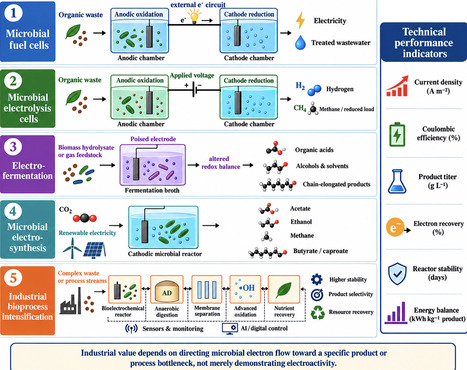
Electroactive microbiomes are mixed microbial communities in which one or more members exchange electrons with extracellular minerals, redox-active compounds, electrodes, or partner organisms and in which community interactions materially influence net electron flow. This review develops a mechanism–interface–function–readiness framework that connects extracellular electron transfer (EET) with biofilm ecology, microbiome–electrode organization, environmental process performance, and translational maturity. Direct transfer through multiheme cytochromes and conductive structures, mediated transfer through soluble redox shuttles, and interspecies electron transfer are evaluated as system-dependent pathways rather than universally ranked mechanisms. Particular emphasis is placed on wastewater treatment and resource recovery, anaerobic digestion, pollutant and metal transformation, soil and sediment bioelectrochemistry, carbon conversion, microbial fuel cells, microbial electrolysis cells, electro-fermentation, and microbial electrosynthesis. Multi-omics, metabolic modelling, synthetic biology, advanced materials, and artificial intelligence are examined according to the strength of their direct evidence in electroactive systems. Across applications, performance depends strongly on reactor configuration, electrode properties, inoculum, biofilm architecture, mass and charge transport, substrate loading, and normalisation basis, making unqualified cross-study numerical comparison inappropriate. Major barriers are long-term stability, mechanistic attribution in mixed communities, standardisation, scale-up, energy and mass balances, biosafety, techno-economic feasibility, and regulatory compatibility. mfc
|
|
Scooped by
mhryu@live.com
September 23, 12:29 PM
|
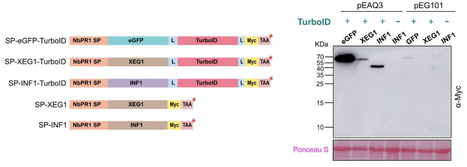
The apoplast is a primary location for interactions between plants and invasive pathogens and is the site where many pathogen-secreted effectors are perceived by cell surface immune receptors to activate defence responses. However, our understanding of apoplastic interactions remains limited because protein interactions are difficult to investigate in this harsh extracellular environment. TurboID-based proximity labelling (PL) has emerged as a powerful approach for studying protein interactions in plants, though its application has to date been restricted to intracellular proteins. Here, we designed and validated a TurboID-based PL strategy for investigating protein interactions in the leaf apoplast using the well-characterised interaction between the Phytophthora infestans elicitor INF1 and the receptor-like protein (RLP) REL in Nicotiana benthamiana. Transient expression of SP-INF1-TurboID (INF1-T) induced a cell death (CD) response comparable to that triggered by native INF1, demonstrating that fusion of the TurboID tag did not impair INF1 recognition by REL. Apoplastic localisation of both INF1-T and the control construct SP-eGFP-TurboID (eGFP-T) was confirmed, validating their suitability for PL experiments. Efficient TurboID-mediated biotinylation was achieved in the apoplast using co-infiltration of biotin, ATP and magnesium acetate. Streptavidin-HRP immunoblotting revealed distinct biotinylation profiles for INF1-T and eGFP-T. Furthermore, co-immunoprecipitation demonstrated specific biotinylation of REL by INF1-T, but not by eGFP-T, in wild-type, bak1 and sobir1/sobir1-like N. benthamiana. These findings demonstrate that TurboID-based PL is functional in the apoplast and provides a proof-of-concept for investigating elicitor-receptor interactions in this compartment.
|
|
Scooped by
mhryu@live.com
September 23, 9:54 AM
|
Synthetic biologists aim for standardization and simplicity in order to ensure reproducibility and reliability. Toolkits offer both, making it easier to share DNA sequences between labs while minimizing context dependent effects from sequences surrounding the construct of interest. The Yeast Toolkit (YTK) for the model organism Saccharomyces cerevisiae has found wide adoption within the scientific community. While the Toolkit and its existing extensions offer a large variety of different parts, there is a lack of characterized logic gates and insulator containing backbones for the assembly of genetic circuits with the yeast toolkit syntax. In this work, we present the Yeast Logic Toolkit (YLT). YLT contains 40 pre-assembled backbones with dropouts, 109 parts for NOT/NOR gate assembly, and a subdivided promoter Type 2 part that allows more flexible 5'UTR design. For insulation, the backbones contain spacer sequences and self-cleaving ribozymes which buffer against transcriptional read-through from upstream sequences. Due to our subdivision of Type 2 parts, we are able to manipulate the 5' untranslated region without a cloning scar upstream of the start codon. We also characterized the NOT and NOR gates from the Cello library for yeast in the sequence context of the yeast toolkit cloning scheme. This toolkit extension will make it easier and faster for scientists to assemble genetic circuits in yeast while providing a minimum of context dependent effects such as genetic read-trough due to the standardization of up- and downstream sequences surrounding the transcriptional units.
|
|
Scooped by
mhryu@live.com
September 23, 12:29 AM
|
Synthetic biology has enabled the production of natural and unnatural products from inexpensive sustainable feedstocks. Yet, the scope of available products has been limited largely to compounds accessible from nature’s chemical reactions. Evolved enzymes can catalyze reactions of unnatural substrates or reactions not found in nature but often require the addition of synthetic reagents to purified enzymes or to resting cells containing those enzymes. Here we show that chemical reactions of metabolic intermediates produced intracellularly in living cells can include intermolecular nitrene transfers. The biosynthesis of N-acetoxyanilines, in combination with the generation and transfer of N-aryl nitrene intermediates from them catalysed by a cytochrome P450, generates amino alcohols, diamines, diarylamines and aminoalkyl arenes from simple carbon feedstocks. These products—common substructures of pharmaceuticals and agrochemicals—are challenging to synthesize by standard organic chemistry and were produced from inexpensive, renewable feedstocks. Evolution of the enzymes in this pathway showed that titres can be increased by engineering and that the products can be synthesized with high enantioselectivity. The incorporation of unnatural chemical reactions into biosynthetic pathways is a key aim of synthetic biology. Now it has been shown that a nitrene precursor derived from the natural metabolite p-aminobenzoic acid can be generated through biosynthesis in Escherichia coli and transferred to several biosynthesized olefins to form new-to-nature amino alcohol, diamine and diarylamine products.
|
|
Scooped by
mhryu@live.com
September 23, 12:23 AM
|
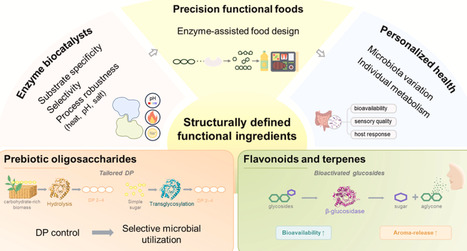
Next-generation functional foods provide a paradigm shift from generalized healthcare to personalized nutrition. Rational design of functional ingredients based on structure-activity relationships is essential for their further development. Because of high substrate specificity and selectivity, enzymes enable the precise conversion of food components into targeted bioactive molecules. Among diverse functional ingredients, prebiotic oligosaccharides (OSs), flavonoids, and terpenoids are particularly suitable for enzyme-guided design because their biological activities strongly depend on structural features. In this review, we overview enzymatic approaches for developing degree-of-polymerization-controlled prebiotic OSs and for modifying flavonoids and terpenoids to enhance their biological activities with brief perspectives on structure–activity relationships for rational design. Representative biocatalytic strategies, including synthetic route selection and suitable enzyme engineering, are discussed for structural control and enhanced biocatalytic performance. The approaches presented here extend beyond the selected examples, highlighting the potential of enzyme-guided design to expand the repertoire of structurally defined functional food ingredients.
|
|
Scooped by
mhryu@live.com
September 23, 12:02 AM
|
Over the past two decades, microbiome manipulations have emerged as a strategy to bolster coral fitness. Here, we provide a timeline of two decades of research on in vivo coral microbiome manipulation studies aimed at improving coral health. A summary of coral hosts, probiotic taxa, and how experimental design varies across studies is synthesized to identify commonly used taxa and research gaps. This review highlights methodological challenges and identifies opportunities to advance probiotic development and translate microbial interventions into practical tools for coral restoration and reef management.
|
|
Scooped by
mhryu@live.com
September 22, 11:04 PM
|
Mobile genetic elements drive genome evolution and horizontal gene transfer, yet the mechanisms underlying the mobility of many eukaryotic elements remain poorly understood. Here we show that Starships, a recently discovered class of giant transposable elements in fungi, mobilize via an extrachromosomal circular intermediate. Using deep sequencing, we detect low-abundance reads spanning the hypothesised junction consistent with circularization. We demonstrate that a synthetic circular intermediate, or "starmid", is sufficient for recombinase-dependent integration into the host genome and that circularisation enhances expression of the starship-encoded tyrosine recombinase through juxtaposition of 3' and 5' terminal sequences. This topology-dependent regulation parallels bacterial integrative elements, in which excision activates recombination machinery. Exploiting this circular intermediate, we explore starmids as a platform for transient DNA delivery, enabling CRISPR Cas9-mediated genome editing in Paecilomyces variotii with subsequent curing of the construct. Together, our results shed light on the biology of starship mobility and suggest promising biotechnology applications for these elements.
|
|
Scooped by
mhryu@live.com
September 22, 10:48 PM
|
Plant peptide hormones have reshaped our understanding of intercellular signaling in plants. Once considered absent in plants, peptide-based signaling pathways emerged as key regulators of plant growth, development, environmental responses and immunity. A paradigm shift occurred with the discoveries of Systemin and Phytosulfokine (PSK) in the 1990s as well as the identifications of receptor-like kinases (RLKs) regulating important biological processes. Over the past three decades, a repertoire of peptide hormone families has been expanded enormously, with deeper understandings of peptide modifications, cleavage, modes of actions, and receptor binding and signal transduction. In this review, I highlight selected peptide hormone families, Systemin, PSK, INFLORESCENCE DEFICIENT IN ABSCISSION (IDA)/IDA-LIKES, CLAVATA3/EMBRYO SURROUNDING REGION (CLE), and EPIDERMAL PATTERNING FACTORs (EPF)/EPF-LIKES, and discuss how individual discoveries of the peptides and their cognate receptors have shaped emerging concepts in plant peptide signaling. Celebrating this Centennial Issue, emphasis will be given on contributions published in Plant Physiology. Finally, I discuss how expanding genomic resources and advanced technologies will accelerate the discovery and engineering of peptide signaling pathways to enhance plant resilience.
|
|
Scooped by
mhryu@live.com
September 22, 4:16 PM
|
Genetic memory enables bacteria to record transient stimuli as persistent genetic states, providing a foundation for cellular information storage, sensing, and computation. Recombinase-based memories encode discrete states through rewritable DNA rearrangements, but these states can continue to evolve after stimulus removal as cells proliferate. Here, we show that the long-term stability of reversible recombinase-based memory can be engineered by controlling post-switching dynamics. We identify a temporal hierarchy in which heterogeneous states arising from imperfect recombinase orthogonality are first resolved through intracellular competition between incompatible plasmids and subsequently reshaped by fitness differences between cells carrying alternative states. Reducing DNA copy number accelerates intracellular state resolution and decreases expression-associated fitness costs, while tuning state-specific gene expression balances the relative fitness of alternative memory states. Using these principles, we engineer a reversible memory device that maintains its two states for up to two weeks while retaining rewritability after prolonged maintenance. Our results establish a framework for engineering persistent and rewritable genetic memory through control of intracellular competition and population-level fitness.
|















2st, PG-bearing methanogens are major drivers of methane emissions. inhibitors targeting archael PG can be developed toward controlling emissions, idea, adding or secreting armA: ArmA only cleaves archaeal PG. no activity on peptidoglycan from either monoderm or diderm bacteria.