


Actinobacteria is a phylum of gram-positive bacteria, and members of bacteria belonging to this phylum are classified into six classes, namely Acidimicrobiia, Actinobacteria, Coriobacteriia, Nitriliruptoria, Rubrobacteria, and Thermoleophilia. Among the six different classes, members of the actinobacteria class are the most dominant and contain one of the largest genera, Streptomyces, with 961 distinct species. Members of phylum actinobacteria are ubiquitous in nature and have been isolated from various extreme environments (high temperatures, pH, salinities, pressure, and drought) and are associated with plants growing in different habitats. The rhizospheric actinobacteria are the most dominant in nature and they are of great economic importance to humans due to their huge contributions to soil systems. Based on a comprehensive literature analysis members of phylum actinobacteria have been reported from different genera such as Acidimicrobium, Actinomyces, Arthrobacter, Bifidobacterium, Cellulomonas, Clavibacter, Corynebacterium, Frankia, Microbacterium, Micrococcus, Mycobacterium, Nocardia, Propionibacterium, Pseudonocardia, Rhodococcus, Sanguibacter, and Streptomyces. Actinobacteria can be utilized as bioinoculants for sustainable agriculture as they can enhance plant growth and yield both by directly promoting plant growth by the fixation of atmospheric nitrogen, the solubilization of minerals such as phosphorus, potassium, and zinc, the production of siderophores and plant growth hormones such cytokinin, auxin, and gibberellins, and by indirect plant growth promotion via production of antagonistic substances by inducing resistance against plant pathogens. The actinobacteria has been proved to have immense importance in biotechnological applications in various industrial and agricultural processes that are discussed in this chapter.
Follow, research and publish the best content
Get Started for FREE
Sign up with Facebook Sign up with X
I don't have a Facebook or a X account
Already have an account: Login

RMH
39.8K views |
+1.6K today
 Your new post is loading... Your new post is loading...
 Scoop.it!
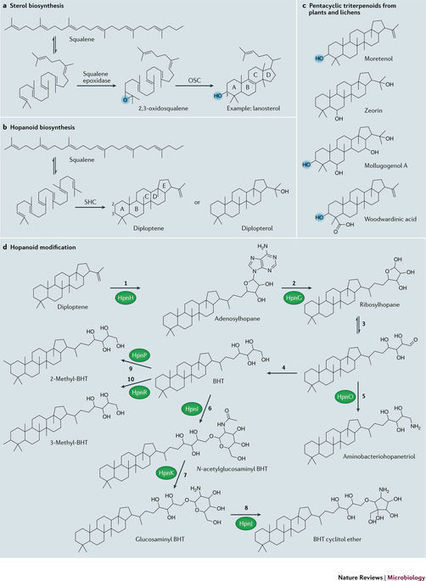
Hopanoids, which resemble sterols and are found in the membranes of diverse bacteria, have left an extensive molecular fossil record. Today, hopanoid-producing bacteria remain abundant in various ecosystems, such as the rhizosphere. In vitro, hopanoids contribute to bacterial stress resistance, which may help explain their ability to facilitate beneficial plant–bacteria interactions. However, given that hopanoids can also serve as carriers for plant hormones and that plants themselves make hopanoid-like compounds, it is likely that other mechanisms are additionally at play. In closing, we remind the reader of the words of John F. Kennedy when explaining what was needed to send astronauts to the Moon. “We choose to go to the Moon! ... We choose to go to the Moon in this decade and do the other things, not because they are easy, but because they are hard; because that goal will serve to organize and measure the best of our energies and skills...”. Replacing the words 'go to the Moon' with 'study lipids' provides fitting inspiration for tackling one of the next great challenges in microbiology. It is time for lipids to get the attention they deserve, and the study of hopanoids is an excellent place to begin. 
Scoop.it!
Four nucleotide bases carry all the information an organism needs to live and function. Can this limited set of bases be expanded to carry more information? Now, a new study by Floyd Romesberg at The Scripps Research Institute reports that introducing unnatural nucleotides into DNA results in the incorporation of novel amino acids into proteins in E.coli.
While other research groups have engineered cells to incorporate unnatural amino acids into cellular proteins, Romesberg focused on expanding the information stored in DNAso that semi-synthetic organisms could create new proteins and perform unnatural functions. “The natural system was there, and I wanted to augment the natural system,” said Romesberg.
Scoop.it!
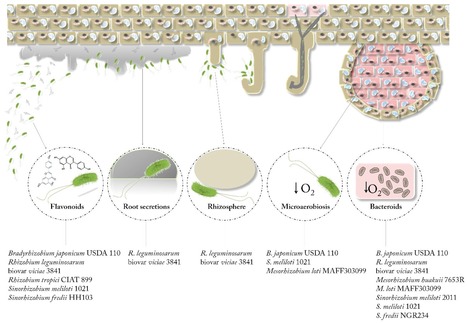
Simultaneous quantification of transcripts of the whole bacterial genome allows the analysis of the global transcriptional response under changing conditions. RNA-seq and microarrays are the most used techniques to measure these transcriptomic changes, and both complement each other in transcriptome profiling. In this review, we exhaustively compiled the symbiosis-related transcriptomic reports (microarrays and RNA sequencing) carried out hitherto in rhizobia. This review is specially focused on transcriptomic changes that takes place when five rhizobial species, Bradyrhizobium japonicum (=diazoefficiens) USDA 110, Rhizobium leguminosarum biovar viciae 3841, Rhizobium tropici CIAT 899, Sinorhizobium (=Ensifer) meliloti 1021 and S. fredii HH103, recognize inducing flavonoids, plant-exuded phenolic compounds that activate the biosynthesis and export of Nod factors (NF) in all analysed rhizobia. Interestingly, our global transcriptomic comparison also indicates that each rhizobial species possesses its own arsenal of molecular weapons accompanying the set of NF in order to establish a successful interaction with host legumes.
mhryu@live.com's insight:
also check The Rhizobium tropici CIAT 899 NodD2 protein regulates the production of Nod factors under salt stress in a flavonoid-independent manner
Scoop.it!
Protocol
mhryu@live.com's insight:
protein modeling tool
|
Scoop.it!
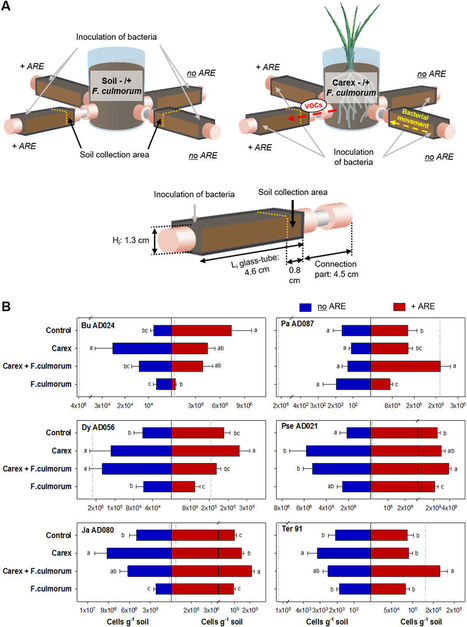
Plants release a wide set of secondary metabolites including volatile organic compounds (VOCs). Many of those compounds are considered to function as defense against herbivory, pests, and pathogens. However, little knowledge exists about the role of belowground plant VOCs for attracting beneficial soil microorganisms. We developed an olfactometer system to test the attraction of soil bacteria by VOCs emitted by Carex arenaria roots. Moreover, we tested whether infection of C. arenaria with the fungal pathogen Fusarium culmorum modifies the VOCs profile and bacterial attraction. The results revealed that migration of distant bacteria in soil towards roots can be stimulated by plant VOCs. Upon fungal infection, the blend of root VOCs changed and specific bacteria with antifungal properties were attracted. Tests with various pure VOCs indicated that those compounds can diffuse over long distance but with different diffusion abilities. Overall, this work highlights the importance of plant VOCs in belowground long-distance plant–microbe interactions.
Scoop.it!
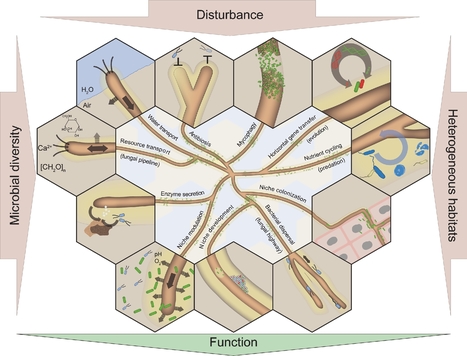
Fungi and bacteria are found living together in a wide variety of environments. Their interactions are significant drivers of many ecosystem functions and are important for the health of plants and animals. A large number of fungal and bacterial families are engaged in complex interactions that lead to critical behavioural shifts of the microorganisms ranging from mutualism to pathogenicity. The importance of bacterial-fungal interactions (BFI) in environmental science, medicine and biotechnology has led to the emergence of a dynamic and multidisciplinary research field that combines highly diverse approaches including molecular biology, genomics, geochemistry, chemical and microbial ecology, biophysics and ecological modelling. In this review, we discuss most recent advances that underscore the roles of BFI across relevant habitats and ecosystems. A particular focus is placed on the understanding of BFI within complex microbial communities and in regards of the metaorganism concept. We also discuss recent discoveries that clarify the (molecular) mechanisms involved in bacterial-fungal relationships, and the contribution of new technologies to decipher generic principles of BFI in terms of physical associations and molecular dialogues. Finally, we discuss future directions for researches in order to catalyse a synergy within the BFI research area and to resolve outstanding questions.
Scoop.it!
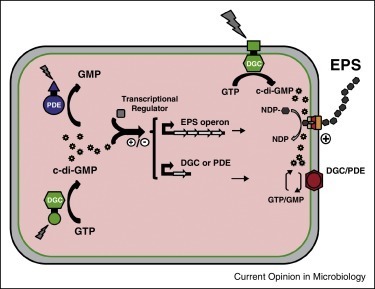
mhryu@live.com's insight:
check "Cyclic (di)nucleotides: the common language shared by microbe and host"
Scoop.it!
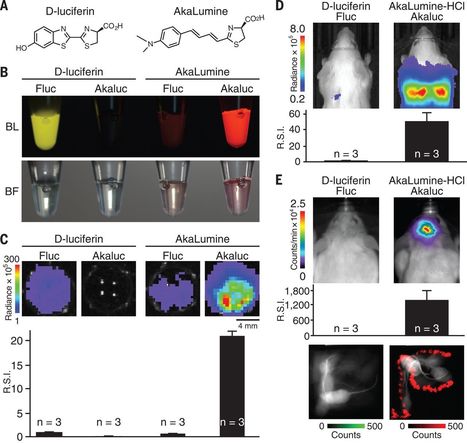
Bioluminescence imaging is a tremendous asset to medical research, providing a way to monitor living cells noninvasively within their natural environments. Advances in imaging methods allow researchers to measure tumor growth, visualize developmental processes, and track cell-cell interactions. Yet technical limitations exist, and it is difficult to image deep tissues or detect low cell numbers in vivo. Iwano et al. designed a bioluminescence imaging system that produces brighter emission by up to a factor of 1000 compared with conventional technology (see the Perspective by Nasu and Campbell). Individual tumor cells were successfully visualized in the lungs of mice. Small numbers of striatal neurons were detected in the brains of naturally behaving marmosets. The ability of the substrate to cross the blood-brain barrier should provide important opportunities for neuroscience research.
mhryu@live.com's insight:
wonder how this luciferase works in microbes and plants. What is the minimum conc. of AkaLumine (substrate) for luminescence?
|







intersting chassis to look