Your new post is loading...

|
Scooped by
Robin Landis
December 10, 2012 2:17 AM
|
Oxfam has called the new USAID guidance on building resilience to recurrent crises "a breakthrough" in linking short-term humanitarian responses with longer-term development programming. "The new USAID guidance comes at a critical juncture when the world is looking more deeply than ever at how to assist people and their societies withstand and recover from a growing number of natural disasters." The need to build resilience in the Horn of Africa was highlighted when African leaders meeting in September 2011 in Nairobi, Kenya, called for a new way to address recurrent crisis in the region due to drought and conflict. Those events affected some 13 million people in Somalia, Ethiopia, Djibouti, Kenya and Uganda, according to the UN World Food Programme. In response, in April 2012 USAID and African and international development partners met in Nairobi to establish the Global Alliance for Action for Drought Resilience and Growth in the Horn of Africa. In June, USAID convened the group's first meeting in Geneva. The following month, the European Union led the founding of the Global Alliance for Resilience in the Sahel that will work closely with the Global Alliance for Action for Drought Resilience and Growth in the Horn of Africa. "Through building resilience, we can help prevent that desperation, save lives, and create the conditions where families and communities can prosper." [Rajiv Shah, USAID Administrator]
|
|
Scooped by
Robin Landis
December 10, 2012 1:31 AM
|
Value-added agriculture offers the possibility of changing the rural face of East Africa by increasing returns to farmers and–with the right investment–making East Africa the food factory of the world. The sheer size of the East African market (135 million people, not including South Sudan and DR Congo), which has witnessed tremendous growth in recent years, has caught the imagination and incited business interests of top global conglomerates. From sole traders to small and medium sized enterprises (SMEs) to multinational corporations, East Africa’s economic potential has never been greater. In their report “Why Africa can make it big in agriculture” (Africa Research Institute, 2010) Mark Ashurst and Stephen Mbithi state that “agriculture is the continent’s most neglected – and important – potential competitive advantage. It is Africa’s best answer to globalisation. Until farming is commercially viable, there will always be hunger in Africa.” The authors argue that “Global demand for food is a strategic opportunity to rebalance the inequities of world trade in Africa’s favour.” This means East Africa should be far more ambitious than just planning for self-sufficiency. The land, low labour costs and improved farming, irrigation, processing and storage techniques mean that the region’s potential as a cost-effective producer of food for export remains largely untapped.
|
|
Scooped by
Robin Landis
December 7, 2012 10:09 AM
|
According to Josette Sheeran, Vice-Chairman of the World Economic Forum (WEF) and former Executive Director of the World Food Programme (WFP), falling off this precipice could have even more dire and far-reaching consequences than America’s financial woes, and would be felt throughout the world for generations to come. ...Recent developments indicate that the “food cliff” may be even closer than we previously thought. In six of the past 11 years, global food consumption has exceeded production, and food reserves are now “dangerously low,” particularly for staple grains such as wheat and maize. Sheeran proposes a “21st century paradigm” for food and nutrition, based on four important “game changers” in public-private partnerships. First, enhance partnerships to produce and expand access to affordable, nutrient-dense, fortified foods, such as biofortified crops and emergency food packets for the severely malnourished. Second, invest in smallholder farmers— particularly women—and in whole agricultural value chains. Such investments have led to major payoffs not only toward increasing production but also raising incomes and reducing poverty. [Third, we need] to change the way we view the entire food and nutrition system and form a sustainable “circular food economy,” as the third game changer. She cited the Zero Hunger Project in Brazil and the Grow Africa initiative as excellent recent examples of such “whole picture” level approaches. Finally, Sheeran recommended engendering strong, inspired leaders who are prepared to take action in the growing face of food and nutrition security challenges. As she explained, during the 2007-08 global food crisis, she “didn’t know who to call,” as there was no one person or governing body suitably prepared to take effective action at the time.
|
|
Scooped by
Robin Landis
December 7, 2012 2:37 AM
|
Efforts to ease the epidemic of under nutrition that effects about 2 billion people globally have made some progress, but only 58 of 118 tracked countries are on course to reduce hunger and micronutrient deficiencies by 2015, according to a UK report. See FAO's interactive map on global undernutrition: http://www.fao.org/hunger/en/
|
|
Scooped by
Robin Landis
December 7, 2012 2:20 AM
|
The United Nations has launched a $1.3 billion humanitarian appeal in Mogadishu to address the immediate needs of the Somali people over the next year and enhance resilience in the country, which has for decades been mired by conflict, drought, floods and food insecurity. The appeal issued on December 4 is part of a three-year strategy. It is expected to benefit 369 humanitarian projects targeting 3.8 million Somalis in need, according to the UN Office for the Coordination of Humanitarian Affairs (OCHA). The strategy will be implemented by 177 national and international non-governmental organizations and UN agencies operating in Somalia. “While the humanitarian situation in Somalia remains critical, the improvement in the food security situation and the new security and political landscape present opportunities to break the cycle of recurring crises brought on by drought and conflict,” said the Humanitarian Coordinator [and WFP Country Director] in the country, Stefano Porretti. “The road to resilience will be long and difficult,” Porretti said. “There is an absolute imperative to continue supporting the humanitarian work in Somalia. The new three-year humanitarian appeal allows for greater continuity in programming and aims at responding to the existing emergency needs of the population in crisis in a sustainable manner.”
|
|
Scooped by
Robin Landis
December 4, 2012 7:32 AM
|
Cecilia Kibe’s home in Turkana district, a remote area in Kenya inhabited by mostly nomadic communities and pastoralists hit hard by the effects of climate change. Kibe is on a mission – to gather as much knowledge as possible to share with the women in her community. Turkana district was one of the hardest-hit areas in the Horn of Africa in the 2011 drought that affected the entire region...She said that often the information from conferences such as COP 18 does not filter down to the people most affected by climate change. “We need to get the information from this conference to help them understand what exactly is happening,” said Kibe. Top of Kibe’s priority list of things to tackle is food insecurity. And the cultivation of cassava, a drought-tolerant crop, has been identified as part of the strategy to combat this. Previously people in Kibe’s area grew maize, which often failed because of the lack of rain. Another priority is addressing water insecurity... women and children have to travel long distances to fetch water, which in many cases is contaminated. “We have introduced solar water cleaning, which is a technology that uses a device that easily purifies water when placed in the sun ...It’s just a press of a button.” Women are also encouraged to plant five trees each to combat carbon emissions.
|
|
Scooped by
Robin Landis
December 6, 2012 9:11 AM
|
[ESSP II Working Paper 48] "Enhancing Resilience in the Horn of Africa. An Exploration into Alternative Investment Options" by Derek Headey, Alemayehu Seyoum Taffesse, and Liangzhi You. Abstract: The most recent (2010–2011) drought in the arid and semiarid lowlands (ASAL) of the Horn of Africa has rendered over 13 million people in need of food, and caused a devastating famine in southern Somalia. The drought has also raised concerns that pastoralist livelihoods in this region are no longer viable or sustainable, thereby justifying strategies that aim to sedentarize and diversify these livelihoods. The authors argue that both economic theory and the existing evidence base warrant a more balanced development strategy involving movement out of pastoralism, modernization of pastoralism, and cross-cutting transformations of the demographic, social, and political structure of ASAL populations. They explore the empirical basis for balancing investments across these kinds of transformations. While the available evidence base is weak in some respects, they find that most nonpastoralist livelihoods in ASAL yield lower incomes than pastoralism, with the exception of urban livelihoods and irrigated farming. However, both irrigation and urban migration have a limited capacity to absorb growing populations. Being the dominant livelihood for the foreseeable future, and potentially quite a profitable one given growing demand for livestock products, pastoralism therefore needs to be an important component of local and regional development strategies. The goal of livestock investments should be to transform the pastoralist sector into a more profitable, more integrated, and more resilient economic system. Building a better strategy for ASAL regions therefore requires a coordinated but interdisciplinary research program that can systematically pick up the various pieces of the pastoralist puzzle.
|
|
Scooped by
Robin Landis
December 4, 2012 7:10 AM
|
BLOG: Although its interests in the continent are broadly similar, India’s engagement with Africa differs significantly from China. Will it prove sustainable?...India’s engagement with Africa has grown remarkably over the past decade. ...“Capacity building is an important component of India’s engagement of Africa”...India is supporting institutional capacity building at the pan-African, regional and bilateral levels. It is setting up scores of institutions in areas as diverse as food processing, agriculture, textiles, weather forecasting and rural development. A pan-African e-network linking schools and hospitals across Africa with top institutions in India will make Indian expertise in healthcare and education accessible to the African people.... India’s investments in African land have drawn criticism... It has been accused of engaging in a “land grab,” especially in Ethiopia where Indian companies like Karturi Global, one of the world’s largest exporters of roses, have leased vast tracts of land to cultivate cash crops. This could undermine Africa’s food security, critics charge....
|
|
Scooped by
Robin Landis
December 2, 2012 2:20 AM
|
"...Greater resilience also needs to be built to shocks, not least those caused by extreme climate events. Poor households in Africa often lack access to sufficient credit, insurance, and other income-smoothing mechanisms, and are frequently unable to maintain the consumption levels which can support human development during times of adversity... Putting social protection policies in place builds resilience. It is also an investment in future development, because it helps preserve gains already made. To the extent that social protection nurtures social capital and cohesion, it can also mitigate some of the sources of instability and conflict... ...Unleashing the transformative power of women. Women are key actors in Africa's economies, but their full potential is as yet unrealized. Measures need to be taken to grant women in rural and urban settings equal rights in every respect to ensure their economic, social, and political empowerment. The multiplier effects of investment in women and girls are very significant for development... Addressing food insecurity. More than one in four Africans is undernourished and food insecure. In 2008, almost 240 million people in Africa were undernourished - around twenty million more than five years before. The extent of food insecurity in Africa is a paradox, given that over the last decade most African economies improved their economic performance and overall human development ratings. As a matter of urgency from now until 2015, enhancing food security must be at the top of the policy agenda."
|
|
Scooped by
Robin Landis
November 30, 2012 2:47 AM
|
This is a good overview by Heather Cruise. "The USAID East African Regional Feed the Future program is a multi-year development strategy addressing food security throughout the region including Kenya, Uganda, Tanzania, Rwanda, Ethiopia, Malawi, Zambia, S. Sudan, and DR Congo. In this region agriculture accounts for nearly 30% of the GDP and employs more than 60% of the population. However, even when there is a surplus of food in the region, countries still face food crises. Thus, the movement of staple foods from surplus to deficit areas by means of regional trade could help countries and sub-areas take advantage of crop diversity and various harvest periods, minimizing risk of local food shortages. Regional integration allows for market expansion and enhanced efficiency. This results in an increase in competition and improves policies that align with development agendas. A key strategy of the Feed the Future program is to facilitate the integration of regional markets in East Africa to enhance trade flows of staple foods in the region and scale up production technologies thereby increasing consumer access, availability, and utilization. Structured regional markets around corridors combined with lowered transit costs will spur economic growth and structural change resulting in improved food security and nutrition in the region..."
|
|
Scooped by
Robin Landis
November 29, 2012 9:48 AM
|
Successive years of poor rains have eroded the coping mechanisms of pastoralists in Djibouti's rural regions, even as high food prices and unemployment rates afflict the country's urban areas. These factors are increasing the vulnerability to food insecurity and spurring migration. At present, about 70,000 people in rural Djibouti are food insecure. More than 60 percent of household food supply is being met by food assistance in the northwest pastoral zone, according to an October-to-March 2013 food security outlook by the Famine Early Warning Systems Network (FEWSNET). In the southeast pastoral border area, "households are marginally able to meet minimum food needs only through accelerated depletion of livelihood assets and adoption of unsustainable coping strategies such as charcoal sales," the outlook says... "There is a need for more integrated strategies in water, agriculture, health and nutrition for sustainability," said Mario Touchette, the UN World Food Programme's (WFP) Djibouti representative and country director. "For example, building small water catchments dams could help to improve the situation in rural communities. The access of health and nutrition services would also be important for them. There is also a need to provide alternative livelihood sources for rural-based populations, a majority of whom are pastoralists, but the environment is too challenging." Touchette said aid organizations must strike a difficult balance between meeting the needs of increasingly vulnerable urban populations and focusing on rural areas where humanitarian needs remain high and many donors expect action. "If we provide more assistance to the urban areas, vulnerable people from rural areas might be more attracted to migrate to urban areas," he noted. Still, food insecurity in urban areas is becoming a priority for WFP; Djibouti's population of about 800,000 is mainly urban. WFP is also keen on helping the country develop a national safety net programme. "The safety net should include food-cash vouchers, supplementary feeding programmes and school feeding programmes. We could link it also to some professional training, for example," Touchette said. "The challenge is how to continue providing assistance without maintaining them [beneficiaries] in this cycle of perpetual assistance."
|
|
Scooped by
Robin Landis
November 25, 2012 12:42 AM
|
This effort brings together the AUC’s leadership, FAO’s technical expertise and renewed commitment to fight hunger as well as the political backing of former Brazilian President Lula Da Silva. Knowledge and support from other international, regional and national partners will also go a long way to enhancing this new partnership. The three parties agreed to convene a high-level meeting with African and International Leaders on “New, unified approaches to end hunger in Africa”. The meeting will be held in Addis Ababa on 4 and 5 March 2013. The partnership will be based on the shared vision that a hunger-free Africa is possible and that concerted efforts can achieve tangible improvements in food security and nutrition. Among the areas to focus action, the leaders agreed on the need to scale up and build on existing successful initiatives and to promote knowledge-sharing between countries. They also stressed that high-level dialogue needs to be facilitated to reinforce political commitment in the fight against hunger, food insecurity and malnutrition...much remains to be done in terms of coordination, allocation and deployment of financial and human resources and strengthening regional and national institutional capacities.
|
|
Scooped by
Robin Landis
November 25, 2012 12:33 AM
|
Although this article is about Zimbabwe, it represents innovation in the agriculture sector with relevance for the East and Central Africa region. The system is designed to improve food security among vulnerable households through crop and livestock production...It also aims "to resuscitate the fragile rural agricultural input supply chain through re-engagement of markets, provision of subsidized inputs... [and] farmers' timely access to inputs".... But according to FAO, the e-voucher scheme has its own constraints, including the lack of collateral security among agro-dealers, resulting in reluctance by suppliers to supply in bulk, and a tendency among dealers to hike prices of inputs and tools...beneficiaries also sometimes fail to get their inputs because they have poorly handled and damaged their e-voucher cards - or because they have lost their identity information.
|
|
|
Scooped by
Robin Landis
December 10, 2012 1:48 AM
|
Like last year’s UN climate change talks, this year’s conference in Doha culminated in an all-night session to hammer out a deal on preventing further global warming and protecting people from the effects of climate change. IRIN provides a snapshot of the three overarching themes [of the decisions that came out of the 18th session of the Conference of Parties (COP18) to UN Framework Convention on Climate Change (UNFCCC), and what these decisions mean for humanitarian actors
|
|
Scooped by
Robin Landis
December 10, 2012 1:30 AM
|
Oxfam America and The Rockefeller Foundation announced a weather index insurance payout of unprecedented scale directly to poor farmers. Thanks to a groundbreaking new program that relies on advanced satellite technology, more than 12,200 farmers in 45 villages in Northern Ethiopia will benefit from drought protection. As a result of this year's drought conditions each farmer will receive a share of the total $322,772 in payouts offered through the Horn of Africa Risk Transfer for Adaption Program (HARITA) to help cover crop losses. Oxfam, with funding from The Rockefeller Foundation, partnered with Swiss Re, The International Research Institute for Climate and Society (IRI), the Relief Society of Tigray, Dedebit Credit and Savings Institution, Nyala Insurance Company, and Africa Insurance Company to start HARITA in 2007. Last year, WFP supported by USAID and Oxfam expanded HARITA, now known as the "R4 Rural Resilience Initiative" to help poor farmers protect their crops and livelihoods from the impacts of climate variability and change, including drought. "In the history of weather index insurance programs, this is the first-ever set of large payouts directly to small scale farmers in Ethiopia...Until now payouts have been for small pilots. But at this new scale, we are proving that weather insurance can be a successful and market-ready financial product. These kinds of products are the new face of development: They empower people to take chances and build a better future for themselves." [David Satterthwaite, Oxfam America]
|
|
Scooped by
Robin Landis
December 4, 2012 7:23 AM
|
United States Agency for International Development (USAID) Administrator Rajiv Shah announced the launch of the Agency’s first-ever policy and program guidance on Building Resilience to Recurrent Crisis during an event in Washington DC. USAID seeks to achieve specific results to build resilience for vulnerable populations: increased adaptive capacity; improved ability to address and reduce risk as well as mitigate and recover from shocks and stresses; and improved social and economic conditions. Over the long-term, USAID intends for these efforts to collectively contribute to reduced humanitarian need.
|
|
Scooped by
Robin Landis
December 7, 2012 2:29 AM
|
Poor rains push Djibouti's hungry pastoralists towards the cityThe Guardian... health and nutrition for sustainability," said Mario Touchette, the UN World Food Programme's (WFP) Djibouti representative and country director. "There is a need for more integrated strategies in water, agriculture, health and nutrition for sustainability...For example, building small water catchments dams could help to improve the situation in rural communities. The access of health and nutrition services would also be important for them. There is also a need to provide alternative livelihood sources for rural-based populations, a majority of whom are pastoralists, but the environment is too challenging." [Touchette, WFP] Aid organisations must strike a difficult balance between meeting the needs of increasingly vulnerable urban populations and focusing on rural areas where humanitarian needs remain high and many donors expect action....WFP is keen on helping the country develop a national safety-net programme. "The safety net should include food-cash vouchers, supplementary feeding programmes and school feeding programmes. We could link it to some professional training, for example." [Touchette, WFP]. During the country's lean season, from July to September, WFP, alongside three local NGOs and the state secretary for national solidarity, provided food vouchers to around 3,000 households in Balbala. The coupons were distributed to women every week, helping to supplement their households' food needs. This pilot programme received financial support from the UN Central Emergency Response Fund and Switzerland.
|
|
Scooped by
Robin Landis
December 6, 2012 3:54 AM
|
DOHA: Food prices set to more than double if climate change not checked and developing countries not helped to adapt farming. The UN's Committee on World Food Security said the world would need a 75-90% increase in food production to feed the extra 2 billion people expected to be alive in 2050. But climate change could reduce yields worldwide by 5-25% over the same period. "Extreme weather means extreme prices. Our failure to slash emissions presents a future of greater food price volatility with severe consequences for the precarious lives of the people in poverty..."If developing countries are left alone to deal with the impacts of climate change, we are going to see millions of people lose their lands and livelihoods. Investing in the resilience of the poorest communities is not just a matter of justice, but a smart investment in a better collective future on this small planet." [Oxfam] "What we are seeing already in northern Kenya and parts of Africa is food prices skyrocketing as farmers' production declines in successive droughts...The number of people is growing, putting extra stress on food production." [Christian Aid].
|
|
Scooped by
Robin Landis
December 6, 2012 9:24 AM
|
Nestle, the Geneva-based food multinational, has been selling products in Africa for more than 130 years. However, in recent years the company has stepped up its investment. In 2010, for example, the company launched a three-year CHF150m investment programme in equatorial Africa to "unlock the long-term potential of the area". Nestle's equatorial Africa business is made up of 21 countries, including Angola, Democratic Republic of Congo (DRC), Kenya, Mozambique and Zimbabwe. According to Donald, Nestle sees the region as a "significant potential future growth area"..."It has a very large young population, an emerging middle class, some significant economic developments that are going on around the region - there have been some very strong gas and oil finds and there is agricultural development. It is definitely an emerging area where we expect to see big growth coming in the future," [Nestle CEO of Equatorial Africa]. Nestle expects to sees the greatest potential in east African countries such as Kenya and Ethiopia..."We see east Africa, led by Kenya, as a very strong potential area for a number of reasons. It has a very strong agricultural base that is being developed, it also will benefit from these gas finds along the east coast, it is a natural hub for east Africa, it is the lead economy for east Africa. Maybe it will take a little bit longer but we see good potential in Ethiopia coming. The other countries are: Mozambique, Angola and the Congos, where we are very bullish about the future."
|
|
Scooped by
Robin Landis
December 3, 2012 3:04 AM
|
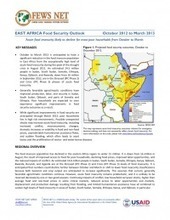
October to March 2013 is anticipated to have a significant reduction in the food insecure population in East Africa from the exceptionally high level of acute food insecurity during the peak of the drought crisis in August 2011. An estimated 14.5 million people in Sudan, South Sudan, Somalia, Ethiopia, Kenya, Djibouti, and Rwanda, down from 16 million in September 2012, are in the Stressed (IPC Phase 2) and Crisis (IPC Phase 3) phases of acute food insecurity. Generally favorable agroclimactic conditions have improved production, labor, and security in Sudan, South Sudan, Djibouti, and parts of Somalia and Ethiopia. Poor households are expected to soon experience significant improvements in food security outcomes as a result. While significant improvements in food security are anticipated through March 2013, poor households live in high risk environments. Possible unexpected shocks may increase acute food insecurity, including increased conflict, macroeconomic changes, dramatic increases or volatility in food and non-food prices, unpredictable humanitarian assistance flows, and sudden flooding, which often leads to asset losses and the proliferation of vector- and water-borne diseases.
|
|
Scooped by
Robin Landis
December 3, 2012 2:57 AM
|
Photo essays by Ashley Jonathan Clements. Beautifiul portraits of Children of the Horn, Women of Somaliland and Ethiopia.
|
|
Scooped by
Robin Landis
November 23, 2012 7:19 AM
|
Check here for the latest Global AIDS Report, fact sheets, video clips, epidemiological data and a special Results report. There's some good news this year!
|
|
Scooped by
Robin Landis
November 29, 2012 10:10 AM
|
Editors: Daniel Maxwell, Nicholas Haan, Kirsten Gelsdorf and David Dawe On July 20, 2011, the United Nations declared a famine in Somalia. Although a major crisis had been predicted in the Horn of Africa for nearly a year, it took the Declaration to mobilize a large-scale response. 2011 was the first time that a famine was declared in real time in accordance with an agreed set of criteria and on the basis of assessment data. Given constraints of access, major humanitarian agencies were not able to respond in the usual ways—which complicated the crisis and therefore demanded innovative responses. This Special Edition of Global Food Security—written from the perspective of both humanitarian practitioners and academic researchers—draws out the lessons of the 2011–2012 famine so that there is not only an increased understanding of what happened, but also what improvements are needed to reduce the risk of famine in the future.
|
|
Scooped by
Robin Landis
November 29, 2012 9:38 AM
|
The EAC regional member states meet next month in Kigali, Rwanda to adopt uniform standards for foods particularly those suitable for children under one year. Groups of the foods to be included in the standards harmonization process are milk based baby food, infant formula, follow up formula food supplements, vitamins and minerals and processed cereal based weaning foods.
|
|
Scooped by
Robin Landis
November 26, 2012 12:01 PM
|
"...Then there is the developing world, which is a entirely different story when it comes to resiliency. ...[The project], which started in 2008 in one village in Ethiopia in partnership with Oxfam America, Columbia University, and the Rockefeller Foundation, encourages the village population to work on projects which would improve the resilience of that village to the kinds of weather events that they might experience quite regularly. In the case of Ethiopia this would be drought. The villages implement projects such as installation of irrigation systems, planting of nitrogen fixing trees, and improvement of storage facilities for crops they have grown. In return for this they get an insurance policy. In 2008 there were zero insurance policies. In 2011 the project has expanded to 45 villages and 13,000 policies (80,000 people)... "And good news. The World Food Program has now expressed interest in the project and through their work it is being scaled up from one country to three new countries and USAID to expand access to this kind of project. The next country is Senegal."
|