reflects on what it means to care for a cultural treasure that is also understood as a living being and how establishing dialogue with communities is crucial to framing decolonial practice with library collections.
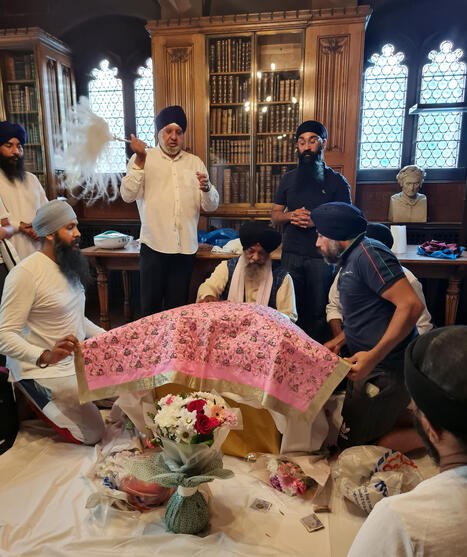
UML has in its collections one of the oldest known copies of the Sri Guru Granth Sahib, one of the most sacred scriptures in the Sikh faith. The copy currently residing at the Rylands can trace its history back to 21 February 1849, when it was ‘wrested out of the hands of a Sikh Priest at the battle of Guzerat by an Officer of the 52nd Bengal Native Infantry’. It is regarded by Sikhs as the embodiment of the eleventh Guru and revered as a living person, as a result there are many acts of respect that must be considered when even consulting the text. Since 2021, UML has worked closely with the Sikh community in Manchester to conserve, digitise and respectfully care for the Sri Guru Granth Sahib. As well as this, UML have digitised other manuscripts relating to Sikh heritage in the collections and have worked with the community to digitise some of their personal material, adding to the rich history of Sikhi in Manchester. The manuscript has also been taken into the community and used during Vaisakhi festivities at a Manchester Gurdwara.
This is the first attempted decolonial act that the Rylands has undertaken. It has not been without its challenges and the library is very much at the beginning of addressing colonial collections at UML. Gurtek Singh, an honorary research fellow at the John Rylands Research Institute, and Jamie Robinson, Manager of the Rylands Heritage Imaging Lab discussed the work undertaken, reflect on their learning and consider future possibilities for decolonising the library.


 Your new post is loading...