‘Unpacked: Young People & Violence’ is a five-part podcast series challenging us to think differently. Presented by Richie Brave and featuring a range of expert voices, this series encourages us to flip the narrative to question who gets forgotten, and how we can really keep young people safe.
In the first episode, Richie Brave sits down with rapper KOJand researcher and lecturerDr Becky Clarke to unpack the racialised a myth that youth violence has a face: Black and male. This myth shapes who gets stopped by police, who gets excluded from school, and who is automatically labelled as dangerous.
An urgent review led by Lord John Mann examining how the NHS, including employers and UK health regulators, identify, report and respond to antisemitism and other forms of racism.
Launched by the Black Equity Organisation to provide support to individuals effected by the Windrush scandal it comprises an interactive map where people can enter their postcode to find links to the organisations, legal aid centres and projects that might help when making an initial Windrush Scheme Status or Compensation application, challenging a compensation award at Tier 1 or Tier 2, or making a complaint to the Parliamentary and Health Service Ombudsman.
Translate: Multilingual Access to Critical Services in the Age of AI looks at how AI translation is being used to mediate multilingual communication in high‑stakes settings such as healthcare, social work, emergency services and policing. The book is openly accessible via Cambridge University Press here:
Higher education institutions are still reluctant to discuss class, and how it plays out in academic careers. For Jamie Tully and Hazel Mycroft, it’s time to start talking Higher education institutions are still reluctant to discuss class, and how it plays out in academic careers. For Jamie Tully and Hazel Mycroft, it’s time to start talking
Introduction This online exhibition features significant historic books and manuscripts in multiple languages relating to Sikh heritage in India and in Manchester, from the 18th century to the present day.
LPP, a small, independent publisher of Lived Experience course readings, proudly partners with librarians, faculty, authors, activists and others to champion underrepresented voices and identities. With their help, we are pleased to announce the following new developments.
Landmark report details impact of enslavement in Georgia | A Georgia taskforce has released a 600-page report that details the lasting impact of slavery and its afterlives in Fulton county, the state’s most populous county. In an attempt to quantify the financial impact of the county’s discrimination against Black residents, research found that in just one decade, from 1854 to 1864, stolen labour and lost wages translated to about $903bn.
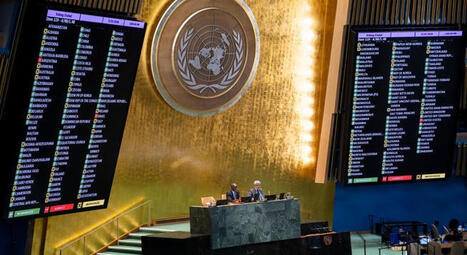
Applause erupted in the UN General Assembly Hall on Wednesday as Member States adopted a resolution declaring the transatlantic slave trade the gravest crime against humanity.
The second lecture in this series is on Frank Hill, the Jamaican trade unionist, historian, journalist and broadcaster and was delivered by Professor Matthew J Smith on 5 February 2026 at Queen Mary University of London.
The George Padmore Institute Annual Lecture is designed to highlight and platform innovative scholarship on anti-imperialism, anti-racism, internationalism and the relationship between politics and culture. The series aims to continue the legacy of GPI co-founder, Trinidadian trade unionist, activist and publisher John La Rose who dedicated his life's work to the ethos and philosophies of great Pan-Africanist George Padmore, embracing his 'independent, radical vision and outlook connecting the Caribbean, Africa, Europe, North America and Asia'.
Principles to support anti-racism in midwifery and nursing education and practice Racism and other forms of discrimination not only affect people receiving care, but also many midwifery and nursing professionals who provide it.
While researching historical British presence in his hometown Barakar, India, Sovon Dutta found a series of 19th century letters at LSE Library. What did it feel like to read them as a citizen today?
reflects on what it means to care for a cultural treasure that is also understood as a living being and how establishing dialogue with communities is crucial to framing decolonial practice with library collections.
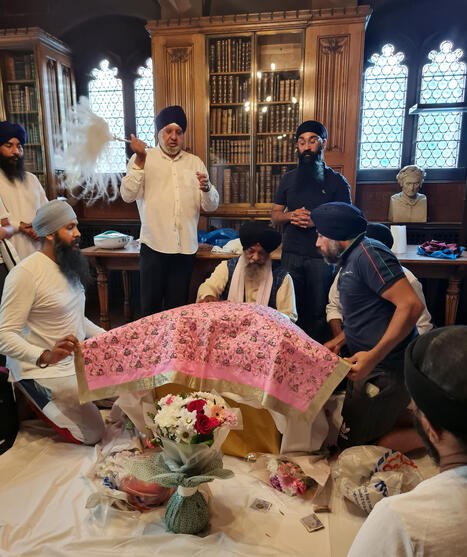
UML has in its collections one of the oldest known copies of the Sri Guru Granth Sahib, one of the most sacred scriptures in the Sikh faith. The copy currently residing at the Rylands can trace its history back to 21 February 1849, when it was ‘wrested out of the hands of a Sikh Priest at the battle of Guzerat by an Officer of the 52nd Bengal Native Infantry’. It is regarded by Sikhs as the embodiment of the eleventh Guru and revered as a living person, as a result there are many acts of respect that must be considered when even consulting the text. Since 2021, UML has worked closely with the Sikh community in Manchester to conserve, digitise and respectfully care for the Sri Guru Granth Sahib. As well as this, UML have digitised other manuscripts relating to Sikh heritage in the collections and have worked with the community to digitise some of their personal material, adding to the rich history of Sikhi in Manchester. The manuscript has also been taken into the community and used during Vaisakhi festivities at a Manchester Gurdwara.
This is the first attempted decolonial act that the Rylands has undertaken. It has not been without its challenges and the library is very much at the beginning of addressing colonial collections at UML. Gurtek Singh, an honorary research fellow at the John Rylands Research Institute, and Jamie Robinson, Manager of the Rylands Heritage Imaging Lab discussed the work undertaken, reflect on their learning and consider future possibilities for decolonising the library.
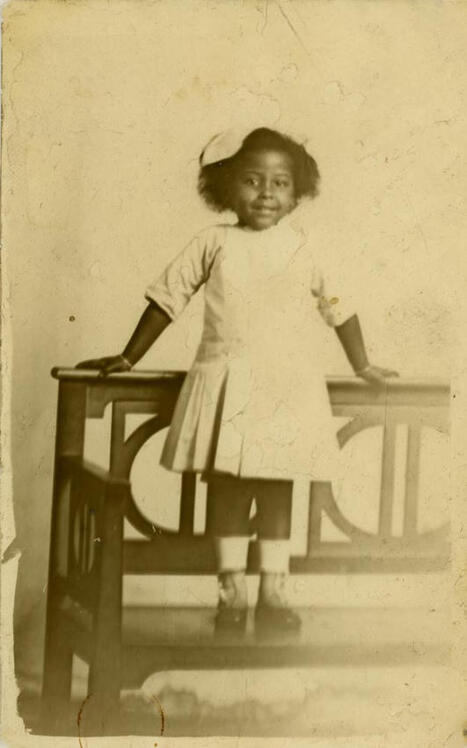
This website contains a collection of photographs taken between 1900 and 1920, many by Fred Petersen of Bute Street. These are notable for images of Black and mixed‑race community members. The site also provides access to a series of pages which imaginatively reconstruct their lives.
Jisc has released a report on digital equity in transnational education, identifying considerations for institutions seeking to provide equitable digital experiences to students learning on overseas programmes. The guidance covers themes including licensing, curriculum adaptation, staff cross-cultural readiness, and infrastructure. Jisc observes that UK providers “cannot assume that curriculum journeys designed for a UK infrastructure and educational context will translate as intended within TNE environments.”
The Runnymede Trust’s new report, Keeping Us Safe, calls for a fundamental shift in how the UK approaches safety, harm prevention and justice. Drawing on polling and in-depth community-based qualitative research, it finds strong public support for social investment over punitive enforcement when nuanced choices are on offer. As Farzana Khan, with Healing Justice Ldn, emphasises in the report’s foreword, the systems we rely on to create safety, justice and health cannot themselves be places of injustice, harm and violence.
To get content containing either thought or leadership enter:
To get content containing both thought and leadership enter:
To get content containing the expression thought leadership enter:
You can enter several keywords and you can refine them whenever you want. Our suggestion engine uses more signals but entering a few keywords here will rapidly give you great content to curate.


 Your new post is loading...