Every year the world waits with baited breath for Pantone’s big color announcement, which sets the creative stage for industries like fashion, home decor and (of course) graphic design.
The annual selection is meant not only to predict aesthetic trends, but take our global temperature. The chosen color is a cultural representation of the world’s current mood and attitude, which is why Greenery seems so fitting for the 2017 Pantone Color of the Year.
Greenery is a continuation of 2016’s soothing Rose Quartz and Serenity, responding to another tumultuous year with hope and resilience. Drawing on universal qualities like the emergence of spring foliage and the lush outdoors, the color is meant as a symbol of new beginnings....
Drawing on universal qualities like the emergence of spring foliage and the lush outdoors, the 2017 Pantone Color of the Year - Greenery - symbolizes new beginnings.
The art and psychology of color is a deeply intimate thing. Color affects us daily, from the moment we wake, throughout our day, and well into our evening. This connection to color, and the emotions it evokes plays a big part in how we design as educators, marketers, and brand storytellers.
What Is The Psychology Of Color?
Color psychology is the science of how color can affect human behavior. This field is a broach branch within psychology and can be very complicated. Humans interpret color based on their personal color preferences, but there are also stereotypical ideas and color associations that affect consumer preference. The combination of the two leads to color and color choice playing a large role in brand marketing and strategy....
Es innegable que el color afecta nuestras emociones, nos evoca recuerdos y genera asociaciones, pero cómo impacta el color en el consumidor depende de muchas variables que el autor menciona, como las preferencias personales, las diferencias culturales y sobre todo el contexto en el que se encuentra.
Los estudios de psicología del color ayudan a tomar decisiones al momento de diseñar una marca, pero no son absolutos, es importante tomar en cuenta otros factores involucrados en la comunicación de esa marca.
To help with this process, I’ve hand selected some of the best social media focused infographics on the internet today.Each of these infographics are special in their own way and focus on growth numbers, promotion methods and how to improve social media engagement and revenue.
Be sure to check each of them out below and also start implementing such methods into your own brand or business....
Mobile has upended the communications landscape. In fact, mobile device usage passed desktop usage in 2015. More people are on the go and they have less time to consume information than they used to. So content creators — now more than ever — need to be pinpoint in their efforts to reach their audience. If there’s one thing that’s clear about communication in 2016 and beyond, it’s that we can’t make our audience fit into the systems and rules that we think they should be in. We need to put the audience at the center of the experience.
In 2017, I think you’re going to see more of an effort by social media and content marketers to do just that. Communications need to be intentionally designed to be more personal, because what’s happening more and more is that our audience is demanding that.
Here are a few predictions for social media and content marketing I believe you’ll see happen in 2017....
If we can figure this out, then we would know how to dominate local SEO.
I did exactly that. I set out to discover how Google’s local algorithm works. To do so, I turned to the only answer source I know: Data.
What you’re reading is one of the first ever massive data research projects that seeks to uncover how Google’s local algorithm works and what it takes to gain rank in local SEO....
Do you want to grow your Twitter following significantly? Do you want to build a highly engaged community?
What you need is a tool that is specifically focused on doing this, so we want to talk about a tool called Audiense that could be just the thing you are looking for.
All the discussion recently about the impact and reach of FAKE news is important, and I’m glad it’s being examined so deeply. Clearly that is part of the problem to be solved — but it’s only one part. I’m not letting REAL news off the hook.
As someone who has deeply considered news nutrition, public engagement, and what makes our democracy function well (or not), here’s my diagnosis of what happened.
The top 10 ingredients of a ‘Social Media Revolution Election’:
Fragmented media consumption. People are consuming content on more screens in more forms than ever. Online, Text, Television, Video, Radio, On demand Audio/podcast, Social Media and via Search.
Redundancy of mass media news content: dominated by the Eastern corridor-based perspectives (same people, same tone, same talking heads, same horse-race obsessions with various biases). Did you know that 6 companies drive what ~90% of Americans see from mass media sources?
Commercial news as entertainment: pressures of the bottom line and disruption, translate to a focus on stories and coverage that drives clicks and views to generate higher advertising revenue.
Lack of inclusion in the news: diverse races, gender, geographic locations, etc. are not seeing themselves in the news or are shown in highly stereotypical ways (which creates a distortion of reality). These audiences thus seek more relevant and relate-able alternatives, while the people who remain to consume mass media are not getting the full story. This leads decreasing knowledge and an overall lack of connection and empathy....
Alisa Miller insights into the election and social media are valuable and a must-read for those who are thoughtful about journalism and social media. 9.5/10
After evaluating hundreds of B2B brands, we narrowed it down to the best of the best.
The 2016 Kapost 50 are top-notch marketing teams, learning to integrate strategies, create full-funnel content, and value quality over quantity—all to thrive in the digital age. Dive in to read their stories of world-class marketing.
Kapost 50 showcases 50 top marketing teams and samples of their work. It takes a little bit of work to go through the examples, but there's lots of learning there if you dig for it.
The e-commerce technology company announced on Monday a new Seattle location, Amazon Go, that has no registers. Instead, shoppers scan into the store with their free Amazon Go app, shop as normal, and leave the store with the items billed to their Amazon.com account.
While some stores have used a wedding-registry technique to allow this kind of shopping, Amazon takes it one step further. Using computer vision — the kind of technology that lets self-driving cars “see” — the store recognizes the user, making it unnecessary to individually scan items.
According to the Seattle Times, the 1,800 square-foot store, featuring ready-to-eat meals and snacks, is open to Amazon employees participating in a testing program. The store will open to the public in early 2017....
Amazon is now testing three different types of retail – bookstores, pickup/drive-through and now, an innovative no cashier, no checkout, no lineups, convenience store. Retailers look out!
Three weeks after Donald Trump won a historic victory to become the 45th president of the United States, the media postmortems continue.
In particular, the role played by the media and technology industries is coming under heavy scrutiny in the press, with Facebook’s role in the rise of fake news currently enjoying considerable coverage.
This represents a shift from earlier in the campaign, when the volume of media airtime given to Trump was often held culpable for “The Apprentice” star’s political ascendancy.
In truth, a Trump presidency is – in part – a reflection of the status and evolution of the media and tech industries in 2016. Here are 10 ways that they combined to help Trump capture the White House in a manner not previously possible. Without them, Trump might not have stood a chance....
Like last year’s predictions deck, we’ve pulled together a select group of 70 top marketing minds who rock the digital trenches every day, to find out their vision for “What’s Next in 2017” in social media and content marketing. They live it, breathe it, and know what’s working today, so no doubt we’ll get a glimpse into the crystal ball and reveal key trends based on their insight and experience before they happen.It wouldn’t be the first time.
Last year, 69 folks weighed in (you can check out the full piece here: http://bit.ly/2016ContentSocialPredictions and they overwhelmingly predicted that live streaming video would dominate 2016. They couldn’t have been more spot on, with the explosion of Facebook Live in April 2016 and Twitter’s Periscope surpassing the 200 million broadcast mark.
So what will they say for 2017? Read through and see if you agree with their predictions, and compare word clouds to last year’s answers versus what they had to say for the coming year. ...
Since winning the presidential election, Donald Trump has reportedly skipped out on the majority of his intelligence briefings; this past Sunday, Trump made headlines after sharing false information blaming his loss of the popular vote on mass voter fraud — a claim previously reported by the conspiracy news site Infowars. It’s been widely reported that Trump is an obsessive consumer of cable news — he has himself admitted to receiving at least a portion of his military advice from “the shows.”
But, pundits and chyrons aside, relatively little is known about where the next president will find the news and commentary that might color his time in office. What exactly is Trump’s media diet? What we know of Trump’s relationship to the modern internet suggests the president-elect rarely browses it himself. Trump campaign press secretary Hope Hicks told GQ he relies largely on Google News printouts from staffers and sparingly reads his own email. And a 2007 deposition suggests that Trump doesn’t use a computer or carry a smartphone during the daytime hours, and often dictates daytime tweets to his assistants.
To better understand Trump’s media consumption, BuzzFeed News turned to the president-elect’s largest source of public proclamations and shared news: Twitter. While Trump’s media consumption and methods appear opaque and unconventional, the stories he chooses to share with his now 16 million–plus followers offer a unique window into the news and commentary that catch his eye...
Our analysis revealed a media ecosystem that appears to largely reinforce and affirm the views publicly expressed by Trump and his closest advisers. The news stories Trump tweets share several characteristics: 1) They often favor sensationalism over facts and reporting; 2) They frequently echo direct quotes from Trump himself or his closest advisers; and 3) They routinely malign his enemies and vindicate his most controversial opinions....
The stories shared by Trump’s account throughout his campaign suggest the president-elect has constructed a powerful online filter bubble that largely flatters and confirms that which he claims to be true....
In 2018 our current president uses social media to speak to the public more than any other president has ever done. Some of the statements he releases on these sights are often questioned due to the lack of evidence behind some of his comments. This article breaks down where our current president and his staff receive most of their evidence from that supports his statements which is shocking because a lot of these sources are looked at as not reliable sources. This catches peoples attention because not only do a lot of people already question some of our Presidents comments already but to find out the sources that the facts are coming from are questionable as well.
Welcome to the next post in our series on monetising your influence type. Last time we looked at Platform-Specific Superstars – a small percentage of all influencers. This time we’re going to take a look at the other end of the spectrum. Most of us fit into the category of “micro-influencer”, and it can be an exciting place to be!Who are Micro-influencers?
Call them what you will – micro-influencers, long-tail influencers, the “Power Middle” – who are they and why are they getting so much attention?
There is no one defining characteristic or measurement that defines you as a micro-influencer. Generally it’s those of us with an online audience of less than 100,000 followers, be that a social or blog following. Some define it more specifically as having 500-5,000 followers, the power middle crowd have been defined as having 100,000-250,000 followers. You won’t get a straight answer from anyone, so let’s look at something other than just audience size to help figure out if you’re a micro-influencer (my term of choice, so I’ll use that from here on in).
Generally, as audience size goes up, engagement comes down. As marketers get smarter and realise the power of engagement over reach, their gaze has drifted to micro-influencers. Here’s why, neatly summed up in a graph from research done by influencer marketing platform Takumi on half a million instagram accounts....
Being great at content marketing was harder to do in 2016 than ever before. That’s because there’s more content in more places, with more topics and more faces.
And that trend isn’t going to stop in 2017—it’s only going to multiply. The key is going to be understanding how to take a more nuanced, informed approach, so your content works smarter and harder.
I asked my consulting team at Convince & Convert to create this guide to the content marketing trends that matter, based on our content marketing strategy work for some of the world’s most interesting brands....
In 2017, content will continue to be one of the most important marketing tactics for ecommerce businesses. Look for content marketers to produce a greater number of videos, focus on mobile media consumption, spend more money promoting content, produce more shows rather than standalone posts, and use technology to an advantage.
Content marketing is the act of creating, distributing, and promoting content, such as blog posts, articles, podcasts, and videos with the aim of attracting, engaging, and retaining customers. For ecommerce marketers, content can be a way of building a relationship with a shopper, which in turn will allow an online store to compete not on price or delivery speed, but on experience.
What follows are five trends that could impact content marketing in 2017....
Two years ago, well-known blogger Mark Schaefer coined the term “content shock” to describe an inevitable reality in the digital marketing world: too much content and not enough time to consume all of it.
Using simple economic terms, he argued that the “supply” of web content is doubling every nine to 24 months, while “demand”—which is Internet users’ ability to consume content—is finite. Even if mobile devices have allowed us to increase media usage to 12 hours and nine minutes per day, there’s only so much texting and tweeting we can do during the wee hours of the night.
Content creators have known for a while now that a big problem has been looming on the horizon. But much like climate change deniers, some were hoping the uncomfortable truth would go away and that, somehow, the possibilities of content creation would be limitless.
Content marketing is crucial for companies wanting to break through the barriers so many consumers have built to screen out traditional advertisements. Rather than relying on traditional tactics, effective marketers today are storytellers, using narrative content to increase brand awareness, boost lead generation, and grow customer loyalty. Creating and distributing innovative and engaging content isn’t easy, so content marketing tools make a big difference.
Seventy-five percent of marketers are increasing their investment in content marketing, making it more important than ever to find the right software to execute your strategy. Content marketing software streamlines the processes of content curation, editorial planning, content development, and distribution. Benefits of content marketing tools include: mobilizing marketing teams around a set strategy, centralizing content, increasing communication between contributors and editors, and facilitating the creation of interactive and captivating content, amongst others.
Now who better to tell you about the strengths and weaknesses of content marketing tools than the marketers actually using them? At G2 Crowd, we aggregate real-user reviews of the software they use at work. Over 400 content marketers have weighed in on the content marketing tools they’ve used; sharing likes, dislikes, and invaluable insights that can only come with hands-on experience. Below I’ve summarized overall user sentiment regarding the nine content marketing tools that received the highest user satisfaction ratings in our most recent content marketing report.*...
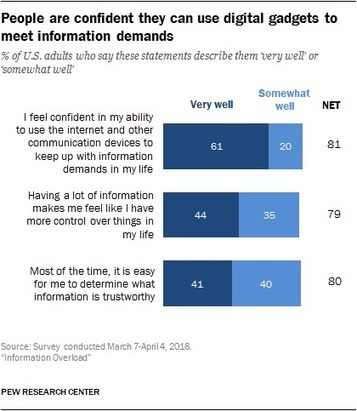
A new Pew Research Center survey finds that, for the most part, the large majority of Americans do not feel that information overload is a problem for them. Some 20% say they feel overloaded by information, a decline from the 27% figure from a decade ago, while 77% say they like having so much information at their fingertips.
Two-thirds (67%) say that having more information at their disposals actually helps to simplify their lives.
The survey shows that most Americans are comfortable with their abilities to cope with information flows in their day-to-day lives. Moreover, those who own more devices are also the ones who feel more on top of the data and media flows in their lives.
Those who are more likely to feel information overload have less technology and are poorer, less well-educated and older....
New Pew research says the majority don't feel information overload and most feel able to tell facts from fake news. There are two possible conclusions about the election.
The data show those overwhelmed most are older, disadvantaged, etc. In other words, the voter majority. The young voters, supposedly less overwhelmed, didn't vote.
The second conclusion is that the voters all did know what they were doing and said damn the torpedoes and flipped the bird at DC even if they knew Trump was llying. I'm not sure either is a great signal but the US has four years to find out. Meanwhile, the Tweeter-in-Chief continues to attack people who disagree with him or who fact check his lies.
Content takes courage. Marketers are all-too familiar with elongated approval processes and revision demands that can sap vitality and originality from created content, leaving only pedestrian work in their wake. Compelling content, the kind that attracts and sustains audiences, often involves conflict and requires risk — attributes businesses (and their legal departments) are prone to avoiding.
How to solve the content problem
Thus, the business community faces a challenging circumstance. Companies believe in content marketing and want to do it well. But getting there almost always means overcoming institutionalized impediments. Here are four ways to get around these problems....
It’s easy to have missed some interesting innovations in retail with the past few weeks focused on Black Friday sales. Today, we’ve got a roundup of retail innovators and news to keep you up-to-speed on who’s getting industry and consumer attention.
First, we start with the announcement of Amazon Go – the online leader’s latest retail innovation which lets consumers pick up grocery products at an Amazon convenience store, pay by mobile app with their Amazon account and leave without a check out lineup thanks to innovative technology. Amazon also opens a drive through store concept early in 2017 in addition to new retail bookstores. With 2,000 or more stores on the horizon, that’s the sound of retail competitors shivering and the industry buzz is enormous.
Walmart is building new warehouse distribution centers and investing in new technology in order to keep up with Amazon. Not to be left behind, Target is developing and planning to open hundreds of new smaller-format stores in urban centers and college towns. Toys “R” Us launched a fourth new interactive toy store in Santa Ana, CA with interactive in-store displays including video screens, sound effects and motion-sensor lights.
Nike used the launch of its $720 HyperAdapt high-tech, self-lacing sneakers to generate consumer buzz and store visits. Ace Hardware and online marketplace The Grommet launched a “makers” initiative to sell 20 unique US-made products exclusively in its 160 stores. What’s ahead for retail in 2017? Social is king and influences everything. And of course, Amazon will continue to innovate and be the elephant in the shopping centers....
Last year, I wrote about five SEO trends you needed to know in 2016. Plenty of things in the SEO industry have stayed the same since I made those predictions (e.g., mobile optimization is still all-important, responsive Web design is still essential to ranking well, and keyword rankings are still important), but much has changed, too.In this article, I walk you through five of the hottest SEO trends that you can expect to see more of in 2017....
Facebook is stepping up its efforts to woo publishers with a new feature allowing users to browse curated selections of content from news publishers drawn from their individual news feeds, according to Business Insider, which first reported the news.
The move comes not long after rival Snapchat began tweaking a similar feature on its own platform.
Facebook is testing a new feature displaying curated content from publishers called Collections, which would enable publishers to highlight content in users’ news feeds regardless of how many likes and shares the content had received, BI reports, citing sources familiar with the tests.
Posts from Collections would appear based on the source and the users’ own content preferences, although it’s unclear how much real estate content Collections would receive compared to other news feed content....
Over the past two years, social media advertising budgets have doubled worldwide, from $16 billion U.S. in 2014 to $31 billion in 2016.
While Facebook currently claims nearly 70% of the social advertising market, it's starting to get some serious competition from younger networks. Twitter, Instagram, LinkedIn, Pinterest, and Snapchat are all vying for their piece of the social ads pie, and advertisers today have more options than ever before to promote their brands on social.
From mobile to live video and everything in between, we've documented some of the most significant milestones for both these top networks as well as social advertising in general.
Check out the below infographic on the history of social advertising and consider: What opportunities and challenges will brands face in the next 10 years?...
To get content containing either thought or leadership enter:
To get content containing both thought and leadership enter:
To get content containing the expression thought leadership enter:
You can enter several keywords and you can refine them whenever you want. Our suggestion engine uses more signals but entering a few keywords here will rapidly give you great content to curate.


 Your new post is loading...



















Drawing on universal qualities like the emergence of spring foliage and the lush outdoors, the 2017 Pantone Color of the Year - Greenery - symbolizes new beginnings.